brake fluid RAM CHASSIS CAB 2021 Owner's Manual
[x] Cancel search | Manufacturer: RAM, Model Year: 2021, Model line: CHASSIS CAB, Model: RAM CHASSIS CAB 2021Pages: 463, PDF Size: 21.5 MB
Page 357 of 463
SERVICING AND MAINTENANCE355
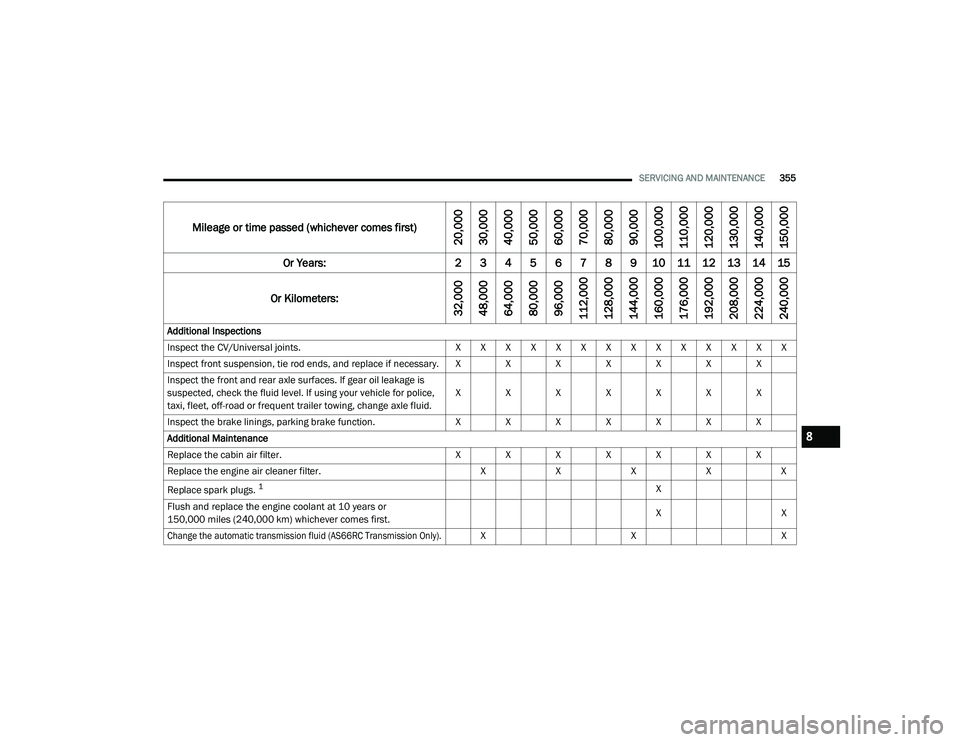
Mileage or time passed (whichever comes first)
20,000
30,000
40,000
50,000
60,000
70,000
80,000
90,000
100,000
110,000
120,000
130,000
140,000
150,000
Or Years: 2 3 4 5 6 7 8 9 10 11 12 13 14 15
Or Kilometers:
32,000
48,000
64,000
80,000
96,000
112,000
128,000
144,000
160,000
176,000
192,000
208,000
224,000
240,000
Additional Inspections
Inspect the CV/Universal joints. X X X X X X X X X X X X X X
Inspect front suspension, tie rod ends, and replace if necessary. X X X X X X X
Inspect the front and rear axle surfaces. If gear oil leakage is
suspected, check the fluid level. If using your vehicle for police,
taxi, fleet, off-road or frequent trailer towing, change axle fluid. X X X X X X X
Inspect the brake linings, parking brake function. X X X X X X X
Additional Maintenance
Replace the cabin air filter. X X X X X X X
Replace the engine air cleaner filter. XXXXX
Replace spark plugs.
1X
Flush and replace the engine coolant at 10 years or
150,000 miles (240,000 km) whichever comes first. X
X
Change the automatic transmission fluid (AS66RC Transmission Only).
XXX
8
21_DPF_OM_EN_USC_t.book Page 355
Page 359 of 463

SERVICING AND MAINTENANCE357
SCHEDULED SERVICING — DIESEL ENGINE
Required Maintenance Intervals
Refer to the maintenance plan on the following
pages for the required maintenance intervals.
More frequent maintenance may be needed in
severe conditions, such as dusty areas and very
short trip driving. In some extreme conditions,
additional maintenance not specified in the
maintenance schedule may be required.
At Each Stop For Fuel
Check the engine oil level at least 30 minutes
after a fully warmed engine is shut off. Checking
the oil level while the vehicle is on level ground
will improve the accuracy of the oil level
reading. Add oil only when the level is at or
below the ADD or MIN mark. Once A Month
Inspect the batteries, and clean and tighten
the terminals as required.
Check the fluid levels of the coolant reservoir,
brake master cylinder, and automatic trans-
mission, and add as needed.
At Each Oil Change
Change the engine oil filter.
Inspect the exhaust system.
Inspect engine air cleaner filter. Replace the
engine air cleaner filter, if necessary.
Inspect the CV/Universal joints.
Check the coolant level, hoses, and clamps.
Inspect front end, and lubricate — If equipped
with serviceable fittings.
Inspect and replace the Evaporative System
Fresh Air Filter as necessary, replacement
may be more frequent if vehicle is operated
in extreme dusty conditions. Inspection and service should also be
performed anytime a malfunction is observed or
suspected. Retain all receipts.
NOTE:
Using white lithium grease, lubricate the door
hinge pivot joints twice a year to prevent prema-
ture wear.
OIL CHANGE INDICATOR SYSTEM —
C
UMMINS DIESEL
Your vehicle is equipped with an engine oil
change indicator system. This system will alert
you when it is time to change your engine oil by
displaying the words “Oil Change Due” in your
instrument cluster display. The oil change
reminder will remind the owner to change the
engine oil every 15,000 miles (24,000 km) or
500 hours, whichever comes first, except for the
Chassis Cab models configured with optional
B20 capability that are using greater than 5%
levels of biodiesel, which are 12,500 miles
(20,000 km) or 400 hours, whichever comes
first. Failure to change the engine oil per the
maintenance schedule can result in internal
engine damage.
CAUTION!
Failure to perform the required maintenance
items may result in damage to the vehicle.
8
21_DPF_OM_EN_USC_t.book Page 357
Page 366 of 463

364SERVICING AND MAINTENANCE
ENGINE COMPARTMENT
6.4L ENGINE
1 — Engine Coolant Pressure Cap 6 — Battery
2 — Engine Coolant Pressure Reservoir 7 — Engine Air Cleaner Filter
3 — Engine Oil Fill 8 — Power Steering Reservoir Cap
4 — Engine Oil Dipstick 9 — Power Distribution Center (Fuses)
5 — Brake Fluid Reservoir Cap 10 — Washer Fluid Reservoir Cap
21_DPF_OM_EN_USC_t.book Page 364
Page 367 of 463
SERVICING AND MAINTENANCE365
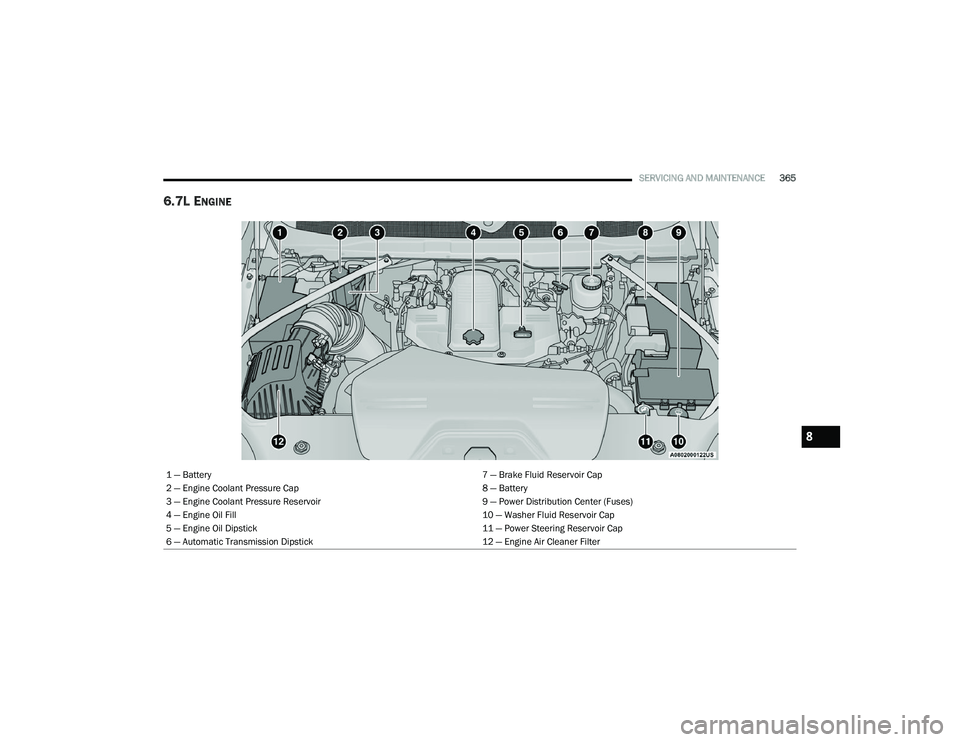
6.7L ENGINE
1 — Battery 7 — Brake Fluid Reservoir Cap
2 — Engine Coolant Pressure Cap 8 — Battery
3 — Engine Coolant Pressure Reservoir 9 — Power Distribution Center (Fuses)
4 — Engine Oil Fill 10 — Washer Fluid Reservoir Cap
5 — Engine Oil Dipstick 11 — Power Steering Reservoir Cap
6 — Automatic Transmission Dipstick 12 — Engine Air Cleaner Filter
8
21_DPF_OM_EN_USC_t.book Page 365
Page 381 of 463

SERVICING AND MAINTENANCE379
Use of biodiesel mixture in excess of 20% can
negatively impact the fuel filter's ability to
separate water from the fuel, resulting in
high pressure fuel system corrosion or
damage.
Ethanol blends are not recommended or
approved for use with your Cummins diesel
engine.
In addition, commercially available fuel addi -
tives are not necessary for the proper opera -
tion of your Cummins diesel engine.
INTERVENTION REGENERATION
S
TRATEGY — MESSAGE PROCESS FLOW
The Cummins diesel engine meets all
Environmental Protection Agency (EPA) Heavy
Duty Diesel Engine Emissions Standards,
resulting in one of the lowest emitting diesel
engines ever produced.
To achieve these emissions standards, your
vehicle is equipped with a state-of-the-art engine
and exhaust system. The engine and exhaust
after-treatment system work together to achieve
the EPA Heavy Duty Diesel Engine Emissions
Standards. These systems are seamlessly
integrated into your vehicle and managed by the Cummins Powertrain Control Module (PCM).
The PCM manages engine combustion to allow
the exhaust system’s catalyst to trap and burn
Particulate Matter (PM) pollutants, with no input
or interaction on your part.
If the engine is allowed to idle or the truck is
driven on low engine speed drive cycles for more
than two hours, the system will automatically
enter an emissions operating mode that will
increase the engine idle speed to 900 RPM
(1,050 RPM for Chassis Cab). While in this mode,
which is designed to help maintain the Diesel
Particulate Filter, the engine idle speed will return
to normal when the brake pedal is applied.
A small change in engine tone or a slight change
in engine performance while accelerating may
also be noticeable at speeds below 20 mph
(32 km/h). This operating mode may last for up
to an hour of idle time, or around 20 minutes of
driving time.
Additionally, your vehicle has the ability to alert
you to additional maintenance required on your
truck or engine Ú
page 90.
DIESEL EXHAUST FLUID
Diesel Exhaust Fluid (DEF) sometimes known
simply by the name of its active component,
UREA—is a key component of Selective Catalytic
Reduction (SCR) systems, which help diesel
vehicles meet stringent emission regulations.
DEF is a liquid reducing agent that reacts with
engine exhaust in the presence of a catalyst to
convert smog-forming nitrogen oxides (NOx)
into harmless nitrogen and water vapor
Úpage 440.
You can receive assistance in locating DEF in
the United States by calling 866-RAM-INFO
(866-726-4636). In Canada call
1–800–465–2001 (English) or
1–800–387–9983 (French)
WARNING!
A hot exhaust system can start a fire if you
park over materials that can burn. Such
materials might be grass or leaves coming
into contact with your exhaust system. Do not
park or operate your vehicle in areas where
your exhaust system can contact anything
that can burn.
8
21_DPF_OM_EN_USC_t.book Page 379
Page 389 of 463
SERVICING AND MAINTENANCE387
(Continued)
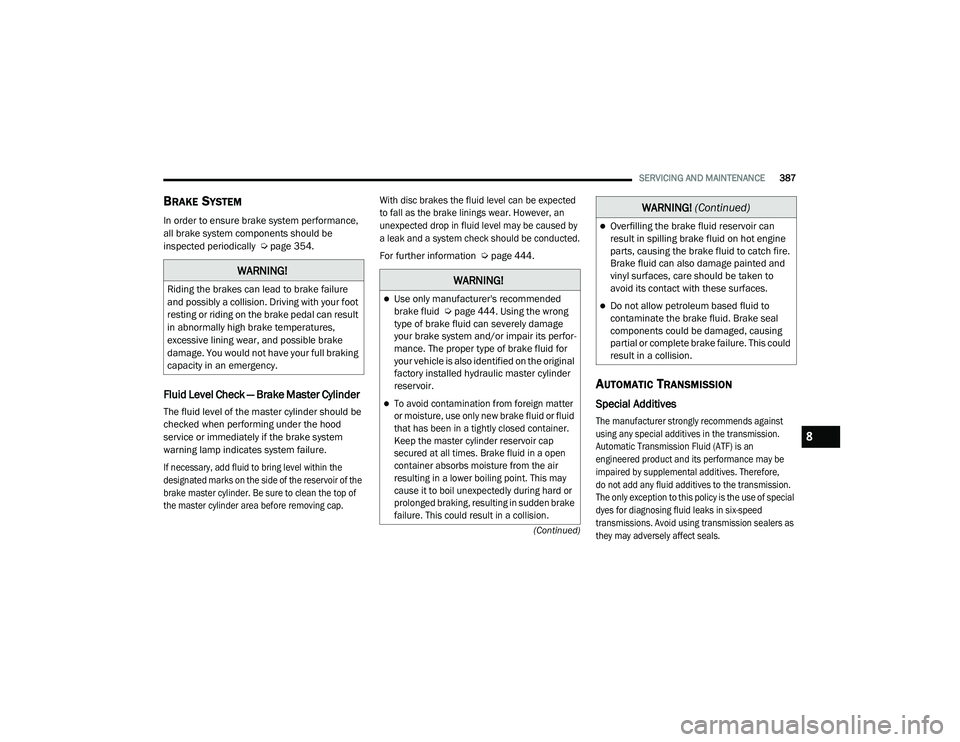
BRAKE SYSTEM
In order to ensure brake system performance,
all brake system components should be
inspected periodically Ú page 354.
Fluid Level Check — Brake Master Cylinder
The fluid level of the master cylinder should be
checked when performing under the hood
service or immediately if the brake system
warning lamp indicates system failure.
If necessary, add fluid to bring level within the
designated marks on the side of the reservoir of the
brake master cylinder. Be sure to clean the top of
the master cylinder area before removing cap.
With disc brakes the fluid level can be expected
to fall as the brake linings wear. However, an
unexpected drop in fluid level may be caused by
a leak and a system check should be conducted.
For further information Ú
page 444.
AUTOMATIC TRANSMISSION
Special Additives
The manufacturer strongly recommends against
using any special additives in the transmission.
Automatic Transmission Fluid (ATF) is an
engineered product and its performance may be
impaired by supplemental additives. Therefore,
do not add any fluid additives to the transmission.
The only exception to this policy is the use of special
dyes for diagnosing fluid leaks in six-speed
transmissions. Avoid using transmission sealers as
they may adversely affect seals.
WARNING!
Riding the brakes can lead to brake failure
and possibly a collision. Driving with your foot
resting or riding on the brake pedal can result
in abnormally high brake temperatures,
excessive lining wear, and possible brake
damage. You would not have your full braking
capacity in an emergency.WARNING!
Use only manufacturer's recommended
brake fluid Úpage 444. Using the wrong
type of brake fluid can severely damage
your brake system and/or impair its perfor -
mance. The proper type of brake fluid for
your vehicle is also identified on the original
factory installed hydraulic master cylinder
reservoir.
To avoid contamination from foreign matter
or moisture, use only new brake fluid or fluid
that has been in a tightly closed container.
Keep the master cylinder reservoir cap
secured at all times. Brake fluid in a open
container absorbs moisture from the air
resulting in a lower boiling point. This may
cause it to boil unexpectedly during hard or
prolonged braking, resulting in sudden brake
failure. This could result in a collision.
Overfilling the brake fluid reservoir can
result in spilling brake fluid on hot engine
parts, causing the brake fluid to catch fire.
Brake fluid can also damage painted and
vinyl surfaces, care should be taken to
avoid its contact with these surfaces.
Do not allow petroleum based fluid to
contaminate the brake fluid. Brake seal
components could be damaged, causing
partial or complete brake failure. This could
result in a collision.
WARNING! (Continued)
8
21_DPF_OM_EN_USC_t.book Page 387
Page 390 of 463

388SERVICING AND MAINTENANCE
Fluid Level Check — Eight-Speed
Transmission
The fluid level is preset at the factory and does
not require adjustment under normal operating
conditions. Routine fluid level checks are not
required, therefore the transmission has no
dipstick. An authorized dealer can check your
transmission fluid level using special service
tools.
If you notice fluid leakage or transmission
malfunction, visit an authorized dealer
immediately to have the transmission fluid
level checked. Operating the vehicle with
an improper fluid level can cause severe
transmission damage.
Fluid Level Check — Six-Speed
Transmission
It is best to check the fluid level when the
transmission is at normal operating
temperature (158-176°F / 70-80°C). This
normally occurs after at least 15 miles (25 km)
of driving. At normal operating temperature the
fluid cannot be held comfortably between the
fingertips. You can read the transmission sump
temperature in the instrument cluster screen
Ú page 90. Use the following procedure to check the
transmission fluid level properly:
1. Monitor the transmission temperature
using the instrument cluster display, and
operate the vehicle as required to reach
the normal operating temperature. If the
transmission is not functioning properly, or
the vehicle cannot be driven, see the NOTE
and CAUTION below about checking the
fluid level at colder temperatures.
2. Park the vehicle on level ground.
3. Run the engine at normal idle speed for at least 60 seconds, and leave the engine
running for the rest of this procedure.
4. Fully apply the parking brake, and press the brake pedal.
5. Place the gear selector momentarily into each gear position (allowing time for the
transmission to fully engage in each
position), ending with the transmission in
PARK.
6. Remove the dipstick, wipe it clean and reinsert it until seated.
CAUTION!
Do not use chemical flushes in your
transmission as the chemicals can damage
your transmission components. Such damage
is not covered by the New Vehicle Limited
Warranty.
CAUTION!
If a transmission fluid leak occurs, visit an
authorized dealer immediately. Severe
transmission damage may occur. An authorized
dealer has the proper tools to adjust the fluid
level accurately.
21_DPF_OM_EN_USC_t.book Page 388
Page 391 of 463

SERVICING AND MAINTENANCE389
7. Remove the dipstick again and note the
fluid level on both sides. The fluid level
reading is only valid if there is a solid
coating of oil on both sides of the dipstick.
Note that the holes in the dipstick will be full
of fluid if the actual level is at or above the
hole. The fluid level should be between the
“HOT” (upper) reference holes on the
dipstick at normal operating temperature.
If the fluid level is low, add fluid through the
dipstick tube to bring it to the proper level.
Do not overfill. Use ONLY the specified fluid
Ú page 444. After adding any quantity of oil
through the dipstick tube, wait a minimum
of two minutes for the oil to fully drain into
the transmission before rechecking the
fluid level.
NOTE:
If it is necessary to check the transmission below
the operating temperature, the fluid level should be
between the two “COLD” (lower) holes on the
dipstick with the fluid at 60-70°F / 16-21°C. Only
use the COLD region of the dipstick as a rough refer -
ence when setting the fluid level after a transmis -sion service or fluid change. Re-check the fluid level,
and adjust as required, once the transmission
reaches normal operating temperature.
8. Reinsert the dipstick. Check for leaks.
Release the parking brake.
NOTE:
If it is necessary to check the transmission below
the operating temperature, the fluid level should be
between the two COLD (lower) holes on the dipstick
with the fluid at 68-86°F / 20-30°C. Only use the
COLD region of the dipstick as a rough reference
when setting the fluid level after a transmission
service or fluid change. Re-check the fluid level, and
adjust as required, once the transmission reaches
normal operating temperature.
Fluid And Filter Changes — Eight-Speed
Transmission
Under normal operating conditions, the fluid
installed at the factory will provide satisfactory
lubrication for the life of the vehicle.
Routine fluid and filter changes are not required.
However, change the fluid and filter if the fluid
becomes contaminated (with water, etc.), or if the
transmission is disassembled for any reason.
Fluid And Filter Changes — Six Speed
Transmission
For the proper maintenance intervals
Ú page 354.
In addition, change the fluid and filters if the
fluid becomes contaminated (with water, etc.),
or if the transmission is disassembled for any
reason.
CAUTION!
If the fluid temperature is below 50°F (10°C)
it may not register on the dipstick. Do not add
fluid until the temperature is elevated enough
to produce an accurate reading. Run the
engine at idle, in PARK, to warm the fluid.
CAUTION!
If the fluid temperature is below 50°F (10°C)
it may not register on the dipstick. Do not add
fluid until the temperature is elevated enough
to produce an accurate reading. Run the
engine at idle, in PARK, to warm the fluid.
8
21_DPF_OM_EN_USC_t.book Page 389
Page 433 of 463

431
TECHNICAL SPECIFICATIONS
VEHICLE IDENTIFICATION NUMBER (VIN)
The VIN is found on the left front corner of
the instrument panel, visible through the
windshield.
Vehicle Identification Number
NOTE:
It is illegal to remove or alter the VIN.
BRAKE SYSTEM
If power assist is lost for any reason (for
example, repeated brake applications with
the engine off), the brakes will still function.
However, you will experience a substantial
increase in braking effort to stop the vehicle.
If either the front or rear hydraulic system loses
normal braking capability, the remaining system
will still function with some loss of overall braking
effectiveness. This will be evident by increased
pedal travel during application, greater pedal
force required to slow or stop, and activation of
the “Brake Warning Light” and/or the “ABS
Warning Light” during brake use.
HYDRAULIC BRAKE ASSIST — IF
E
QUIPPED
The brake system power assist is provided by a
hydro-boost unit which shares fluid with the
power steering system. You may experience
some clicking or hissing noises from the
hydro-boost system during hard braking
conditions.
NOTE:
Under cold temperatures, pedal effort will be
higher than normal until the power steering fluid
reaches operating temperature.
9
21_DPF_OM_EN_USC_t.book Page 431
Page 446 of 463
444TECHNICAL SPECIFICATIONS
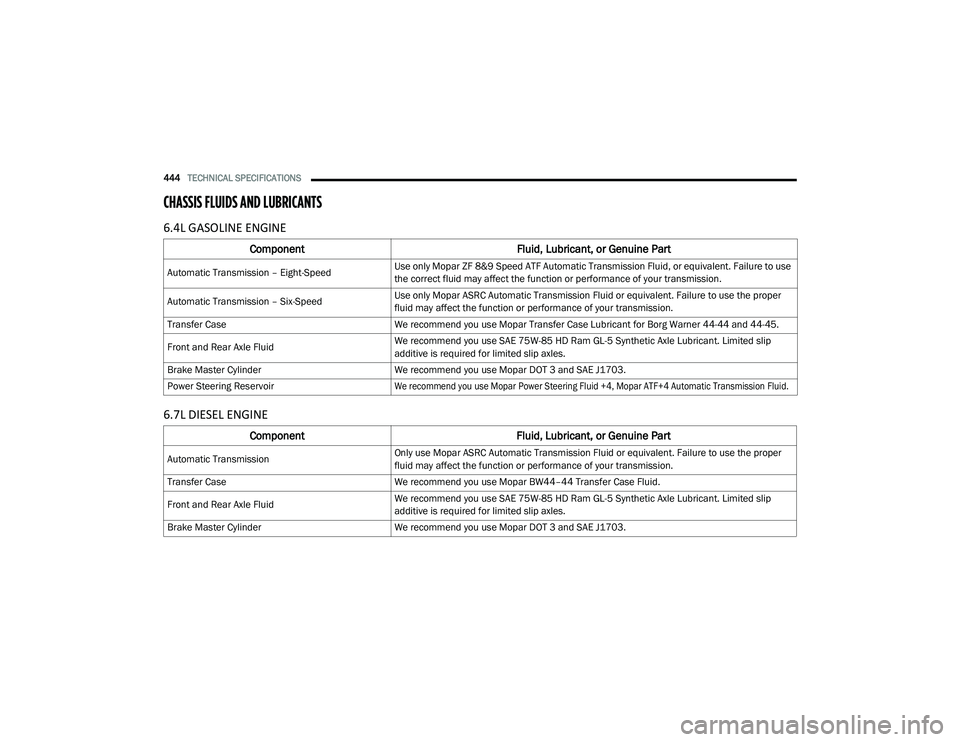
CHASSIS FLUIDS AND LUBRICANTS
6.4L GASOLINE ENGINE
6.7L DIESEL ENGINE
Component Fluid, Lubricant, or Genuine Part
Automatic Transmission – Eight-SpeedUse only Mopar ZF 8&9 Speed ATF Automatic Transmission Fluid, or equivalent. Failure to use
the correct fluid may affect the function or performance of your transmission.
Automatic Transmission – Six-Speed Use only Mopar ASRC Automatic Transmission Fluid or equivalent. Failure to use the proper
fluid may affect the function or performance of your transmission.
Transfer Case We recommend you use Mopar Transfer Case Lubricant for Borg Warner 44-44 and 44-45.
Front and Rear Axle Fluid We recommend you use SAE 75W-85 HD Ram GL-5 Synthetic Axle Lubricant. Limited slip
additive is required for limited slip axles.
Brake Master Cylinder We recommend you use Mopar DOT 3 and SAE J1703.
Power Steering Reservoir
We recommend you use Mopar Power Steering Fluid +4, Mopar ATF+4 Automatic Transmission Fluid.
Component Fluid, Lubricant, or Genuine Part
Automatic TransmissionOnly use Mopar ASRC Automatic Transmission Fluid or equivalent. Failure to use the proper
fluid may affect the function or performance of your transmission.
Transfer Case We recommend you use Mopar BW44–44 Transfer Case Fluid.
Front and Rear Axle Fluid We recommend you use SAE 75W-85 HD Ram GL-5 Synthetic Axle Lubricant. Limited slip
additive is required for limited slip axles.
Brake Master Cylinder We recommend you use Mopar DOT 3 and SAE J1703.
21_DPF_OM_EN_USC_t.book Page 444