oil change RAM CHASSIS CAB 2021 Owner's Manual
[x] Cancel search | Manufacturer: RAM, Model Year: 2021, Model line: CHASSIS CAB, Model: RAM CHASSIS CAB 2021Pages: 463, PDF Size: 21.5 MB
Page 370 of 463
368SERVICING AND MAINTENANCE
ENGINE OIL
Engine Oil Selection — Gasoline Engine
For best performance and maximum protection
under all types of operating conditions, the
manufacturer only recommends engine oils that
are API Certified and meet the requirements of
FCA Material Standard MS-12633.
NOTE:
Hemi engines (6.4L) at times can tick right after
startup and then quiet down after approxi -
mately 30 seconds. This is normal and will not
harm the engine. This characteristic can be
caused by short drive cycles. For example, if the
vehicle is started then shut off after driving a
short distance. Upon restarting, you may experi -
ence a ticking sound. Other causes could be if
the vehicle is unused for an extended period of
time, incorrect oil, extended oil changes or
extended idling. If the engine continues to tick
or if the Malfunction Indicator Light (MIL) comes
on, see the nearest authorized dealer.
Engine Oil Selection — Diesel Engine
For best performance and maximum protection
under all types of operating conditions, the
manufacturer only recommends engine oils
that are API CK-4 certified and meet the requirements of FCA US LLC. Use Mopar or an
equivalent oil meeting FCA Material Standard
MS-10902. Products meeting Cummins CES
20081 may also be used. The identification of
these engine oils are typically located on the
back of the oil container.
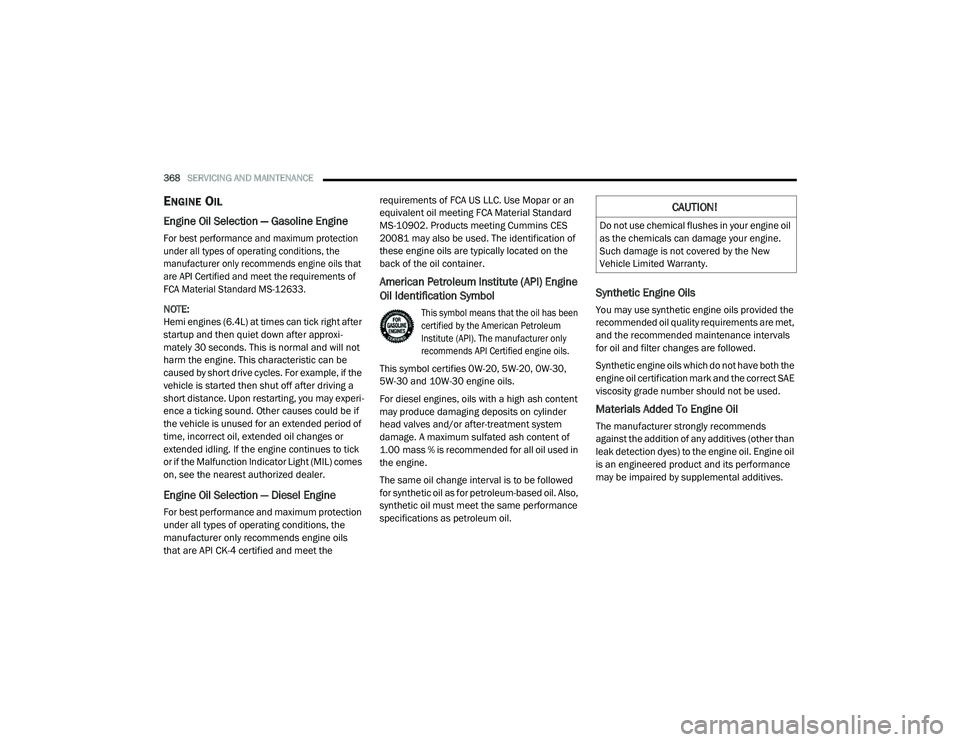
American Petroleum Institute (API) Engine
Oil Identification Symbol
This symbol means that the oil has been
certified by the American Petroleum
Institute (API). The manufacturer only
recommends API Certified engine oils.
This symbol certifies 0W-20, 5W-20, 0W-30,
5W-30 and 10W-30 engine oils.
For diesel engines, oils with a high ash content
may produce damaging deposits on cylinder
head valves and/or after-treatment system
damage. A maximum sulfated ash content of
1.00 mass % is recommended for all oil used in
the engine.
The same oil change interval is to be followed
for synthetic oil as for petroleum-based oil. Also,
synthetic oil must meet the same performance
specifications as petroleum oil.
Synthetic Engine Oils
You may use synthetic engine oils provided the
recommended oil quality requirements are met,
and the recommended maintenance intervals
for oil and filter changes are followed.
Synthetic engine oils which do not have both the
engine oil certification mark and the correct SAE
viscosity grade number should not be used.
Materials Added To Engine Oil
The manufacturer strongly recommends
against the addition of any additives (other than
leak detection dyes) to the engine oil. Engine oil
is an engineered product and its performance
may be impaired by supplemental additives.
CAUTION!
Do not use chemical flushes in your engine oil
as the chemicals can damage your engine.
Such damage is not covered by the New
Vehicle Limited Warranty.
21_DPF_OM_EN_USC_t.book Page 368
Page 371 of 463
SERVICING AND MAINTENANCE369
Disposing Of Used Engine Oil And Oil
Filters
Care should be taken in disposing of used
engine oil and oil filters from your vehicle.
Used oil and oil filters, indiscriminately
discarded, can present a problem to the
environment. Contact an authorized dealer,
service station or governmental agency for
advice on how and where used oil and oil filters
can be safely discarded in your area.
ENGINE OIL FILTER
The engine oil filter should be replaced with a
new filter at every engine oil change.
Engine Oil Filter Selection
A full-flow type disposable oil filter should
be used for replacement. The quality of
replacement filters varies considerably.
Only high quality Mopar certified filters should
be used.
ENGINE AIR CLEANER FILTER
For the proper maintenance intervals
Úpage 354.
NOTE:
Be sure to follow the “Severe Duty Conditions”
maintenance interval if applicable. Engine Air Cleaner Filter Selection
The quality of replacement engine air cleaner
filters varies considerably. Only high quality
filters should be used to ensure most efficient
service. Mopar engine air cleaner filters are a
high quality filter and are recommended.
Engine Air Cleaner Filter Inspection And
Replacement — Gasoline Engine
Inspect engine air cleaner filter for dirt and or
debris, if you find evidence of either dirt or
debris you should change your engine air
cleaner filter.
NOTE:
When replacing the engine air cleaner filter on
vehicles equipped with a 6.4L gasoline engine,
replace with a dry (non-oiled) filter only.WARNING!
The air induction system (air cleaner, hoses,
etc.) can provide a measure of protection in
the case of engine backfire. Do not remove
the air induction system (air cleaner, hoses,
etc.) unless such removal is necessary for
repair or maintenance. Make sure that no
one is near the engine compartment before
starting the vehicle with the air induction
system (air cleaner, hoses, etc.) removed.
Failure to do so can result in serious personal
injury.
8
21_DPF_OM_EN_USC_t.book Page 369
Page 384 of 463

382SERVICING AND MAINTENANCE
5. With the wiper blade disengaged, remove
the wiper blade from the wiper arm by
holding the wiper arm with one hand and
separating the wiper blade from the wiper
arm with the other hand (move the wiper
blade down toward the base of the wiper
arm and away from the J hook in the end of
the wiper arm).
Removing Wiper From Wiper Arm
6. Gently lower the wiper arm onto the glass. Installing The Front Wipers
1. Lift the wiper arm off of the glass, until the
wiper arm is in the full up position.
2. Position the wiper blade under the hook on the tip of the wiper arm with the wiper
locking tab open.
3. Insert the receiver bracket on the wiper assembly into the hook on the tip of the arm
through the opening in the wiper blade
under the locking tab.
4. Slide the wiper blade up into the hook on the wiper arm until it is latched
(engagement will be accompanied by an
audible click). Fold down the latch release
tab and snap it into its locked position.
5. Gently lower the wiper blade onto the glass.
EXHAUST SYSTEM
The best protection against carbon monoxide
entry into the vehicle body is a properly
maintained engine exhaust system.
If you notice a change in the sound of the exhaust
system; or if the exhaust fumes can be detected
inside the vehicle; or when the underside or rear
of the vehicle is damaged; have an authorized
technician inspect the complete exhaust system
and adjacent body areas for broken, damaged,
deteriorated, or mispositioned parts. Open
seams or loose connections could permit
exhaust fumes to seep into the passenger
compartment. In addition, have the exhaust
system inspected each time the vehicle is raised
for lubrication or oil change. Replace as required.
1 — Wiper
2 — Locking Tab
3 — Wiper Arm J Hook
WARNING!
Exhaust gases can injure or kill. They
contain carbon monoxide (CO), which is
colorless and odorless. Breathing it can
make you unconscious and can eventually
poison you Ú
page 333.
A hot exhaust system can start a fire if you
park over materials that can burn. Such
materials might be grass or leaves coming
into contact with your exhaust system.
Do not park or operate your vehicle in areas
where your exhaust system can contact
anything that can burn.
21_DPF_OM_EN_USC_t.book Page 382
Page 391 of 463

SERVICING AND MAINTENANCE389
7. Remove the dipstick again and note the
fluid level on both sides. The fluid level
reading is only valid if there is a solid
coating of oil on both sides of the dipstick.
Note that the holes in the dipstick will be full
of fluid if the actual level is at or above the
hole. The fluid level should be between the
“HOT” (upper) reference holes on the
dipstick at normal operating temperature.
If the fluid level is low, add fluid through the
dipstick tube to bring it to the proper level.
Do not overfill. Use ONLY the specified fluid
Ú page 444. After adding any quantity of oil
through the dipstick tube, wait a minimum
of two minutes for the oil to fully drain into
the transmission before rechecking the
fluid level.
NOTE:
If it is necessary to check the transmission below
the operating temperature, the fluid level should be
between the two “COLD” (lower) holes on the
dipstick with the fluid at 60-70°F / 16-21°C. Only
use the COLD region of the dipstick as a rough refer -
ence when setting the fluid level after a transmis -sion service or fluid change. Re-check the fluid level,
and adjust as required, once the transmission
reaches normal operating temperature.
8. Reinsert the dipstick. Check for leaks.
Release the parking brake.
NOTE:
If it is necessary to check the transmission below
the operating temperature, the fluid level should be
between the two COLD (lower) holes on the dipstick
with the fluid at 68-86°F / 20-30°C. Only use the
COLD region of the dipstick as a rough reference
when setting the fluid level after a transmission
service or fluid change. Re-check the fluid level, and
adjust as required, once the transmission reaches
normal operating temperature.
Fluid And Filter Changes — Eight-Speed
Transmission
Under normal operating conditions, the fluid
installed at the factory will provide satisfactory
lubrication for the life of the vehicle.
Routine fluid and filter changes are not required.
However, change the fluid and filter if the fluid
becomes contaminated (with water, etc.), or if the
transmission is disassembled for any reason.
Fluid And Filter Changes — Six Speed
Transmission
For the proper maintenance intervals
Ú page 354.
In addition, change the fluid and filters if the
fluid becomes contaminated (with water, etc.),
or if the transmission is disassembled for any
reason.
CAUTION!
If the fluid temperature is below 50°F (10°C)
it may not register on the dipstick. Do not add
fluid until the temperature is elevated enough
to produce an accurate reading. Run the
engine at idle, in PARK, to warm the fluid.
CAUTION!
If the fluid temperature is below 50°F (10°C)
it may not register on the dipstick. Do not add
fluid until the temperature is elevated enough
to produce an accurate reading. Run the
engine at idle, in PARK, to warm the fluid.
8
21_DPF_OM_EN_USC_t.book Page 389
Page 439 of 463

TECHNICAL SPECIFICATIONS437
In addition, commercially available fuel addi -
tives are not necessary for the proper opera -
tion of your Cummins diesel engine. However,
if seasonably adjusted fuel is not available and
you are operating below 20°F (-6°C), Mopar
Premium Diesel Fuel Treatment (or equivalent)
may be beneficial to avoid fuel gelling.
Number 1 Ultra Low Sulfur diesel fuel should
only be used where extended arctic condi -
tions (0°F or -18°C) exist.
BIODIESEL FUEL REQUIREMENTS
Chassis Cab Models
A maximum blend of 5% biodiesel meeting
ASTM specification D975 may be used with
your Cummins diesel engine. If operation with
biodiesel blends greater than 5% but not
greater than 20% (B6-B20) is desired, the truck
must first be reconfigured by an authorized
Ram dealer and the provisions in the following
section must be adhered to.
Pickup Models And Chassis Cab Models
Ordered With B20 Option
Your vehicle has been validated and approved
for the use of biodiesel in blends up to 20%
(B20) provided that you comply with the
requirements outlined below. It is important
that you understand and comply with these
requirements. Failure to comply with Oil Change
requirements for vehicles operating on
biodiesel blends up to B20 will result in
premature engine wear. Such wear is not
covered by the New Vehicle Limited Warranty.
Biodiesel is a fuel produced from renewable
resources typically derived from animal fat,
rapeseed oil (Rapeseed Methyl Ester (RME)
base), or soybean oil (Soy Methyl Ester (SME or
SOME) base). Biodiesel fuel has inherent
limitations which require that you understand
and adhere to the following requirements if you
use blends of biodiesel greater then 5% but not
greater than 20% (B6-B20). There are no
unique restrictions for the use of B5. Use of
blends greater than 20% is not approved. Use of
blends greater than 20% can result in engine
damage. Such damage is not covered by the
New Vehicle Limited Warranty.
Fuel Quality — Must Comply With ASTM
Standards
The quality of biodiesel fuel may vary widely.
Only fuel produced by a BQ9000 supplier to the
following specifications may be blended to
meet biodiesel blend (B6–B20) fuel meeting
ASTM specification D-7467:
Petrodiesel fuel meeting ASTM specification
D-975 and biodiesel fuel (B100) meeting
ASTM specification D-6751.
Fuel Oxidation Stability — Must Use Fuel
Within Six Months Of Manufacture
Biodiesel fuel has poor oxidation stability which
can result in long term storage problems. Fuel
produced to approved ASTM standards, if
stored properly, provides for protection against
fuel oxidation for up to six months.
9
21_DPF_OM_EN_USC_t.book Page 437
Page 440 of 463

438TECHNICAL SPECIFICATIONS
Fuel Water Separation — Must Use Mopar/
Cummins Approved Fuel Filter Elements
You must use Mopar/Cummins approved fuel
filter elements in both your engine mounted
filter and frame mounted filter.
Biodiesel fuel has a natural affinity to water and
water accelerates microbial growth. Your
Mopar/Cummins filtration system is designed
to provide adequate fuel water separation
capabilities.
Bio-Diesel Fuel Properties — Low Ambient
Temperatures
Biodiesel fuel may gel or solidify at low ambient
temperatures, which may pose problems for
both storage and operation. Precautions can be
necessary at low ambient temperatures, such
as storing the fuel in a heated building or a
heated storage tank, or using cold temperature
additives.
Fuel In Oil Dilution — Must Adhere To
Required Oil Change Interval
Fuel dilution of lubricating oil has been observed
with the use of biodiesel fuel. Fuel in oil must not
exceed 5%. To ensure this limit is met your oil
change interval must be maintained to the
following schedule:
Ram 3500/4500/5500 Chassis
Cab — 12,500 Miles (20,000 km)*
(*unless otherwise notified with a oil service
message)
CAUTION!
Under no circumstances should oil change
intervals exceed 12,500 miles (20,000 km)
if operation occurs with greater than 5%
biodiesel blends. Oil change intervals should
not exceed six months in either case. Failure
to comply with these Oil Change require -
ments for vehicles operating on biodiesel
blends up to B20 may result in premature
engine wear. Such wear is not covered by the
New Vehicle Limited Warranty.
B20 Biodiesel capable: The engine may
suffer severe damage if operated with
concentrations of Biodiesel higher than
20%.
21_DPF_OM_EN_USC_t.book Page 438
Page 457 of 463
455
Manual Park Release
............................................. 348Service...................................................... 448Media Hub....................................................... 72Media Mode.................................................. 255Memory Seat................................................... 32Memory Settings............................................. 32Methanol....................................................... 434Mirrors............................................................. 41Electric Powered......................................... 44Heated........................................................ 46Memory....................................................... 32Outside........................................................ 44Rearview..................................... 41, 42, 335Trailer Towing.............................................. 46Modifications/AlterationsVehicle........................................................ 10Monitor, Tire Pressure System....................... 284Mopar Parts................................................... 447MP3 Control.................................................... 72Multi-Function Control Lever............................ 51
N
Navigation System (Uconnect GPS)............... 186New Vehicle Break-In Period................ 136, 137Noise ControlMaintenance............................................. 391Tampering Prohibited................................ 392Noise Emission Warranty..................... 391, 392
O
Occupant Restraints..................................... 292Octane Rating, Gasoline (Fuel)..................... 433Oil Change Indicator..................................... 357Oil Filter, Change.......................................... 369Oil Filter, Selection........................................ 369Oil Pressure Light.......................................... 108Oil Reset.......................................................... 91Oil, Engine............................................ 368, 440Capacity.................................................... 439Dipstick.................................................... 366Disposal................................................... 369Filter................................................ 369, 440Filter Disposal........................................... 369Identification Logo.................................... 368Materials Added To.................................. 368Pressure Warning Light............................ 108Recommendation..................................... 368Synthetic.................................................. 368Onboard Diagnostic System.......................... 116Operating Precautions.................................. 116Operator ManualOwner's Manual........................................ 448Outside Rearview Mirrors................................ 44Overdrive...................................................... 151Overdrive OFF Switch.................................... 151Overheating, Engine...................................... 346
P
Paint Care..................................................... 427Pair (Link) Uconnect Phone To A Mobile
Phone .................................................... 260Parking Brake............................................... 137ParkSense System, Rear............................... 177Passive Entry....................................................26Pedals, Adjustable...........................................40Pets............................................................... 330Phone Mode.................................................. 258Placard, Tire And Loading Information.......... 411Power
Distribution Center (Fuses)....................... 395Door Locks...................................................25Mirrors.........................................................44Outlet (Auxiliary Electrical Outlet)..........73, 74Seats...........................................................35Sliding Rear Window....................................78Steering............................................. 44, 163Take-Off Adapter....................................... 163Take-Off Operation.................................... 163Windows......................................................76Power SeatsDown...........................................................35Forward.......................................................35Rearward.....................................................35Recline.........................................................35Tilt................................................................35Up................................................................35
11
21_DPF_OM_EN_USC_t.book Page 455