cooling RAM CHASSIS CAB 2021 Owners Manual
[x] Cancel search | Manufacturer: RAM, Model Year: 2021, Model line: CHASSIS CAB, Model: RAM CHASSIS CAB 2021Pages: 463, PDF Size: 21.5 MB
Page 6 of 463
4
ONBOARD DIAGNOSTIC SYSTEM — OBD II ... 116 Onboard Diagnostic System
(OBD II) Cybersecurity ................................116
EMISSIONS INSPECTION AND MAINTENANCE
PROGRAMS ........................................................ 117
STARTING AND OPERATING
STARTING THE ENGINE — GASOLINE
ENGINE ............................................................... 118
Automatic Transmission ............................118
Tip Start Feature .......................................118
Keyless Enter-N-Go — Ignition ...................118Normal Starting Using ENGINE
START/STOP Button .................................119 AutoPark — Rotary Shifter and Eight
Speed Transmission Only ..........................120 Cold Weather Operation
(Below –22°F Or −30°C) .........................122 After Starting ..............................................122
STARTING THE ENGINE — DIESEL ENGINE..... 122
Automatic Transmission ............................123
Keyless Enter-N-Go — Ignition ...................123Extreme Cold Weather...............................125
Normal Starting Procedure — Engine Manifold
Air Temperature Above 66°F (19°C) .......125 Starting Procedure — Engine Manifold
Air Temperature 0°F To 66°F
(–18°C to 19°C)........................................126 Starting Procedure — Engine Manifold Air
Temperature Below 0°F (-18°C) .............. 127 Starting Fluids ............................................ 128
NORMAL OPERATION — DIESEL ENGINE ........128
Cold Weather Precautions ........................ 129
Engine Idling ............................................. 131
Noise........................................................... 132
Stopping The Engine ................................. 133
Idle Shutdown ............................................ 133Programmable Maximum Vehicle
Speed ......................................................... 134 Operating Precautions............................... 134Cooling System Tips .................................. 134Diesel Particulate Filter (DPF) Manual
Regeneration - If Equipped ....................... 135
ENGINE BLOCK HEATER — IF EQUIPPED ........135
ENGINE BREAK-IN RECOMMENDATIONS —
GASOLINE ENGINE ............................................136
ENGINE BREAK-IN RECOMMENDATIONS —
DIESEL ENGINE...................................................137
PARKING BRAKE ............................................... 137
DIESEL EXHAUST BRAKE
(ENGINE BRAKING) ...........................................138
AUTOMATIC TRANSMISSION ............................ 140 Ignition Park Interlock ............................... 141Brake/Transmission Shift Interlock (BTSI)
System ....................................................... 141 Eight-Speed Automatic Transmission — If
Equipped .................................................... 141 Six-Speed Automatic
Transmission — If Equipped ..................... 146 AUXILIARY SWITCHES — IF EQUIPPED ........... 152
FOUR-WHEEL DRIVE OPERATION —
IF EQUIPPED ...................................................... 153
Electronically Shifted Transfer Case (Eight
Speed Transmission) — If Equipped ........ 153 Electronically Shifted Transfer Case
(Six Speed Transmission) — If Equipped .. 156 Manually Shifted Transfer Case —
If Equipped ................................................. 160
LIMITED-SLIP DIFFERENTIAL .......................... 162
POWER TAKE OFF (PTO) OPERATION — IF
EQUIPPED .......................................................... 163
POWER STEERING............................................. 163
Hydraulic Power Steering .......................... 163
CRUISE CONTROL SYSTEMS —
IF EQUIPPED ...................................................... 164
Cruise Control — If Equipped ................... 164
Adaptive Cruise Control (ACC) —
If Equipped ................................................ 166
PARKSENSE FRONT/REAR PARK
ASSIST — IF EQUIPPED ..................................... 177
ParkSense Sensors ................................... 178
ParkSense Warning Display...................... 178
ParkSense Display..................................... 178
Enabling And Disabling ParkSense .......... 181Service The ParkSense Park Assist
System........................................................ 182 Cleaning The ParkSense System.............. 182
ParkSense System Usage Precautions .... 182
21_DPF_OM_EN_USC_t.book Page 4
Page 9 of 463
7
Underbody Mounted Fuel Filter
Replacement ..............................................377 Priming If The Engine Has Run Out
Of Fuel .......................................................378 Intervention Regeneration Strategy —
Message Process Flow .............................379 Diesel Exhaust Fluid ..................................379Body Lubrication ........................................380
Windshield Wiper Blades ..........................380
Exhaust System ........................................382
Cooling System .........................................383
Charge Air Cooler — Inter-Cooler ..............386
Brake System ............................................387
Automatic Transmission ............................387
Rear Axle And 4x4 Front Driving Axle
Fluid Level .................................................. 390 Transfer Case ............................................391
Noise Control System Required
Maintenance & Warranty .........................391
TIRES ................................................................... 406
Tire Safety Information .............................406Tires — General Information .....................414 Tire Types ................................................... 418
Spare Tires — If Equipped ......................... 419
Wheel And Wheel Trim Care .................... 421
Snow Traction Devices ............................. 422
Tire Rotation Recommendations .............. 424
DEPARTMENT OF TRANSPORTATION UNIFORM
TIRE QUALITY GRADES .....................................425
Treadwear .................................................. 426
Traction Grades ......................................... 426
Temperature Grades ................................. 426
STORING THE VEHICLE .....................................427
BODYWORK ........................................................ 427
Protection From Atmospheric Agents....... 427
Body And Underbody Maintenance .......... 427Preserving The Bodywork .......................... 428
INTERIORS ......................................................... 428
Seats And Fabric Parts .............................. 428
Plastic And Coated Parts ........................... 429
Leather Surfaces ....................................... 430Glass Surfaces .......................................... 430
TECHNICAL SPECIFICATIONS
VEHICLE IDENTIFICATION NUMBER (VIN) ..... 431
BRAKE SYSTEM ................................................ 431
Hydraulic Brake Assist — If Equipped....... 431
WHEEL AND TIRE TORQUE
SPECIFICATIONS ................................................ 432
Torque Specifications................................ 432
FUEL REQUIREMENTS — GASOLINE
ENGINE ................................................................ 433
6.4L Engine ................................................ 433
Reformulated Gasoline ............................ 433Materials Added To Fuel ........................... 434
Gasoline/Oxygenate Blends .................... 434Do Not Use E-85 In Non-Flex Fuel
Vehicles ...................................................... 434 CNG And LP Fuel System Modifications .. 435Methylcyclopentadienyl Manganese
Tricarbonyl (MMT) In Gasoline .................. 435 Fuel System Cautions................................ 435
21_DPF_OM_EN_USC_t.book Page 7
Page 61 of 463

GETTING TO KNOW YOUR VEHICLE59
AUTOMATIC CLIMATE CONTROL
D
ESCRIPTIONS AND FUNCTIONS
Uconnect 4/4C/4C NAV With 8.4–inch Display
Automatic Temperature Controls
Uconnect 4C NAV With 12–inch Display Automatic Temperature Controls
NOTE:
Icons and descriptions can vary based upon
vehicle equipment.
MAX A/C Button
Press and release the MAX A/C button
on the touchscreen to change the
current setting to the coldest output
of air. The MAX A/C indicator
illuminates when MAX A/C is on. Pressing the
button again will cause the MAX A/C operation
to exit. Pressing other settings will also cause
the MAX A/C to exit.
NOTE:
MAX A/C sets the control for maximum
cooling performance.
The MAX A/C button is only available on the
touchscreen.
A/C Button
Press and release this button on the
touchscreen, or push the button on
the faceplate to change the current
setting. The A/C indicator illuminates
when A/C is on.
Recirculation Button
Press and release this button on the
touchscreen, or push the button on the
faceplate, to change the system between
Recirculation mode and outside air
mode. The Recirculation indicator and the A/C
indicator illuminate when the Recirculation button is
pressed. Recirculation can be used when outside
conditions, such as smoke, odors, dust, or high
humidity are present. Recirculation can be used in
all modes. Recirculation may be unavailable (button
on the touchscreen greyed out) if conditions exist
that could create fogging on the inside of the
windshield. The A/C can be deselected manually
without disturbing the mode control selection.
Continuous use of the Recirculation mode may
make the inside air stuffy and window fogging
may occur. Extended use of this mode is not
recommended.
In cold weather, use of Recirculation mode may lead
to excessive window fogging. The Recirculation
feature may be unavailable if conditions exist that
could create fogging on the inside of the windshield.
2
21_DPF_OM_EN_USC_t.book Page 59
Page 67 of 463

GETTING TO KNOW YOUR VEHICLE65
CLIMATE VOICE RECOGNITION
Adjust vehicle temperatures hands-free and
keep everyone comfortable while you keep
moving ahead.
Push the VR button on the steering wheel. After
the beep, say one of the following commands:
“Set driver temperature to 70 degrees ”
“Set passenger temperature to 70 degrees ”
Did you know: Voice Command for Climate may only
be used to adjust the interior temperature of your
vehicle. Voice Command will not work to adjust the
heated seats or steering wheel if equipped.
OPERATING TIPS
NOTE:
Refer to the chart at the end of this section for
suggested control settings for various weather
conditions.
Summer Operation
The engine cooling system must be protected
with a high-quality antifreeze coolant to provide
proper corrosion protection and to protect
against engine overheating. OAT coolant
(conforming to MS.90032) is recommended.
Winter Operation
To ensure the best possible heater and defroster
performance, make sure the engine cooling
system is functioning properly and the proper
amount, type, and concentration of coolant is
used. Use of the Air Recirculation mode during
Winter months is not recommended, because it
may cause window fogging.
Vacation/Storage
For information on maintaining the Climate
Control system when the vehicle is being stored
for an extended period of time, see
Ú
page 427.
Window Fogging
Vehicle windows tend to fog on the inside in mild,
rainy, and/or humid weather. To clear the
windows, select Defrost or Mix mode and
increase the front blower speed. Do not use the
Recirculation mode without A/C for long periods,
as fogging may occur.
Outside Air Intake
Make sure the air intake, located directly in
front of the windshield, is free of obstructions,
such as leaves. Leaves collected in the air
intake may reduce airflow, and if they enter
the plenum, they could plug the water drains. In Winter months, make sure the air intake is
clear of ice, slush, and snow.
Cabin Air Filter
The climate control system filters out dust and
pollen from the air. Contact an authorized
dealer to service your cabin air filter, and to
have it replaced when needed.
Operating Tips Chart
WEATHER CONTROL SETTINGS
Hot Weather And
Vehicle Interior Is Very Hot Set the mode control
to , on, and blower on high. Roll down the
windows for a minute to flush out the hot air.
Adjust the controls as needed to achieve comfort.
Warm Weather Turn on and set the
mode control to the position.
Cool Sunny Operate in position.
2
21_DPF_OM_EN_USC_t.book Page 65
Page 84 of 463
82GETTING TO KNOW YOUR INSTRUMENT PANEL
6. Temperature Gauge
The gauge pointer shows engine coolant
temperature. The pointer positioned
within the normal range indicates that
the engine cooling system is operating
satisfactorily.
The gauge pointer will likely indicate a
higher temperature when driving in hot
weather, up mountain grades, or when
towing a trailer. It should not be allowed
to exceed the upper limits of the normal
operating range. 7. Fuel Gauge
The pointer shows the level of fuel in
the fuel tank when the ignition is in the
ON/RUN position.
The fuel pump symbol points
to the side of the vehicle where
the fuel door is located.
WARNING!
A hot engine cooling system is dangerous.
You or others could be badly burned by steam
or boiling coolant. It is recommended to call an
authorized dealer for service if your vehicle
overheats. If you decide to look under the hood
yourself, Follow the warnings under the Cooling
System Pressure Cap paragraph
Ú
page 383.
CAUTION!
Driving with a hot engine cooling system could
damage your vehicle. If the temperature gauge
reads “H,” pull over and stop the vehicle. Idle
the vehicle with the air conditioner turned off
until the pointer drops back into the normal
range. If the pointer remains on the “H,” turn
the engine off immediately and call an
authorized dealer for service.
21_DPF_OM_EN_USC_t.book Page 82
Page 86 of 463
84GETTING TO KNOW YOUR INSTRUMENT PANEL
PREMIUM INSTRUMENT CLUSTER
D
ESCRIPTIONS
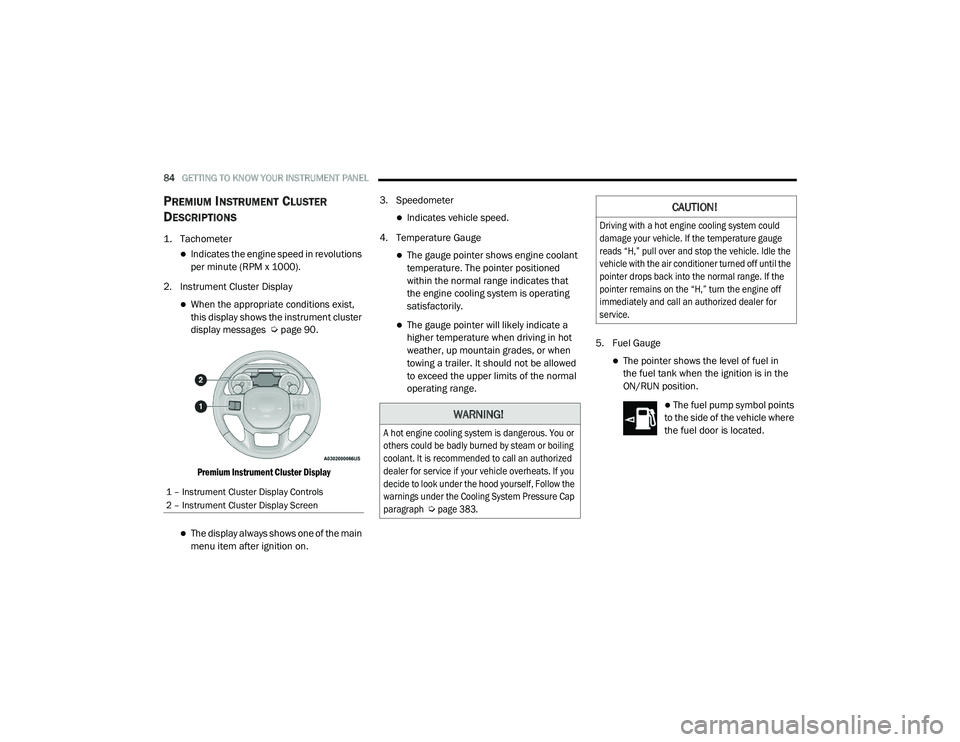
1. Tachometer
Indicates the engine speed in revolutions
per minute (RPM x 1000).
2. Instrument Cluster Display
When the appropriate conditions exist,
this display shows the instrument cluster
display messages Ú page 90.
Premium Instrument Cluster Display
The display always shows one of the main
menu item after ignition on. 3. Speedometer
Indicates vehicle speed.
4. Temperature Gauge
The gauge pointer shows engine coolant
temperature. The pointer positioned
within the normal range indicates that
the engine cooling system is operating
satisfactorily.
The gauge pointer will likely indicate a
higher temperature when driving in hot
weather, up mountain grades, or when
towing a trailer. It should not be allowed
to exceed the upper limits of the normal
operating range. 5. Fuel Gauge
The pointer shows the level of fuel in
the fuel tank when the ignition is in the
ON/RUN position.
The fuel pump symbol points
to the side of the vehicle where
the fuel door is located.
1 – Instrument Cluster Display Controls
2 – Instrument Cluster Display Screen
WARNING!
A hot engine cooling system is dangerous. You or
others could be badly burned by steam or boiling
coolant. It is recommended to call an authorized
dealer for service if your vehicle overheats. If you
decide to look under the hood yourself, Follow the
warnings under the Cooling System Pressure Cap
paragraph
Ú
page 383.
CAUTION!
Driving with a hot engine cooling system could
damage your vehicle. If the temperature gauge
reads “H,” pull over and stop the vehicle. Idle the
vehicle with the air conditioner turned off until the
pointer drops back into the normal range. If the
pointer remains on the “H,” turn the engine off
immediately and call an authorized dealer for
service.
21_DPF_OM_EN_USC_t.book Page 84
Page 88 of 463
86GETTING TO KNOW YOUR INSTRUMENT PANEL
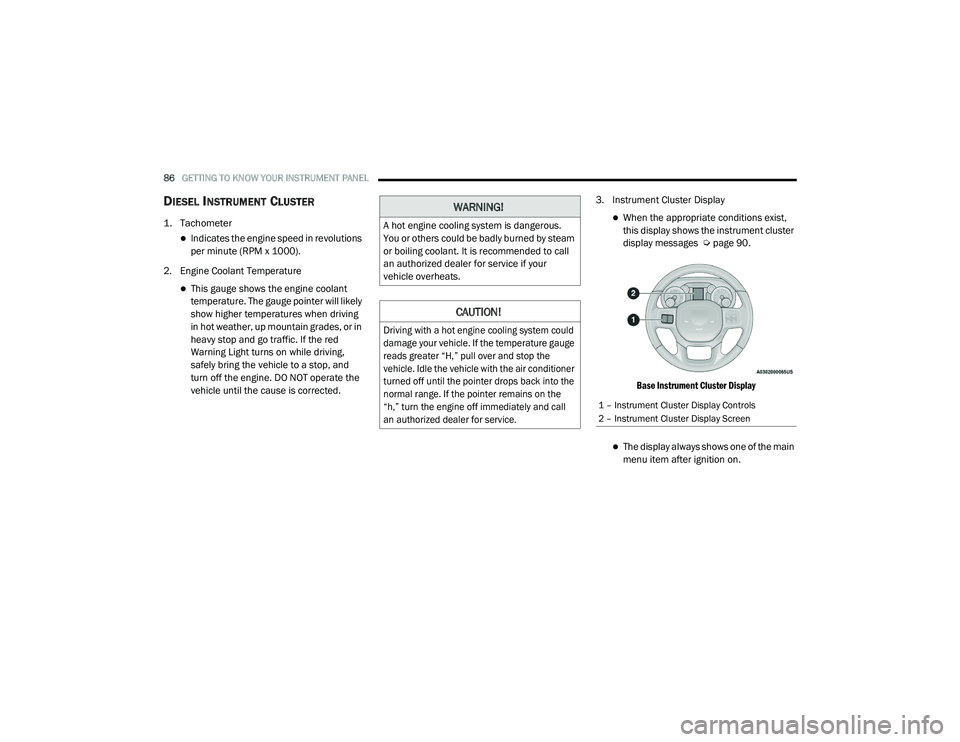
DIESEL INSTRUMENT CLUSTER
1. Tachometer
Indicates the engine speed in revolutions
per minute (RPM x 1000).
2. Engine Coolant Temperature
This gauge shows the engine coolant
temperature. The gauge pointer will likely
show higher temperatures when driving
in hot weather, up mountain grades, or in
heavy stop and go traffic. If the red
Warning Light turns on while driving,
safely bring the vehicle to a stop, and
turn off the engine. DO NOT operate the
vehicle until the cause is corrected. 3. Instrument Cluster Display
When the appropriate conditions exist,
this display shows the instrument cluster
display messages Ú
page 90.
Base Instrument Cluster Display
The display always shows one of the main
menu item after ignition on.
WARNING!
A hot engine cooling system is dangerous.
You or others could be badly burned by steam
or boiling coolant. It is recommended to call
an authorized dealer for service if your
vehicle overheats.
CAUTION!
Driving with a hot engine cooling system could
damage your vehicle. If the temperature gauge
reads greater “H,” pull over and stop the
vehicle. Idle the vehicle with the air conditioner
turned off until the pointer drops back into the
normal range. If the pointer remains on the
“h,” turn the engine off immediately and call
an authorized dealer for service.
1 – Instrument Cluster Display Controls
2 – Instrument Cluster Display Screen
21_DPF_OM_EN_USC_t.book Page 86
Page 136 of 463

134STARTING AND OPERATING
PROGRAMMABLE MAXIMUM VEHICLE
S
PEED
This feature allows the owner to set a maximum
vehicle speed for the vehicle. The 2500 and
3500 Series maximum vehicle speed can be set
between 40 mph to 87 mph (64 km/h to
140 km/h). The 4500/5500 Series maximum
vehicle speed can be set between 40 mph to
85 mph (64 km/h to 136 km/h). See an
authorized dealer to enable this feature.
NOTE:
DO NOT set the maximum vehicle speed to a
value greater than what the vehicle tires are
rated for.
OPERATING PRECAUTIONS
Avoid Overheating The Engine
The temperature of the engine coolant
(antifreeze: a mixture of 50% ethylene-glycol and
50% water) must not exceed the normal range
of the temperature gauge 240°F (116°C) with a
21 psi (145 kPa) coolant pressure cap.
Usually the engine coolant (antifreeze)
temperature indicated during operation will be
to the left of center in the normal range of the
gauge.
Avoid Low Coolant Temperature Operation
Continual operation at low engine coolant
(antifreeze) temperature below the normal
range on the gauge 140°F (60°C) can be
harmful to the engine. Low engine coolant
(antifreeze) temperature can cause incomplete
combustion which allows carbon and varnish to form on piston rings and injector nozzles.
Also, the unburned fuel can enter the
crankcase, diluting the lubricating oil and
causing rapid wear to the engine.
COOLING SYSTEM TIPS
To reduce potential for engine and transmission
overheating in high ambient temperature
conditions, take the following actions:
City Driving — When stopped, shift the trans
-
mission into NEUTRAL and increase engine
idle speed.
Highway Driving — Reduce your speed.
Up Steep Hills — Select a lower transmission
gear.
Air Conditioning — Turn it off temporarily.
21_DPF_OM_EN_USC_t.book Page 134
Page 151 of 463
STARTING AND OPERATING149
REVERSE (R)
This range is for moving the vehicle backward.
Shift into REVERSE only after the vehicle has
come to a complete stop.
NEUTRAL (N)
Use this range when the vehicle is standing
for prolonged periods with the engine running.
The engine may be started in this range. Apply
the parking brake and shift the transmission
into PARK if you must exit the vehicle. DRIVE (D)
This range should be used for most city and
highway driving. It provides the smoothest
upshifts and downshifts, and the best fuel
economy. The transmission automatically
upshifts through all forward gears.
When frequent transmission shifting occurs
(such as when operating the vehicle under
heavy loading conditions, in hilly terrain,
traveling into strong head winds, or while towing
a heavy trailer), select TOW/HAUL mode or use
the Electronic Range Select (ERS) shift control
to select a lower gear range
Úpage 150. Under
these conditions, using a lower gear range will
improve performance and extend transmission
life by reducing excessive shifting and heat
buildup.
If the transmission temperature exceeds normal
operating limits, the powertrain controller will
modify the transmission shift schedule and
expand the range of torque converter clutch
engagement. This is done to prevent
transmission damage due to overheating.
If the transmission becomes extremely hot or is
in danger of overheating, the “Transmission
Temperature Warning Light” may illuminate and
the transmission may operate differently until
the transmission cools down.
NOTE:
Use caution when operating a heavily loaded
vehicle at low speeds (such as towing a trailer
up a steep grade, or in stop-and-go traffic)
during hot weather. In these conditions, torque
converter slip can impose a significant addi
-
tional heat load on the cooling system. Down -
shifting the transmission to the lowest possible
gear (when climbing a grade), or shifting to
NEUTRAL (when stopped in heavy traffic) can
help to reduce this excess heat generation.
During cold temperatures, transmission
operation may be modified depending on
engine and transmission temperature as well
as vehicle speed. This feature improves
warm-up time of the engine and transmission to
achieve maximum efficiency. Engagement of
the torque converter clutch is inhibited until the
transmission fluid is warm Ú page 151.
WARNING!
Do not coast in NEUTRAL and never turn off the
ignition to coast down a hill. These are unsafe
practices that limit your response to changing
traffic or road conditions. You might lose
control of the vehicle and have a collision.
CAUTION!
Towing the vehicle, coasting, or driving for any
other reason with the transmission in NEUTRAL
can cause severe transmission damage.
For Towing A Disabled Vehicle Ú page 350.
For Recreational Towing Ú page 215.
4
21_DPF_OM_EN_USC_t.book Page 149
Page 335 of 463

SAFETY333
EXHAUST GAS The best protection against carbon monoxide
entry into the vehicle body is a properly
maintained engine exhaust system.
Whenever a change is noticed in the sound of
the exhaust system, when exhaust fumes can
be detected inside the vehicle, or when the
underside or rear of the vehicle is damaged, have
an authorized dealer inspect the complete
exhaust system and adjacent body areas for
broken, damaged, deteriorated, or mispositioned
parts. Open seams or loose connections could
permit exhaust fumes to seep into the passenger
compartment. In addition, inspect the exhaust
system each time the vehicle is raised for
lubrication or oil change. Replace as required.
CARBON MONOXIDE WARNINGS
WARNING!
Exhaust gases can injure or kill. They contain
carbon monoxide (CO), which is colorless
and odorless. Breathing it can make you
unconscious and can eventually poison you.
To avoid breathing (CO), follow these safety tips:
Do not run the engine in a closed garage or
in confined areas any longer than needed
to move your vehicle in or out of the area.
If you are required to drive with the trunk/
liftgate/rear doors open, make sure that all
windows are closed and the climate control
BLOWER switch is set at high speed.
DO NOT use the recirculation mode.
If it is necessary to sit in a parked vehicle
with the engine running, adjust your
heating or cooling controls to force outside
air into the vehicle. Set the blower at high
speed.
WARNING!
Carbon monoxide (CO) in exhaust gases is
deadly. Follow the precautions below to
prevent carbon monoxide poisoning:
Do not inhale exhaust gases. They contain
carbon monoxide, a colorless and odorless
gas, which can kill. Never run the engine in
a closed area, such as a garage, and never
sit in a parked vehicle with the engine
running for an extended period. If the
vehicle is stopped in an open area with
the engine running for more than a short
period, adjust the ventilation system to
force fresh, outside air into the vehicle.
Guard against carbon monoxide with
proper maintenance. Have the exhaust
system inspected every time the vehicle is
raised. Have any abnormal conditions
repaired promptly. Until repaired, drive with
all side windows fully open.
6
21_DPF_OM_EN_USC_t.book Page 333