oil change RAM CHASSIS CAB 2022 Owner's Manual
[x] Cancel search | Manufacturer: RAM, Model Year: 2022, Model line: CHASSIS CAB, Model: RAM CHASSIS CAB 2022Pages: 428, PDF Size: 20.18 MB
Page 344 of 428
342SERVICING AND MAINTENANCE
American Petroleum Institute (API)
Approved Engine Oil
These symbols mean that the oil has been certified
by the API. The manufacturer only recommends API
trademark oils.
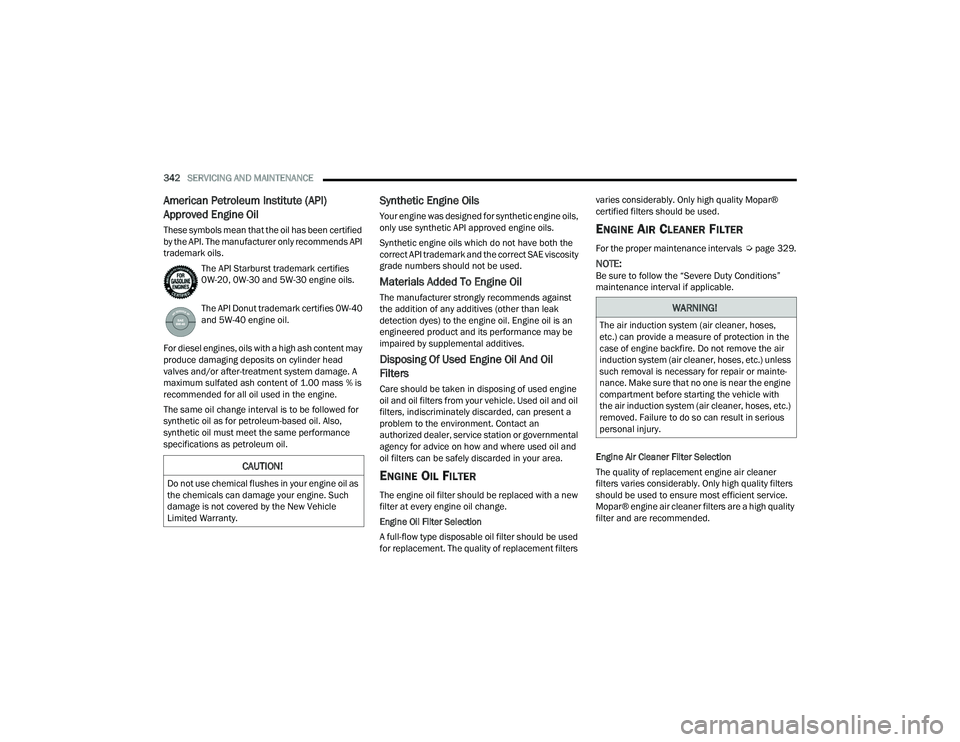
The API Starburst trademark certifies
0W-20, 0W-30 and 5W-30 engine oils.
The API Donut trademark certifies 0W-40
and 5W-40 engine oil.
For diesel engines, oils with a high ash content may
produce damaging deposits on cylinder head
valves and/or after-treatment system damage. A
maximum sulfated ash content of 1.00 mass % is
recommended for all oil used in the engine.
The same oil change interval is to be followed for
synthetic oil as for petroleum-based oil. Also,
synthetic oil must meet the same performance
specifications as petroleum oil.
Synthetic Engine Oils
Your engine was designed for synthetic engine oils,
only use synthetic API approved engine oils.
Synthetic engine oils which do not have both the
correct API trademark and the correct SAE viscosity
grade numbers should not be used.
Materials Added To Engine Oil
The manufacturer strongly recommends against
the addition of any additives (other than leak
detection dyes) to the engine oil. Engine oil is an
engineered product and its performance may be
impaired by supplemental additives.
Disposing Of Used Engine Oil And Oil
Filters
Care should be taken in disposing of used engine
oil and oil filters from your vehicle. Used oil and oil
filters, indiscriminately discarded, can present a
problem to the environment. Contact an
authorized dealer, service station or governmental
agency for advice on how and where used oil and
oil filters can be safely discarded in your area.
ENGINE OIL FILTER
The engine oil filter should be replaced with a new
filter at every engine oil change.
Engine Oil Filter Selection
A full-flow type disposable oil filter should be used
for replacement. The quality of replacement filters varies considerably. Only high quality Mopar®
certified filters should be used.
ENGINE AIR CLEANER FILTER
For the proper maintenance intervals
Úpage 329.
NOTE:Be sure to follow the “Severe Duty Conditions”
maintenance interval if applicable.
Engine Air Cleaner Filter Selection
The quality of replacement engine air cleaner
filters varies considerably. Only high quality filters
should be used to ensure most efficient service.
Mopar® engine air cleaner filters are a high quality
filter and are recommended.
CAUTION!
Do not use chemical flushes in your engine oil as
the chemicals can damage your engine. Such
damage is not covered by the New Vehicle
Limited Warranty.
WARNING!
The air induction system (air cleaner, hoses,
etc.) can provide a measure of protection in the
case of engine backfire. Do not remove the air
induction system (air cleaner, hoses, etc.) unless
such removal is necessary for repair or mainte -
nance. Make sure that no one is near the engine
compartment before starting the vehicle with
the air induction system (air cleaner, hoses, etc.)
removed. Failure to do so can result in serious
personal injury.
22_DPF_OM_EN_USC_t.book Page 342
Page 345 of 428

SERVICING AND MAINTENANCE343
Engine Air Cleaner Filter Inspection And
Replacement— Gasoline Engine
Inspect engine air cleaner filter for dirt and or
debris, if you find evidence of either dirt or debris
you should change your engine air cleaner filter.
NOTE:When replacing the engine air cleaner filter on
vehicles equipped with a 6.4L gasoline engine,
replace with a dry (non-oiled) filter only.
Engine Air Cleaner Filter Removal
1. With suitable tool fully loosen (six) fasteners
on engine air cleaner filter.
Engine Air Cleaner Filter
2. Lift the engine air cleaner filter cover to access
the engine air cleaner filter.
3. Remove the engine air cleaner filter from the housing assembly.
Engine Air Cleaner Filter Assembly
Engine Air Cleaner Filter Installation
NOTE:Inspect and clean the housing if dirt or debris is
present before replacing the engine air cleaner
filter.
1. Install the engine air cleaner filter into the housing assembly with the engine air cleaner
filter inspection surface facing downward.
2. Install the engine air cleaner filter cover onto the housing assembly. 3. Tighten the fasteners (six) on the engine air
cleaner filter assembly.
Engine Air Cleaner Filter Inspection and
Replacement — Diesel Engine
Inspect engine air cleaner filter for dirt and or
debris, if you find evidence of either dirt or debris
you should change your engine air cleaner filter.
Engine Air Cleaner Filter Removal
1. Remove the screws from the engine air cleaner filter cover.
Engine Air Cleaner Filter Cover
2. Lift the engine air cleaner filter cover to access the engine air cleaner filter.
1 — Fasteners
2 — Air Hose Clamp
3 — Engine Air Cleaner Filter Cover
1 — Engine Air Cleaner Filter Cover
2 — Engine Air Cleaner Filter
1 — Engine Air Cleaner Filter Cover
2 — Screws
8
22_DPF_OM_EN_USC_t.book Page 343
Page 353 of 428

SERVICING AND MAINTENANCE351
the EPA Heavy Duty Diesel Engine Emissions
Standards. These systems are seamlessly
integrated into your vehicle and managed by the
Cummins® Powertrain Control Module (PCM). The
PCM manages engine combustion to allow the
exhaust system’s catalyst to trap and burn
Particulate Matter (PM) pollutants, with no input or
interaction on your part.
If the engine is allowed to idle or the truck is driven
on low engine speed drive cycles for more than two
hours, the system will automatically enter an
emissions operating mode that will increase the
engine idle speed to 1,050 RPM. While in this
mode, which is designed to help maintain the
Diesel Particulate Filter, the engine idle speed will
return to normal when the brake pedal is applied.
A small change in engine tone or a slight change in
engine performance while accelerating may also
be noticeable at speeds below 20 mph (32 km/h).
This operating mode may last for up to an hour of
idle time, or around 20 minutes of driving time.
Additionally, your vehicle has the ability to alert you
to additional maintenance required on your truck
or engine Ú page 81.
DIESEL EXHAUST FLUID (DEF)
DEF sometimes known simply by the name of its
active component, UREA—is a key component of
Selective Catalytic Reduction (SCR) systems, which
help diesel vehicles meet stringent emission
regulations. DEF is a liquid reducing agent that
reacts with engine exhaust in the presence of a
catalyst to convert smog-forming nitrogen oxides
(NOx) into harmless nitrogen and water vapor
Úpage 404.
You can receive assistance in locating DEF by
contacting an authorized dealer.
BODY LUBRICATION
Locks and all body pivot points, including such
items as seat tracks, door hinge pivot points and
rollers, liftgate, tailgate, decklid, sliding doors and
hood hinges, should be lubricated periodically with
a lithium-based grease, such as Mopar® Spray
White Lube to ensure quiet, easy operation and to protect against rust and wear. Prior to the
application of any lubricant, the parts concerned
should be wiped clean to remove dust and grit;
after lubricating excess, oil and grease should be
removed. Particular attention should also be given
to hood latching components to ensure proper
function. When performing other underhood
services, the hood latch, release mechanism and
safety catch should be cleaned and lubricated.
The external lock cylinders should be lubricated
twice a year, preferably in the Autumn and Spring.
Apply a small amount of a high quality lubricant,
such as Mopar® Lock Cylinder Lubricant directly
into the lock cylinder.
WINDSHIELD WIPER BLADES
Clean the rubber edges of the wiper blades and the
windshield periodically with a sponge or soft cloth
and a mild nonabrasive cleaner. This will remove
accumulations of salt or road film.
Operation of the wipers on dry glass for long
periods may cause deterioration of the wiper
blades. Always use washer fluid when using the
wipers to remove salt or dirt from a dry windshield.
Avoid using the wiper blades to remove frost or ice
from the windshield. Keep the blade rubber out of
contact with petroleum products such as engine
oil, gasoline, etc.
WARNING!
A hot exhaust system can start a fire if you park
over materials that can burn. Such materials
might be grass or leaves coming into contact
with your exhaust system. Do not park or oper
-
ate your vehicle in areas where your exhaust sys -
tem can contact anything that can burn.
8
22_DPF_OM_EN_USC_t.book Page 351
Page 355 of 428

SERVICING AND MAINTENANCE353
3. Tilt the lower end of the wiper blade away from the arm and with one finger, push the release
tab toward the wiper arm.
Wiper Disengaging
4. Slide the wiper blade down towards the base of the wiper arm.
5. With the wiper blade disengaged, remove the wiper blade from the wiper arm by holding the
wiper arm with one hand and separating the
wiper blade from the wiper arm with the other
hand (move the wiper blade down toward the
base of the wiper arm and away from the J
hook in the end of the wiper arm).
Removing Wiper From Wiper Arm
6. Gently lower the wiper arm onto the glass.
Installing The Front Wipers
1. Lift the wiper arm off of the glass, until the wiper arm is in the full up position.
2. Position the wiper blade under the hook on the tip of the wiper arm with the wiper locking tab
open.
3. Insert the receiver bracket on the wiper assembly into the hook on the tip of the arm
through the opening in the wiper blade under
the locking tab. 4. Slide the wiper blade up into the hook on the
wiper arm until it is latched (engagement will
be accompanied by an audible click). Fold
down the latch release tab and snap it into its
locked position.
5. Gently lower the wiper blade onto the glass.
EXHAUST SYSTEM
The best protection against carbon monoxide entry
into the vehicle body is a properly maintained
engine exhaust system.
If you notice a change in the sound of the exhaust
system; or if the exhaust fumes can be detected
inside the vehicle; or when the underside or rear of
the vehicle is damaged; have an authorized
technician inspect the complete exhaust system
and adjacent body areas for broken, damaged,
deteriorated, or mispositioned parts. Open seams
or loose connections could permit exhaust fumes
to seep into the passenger compartment. In
addition, have the exhaust system inspected each
time the vehicle is raised for lubrication or oil
change. Replace as required.
1 — Locking Tab
2 — Wiper
3 — Release Tab
1 — Wiper
2 — Locking Tab
3 — Wiper Arm J Hook
8
22_DPF_OM_EN_USC_t.book Page 353
Page 361 of 428

SERVICING AND MAINTENANCE359
Fluid Level Check — 8-Speed Transmission
The fluid level is preset at the factory and does not
require adjustment under normal operating
conditions. Routine fluid level checks are not
required, therefore the transmission has no
dipstick. An authorized dealer can check your
transmission fluid level using special service tools.
If you notice fluid leakage or transmission
malfunction, visit an authorized dealer
immediately to have the transmission fluid level
checked. Operating the vehicle with an improper
fluid level can cause severe transmission damage.
Fluid Level Check — 6-Speed Transmission
It is best to check the fluid level when the
transmission is at normal operating temperature
(158-176°F / 70-80°C). This normally occurs
after at least 15 miles (25 km) of driving. At normal
operating temperature the fluid cannot be held
comfortably between the fingertips. You can read
the transmission sump temperature in the
instrument cluster screen Ú page 81.Use the following procedure to check the
transmission fluid level properly:
1. Monitor the transmission temperature using
the instrument cluster display, and operate
the vehicle as required to reach the normal
operating temperature. If the transmission is
not functioning properly, or the vehicle cannot
be driven, see the NOTE and CAUTION below
about checking the fluid level at colder
temperatures.
2. Park the vehicle on level ground.
3. Run the engine at normal idle speed for at least 60 seconds, and leave the engine
running for the rest of this procedure.
4. Fully apply the parking brake, and press the brake pedal.
5. Place the gear selector momentarily into each gear position (allowing time for the
transmission to fully engage in each position),
ending with the transmission in PARK.
6. Remove the dipstick, wipe it clean and reinsert it until seated.
7. Remove the dipstick again and note the fluid level on both sides. The fluid level reading is
only valid if there is a solid coating of oil on
both sides of the dipstick. Note that the holes
in the dipstick will be full of fluid if the actual
level is at or above the hole. The fluid level
should be between the “HOT” (upper) reference holes on the dipstick at normal
operating temperature. If the fluid level is low,
add fluid through the dipstick tube to bring it to
the proper level.
Do not overfill. Use ONLY the
specified fluid Ú page 407. After adding any
quantity of oil through the dipstick tube, wait a
minimum of two minutes for the oil to fully
drain into the transmission before rechecking
the fluid level.
NOTE:If it is necessary to check the transmission below
the operating temperature, the fluid level should
be between the two “COLD” (lower) holes on the
dipstick with the fluid at 60-70°F / 16-21°C. Only
use the COLD region of the dipstick as a rough
reference when setting the fluid level after a trans -
mission service or fluid change. Re-check the fluid
level, and adjust as required, once the trans -
mission reaches normal operating temperature.
8. Reinsert the dipstick. Check for leaks. Release the parking brake.
CAUTION!
If a transmission fluid leak occurs, visit an
authorized dealer immediately. Severe
transmission damage may occur. An authorized
dealer has the proper tools to adjust the fluid
level accurately.
CAUTION!
If the fluid temperature is below 50°F (10°C) it
may not register on the dipstick. Do not add fluid
until the temperature is elevated enough to
produce an accurate reading. Run the engine at
idle, in PARK, to warm the fluid.
8
22_DPF_OM_EN_USC_t.book Page 359
Page 362 of 428
360SERVICING AND MAINTENANCE
NOTE:If it is necessary to check the transmission below
the operating temperature, the fluid level should
be between the two COLD (lower) holes on the
dipstick with the fluid at 68-86°F / 20-30°C. Only
use the COLD region of the dipstick as a rough
reference when setting the fluid level after a trans -
mission service or fluid change. Re-check the fluid
level, and adjust as required, once the trans -
mission reaches normal operating temperature.
Fluid And Filter Changes — 8-Speed
Transmission
Under normal operating conditions, the fluid
installed at the factory will provide satisfactory
lubrication for the life of the vehicle.
Routine fluid and filter changes are not required.
However, change the fluid and filter if the fluid
becomes contaminated (with water, etc.), or if the
transmission is disassembled for any reason.
Fluid And Filter Changes — 6-Speed
Transmission
For the proper maintenance intervals Úpage 329.
In addition, change the fluid and filters if the fluid
becomes contaminated (with water, etc.), or if the
transmission is disassembled for any reason.
Selection Of Lubricant
It is important to use the proper transmission fluid
to ensure optimum transmission performance and
life. Use only the manufacturer’s specified
transmission fluid Ú page 407. It is important to
maintain the transmission fluid at the correct level
using the recommended fluid. No chemical flushes
should be used in any transmission; only the
approved lubricant should be used.
REAR AXLE AND 4X4 FRONT DRIVING
A
XLE FLUID LEVEL
For normal service, periodic fluid level checks are
not required. When the vehicle is serviced for other
reasons the exterior surfaces of the axle assembly
should be inspected. If gear oil leakage is
suspected inspect the fluid level. This inspection
should be made with the vehicle in a level position.
When checking the fluid level, the vehicle should
be in a level position. The fluid level at room
temperature should be as follows:
3500 Front Axle: ¼ inch ± ¼ inch (6.4 mm ±
6.4 mm) below the bottom of the fill hole.
3500 Rear Axle: ¼ inch ± ¼ inch (6.4 mm ±
6.4 mm) below the bottom of the fill hole.
4500/5500 Front Axle: ¼ inch +/- ¼ inch (6.4 mm
± 6.4 mm) below the bottom of the fill hole.
4500/5500 Rear Axle: 1/8 inch +/- 1/8 inch
(3.2 mm +/- 3.2 mm) below the bottom of the fill
hole.
CAUTION!
If the fluid temperature is below 50°F (10°C) it
may not register on the dipstick. Do not add fluid
until the temperature is elevated enough to
produce an accurate reading. Run the engine at
idle, in PARK, to warm the fluid.
CAUTION!
Using a transmission fluid other than the
manufacturer’s recommended fluid may cause
deterioration in transmission shift quality and/or
torque converter shudder, and (for 6-speed
transmissions) will require more frequent fluid
and filter changes Ú page 407.
22_DPF_OM_EN_USC_t.book Page 360
Page 388 of 428
386SERVICING AND MAINTENANCE
Keep dismounted tires in a cool, dry place with as
little exposure to light as possible. Protect tires
from contact with oil, grease, and gasoline.
Replacement Tires
The tires on your new vehicle provide a balance of
many characteristics. They should be inspected
regularly for wear and correct cold tire inflation
pressures. The manufacturer strongly
recommends that you use tires equivalent to the
originals in size, quality and performance when
replacement is needed Ú page 385. Refer to the
Tire and Loading Information placard or the
Vehicle Certification Label for the size designation
of your tire. The Load Index and Speed Symbol for
your tire will be found on the original equipment
tire sidewall.
For more information relating to the Load Index
and Speed Symbol of a tire Ú page 376.
It is recommended to replace the two front tires or
two rear tires as a pair. Replacing just one tire can
seriously affect your vehicle’s handling. If you ever
replace a wheel, make sure that the wheel’s
specifications match those of the original wheels.
It is recommended you contact an authorized tire
dealer or original equipment dealer with any
questions you may have on tire specifications or
capability. Failure to use equivalent replacement
tires may adversely affect the safety, handling, and
ride of your vehicle.
TIRE TYPES
All Season Tires — If Equipped
All Season tires provide traction for all seasons
(Spring, Summer, Autumn, and Winter). Traction
levels may vary between different all season tires.
All season tires can be identified by the M+S, M&S,
M/S or MS designation on the tire sidewall. Use all
season tires only in sets of four; failure to do so
may adversely affect the safety and handling of
your vehicle.
Summer Or Three Season Tires —
If Equipped
Summer tires provide traction in both wet and dry
conditions, and are not intended to be driven in
snow or on ice. If your vehicle is equipped with
Summer tires, be aware these tires are not
designed for Winter or cold driving conditions.
Install Winter tires on your vehicle when ambient
temperatures are less than 40°F (5°C) or if roads
are covered with ice or snow. For more
information, contact an authorized dealer.
WARNING!
Do not use a tire, wheel size, load rating, or
speed rating other than that specified for your
vehicle. Some combinations of unapproved
tires and wheels may change suspension
dimensions and performance characteristics,
resulting in changes to steering, handling, and
braking of your vehicle. This can cause unpre -
dictable handling and stress to steering and
suspension components. You could lose
control and have a collision resulting in
serious injury or death. Use only the tire and
wheel sizes with load ratings approved for
your vehicle.
Never use a tire with a smaller load index or
capacity, other than what was originally
equipped on your vehicle. Using a tire with a
smaller load index could result in tire over -
loading and failure. You could lose control and
have a collision.
Failure to equip your vehicle with tires having
adequate speed capability can result in
sudden tire failure and loss of vehicle control.
CAUTION!
Replacing original tires with tires of a different
size may result in false speedometer and
odometer readings.
22_DPF_OM_EN_USC_t.book Page 386
Page 404 of 428
402TECHNICAL SPECIFICATIONS
comply with Oil Change requirements for vehicles
operating on biodiesel blends up to B20 will result
in premature engine wear. Such wear is not
covered by the New Vehicle Limited Warranty.
Biodiesel is a fuel produced from renewable
resources typically derived from animal fat,
rapeseed oil (Rapeseed Methyl Ester (RME) base),
or soybean oil (Soy Methyl Ester (SME or SOME)
base). Biodiesel fuel has inherent limitations which
require that you understand and adhere to the
following requirements if you use blends of
biodiesel greater then 5% but not greater than
20% (B6-B20). There are no unique restrictions for
the use of B5. Use of blends greater than 20% is
not approved. Use of blends greater than 20% can
result in engine damage. Such damage is not
covered by the New Vehicle Limited Warranty.
Fuel Quality — Must Comply With ASTM
Standards
The quality of biodiesel fuel may vary widely. Only
fuel produced by a BQ9000 supplier to the
following specifications may be blended to meet
biodiesel blend (B6–B20) fuel meeting ASTM
specification D-7467:
Petrodiesel fuel meeting ASTM specification
D-975 and biodiesel fuel (B100) meeting ASTM
specification D-6751.
Fuel Oxidation Stability — Must Use Fuel
Within Six Months Of Manufacture
Biodiesel fuel has poor oxidation stability which
can result in long term storage problems. Fuel
produced to approved ASTM standards, if stored
properly, provides for protection against fuel
oxidation for up to six months.
Fuel Water Separation — Must Use
Mopar®/Cummins® Approved Fuel Filter
Elements
You must use Mopar®/Cummins® approved fuel
filter elements in both your engine mounted filter
and frame mounted filter.
Biodiesel fuel has a natural affinity to water and
water accelerates microbial growth. Your Mopar®/
Cummins® filtration system is designed to provide
adequate fuel water separation capabilities.
Biodiesel Fuel Properties — Low Ambient
Temperatures
Biodiesel fuel may gel or solidify at low ambient
temperatures, which may pose problems for both
storage and operation. Precautions can be
necessary at low ambient temperatures, such as
storing the fuel in a heated building or a heated
storage tank, or using cold temperature additives.
Fuel In Oil Dilution — Must Adhere To
Required Oil Change Interval
Fuel dilution of lubricating oil has been observed
with the use of biodiesel fuel. Fuel in oil must not
exceed 5%. To ensure this limit is met your oil
change interval must be maintained to the
following schedule:
Ram 3500/4500/5500 Chassis Cab —
12,500 Miles (20,000 km)*
(*unless otherwise notified with a oil service
message)
CAUTION!
Under no circumstances should oil change
intervals exceed 12,500 miles (20,000 km) if
operation occurs with greater than 5%
biodiesel blends. Oil change intervals should
not exceed six months in either case. Failure to
comply with these Oil Change requirements for
vehicles operating on biodiesel blends up to
B20 may result in premature engine wear.
Such wear is not covered by the New Vehicle
Limited Warranty.
B20 Biodiesel capable: The engine may suffer
severe damage if operated with concentra -
tions of Biodiesel higher than 20%.
22_DPF_OM_EN_USC_t.book Page 402
Page 419 of 428

417
I
Idle-Up Feature
.............................................. 115Ignition............................................................ 18Switch......................................................... 18Illuminated Entry............................................. 52Inside Rearview Mirror............................ 38, 312Instrument Cluster...................... 78, 79, 80, 81Descriptions.............................................. 102Display........................................................ 81Engine Oil Reset.......................................... 82Instrument Panel Lens Cleaning.................... 396Integrated Trailer Brake Control.................... 179Interior Appearance Care............................... 395Interior Lights.................................................. 51Intermittent Wipers (Delay Wipers).................. 53Intervention Regeneration Strategy........ 90, 350Inverter Outlet (115V)...................................... 69
J
Jack Location................................................. 315Jack Operation............................................... 315Jacking And Tire Changing............................. 315Jump Starting................................................ 319
K
Key Fob Programming Additional Key Fobs
.............. 17Key Fob Battery Service (Remote Keyless
Entry)............................................................... 16
Key Fob Programming (Remote Keyless
Entry)............................................................... 17Keyless Enter 'n Go™.................... 25, 107, 109Passive Entry............................................... 25Keys................................................................. 15
L
Lane Change And Turn Signals........................ 50Lane Change Assist......................................... 50LaneSense.................................................... 156Latches......................................................... 309Hood............................................................ 73Lead Free Gasoline....................................... 399Leaks, Fluid.................................................. 309Life Of Tires................................................... 385Light Bulbs........................................... 309, 371LIghtsElectrinic Power Steering Pump.................. 97Oil Temperature........................................... 96Lights............................................................ 309Air Bag...................................... 95, 284, 307Automatic High Beam.................................. 48Brake Assist Warning............................... 263Brake Warning............................................. 95Bulb Replacement.................................... 371Cab Top Clearance................................... 375Cargo........................................................... 50Center Mounted Stop............................... 375
Courtesy/Reading........................................51Cruise....................................................... 102Daytime Running.........................................48Electronic Stability Program (ESP) Indicator..................................................96Exterior.............................................. 47, 309Fog............................................................ 374Four Wheel Drive Indicator....................... 139Hazard Warning Flasher........................... 311Headlights............................................ 47, 48High Beam...................................................48Hill Descent Control Indicator................... 263Illuminated Entry.........................................52Interior.........................................................51Lights On Reminder.....................................49Low Fuel......................................................99Malfunction Indicator (Check Engine)..........97Park.......................................................... 102Passing........................................................48Seat Belt Reminder.....................................94Security Alarm.............................................96Service...................................................... 371Traction Control........................................ 263Transfer Case........................................... 139Turn Signals..................... 50, 102, 309, 373Warning Instrument Cluster Descriptions.................................. 96, 102Limited-Slip Differential....................... 139, 36111
22_DPF_OM_EN_USC_t.book Page 417
Page 420 of 428

418
Load Shed Battery Saver Mode
....................... 93Load Shed Battery Saver On............................ 93Load Shed Electrical Load Reduction.............. 93Load Shed Intelligent Battery Sensor.............. 93Loading Vehicle............................................. 172Tires.......................................................... 380Locks Automatic Door........................................... 26Child Protection........................................... 27Power Door.................................................. 24Low Tire Pressure System............................. 268Lubrication, Body........................................... 351Lug Nuts/Bolts.................................... 318, 397
M
Maintenance Free Battery............................. 340Maintenance Plan......................................... 334Maintenance Schedule............... 328, 332, 334Malfunction Indicator Light (Check Engine)..... 97ManualPark Release............................................. 323Service...................................................... 411Media Hub....................................................... 66Media Mode.................................................. 221Memory Seat................................................... 29Memory Settings............................................. 29Methanol....................................................... 399Mirrors............................................................. 38Electric Powered......................................... 40Heated........................................................ 42
Memory....................................................... 29Outside........................................................ 40Rearview.............................................38, 312Trailer Towing.............................................. 42Mirrors, Digital................................................. 39Mobile App.................................................... 235Modifications/AlterationsVehicle......................................................... 10Monitor, Tire Pressure System...................... 268Mopar Parts.................................................. 411MP3 Control..................................................... 66Multi-Function Control Lever............................ 47
N
Navigation System (Uconnect GPS).............. 159New Vehicle Break-In Period................ 118, 119Noise ControlMaintenance............................................ 361Tampering Prohibited............................... 362Noise Emission Warranty..................... 361, 362
O
Occupant Restraints..................................... 275Octane Rating, Gasoline (Fuel)..................... 399Oil Change Indicator..................................... 332Oil Filter, Change.......................................... 342Oil Filter, Selection........................................ 342Oil Pressure Light............................................. 96Oil Reset.......................................................... 82Oil, Engine............................................ 341, 404
Capacity.................................................... 403Dipstick..................................................... 340Disposal.................................................... 342Filter................................................ 342, 404Filter Disposal........................................... 342Identification Logo.................................... 342Materials Added To................................... 342Pressure Warning Light................................96Recommendation..................................... 341Synthetic................................................... 342Onboard Diagnostic System.......................... 103Operating Precautions.................................. 103Operator ManualOwner's Manual........................................ 411Outside Rearview Mirrors.................................40Overdrive....................................................... 130Overdrive OFF Switch.................................... 130Overheating, Engine...................................... 322
P
Paint Care..................................................... 393Pair (Link) Uconnect Phone To A Mobile
Phone
S
.................................................... 225Parking Brake............................................... 119ParkSense System, Rear............................... 151Passive Entry....................................................25Pedals, Adjustable...........................................37Pets............................................................... 307Phone Mode.................................................. 223Placard, Tire And Loading Information.......... 380
22_DPF_OM_EN_USC_t.book Page 418