oil RAM CHASSIS CAB 2022 Workshop Manual
[x] Cancel search | Manufacturer: RAM, Model Year: 2022, Model line: CHASSIS CAB, Model: RAM CHASSIS CAB 2022Pages: 428, PDF Size: 20.18 MB
Page 360 of 428
358SERVICING AND MAINTENANCE
(Continued)
BRAKE SYSTEM
In order to ensure brake system performance, all
brake system components should be inspected
periodically Úpage 329.
Fluid Level Check — Brake Master Cylinder
The fluid level of the master cylinder should be
checked when performing under the hood service
or immediately if the Brake System Warning Light
indicates system failure.
If necessary, add fluid to bring level within the
designated marks on the side of the reservoir of
the brake master cylinder. Be sure to clean the top
of the master cylinder area before removing cap.
With disc brakes the fluid level can be expected to
fall as the brake linings wear. However, an
unexpected drop in fluid level may be caused by a
leak and a system check should be conducted.
For further information Ú page 407.
AUTOMATIC TRANSMISSION
Special Additives
The manufacturer strongly recommends against
using any special additives in the transmission.
Automatic Transmission Fluid (ATF) is an
engineered product and its performance may be
impaired by supplemental additives. Therefore, do
not add any fluid additives to the transmission. The
only exception to this policy is the use of special
dyes for diagnosing fluid leaks in 6-speed
transmissions. Avoid using transmission sealers as
they may adversely affect seals.
WARNING!
Riding the brakes can lead to brake failure and
possibly a collision. Driving with your foot resting
or riding on the brake pedal can result in
abnormally high brake temperatures, excessive
lining wear, and possible brake damage. You
would not have your full braking capacity in an
emergency.
WARNING!
Use only manufacturer's recommended brake
fluid Úpage 407. Using the wrong type of
brake fluid can severely damage your brake
system and/or impair its performance. The
proper type of brake fluid for your vehicle is
also identified on the original factory installed
hydraulic master cylinder reservoir.
To avoid contamination from foreign matter or
moisture, use only new brake fluid or fluid that
has been in a tightly closed container. Keep
the master cylinder reservoir cap secured at
all times. Brake fluid in an open container
absorbs moisture from the air resulting in a
lower boiling point. This may cause it to boil
unexpectedly during hard or prolonged
braking, resulting in sudden brake failure. This
could result in a collision.
Overfilling the brake fluid reservoir can result
in spilling brake fluid on hot engine parts,
causing the brake fluid to catch fire. Brake
fluid can also damage painted and vinyl
surfaces, care should be taken to avoid its
contact with these surfaces.
Do not allow petroleum based fluid to contam -
inate the brake fluid. Brake seal components
could be damaged, causing partial or
complete brake failure. This could result in a
collision.
CAUTION!
Do not use chemical flushes in your
transmission as the chemicals can damage your
transmission components. Such damage is not
covered by the New Vehicle Limited Warranty.
WARNING!
22_DPF_OM_EN_USC_t.book Page 358
Page 361 of 428

SERVICING AND MAINTENANCE359
Fluid Level Check — 8-Speed Transmission
The fluid level is preset at the factory and does not
require adjustment under normal operating
conditions. Routine fluid level checks are not
required, therefore the transmission has no
dipstick. An authorized dealer can check your
transmission fluid level using special service tools.
If you notice fluid leakage or transmission
malfunction, visit an authorized dealer
immediately to have the transmission fluid level
checked. Operating the vehicle with an improper
fluid level can cause severe transmission damage.
Fluid Level Check — 6-Speed Transmission
It is best to check the fluid level when the
transmission is at normal operating temperature
(158-176°F / 70-80°C). This normally occurs
after at least 15 miles (25 km) of driving. At normal
operating temperature the fluid cannot be held
comfortably between the fingertips. You can read
the transmission sump temperature in the
instrument cluster screen Ú page 81.Use the following procedure to check the
transmission fluid level properly:
1. Monitor the transmission temperature using
the instrument cluster display, and operate
the vehicle as required to reach the normal
operating temperature. If the transmission is
not functioning properly, or the vehicle cannot
be driven, see the NOTE and CAUTION below
about checking the fluid level at colder
temperatures.
2. Park the vehicle on level ground.
3. Run the engine at normal idle speed for at least 60 seconds, and leave the engine
running for the rest of this procedure.
4. Fully apply the parking brake, and press the brake pedal.
5. Place the gear selector momentarily into each gear position (allowing time for the
transmission to fully engage in each position),
ending with the transmission in PARK.
6. Remove the dipstick, wipe it clean and reinsert it until seated.
7. Remove the dipstick again and note the fluid level on both sides. The fluid level reading is
only valid if there is a solid coating of oil on
both sides of the dipstick. Note that the holes
in the dipstick will be full of fluid if the actual
level is at or above the hole. The fluid level
should be between the “HOT” (upper) reference holes on the dipstick at normal
operating temperature. If the fluid level is low,
add fluid through the dipstick tube to bring it to
the proper level.
Do not overfill. Use ONLY the
specified fluid Ú page 407. After adding any
quantity of oil through the dipstick tube, wait a
minimum of two minutes for the oil to fully
drain into the transmission before rechecking
the fluid level.
NOTE:If it is necessary to check the transmission below
the operating temperature, the fluid level should
be between the two “COLD” (lower) holes on the
dipstick with the fluid at 60-70°F / 16-21°C. Only
use the COLD region of the dipstick as a rough
reference when setting the fluid level after a trans -
mission service or fluid change. Re-check the fluid
level, and adjust as required, once the trans -
mission reaches normal operating temperature.
8. Reinsert the dipstick. Check for leaks. Release the parking brake.
CAUTION!
If a transmission fluid leak occurs, visit an
authorized dealer immediately. Severe
transmission damage may occur. An authorized
dealer has the proper tools to adjust the fluid
level accurately.
CAUTION!
If the fluid temperature is below 50°F (10°C) it
may not register on the dipstick. Do not add fluid
until the temperature is elevated enough to
produce an accurate reading. Run the engine at
idle, in PARK, to warm the fluid.
8
22_DPF_OM_EN_USC_t.book Page 359
Page 362 of 428
360SERVICING AND MAINTENANCE
NOTE:If it is necessary to check the transmission below
the operating temperature, the fluid level should
be between the two COLD (lower) holes on the
dipstick with the fluid at 68-86°F / 20-30°C. Only
use the COLD region of the dipstick as a rough
reference when setting the fluid level after a trans -
mission service or fluid change. Re-check the fluid
level, and adjust as required, once the trans -
mission reaches normal operating temperature.
Fluid And Filter Changes — 8-Speed
Transmission
Under normal operating conditions, the fluid
installed at the factory will provide satisfactory
lubrication for the life of the vehicle.
Routine fluid and filter changes are not required.
However, change the fluid and filter if the fluid
becomes contaminated (with water, etc.), or if the
transmission is disassembled for any reason.
Fluid And Filter Changes — 6-Speed
Transmission
For the proper maintenance intervals Úpage 329.
In addition, change the fluid and filters if the fluid
becomes contaminated (with water, etc.), or if the
transmission is disassembled for any reason.
Selection Of Lubricant
It is important to use the proper transmission fluid
to ensure optimum transmission performance and
life. Use only the manufacturer’s specified
transmission fluid Ú page 407. It is important to
maintain the transmission fluid at the correct level
using the recommended fluid. No chemical flushes
should be used in any transmission; only the
approved lubricant should be used.
REAR AXLE AND 4X4 FRONT DRIVING
A
XLE FLUID LEVEL
For normal service, periodic fluid level checks are
not required. When the vehicle is serviced for other
reasons the exterior surfaces of the axle assembly
should be inspected. If gear oil leakage is
suspected inspect the fluid level. This inspection
should be made with the vehicle in a level position.
When checking the fluid level, the vehicle should
be in a level position. The fluid level at room
temperature should be as follows:
3500 Front Axle: ¼ inch ± ¼ inch (6.4 mm ±
6.4 mm) below the bottom of the fill hole.
3500 Rear Axle: ¼ inch ± ¼ inch (6.4 mm ±
6.4 mm) below the bottom of the fill hole.
4500/5500 Front Axle: ¼ inch +/- ¼ inch (6.4 mm
± 6.4 mm) below the bottom of the fill hole.
4500/5500 Rear Axle: 1/8 inch +/- 1/8 inch
(3.2 mm +/- 3.2 mm) below the bottom of the fill
hole.
CAUTION!
If the fluid temperature is below 50°F (10°C) it
may not register on the dipstick. Do not add fluid
until the temperature is elevated enough to
produce an accurate reading. Run the engine at
idle, in PARK, to warm the fluid.
CAUTION!
Using a transmission fluid other than the
manufacturer’s recommended fluid may cause
deterioration in transmission shift quality and/or
torque converter shudder, and (for 6-speed
transmissions) will require more frequent fluid
and filter changes Ú page 407.
22_DPF_OM_EN_USC_t.book Page 360
Page 363 of 428
SERVICING AND MAINTENANCE361
Drain And Refill
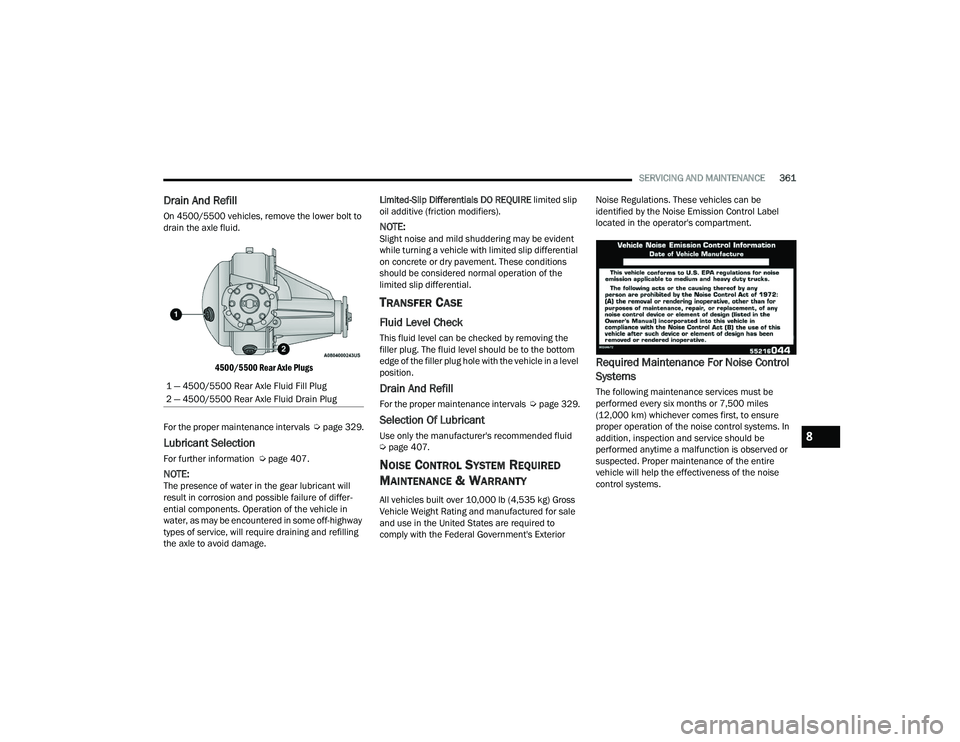
On 4500/5500 vehicles, remove the lower bolt to
drain the axle fluid.
4500/5500 Rear Axle Plugs
For the proper maintenance intervals Úpage 329.
Lubricant Selection
For further information Ú page 407.
NOTE:The presence of water in the gear lubricant will
result in corrosion and possible failure of differ -
ential components. Operation of the vehicle in
water, as may be encountered in some off-highway
types of service, will require draining and refilling
the axle to avoid damage. Limited-Slip Differentials DO REQUIRE
limited slip
oil additive (friction modifiers).
NOTE:Slight noise and mild shuddering may be evident
while turning a vehicle with limited slip differential
on concrete or dry pavement. These conditions
should be considered normal operation of the
limited slip differential.
TRANSFER CASE
Fluid Level Check
This fluid level can be checked by removing the
filler plug. The fluid level should be to the bottom
edge of the filler plug hole with the vehicle in a level
position.
Drain And Refill
For the proper maintenance intervals Úpage 329.
Selection Of Lubricant
Use only the manufacturer's recommended fluid
Úpage 407.
NOISE CONTROL SYSTEM REQUIRED
M
AINTENANCE & WARRANTY
All vehicles built over 10,000 lb (4,535 kg) Gross
Vehicle Weight Rating and manufactured for sale
and use in the United States are required to
comply with the Federal Government's Exterior Noise Regulations. These vehicles can be
identified by the Noise Emission Control Label
located in the operator's compartment.
Required Maintenance For Noise Control
Systems
The following maintenance services must be
performed every six months or 7,500 miles
(12,000 km) whichever comes first, to ensure
proper operation of the noise control systems. In
addition, inspection and service should be
performed anytime a malfunction is observed or
suspected. Proper maintenance of the entire
vehicle will help the effectiveness of the noise
control systems.
1 — 4500/5500 Rear Axle Fluid Fill Plug
2 — 4500/5500 Rear Axle Fluid Drain Plug
8
22_DPF_OM_EN_USC_t.book Page 361
Page 370 of 428

368SERVICING AND MAINTENANCE
F43 –15 Amp Blue Heated Strng Wheel *
F44 –10 Amp Red Diagnostic Port
F45 ––Spare
F46 –10 Amp Red Upfitters Relay Coils *
F47 ––Spare
F48 ––Spare
F49 –10 Amp Red IP Cluster / CSG
F50 –20 Amp Yellow Air Suspension Mod *
F51 –10 Amp Red IGN Mod / KIN Mod/ RF Hub
F52 –5 Amp Tan Batt Snsr
F53 –20 Amp Yellow Trlr Tow – Lt Turn/Stop
F54 –20 Amp Yellow Non-Memory Adjustable Pedals *
F55 ––Spare
F56 –10 Amp Red Fuel Vapor Blocking Valve (VBV) *
F57 –20 Amp Yellow TCM / PCM / Trans PRSR SW
F58 –10 Amp Red Bed Lighting
F59 ––Spare
F60 ––Spare
F61 –10 Amp Red NH3 Sensor / PM Sensor *
F62 –10 Amp Red A/C Clutch
CavityCartridge Fuse Micro Fuse Description
* If Equipped
22_DPF_OM_EN_USC_t.book Page 368
Page 371 of 428

SERVICING AND MAINTENANCE369
F63 –20 Amp Yellow Ignition Coils / CAPS
F64 –25 Amp Clear Fuel Injectors
F65 ––Spare
F66 –10 Amp RedSunroof / USB Rear * / Inside Rearview Mirror / Passenger
Window SW
F67 –10 Amp Red
UCI Port / USB Front / Trailer Gateway Module (360 Camera) /
Tachograph
F68 –10 Amp Red AEB RACAM HTR *
F69 –15 Amp Blue SCR Mod 12 Volt *
F70 –30 Amp Green Fuel Pump Mtr/ Fuel Htr RLY
F71 –25 Amp Clear Amp / Act Noise Cnsl
F72 ––Spare
F73 –20 Amp Yellow Fuel Transfer Pump *
F74 –10 Amp Red Backup Alarm
F75 –10 Amp Red SCR RLY / ATMM*
F76 –10 Amp Red Electronic Stability Control (ESC) *
F77 –10 Amp Red DTCM / TCM / FAD MOD / STOM
F78 –15 Amp Blue ECM / PCM / IRCM / AUX PDC Relay Coil Feed / HRLS
F79 –15 Amp Blue ID / Clearance Lt
F80 –10 Amp Red Ovrdh Con / Assist / 911
F81 –20 Amp Yellow Trlr tow Rt turn/Stop
Cavity Cartridge Fuse Micro Fuse Description
* If Equipped
8
22_DPF_OM_EN_USC_t.book Page 369
Page 375 of 428
SERVICING AND MAINTENANCE373
Replacing Exterior Bulbs
BASE QUAD: LOW BEAM HEADLAMP, HIGH
BEAM HEADLAMP, FRONT PARK AND TURN —
IF EQUIPPED
Low Beam
See below steps to replace:
1. Open the hood.
2. Disconnect and isolate the negative battery
cable.
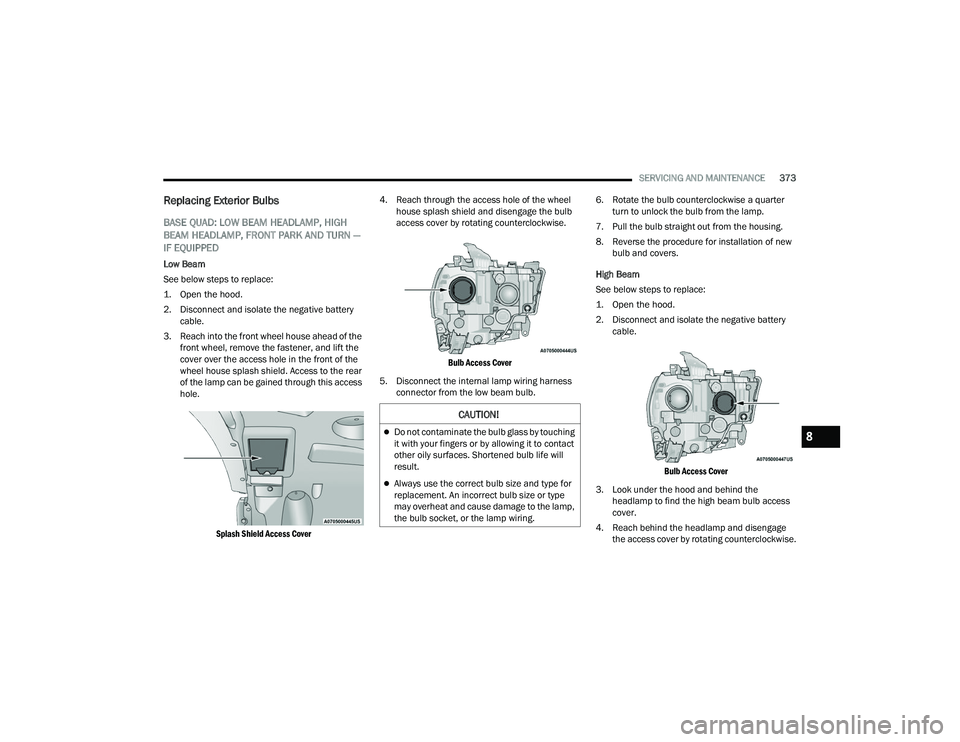
3. Reach into the front wheel house ahead of the front wheel, remove the fastener, and lift the
cover over the access hole in the front of the
wheel house splash shield. Access to the rear
of the lamp can be gained through this access
hole.
Splash Shield Access Cover
4. Reach through the access hole of the wheel
house splash shield and disengage the bulb
access cover by rotating counterclockwise.
Bulb Access Cover
5. Disconnect the internal lamp wiring harness connector from the low beam bulb. 6. Rotate the bulb counterclockwise a quarter
turn to unlock the bulb from the lamp.
7. Pull the bulb straight out from the housing.
8. Reverse the procedure for installation of new bulb and covers.
High Beam
See below steps to replace:
1. Open the hood.
2. Disconnect and isolate the negative battery cable.
Bulb Access Cover
3. Look under the hood and behind the headlamp to find the high beam bulb access
cover.
4. Reach behind the headlamp and disengage the access cover by rotating counterclockwise.
CAUTION!
Do not contaminate the bulb glass by touching
it with your fingers or by allowing it to contact
other oily surfaces. Shortened bulb life will
result.
Always use the correct bulb size and type for
replacement. An incorrect bulb size or type
may overheat and cause damage to the lamp,
the bulb socket, or the lamp wiring.
8
22_DPF_OM_EN_USC_t.book Page 373
Page 376 of 428
374SERVICING AND MAINTENANCE
5. Disconnect the internal lamp wiring harness connector from the high beam bulb.
6. Rotate the bulb counterclockwise a quarter turn to unlock the bulb from the lamp.
7. Pull the bulb straight out from the housing.
8. Reverse the procedure for installation of new bulb and covers.
Outer Park And Turn
See below steps to replace:
1. Open the hood.
2. Disconnect and isolate the negative battery cable.
3. Reach into the front wheel house ahead of the front wheel, remove the fastener, and lift the
cover over the access hole in the front of the
wheel house splash shield. Access to the rear of the lamp can be gained through this access
hole.
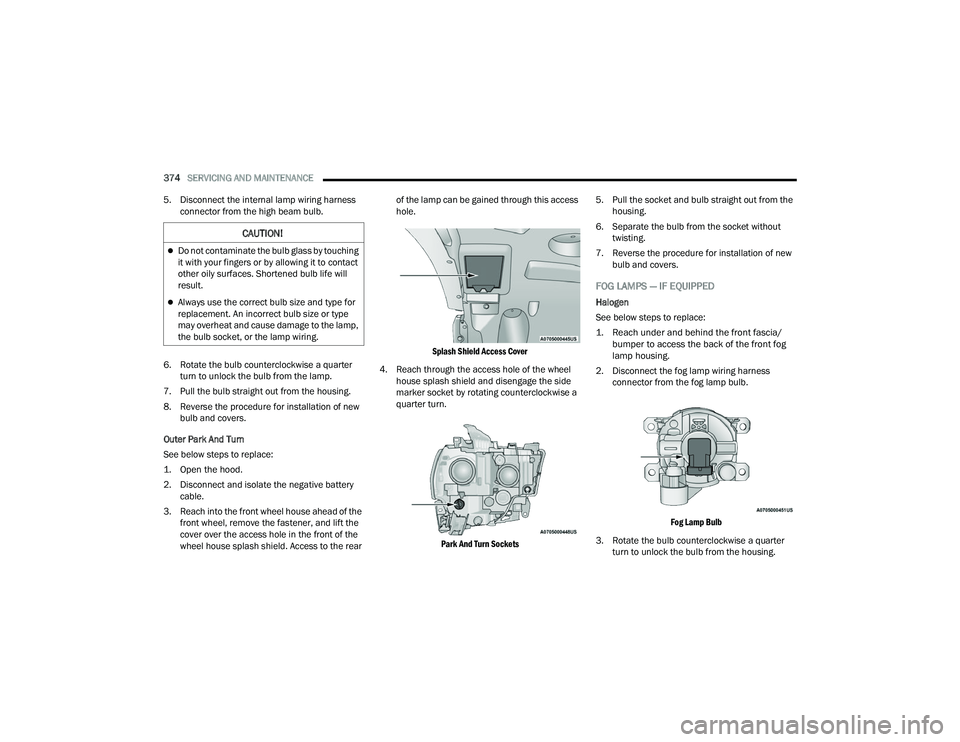
Splash Shield Access Cover
4. Reach through the access hole of the wheel house splash shield and disengage the side
marker socket by rotating counterclockwise a
quarter turn.
Park And Turn Sockets
5. Pull the socket and bulb straight out from the
housing.
6. Separate the bulb from the socket without twisting.
7. Reverse the procedure for installation of new bulb and covers.
FOG LAMPS — IF EQUIPPED
Halogen
See below steps to replace:
1. Reach under and behind the front fascia/bumper to access the back of the front fog
lamp housing.
2. Disconnect the fog lamp wiring harness connector from the fog lamp bulb.
Fog Lamp Bulb
3. Rotate the bulb counterclockwise a quarter turn to unlock the bulb from the housing.
CAUTION!
Do not contaminate the bulb glass by touching
it with your fingers or by allowing it to contact
other oily surfaces. Shortened bulb life will
result.
Always use the correct bulb size and type for
replacement. An incorrect bulb size or type
may overheat and cause damage to the lamp,
the bulb socket, or the lamp wiring.
22_DPF_OM_EN_USC_t.book Page 374
Page 377 of 428
SERVICING AND MAINTENANCE375
4. Pull the bulb straight out from the housing.
5. Reverse the procedure to install the bulb and cover.
CENTER HIGH MOUNTED STOP LAMP (CHMSL)
WITH CARGO LAMP
See below steps to replace:
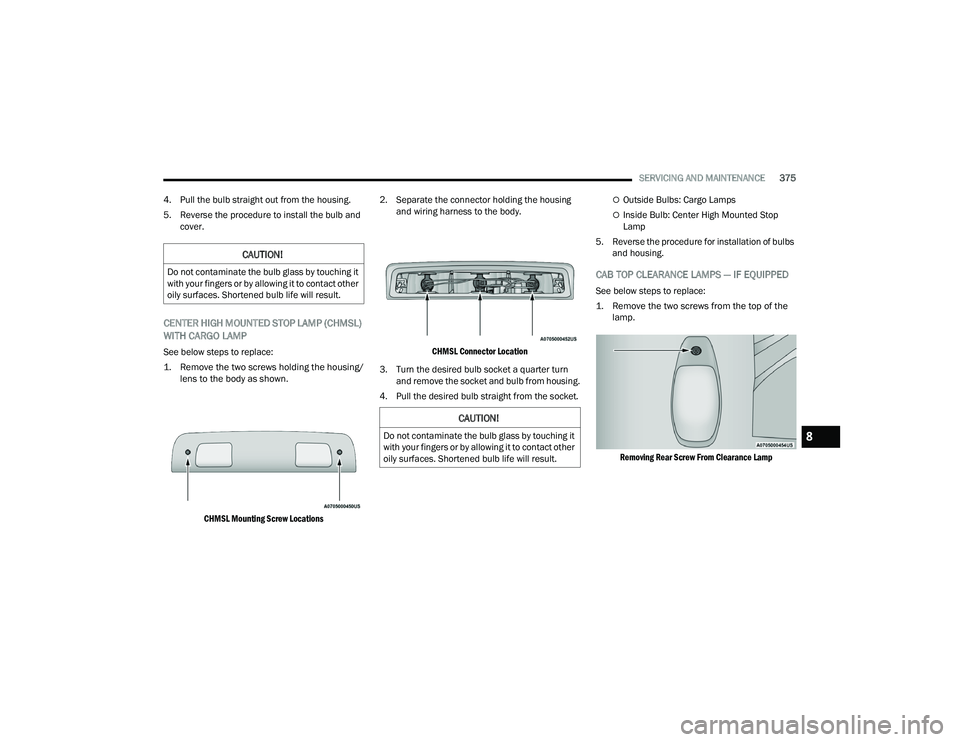
1. Remove the two screws holding the housing/lens to the body as shown.
CHMSL Mounting Screw Locations
2. Separate the connector holding the housing
and wiring harness to the body.
CHMSL Connector Location
3. Turn the desired bulb socket a quarter turn and remove the socket and bulb from housing.
4. Pull the desired bulb straight from the socket.
Outside Bulbs: Cargo Lamps
Inside Bulb: Center High Mounted Stop
Lamp
5. Reverse the procedure for installation of bulbs and housing.
CAB TOP CLEARANCE LAMPS — IF EQUIPPED
See below steps to replace:
1. Remove the two screws from the top of the lamp.
Removing Rear Screw From Clearance Lamp
CAUTION!
Do not contaminate the bulb glass by touching it
with your fingers or by allowing it to contact other
oily surfaces. Shortened bulb life will result.
CAUTION!
Do not contaminate the bulb glass by touching it
with your fingers or by allowing it to contact other
oily surfaces. Shortened bulb life will result.8
22_DPF_OM_EN_USC_t.book Page 375
Page 388 of 428
386SERVICING AND MAINTENANCE
Keep dismounted tires in a cool, dry place with as
little exposure to light as possible. Protect tires
from contact with oil, grease, and gasoline.
Replacement Tires
The tires on your new vehicle provide a balance of
many characteristics. They should be inspected
regularly for wear and correct cold tire inflation
pressures. The manufacturer strongly
recommends that you use tires equivalent to the
originals in size, quality and performance when
replacement is needed Ú page 385. Refer to the
Tire and Loading Information placard or the
Vehicle Certification Label for the size designation
of your tire. The Load Index and Speed Symbol for
your tire will be found on the original equipment
tire sidewall.
For more information relating to the Load Index
and Speed Symbol of a tire Ú page 376.
It is recommended to replace the two front tires or
two rear tires as a pair. Replacing just one tire can
seriously affect your vehicle’s handling. If you ever
replace a wheel, make sure that the wheel’s
specifications match those of the original wheels.
It is recommended you contact an authorized tire
dealer or original equipment dealer with any
questions you may have on tire specifications or
capability. Failure to use equivalent replacement
tires may adversely affect the safety, handling, and
ride of your vehicle.
TIRE TYPES
All Season Tires — If Equipped
All Season tires provide traction for all seasons
(Spring, Summer, Autumn, and Winter). Traction
levels may vary between different all season tires.
All season tires can be identified by the M+S, M&S,
M/S or MS designation on the tire sidewall. Use all
season tires only in sets of four; failure to do so
may adversely affect the safety and handling of
your vehicle.
Summer Or Three Season Tires —
If Equipped
Summer tires provide traction in both wet and dry
conditions, and are not intended to be driven in
snow or on ice. If your vehicle is equipped with
Summer tires, be aware these tires are not
designed for Winter or cold driving conditions.
Install Winter tires on your vehicle when ambient
temperatures are less than 40°F (5°C) or if roads
are covered with ice or snow. For more
information, contact an authorized dealer.
WARNING!
Do not use a tire, wheel size, load rating, or
speed rating other than that specified for your
vehicle. Some combinations of unapproved
tires and wheels may change suspension
dimensions and performance characteristics,
resulting in changes to steering, handling, and
braking of your vehicle. This can cause unpre -
dictable handling and stress to steering and
suspension components. You could lose
control and have a collision resulting in
serious injury or death. Use only the tire and
wheel sizes with load ratings approved for
your vehicle.
Never use a tire with a smaller load index or
capacity, other than what was originally
equipped on your vehicle. Using a tire with a
smaller load index could result in tire over -
loading and failure. You could lose control and
have a collision.
Failure to equip your vehicle with tires having
adequate speed capability can result in
sudden tire failure and loss of vehicle control.
CAUTION!
Replacing original tires with tires of a different
size may result in false speedometer and
odometer readings.
22_DPF_OM_EN_USC_t.book Page 386