water pump RAM CHASSIS CAB 2022 Owners Manual
[x] Cancel search | Manufacturer: RAM, Model Year: 2022, Model line: CHASSIS CAB, Model: RAM CHASSIS CAB 2022Pages: 428, PDF Size: 20.18 MB
Page 172 of 428
170STARTING AND OPERATING
DIESEL EXHAUST FLUID
Your vehicle is equipped with a Selective Catalytic
Reduction (SCR) system to meet the very stringent
diesel emissions standards required by the
Environmental Protection Agency.
The purpose of the SCR system is to reduce levels
of NOx (oxides of nitrogen emitted from engines)
that are harmful to our health and the environment
to a near-zero level. A small quantity of Diesel
Exhaust Fluid (DEF) is injected into the exhaust
upstream of a catalyst where, when vaporized, it
converts smog-forming nitrogen oxides (NOx) into
harmless nitrogen (N2) and water vapor (H2O), two
natural components of the air we breathe. You can
operate with the comfort that your vehicle is
contributing to a cleaner, healthier world
environment for this and generations to come.
System Overview
This vehicle is equipped with a Diesel Exhaust Fluid
(DEF) injection system and a Selective Catalytic
Reduction (SCR) catalyst to meet the emission
requirements.
The DEF injection system consists of the following
components:
DEF tank
DEF pump
DEF injector
Electronically-heated DEF lines
DEF control module
NOx sensors
Temperature sensors
SCR catalyst
UQS Sensor
For system messages and warnings Ú page 81.
NOTE:
Your vehicle is equipped with a DEF injection
system. You may occasionally hear an audible
clicking noise. This is normal operation.
The DEF pump will run for a period of time after
engine shutdown to purge the DEF system. This
is normal operation.
Diesel Exhaust Fluid Storage
Diesel Exhaust Fluid (DEF) is considered a very
stable product with a long shelf life. If DEF is kept
in temperatures between 10° and 90°F (-12° and
32°C), it will last a minimum of one year.
DEF is subject to freezing at the lowest
temperatures. For example, DEF may freeze at
temperatures at or below 12°F (-11°C). The
system has been designed to operate in this
environment.
NOTE:When working with DEF, it is important to know
that:
Any containers or parts that come into contact
with DEF must be DEF compatible (plastic or
stainless steel). Copper, brass, aluminum, iron
or non-stainless steel should be avoided as they
are subject to corrosion by DEF.
If DEF is spilled, it should be wiped up
completely.
Adding Diesel Exhaust Fluid (DEF)
The DEF gauge (located on the instrument cluster)
will display the level of DEF remaining in the tank
Úpage 81.
NOTE:
Driving conditions (altitude, vehicle speed, load,
etc.) will effect the amount of DEF that is used in
your vehicle.
Another factor is that outside temperature can
affect DEF consumption. In cold conditions,
12°F (-11°C) and below, the DEF gauge needle
can stay on a fixed position and may not move
for extended periods of time. This is a normal
function of the system.
There is an electric heater inside the DEF tank
that automatically works when necessary. If the
DEF supply does freeze, the truck will operate
normally until it thaws.
22_DPF_OM_EN_USC_t.book Page 170
Page 173 of 428
STARTING AND OPERATING171
(Continued)
DEF FILL PROCEDURE
NOTE:
For the correct fluid type Ú page 404.
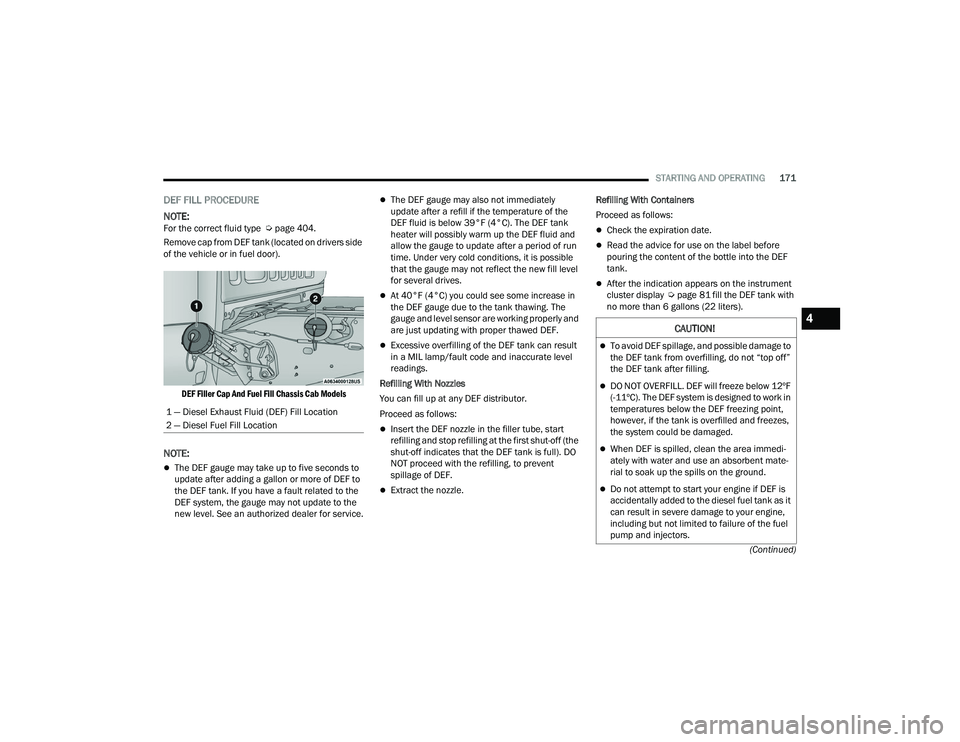
Remove cap from DEF tank (located on drivers side
of the vehicle or in fuel door).
DEF Filler Cap And Fuel Fill Chassis Cab Models
NOTE:
The DEF gauge may take up to five seconds to
update after adding a gallon or more of DEF to
the DEF tank. If you have a fault related to the
DEF system, the gauge may not update to the
new level. See an authorized dealer for service.
The DEF gauge may also not immediately
update after a refill if the temperature of the
DEF fluid is below 39°F (4°C). The DEF tank
heater will possibly warm up the DEF fluid and
allow the gauge to update after a period of run
time. Under very cold conditions, it is possible
that the gauge may not reflect the new fill level
for several drives.
At 40°F (4°C) you could see some increase in
the DEF gauge due to the tank thawing. The
gauge and level sensor are working properly and
are just updating with proper thawed DEF.
Excessive overfilling of the DEF tank can result
in a MIL lamp/fault code and inaccurate level
readings.
Refilling With Nozzles
You can fill up at any DEF distributor.
Proceed as follows:
Insert the DEF nozzle in the filler tube, start
refilling and stop refilling at the first shut-off (the
shut-off indicates that the DEF tank is full). DO
NOT proceed with the refilling, to prevent
spillage of DEF.
Extract the nozzle. Refilling With Containers
Proceed as follows:
Check the expiration date.
Read the advice for use on the label before
pouring the content of the bottle into the DEF
tank.
After the indication appears on the instrument
cluster display
Úpage 81 fill the DEF tank with
no more than 6 gallons (22 liters).
1 — Diesel Exhaust Fluid (DEF) Fill Location
2 — Diesel Fuel Fill Location
CAUTION!
To avoid DEF spillage, and possible damage to
the DEF tank from overfilling, do not “top off”
the DEF tank after filling.
DO NOT OVERFILL. DEF will freeze below 12ºF
(-11ºC). The DEF system is designed to work in
temperatures below the DEF freezing point,
however, if the tank is overfilled and freezes,
the system could be damaged.
When DEF is spilled, clean the area immedi -
ately with water and use an absorbent mate -
rial to soak up the spills on the ground.
Do not attempt to start your engine if DEF is
accidentally added to the diesel fuel tank as it
can result in severe damage to your engine,
including but not limited to failure of the fuel
pump and injectors.
4
22_DPF_OM_EN_USC_t.book Page 171
Page 350 of 428

348SERVICING AND MAINTENANCE
station, or government agency for advice on recy -
cling programs and for where used fluids and
filters can be properly disposed of in your area.
Drain the fuel/water separator filters when the
“Water In Fuel Indicator Light” is ON. Within
10 minutes of vehicle shutdown, turn the engine
mounted filter drain valve (located on the side of
the filter assembly) counterclockwise a quarter
turn, and turn the under body mounted filter drain
valve (located on the bottom of the filter assembly)
counterclockwise 1 full turn. Then turn the ignition
switch to the ON position, and allow any
accumulated water to drain. Leave the drain valve
open until all water and contaminants have been
removed. When clean fuel is visible, close the drain
valve following these guidelines:
1. Rotate the drain clockwise to close until you feel resistance from the internal seal.
2. Continue turning the drain half of a turn to properly compress the seal.
NOTE:Over-compression of the seal due to overtightening
of the drain will damage the seal, cause a leak, and
require the entire sensor to be replaced.
3. Turn the ignition switch to OFF. The sensor drain should not be overtightened
during normal service operations to avoid internal
damage and future fuel leaks. The drain should be
closed and secured without the use of tools.
If more than a couple ounces/milliliters of fuel
have been drained, follow the directions
Ú
page 350
ENGINE MOUNTED FUEL FILTER
R
EPLACEMENT
NOTE:
Using a fuel filter that does not meet the manu -
facturer's filtration and water separating
requirements can severely impact fuel system
life and reliability.
The engine mounted filter housing is equipped
with a No-Filter-No-Run (NFNR) feature. Engine
will not run if:
No filter is installed.
Inferior/Non-approved filter is used. Use of
OEM filter is required to ensure vehicle will
run.
Engine Mounted Fuel Filter Assembly
1 — Drain Valve
CAUTION!
Diesel fuel will damage blacktop paving
surfaces. Drain the filter into an appropriate
container.
Do not prefill the fuel filter when installing a
new fuel filter. There is a possibility debris
could be introduced into the fuel filter during
this action. It is best to install the filter dry and
allow the in-tank lift pump to prime the fuel
system.
22_DPF_OM_EN_USC_t.book Page 348
Page 351 of 428

SERVICING AND MAINTENANCE349
1. Ensure engine is turned off.
2. Place drain pan under the fuel filter drain hose.
3. Open the water drain valve a quarter turn counterclockwise and completely drain fuel
and water into the approved container.
4. Close the water drain valve.
5. Remove lid using a socket or strap wrench. Rotate counterclockwise for removal. Remove
used o-ring and discard it.
6. Remove the used filter cartridge from the housing and dispose of according to your local
regulations.
7. Wipe clean the sealing surfaces of the lid and housing.
8. Install new o-ring back into ring groove on the filter housing and lubricate with clean engine
oil.
9. Remove new filter cartridge from plastic bag and install into housing.
NOTE:Do not remove cartridge from bag until you reach
this step in order to keep cartridge clean.
10. Push down on the cartridge to ensure it is properly seated. Do not pre-fill the filter
housing with fuel. 11. Install lid onto housing and tighten to 22.5 ft lb
(30.5 N.m). Do not overtighten the lid.
12. Prime the engine, then start the engine and confirm there are no leaks Ú page 350.
UNDERBODY MOUNTED FUEL FILTER
R
EPLACEMENT
NOTE:
Using a fuel filter that does not meet the manu -
facturer's filtration and water separating
requirements can severely impact fuel system
life and reliability.
The underbody mounted filter housing will
cause the engine not to run if:
a. No filter is installed.
Underbody Mounted Fuel Filter Assembly
1. Ensure engine is turned off.
2. Place drain pan under the fuel filter drain hose.
3. Open the water drain valve one full turn
counterclockwise and completely drain fuel
and water into the approved container.
4. Close the water drain valve.
5. Remove lid using a socket or strap wrench. Rotate counterclockwise for removal. Remove
used o-ring and discard it.
6. Remove the used filter cartridge from the housing and dispose of according to your local
regulations.
7. Wipe clean the sealing surfaces of the lid and housing.
1 — Drain Valve
CAUTION!
Diesel fuel will damage blacktop paving
surfaces. Drain the filter into an appropriate
container.
Do not prefill the fuel filter when installing a
new fuel filter. There is a possibility debris
could be introduced into the fuel filter during
this action. It is best to install the filter dry and
allow the in-tank lift pump to prime the fuel
system.
8
22_DPF_OM_EN_USC_t.book Page 349
Page 352 of 428

350SERVICING AND MAINTENANCE
8. Install new o-ring back into ring groove on the filter housing and lubricate with clean engine
oil.
NOTE:Water In Fuel (WIF) sensor is re-usable. Service kit
comes with new o-ring for filter canister and WIF
sensor.
PRIMING IF THE ENGINE HAS RUN OUT
O
F FUEL
1. Add a substantial amount of fuel to the tank,
approximately 2 to 5 gal (8L to 19L).
2. Three priming cycles must be completed. Turn ignition to the RUN position and wait approxi -
mately 30 seconds. This will activate the in tank
fuel pump. Turn the ignition switch to the off
position, and leave off for at least 30 seconds.
Repeat this procedure three times before
cranking the engine.
3. Start the engine using the “Normal Starting”
procedure Ú page 108.
4. Once the engine starts, allow the engine to idle for a minimum of 30 seconds.
NOTE:The engine may run rough until the air is forced
from all the fuel lines.
NOTE:
A maximum blend of 5% biodiesel, meeting
ASTM specification D-975 may be used with
your Cummins® diesel engine.
A maximum blend of 20% biodiesel, meeting
ASTM specification D-7467 may be used with
your Cummins® diesel engine.
Use of biodiesel mixture in excess of 20% can
negatively impact the fuel filter's ability to sepa -
rate water from the fuel, resulting in high pres -
sure fuel system corrosion or damage.
Ethanol blends are not recommended or
approved for use with your Cummins® diesel
engine.
In addition, commercially available fuel addi -
tives are not necessary for the proper operation
of your Cummins® diesel engine.
INTERVENTION REGENERATION
S
TRATEGY — MESSAGE PROCESS FLOW
The Cummins® diesel engine meets all
Environmental Protection Agency (EPA) Heavy Duty
Diesel Engine Emissions Standards, resulting in
one of the lowest emitting diesel engines ever
produced.
To achieve these emissions standards, your
vehicle is equipped with a state-of-the-art engine
and exhaust system. The engine and exhaust
after-treatment system work together to achieve
WARNING!
Do not open the high pressure fuel system with
the engine running. Engine operation causes
high fuel pressure. High pressure fuel spray can
cause serious injury or death.
CAUTION!
Do not engage the starter motor for more than
15 seconds at a time. Allow two minutes
between the cranking intervals.
WARNING!
Do not use alcohol or gasoline as a fuel blending
agent. They can be unstable under certain
conditions and be hazardous or explosive when
mixed with diesel fuel.
CAUTION!
Due to lack of lubricants in alcohol or gasoline,
the use of these fuels can cause damage to the
fuel system.
22_DPF_OM_EN_USC_t.book Page 350