spare tire RAM CHASSIS CAB 2023 User Guide
[x] Cancel search | Manufacturer: RAM, Model Year: 2023, Model line: CHASSIS CAB, Model: RAM CHASSIS CAB 2023Pages: 444, PDF Size: 20.51 MB
Page 334 of 444

332IN CASE OF EMERGENCY
Dual Rear Wheels
Slots in the wheels will assist in properly orienting
the inner and outer wheels. Align these slots when
assembling the wheels for best access to the tire
valve on the inner wheel. The tires of both dual
wheels must be completely off the ground when
tightening to ensure wheel centering and
maximum wheel clamping.
Dual wheel models require a special heavy-duty lug
nut tightening adapter (included with the vehicle)
to correctly tighten the lug nuts. Also, when it is
necessary to remove and install dual rear wheels,
use a proper vehicle lifting device.
NOTE:When installing a spare tire (if equipped) as part of
a dual rear wheel end combination, the tire
diameter of the two individual tires must be
compared. If there is a significant difference, the
larger tire should be installed in a front location.
The correct direction of rotation for dual tire instal -
lations must also be observed.
It is recommended that wheel stud nuts be kept
torqued to specifications at all times. Torque wheel
stud nuts to specifications at each lubrication
interval Ú page 411.
Wheel Nuts
All wheel nuts should be tightened occasionally to
eliminate the possibility of wheel studs being
sheared or the bolt holes in the wheels becoming elongated. This is especially important during the
first few hundred miles/kilometers of operation to
allow the wheel nuts to become properly set. All
wheel nuts should first be firmly seated against the
wheel. The wheel nuts should then be tightened to
recommended torque. Tighten the wheel nuts to
final torque in increments. Progress around the
bolt circle, tightening the wheel nut opposite to the
wheel nut just previously tightened until final
torque is achieved Ú
page 411.
TO STOW THE FLAT OR SPARE —
I
F EQUIPPED
Refer to Upfitters Body Builder’s Guide for
information on stowing your spare tire (if
equipped).
HUB CAPS/WHEEL COVERS —
I
F EQUIPPED
The hub caps must be removed before raising the
vehicle off the ground. For 3500 Single Rear-Wheel (SRW) models, use
the flat end of the lug wrench to hook and pull off
the hub cap. Find the opening in the hub cap,
insert the lug wrench, and pull off the cap. If you
need to pry against the wheel, protect the wheel
surface.
Lug Wrench Insertion Location — Hub Cap
On 3500 models with Dual Rear-Wheels (DRW),
you must first remove the hub caps—use the
procedure noted for the single rear wheel. For the
wheel covers (wheel skins), insert the flat end of
the lug wrench between the outer edge of the
wheel cover and the wheel. Pry against the wheel
to remove the wheel cover. Repeat this procedure
around the wheel until the cover pops off.
CAUTION!
Use extreme caution when removing the front
and rear wheel covers. Damage can occur to the
center cap and/or the wheel if screwdriver type
tools are used. A pulling motion, not a pry off
motion, is recommended to remove the caps.
23_DPF_OM_EN_USC_t.book Page 332
Page 391 of 444
SERVICING AND MAINTENANCE389
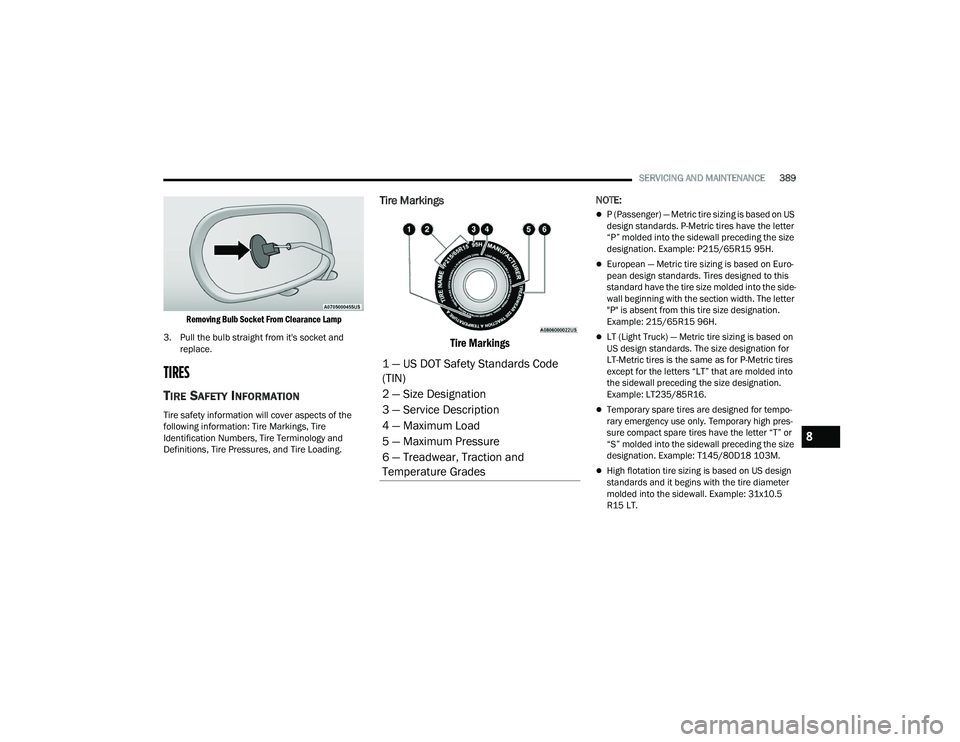
Removing Bulb Socket From Clearance Lamp
3. Pull the bulb straight from it's socket and replace.
TIRES
TIRE SAFETY INFORMATION
Tire safety information will cover aspects of the
following information: Tire Markings, Tire
Identification Numbers, Tire Terminology and
Definitions, Tire Pressures, and Tire Loading.
Tire Markings
Tire Markings
NOTE:
P (Passenger) — Metric tire sizing is based on US
design standards. P-Metric tires have the letter
“P” molded into the sidewall preceding the size
designation. Example: P215/65R15 95H.
European — Metric tire sizing is based on Euro -
pean design standards. Tires designed to this
standard have the tire size molded into the side -
wall beginning with the section width. The letter
"P" is absent from this tire size designation.
Example: 215/65R15 96H.
LT (Light Truck) — Metric tire sizing is based on
US design standards. The size designation for
LT-Metric tires is the same as for P-Metric tires
except for the letters “LT” that are molded into
the sidewall preceding the size designation.
Example: LT235/85R16.
Temporary spare tires are designed for tempo -
rary emergency use only. Temporary high pres -
sure compact spare tires have the letter “T” or
“S” molded into the sidewall preceding the size
designation. Example: T145/80D18 103M.
High flotation tire sizing is based on US design
standards and it begins with the tire diameter
molded into the sidewall. Example: 31x10.5
R15 LT.
1 — US DOT Safety Standards Code
(TIN)
2 — Size Designation
3 — Service Description
4 — Maximum Load
5 — Maximum Pressure
6 — Treadwear, Traction and
Temperature Grades
8
23_DPF_OM_EN_USC_t.book Page 389
Page 392 of 444
390SERVICING AND MAINTENANCE
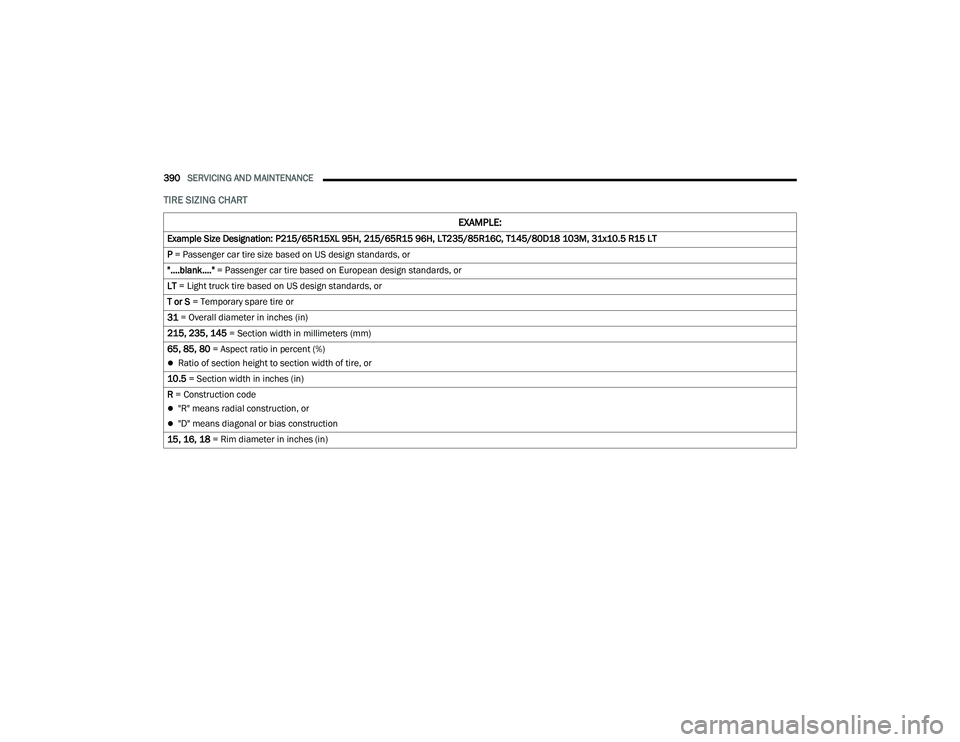
TIRE SIZING CHART
EXAMPLE:
Example Size Designation: P215/65R15XL 95H, 215/65R15 96H, LT235/85R16C, T145/80D18 103M, 31x10.5 R15 LT
P = Passenger car tire size based on US design standards, or
"....blank...." = Passenger car tire based on European design standards, or
LT = Light truck tire based on US design standards, or
T or S = Temporary spare tire or
31 = Overall diameter in inches (in)
215, 235, 145 = Section width in millimeters (mm)
65, 85, 80 = Aspect ratio in percent (%)
Ratio of section height to section width of tire, or
10.5 = Section width in inches (in)
R = Construction code
"R" means radial construction, or
"D" means diagonal or bias construction
15, 16, 18 = Rim diameter in inches (in)
23_DPF_OM_EN_USC_t.book Page 390
Page 396 of 444

394SERVICING AND MAINTENANCE
Tire Loading And Tire Pressure
NOTE:The proper cold tire inflation pressure is listed on
the driver’s side B-pillar or the rear edge of the
driver's side door.
Check the inflation pressure of each tire, including
the spare tire (if equipped), at least monthly and
inflate to the recommended pressure for your
vehicle.
Example Tire Placard Location (Door) Example Tire Placard Location (B-pillar)
Tire And Loading Information Placard
Tire And Loading Information Placard
This placard tells you important information about
the:
1. Number of people that can be carried in the
vehicle.
2. Total weight your vehicle can carry.
3. Tire size designed for your vehicle.
4. Cold tire inflation pressures for the front, rear, and spare tires.
Loading
The vehicle maximum load on the tire must not
exceed the load carrying capacity of the tire on your
vehicle. You will not exceed the tire's load carrying
capacity if you adhere to the loading conditions,
tire size, and cold tire inflation pressures specified
on the Tire And Loading Information Placard
Úpage 180.
NOTE:Under a maximum loaded vehicle condition, gross
axle weight ratings (GAWR) for the front and rear
axles must not be exceeded.
For further information on GAWR, vehicle loading,
and trailer towing Ú page 180.
23_DPF_OM_EN_USC_t.book Page 394
Page 401 of 444

SERVICING AND MAINTENANCE399
Run Flat Tires — If Equipped
Run Flat tires allow you the capability to drive
50 miles (80 km) at 50 mph (80 km/h) after a
rapid loss of inflation pressure. This rapid loss of
inflation is referred to as the Run Flat mode. A Run
Flat mode occurs when the tire inflation pressure is
of/or below 14 psi (96 kPa). Once a Run Flat tire
reaches the Run Flat mode it has limited driving
capabilities and needs to be replaced immediately.
A Run Flat tire is not repairable. When a Run Flat
tire is changed after being driven under a Run Flat
mode 14 psi (96 kPa) condition, please replace the
TPMS sensor as it is not designed to be reused.
NOTE:TPMS sensor must be replaced after driving the
vehicle on a flat tire condition.
It is not recommended driving a vehicle loaded at
full capacity or to tow a trailer while a tire is in the
Run Flat mode.
See the Tire Pressure Monitoring System section
for more information.
Tire Spinning
When stuck in mud, sand, snow, or ice conditions,
do not spin your vehicle's wheels above 30 mph
(48 km/h) or for longer than 30 seconds
continuously without stopping.
Tread Wear Indicators
Tread wear indicators are in the original equipment
tires to help you in determining when your tires
should be replaced.
Tire Tread
These indicators are molded into the bottom of the
tread grooves. They will appear as bands when the
tread depth becomes 1/16 of an inch (1.6 mm).
When the tread is worn to the tread wear
indicators, the tire should be replaced.
Life Of Tire
The service life of a tire is dependent upon varying
factors including, but not limited to:
Driving style.
Tire pressure - Improper cold tire inflation pres
-
sures can cause uneven wear patterns to
develop across the tire tread. These abnormal
wear patterns will reduce tread life, resulting in
the need for earlier tire replacement.
Distance driven.
Performance tires, tires with a speed rating of V
or higher, and Summer tires typically have a
reduced tread life. Rotation of these tires per
the vehicle scheduled maintenance is highly
recommended.
WARNING!
Fast spinning tires can be dangerous. Forces
generated by excessive wheel speeds may
cause tire damage or failure. A tire could
explode and injure someone. Do not spin your
vehicle's wheels faster than 30 mph (48 km/h)
for more than 30 seconds continuously when
you are stuck, and do not let anyone near a
spinning wheel, no matter what the speed.
1 — Tread Wear Indicators
WARNING!
Tires and the spare tire should be replaced after
six years, regardless of the remaining tread.
Failure to follow this warning can result in
sudden tire failure. You could lose control and
have a collision resulting in serious injury or
death.
8
23_DPF_OM_EN_USC_t.book Page 399
Page 403 of 444

SERVICING AND MAINTENANCE401
Summer tires do not contain the all season
designation or mountain/snowflake symbol on the
tire sidewall. Use Summer tires only in sets of four;
failure to do so may adversely affect the safety and
handling of your vehicle.
Snow Tires
Some areas of the country require the use of snow
tires during the Winter. Snow tires can be identified
by a mountain/snowflake symbol on the tire
sidewall. If you need snow tires, select tires
equivalent in size and type to the original
equipment tires. Use snow tires only in
sets of four; failure to do so may
adversely affect the safety and handling of your
vehicle.
Snow tires generally have lower speed ratings than
what was originally equipped with your vehicle and
should not be operated at sustained speeds over
75 mph (120 km/h). For speeds above 75 mph
(120 km/h) refer to original equipment or an authorized tire dealer for recommended safe
operating speeds, loading and cold tire inflation
pressures.
While studded tires improve performance on ice,
skid and traction capability on wet or dry surfaces
may be poorer than that of non-studded tires.
Some states prohibit studded tires; therefore, local
laws should be checked before using these tire
types.
SPARE TIRES — IF EQUIPPED
For restrictions when towing with a spare tire
designated for temporary emergency use
Ú
page 187.
Spare Tire Matching Original Equipped Tire
And Wheel — If Equipped
Your vehicle may be equipped with a spare tire and
wheel equivalent in look and function to the
original equipment tire and wheel found on the
front or rear axle of your vehicle. This spare tire
may be used in the tire rotation for your vehicle. If your vehicle has this option, refer to an authorized
tire dealer for the recommended tire rotation
pattern.
Compact Spare Tire — If Equipped
The compact spare is for temporary emergency
use only. You can identify if your vehicle is
equipped with a compact spare by looking at the
spare tire description on the Tire And Loading
Information Placard located on the driver’s side
door opening or on the sidewall of the tire.
Compact spare tire descriptions begin with the
letter “T” or “S” preceding the size designation.
Example: T145/80D18 103M.
T, S = Temporary Spare Tire
Since this tire has limited tread life, the original
equipment tire should be repaired (or replaced)
and reinstalled on your vehicle at the first
opportunity.
Do not install a wheel cover or attempt to mount a
conventional tire on the compact spare wheel,
since the wheel is designed specifically for the
compact spare tire. Do not install more than one
compact spare tire and wheel on the vehicle at any
given time.
WARNING!
Do not use Summer tires in snow/ice conditions.
You could lose vehicle control, resulting in
severe injury or death. Driving too fast for
conditions also creates the possibility of loss of
vehicle control.
CAUTION!
Because of the reduced ground clearance, do
not take your vehicle through an automatic car
wash with a compact or limited use temporary
spare installed. Damage to the vehicle may
result.
8
23_DPF_OM_EN_USC_t.book Page 401
Page 404 of 444

402SERVICING AND MAINTENANCE
Collapsible Spare Tire — If Equipped
The collapsible spare is for temporary emergency
use only. You can identify if your vehicle is
equipped with a collapsible spare by looking at the
spare tire description on the Tire And Loading
Information Placard located on the driver’s side
door opening or on the sidewall of the tire.
Collapsible spare tire description example: 165/
80-17 101P.
Since this tire has limited tread life, the original
equipment tire should be repaired (or replaced)
and reinstalled on your vehicle at the first
opportunity.
Inflate collapsible tire only after the wheel is
properly installed to the vehicle. Inflate the
collapsible tire using the electric air pump before
lowering the vehicle. Do not install a wheel cover or attempt to mount a
conventional tire on the collapsible spare wheel,
since the wheel is designed specifically for the
collapsible spare tire.
Full Size Spare — If Equipped
The full size spare is for temporary emergency use
only. This tire may look like the originally equipped
tire on the front or rear axle of your vehicle, but it is
not. This spare tire may have limited tread life.
When the tread is worn to the tread wear
indicators, the temporary use full size spare tire
needs to be replaced. Since it is not the same as
your original equipment tire, replace (or repair) the
original equipment tire and reinstall on the vehicle
at the first opportunity.
Limited Use Spare — If Equipped
The limited use spare tire is for temporary
emergency use only. This tire is identified by a label
located on the limited use spare wheel. This label
contains the driving limitations for this spare. This
tire may look like the original equipped tire on the
front or rear axle of your vehicle, but it is not.
Installation of this limited use spare tire affects
vehicle handling. Since it is not the same as your
original equipment tire, replace (or repair) the
original equipment tire and reinstall on the vehicle
at the first opportunity.WARNING!
Compact and collapsible spares are for temporary
emergency use only. With these spares, do not
drive more than 50 mph (80 km/h). Temporary
use spares have limited tread life. When the tread
is worn to the tread wear indicators, the
temporary use spare tire needs to be replaced. Be
sure to follow the warnings, which apply to your
spare. Failure to do so could result in spare tire
failure and loss of vehicle control.
WARNING!
Compact and Collapsible spares are for
temporary emergency use only. With these
spares, do not drive more than 50 mph
(80 km/h). Temporary use spares have limited
tread life. When the tread is worn to the tread
wear indicators, the temporary use spare tire
needs to be replaced. Be sure to follow the
warnings, which apply to your spare. Failure to
do so could result in spare tire failure and loss of
vehicle control.
WARNING!
Limited use spares are for emergency use only.
Installation of this limited use spare tire affects
vehicle handling. With this tire, do not drive
more than the speed listed on the limited use
spare wheel. Keep inflated to the cold tire
inflation pressures listed on your Tire And
Loading Information Placard located on the
driver’s side B-pillar or the rear edge of the
driver’s side door. Replace (or repair) the original
equipment tire at the first opportunity and
reinstall it on your vehicle. Failure to do so could
result in loss of vehicle control.
23_DPF_OM_EN_USC_t.book Page 402
Page 407 of 444

SERVICING AND MAINTENANCE405
(Continued)
TIRE ROTATION RECOMMENDATIONS
Tires on the front and rear axles of vehicles
operate at different loads and perform different
steering, driving, and braking functions. For these
reasons, they wear at unequal rates.
These effects can be reduced by timely rotation of
tires. The benefits of rotation are especially
worthwhile with aggressive tread designs such as
those on On/Off Road type tires. Rotation will
increase tread life, help to maintain mud, snow,
and wet traction levels, and contribute to a
smooth, quiet ride. For the proper maintenance intervals
Úpage 344.
More frequent rotation is permissible if desired.
The reasons for any rapid or unusual wear should
be corrected prior to rotation being performed.
Tire Rotation (Rearward Cross)
NOTE:On Canadian vehicles only, if your vehicle is
equipped with All-Season type tires on the front
and On/Off Road type tires mounted on the rear,
do not use a front to back rotation pattern. Instead,
rotate your tires side to side at the recommended
intervals.
WARNING!
Using tires of different size and type (M+S,
Snow) between front and rear axles can cause
unpredictable handling. You could lose control
and have a collision.
CAUTION!
To avoid damage to your vehicle or tires, observe
the following precautions:
Because of restricted traction device clear -
ance between tires and other suspension
components, it is important that only traction
devices in good condition are used. Broken
devices can cause serious damage. Stop the
vehicle immediately if noise occurs that could
indicate device breakage. Remove the
damaged parts of the device before further
use.
Install device as tightly as possible and then
retighten after driving about 0.5 mile
(0.8 km). Autosock devices do not require
retightening.
Do not exceed 30 mph (48 km/h).
Drive cautiously and avoid severe turns and
large bumps, especially with a loaded vehicle.
Do not drive for a prolonged period on dry
pavement.
Observe the traction device manufacturer’s
instructions on the method of installation,
operating speed, and conditions for use.
Always use the suggested operating speed of
the device manufacturer’s if it is less than
30 mph (48 km/h).
Do not use traction devices on a compact
spare tire.
CAUTION!
8
23_DPF_OM_EN_USC_t.book Page 405
Page 408 of 444

406SERVICING AND MAINTENANCE
Dual Rear Wheels
Tire Rotation
The tires used on dual wheel assemblies should be
matched for wear to prevent overloading one tire in
a set. To check if tires are even, lay a straight edge
across all four tires. The straight edge should touch
all the tires.
NOTE:If your vehicle is equipped with a Tire Pressure
Information System (TPIS):
The Tire Pressure Information System (TPIS)
uses unique sensors in the inner rear wheels to
help identify them from the outer rear wheels,
because of this, the inner and outer wheel loca -
tions can’t be switched.
After a tire rotation is completed, as shown
below, the system can auto learn the locations
of each sensor ID. Auto learning/localization occurs when the vehicle ignition status is
changed from Off to On and speeds of greater
than 5 mph (8 km/h) are obtained and remain
over 5 mph (8 km/h) for at about a 15 minute
period. You may need to drive for 20 minutes to
account slower speeds and stops.
If the tires are rotated incorrectly, the Auto local
-
ization of the TPIS sensors will fail to locate
correctly resulting in incorrect locations for the
pressure values displayed in the Instrument
Cluster.
DEPARTMENT OF TRANSPORTATION
UNIFORM TIRE QUALITY GRADES
The following tire grading categories
were established by the National
Highway Traffic Safety Administration.
The specific grade rating assigned by the
tire's manufacturer in each category is
shown on the sidewall of the tires on
your vehicle.
All passenger vehicle tires must conform
to Federal safety requirements in
addition to these grades.
TREADWEAR
The Treadwear grade is a comparative
rating, based on the wear rate of the tire
when tested under controlled conditions
on a specified government test course.
For example, a tire graded 150 would
wear one and one-half times as well on
the government course as a tire graded
100. The relative performance of tires
depends upon the actual conditions of
their use, however, and may depart
CAUTION!
4500/5500 Dual Rear Tires may only have
one approved direction of rotation. This is to
accommodate the asymmetrical design (tread
pattern) of the On/Off road tire.
When replacing a flat, the spare tire may have
to be remounted on the rim or installed at a
different location to maintain the correct
placement of the tire on the wheel relative to
the tire/wheel position on the vehicle. For
example, if the spare is used to replace an
outer rear tire it will have to be remounted on
the rim so that the wheel is dished inward.
That way the tread design of asymmetrical
tires will maintain proper position.
23_DPF_OM_EN_USC_t.book Page 406
Page 425 of 444

CUSTOMER ASSISTANCE423
Who is Covered
You are covered by Roadside Assistance services if
you are a purchaser for use of the vehicle.
Roadside Assistance services last for five years or
60,000 miles on the odometer, whichever occurs
first, calculated from the start date of the Basic
Limited Warranty, as set forth in your Warranty
Information book.
1
1. Towing services provided through Cross Country Motor Club,
Inc. Medford, MA 02155, except in AK,CA, HI, OR, WI, and WY,
where services are provided by Cross Country Motor Club of
California, Inc., Thousand Oaks, CA 91360.
What to Do
If your vehicle requires jump start assistance, out
of gas/fuel delivery, tire service, lockout service or
towing as a result of a mechanical breakdown, dial
toll-free: USA: 1-800-521-2779/Canada:
1-800-363-4869. Provide your name, Vehicle
Identification Number (VIN) required for covered
services, license plate number, and your location,
including the telephone number from which you
are calling. Briefly describe the nature of the
problem and answer a few simple questions. You
will be given the name of the service provider and
an estimated time of arrival. If you feel you are in
an unsafe situation, please let us know. With your
consent, we will contact local police or safety
authorities. If Unable to Contact Roadside Assistance
If you are unable to contact Roadside Assistance or
unable to provide a valid Vehicle Identification
Number (VIN), and you obtain towing services on
your own, you may submit your original receipts
from the licensed towing or service facility, for
services rendered within30 days of the
occurrence. Be sure to include your VIN, odometer
mileage at the time of service, and current mailing
address. We will process the claim based on
vehicle and service eligibility. If eligible, we will
reimburse you for the reasonable amount actually
paid, based on the usual and customary charges
for that service in the area where they were
provided. FCA US LLC’s determination relating to
reimbursement is final. Correspondence should be
mailed to:
FCA US LLC Customer Assistance
P.O. Box 9145
Medford, MA 02155
Attention Claims Department
FCA US LLC reserves the right to modify the terms
or discontinue the Roadside Assistance Program
at any time. The Roadside Assistance program is
subject to restrictions and conditions of use, which
are determined solely by FCA US LLC.
Flat Tire Service
If you are inconvenienced by a flat tire, we will
dispatch a service provider to use your vehicle’s
temporary spare tire (if equipped) as
recommended in your Owner’s Manual. This is not
a permanent flat tire repair.
Out of Gas/Fuel Delivery
Drivers cannot always count on a gas station being
nearby, especially when traveling away from home.
We will dispatch a service provider to deliver a
small amount of fuel (maximum two gallons) to get
you to a nearby station. This service is limited to
two occurrences in a 12-month period.
Battery Jump Assistance
No time is a good time for a depleted battery. With
Roadside Assistance, you do not have to worry
about being stranded. We will dispatch a service
provider to provide you with a battery jump
anytime, day or night.
Lockout Service
Whether the keys are locked in your vehicle or
frozen locks are keeping you from getting on your
way, help is just a phone call away. This service is
limited to providing access to the vehicle’s seating
area. It does not cover the cost of replacement
keys.
10
23_DPF_OM_EN_USC_t.book Page 423