fuel Ram ProMaster 2015 Diesel Supplement
[x] Cancel search | Manufacturer: RAM, Model Year: 2015, Model line: ProMaster, Model: Ram ProMaster 2015Pages: 130, PDF Size: 0.59 MB
Page 40 of 130
Normal Starting Procedure
The shift lever must be in the NEUTRAL (N) position,
and the brake pedal must be pressed, to allow engine
cranking. Place the shift lever in NEUTRAL (N) and
apply the brake pedal BEFORE turning the key to the
START/AVV position; otherwise, the engine will not
crank and the key must be cycled OFF, then back on,
before cranking is allowed.
Observe the instrument panel cluster lights when starting
the engine.
NOTE:Normal starting of either a cold or a warm
engine is obtained without pumping or pressing the
accelerator pedal.
1. Press and hold the brake pedal.
2. Place the shift lever into the NEUTRAL (N) position while keeping the brake pedal depressed. 3. Turn the ignition switch to the ON/RUN/MAR posi-
tion and watch the instrument panel cluster lights.
CAUTION!
If the “Generic Warning Light” remains on and a
“Service Fuel Filter” message displays, DO NOT
START engine before you drain the water from the
fuel filter housing to avoid engine damage. Please
see your authorized dealer for draining the fuel
filter/water separator and fuel filter replacement.
4. After the Glow Plug light turns off, turn the ignition switch to the AVV (START) position to start the engine.
Do not press the accelerator during starting.
5. If you wish to stop the cranking of the engine prior to the engine starting, release the ignition key so that it
turns back to the ON/RUN position.
38 STARTING AND OPERATING
Page 43 of 130
NOTE:The engine and transmission block heater cord is
a factory installed option. If your vehicle is not equipped,
heater cords are available from your authorized
MOPAR® dealer.
• A 12 Volt heater built into the fuel filter housing aids in
preventing fuel gelling. It is controlled by a built-in
thermostat.
• A Diesel Pre-Heat system both improves engine start-
ing and reduces the amount of white smoke generated
by a warming engine.
NORMAL OPERATION
Observe the following when the diesel engine is operat-
ing.
• All message center lights are off.
• Malfunction Indicator Light (MIL) is off.
• Generic Warning Light is off. •
Engine Oil Pressure telltale is not illuminated.
Cold Weather Precautions
Operation in ambient temperature below 32°F (0°C) may
require special considerations. The following charts sug-
gest these options:
Fuel Operating Range
NOTE: Use “Ultra Low Sulfur Diesel Fuels” ONLY.
Fuel Operating Range Chart
5
STARTING AND OPERATING 41
Page 44 of 130
*No. 1 Ultra Low Sulfur Diesel Fuel should only be used
where extended arctic conditions (-10°F/-23°C) exist.
NOTE:
•Use of Climatized Ultra Low Sulfur Diesel Fuel or
Number 1 Ultra Low Sulfur Diesel Fuel results in a
noticeable decrease in fuel economy.
• Climatized Ultra Low Sulfur Diesel Fuel is a blend of
Number 2 Ultra Low Sulfur and Number 1 Ultra Low
Sulfur Diesel Fuels which reduces the temperature at
which wax crystals form in fuel.
• The fuel grade should be clearly marked on the pump
at the fuel station.
• The engine requires the use of “Ultra Low Sulfur
Diesel Fuel”. Use of incorrect fuel could result in
engine and exhaust system damage. Refer to “Fuel
Requirements” in “Starting And Operating” for fur-
ther information. •
Commercially available fuel additives are not neces-
sary for the proper operation of your diesel engine.
However, if seasonably adjusted fuel is not available
and you are operating below 20°F (-6°C), MOPAR
Premium Diesel Fuel Treatment (or equivalent) may be
beneficial to avoid fuel gelling.
Engine Oil Usage
Refer to “Maintenance Procedures” in “Maintaining Your
Vehicle” for the correct engine oil viscosity.
Engine Warm-Up
Avoid full throttle operation when the engine is cold.
When starting a cold engine, bring the engine up to
operating speed slowly to allow the oil pressure to
stabilize as the engine warms up.
If temperatures are below 32°F (0°C), operate the engine
at moderate speeds for five minutes before full loads are
applied.
42 STARTING AND OPERATING
Page 45 of 130
Engine Idling
Avoid prolonged idling, long periods of idling may be
harmful to your engine because combustion chamber tem-
peratures can drop so low that the fuel may not burn
completely. Incomplete combustion allows carbon and var-
nish to form on piston rings, cylinder head valves, and
injector nozzles. Also, the unburned fuel can enter the
crankcase, diluting the oil and causing rapid wear to the
engine.
Stopping The Engine
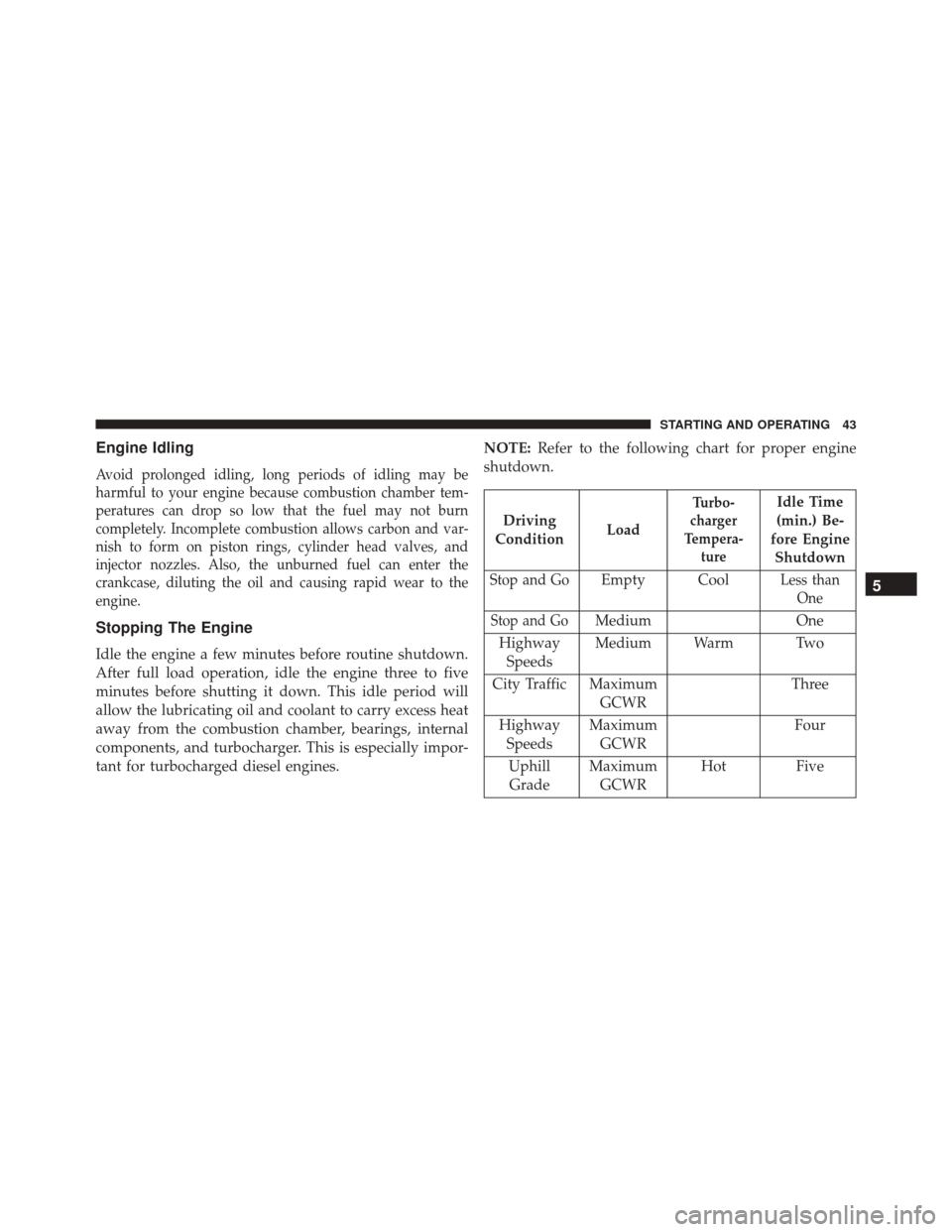
Idle the engine a few minutes before routine shutdown.
After full load operation, idle the engine three to five
minutes before shutting it down. This idle period will
allow the lubricating oil and coolant to carry excess heat
away from the combustion chamber, bearings, internal
components, and turbocharger. This is especially impor-
tant for turbocharged diesel engines.NOTE:
Refer to the following chart for proper engine
shutdown.
Driving
Condition Load
Turbo-
charger
Tempera- tureIdle Time
(min.) Be-
fore Engine Shutdown
Stop and GoEmpty CoolLess than One
Stop and GoMedium One
Highway Speeds Medium Warm Two
City Traffic Maximum GCWR Three
Highway Speeds Maximum
GCWR Four
Uphill Grade Maximum
GCWR Hot Five
5
STARTING AND OPERATING 43
Page 47 of 130
Do Not Operate The Engine With Failed Parts
All engine failures give some warning before the parts
fail. Be on the alert for changes in performance, sounds,
and visual evidence that the engine requires service.
Some important clues are:
•engine misfiring or vibrating severely
• sudden loss of power
• unusual engine noises
• fuel, oil or coolant leaks
• sudden change, outside the normal operating range, in
the engine operating temperature
• excessive smoke
• oil pressure drop
ENGINE BLOCK/TRANSMISSION HEATER — IF
EQUIPPED
To ensure reliable starting/operating at these tempera-
tures, use of an externally powered electric engine block/
transmission heater (available from your authorized
dealer) is recommended.
The engine block heater warms engine coolant and
permits quicker starts in cold weather. The transmission
heaters warm gearbox oil and hydraulic actuation system
oil to operate in cold weather. Connect the heater cord to
a ground-fault interrupter protected 110–115 Volt AC
electrical outlet with a grounded, three-wire extension
cord.
Its use is recommended for environments that routinely
fall below -10°F (-23°C). It should be used when the
vehicle has not been running overnight or longer periods
5
STARTING AND OPERATING 45
Page 62 of 130
Towing The Vehicle
•The manufacturer recommends towing your vehicle
with all four wheels OFFthe ground using a flatbed.
• Automated Manual transmission vehicles can also be
flat towed (all four wheels on the ground) with the
transmission in NEUTRAL. Ensure the transmission is
in NEUTRAL (N) (by checking that the vehicle moves
when pushed) and tow in the same way as a normal
vehicle with a manual transmission.
CAUTION!
• DO NOT flat tow any disabled vehicle if condition
is related to the clutch, transmission or driveline.
Additional damage to the drivetrain could result.
• Towing this vehicle in violation of the above re-
quirements can cause severe engine, transmission,
(Continued)
CAUTION! (Continued)
or drivetrain damage. Damage from improper tow-
ing is not covered under the New Vehicle Limited
Warranty.
If it is not possible to shift the transmission to NEUTRAL
(N), do not flat tow the vehicle and contact your autho-
rized dealer.
FUEL REQUIREMENTS
Use good quality diesel fuel from a reputable supplier in
your vehicle. Federal law requires that you must fuel this
vehicle with Ultra Low Sulfur Highway Diesel fuel
(15 ppm Sulfur maximum) and prohibits the use of Low
Sulfur Highway Diesel fuel (500 ppm Sulfur maximum)
to avoid damage to the emissions control system.
60 STARTING AND OPERATING
Page 63 of 130
For most year-round service, No. 2 diesel fuel meeting
ASTM (formerly known as the American Society for
Testing and Materials) specification D-975 Grade S15 will
provide good performance.
If the vehicle is exposed to extreme cold (below 20°F or
-7°C), or is required to operate at colder-than-normal
conditions for prolonged periods, use climatized No. 2
diesel fuel or dilute the No. 2 diesel fuel with 50% No. 1
diesel fuel. This will provide better protection from fuel
gelling or wax-plugging of the fuel filter.
WARNING!
Do not use alcohol or gasoline as a fuel blending
agent. They can be unstable under certain conditions
and hazardous or explosive when mixed with diesel
fuel.Diesel fuel is seldom completely free of water. If water is
detected in the water separator while the engine is
running or while the ignition switch is in the ON/RUN
position, the “Generic Warning Light” will illuminate
and the specific message, “Service Fuel Filter” will ap-
pear in the Electronic Vehicle Information Center (EVIC).
If this occurs you should stop the engine and drain the
water from the filter housing.
NOTE:
Please see your authorized dealer for draining the
fuel/water separator and fuel filter replacement.
Purchasing good quality fuel and by following the cold
weather advice above, fuel conditioners should not be
required in your vehicle.
NOTE: If available in your area, a high cetane “pre-
mium” diesel fuel may offer improved cold-starting and
warm-up performance.
5
STARTING AND OPERATING 61
Page 64 of 130
CAUTION!
If the “Generic Warning Light” remains on and a
“Service Fuel Filter” message displays, DO NOT
START engine before you drain the water from the
fuel filter housing to avoid engine damage. Please
see your authorized dealer for draining the fuel
filter/water separator and fuel filter replacement.
Fuel Specifications
This diesel engine has been developed to take advantage
of the high energy content and generally lower cost No.
2 Ultra Low Sulfur diesel fuel or No. 2 Ultra Low Sulfur
climatized diesel fuels.NOTE:
•
If you accidentally fill the fuel tank with gasoline on
your diesel vehicle, do not start the engine. Damage to
the engine and fuel system could occur. Please call
your authorized dealer for service.
• A maximum blend of 5% biodiesel meeting ASTM
specification D-975 may be used with your diesel
engine without any adjustments to regular service
schedules.
• Commercially available fuel additives are not neces-
sary for the proper operation of your diesel engine.
• No. 1 Ultra Low Sulfur diesel fuel should only be used
where extended arctic conditions (-10°F or -23°C) exist.
62 STARTING AND OPERATING
Page 65 of 130
Biodiesel Fuel Requirements
A maximum blend of 5% biodiesel meeting ASTM speci-
fication D975 is recommended for use with your diesel
engine. If frequent operation with Biodiesel blends that
are between 6% and 20% (B6–B20) is desired, the main-
tenance schedule is subject to shorter intervals.
The oil and filter change along with fuel filter replace-
ment is subject to shorter intervals when operating your
engine on biodiesel greater than 5%. Do not use biodiesel
greater than 20%.
For regular use of biodiesel blends between 6% and 20%
(B6–B20) it is important that you understand and comply
with these requirements. Refer to the “Maintenance
Chart” in the “Maintenance Schedules” section for fur-
ther direction.
CAUTION!
Failure to comply with Oil Change requirements for
vehicles operating on biodiesel blends between 6%
and 20% (B6–B20) will result in premature engine
wear. Such wear is not covered by the New Vehicle
Limited Warranty.
Biodiesel is a fuel produced from renewable resources
typically derived from animal fat, rapeseed oil (Rapeseed
Methyl Ester (RME) base), or soybean oil (Soy Methyl
Ester (SME or SOME) base).
Biodiesel fuel has inherent limitations which require that
you understand and adhere to the following require-
ments if you use blends of Biodiesel between 6% and 20%
(B6–B20). There are no unique restrictions for the use of
B5.
5
STARTING AND OPERATING 63
Page 66 of 130
CAUTION!
Use of blends greater than 20% is not approved. Use
of blends greater than 20% can result in engine
damage. Such damage is not covered by the New
Vehicle Limited Warranty.
Biodiesel Fuel Properties — Low Ambient
Temperatures
Biodiesel fuel may gel or solidify at low ambient tem-
peratures, which may pose problems for both storage and
operation. Precautions can be necessary at low ambient
temperatures, such as storing the fuel in a heated build-
ing or a heated storage tank, or using cold temperature
additives.
Fuel Quality — Must Comply With ASTM
Standards
The quality of Biodiesel fuel may vary widely. Only fuel
produced by a BQ9000 supplier to the following specifi-
cations may be blended to meet Biodiesel blend B6 – B20
fuel meeting ASTM specification D-7467:
•Petrodiesel fuel meeting ASTM specification D-975
and Biodiesel fuel (B100) meeting ASTM specification
D-6751
Fuel Oxidation Stability — Must Use Fuel Within
Six Months Of Manufacture
Biodiesel fuel has poor oxidation stability which can
result in long term storage problems. Fuel produced to
approved ASTM standards, if stored properly, provides
for protection against fuel oxidation for up to six months.
64 STARTING AND OPERATING