brake Ram ProMaster 2015 Diesel Supplement
[x] Cancel search | Manufacturer: RAM, Model Year: 2015, Model line: ProMaster, Model: Ram ProMaster 2015Pages: 130, PDF Size: 0.59 MB
Page 105 of 130
•Do not change the thermostat for Summer or Winter
operation. If replacement is ever necessary, install
ONLY the correct type thermostat. Other designs may
result in unsatisfactory engine coolant (antifreeze)
performance, poor gas mileage, and increased emis-
sions.
Brake System
Brake Master Cylinder — Brake Fluid Level Check
The fluid level of the master cylinder should be checked
when performing under the hood service, or immedi-
ately if the “Brake System Warning Light” indicates
system failure.
The brake master cylinder has a translucent plastic
reservoir. On the outboard side of the reservoir, there is a
“MAX” mark and a “MIN” mark. The fluid level must be
kept within these two marks. Do not add fluid above the
full mark because leakage may occur at the cap. With disc brakes, the fluid level can be expected to fall as
the brake linings wear. However, an unexpected drop in
fluid level may be caused by a leak and a system check
should be conducted.
Refer to “Fluids, Lubricants, And Genuine Parts” in
“Maintaining Your Vehicle” for further information.
WARNING!
•
Use only manufacturer’s recommended brake
fluid. Refer to “Fluids, Lubricants, and Genuine
Parts” in “Maintaining Your Vehicle” for further
information. Using the wrong type of brake fluid
can severely damage your brake system and/or
impair its performance. The proper type of brake
fluid for your vehicle is also identified on the
original factory installed hydraulic master cylinder
reservoir.
(Continued)
6
MAINTAINING YOUR VEHICLE 103
Page 106 of 130
WARNING!(Continued)
•To avoid contamination from foreign matter or
moisture, use only new brake fluid or fluid that has
been in a tightly closed container. Keep the master
cylinder reservoir cap secured at all times. Brake
fluid in a open container absorbs moisture from the
air resulting in a lower boiling point. This may
cause it to boil unexpectedly during hard or pro-
longed braking, resulting in sudden brake failure.
This could result in a accident.
•
Overfilling the brake fluid reservoir can result in
spilling brake fluid on hot engine parts, causing the
brake fluid to catch fire. Brake fluid can also damage
painted and vinyl surfaces, care should be taken to
avoid its contact with these surfaces.
•Do not allow petroleum based fluid to contaminate
the brake fluid. Brake seal components could be
damaged, causing partial or complete brake failure.
This could result in an accident.
Automated Manual Transmission
Checking Fluid Levels
To check the gear oil and check/replace the hydraulic
clutch operating system fluid, contact only your autho-
rized dealer.
NOTE: Do not add or use leak detection dye in the
hydraulic clutch operating system fluid.
WARNING!
Used gear oil contains substances that are hazardous
for the environment. It is advisable to have oil
changed by your authorized dealer where used oil
will be disposed of according to the law.
104 MAINTAINING YOUR VEHICLE
Page 111 of 130
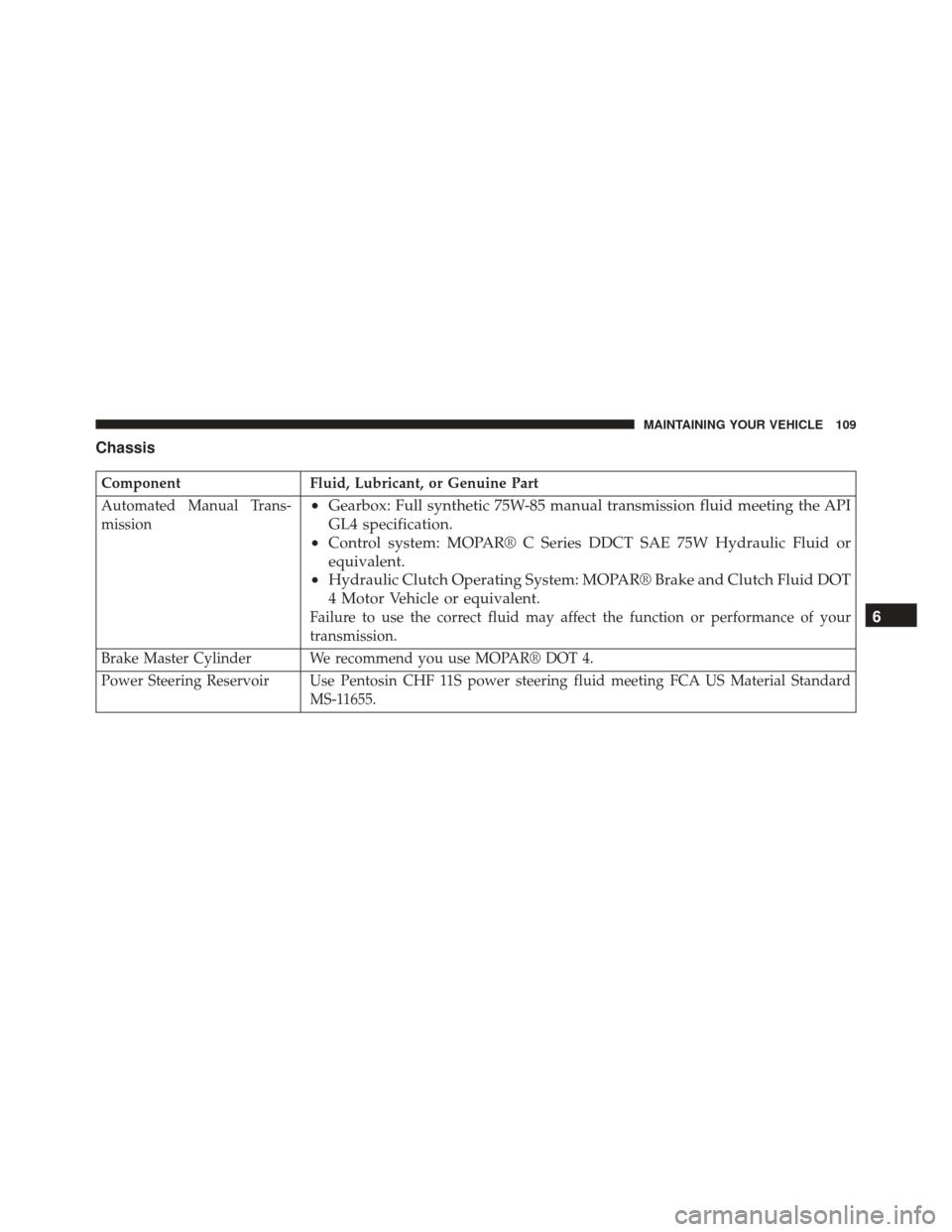
Chassis
ComponentFluid, Lubricant, or Genuine Part
Automated Manual Trans-
mission
• Gearbox: Full synthetic 75W-85 manual transmission fluid meeting the API
GL4 specification.
• Control system: MOPAR® C Series DDCT SAE 75W Hydraulic Fluid or
equivalent.
• Hydraulic Clutch Operating System: MOPAR® Brake and Clutch Fluid DOT
4 Motor Vehicle or equivalent.
Failure to use the correct fluid may affect the function or performance of your
transmission.
Brake Master Cylinder We recommend you use MOPAR® DOT 4.
Power Steering Reservoir Use Pentosin CHF 11S power steering fluid meeting FCA US Material Standard MS-11655.6
MAINTAINING YOUR VEHICLE 109
Page 114 of 130
MAINTENANCE SCHEDULE — DIESEL ENGINE
Your vehicle is equipped with an automatic oil change
indicator system. The oil change indicator system will
remind you that it is time to take your vehicle in for
scheduled maintenance.
Based on engine operation conditions, the oil change
indicator message will illuminate in the instrument clus-
ter. This means that service is required for your vehicle.
Operating conditions such as frequent short-trips, trailer
tow, and extremely hot or cold ambient temperatures will
influence when the “Oil Change Required” message is
displayed. Severe Operating Conditions can cause the
change oil message to illuminate as early as 3,500 miles
(5,600 km) since last reset. Have your vehicle serviced as
soon as possible, within the next 500 miles (805 km).
Your authorized dealer will reset the oil change indicator
message after completing the scheduled oil change. If a
scheduled oil change is performed by someone otherthan your authorized dealer, the message can be reset by
referring to the steps described under “Electronic Vehicle
Information Center (EVIC)” in “Understanding Your
Instrument Panel” for further information.
NOTE:
Under no circumstances should oil change inter-
vals exceed 18,500 miles (29,773 km) or twelve months,
whichever comes first.
Once A Month Or Before A Long Trip:
• Check engine oil level
• Check windshield washer fluid level
• Check the tire inflation pressures and look for unusual
wear or damage
• Check the fluid levels of the coolant reservoir, brake
master cylinder, and power steering and fill as needed
• Check function of all interior and exterior lights
112 MAINTENANCE SCHEDULE
Page 115 of 130
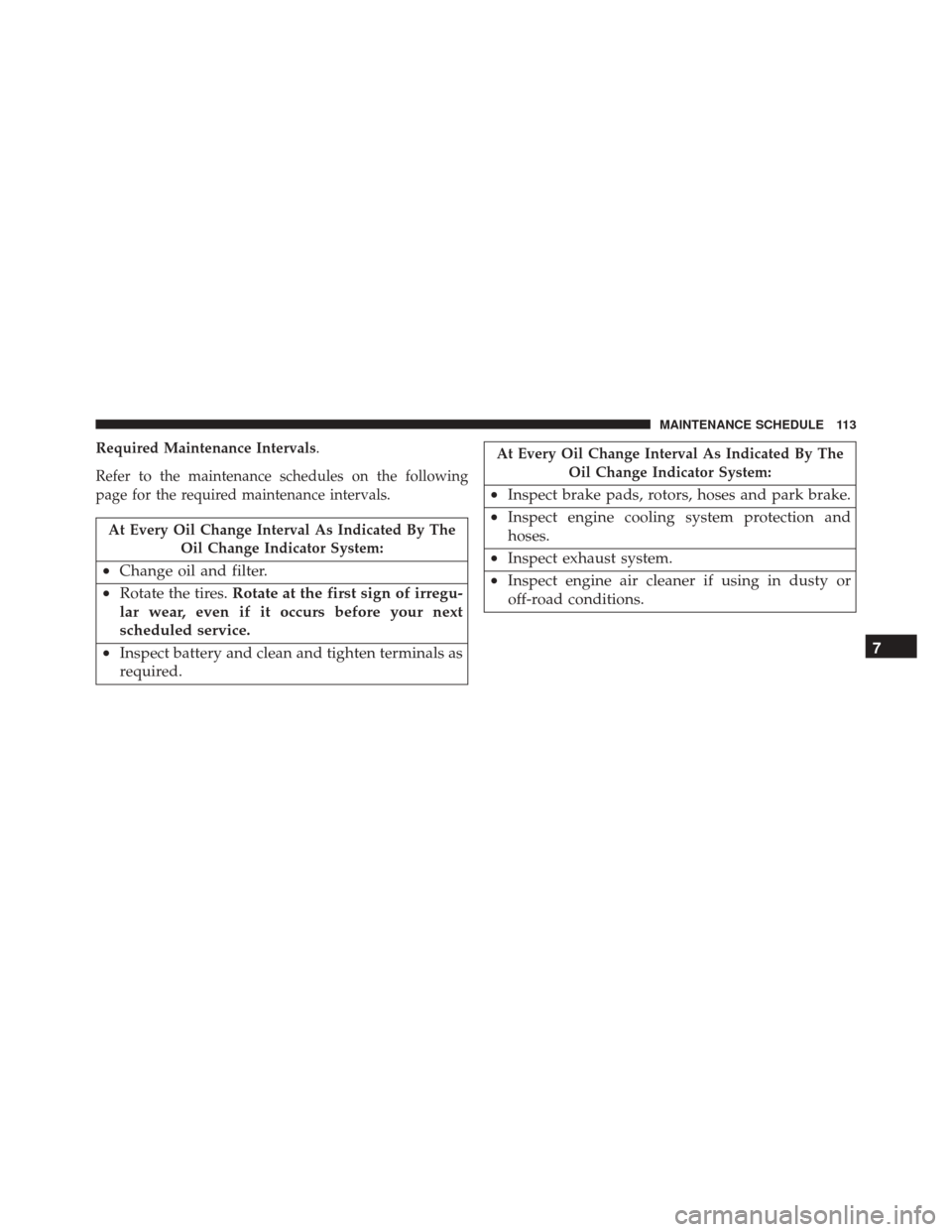
Required Maintenance Intervals.
Refer to the maintenance schedules on the following
page for the required maintenance intervals.
At Every Oil Change Interval As Indicated By TheOil Change Indicator System:
•Change oil and filter.
• Rotate the tires. Rotate at the first sign of irregu-
lar wear, even if it occurs before your next
scheduled service.
• Inspect battery and clean and tighten terminals as
required.
At Every Oil Change Interval As Indicated By The
Oil Change Indicator System:
•Inspect brake pads, rotors, hoses and park brake.
• Inspect engine cooling system protection and
hoses.
• Inspect exhaust system.
• Inspect engine air cleaner if using in dusty or
off-road conditions.
7
MAINTENANCE SCHEDULE 113
Page 116 of 130
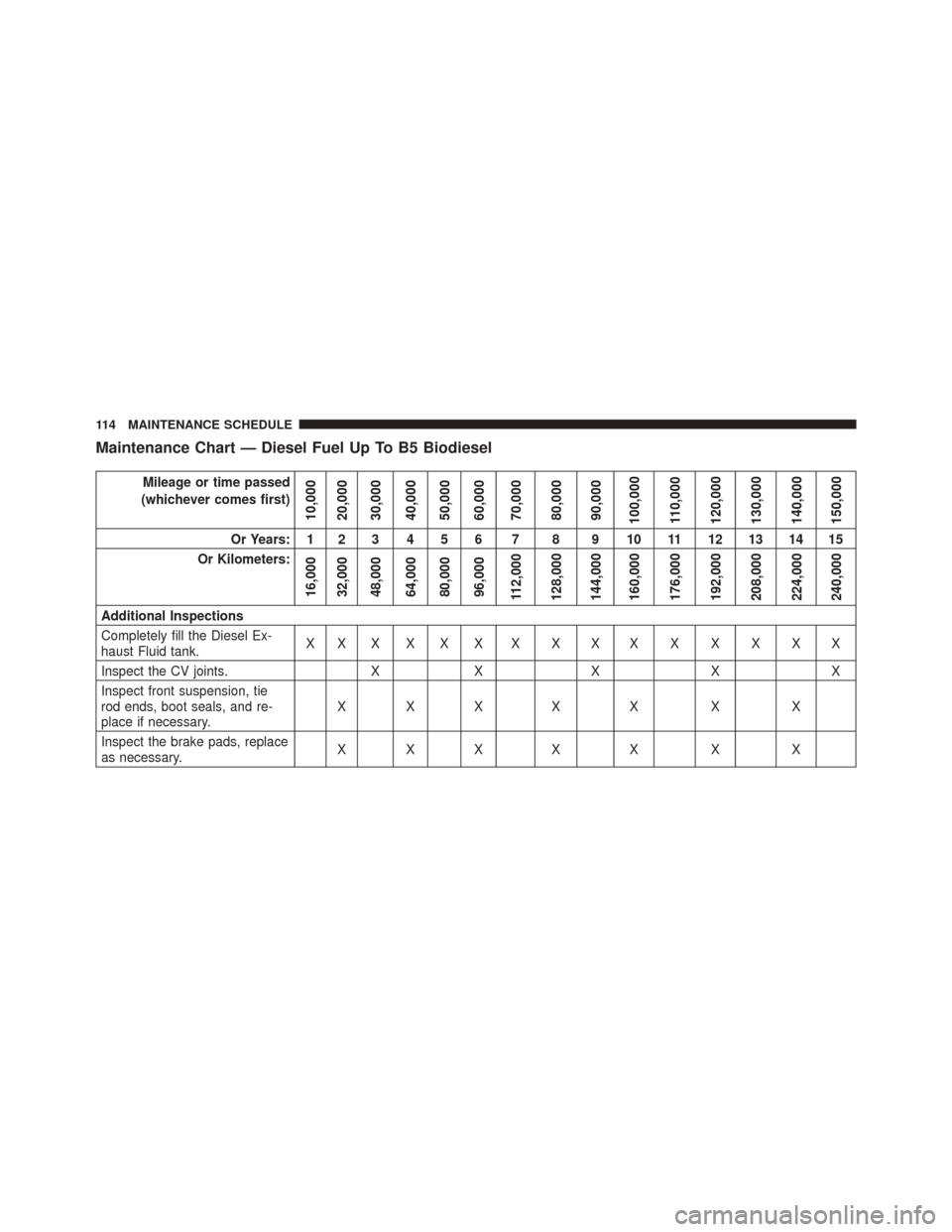
Maintenance Chart — Diesel Fuel Up To B5 Biodiesel
Mileage or time passed
(whichever comes first)
10,000
20,000
30,000
40,000
50,000
60,000
70,000
80,000
90,000
100,000
110,000
120,000
130,000
140,000
150,000
Or Years: 1 2 3 4 5 6 7 8 9 10 11 12 13 14 15
Or Kilometers:
16,000
32,000
48,000
64,000
80,000
96,000
112,000
128,000
144,000
160,000
176,000
192,000
208,000
224,000
240,000
Additional Inspections
Completely fill the Diesel Ex-
haust Fluid tank. XXXXXXXXXXXXXXX
Inspect the CV joints. XX X X X
Inspect front suspension, tie
rod ends, boot seals, and re-
place if necessary. XXX X X X X
Inspect the brake pads, replace
as necessary. XXX X X X X
114 MAINTENANCE SCHEDULE
Page 117 of 130
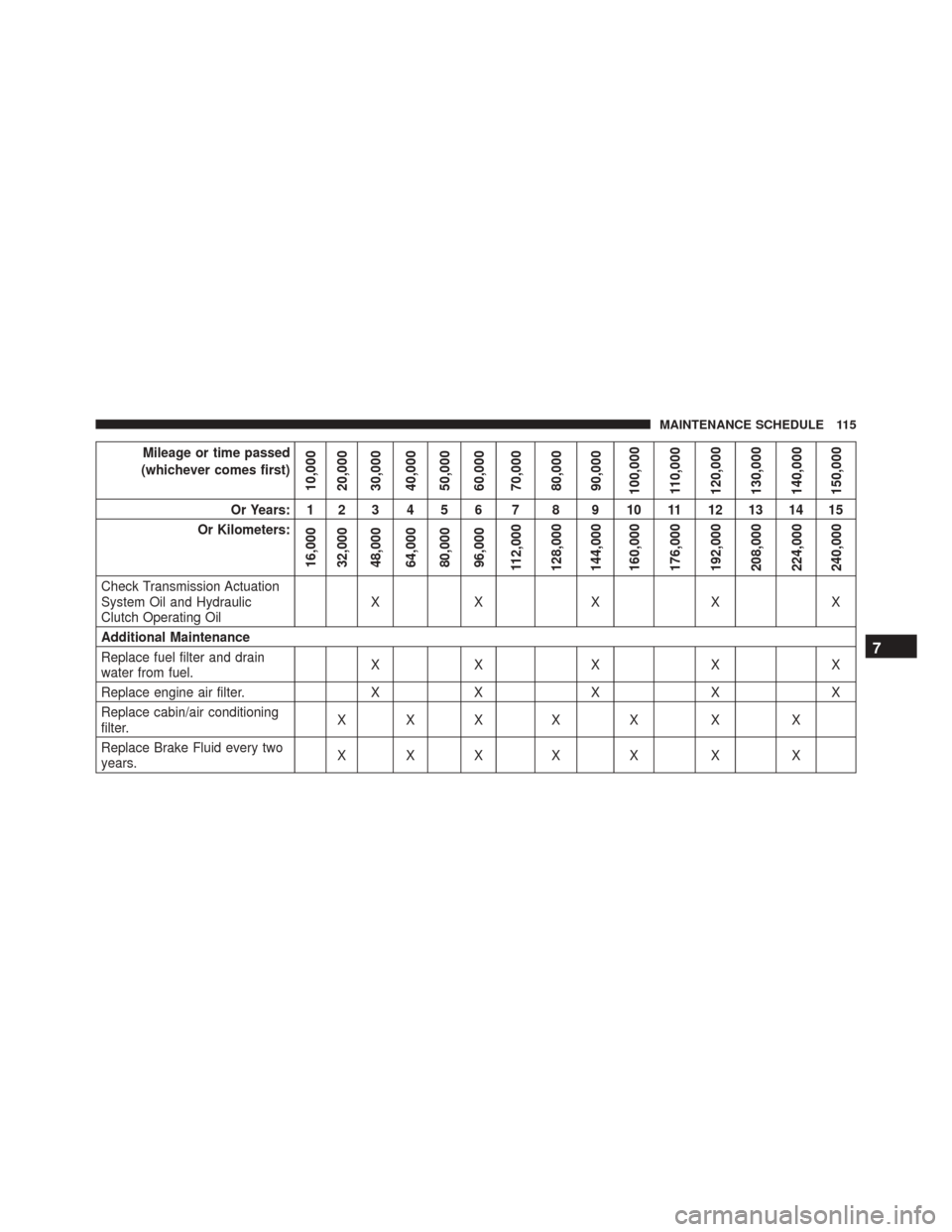
Mileage or time passed
(whichever comes first)
10,000
20,000
30,000
40,000
50,000
60,000
70,000
80,000
90,000
100,000
110,000
120,000
130,000
140,000
150,000
Or Years: 1 2 3 4 5 6 7 8 9 10 11 12 13 14 15
Or Kilometers:
16,000
32,000
48,000
64,000
80,000
96,000
112,000
128,000
144,000
160,000
176,000
192,000
208,000
224,000
240,000
Check Transmission Actuation
System Oil and Hydraulic
Clutch Operating Oil XX X X X
Additional Maintenance
Replace fuel filter and drain
water from fuel. XX X X X
Replace engine air filter. X X X X X
Replace cabin/air conditioning
filter. XXX X X X X
Replace Brake Fluid every two
years. XXX X X X X
7
MAINTENANCE SCHEDULE 115
Page 124 of 130
Adding Engine Coolant (Antifreeze).............99
Adding Fuel ..............................66
Air bag Light .............................17
Air Cleaner, Engine (Engine Air Cleaner Filter) .....92
Antifreeze (Engine Coolant) ...............98, 105
Disposal ............................. .101
Anti-Lock Warning Light .....................17
Automated Manual Transmission Fluid Type ........................... .109
Battery .................................96
Brake Fluid ............................ .109
Brake System ........................... .103
Fluid Check .......................... .103
Master Cylinder ....................... .103
Warning Light ..........................17
Capacities, Fluid ......................... .105Caps, Filler
Oil (Engine) ............................91
Radiator (Coolant Pressure) ................101
Check Engine Light (Malfunction Indicator Light) . . .17
Coolant Pressure Cap (Radiator Cap) ...........101
Cooling System ...........................97
Adding Coolant (Antifreeze) ................99
Coolant Capacity ...................... .105
Coolant Level ...........................97
Disposal of Used Coolant .................101
Drain, Flush, and Refill ....................98
Points to Remember .....................102
Pressure Cap ......................... .101
Radiator Cap ......................... .101
Selection of Coolant (Antifreeze) .......98, 105, 106
Cruise Light ..............................17
Diesel Exhaust Fluid (DEF) ..................106
Diesel Fuel .......................... .60, 106
122 INDEX
Page 125 of 130
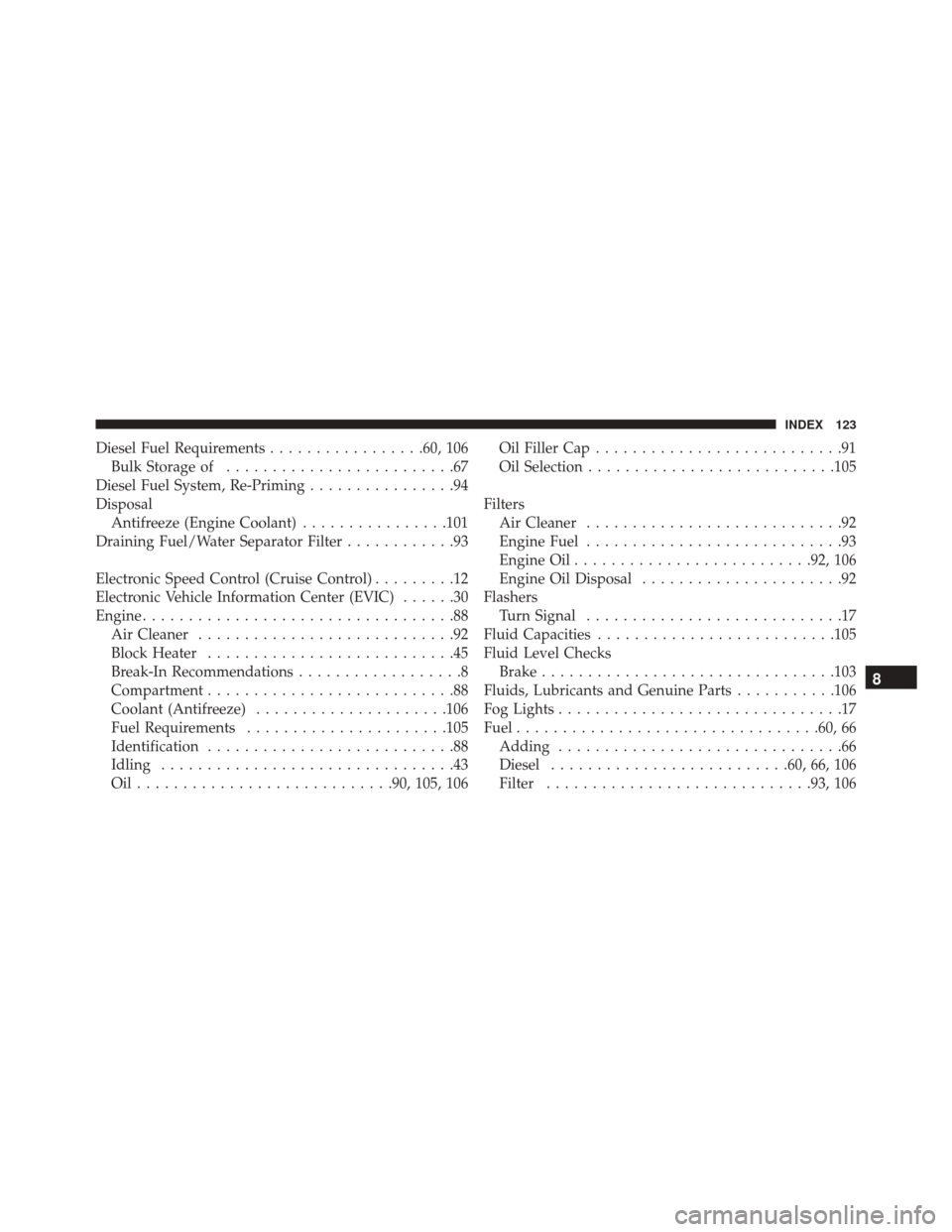
Diesel Fuel Requirements.................60, 106
Bulk Storage of .........................67
Diesel Fuel System, Re-Priming ................94
Disposal Antifreeze (Engine Coolant) ................101
Draining Fuel/Water Separator Filter ............93
Electronic Speed Control (Cruise Control) .........12
Electronic Vehicle Information Center (EVIC) ......30
Engine ..................................88
Air Cleaner ............................92
Block Heater ...........................45
Break-In Recommendations ..................8
Compartment ...........................88
Coolant (Antifreeze) .....................106
Fuel Requirements ..................... .105
Identification ...........................88
Idling ................................43
Oil........................... .90, 105, 106Oil Filler Cap
...........................91
Oil Selection .......................... .105
Filters Air Cleaner ............................92
Engine Fuel ............................93
Engine Oil ......................... .92, 106
Engine Oil Disposal ......................92
Flashers Turn Signal ............................17
Fluid Capacities ......................... .105
Fluid Level Checks Brake ............................... .103
Fluids, Lubricants and Genuine Parts ...........106
Fog Lights ...............................17
Fuel ................................ .60, 66
Adding ...............................66
Diesel ......................... .60, 66, 106
Filter ............................ .93, 106
8
INDEX 123
Page 126 of 130
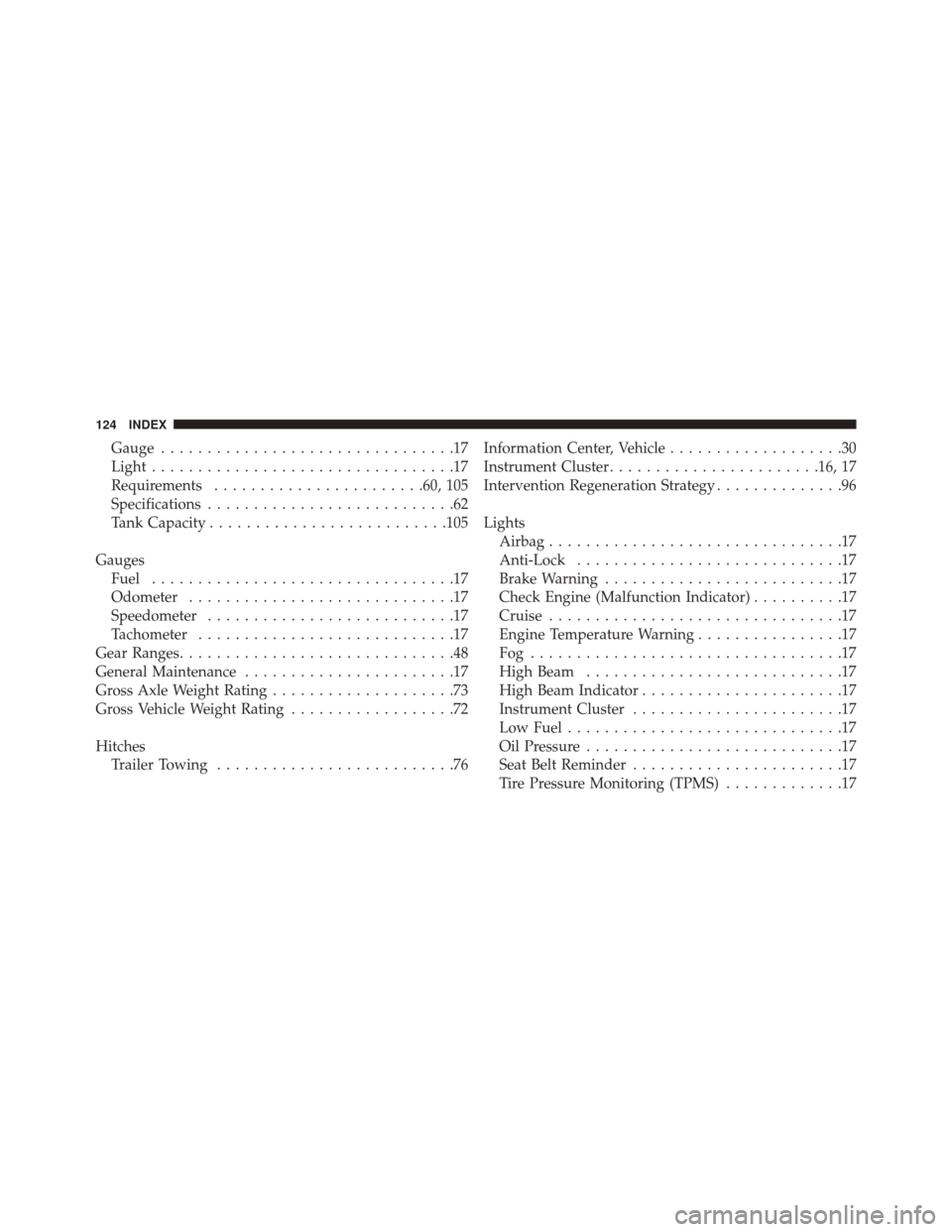
Gauge................................17
Light .................................17
Requirements ...................... .60, 105
Specifications ...........................62
Tank Capacity ......................... .105
Gauges Fuel .................................17
Odometer .............................17
Speedometer ...........................17
Tachometer ............................17
Gear Ranges ..............................48
General Maintenance .......................17
Gross Axle Weight Rating ....................73
Gross Vehicle Weight Rating ..................72
Hitches Trailer Towing ..........................76 Information Center, Vehicle
...................30
Instrument Cluster ...................... .16, 17
Intervention Regeneration Strategy ..............96
Lights Airbag ................................17
Anti-Lock .............................17
Brake Warning ..........................17
Check Engine (Malfunction Indicator) ..........17
Cruise ................................17
Engine Temperature Warning ................17
Fog ..................................17
High Beam ............................17
High Beam Indicator ......................17
Instrument Cluster .......................17
Low Fuel ..............................17
Oil Pressure ............................17
Seat Belt Reminder .......................17
Tire Pressure Monitoring (TPMS) .............17
124 INDEX