door lock Ram ProMaster 2015 User Guide
[x] Cancel search | Manufacturer: RAM, Model Year: 2015, Model line: ProMaster, Model: Ram ProMaster 2015Pages: 425, PDF Size: 2.97 MB
Page 24 of 425
Automatic Door Locks
The auto door lock feature default condition is enabled.
When enabled, the door locks will lock automatically
when the vehicle’s speed exceeds 12 mph (20 km/h). The
auto door lock feature can be enabled or disabled
through the EVIC or the Uconnect® system.
Auto Unlock Doors
This feature unlocks all doors when the driver door is
open.
WINDOWS
Power Windows
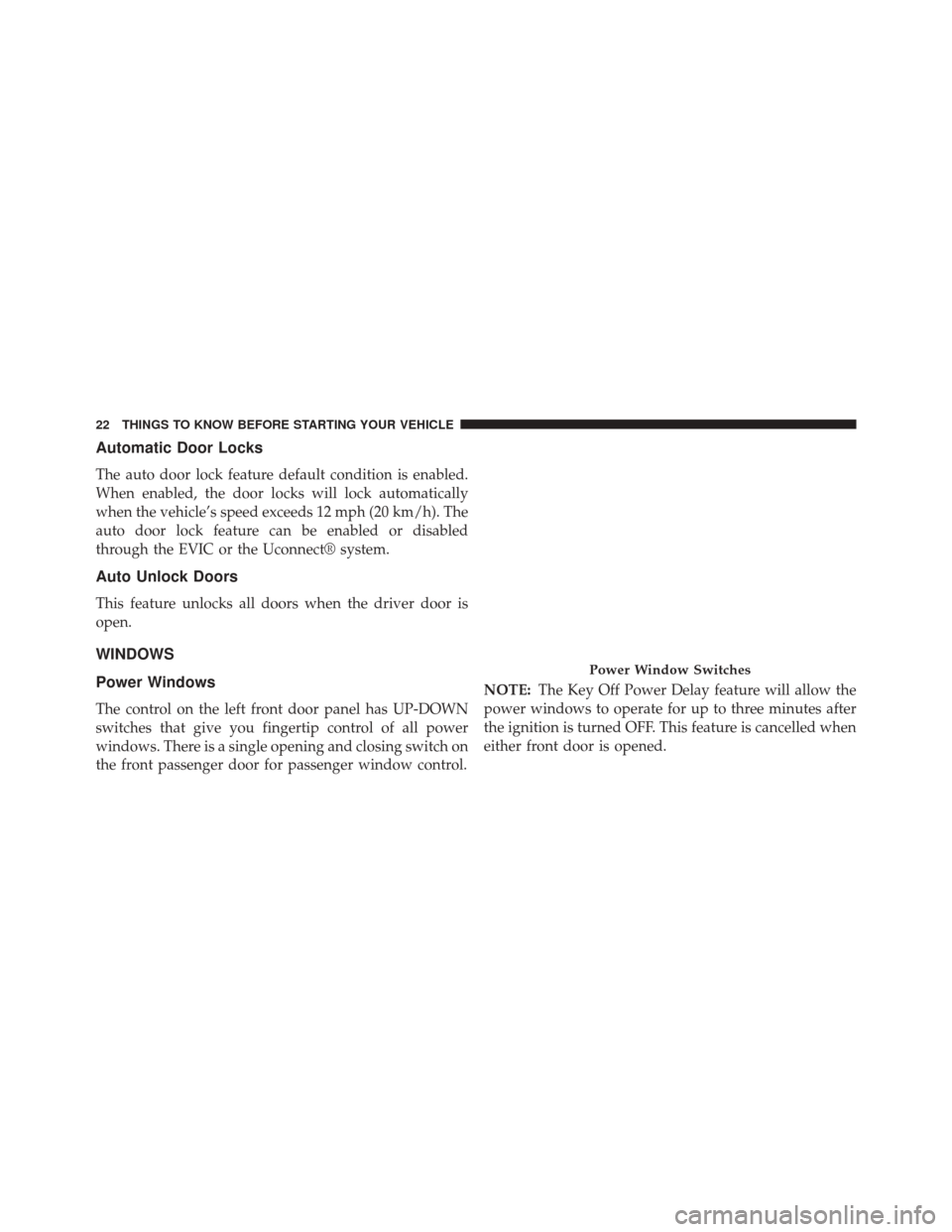
The control on the left front door panel has UP-DOWN
switches that give you fingertip control of all power
windows. There is a single opening and closing switch on
the front passenger door for passenger window control.NOTE:
The Key Off Power Delay feature will allow the
power windows to operate for up to three minutes after
the ignition is turned OFF. This feature is cancelled when
either front door is opened.
Power Window Switches
22 THINGS TO KNOW BEFORE STARTING YOUR VEHICLE
Page 25 of 425
WARNING!
•Never leave children alone in a vehicle, or with
access to an unlocked vehicle. Allowing children to
be in a vehicle unattended is dangerous for a
number of reasons. A child or others could be
seriously or fatally injured. Children should be
warned not to touch the parking brake, brake pedal
or the gear selector.
• Do not leave the Key Fob in or near the vehicle or
in a location accessible to children. A child could
operate power windows, other controls, or move
the vehicle.
Auto-Down Feature
The front window switches are equipped with an Auto-
Down feature. Push the window switch for a short period
of time, release, and the window will go down automati-
cally. To open the window part way, push the window switch
and release it when you want the window to stop.
NOTE:
The power window switches remain active for up
to three minutes (depending on the accessory delay
setting) after the ignition switch has been turned OFF.
Opening a vehicle front door will cancel this feature.
Wind Buffeting
Wind buffeting can be described as the perception of
pressure on the ears or a helicopter-type sound in the
ears. Your vehicle may exhibit wind buffeting with the
windows down in certain open or partially open posi-
tions. This is a normal occurrence and can be minimized.
If the buffeting occurs open the front windows together
to minimize the buffeting.
2
THINGS TO KNOW BEFORE STARTING YOUR VEHICLE 23
Page 50 of 425
Enhanced Accident Response System
In the event of an impact, if the communication network
remains intact, and the power remains intact, depending
on the nature of the event, the ORC will determine
whether to have the Enhanced Accident Response Sys-
tem perform the following functions:
•Cut off fuel to the engine.
• Flash hazard lights as long as the battery has power or
until the ignition switch is turned to the “OFF” posi-
tion.
• Turn on the interior lights, which remain on as long as
the battery has power or until the ignition switch is
turned to the “OFF” position.
• Unlock the doors automatically.
Air Bag Warning Light
The air bags must be ready to inflate for your
protection in a collision. The Occupant Re-
straint Controller (ORC) monitors the internal
circuits and interconnecting wiring associated
with air bag system electrical components.
The ORC monitors the readiness of the electronic parts of
the air bag system whenever the ignition switch is in the
START or ON/RUN position. If the ignition switch is in
the OFF position or in the ACC position, the air bag
system is not on and the air bags will not inflate.
The ORC contains a backup power supply system that
may deploy the air bags even if the battery loses power or
it becomes disconnected prior to deployment.
48 THINGS TO KNOW BEFORE STARTING YOUR VEHICLE
Page 63 of 425
9. Test that the child restraint is installed tightly bypulling back and forth on the child seat at the belt
path. It should not move more than 1 inch (25.4 mm)
in any direction.
Any seat belt system will loosen with time, so check the
belt occasionally, and pull it tight if necessary.
Transporting Pets
Air Bags deploying in the front seat could harm your pet.
An unrestrained pet will be thrown about and possibly
injured, or injure a passenger during panic braking or in
a collision.
Pets should be restrained in the rear seat in pet harnesses
or pet carriers that are secured by seat belts.
FUEL CUT OFF SWITCH
The vehicle is fitted with a safety switch that, in the event
of an accident, comes into operation by cutting off the
fuel supply and turning off the engine as a consequence.
When the inertia switch cuts in, this cuts off the fuel
supply and also activates the hazard warning lights, side
lights, and courtesy lights while releasing all the doors
and displaying a message; they are deactivated by push-
ing button A.
NOTE: After an accident, remember to cycle the ignition
to the STOP (OFF/LOCK) position and remove the key
from the ignition switch to avoid draining the battery. If
no fuel leaks or damage to vehicle electrical devices (e.g.
headlights) are detected after the impact, reactivate the
automatic fuel cut off following the procedure described
below.
2
THINGS TO KNOW BEFORE STARTING YOUR VEHICLE 61
Page 70 of 425
Door Latches
Check for proper closing, latching, and locking.
Fluid Leaks
Check area under vehicle after overnight parking for fuel,
engine coolant, oil, or other fluid leaks. Also, if gasoline
fumes are detected or if fuel, power steering fluid (if
equipped), or brake fluid leaks are suspected. The cause
should be located and corrected immediately.
68 THINGS TO KNOW BEFORE STARTING YOUR VEHICLE
Page 84 of 425

Damper Weight Adjustment
Use the weight adjustment knob to set the required
setting based on body weight, with settings between
88 lbs (40 kg) and 286 lbs (130 kg).Swivel Seat — If Equipped
The swivel seat lever is located at the lower front inboard
side of the seat. The seat may be turned through 180°
toward the seat on the opposite side and approximately
35° toward the door. The seat may be locked in the
driving position or at the 180° position. To swivel the
seat, pull the swivel seat inboard lever outward, turn the
seat to the desired position and release the lever. The
swivel seat back lever is located at the lower front
outboard side of the seat, to tilt the seat back forward or
rearward.
If the vehicle is equipped with interlocking swivel seats,
the seats must be locked in facing forward position while
driving. If the seats are not in the correct position, a
warning will display in the EVIC.
Weight Adjustment Knob
82 UNDERSTANDING THE FEATURES OF YOUR VEHICLE
Page 132 of 425
•Daytime Running Lights
• Clearance Lights
• License Plate Lights
The failure relating to these lights could be: •One or more blown bulbs
• A blown protection fuse
• A break in the electrical connection
9. Vehicle Security Light
If during starting, the key code is not correctly
recognized, the Vehicle Security Light comes
on in the instrument panel. In this case, turn
the key to OFF and then to ON/RUN; if it is
still locked, try again with the other keys that come with
the vehicle. Contact an authorized dealer if you still
cannot start the engine.
If with the engine running the warning light flashes, this
means that the car is not protected by the engine inhibitor device. Contact an authorized dealer to have all the keys
programmed.
10. Door Ajar Indicator
This indicator will illuminate when one or
more door(s) are not fully closed.
11. Tachometer
The tachometer indicates engine speed in Revolutions
Per Minute (RPM x 1000).
12. Oil Pressure Warning Light This light indicates low engine oil pressure. The
light should turn on momentarily when the engine is
started. If the light turns on while driving, stop the
vehicle and shut off the engine as soon as possible. A
chime will sound when this light turns on.
Do not operate the vehicle until the cause is corrected.
130 UNDERSTANDING YOUR INSTRUMENT PANEL
Page 173 of 425
Buttons On The Touchscreen
Buttons on the touchscreen are accessible on the
Uconnect® display.
Customer Programmable Features/Personal
Settings
Push the Settings button on the faceplate to display the
menu setting screen. In this mode the Uconnect® system
allows you to access programmable features that may be
equipped such as Display, Clock & Date, Safety & Driv-
ing Assistance (if equipped), Lights, Doors & Locks,
Audio, Phone/Bluetooth®, SiriusXM Setup (if
equipped), Restore Settings (if equipped).
NOTE:
•Only one category may be selected at a time.
• The Back arrow will change into a Done button if any
changes are made. When making a selection, press the button on the touch-
screen to enter the desired mode. Once in the desired
mode, press and release the preferred setting. Once the
setting is complete, either press the Back Arrow button
on the touchscreen or the Back button on the faceplate to
return to the previous menu or press the X button on the
touchscreen to return to the Main Settings screen. Press-
ing the Up or Down Arrow buttons on the touchscreen on
the right side of the screen will allow you to toggle up or
down through the available settings.
Display
After pressing the Display button on the touchscreen the
following settings will be available:
•
Display Mode
Press the display mode button to set the display bright-
ness according to day, night or auto condition. In auto
mode the display brightness is aligned to that of the
instrument panel.
4
UNDERSTANDING YOUR INSTRUMENT PANEL 171
Page 178 of 425

Doors & Locks
After pressing the “Doors & Locks” button on the touch-
screen the following settings will be available:
•Auto Door Locks
When this feature is selected, all doors will lock auto-
matically when the vehicle reaches a speed of 12 mph
(20 km/h). To make your selection, press the “Auto
Lock” button on the touchscreen, then choose “Yes” or
“No.” The button will highlight indicating that the set-
ting has been selected. Press the back arrow/Done button
on the touchscreen to return to the previous menu.
Audio
After pressing the Audio button on the touchscreen the
following settings will be available:
• Balance
This feature allows you to adjust the Balance settings.
Press and drag the speaker icon, use the arrows to adjust,
or tap the speaker icon to readjust to the center. •
Equalizer
This feature allows you to adjust the Bass, Mid and Treble
settings. Adjust the settings with the “–” or “+” arrow
buttons on the touchscreen or by selecting any point on
the scale between the Up and Down arrow buttons on the
touchscreen. Then press the back arrow/Done button on
the touchscreen.
NOTE: Bass/Mid/Treble allow you to simply slide your
finger up or down to change the setting as well as press
directly on the desired setting.
• Speed Adjusted Volume
This feature increases or decreases volume relative to
vehicle speed. To change the Speed Adjusted Volume
press the Off, 1, 2 or 3 button on the touchscreen. Then
press the back arrow/Done button on the touchscreen.
176 UNDERSTANDING YOUR INSTRUMENT PANEL
Page 346 of 425

3. Install the A/C air filter/filter retainer back into thefresh air inlet. When installing the filter retainer make
sure the retainer is fully engaged.
4. Install the two screws back into the assembly to secure the filter retainer to the fresh air inlet.
Body Lubrication
Locks and all body pivot points, including such items as
seat tracks, door hinge pivot points and rollers, liftgate,
tailgate, decklid, sliding doors and hood hinges, should
be lubricated periodically with a lithium based grease,
such as MOPAR® Spray White Lube to assure quiet, easy
operation and to protect against rust and wear. Prior to
the application of any lubricant, the parts concerned
should be wiped clean to remove dust and grit; after
lubricating excess oil and grease should be removed.
Particular attention should also be given to hood latching
components to ensure proper function. When performing other underhood services, the hood latch, release mecha-
nism and safety catch should be cleaned and lubricated.
The external lock cylinders should be lubricated twice a
year, preferably in the Fall and Spring. Apply a small
amount of a high quality lubricant, such as MOPAR®
Lock Cylinder Lubricant directly into the lock cylinder.Windshield Wiper Blades
Clean the rubber edges of the wiper blades and the
windshield periodically with a sponge or soft cloth and a
mild nonabrasive cleaner. This will remove accumula-
tions of salt or road film.
Operation of the wipers on dry glass for long periods
may cause deterioration of the wiper blades. Always use
washer fluid when using the wipers to remove salt or dirt
from a dry windshield.
344 MAINTAINING YOUR VEHICLE