tow Ram ProMaster 2016 Diesel Supplement
[x] Cancel search | Manufacturer: RAM, Model Year: 2016, Model line: ProMaster, Model: Ram ProMaster 2016Pages: 145, PDF Size: 0.75 MB
Page 98 of 145
WARNING!
•Do not connect trailer brakes to your vehicle’s
hydraulic brake lines. It can overload your brake
system and cause it to fail. You might not have
brakes when you need them and could have a
collision.
• Towing any trailer will increase your stopping
distance. When towing you should allow for addi-
tional space between your vehicle and the vehicle
in front of you. Failure to do so could result in a
collision.
CAUTION!
If the trailer weighs more than 1,000 lbs (454 kg)
loaded, it should have its own brakes and they
should be of adequate capacity. Failure to do this
could lead to accelerated brake lining wear, higher
brake pedal effort, and longer stopping distances.
Towing Requirements — Trailer Lights And Wiring
Whenever you pull a trailer, regardless of the trailer size,
stoplights and turn signals on the trailer are required for
motoring safety.
The Trailer Tow Package may include a four- and seven-
pin wiring harness. Use a factory approved trailer har-
ness and connector.
96 STARTING AND OPERATING
Page 100 of 145
Towing Tips
Before setting out on a trip, practice turning, stopping,
and backing up the trailer in an area located away from
heavy traffic.
Automated Manual Transmission
DRIVE (D) (automatic mode) can be used when towing.
If frequent shifting occur while in DRIVE, select TOW/
HAUL mode, or change to MANUAL (M) mode and
manually select a lower gear.
NOTE:Using a lower gear while operating the vehicle
under heavy loading conditions will improve perfor-
mance and extend transmission life by reducing exces-
sive shifting and heat build up. This action will also
provide better engine braking.
Seven-Pin Connector
1 — Battery 5 — Ground
2 — Backup Lamps 6 — Left Stop/Turn
3 — Right Stop/Turn 7 — Running Lamps
4 — Electric Brakes 98 STARTING AND OPERATING
Page 101 of 145
Tow/Haul Mode
To reduce the potential for transmission overheating,
activate the “TOW/HAUL” feature when using DRIVE
(D) (automatic mode) in hilly areas.
Electronic Speed Control — If Equipped
•Do not use in hilly terrain or with heavy loads.
• When using the speed control, if you experience speed
drops greater than 10 mph (16 km/h), disengage until
you can get back to cruising speed.
• Use speed control in flat terrain and with light loads to
maximize fuel efficiency.
Cooling System
To reduce potential for engine and transmission over-
heating, take the following actions:
City Driving
When stopped for short periods, shift the transmission
into NEUTRAL and increase engine idle speed.
Highway Driving
Reduce speed.
Air Conditioning
Turn off temporarily.
5
STARTING AND OPERATING 99
Page 128 of 145
MAINTENANCE SCHEDULE — DIESEL ENGINE
Your vehicle is equipped with an automatic oil change
indicator system. The oil change indicator system will
remind you that it is time to take your vehicle in for
scheduled maintenance.
Based on engine operation conditions, the oil change
indicator message will illuminate in the instrument clus-
ter. This means that service is required for your vehicle.
Operating conditions such as frequent short-trips, trailer
tow, and extremely hot or cold ambient temperatures will
influence when the “Oil Change Required” message is
displayed. Severe Operating Conditions can cause the
change oil message to illuminate as early as 3,500 miles
(5,600 km) since last reset. Have your vehicle serviced as
soon as possible, within the next 500 miles (805 km).
Your authorized dealer will reset the oil change indicator
message after completing the scheduled oil change. If a
scheduled oil change is performed by someone otherthan your authorized dealer, the message can be reset by
referring to the steps described under “Electronic Vehicle
Information Center (EVIC)” in “Understanding Your
Instrument Panel” for further information.
NOTE:
Under no circumstances should oil change inter-
vals exceed 18,500 miles (29,773 km) or twelve months,
whichever comes first.
Once A Month Or Before A Long Trip:
• Check engine oil level
• Check windshield washer fluid level
• Check the tire inflation pressures and look for unusual
wear or damage
• Check the fluid levels of the coolant reservoir, brake
master cylinder, and power steering and fill as needed
• Check function of all interior and exterior lights
126 MAINTENANCE SCHEDULE
Page 140 of 145
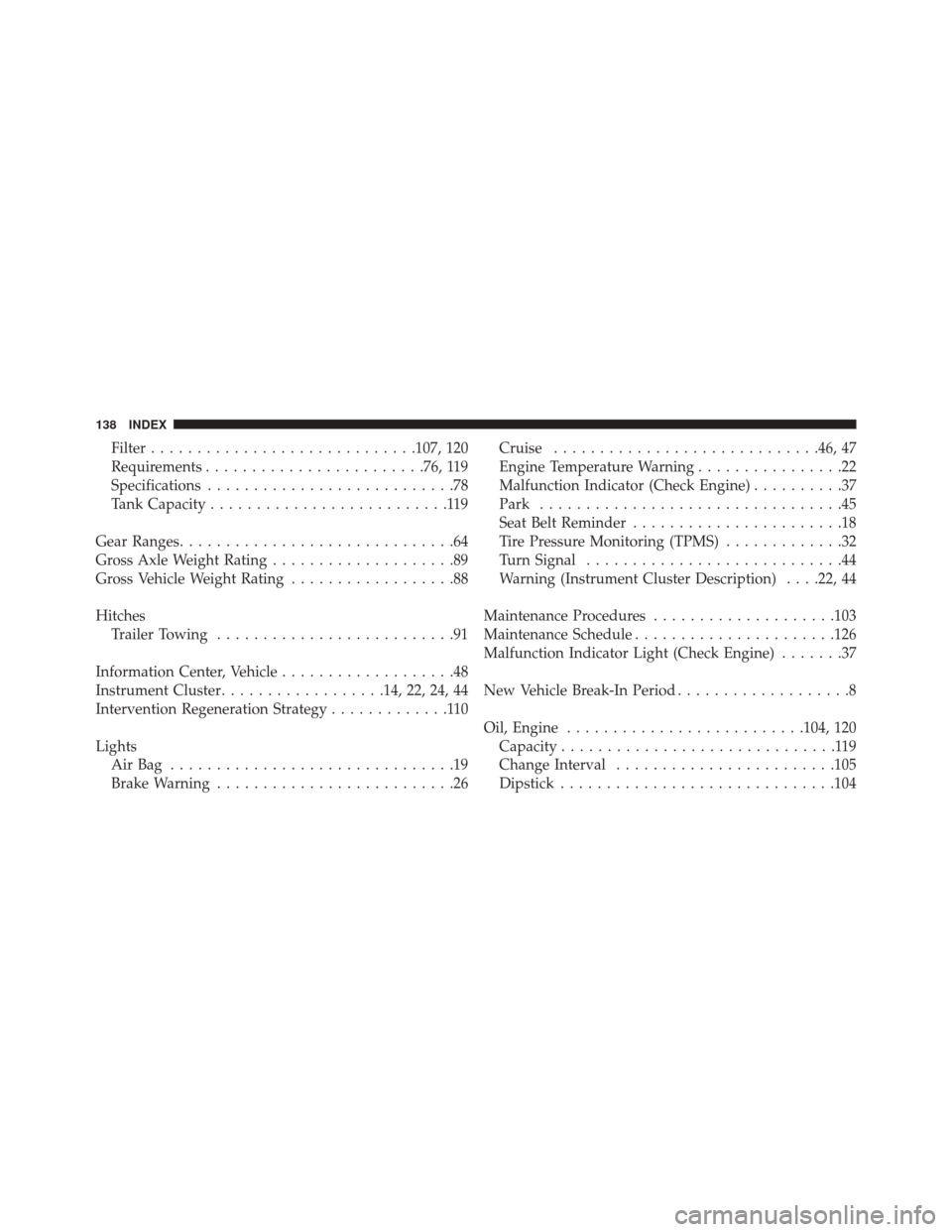
Filter............................ .107, 120
Requirements ....................... .76, 119
Specifications ...........................78
Tank Capacity ..........................119
Gear Ranges ..............................64
Gross Axle Weight Rating ....................89
Gross Vehicle Weight Rating ..................88
Hitches Trailer Towing ..........................91
Information Center, Vehicle ...................48
Instrument Cluster ..................14, 22, 24, 44
Intervention Regeneration Strategy .............110
Lights AirBag ...............................19
Brake Warning ..........................26 Cruise
............................ .46, 47
Engine Temperature Warning ................22
Malfunction Indicator (Check Engine) ..........37
Park .................................45
Seat Belt Reminder .......................18
Tire Pressure Monitoring (TPMS) .............32
Turn Signal ............................44
Warning (Instrument Cluster Description) . . . .22, 44
Maintenance Procedures ....................103
Maintenance Schedule ..................... .126
Malfunction Indicator Light (Check Engine) .......37
New Vehicle Break-In Period ...................8
Oil, Engine ......................... .104, 120
Capacity ..............................119
Change Interval ....................... .105
Dipstick ............................. .104
138 INDEX
Page 141 of 145
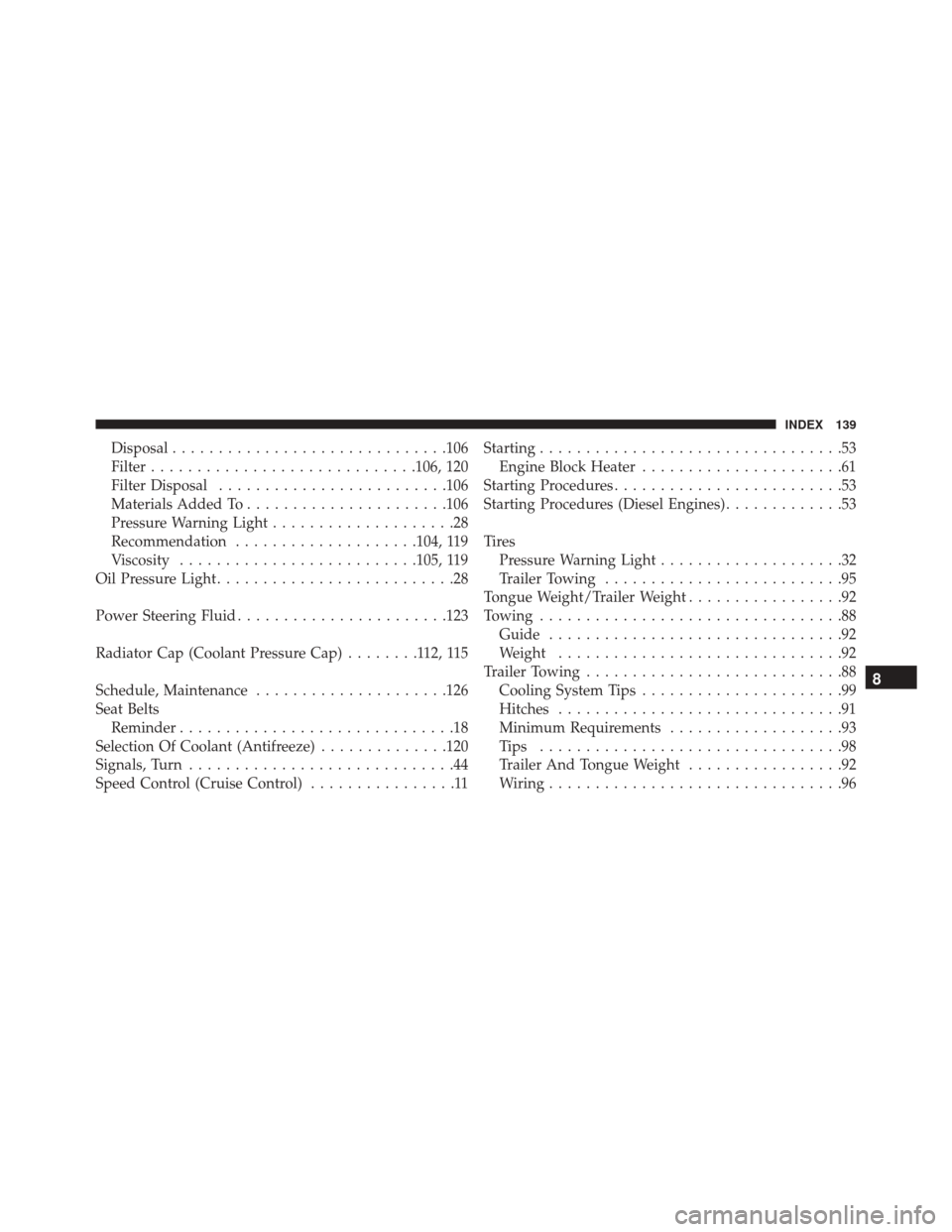
Disposal............................. .106
Filter ............................ .106, 120
Filter Disposal ........................ .106
Materials Added To ..................... .106
Pressure Warning Light ....................28
Recommendation ....................104, 119
Viscosity ......................... .105, 119
Oil Pressure Light ..........................28
Power Steering Fluid ...................... .123
Radiator Cap (Coolant Pressure Cap) ........112,115
Schedule, Maintenance .....................126
Seat Belts Reminder ..............................18
Selection Of Coolant (Antifreeze) ..............120
Signals, Turn .............................44
Speed Control (Cruise Control) ................11Starting
.................................53
Engine Block Heater ......................61
Starting Procedures .........................53
Starting Procedures (Diesel Engines) .............53
Ti re s Pressure Warning Light ....................32
Trailer Towing ..........................95
Tongue Weight/Trailer Weight .................92
Towing .................................88
Guide ................................92
Weight ...............................92
Trailer Towing ............................88
Cooling System Tips ......................99
Hitches ...............................91
Minimum Requirements ...................93
Tips .................................98
Trailer And Tongue Weight .................92
Wiring ................................96
8
INDEX 139
Page 142 of 145
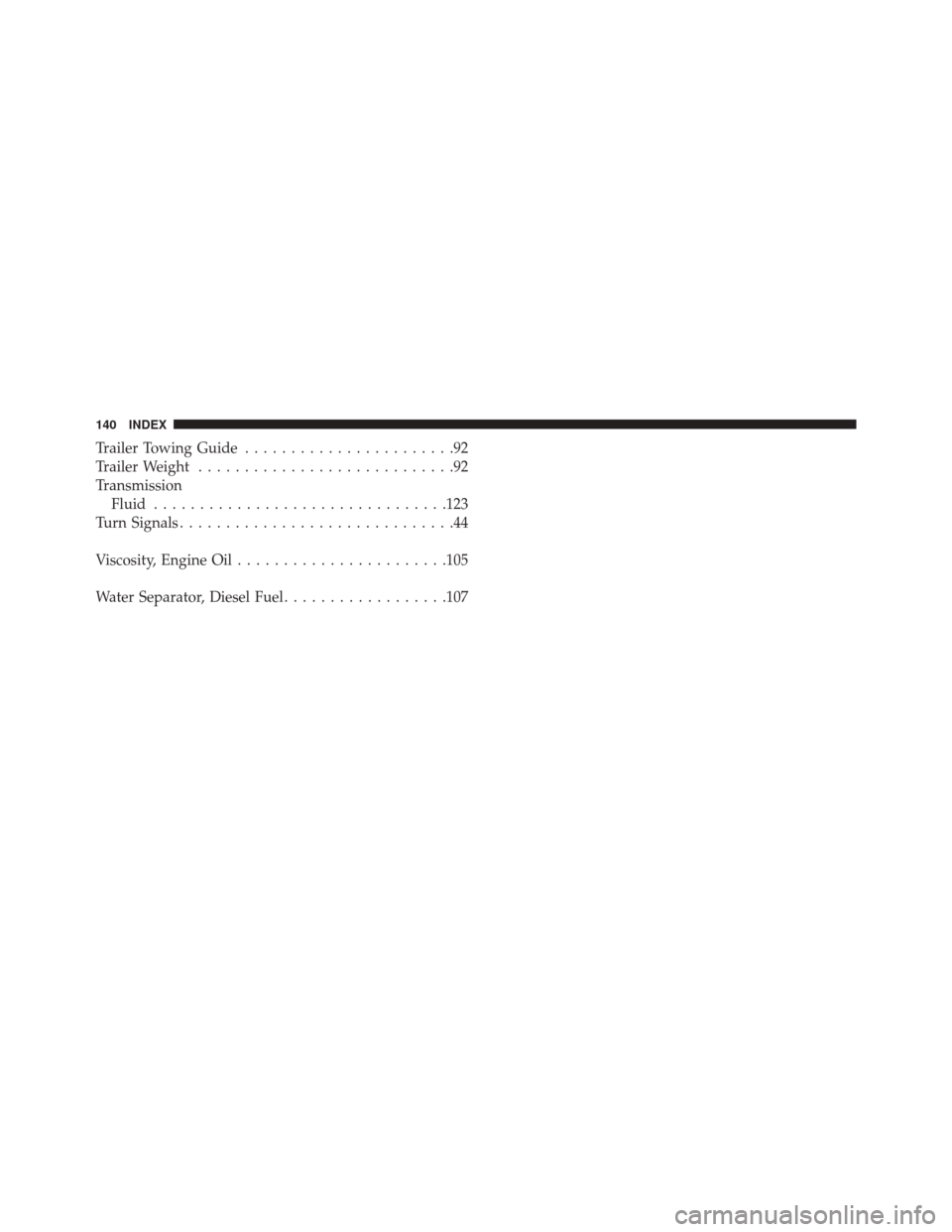
Trailer Towing Guide.......................92
Trailer Weight ............................92
Transmission Fluid ............................... .123
Turn Signals ..............................44
Viscosity, Engine Oil ...................... .105
Water Separator, Diesel Fuel ..................107
140 INDEX