engine oil Ram ProMaster 2016 Owner's Guide
[x] Cancel search | Manufacturer: RAM, Model Year: 2016, Model line: ProMaster, Model: Ram ProMaster 2016Pages: 448, PDF Size: 3.28 MB
Page 369 of 448
Protection Agency and is an ozone-saving product. How-
ever, the manufacturer recommends that air conditioning
service be performed by authorized dealer or other
service facilities using recovery and recycling equipment.
NOTE:Use only manufacturer approved A/C system
PAG compressor oil and refrigerants.
A/C Air Filter
Refer to the “Maintenance Schedule” for the proper
maintenance intervals.
WARNING!
Do not remove the A/C air filter while the blower is
operating or personal injury may result.
The A/C air filter is located in the fresh air inlet in the
engine compartment. Perform the following procedure to
replace the filter: 1. Remove the two screws that secure the filter retainer to
the fresh air inlet, and remove the filter retainer.
Accessing Air Filter
1 — Screw Locations
2 — Fresh Air Inlet
7
MAINTAINING YOUR VEHICLE 367
Page 371 of 448
other underhood services, the hood latch, release mecha-
nism and safety catch should be cleaned and lubricated.
The external lock cylinders should be lubricated twice a
year, preferably in the Fall and Spring. Apply a small
amount of a high quality lubricant, such as MOPAR Lock
Cylinder Lubricant directly into the lock cylinder.
Windshield Wiper Blades
Clean the rubber edges of the wiper blades and the
windshield periodically with a sponge or soft cloth and a
mild nonabrasive cleaner. This will remove accumula-
tions of salt or road film.
Operation of the wipers on dry glass for long periods
may cause deterioration of the wiper blades. Always use
washer fluid when using the wipers to remove salt or dirt
from a dry windshield.Avoid using the wiper blades to remove frost or ice from
the windshield. Keep the blade rubber out of contact with
petroleum products such as engine oil, gasoline, etc.
NOTE:
Life expectancy of wiper blades varies depend-
ing on geographical area and frequency of use. Poor
performance of blades may be present with chattering,
marks, water lines or wet spots. If any of these conditions
are present, clean the wiper blades or replace as neces-
sary.
Adding Washer Fluid
The fluid reservoir is located in the engine compartment
and should be checked at regular intervals. Fill the
reservoir with windshield washer solvent (not radiator
antifreeze) and operate the system for a few seconds to
flush out any residual water.7
MAINTAINING YOUR VEHICLE 369
Page 379 of 448
Overfilling of fluid is not recommended because it may
cause leaking in the system.
Add enough fluid to bring the level up to the require-
ments described on the brake fluid reservoir. With disc
brakes, fluid level can be expected to fall as the brake
pads wear. However, low fluid level may be caused by a
leak and a checkup may be needed.
Use only manufacturer’s recommended brake fluid. Re-
fer to “Fluids, Lubricants, And Genuine Parts” in “Main-
taining Your Vehicle” for further information.
WARNING!
•Use only manufacturer’s recommended brake
fluid. Refer to “Fluids, Lubricants, And Genuine
Parts” in “Maintaining Your Vehicle” for further
information. Using the wrong type of brake fluid
(Continued)
WARNING! (Continued)
can severely damage your brake system and/or
impair its performance. The proper type of brake
fluid for your vehicle is also identified on the
original factory installed hydraulic master cylinder
reservoir.
• To avoid contamination from foreign matter or
moisture, use only new brake fluid or fluid that has
been in a tightly closed container. Keep the master
cylinder reservoir cap secured at all times. Brake
fluid in a open container absorbs moisture from the
air resulting in a lower boiling point. This may
cause it to boil unexpectedly during hard or pro-
longed braking, resulting in sudden brake failure.
This could result in a collision.
• Overfilling the brake fluid reservoir can result in
spilling brake fluid on hot engine parts, causing
(Continued)
7
MAINTAINING YOUR VEHICLE 377
Page 392 of 448
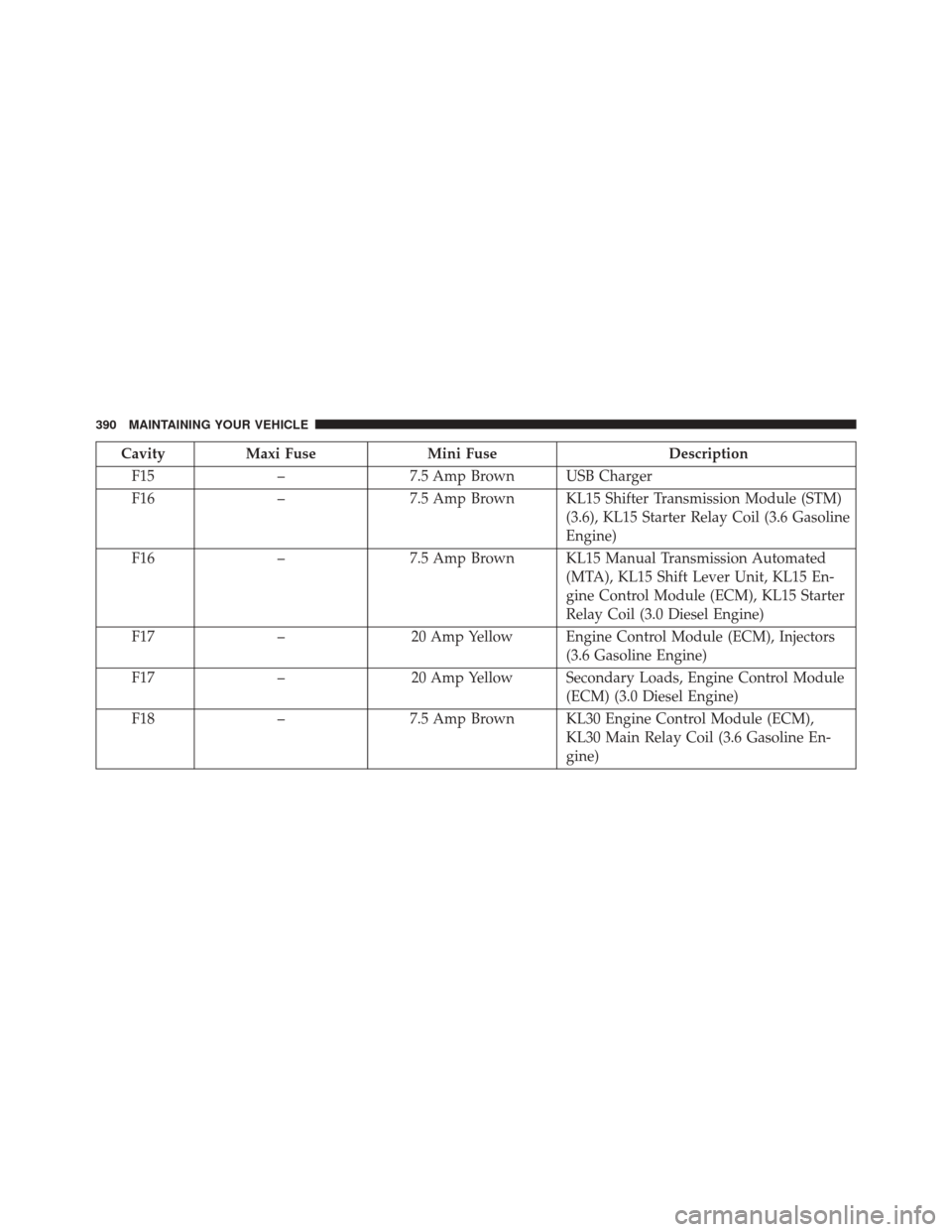
CavityMaxi Fuse Mini Fuse Description
F15 –7.5 Amp Brown USB Charger
F16 –7.5 Amp Brown KL15 Shifter Transmission Module (STM)
(3.6), KL15 Starter Relay Coil (3.6 Gasoline
Engine)
F16 –7.5 Amp Brown KL15 Manual Transmission Automated
(MTA), KL15 Shift Lever Unit, KL15 En-
gine Control Module (ECM), KL15 Starter
Relay Coil (3.0 Diesel Engine)
F17 –20 Amp Yellow Engine Control Module (ECM), Injectors
(3.6 Gasoline Engine)
F17 –20 Amp Yellow Secondary Loads, Engine Control Module
(ECM) (3.0 Diesel Engine)
F18 –7.5 Amp Brown KL30 Engine Control Module (ECM),
KL30 Main Relay Coil (3.6 Gasoline En-
gine)
390 MAINTAINING YOUR VEHICLE
Page 393 of 448
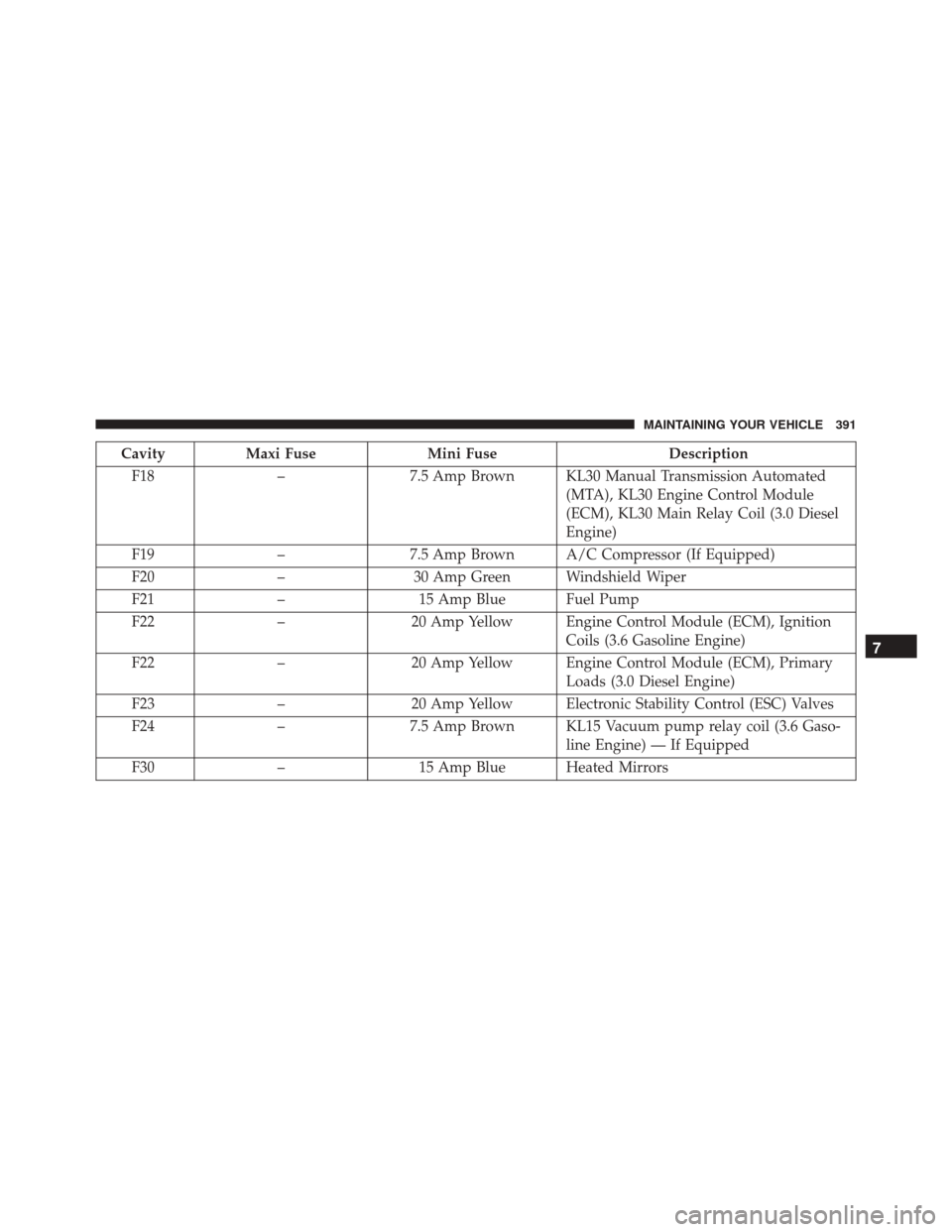
CavityMaxi Fuse Mini Fuse Description
F18 –7.5 Amp Brown KL30 Manual Transmission Automated
(MTA), KL30 Engine Control Module
(ECM), KL30 Main Relay Coil (3.0 Diesel
Engine)
F19 –7.5 Amp Brown A/C Compressor (If Equipped)
F20 –30 Amp Green Windshield Wiper
F21 –15 Amp Blue Fuel Pump
F22 –20 Amp Yellow Engine Control Module (ECM), Ignition
Coils (3.6 Gasoline Engine)
F22 –20 Amp Yellow Engine Control Module (ECM), Primary
Loads (3.0 Diesel Engine)
F23 –20 Amp Yellow Electronic Stability Control (ESC) Valves
F24 –7.5 Amp Brown KL15 Vacuum pump relay coil (3.6 Gaso-
line Engine) — If Equipped
F30 –15 Amp Blue Heated Mirrors
7
MAINTAINING YOUR VEHICLE 391
Page 407 of 448
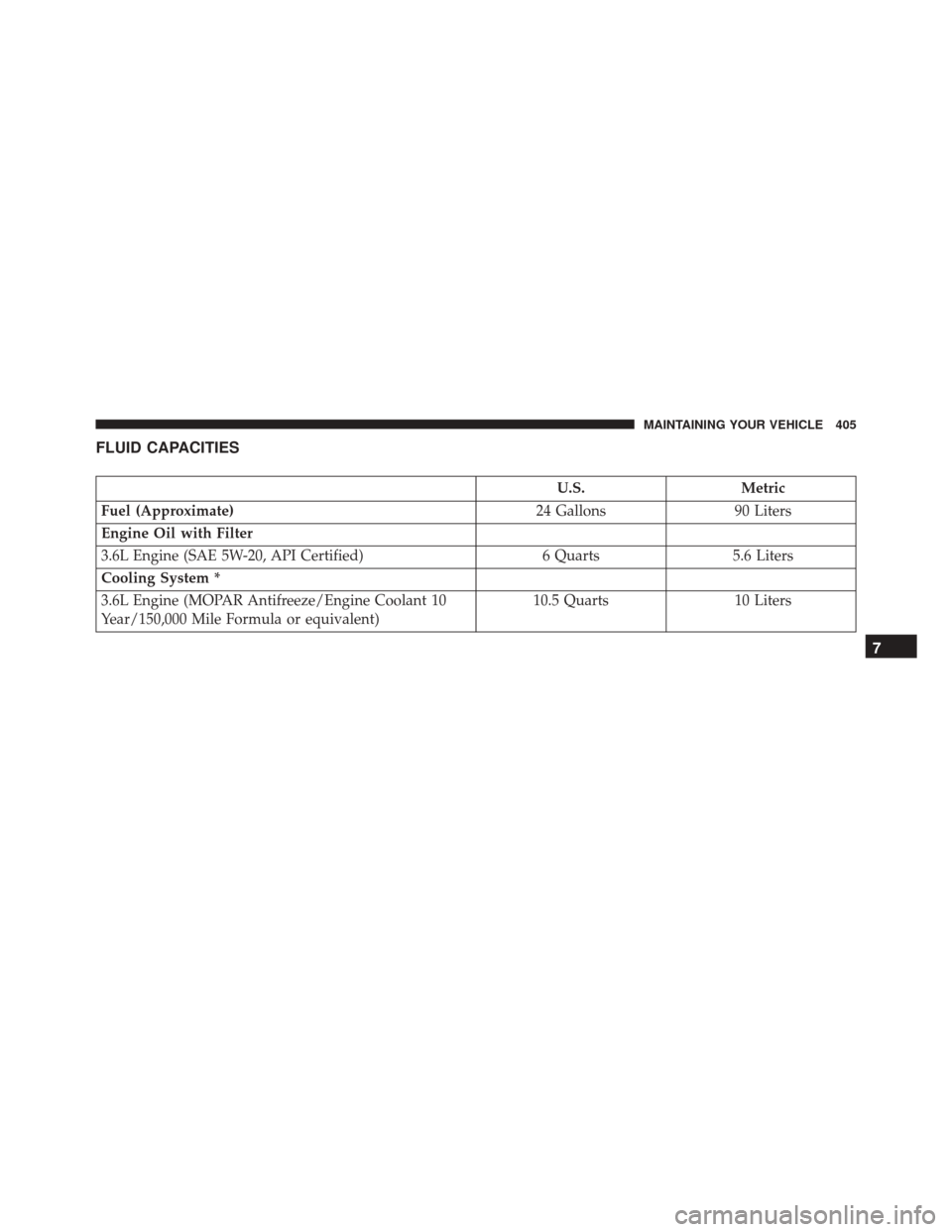
FLUID CAPACITIES
U.S.Metric
Fuel (Approximate) 24 Gallons90 Liters
Engine Oil with Filter
3.6L Engine (SAE 5W-20, API Certified) 6 Quarts5.6 Liters
Cooling System *
3.6L Engine (MOPAR Antifreeze/Engine Coolant 10
Year/150,000 Mile Formula or equivalent) 10.5 Quarts
10 Liters
7
MAINTAINING YOUR VEHICLE 405
Page 408 of 448
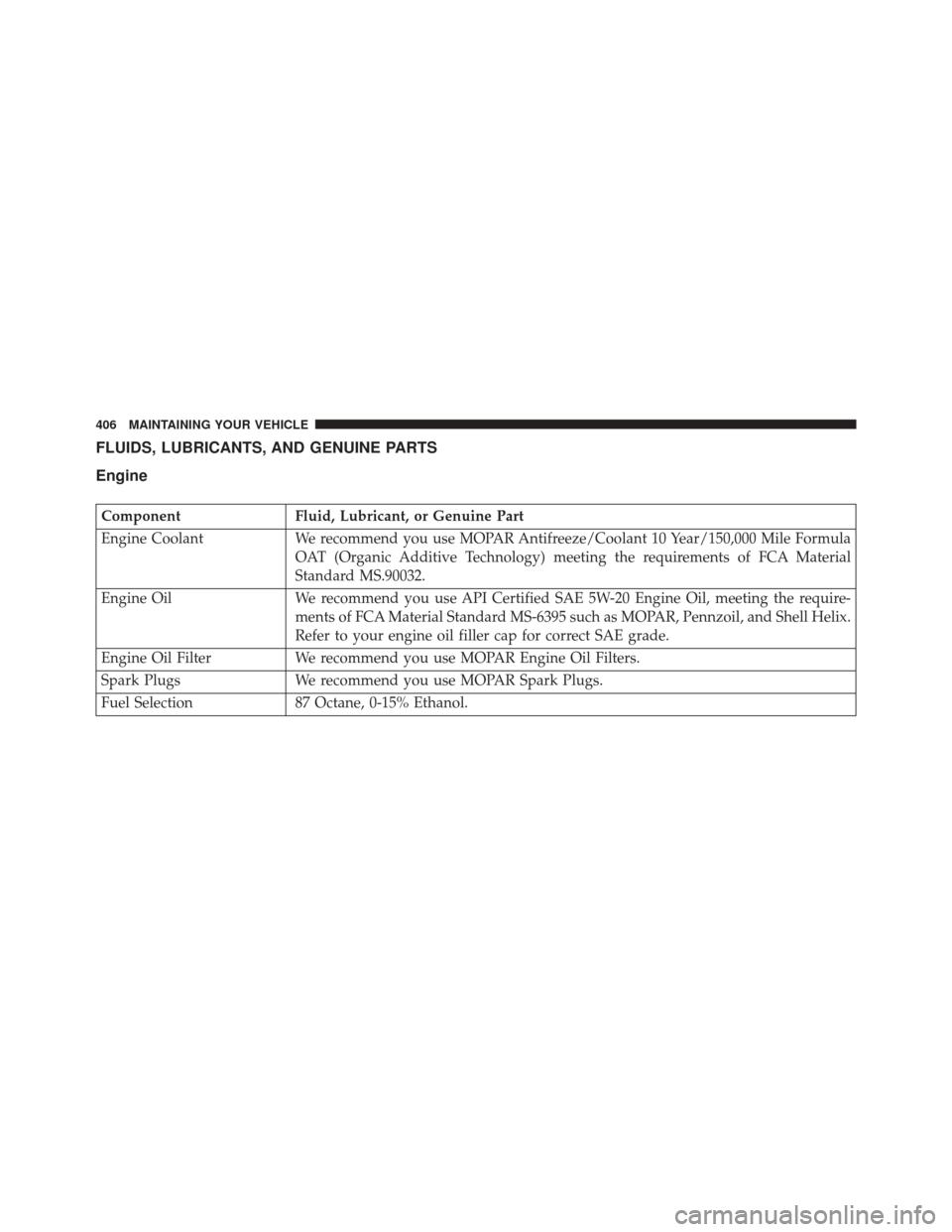
FLUIDS, LUBRICANTS, AND GENUINE PARTS
Engine
ComponentFluid, Lubricant, or Genuine Part
Engine Coolant We recommend you use MOPAR Antifreeze/Coolant 10 Year/150,000 Mile Formula
OAT (Organic Additive Technology) meeting the requirements of FCA Material
Standard MS.90032.
Engine Oil We recommend you use API Certified SAE 5W-20 Engine Oil, meeting the require-
ments of FCA Material Standard MS-6395 such as MOPAR, Pennzoil, and Shell Helix.
Refer to your engine oil filler cap for correct SAE grade.
Engine Oil Filter We recommend you use MOPAR Engine Oil Filters.
Spark Plugs We recommend you use MOPAR Spark Plugs.
Fuel Selection 87 Octane, 0-15% Ethanol.
406 MAINTAINING YOUR VEHICLE
Page 412 of 448

MAINTENANCE SCHEDULE
Your vehicle is equipped with an automatic oil change
indicator system. The oil change indicator system will
remind you that it is time to take your vehicle in for
scheduled maintenance.
Based on engine operation conditions, the oil change
indicator message will illuminate in the instrument clus-
ter. This means that service is required for your vehicle.
Operating conditions such as frequent short-trips, trailer
tow, and extremely hot or cold ambient temperatures will
influence when the “Oil Change Required” message is
displayed. Severe Operating Conditions can cause the
change oil message to illuminate as early as 3,500 miles
(5,600 km) since last reset. Have your vehicle serviced as
soon as possible, within the next 500 miles (805 km).
Your authorized dealer will reset the oil change indicator
message after completing the scheduled oil change. If a
scheduled oil change is performed by someone otherthan your authorized dealer, the message can be reset by
referring to the steps described under “Electronic Vehicle
Information Center (EVIC)” in “Understanding Your
Instrument Panel” for further information.
NOTE:
Under no circumstances should oil change inter-
vals exceed 10,000 miles (16,000 km), twelve months or
350 hours of engine run time, whichever comes first. The
350 hours of engine run or idle time is generally only a
concern for fleet customers.
Severe Duty All Models
Change Engine Oil at 4,000 miles (6,500 km) if the vehicle
is operated in a dusty and off road environment or is
operated predominately at idle or only very low engine
RPM’s. This type of vehicle use is considered Severe
Duty.
410 MAINTENANCE SCHEDULES
Page 413 of 448
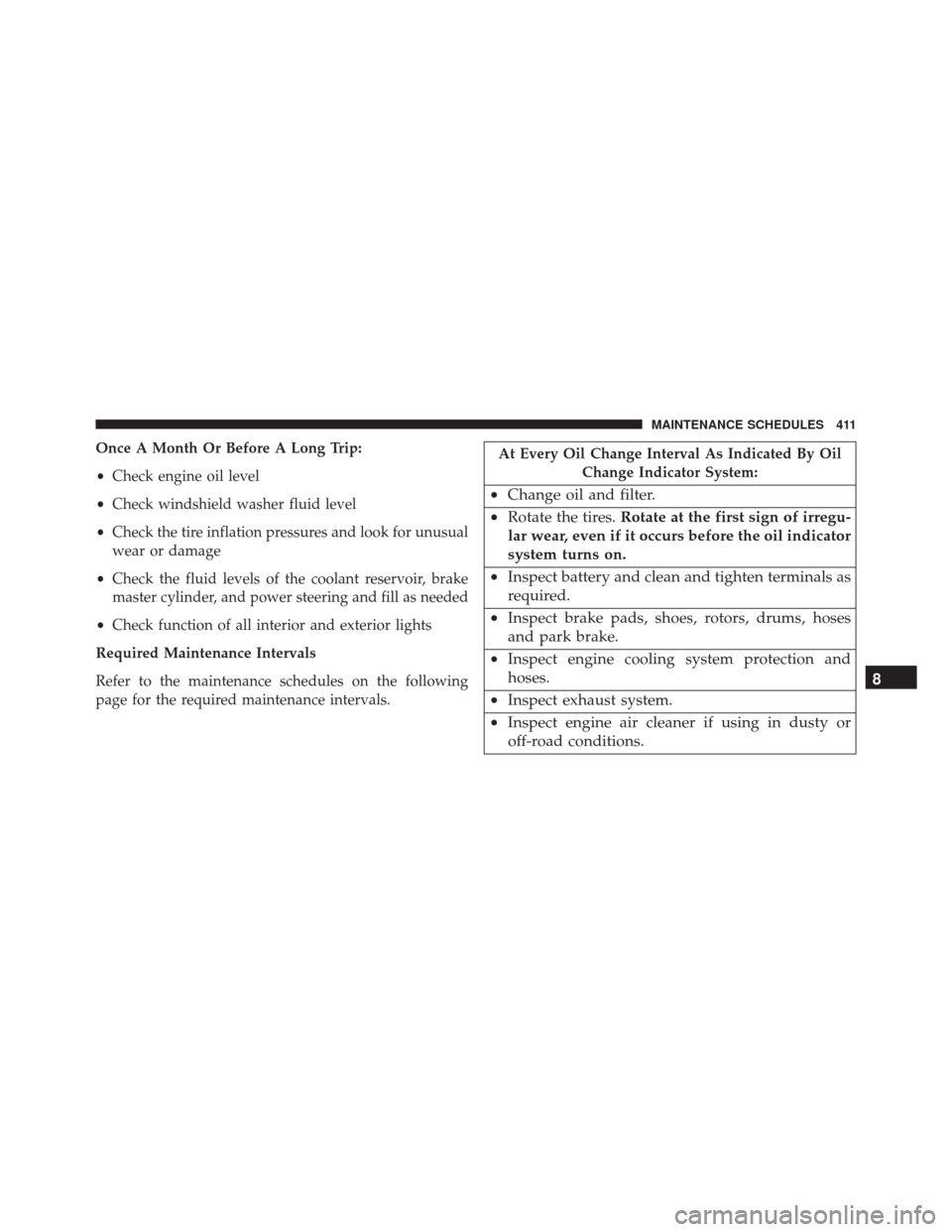
Once A Month Or Before A Long Trip:
•Check engine oil level
• Check windshield washer fluid level
• Check the tire inflation pressures and look for unusual
wear or damage
• Check the fluid levels of the coolant reservoir, brake
master cylinder, and power steering and fill as needed
• Check function of all interior and exterior lights
Required Maintenance Intervals
Refer to the maintenance schedules on the following
page for the required maintenance intervals.At Every Oil Change Interval As Indicated By Oil Change Indicator System:
•Change oil and filter.
• Rotate the tires. Rotate at the first sign of irregu-
lar wear, even if it occurs before the oil indicator
system turns on.
• Inspect battery and clean and tighten terminals as
required.
• Inspect brake pads, shoes, rotors, drums, hoses
and park brake.
• Inspect engine cooling system protection and
hoses.
• Inspect exhaust system.
• Inspect engine air cleaner if using in dusty or
off-road conditions. 8
MAINTENANCE SCHEDULES 411
Page 435 of 448
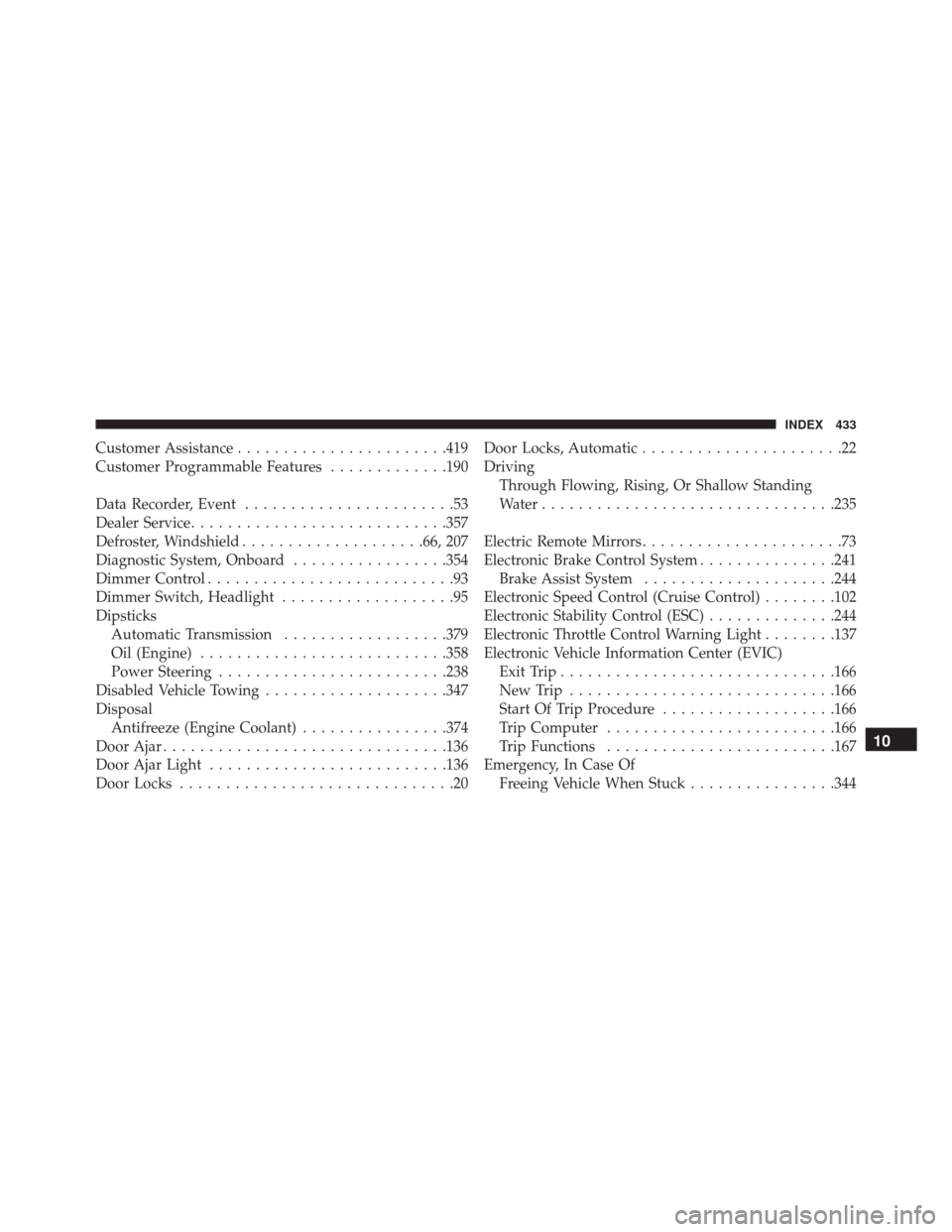
Customer Assistance...................... .419
Customer Programmable Features .............190
Data Recorder, Event .......................53
Dealer Service ........................... .357
Defroster, Windshield ....................66, 207
Diagnostic System, Onboard .................354
Dimmer Control ...........................93
Dimmer Switch, Headlight ...................95
Dipsticks Automatic Transmission ..................379
Oil (Engine) .......................... .358
Power Steering ........................ .238
Disabled Vehicle Towing ....................347
Disposal Antifreeze (Engine Coolant) ................374
Door Ajar .............................. .136
Door Ajar Light ......................... .136
Door Locks ..............................20 Door Locks, Automatic
......................22
Driving Through Flowing, Rising, Or Shallow Standing
Water ............................... .235
Electric Remote Mirrors ......................73
Electronic Brake Control System ...............241
Brake Assist System .....................244
Electronic Speed Control (Cruise Control) ........102
Electronic Stability Control (ESC) ..............244
Electronic Throttle Control Warning Light ........137
Electronic Vehicle Information Center (EVIC) Exit Trip ............................. .166
NewTrip ............................ .166
Start Of Trip Procedure ...................166
Trip Computer ........................ .166
Trip Functions ........................ .167
Emergency, In Case Of Freeing Vehicle When Stuck ................344
10
INDEX 433