warning Ram ProMaster 2017 Owner's Manual
[x] Cancel search | Manufacturer: RAM, Model Year: 2017, Model line: ProMaster, Model: Ram ProMaster 2017Pages: 348, PDF Size: 3.04 MB
Page 302 of 348

WARNING!
Do not use volatile solvents for cleaning purposes.
Many are potentially flammable, and if used in closed
areas they may cause respiratory harm.
CAUTION!
Direct contact of air fresheners, insect repellents, sun-
tan lotions, or hand sanitizers to the plastic, painted, or
decorated surfaces of the interior may cause permanent
damage. Wipe away immediately.
CAUTION!
Damage caused by these type of products may not be
covered by your New Vehicle Limited Warranty.
CAUTION!
Do not use Alcohol and Alcohol-based and/or Keton
based cleaning products to clean leather seats, as
damage to the seat may result.
Cleaning Headlights
Your vehicle is equipped with plastic headlights and fog
lights that are lighter and less susceptible to stone breakage
than glass headlights.
Plastic is not as scratch resistant as glass and therefore
different lens cleaning procedures must be followed.
To minimize the possibility of scratching the lenses and
reducing light output, avoid wiping with a dry cloth. To
remove road dirt, wash with a mild soap solution followed
by rinsing.
Do not use abrasive cleaning components, solvents, steel
wool or other aggressive material to clean the lenses.
Glass Surfaces
All glass surfaces should be cleaned on a regular basis with
MOPAR Glass Cleaner, or any commercial household-type
glass cleaner. Never use an abrasive type cleaner. Use
caution when cleaning the inside rear window equipped
with electric defrosters or windows equipped with radio
antennas. Do not use scrapers or other sharp instrument
that may scratch the elements.
300 MAINTAINING YOUR VEHICLE
Page 303 of 348

When cleaning the rear view mirror, spray cleaner on the
towel or cloth that you are using. Do not spray cleaner
directly on the mirror.
Cleaning Plastic Instrument Cluster Lenses
The lenses in front of the instruments in this vehicle are
molded in clear plastic. When cleaning the lenses, care
must be taken to avoid scratching the plastic.
1. Clean with a wet soft cloth. A mild soap solution may beused, but do not use high alcohol content or abrasive
cleaners. If soap is used, wipe clean with a clean damp
cloth.
2. Dry with a soft cloth.
Seat Belt Maintenance
Do not bleach, dye, or clean the belts with chemical
solvents or abrasive cleaners. This will weaken the fabric.
Sun damage can also weaken the fabric.
If the belts need cleaning, use MOPAR Total Clean, a mild
soap solution, or lukewarm water. Do not remove the belts
from the vehicle to wash them. Dry with a soft cloth.
Replace the belts if they appear frayed or worn or if the
buckles do not work properly.
WARNING!
A frayed or torn belt could rip apart in a collision and
leave you with no protection. Inspect the belt system
periodically, checking for cuts, frays, or loose parts.
Damaged parts must be replaced immediately. Do not
disassemble or modify the system. Seat belt assemblies
must be replaced after a collision if they have been
damaged (i.e., bent retractor, torn webbing, etc.).
Cleaning The Instrument Panel Cupholders
Removal
Pull the flexible liner from the cupholder drawer starting at
one edge to ease removal.
Cleaning
The liner is top shelf dishwasher safe, or you may follow
the cleaning procedure below.
Soak the liner in a mixture of medium hot tap water and
one teaspoon of mild liquid dish soap. Let soak for
approximately 30 minutes. After 30 minutes, pull the liner
from the water and dip it back into the water about six
times. This will loosen any remaining debris. Rinse the
7
MAINTAINING YOUR VEHICLE 301
Page 304 of 348

liner thoroughly under warm running water. Shake the
excess water from the liner and dry the outer surfaces with
a clean soft cloth.
Installation
Place the liner into the cupholder drawer and push the
liner into place so that the retention tabs seat into the
corresponding openings in the drawer.
FUSES
WARNING!
•When replacing a blown fuse, always use an appro-
priate replacement fuse with the same amp rating as
the original fuse. Never replace a fuse with another
fuse of higher amp rating. Never replace a blown
fuse with metal wires or any other material. Failure
to use proper fuses may result in serious personal
injury, fire and/or property damage.
• Before replacing a fuse, make sure that the ignition is
off and that all the other services are switched off
and/or disengaged.
(Continued)
WARNING! (Continued)
•If the replaced fuse blows again, contact an autho-
rized dealer.
• If a general protection fuse for safety systems (air
bag system, braking system), power unit systems
(engine system, gearbox system) or steering system
blows, contact an authorized dealer.
Underhood Fuses
The Front Power Distribution Center is located on the
driver ’s side of the engine compartment. To access the
fuses, remove the cover.
302 MAINTAINING YOUR VEHICLE
Page 325 of 348

Mileage or time passed (which-ever comes first)
20,000
30,000
40,000
50,000
60,000
70,000
80,000
90,000
100,000
110,000
120,000
130,000
140,000
150,000
Or Years: 2 3 4 5 6 7 8 9 10 11 12 13 14 15
Or Kilometers:
32,000
48,000
64,000
80,000
96,000
112,000
128,000
144,000
160,000
176,000
192,000
208,000
224,000
240,000
Flush and replace the engine cool-
ant at 10 years or 150,000 miles
(240,000 km) whichever comes
first. XX
Change automatic transmission
fluid and filter. XX
Inspect and replace PCV valve if
necessary. X
* The brake fluid change interval is time based only,
mileage intervals do not apply.
** The spark plug change interval is mileage based only,
yearly intervals do not apply.
WARNING!
•
You can be badly injured working on or around a
motor vehicle. Do only service work for which you
(Continued)
WARNING! (Continued)
have the knowledge and the right equipment. If you
have any doubt about your ability to perform a
service job, take your vehicle to a competent me-
chanic.
• Failure to properly inspect and maintain your vehicle
could result in a component malfunction and effect
vehicle handling and performance. This could cause
an accident.
8
MAINTENANCE SCHEDULES 323
Page 331 of 348

WARNING!
Engine exhaust (internal combustion engines only),
some of its constituents, and certain vehicle compo-
nents contain, or emit, chemicals known to the State of
California to cause cancer and birth defects, or other
reproductive harm. In addition, certain fluids con-
tained in vehicles and certain products of component
wear contain, or emit, chemicals known to the State of
California to cause cancer and birth defects, or other
reproductive harm.
WARRANTY INFORMATION
See the Warranty Information Booklet, located on the DVD,
for the terms and provisions of FCA US LLC warranties
applicable to this vehicle and market.
MOPAR PARTS
MOPAR fluids, lubricants, parts, and accessories are avail-
able from an authorized dealer. They are recommended for
your vehicle in order to help keep the vehicle operating at
its best.
REPORTING SAFETY DEFECTS
In The 50 United States And Washington, D.C.
If you believe that your vehicle has a defect that could
cause a crash or cause injury or death, you should imme-
diately inform the National Highway Traffic Safety Admin-
istration (NHTSA) in addition to notifying FCA US LLC.
If NHTSA receives similar complaints, it may open an
investigation, and if it finds that a safety defect exists in a
group of vehicles, it may order a recall and remedy
campaign. However, NHTSA cannot become involved in
individual problems between you, your authorized dealer
or FCA US LLC.
To contact NHTSA, you may call the Vehicle Safety Hotline
toll free at 1-888-327-4236 (TTY: 1-800-424-9153); or go to
http://www.safercar.gov; or write to: Administrator,
NHTSA, 400 Seventh Street, SW., Washington, D.C. 20590.
You can also obtain other information about motor vehicle
safety from http://www.safercar.gov.
9
IF YOU NEED CONSUMER ASSISTANCE 329
Page 333 of 348

Or
Visit us on the Worldwide Web at:
•www.techauthority.com
DEPARTMENT OF TRANSPORTATION UNIFORM
TIRE QUALITY GRADES
The following tire grading categories were established by
the National Highway Traffic Safety Administration. The
specific grade rating assigned by the tire’s manufacturer in
each category is shown on the sidewall of the tires on your
vehicle.
All passenger vehicle tires must conform to Federal safety
requirements in addition to these grades.
Treadwear
The Treadwear grade is a comparative rating, based on the
wear rate of the tire when tested under controlled condi-
tions on a specified government test course. For example, a
tire graded 150 would wear one and one-half times as well on the government course as a tire graded 100. The relative
performance of tires depends upon the actual conditions of
their use, however, and may depart significantly from the
norm due to variations in driving habits, service practices,
and differences in road characteristics and climate.
Traction Grades
The Traction grades, from highest to lowest, are AA, A, B,
and C. These grades represent the tire’s ability to stop on
wet pavement, as measured under controlled conditions on
specified government test surfaces of asphalt and concrete.
A tire marked C may have poor traction performance.
WARNING!
The traction grade assigned to this tire is based on
straight-ahead braking traction tests, and does not
include acceleration, cornering, hydroplaning, or peak
traction characteristics.9
IF YOU NEED CONSUMER ASSISTANCE 331
Page 334 of 348

Temperature Grades
The temperature grades are A (the highest), B, and C,
representing the tire’s resistance to the generation of heat
and its ability to dissipate heat, when tested under con-
trolled conditions on a specified indoor laboratory test
wheel. Sustained high temperature can cause the material
of the tire to degenerate and reduce tire life, and excessive
temperature can lead to sudden tire failure. The grade C
corresponds to a level of performance, which all passenger
vehicle tires must meet under the Federal Motor Vehicle
Safety Standard No. 109. Grades B and A represent higher
levels of performance on the laboratory test wheel, than the
minimum required by law.
WARNING!
The temperature grade for this tire is established for a
tire that is properly inflated and not overloaded. Ex-
cessive speed, under-inflation, or excessive loading,
either separately or in combination, can cause heat
buildup and possible tire failure.
332 IF YOU NEED CONSUMER ASSISTANCE
Page 336 of 348
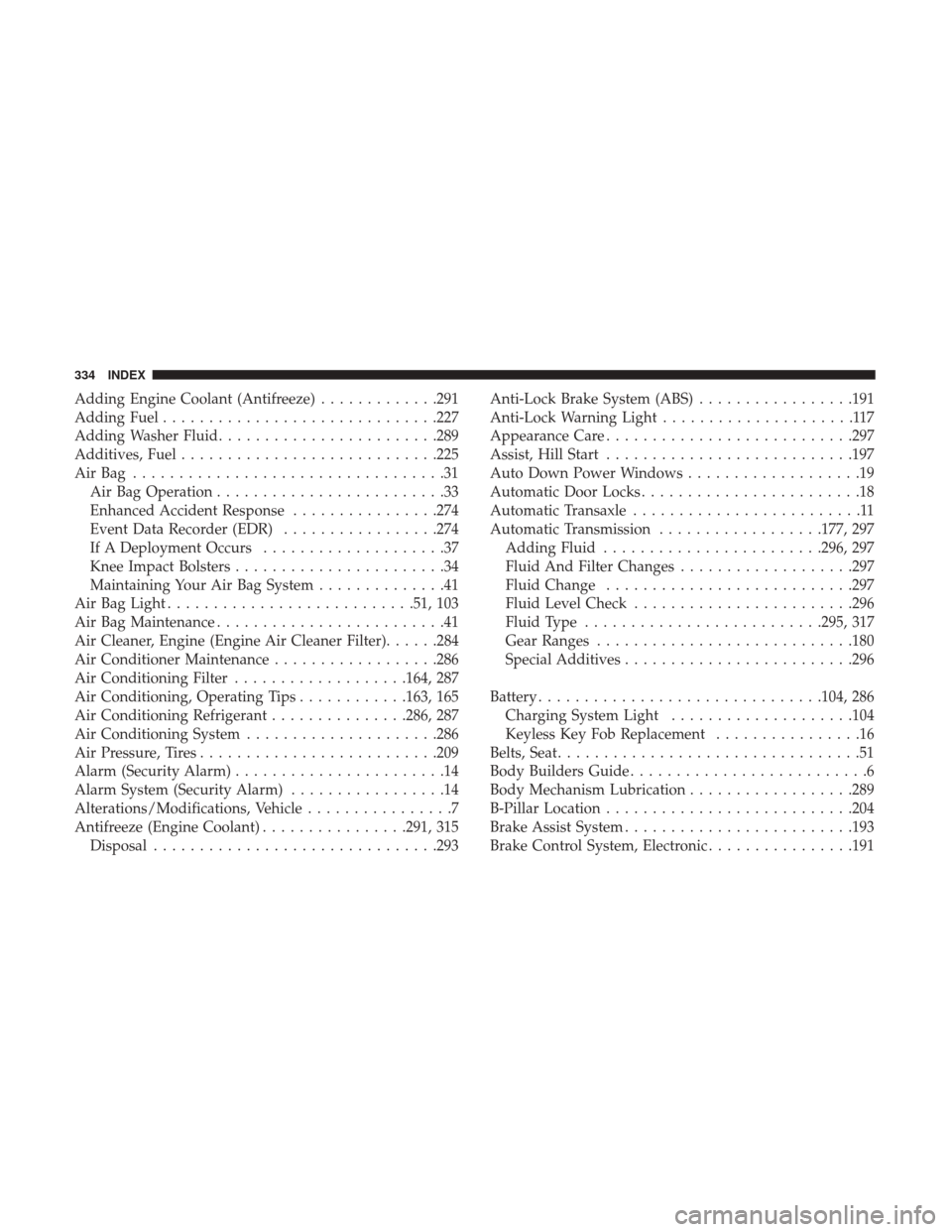
Adding Engine Coolant (Antifreeze).............291
Adding Fuel ............................. .227
Adding Washer Fluid ....................... .289
Additives, Fuel ........................... .225
AirBag ..................................31 Air Bag Operation .........................33
Enhanced Accident Response ................274
Event Data Recorder (EDR) .................274
If A Deployment Occurs ....................37
Knee Impact Bolsters .......................34
Maintaining Your Air Bag System ..............41
Air Bag Light .......................... .51, 103
Air Bag Maintenance .........................41
Air Cleaner, Engine (Engine Air Cleaner Filter) ......284
Air Conditioner Maintenance ..................286
Air Conditioning Filter ...................164, 287
Air Conditioning, Operating Tips ............163, 165
Air Conditioning Refrigerant ...............286, 287
Air Conditioning System .....................286
Air Pressure, Tires ......................... .209
Alarm (Security Alarm) .......................14
Alarm System (Security Alarm) .................14
Alterations/Modifications, Vehicle ................7
Antifreeze (Engine Coolant) ................291, 315
Disposal .............................. .293Anti-Lock Brake System (ABS)
.................191
Anti-Lock Warning Light .....................117
Appearance Care .......................... .297
Assist, Hill Start .......................... .197
Auto Down Power Windows ...................19
Automatic Door Locks ........................18
Automatic Transaxle .........................11
Automatic Transmission ..................177, 297
Adding Fluid ....................... .296, 297
Fluid And Filter Changes ...................297
Fluid Change .......................... .297
Fluid Level Check ....................... .296
Fluid Type ......................... .295, 317
Gear Ranges ........................... .180
Special
Additives ........................ .296
Battery .............................. .104, 286
Charging System Light ....................104
Keyless Key Fob Replacement ................16
Belts, Seat .................................51
Body Builders Guide ..........................6
Body Mechanism Lubrication ..................289
B-Pillar Location .......................... .204
Brake Assist System ........................ .193
Brake Control System, Electronic ................191
334 INDEX
Page 337 of 348

Brake Fluid.............................. .317
Brake, Parking ............................ .189
Brake System ......................... .191, 294
Anti-Lock (ABS) ........................ .191
Fluid Check ........................... .294
Parking .............................. .189
Warning Light .......................... .107
Brake/Transmission Interlock ..................179
Bulb Replacement .......................311,312
Bulbs, Light ........................... .53, 311
Camera, Rear ..............................89
Capacities, Fluid .......................... .315
Caps, Filler Fuel ................................. .227
Power Steering ......................... .189
Radiator (Coolant Pressure) .................292
Carbon Monoxide Warning .................50, 226
Cargo Light ...............................78
Car Washes .............................. .297
Cellular Phone ........................... .157
Certification Label ......................... .228
Chains, Tire ............................. .217
Chart, Tire Sizing .......................... .200
Check Engine Light (Malfunction Indicator Light). . . .279 Checking Your Vehicle For Safety
................50
Checks, Safety .............................50
Child Restraint .............................42
Child Restraints Booster Seats ............................45
Child Restraints ..........................42
Child Seat Installation ......................48
Infants And Child Restraints .................44
Older Children And Child Restraints ...........44
Clean Air Gasoline ........................ .223
Climate Control ........................... .157
Cold Weather Operation ..................... .176
Compact Disc (CD) Maintenance ................156
Compact Spare Tire ........................ .212
Console, Overhead ..........................91
Contract, Service .......................... .328
Coolant
Pressure Cap (Radiator Cap) .............292
Cooling System ........................... .290
Adding Coolant (Antifreeze) .................291
Coolant Capacity ........................ .315
Coolant Level ....................... .290, 293
Disposal Of Used Coolant ..................293
Drain, Flush, And Refill ....................290
Inspection ............................. .293
Points To Remember ..................... .29310
INDEX 335
Page 338 of 348

Pressure Cap........................... .292
Radiator Cap .......................... .292
Selection Of Coolant (Antifreeze) .......291, 315, 316
Corrosion Protection ....................... .297
Cruise Light ..............................119
Cupholders ........................... .94, 301
Customer Assistance ....................... .326
Customer Programmable Features ...............144
Dealer Service ............................ .280
Defroster, Windshield ........................51
Diagnostic System, Onboard ...................278
Dimmer Control ............................75
Dimmer Switch, Headlight .....................76
Dipsticks Automatic Transmission ....................296
Oil (Engine) ........................... .281
Power Steering ......................... .189
Disabled Vehicle Towing .....................272
Disposal Antifreeze (Engine Coolant) .................293
Door Ajar ............................... .104
Door Ajar Light ........................... .104
Door Locks ................................17
Door Locks, Automatic .......................18 Driving
Through Flowing, Rising, Or Shallow Standing
Water ................................ .187
Electric Remote Mirrors .......................59
Electronic Brake Control System ................191
Brake Assist System ...................... .193
Electronic Speed Control (Cruise Control) ..........82
Electronic Stability Control (ESC) ...............193
Electronic Throttle Control Warning Light .........105
Emergency, In Case Of Freeing Vehicle When Stuck .................271
Jump Starting .......................... .267
Emission Control System Maintenance ............279
Engine Air Cleaner ............................ .284
Block Heater ........................... .177
Break-In Recommendations ..................49
Checking Oil Level ...................... .281
Compartment .......................... .277
Compartment
Identification .................277
Coolant (Antifreeze) ...................290, 316
Cooling .............................. .290
Exhaust Gas Caution ...................50, 226
Fails To Start ........................... .176
336 INDEX