child restraint Ram ProMaster 2017 User Guide
[x] Cancel search | Manufacturer: RAM, Model Year: 2017, Model line: ProMaster, Model: Ram ProMaster 2017Pages: 348, PDF Size: 3.04 MB
Page 45 of 348

Manual to make sure you have the correct seat for your
child. Carefully read and follow all the instructions and
warnings in the child restraint Owner ’s Manual and on all
the labels attached to the child restraint.
Before buying any restraint system, make sure that it has a
label certifying that it meets all applicable Safety Stan-
dards. You should also make sure that you can install it in
the vehicle where you will use it.NOTE:
•
For additional information, refer to www.seatcheck.org
or call 1-866-732-8243.
•
Canadian residents should refer to Transport Canada’s
website for additional information: www.tc.gc.ca/eng/
motorvehiclesafety/safedrivers-childsafety-index-53.htm
Summary Of Recommendations For Restraining Children In Vehicles
Child Size, Height, Weight Or Age Recommended Type Of
Child Restraint
Infants and Toddlers Children who are two years old or
younger and who have not reached the height or weight limits of their child restraint Either an Infant Carrier or a Convert-
ible Child Restraint, facing rearward in the rear seat of the vehicle
Small Children Children who are at least two years
old or who have out-grown the
height or weight limit of their rear- facing child restraint Forward-Facing Child Restraint with
a five-point Harness, facing forward in the rear seat of the vehicle
Larger Children Children who have out-grown their
forward-facing child restraint, but
are too small to properly fit the vehi- cle’s seat belt Belt Positioning Booster Seat and the
vehicle seat belt, seated in the rear seat of the vehicle
2
THINGS TO KNOW BEFORE STARTING YOUR VEHICLE 43
Page 46 of 348

Child Size, Height, Weight Or AgeRecommended Type Of
Child Restraint
Children Too Large for Child Re- straints Children 12 years old or younger,
who have out-grown the height or weight limit of their booster seat Vehicle Seat Belt, seated in the rear
seat of the vehicle
Infants And Child Restraints
Safety experts recommend that children ride rear-facing in
the vehicle until they are two years old or until they reach
either the height or weight limit of their rear-facing child
restraint. Two types of child restraints can be used rear-
facing: infant carriers and convertible child seats.
The infant carrier is only used rear-facing in the vehicle. It
is recommended for children from birth until they reach
the weight or height limit of the infant carrier. Convertible
child seats can be used either rear-facing or forward-facing
in the vehicle. Convertible child seats often have a higher
weight limit in the rear-facing direction than infant carriers
do, so they can be used rear-facing by children who have
outgrown their infant carrier but are still less than at least
two years old. Children should remain rear-facing until
they reach the highest weight or height allowed by their
convertible child seat.
WARNING!
•Never place a rear-facing child restraint in front of an
air bag. A deploying passenger Advanced Front Air
Bag can cause death or serious injury to a child 12
years or younger, including a child in a rear-facing
child restraint.
• Only use a rear-facing child restraint in a vehicle
with a rear seat.
Older Children And Child Restraints
Children who are two years old or who have outgrown
their rear-facing convertible child seat can ride forward-
facing in the vehicle. Forward-facing child seats and con-
vertible child seats used in the forward-facing direction are
for children who are over two years old or who have
outgrown the rear-facing weight or height limit of their
rear-facing convertible child seat. Children should remain
44 THINGS TO KNOW BEFORE STARTING YOUR VEHICLE
Page 47 of 348

in a forward-facing child seat with a harness for as long as
possible, up to the highest weight or height allowed by the
child seat.
All children whose weight or height is above the forward-
facing limit for the child seat should use a belt-positioning
booster seat until the vehicle’s seat belts fit properly. If the
child cannot sit with knees bent over the vehicle’s seat
cushion while the child’s back is against the seatback, they
should use a belt-positioning booster seat. The child and
belt-positioning booster seat are held in the vehicle by the
seat belt.
WARNING!
•Improper installation can lead to failure of an infant
or child restraint. It could come loose in a collision.
The child could be badly injured or killed. Follow
the child restraint manufacturer ’s directions exactly
when installing an infant or child restraint.
• After a child restraint is installed in the vehicle, do
not move the vehicle seat forward or rearward be-
cause it can loosen the child restraint attachments.
(Continued)
WARNING! (Continued)
Remove the child restraint before adjusting the ve-
hicle seat position. When the vehicle seat has been
adjusted, reinstall the child restraint.
• When your child restraint is not in use, secure it in
the vehicle with the seat belt or LATCH anchorages,
or remove it from the vehicle. Do not leave it loose in
the vehicle. In a sudden stop or accident, it could
strike the occupants or seatbacks and cause serious
personal injury.
Children Too Large For Booster Seats
Children who are large enough to wear the shoulder belt
comfortably, and whose legs are long enough to bend over
the front of the seat when their back is against the seatback,
should use the seat belt in a rear seat. Use this simple 5-step
test to decide whether the child can use the vehicle’s seat
belt alone:
1. Can the child sit all the way back against the back of the vehicle seat?
2. Do the child’s knees bend comfortably over the front of the vehicle seat – while they are still sitting all the way
back?
2
THINGS TO KNOW BEFORE STARTING YOUR VEHICLE 45
Page 48 of 348

3. Does the shoulder belt cross the child’s shoulder be-tween their neck and arm?
4. Is the lap part of the belt as low as possible, touching the child’s thighs and not their stomach?
5. Can the child stay seated like this for the whole trip?
If the answer to any of these questions was “no,” then the
child still needs to use a booster seat in this vehicle. If the
child is using the lap/shoulder belt, check seat belt fit
periodically and make sure the seat belt buckle is latched.
A child’s squirming or slouching can move the belt out of
position. If the shoulder belt contacts the face or neck,
move the child closer to the center of the vehicle, or use a
booster seat to position the seat belt on the child correctly.
WARNING!
Never allow a child to put the shoulder belt under an
arm or behind their back. In a crash, the shoulder belt
will not protect a child properly, which may result in
serious injury or death. A child must always wear both
the lap and shoulder portions of the seat belt correctly.
Installing Child Restraints in Commercial Vehicles
This commercial vehicle is not designed for use as a family
vehicle and is not intended for carrying children in the
front passenger seat(s). Never install rearward-facing child
restraints in this vehicle. Although the seat belt can be
locked to secure a child restraint, there are no tether
anchorages to complete the proper installation of a
forward-facing child restraint. If you must carry a child in
a forward-facing child restraint, the passenger seat should
be moved to the full rearward position and the child must
be in a proper restraint system based on its age, size and
weight. Follow the instructions below to secure the child
restraint using the seat belt.
WARNING!
Rear-facing infant restraints must never be secured in
the passenger seat of a vehicle with a passenger Air
Bag. In a collision, a passenger Air Bag may deploy
causing severe injury or death to infants riding in
rear-facing infant restraints.
46 THINGS TO KNOW BEFORE STARTING YOUR VEHICLE
Page 49 of 348

Installing Child Restraints Using the Vehicle Seat
Belt
The seat belts in the passenger seating positions are
equipped with a Switchable Automatic Locking Retractor
(ALR) that is designed to keep the lap portion of the seat
belt tight around the child restraint so that it is not
necessary to use a locking clip. The ALR retractor can be
“switched” into a locked mode by pulling all of the
webbing out of the retractor and then letting the webbing
retract back into the retractor. If it is locked, the ALR will
make a clicking noise while the webbing is pulled back into
the retractor. Refer to the “Automatic Locking Mode”
description under “Occupant Restraints” for additional
information on ALR.
Front Bucket Seat Automatic Locking Retractor (ALR)Location
2
THINGS TO KNOW BEFORE STARTING YOUR VEHICLE 47
Page 50 of 348

Installing A Child Restraint With A Switchable
Automatic Locking Retractor (ALR)
1. Place the child seat in the center of the seating position.For some second row seats, you may need to recline the
seat and/or raise the head restraint to get a better fit. If
the rear seat can be moved forward and rearward in the
vehicle, you may wish to move it to its rear-most
position to make room for the child seat. You may also
move the front seat forward to allow more room for the
child seat. 2. Pull enough of the seat belt webbing from the retractor
to pass it through the belt path of the child restraint. Do
not twist the belt webbing in the belt path.
3. Slide the latch plate into the buckle until you hear a “click.”
4. Pull on the webbing to make the lap portion tight against the child seat.
5. To lock the seat belt, pull down on the shoulder part of the belt until you have pulled all the seat belt webbing
out of the retractor. Then, allow the webbing to retract
back into the retractor. As the webbing retracts, you will
hear a clicking sound. This means the seat belt is now in
the Automatic Locking mode.
6. Try to pull the webbing out of the retractor. If it is locked, you should not be able to pull out any webbing.
If the retractor is not locked, repeat step 5.
7. Finally, pull up on any excess webbing to tighten the lap portion around the child restraint while you push the
child restraint rearward and downward into the vehicle
seat.
8. If the child restraint has a top tether strap and the seating position has a top tether anchorage, connect the
Front Bench Seat Automatic Locking Retractor (ALR)
Locations
•ALR = Switchable Automatic Locking Retractor
48 THINGS TO KNOW BEFORE STARTING YOUR VEHICLE
Page 51 of 348
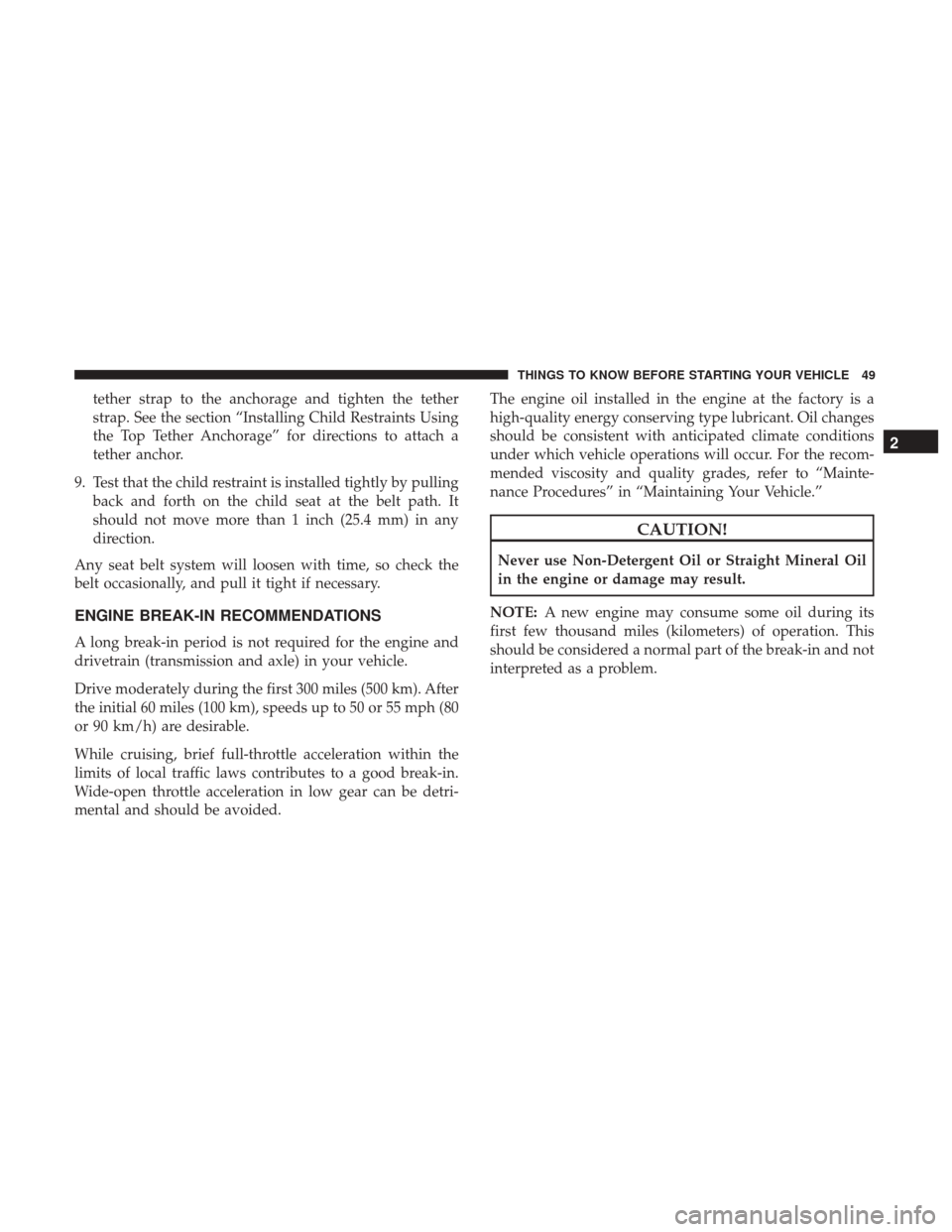
tether strap to the anchorage and tighten the tether
strap. See the section “Installing Child Restraints Using
the Top Tether Anchorage” for directions to attach a
tether anchor.
9. Test that the child restraint is installed tightly by pulling back and forth on the child seat at the belt path. It
should not move more than 1 inch (25.4 mm) in any
direction.
Any seat belt system will loosen with time, so check the
belt occasionally, and pull it tight if necessary.
ENGINE BREAK-IN RECOMMENDATIONS
A long break-in period is not required for the engine and
drivetrain (transmission and axle) in your vehicle.
Drive moderately during the first 300 miles (500 km). After
the initial 60 miles (100 km), speeds up to 50 or 55 mph (80
or 90 km/h) are desirable.
While cruising, brief full-throttle acceleration within the
limits of local traffic laws contributes to a good break-in.
Wide-open throttle acceleration in low gear can be detri-
mental and should be avoided. The engine oil installed in the engine at the factory is a
high-quality energy conserving type lubricant. Oil changes
should be consistent with anticipated climate conditions
under which vehicle operations will occur. For the recom-
mended viscosity and quality grades, refer to “Mainte-
nance Procedures” in “Maintaining Your Vehicle.”
CAUTION!
Never use Non-Detergent Oil or Straight Mineral Oil
in the engine or damage may result.
NOTE: A new engine may consume some oil during its
first few thousand miles (kilometers) of operation. This
should be considered a normal part of the break-in and not
interpreted as a problem.
2
THINGS TO KNOW BEFORE STARTING YOUR VEHICLE 49
Page 337 of 348

Brake Fluid.............................. .317
Brake, Parking ............................ .189
Brake System ......................... .191, 294
Anti-Lock (ABS) ........................ .191
Fluid Check ........................... .294
Parking .............................. .189
Warning Light .......................... .107
Brake/Transmission Interlock ..................179
Bulb Replacement .......................311,312
Bulbs, Light ........................... .53, 311
Camera, Rear ..............................89
Capacities, Fluid .......................... .315
Caps, Filler Fuel ................................. .227
Power Steering ......................... .189
Radiator (Coolant Pressure) .................292
Carbon Monoxide Warning .................50, 226
Cargo Light ...............................78
Car Washes .............................. .297
Cellular Phone ........................... .157
Certification Label ......................... .228
Chains, Tire ............................. .217
Chart, Tire Sizing .......................... .200
Check Engine Light (Malfunction Indicator Light). . . .279 Checking Your Vehicle For Safety
................50
Checks, Safety .............................50
Child Restraint .............................42
Child Restraints Booster Seats ............................45
Child Restraints ..........................42
Child Seat Installation ......................48
Infants And Child Restraints .................44
Older Children And Child Restraints ...........44
Clean Air Gasoline ........................ .223
Climate Control ........................... .157
Cold Weather Operation ..................... .176
Compact Disc (CD) Maintenance ................156
Compact Spare Tire ........................ .212
Console, Overhead ..........................91
Contract, Service .......................... .328
Coolant
Pressure Cap (Radiator Cap) .............292
Cooling System ........................... .290
Adding Coolant (Antifreeze) .................291
Coolant Capacity ........................ .315
Coolant Level ....................... .290, 293
Disposal Of Used Coolant ..................293
Drain, Flush, And Refill ....................290
Inspection ............................. .293
Points To Remember ..................... .29310
INDEX 335
Page 343 of 348
Personal Settings.......................... .144
Placard, Tire And Loading Information ...........205
Power Mirrors ................................59
Steering ........................... .188, 189
Windows ...............................18
Power Steering Fluid ....................... .317
Pregnant Women And Seat Belts .................28
Pretensioners Seat Belts ...............................28
Radial Ply Tires ........................... .210
Radiator Cap (Coolant Pressure Cap) .............292
Radio Frequency General Information .....................13, 16
Radio Operation .......................... .157
Radio (Sound Systems) ..................... .144
Rear Camera ...............................89
Rear ParkSense System .......................85
Rearview Mirrors ...........................58
Recreational Towing ........................ .239
Reformulated Gasoline ...................... .223
Refrigerant .............................. .287
Reminder, Seat Belt ..........................22
Remote Sound System (Radio) Controls ...........156Replacement Bulbs
..........................311
Replacement Keys ...........................13
Replacement Parts ......................... .280
Replacement Tires ......................... .216
Reporting Safety Defects .....................329
Restraint, Head .............................69
Restraints, Child ............................42
Rotation, Tires ............................ .218
Safety Checks Inside Vehicle ...................51
Safety Checks Outside Vehicle ..................53
Safety Defects, Reporting .....................329
Safety, Exhaust Gas ..........................50
Safety Information, Tire ..................... .198
Safety Tips ................................50
Schedule, Maintenance ...................... .320
Seat Belt Adjustable Upper Shoulder Belt Anchorage .......26
Automatic Locking Retractor (ALR) ............29
Energy Management Feature .................28
Lap/Shoulder
Belt Operation .................25
Lap/Shoulder Belts ........................23
Lap/Shoulder Belt Untwisting ................26
Pregnant Women .........................28
Seat Belt Pretensioner ......................28
10
INDEX 341
Page 344 of 348
Seat Belt Reminder........................22
Seat Belt Maintenance ...................... .301
Seat Belt Reminder ..........................22
Seat Belts ............................. .21, 51
Adjustable Shoulder Belt ....................26
Adjustable Upper Shoulder Anchorage ..........26
Child Restraint ...........................42
Front Seat ........................ .21, 23, 25
Inspection ..............................51
Operating Instructions ......................25
Pregnant Women .........................28
Pretensioners ............................28
Rear Seat ...............................23
Reminder ............................. .103
Untwisting Procedure ......................26
Seats ....................................61
Adjustment .............................61
Heated .................................68
Security Alarm .............................14
Selection Of Coolant (Antifreeze) ...............316
Sentry Key (Immobilizer) ......................12
Service Assistance ......................... .326
Service Contract .......................... .328
Service Manuals .......................... .330
Shift Lever Override ....................... .272Shoulder Belts
.............................23
Signals, Turn .......................... .53, 118
Snow Chains (Tire Chains) ....................217
Snow Tires ...............................211
Spare Tire ............................ .212, 214
Spark Plugs ............................. .316
Speed Control Accel/Decel .............................84
Speed Control (Cruise Control) ..................82
Starting ................................ .176
Automatic Transmission ....................176
Cold Weather .......................... .176
Engine Fails To Start ..................... .176
Steering Column Lock ............................81
Power ............................ .188, 189
Steering Wheel Audio Controls .................156
Steering Wheel Mounted Sound System Controls .
. . .156
Storage ..................................311
Storage, Vehicle ........................ .164, 311
Storing Your Vehicle .........................311
Supplemental Restraint System - Air Bag ...........31
Sway Control, Trailer ....................... .196
Synthetic Engine Oil ....................... .283
342 INDEX