transmission oil Ram ProMaster 2018 User Guide
[x] Cancel search | Manufacturer: RAM, Model Year: 2018, Model line: ProMaster, Model: Ram ProMaster 2018Pages: 204, PDF Size: 4 MB
Page 38 of 204
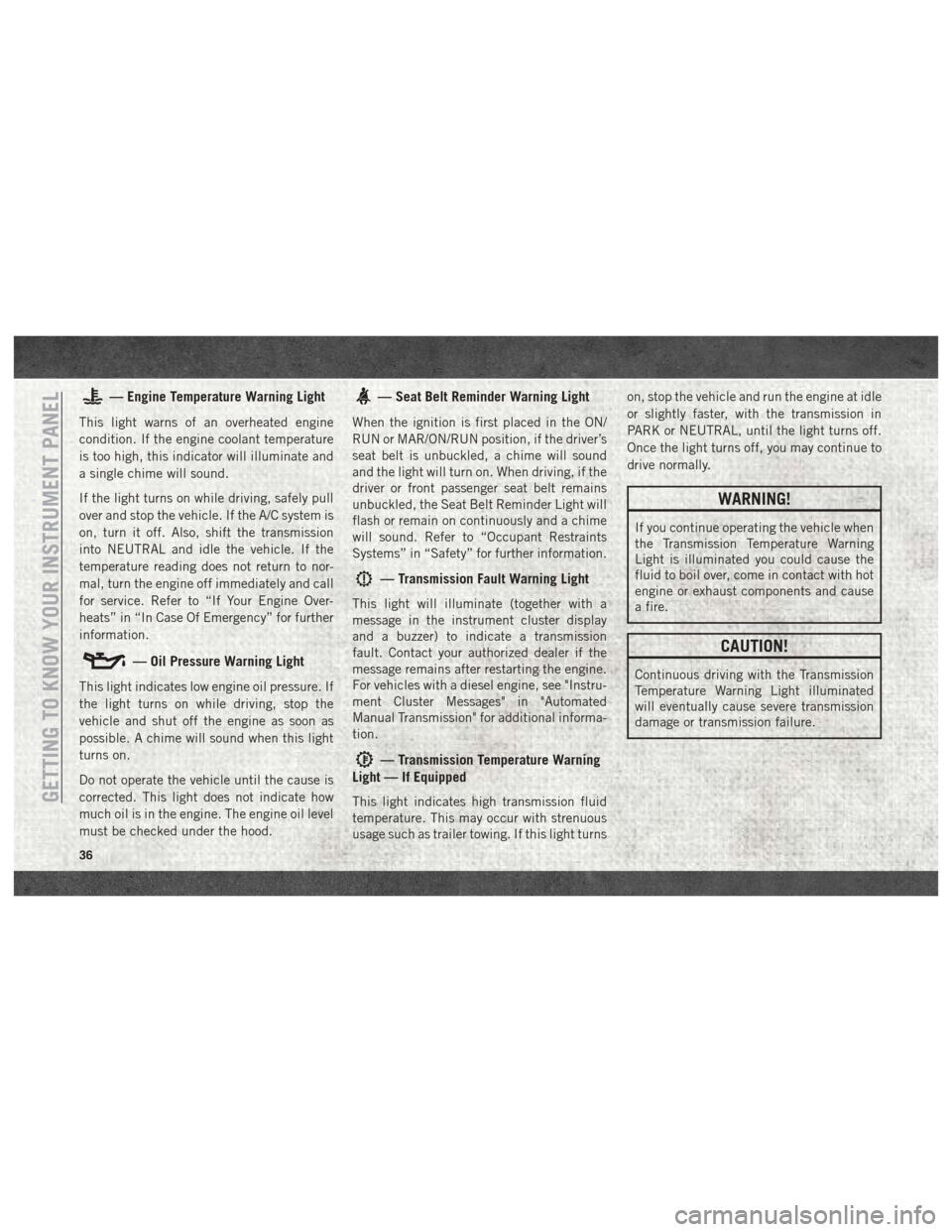
— Engine Temperature Warning Light
This light warns of an overheated engine
condition. If the engine coolant temperature
is too high, this indicator will illuminate and
a single chime will sound.
If the light turns on while driving, safely pull
over and stop the vehicle. If the A/C system is
on, turn it off. Also, shift the transmission
into NEUTRAL and idle the vehicle. If the
temperature reading does not return to nor-
mal, turn the engine off immediately and call
for service. Refer to “If Your Engine Over-
heats” in “In Case Of Emergency” for further
information.
— Oil Pressure Warning Light
This light indicates low engine oil pressure. If
the light turns on while driving, stop the
vehicle and shut off the engine as soon as
possible. A chime will sound when this light
turns on.
Do not operate the vehicle until the cause is
corrected. This light does not indicate how
much oil is in the engine. The engine oil level
must be checked under the hood.
— Seat Belt Reminder Warning Light
When the ignition is first placed in the ON/
RUN or MAR/ON/RUN position, if the driver’s
seat belt is unbuckled, a chime will sound
and the light will turn on. When driving, if the
driver or front passenger seat belt remains
unbuckled, the Seat Belt Reminder Light will
flash or remain on continuously and a chime
will sound. Refer to “Occupant Restraints
Systems” in “Safety” for further information.
— Transmission Fault Warning Light
This light will illuminate (together with a
message in the instrument cluster display
and a buzzer) to indicate a transmission
fault. Contact your authorized dealer if the
message remains after restarting the engine.
For vehicles with a diesel engine, see "Instru-
ment Cluster Messages" in "Automated
Manual Transmission" for additional informa-
tion.
— Transmission Temperature Warning
Light — If Equipped
This light indicates high transmission fluid
temperature. This may occur with strenuous
usage such as trailer towing. If this light turns on, stop the vehicle and run the engine at idle
or slightly faster, with the transmission in
PARK or NEUTRAL, until the light turns off.
Once the light turns off, you may continue to
drive normally.
WARNING!
If you continue operating the vehicle when
the Transmission Temperature Warning
Light is illuminated you could cause the
fluid to boil over, come in contact with hot
engine or exhaust components and cause
a fire.
CAUTION!
Continuous driving with the Transmission
Temperature Warning Light illuminated
will eventually cause severe transmission
damage or transmission failure.
GETTING TO KNOW YOUR INSTRUMENT PANEL
36
Page 77 of 204
CAUTION!
If the “Generic Warning Light” remains on
and a “Service Fuel Filter” message dis-
plays, DO NOT START engine before you
drain the water from the fuel filter housing
to avoid engine damage. Please see your
authorized dealer for draining the fuel
filter/water separator and fuel filter re-
placement.
Normal Starting Procedure
The gear selector must be in the NEUTRAL
(N) position, and the brake pedal must be
pressed, to allow engine cranking. Place the
gear selector in NEUTRAL (N) and apply the
brake pedal BEFORE turning the key to the
START/AVV position; otherwise, the engine
will not crank and the key must be cycled
OFF, then back on, before cranking is al-
lowed.
Observe the instrument panel cluster lights
when starting the engine.NOTE:
Normal starting of either a cold or a warm
engine is obtained without pumping or press-
ing the accelerator pedal.
1. Press and hold the brake pedal.
2. Place the gear selector into the NEUTRAL
(N) position while keeping the brake pedal
depressed.
3. Turn the ignition switch to the ON/RUN/ MAR position and watch the instrument
panel cluster lights.CAUTION!
If the “Generic Warning Light” remains on
and a “Service Fuel Filter” message dis-
plays, DO NOT START engine before you
drain the water from the fuel filter housing
to avoid engine damage. Please see your
authorized dealer for draining the fuel
filter/water separator and fuel filter re-
placement.
4. After the Glow Plug light turns off, turn the ignition switch to the AVV (START)
position to start the engine. Do not press
the accelerator during starting. 5. If you wish to stop the cranking of the
engine prior to the engine starting, release
the ignition key so that it turns back to the
ON/RUN position.
6. Check that the oil pressure warning light has turned off.
7. Release the parking brake.
To start the engine if the transmission is
faulty, the “Delayed startup” procedure may
be required.
NOTE:
Not all Transmission Failures requires the
“Delayed startup” Procedure, it depends on
the type of failure.(refer to "Instrument Clus-
ter Messages" under "Automated Manual
Transmission" in this section for further infor-
mation):
• Begin with the key in the OFF position.
• Press and hold the brake pedal.
• Turn the key to the START/AVV position and hold it there for at least seven seconds with
the brake depressed. The engine will start,
and the transmission will operate in recov-
ery mode (maximum gear permitted = 3rd,
75
Page 78 of 204
automatic mode not available). If the en-
gine does not start, contact your authorized
dealer.
Extreme Cold Weather
Your vehicle may be equipped with three
heating elements; one engine block heater (a
resistance heater installed in the water jacket
of the engine) and two transmission heaters
(one resistance heater installed under the oil
reservoir of the hydraulic actuation system
and one on the differential cover of the trans-
mission). To ensure reliable starting/
operating in extreme cold temperatures, use
of an externally powered electric engine
block/transmission heater (available from
your authorized dealer) is recommended.
They require a 110–115 Volt AC electrical
outlet with a grounded, three-wire extension
cord. Their use is recommended for environ-
ments that routinely fall below -10°F
(-23°C). They should be used when the ve-
hicle has not been running overnight or lon-
ger periods and should be plugged in two
hours prior to start. Their use is required for
cold starts with temperatures under -17°F
(-27°C).NOTE:
The engine is designed to work at an ambient
temperature ranging from -22°F to + 122°F
(-30°C to + 50C°). Rubber, pipes, timing belt
cover and electronic devices are not designed
to work out of this range.
In the case of LOW temperature after Start-
ing, the Automated Manual Transmission
may not be able to engage first gear. In this
case a message "Shift not allowed" appears.
In this situation use the engine block heater.
NOTE:
The engine and transmission block heater
cord is a factory installed option. If your
vehicle is not equipped, heater cords are
available from your authorized Mopar dealer.
• A 12 Volt heater built into the fuel filter
housing aids in preventing fuel gelling. It is
controlled by a built-in thermostat.
• A Diesel Pre-Heat system both improves engine starting and reduces the amount of
white smoke generated by a warming
engine.
NORMAL OPERATION
Observe the following when the diesel engine
is operating.
• All message center lights are off.
• Malfunction Indicator Light (MIL) is off.
• Generic Warning Light is off.
• Engine Oil Pressure telltale is notilluminated.
Stopping The Diesel Engine
Idle the engine a few minutes before routine
shutdown. After full load operation, idle the
engine three to five minutes before shutting it
down. This idle period will allow the lubricat-
ing oil and coolant to carry excess heat away
from the combustion chamber, bearings, in-
ternal components, and turbocharger. This is
especially important for turbocharged diesel
engines.
NOTE:
Refer to the following chart for proper engine
shutdown.STARTING AND OPERATING
76
Page 79 of 204

Driving
Condition LoadTurbo-
charger
Tempera- ture Idle Time
(min.)
Before
Engine
Shutdown
Stop and Go Empty Cool Less than
One
Stop and Go Medium
One
Highway Speeds Medium Warm Two
City Traf- fic Maximum
GCWR Three
Highway Speeds Maximum
GCWR Four
Uphill Grade Maximum
GCWR Hot Five
ENGINE BREAK-IN RECOMMENDATIONS
— GASOLINE ENGINE
A long break-in period is not required for the
engine and drivetrain (transmission and axle)
in your vehicle. Drive moderately during the first 300 miles
(500 km). After the initial 60 miles
(100 km), speeds up to 50 or 55 mph (80 or
90 km/h) are desirable.
While cruising, brief full-throttle acceleration
within the limits of local traffic laws contrib-
utes to a good break-in. Wide-open throttle
acceleration in low gear can be detrimental
and should be avoided.
The engine oil installed in the engine at the
factory is a high-quality energy conserving
type lubricant. Oil changes should be consis-
tent with anticipated climate conditions un-
der which vehicle operations will occur. For
the recommended viscosity and quality
grades, refer to “Fluids And Lubricants” in
“Technical Specifications”.
CAUTION!
Never use Non-Detergent Oil or Straight
Mineral Oil in the engine or damage may
result.
NOTE:
A new engine may consume some oil during
its first few thousand miles (kilometers) of
operation. This should be considered a nor-
mal part of the break-in and not interpreted
as a problem. Please check your oil level with
the engine oil indicator often during the
break in period. Add oil as required.
ENGINE BREAK-IN RECOMMENDATIONS
– DIESEL ENGINE
The diesel engine does not require a break-in
period due to its construction. Normal opera-
tion is allowed, providing the following rec-
ommendations are followed:
• Warm up the engine before placing it under
load.
• Do not operate the engine at idle for pro- longed periods.
• Use the appropriate transmission gear to prevent engine lugging.
• Observe vehicle oil pressure and tempera- ture indicators.
• Check the coolant and oil levels frequently.
77
Page 85 of 204

NOTE:
Do not press the brake and accelerator pedals
at the same time. Use only one foot to operate
the brake and accelerator.
To operate in DRIVE (D) (Automatic mode):
• Press and hold the brake pedal.
• Move the gear selector to the DRIVE (D)position.
NOTE:
If the vehicle is moving, DRIVE engagement
will only occur if the vehicle speed is less
than 2 mph (3 km/h). Otherwise, a chime will
sound, the transmission will shift to NEU-
TRAL, and the DRIVE request must then be
repeated by returning the lever to NEUTRAL
and then back into DRIVE once the speed has
been sufficiently reduced.
• To drive, release the brake pedal and press the accelerator pedal.
When in DRIVE (D) the transmission will shift
gears automatically. The Automated Manual
Transmission uses a geartrain and clutch
similar to other manual transmissions. There- fore, you should become familiar with some
of the normal operational characteristics of
the Automated Manual Transmission:
• Engine torque will be interrupted briefly
during the transmission upshifts, making
these shifts more abrupt than with a typical
automatic transmission. This is normal.
• Although transmission shifting is per- formed automatically, the vehicle will not
"creep" when the brake pedal is released,
and may in fact roll down on an incline.
Leaving from a stop, the accelerator pedal
must be pressed to transmit driving torque
to the wheels.
• In Automatic Mode, the Automated Manual Transmission adapts the gear changing
strategy evaluating the road condition such
as slopes in the road.
• During low-speed driving conditions in first gear, vehicle momentum changes may feel
exaggerated in response to changes in ac-
celerator pedal position. This behavior is
normal and is similar to other vehicles
equipped with manual transmissions. • At low speeds you may hear mechanical
noises similar to a manual transmission as
the transmission changes gears. These
noises are normal and will not damage the
transmission.
• Very aggressive driving may result in some clutch odor. A warning message will display
in the instrument cluster display if cool
down actions are needed.
• Before and after the engine is started, you may hear a hydraulic pump for a short
period of time. This noise is normal and will
not damage the transmission.
During extremely cold temperatures, the
transmission will not operate if the oil tem-
perature is -22°F (-30°C) or below. Normal
operation will resume once the transmission
temperature has risen to a suitable level.
When transmission actuation oil temperature
is lower than -22°F (-30°C), engine start will
not be allowed. For this reason the block
heater is recommended below -17°F (-27°C).
83
Page 106 of 204

CavityMaxi Fuse Mini Fuse Description
F10 –15 Amp BlueHorn
F11 –15 Amp BlueFuel Pressure Regulator (MPROP)-DRV (3.0 Diesel
Engine) — If Equipped
F14 –20 Amp Yellow Power Outlet
F15 –7.5 Amp Brown USB Charger
F16 –7.5 Amp BrownKL15 Shifter Transmission Module (STM) (3.6),
KL15 Starter Relay Coil (3.6 Gasoline Engine)
F16 –7.5 Amp BrownKL15 Manual Transmission Automated (MTA),
KL15 Gear Selector Unit, KL15 Engine Control Mod-
ule (ECM), KL15 Starter Relay Coil (3.0 Diesel En-
gine)
F17 –20 Amp YellowEngine Control Module (ECM), Injectors (3.6 Gasoline
Engine)
F17 –20 Amp YellowSecondary Loads, Engine Control Module (ECM)
(3.0 Diesel Engine)
F18 –7.5 Amp BrownKL30 Engine Control Module (ECM), KL30 Main Re-
lay Coil (3.6 Gasoline Engine)
F18 –7.5 Amp BrownKL30 Manual Transmission Automated (MTA),
KL30 Engine Control Module (ECM), KL30 Main Re-
lay Coil (3.0 Diesel Engine)
F19 –7.5 Amp Brown A/C Compressor — If Equipped
F20 –30 Amp Green Windshield Wiper
F21 –15 Amp BlueFuel Pump
F22 –20 Amp YellowEngine Control Module (ECM), Ignition Coils
(3.6 Gasoline Engine)
IN CASE OF EMERGENCY
104
Page 107 of 204

CavityMaxi Fuse Mini Fuse Description
F22 –20 Amp YellowEngine Control Module (ECM), Primary Loads
(3.0 Diesel Engine)
F23 –20 Amp Yellow Electronic Stability Control (ESC) Valves
F24 –7.5 Amp BrownKL15 Vacuum Pump Relay Coil (3.6 Gasoline Engine)
— If Equipped
F30 –15 Amp BlueHeated Mirrors
Front PDC Additional Fuses
The additional fuse box is located inside the front PDC Box.
Cavity Mini Fuse Description
F61 20 Amp YellowVacuum Pump (3.6 Gasoline Engine) — If Equipped
F62 30 Amp GreenTransmission Power RELE (3.6 Gasoline Engine) — If Equipped
F64 7.5 Amp Brown Urea Pump (3.0 Diesel Engine) — If Equipped
F65 20 Amp YellowUREA NOX SNS 1-2 + PM SNS (3.0 Diesel Engine) — If Equipped
F66 5 Amp BeigeShifter Transmission Module (STM) (3.6 Gasoline Engine) — If
Equipped
105
Page 131 of 204

Mileage or time passed
(whichever comes first)
10,000
20,000
30,000
40,000
50,000
60,000
70,000
80,000
90,000
100,000
110,000
120,000
130,000
140,000
150,000
Or Years: 1 2 3 4 5 6 7 8 9 10 11 12 13 14 15
Or Kilometers:
16,000
32,000
48,000
64,000
80,000
96,000
112,000
128,000
144,000
160,000
176,000
192,000
208,000
224,000
240,000
Additional Inspections
Completely fill the Diesel Exhaust Fluid
tank. XXXXXXXXXXXXXXX
Inspect the CV joints. X X X X X
Inspect front suspension, tie rod ends,
boot seals, and replace if necessary. XXX X X X X
Inspect the brake pads, replace as neces-
sary. XXX X X X X
Check Transmission Actuation System Oil
and Hydraulic Clutch Operating Oil XX X X X
Additional Maintenance
Replace fuel filter and drain water from
fuel. XX X X X
Replace engine air filter. X X X X X
Replace cabin/air conditioning filter. X X X X X X X
Replace Brake Fluid every two years. * X X X X X X X
Replace Hydraulic Clutch Oil every two
years or 60,000 miles (96,000 km) which
ever comes first. XXX X X X X
Flush and replace the engine coolant at
10 years or 150,000 miles (240,000 km)
whichever comes first. XX
129
Page 157 of 204

FLUID CAPACITIES — GASOLINE ENGINE
U.S.Metric
Fuel (Approximate) 24 Gallons90 Liters
Engine Oil With Filter
3.6L Engine (SAE 5W-20, API Certified) 6 Quarts5.6 Liters
Cooling System *
3.6L Engine (Mopar Antifreeze/Engine Coolant
10 Year/150,000 Mile Formula or equivalent) 10.5 Quarts
10 Liters
FLUID CAPACITIES — DIESEL ENGINE
U.S.Metric
Fuel (Approximate)
3.0L Diesel Engine 24 Gallons90 Liters
Diesel Exhaust Fluid Tank 5 Gallons18.9 Liters
Engine Oil with Filter
3.0L Diesel Engine 9.5 Quarts9.0 Liters
Cooling System *
3.0L Diesel Engine With MTA Transmission
(Mopar Antifreeze/Engine Coolant 10 Year/
150,000 Mile Formula or equivalent) 12.7 Quarts
12 Liters
* Includes heater and coolant recovery bottle filled to MAX level. Add 2.9 Qts (2.8 L) if equipped with a rear heater.
155
Page 159 of 204

Chassis
ComponentFluid, Lubricant, Or Genuine Part
Automatic Transmission – 3.6L Gasoline Engine Only Use Only ATF+4 Automatic Transmission Fluid. Failure to use ATF+4 fluid
may affect the function or performance of your transmission. We recom-
mend Mopar ATF+4 Fluid.
Brake Master Cylinder We recommend you use Mopar DOT 4.
DOT 4 brake fluid must be changed every two years regardless of mileage.
Power Steering Reservoir Use Pentosin CHF 11S power steering fluid meeting FCA Material Stan-
dard MS-11655.
FLUIDS AND LUBRICANTS — 3.0L DIESEL ENGINE
Engine
Component
Fluid, Lubricant, Or Genuine Part
Engine Coolant We recommend you use Mopar Antifreeze/Coolant 10 Year/150,000 Mile Formula OAT (Organic
Additive Technology).
Engine Oil Only use ACEA C3 5W-30 Synthetic Low Ash engine oil meeting FCA Material Standard MS-11106 or
Pennzoil Ultra Euro L full synthetic 5W-30 motor oil.
Engine Oil Filter We recommend you use Mopar Engine Oil Filters.
Fuel Filter We recommend you use Mopar Fuel Filter. Must meet 3 micron rating.
Using a fuel filter that does not
meet the manufacturers filtration and water separating requirements can severely impact fuel system life
and reliability.
157