child lock RAM PROMASTER 2023 User Guide
[x] Cancel search | Manufacturer: RAM, Model Year: 2023, Model line: PROMASTER, Model: RAM PROMASTER 2023Pages: 296, PDF Size: 12.31 MB
Page 178 of 296

176SAFETY
Seat Belts And Pregnant Women
Seat Belts And Pregnant Women
Seat belts must be worn by all occupants including
pregnant women: the risk of injury in the event of
an accident is reduced for the mother and the
unborn child if they are wearing a seat belt.
Position the lap belt snug and low below the
abdomen and across the strong bones of the hips.
Place the shoulder belt across the chest and away
from the neck. Never place the shoulder belt
behind the back or under the arm.
Seat Belt Pretensioner
The front seat belt system is equipped with
pretensioning devices that are designed to remove
slack from the seat belt in the event of a collision.
These devices may improve the performance of the seat belt by removing slack from the seat belt
early in a collision. Pretensioners work for all size
occupants, including those in child restraints.
NOTE:These devices are not a substitute for proper seat
belt placement by the occupant. The seat belt still
must be worn snugly and positioned properly.
The pretensioners are triggered by the Occupant
Restraint Controller (ORC). Like the air bags, the
pretensioners are single use items. A deployed
pretensioner or a deployed air bag must be
replaced immediately.
Energy Management Feature
The front seat belt system is equipped with an
Energy Management feature that may help further
reduce the risk of injury in the event of a collision.
The seat belt system has a retractor assembly that
is designed to release webbing in a controlled
manner.
Switchable Automatic Locking
Retractor (ALR)
The seat belt in the passenger seating position is
equipped with a Switchable Automatic Locking
Retractor (ALR) which is used to secure a child restraint
system
Ú
page 188. The figure below illustrates the
locking feature for each seating position.
Front Bucket Seat: Switchable Automatic Locking
Retractor (ALR) Location
Front Bench Seat: Switchable Automatic Locking Retractor (ALR) Locations
23_VF_OM_EN_USC_t.book Page 176
Page 179 of 296

SAFETY177
If the passenger seating position is equipped with an
ALR and is being used for normal usage, only pull the
seat belt webbing out far enough to comfortably wrap
around the occupant’s mid-section so as to not activate
the ALR. If the ALR is activated, you will hear a clicking
sound as the seat belt retracts. Allow the webbing
to retract completely in this case and then carefully
pull out only the amount of webbing necessary to
comfortably wrap around the occupant’s mid-section.
Slide the latch plate into the buckle until you hear a
"click."
In Automatic Locking Mode, the shoulder belt is
automatically pre-locked. The seat belt will still
retract to remove any slack in the shoulder belt.
Use the Automatic Locking Mode anytime a child
restraint is installed in a seating position that has
a seat belt with this feature. Children 12 years old
and under should always be properly restrained in
the rear seat of a vehicle with a rear seat. How To Engage The Automatic Locking Mode
1. Buckle the combination lap and shoulder belt.
2. Grab the shoulder portion and pull downward
until the entire seat belt is extracted.
3. Allow the seat belt to retract. As the seat belt retracts, you will hear a clicking sound.
This indicates the seat belt is now in the
Automatic Locking Mode. How To Disengage The Automatic Locking Mode
Unbuckle the combination lap/shoulder belt and
allow it to retract completely to disengage the
Automatic Locking Mode and activate the vehicle
sensitive (emergency) locking mode.
WARNING!
Never place a rear-facing child restraint in
front of an air bag. A deploying passenger
front air bag can cause death or serious injury
to a child 12 years or younger, including a
child in a rear-facing child restraint.
Never install a rear-facing child restraint in the
front seat of a vehicle. Only use a rear-facing
child restraint in the rear seat. If the vehicle
does not have a rear seat, do not transport a
rear-facing child restraint in that vehicle.
WARNING!
The seat belt assembly must be replaced if the
switchable Automatic Locking Retractor (ALR)
feature or any other seat belt function is not
working properly when checked according to
the procedures in the Service Manual.
Failure to replace the seat belt assembly
could increase the risk of injury in collisions.
Do not use the Automatic Locking Mode to
restrain occupants who are wearing the seat
belt or children who are using booster seats.
The locked mode is only used to install
rear-facing or forward-facing child restraints
that have a harness for restraining the child.6
23_VF_OM_EN_USC_t.book Page 177
Page 183 of 296

SAFETY181
Supplemental Side Air Bag Inflatable
Curtains (SABICs)
This vehicle is equipped with Supplemental Side
Air Bag Inflatable Curtains (SABICs).
Supplemental Side Air Bag Inflatable Curtains
(SABICs) are located above the side windows.
The trim covering the SABICs is labeled
“SRS AIRBAG” or “AIRBAG.”
Supplemental Side Air Bag Inflatable Curtain (SABIC) Label Location
SABICs may help reduce the risk of head and other
injuries to front and rear seat outboard occupants
in certain side impacts, in addition to the injury
reduction potential provided by the seat belts and
body structure. The SABIC deploys downward, covering the side
windows. An inflating SABIC pushes the outside
edge of the headliner out of the way and covers the
window. The SABICs inflate with enough force to
injure occupants if they are not belted and seated
properly, or if items are positioned in the area
where the SABICs inflate. Children are at an even
greater risk of injury from a deploying air bag.
The SABICs may help reduce the risk of partial or
complete ejection of vehicle occupants through
side windows in certain side impact events.
Side Impacts
The Side Air Bags are designed to activate in
certain side impacts. The Occupant Restraint
Controller (ORC) determines whether the
deployment of the Side Air Bags in a particular
impact event is appropriate, based on the severity
and type of collision. The side impact sensors aid
the ORC in determining the appropriate response
to impact events. The system is calibrated to
deploy the Side Air Bags on the impact side of the
vehicle during impacts that require Side Air Bag
occupant protection. In side impacts, the Side Air
Bags deploy independently; a left side impact
deploys the left Side Air Bags only and a right-side
impact deploys the right Side Air Bags only. Vehicle
damage by itself is not a good indicator of whether
or not Side Air Bags should have deployed.
The Side Air Bags will not deploy in all side
collisions, including some collisions at certain
angles, or some side collisions that do not impact
the area of the passenger compartment. The Side
Air Bags may deploy during angled or offset frontal
collisions where the front air bags deploy.
Side Air Bags are a supplement to the seat belt
restraint system. Side Air Bags deploy in less time
than it takes to blink your eyes.
WARNING!
Do not mount equipment, or stack luggage
or other cargo up high enough to block the
deployment of the SABICs. The trim covering
above the side windows where the SABIC and
its deployment path are located should
remain free from any obstructions.
In order for the SABICs to work as intended, do
not install any accessory items in your vehicle
which could alter the roof. Do not add an after
-
market sunroof to your vehicle. Do not add
roof racks that require permanent attach -
ments (bolts or screws) for installation on the
vehicle roof. Do not drill into the roof of the
vehicle for any reason.
6
23_VF_OM_EN_USC_t.book Page 181
Page 190 of 296
188SAFETY
Installing Child Restraints In Commercial
Vehicles
This commercial vehicle is not designed for use as a
family vehicle and is not intended for carrying children
in the front passenger seat(s). Never install rear-facing
child restraints in this vehicle. Although the seat belt
can be locked to secure a child restraint, there are no
tether anchorages to complete the proper installation
of a forward-facing child restraint. If you must carry a
child in a forward-facing child restraint, the passenger
seat should be moved to the full rearward position and
the child must be in a proper restraint system based on
its age, size and weight. Follow the instructions below
to secure the child restraint using the seat belt.
Installing Child Restraints Using The
Vehicle Seat Belt
Child restraint systems are designed to be secured
in vehicle seats by lap belts or the lap belt portion
of a lap/shoulder belt.
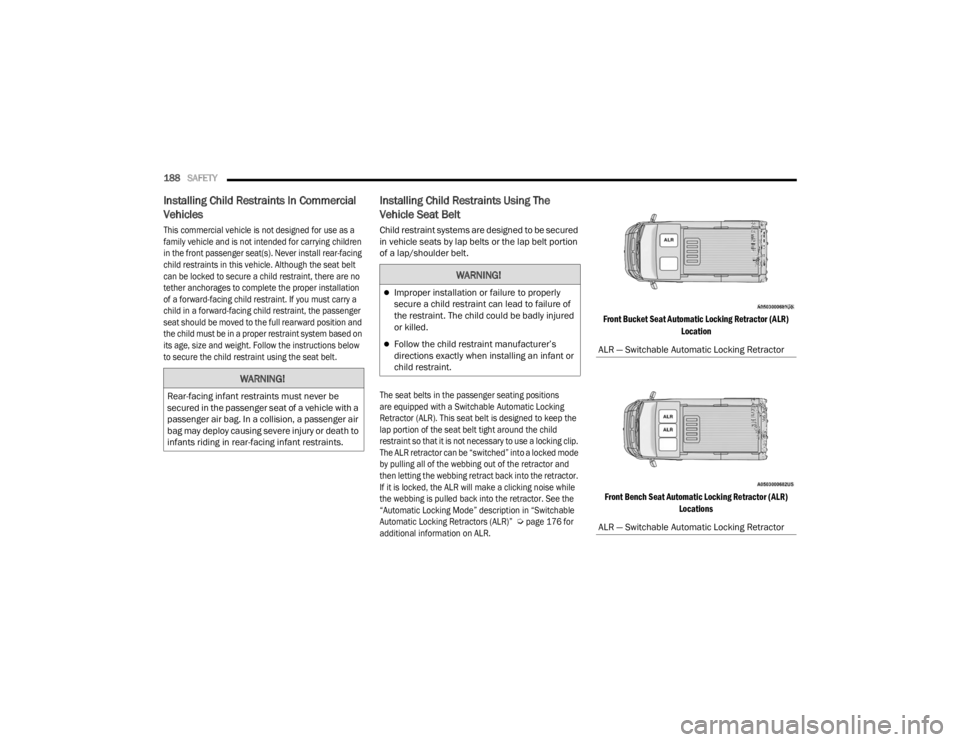
The seat belts in the passenger seating positions
are equipped with a Switchable Automatic Locking
Retractor (ALR). This seat belt is designed to keep the
lap portion of the seat belt tight around the child
restraint so that it is not necessary to use a locking clip.
The ALR retractor can be “switched” into a locked mode
by pulling all of the webbing out of the retractor and
then letting the webbing retract back into the retractor.
If it is locked, the ALR will make a clicking noise while
the webbing is pulled back into the retractor. See the
“Automatic Locking Mode” description in “Switchable
Automatic Locking Retractors (ALR)”
Ú
page 176 for
additional information on ALR.
Front Bucket Seat Automatic Locking Retractor (ALR)
Location
Front Bench Seat Automatic Locking Retractor (ALR) Locations
WARNING!
Rear-facing infant restraints must never be
secured in the passenger seat of a vehicle with a
passenger air bag. In a collision, a passenger air
bag may deploy causing severe injury or death to
infants riding in rear-facing infant restraints.
WARNING!
Improper installation or failure to properly
secure a child restraint can lead to failure of
the restraint. The child could be badly injured
or killed.
Follow the child restraint manufacturer’s
directions exactly when installing an infant or
child restraint.ALR — Switchable Automatic Locking Retractor
ALR — Switchable Automatic Locking Retractor
23_VF_OM_EN_USC_t.book Page 188
Page 191 of 296

SAFETY189
Installing A Child Restraint With A
Switchable Automatic Locking
Retractor (ALR)
Child restraint systems are designed to be secured
in vehicle seats by lap belts or the lap belt portion
of a lap/shoulder belt.
1. Place the child seat in the center of the
seating position.
2. Pull enough of the seat belt webbing from the retractor to pass it through the belt path of the
child restraint. Do not twist the belt webbing in
the belt path.
3. Slide the latch plate into the buckle until you hear a “click.” 4. Pull on the webbing to make the lap portion
tight against the child seat.
5. To lock the seat belt, pull down on the shoulder part of the belt until you have pulled all the
seat belt webbing out of the retractor. Then,
allow the webbing to retract back into the
retractor. As the webbing retracts, you will hear
a clicking sound. This means the seat belt is
now in the Automatic Locking mode.
6. Try to pull the webbing out of the retractor. If it is locked, you should not be able to pull out any
webbing. If the retractor is not
locked, repeat
step 5.
7. Finally, pull up on any excess webbing to tighten the lap portion around the child
restraint while you push the child restraint
rearward and downward into the vehicle seat.
8. Test that the child restraint is installed tightly by pulling back and forth on the child seat at
the belt path. It should not move more than
1 inch (25.4 mm) in any direction.
Any seat belt system will loosen with time, so check
the belt occasionally, and pull it tight if necessary.
SAFETY TIPS
TRANSPORTING PASSENGERS
NEVER TRANSPORT PASSENGERS IN THE CARGO
AREA.
WARNING!
Improper installation or failure to properly
secure a child restraint can lead to failure of
the restraint. The child could be badly injured
or killed.
Follow the child restraint manufacturer’s
directions exactly when installing an infant or
child restraint.
WARNING!
Do not leave children or animals inside parked
vehicles in hot weather. Interior heat buildup
may cause serious injury or death.
It is extremely dangerous to ride in a cargo
area, inside or outside of a vehicle. In a colli -
sion, people riding in these areas are more
likely to be seriously injured or killed.
Do not allow people to ride in any area of your
vehicle that is not equipped with seats and
seat belts.
Be sure everyone in your vehicle is in a seat
and using a seat belt properly.
6
23_VF_OM_EN_USC_t.book Page 189
Page 286 of 296

284 Brake/Transmission Interlock
......................... 81Bulb Replacement......................................... 244Bulbs, Light.......................................... 191, 244
C
Camera, Rear...................................... 119, 120Capacities, Fluid............................................ 273Caps, Filler Fuel........................................................... 122Oil (Engine)................................................ 225Radiator (Coolant Pressure)...................... 234Car Washes................................................... 266Carbon Monoxide Warning............................ 192Cargo Area Cover............................................. 51Cargo Compartment........................................ 51Cargo Light...................................................... 36Cellular Phone............................................... 151Certification Label......................................... 123Change Engine Oil — If Equipped
S
.............. 57Change Oil Indicator........................................ 57Changing A Flat Tire....................................... 196Chart, Tire Sizing............................................ 250Check Engine Light (Malfunction
Indicator Light)................................................ 74Checking Your Vehicle For Safety.................. 189Checks, Safety............................................... 189Child Restraint............................................... 185
Child RestraintsBooster Seats........................................... 187Child Seat Installation.............................. 189Infant And Child Restraints....................... 186Older Children And Child Restraints......... 187Clean Air Gasoline......................................... 271CleaningWheels..................................................... 262Climate Control................................................ 40Manual........................................................ 40Rear............................................................. 43Cold Weather Operation.................................. 76Compact Spare Tire...................................... 260Contract, Service.......................................... 277Cooling Pressure Cap (Radiator Cap)............ 234Cooling System............................................. 233Adding Coolant (Antifreeze)...................... 233Coolant Level................................... 233, 234Cooling Capacity....................................... 273Disposal Of Used Coolant......................... 234Drain, Flush, And Refill............................. 233Inspection................................................. 234Points To Remember................................ 234Pressure Cap............................................ 234Radiator Cap............................................ 234Selection Of Coolant (Antifreeze)..... 233, 273Corrosion Protection..................................... 265Cruise Control (Speed Control)................. 87, 88
Cruise Light......................................................72Customer Assistance.................................... 275Customer Programmable Features............... 134Cybersecurity................................................ 133
D
Dealer Service............................................... 227Defroster, Windshield................................... 190Diagnostic System, Onboard............................74Dimmer Control Switch....................................37Dimmer SwitchHeadlight.....................................................34DipsticksAutomatic Transmission........................... 236Oil (Engine)............................................... 226Disable Vehicle Towing................................. 219DisposalAntifreeze (Engine Coolant)...................... 234Door Ajar..........................................................66Door Ajar Light.................................................66Door Locks.......................................................21Automatic....................................................23Doors...............................................................21Driver’s Seat Back Tilt......................................23DrivingThrough Flowing, Rising, Or Shallow Standing Water
.................................................... 131Drowsy Driver Detection................................ 157
23_VF_OM_EN_USC_t.book Page 284
Page 290 of 296

288 Operator Manual Owner's Manual
........................................ 279Outside Rearview Mirrors......................... 30, 31Overheating, Engine...................................... 216
P
Paint Care...................................................... 265Parking Brake.................................................. 78ParkSenseFront And Rear.......................................... 104ParkSense Active Park Assist........................ 112ParkSense System, Rear............................... 104Passing Light................................................... 34Passive Entry................................................... 22Pedestrian Warning System.......................... 167Personal Settings............................................ 59Pets............................................................... 190Placard, Tire And Loading Information........... 253PowerInverter........................................................ 47Mirrors......................................................... 32Outlet (Auxiliary Electrical Outlet)................ 46Steering....................................................... 85Windows...................................................... 49Pregnant Women And Seat Belts...................176Preparation For Jacking....................... 196, 197
R
Radial Ply Tires.............................................. 257Radiator Cap (Coolant Pressure Cap)............ 234
RadioSound Setting........................................... 147Radio Operation............................................ 151Rain Sensitive Wiper System........................... 39Rear Camera........................................ 119, 120Rear Cross Path............................................ 161Rear ParkSense System............................... 104Rearview Mirror............................................... 30Recreational Towing..................................... 130Reformulated Gasoline................................. 271Refrigerant.................................................... 230Release, Hood................................................. 50Reminder, Seat Belt...................................... 171Remote Keyless EntryProgramming Additional Key Fobs............... 15Remote StartingExit Remote Start Mode.............................. 19Remote Starting System.................................. 18Replacement Bulbs...................................... 244Replacement Keys........................................... 15Replacement Tires........................................ 259Reporting Safety Defects.............................. 278Restraints, Child........................................... 185Restraints, Head.............................................. 28Rotation, Tires.............................................. 264
S
Safety Checks Inside Vehicle........................ 190Safety Checks Outside Vehicle..................... 191Safety Defects, Reporting............................. 278
Safety Information, Tire................................. 249Safety Tips.................................................... 189Safety, Exhaust Gas...................................... 192Schedule, Maintenance................................ 221Seat Belts............................................ 171, 190Adjustable Shoulder Belt.......................... 175Adjustable Upper Shoulder Anchorage..... 175Adjustable Upper Shoulder Belt Anchorage............................................ 175Automatic Locking Retractor (ALR)........... 176Child Restraints........................................ 185Energy Management Feature................... 176Front Seat............................... 171, 172, 174Inspection................................................. 190Lap/Shoulder Belt Operation.................... 174Lap/Shoulder Belt Untwisting................... 174Lap/Shoulder Belts................................... 172Operating Instructions.............................. 174Pregnant Women...................................... 176Rear Seat.................................................. 172Reminder.................................................. 171Untwisting Procedure................................ 174Seat Belts Maintenance................................ 267Seats................................................................23Adjustment..................................................23Heated.........................................................26Rear Folding................................................23Tilting...........................................................23Security Alarm...........................................20, 68Selection Of Coolant (Antifreeze).................. 273
23_VF_OM_EN_USC_t.book Page 288