fuse Ram ProMaster City 2015 User Guide
[x] Cancel search | Manufacturer: RAM, Model Year: 2015, Model line: ProMaster City, Model: Ram ProMaster City 2015Pages: 414, PDF Size: 2.86 MB
Page 366 of 414
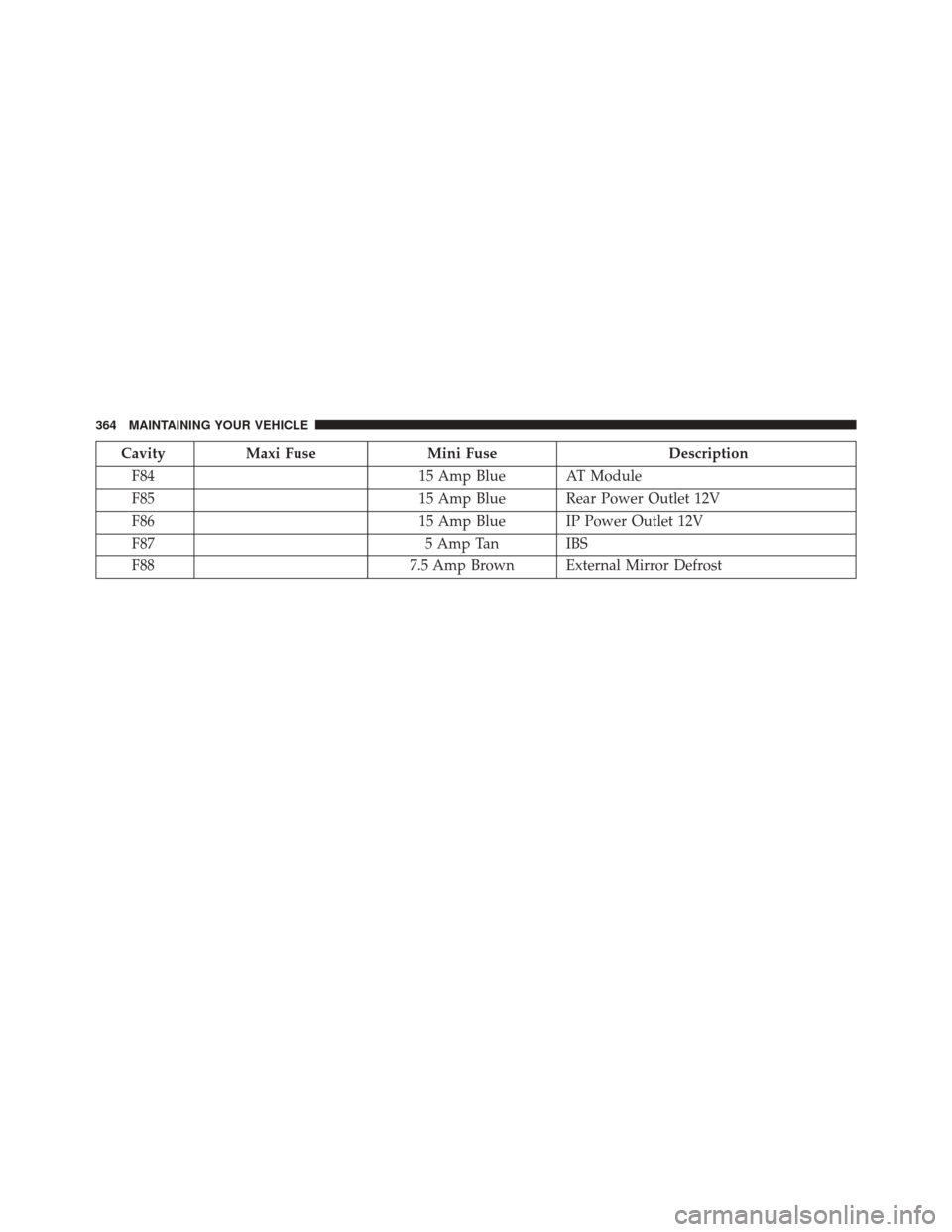
CavityMaxi Fuse Mini Fuse Description
F84 15 Amp Blue AT Module
F85 15 Amp Blue Rear Power Outlet 12V
F86 15 Amp Blue IP Power Outlet 12V
F87 5 Amp Tan IBS
F88 7.5 Amp Brown External Mirror Defrost
364 MAINTAINING YOUR VEHICLE
Page 367 of 414
Interior Fuses
The interior fuse panel is part of the Body Control
Module (BCM) and is located on the driver’s side under
the instrument panel.
Fuse Panel Cover
7
MAINTAINING YOUR VEHICLE 365
Page 368 of 414

Fuse Panel Cavity Locations
366 MAINTAINING YOUR VEHICLE
Page 369 of 414
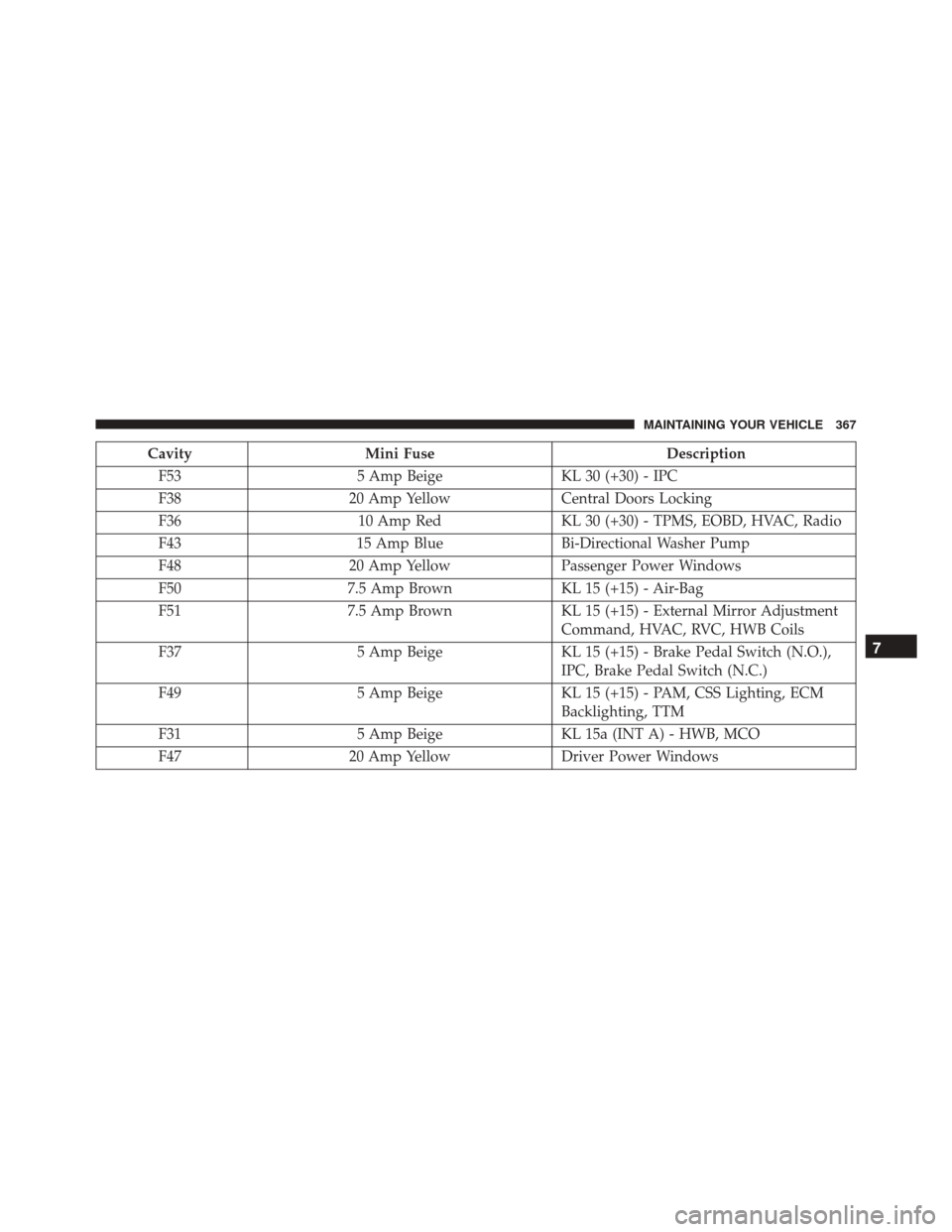
CavityMini Fuse Description
F53 5 Amp Beige KL 30 (+30) - IPC
F38 20 Amp Yellow Central Doors Locking
F36 10 Amp Red KL 30 (+30) - TPMS, EOBD, HVAC, Radio
F43 15 Amp Blue Bi-Directional Washer Pump
F48 20 Amp Yellow Passenger Power Windows
F50 7.5 Amp Brown KL 15 (+15) - Air-Bag
F51 7.5 Amp Brown KL 15 (+15) - External Mirror Adjustment
Command, HVAC, RVC, HWB Coils
F37 5 Amp Beige KL 15 (+15) - Brake Pedal Switch (N.O.),
IPC, Brake Pedal Switch (N.C.)
F49 5 Amp Beige KL 15 (+15) - PAM, CSS Lighting, ECM
Backlighting, TTM
F31 5 Amp Beige KL 15a (INT A) - HWB, MCO
F47 20 Amp Yellow Driver Power Windows
7
MAINTAINING YOUR VEHICLE 367
Page 370 of 414
Central Unit Fuse Panel
The central power fuse panel is located on the driver ’s
side under the instrument panel.
Fuse Panel Cover
Fuse Panel
368 MAINTAINING YOUR VEHICLE
Page 371 of 414
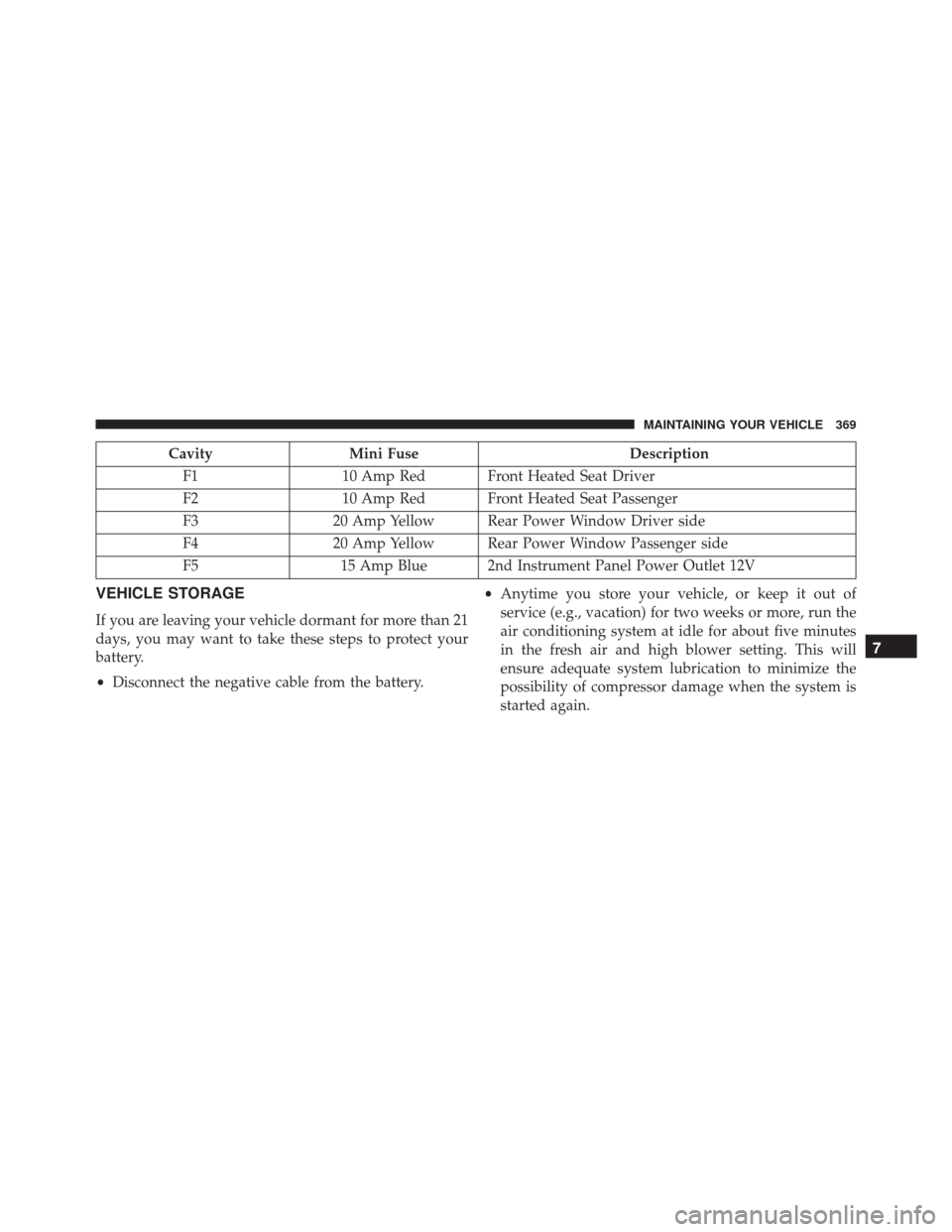
CavityMini Fuse Description
F1 10 Amp Red Front Heated Seat Driver
F2 10 Amp Red Front Heated Seat Passenger
F3 20 Amp Yellow Rear Power Window Driver side
F4 20 Amp Yellow Rear Power Window Passenger side
F5 15 Amp Blue 2nd Instrument Panel Power Outlet 12V
VEHICLE STORAGE
If you are leaving your vehicle dormant for more than 21
days, you may want to take these steps to protect your
battery.
•Disconnect the negative cable from the battery. •
Anytime you store your vehicle, or keep it out of
service (e.g., vacation) for two weeks or more, run the
air conditioning system at idle for about five minutes
in the fresh air and high blower setting. This will
ensure adequate system lubrication to minimize the
possibility of compressor damage when the system is
started again.
7
MAINTAINING YOUR VEHICLE 369
Page 403 of 414
Engine Oil Disposal.....................334
Flashers Hazard Warning ....................... .287
Turn Signal ........................ .90, 147
Flash-To-Pass ............................111
Flooded Engine Starting ....................201
Fluid, Brake ............................ .377
Fluid Capacities ......................... .374
Fluid Leaks ..............................90
Fluid Level Checks Brake ............................... .350
Engine Oil ........................... .332
Power Steering ........................ .217
Fluids, Lubricants and Genuine Parts ...........375
Fog Lights ...........................113,147
Four-Way Hazard Flasher ...................287
Freeing A Stuck Vehicle .....................315
Fuel .................................. .260
Additives ............................ .263Clean Air
............................ .261
Ethanol ............................. .261
Filler Cap (Gas Cap) .....................265
Gasoline ............................. .260
Gauge .............................. .147
Materials Added ....................... .263
Methanol ............................ .261
Octane Rating ..................... .260, 375
Requirements ......................... .260
Specifications ......................... .375
Tank Capacity ......................... .374
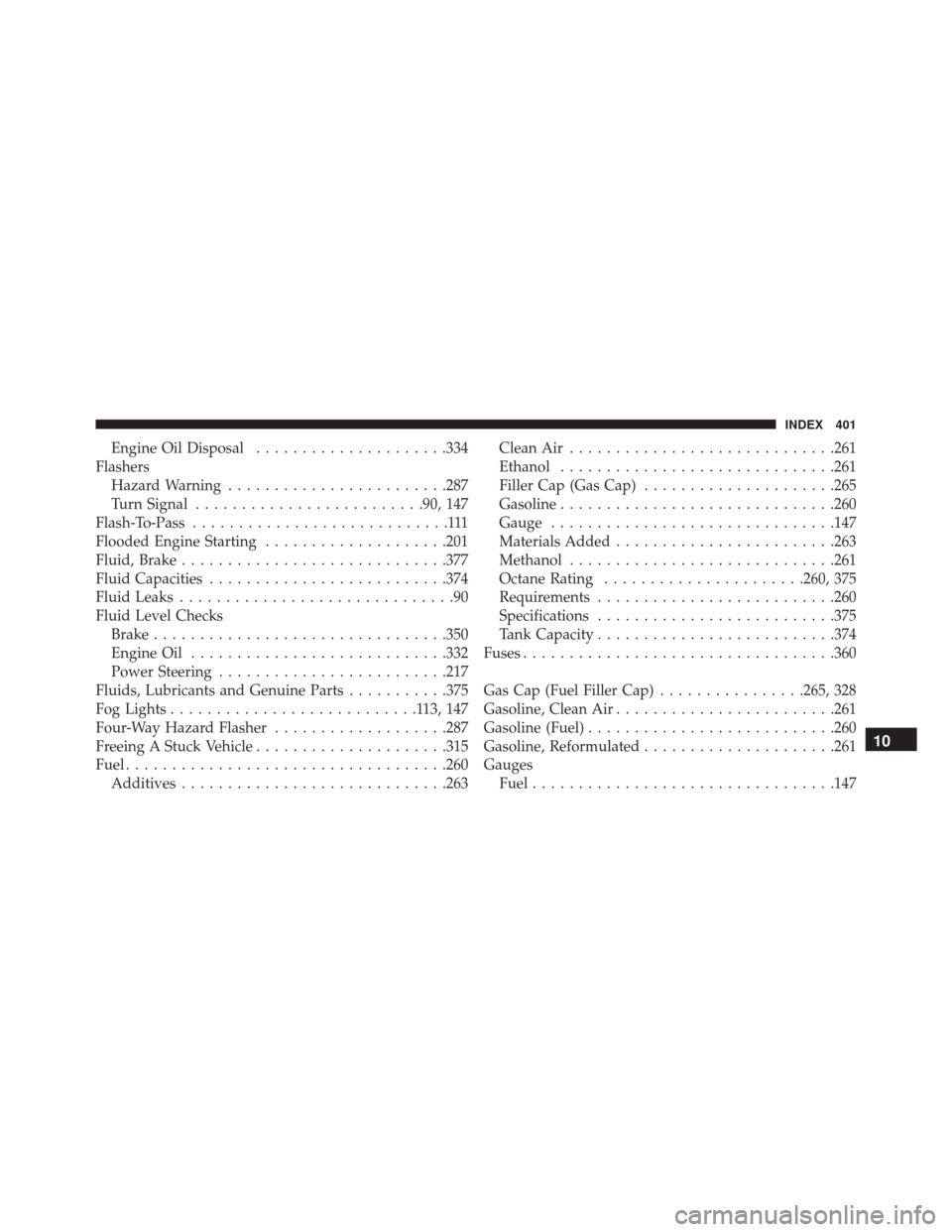
Fuses ................................. .360
Gas Cap (Fuel Filler Cap) ................265, 328
Gasoline, Clean Air ....................... .261
Gasoline (Fuel) .......................... .260
Gasoline, Reformulated .....................261
Gauges Fuel ................................ .147
10
INDEX 401
Page 413 of 414

INSTALLATION OF RADIO TRANSMITTING
EQUIPMENTSpecial design considerations are incorporated into this
vehicle’s electronic system to provide immunity to radio
frequency signals. Mobile two-way radios and telephone
equipment must be installed properly by trained person-
nel. The following must be observed during installation.
The positive power connection should be made directly
to the battery and fused as close to the battery as possible.
The negative power connection should be made to body
sheet metal adjacent to the negative battery connection.
This connection should not be fused.
Antennas for two-way radios should be mounted on the
roof or the rear area of the vehicle. Care should be used
in mounting antennas with magnet bases. Magnets may
affect the accuracy or operation of the compass on
vehicles so equipped.The antenna cable should be as short as practical and
routed away from the vehicle wiring when possible. Use
only fully shielded coaxial cable.
Carefully match the antenna and cable to the radio to
ensure a low Standing Wave Ratio (SWR).
Mobile radio equipment with output power greater than
normal may require special precautions.
All installations should be checked for possible interfer-
ence between the communications equipment and the
vehicle’s electronic systems.