ignition Ram ProMaster City 2015 Workshop Manual
[x] Cancel search | Manufacturer: RAM, Model Year: 2015, Model line: ProMaster City, Model: Ram ProMaster City 2015Pages: 414, PDF Size: 2.86 MB
Page 315 of 414
WARNING!
•Take care to avoid the radiator cooling fan when-
ever the hood is raised. It can start anytime the
ignition switch is ON. You can be injured by
moving fan blades.
• Remove any metal jewelry such as rings, watch
bands and bracelets that could make an inadvertent
electrical contact. You could be seriously injured.
• Batteries contain sulfuric acid that can burn your
skin or eyes and generate hydrogen gas which is
flammable and explosive. Keep open flames or
sparks away from the battery.
1. Set the parking brake, shift the automatic transmission into PARK and turn the ignition to LOCK.
2. Turn off the heater, radio, and all unnecessary electri- cal accessories. 3. If using another vehicle to jump-start the battery, park
the vehicle within the jumper cables reach, set the
parking brake and make sure the ignition is OFF.
WARNING!
Do not allow vehicles to touch each other as this
could establish a ground connection and personal
injury could result.
Jump-Starting Procedure
WARNING!
Failure to follow this jump-starting procedure could
result in personal injury or property damage due to
battery explosion.
6
WHAT TO DO IN EMERGENCIES 313
Page 322 of 414
Insert the wheel bolt wrench handle through the eye and
tighten, refer to “Jacking and Tire Changing” for further
information. The tow eye must be fully seated to the
attaching bracket through the lower rear fascia. If the tow
eye is not fully seated to the attaching bracket, the vehicle
should not be towed.TOWING A DISABLED VEHICLE
This section describes procedures for towing a disabled
vehicle using a commercial towing service.
Towing ConditionWheel OFF the Ground ALL MODELS
Flat Tow NONENOT ALLOWED
Wheel Lift Or Dolly Tow RearNOT ALLOWED
Front OK
Flatbed ALLBEST METHOD
Proper towing or lifting equipment is required to prevent
damage to your vehicle. Use only tow bars and other
equipment designed for this purpose, following equip-
ment manufacturer ’s instructions. Use of safety chains is
mandatory. Attach a tow bar or other towing device to main structural members of the vehicle, not to bumpers
or associated brackets. State and local laws regarding
vehicles under tow must be observed.
If you must use the accessories (wipers, defrosters, etc.)
while being towed, the ignition must be in the ON/RUN
position.
320 WHAT TO DO IN EMERGENCIES
Page 323 of 414
If the ignition key is unavailable, or the vehicle’s battery
is discharged, refer to “SHIFT LEVER OVERRIDE” in
this section for instructions on shifting the transmission
out of PARK for towing.
CAUTION!
•Do not use sling-type equipment when towing.
Vehicle damage may occur.
• When securing the vehicle to a flatbed truck, do not
attach to front or rear suspension components.
Damage to your vehicle may result from improper
towing.
The manufacturer recommends towing your vehicle with
all four wheels OFF the ground using a flatbed.
If flatbed equipment is not available, this vehicle must be
towed with the front wheels OFF the ground (using a
towing dolly, or wheel lift equipment with the front
wheels raised).
CAUTION!
Towing this vehicle in violation of the above require-
ments can cause severe transmission damage. Dam-
age from improper towing is not covered under the
New Vehicle Limited Warranty.
SHIFT LEVER OVERRIDE
If a malfunction occurs and the shift lever cannot be
moved out of the PARK position, you can use the
following procedure to temporarily move the shift lever:
1. Turn the engine OFF.
2. Firmly apply the parking brake.
3. Using a screwdriver or similar tool, carefully separate the shift lever boot from the center console.6
WHAT TO DO IN EMERGENCIES 321
Page 325 of 414
IGNITION KEY REMOVAL OVERRIDE
This vehicle is equipped with a Key Ignition Park Inter-
lock which requires the transmission to be in PARK
before the ignition switch can be turned to the LOCK/
OFF (key removal) position. To remove the key manually,
proceed as follows:
1. Firmly apply the parking brake
2. Remove the Allen Key located in the rear cargo area, inthe tool bag (if equipped) or on the left side in the
cargo box.
3. Unlock the steering column, pull the tilt/telescoping control handle down.
4. Pull the steering wheel outward until it is in the end of the travel position, then lock the steering column in
position, push the control handle up until fully en-
gaged. 5. Using the Allen key, undo the lower steering column
cover screws, and remove the lower cover.
6. Pull the release tab downwards using one hand and with the other one remove the key, sliding it outwards.
Lower Steering Column Screw Locations
6
WHAT TO DO IN EMERGENCIES 323
Page 332 of 414
Your vehicle has a simple ignition actuated test, which
you can use prior to going to the test station. To check if
your vehicle’s OBD II system is ready, you must do the
following:
1. Cycle the ignition switch to the ON position, but donot crank or start the engine.
NOTE: If you crank or start the engine, you will have to
start this test over.
2. As soon as you cycle the ignition switch to the ON position, you will see the Malfunction Indicator Light
(MIL) symbol come on as part of a normal bulb check.
3. Approximately 15 seconds later, one of two things will happen:
• The MIL will flash for about 10 seconds and then
return to being fully illuminated until you turn OFF the ignition or start the engine. This means that your
vehicle’s OBD II system is
not readyand you should
not proceed to the I/M station.
• The MIL will not flash at all and will remain fully
illuminated until you place the ignition in the off
position or start the engine. This means that your
vehicle’s OBD II system is readyand you can proceed
to the I/M station.
If your OBD II system is not ready,you should see your
authorized dealer or repair facility. If your vehicle was
recently serviced or had a battery failure or replacement,
you may need to do nothing more than drive your
vehicle as you normally would in order for your OBD II
system to update. A recheck with the above test routine
may then indicate that the system is now ready.
Regardless of whether your vehicle’s OBD II system is
ready or not, if the MIL is illuminated during normal
vehicle operation you should have your vehicle serviced
330 MAINTAINING YOUR VEHICLE
Page 342 of 414
2. Turn the ignition to the MAR-ON position then toSTOP.
3. After turning the ignition to the STOP, within two minutes move the right stalk upward, into the un-
stable (“anti-panic”) position, for at least half of a
second. The windshield wiper then executes part of a
stroke; at each command, approximately 1/3 of a
normal wiper stroke is triggered.
NOTE: The previous operation can be repeated up to
three times. In order to move the blades to the most
suitable position.
4. Lift the blade from the windshield and proceed with the required operation.
5. Carefully lower the blade, bringing it back in contact with the windshield.
6. Bring the blade to the initial rest position, turning the ignition to MAR-ON. NOTE:
Do not operate the screen wiper with the blades
lifted from the windshield.
Adding Washer Fluid
The fluid reservoir is located in the front of the engine
compartment. Be sure to check the fluid level in the
reservoir at regular intervals. Fill the reservoir with
windshield washer solvent (not radiator antifreeze) and
operate the system for a few seconds to flush out the
residual water.
When refilling the washer fluid reservoir, take some
washer fluid and apply it to a cloth or towel and wipe
clean the wiper blades, this will help blade performance.
To prevent freeze-up of your windshield washer system
in cold weather, select a solution or mixture that meets or
exceeds the temperature range of your climate. This
rating information can be found on most washer fluid
containers.
340 MAINTAINING YOUR VEHICLE
Page 345 of 414
To minimize the possibility of catalytic converter dam-
age:
•Do not shut off the engine or interrupt the ignition,
when the transmission is in gear and the vehicle is in
motion.
• Do not try to start the engine by pushing or towing the
vehicle.
• Do not idle the engine with any spark plug wires
disconnected or removed, such as when diagnostic
testing, or for prolonged periods during very rough
idle or malfunctioning operating conditions.Cooling System
WARNING!
You or others can be badly burned by hot engine
coolant (antifreeze) or steam from your radiator. If
you see or hear steam coming from under the hood,
do not open the hood until the radiator has had time
to cool. Never try to open a cooling system pressure
cap when the radiator or coolant bottle is hot.
Engine Coolant Checks
Check the engine coolant (antifreeze) protection every 12
months (before the onset of freezing weather, where
applicable). If the engine coolant (antifreeze) is dirty, the
system should be drained, flushed, and refilled with
fresh OAT coolant (conforming to MS.90032) by an
authorized dealer. Check the front of the A/C condenser
7
MAINTAINING YOUR VEHICLE 343
Page 362 of 414
WARNING!(Continued)
assemblies must be replaced after a collision if they
have been damaged (i.e., bent retractor, torn web-
bing, etc.).
FUSES
WARNING!
•When replacing a blown fuse, always use an ap-
propriate replacement fuse with the same amp
rating as the original fuse. Never replace a fuse
with another fuse of higher amp rating. Never
replace a blown fuse with metal wires or any other
material. Failure to use proper fuses may result in
serious personal injury, fire and/or property dam-
age.
(Continued)
WARNING! (Continued)
•Before replacing a fuse, make sure that the ignition
is off and that all the other services are switched off
and/or disengaged.
• If the replaced fuse blows again, contact an autho-
rized dealer.
• If a general protection fuse for safety systems (air
bag system, braking system), power unit systems
(engine system, gearbox system) or steering system
blows, contact an authorized dealer.
360 MAINTAINING YOUR VEHICLE
Page 364 of 414
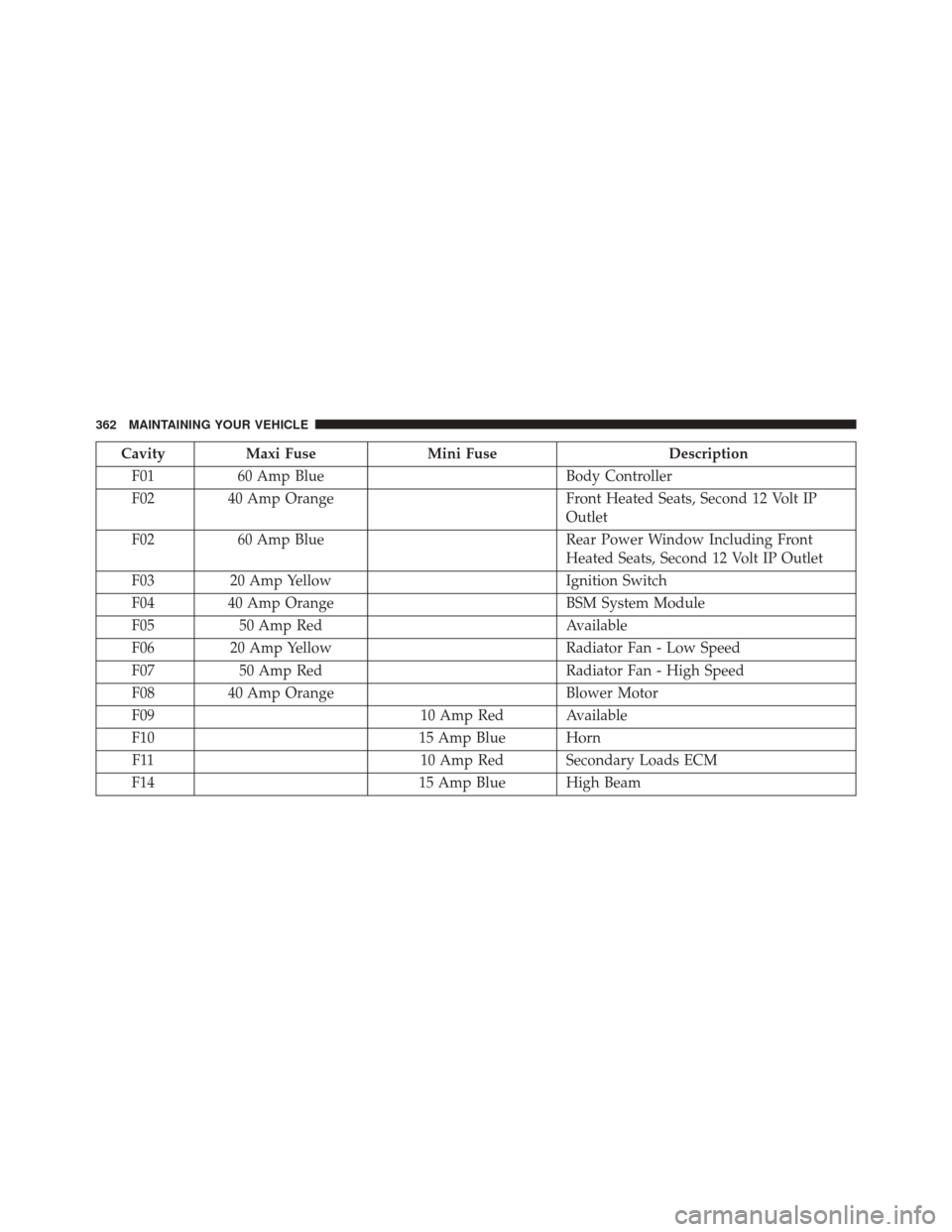
CavityMaxi Fuse Mini Fuse Description
F01 60 Amp Blue Body Controller
F02 40 Amp Orange Front Heated Seats, Second 12 Volt IP
Outlet
F02 60 Amp Blue Rear Power Window Including Front
Heated Seats, Second 12 Volt IP Outlet
F03 20 Amp Yellow Ignition Switch
F04 40 Amp Orange BSM System Module
F05 50 Amp Red Available
F06 20 Amp Yellow Radiator Fan - Low Speed
F07 50 Amp Red Radiator Fan - High Speed
F08 40 Amp Orange Blower Motor
F09 10 Amp Red Available
F10 15 Amp Blue Horn
F11 10 Amp Red Secondary Loads ECM
F14 15 Amp Blue High Beam
362 MAINTAINING YOUR VEHICLE
Page 404 of 414
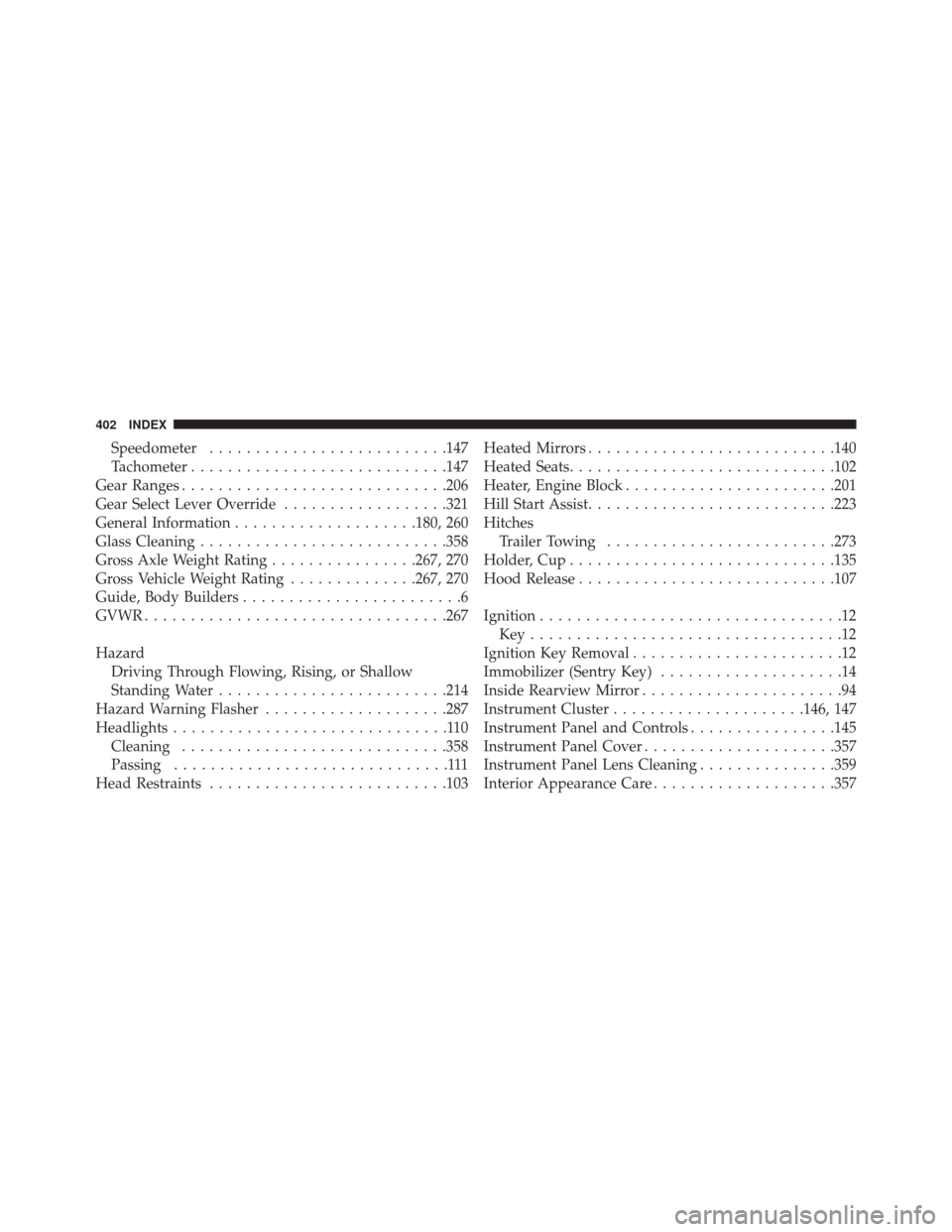
Speedometer......................... .147
Tachometer ........................... .147
Gear Ranges ............................ .206
Gear Select Lever Override ..................321
General Information ....................180, 260
Glass Cleaning .......................... .358
Gross Axle Weight Rating ................267, 270
Gross Vehicle Weight Rating ..............267, 270
Guide, Body Builders ........................6
GVWR ................................ .267
Hazard Driving Through Flowing, Rising, or Shallow
Standing Water ........................ .214
Hazard Warning Flasher ....................287
Headlights ..............................110
Cleaning ............................ .358
Passing ..............................111
Head Restraints ......................... .103Heated Mirrors
.......................... .140
Heated Seats ............................ .102
Heater, Engine Block ...................... .201
Hill Start Assist .......................... .223
Hitches Trailer Towing ........................ .273
Holder, Cup ............................ .135
Hood Release ........................... .107
Ignition .................................12
Key..................................12
Ignition Key Removal .......................12
Immobilizer (Sentry Key) ....................14
Inside Rearview Mirror ......................94
Instrument Cluster .....................146, 147
Instrument Panel and Controls ................145
Instrument Panel Cover .....................357
Instrument Panel Lens Cleaning ...............359
Interior Appearance Care ....................357
402 INDEX