battery Ram ProMaster City 2018 Owner's Guide
[x] Cancel search | Manufacturer: RAM, Model Year: 2018, Model line: ProMaster City, Model: Ram ProMaster City 2018Pages: 347, PDF Size: 4.08 MB
Page 240 of 347
Maintenance Plan
Required Maintenance Intervals
Refer to the maintenance schedules on the following page
for the required maintenance intervals.
At Every Oil Change Interval As Indicated By OilChange Indicator System:
•Change oil and filter
• Rotate the tires
Rotate at the first sign of irregular wear, even if it
occurs before the oil indicator system turns on
• Inspect battery and clean and tighten terminals as
required
• Inspect brake pads, shoes, rotors, drums, hoses,
lines and park brake
• Inspect engine cooling system protection and hoses
• Inspect exhaust system
• Inspect engine air cleaner if using in dusty or
off-road conditions
238 SERVICING AND MAINTENANCE
Page 245 of 347
WARNING!
Commercially available windshield washer solvents
are flammable. They could ignite and burn you. Care
must be exercised when filling or working around the
washer solution.
Maintenance-Free Battery
Your vehicle is equipped with a maintenance-free battery.
You will never have to add water, nor is periodic mainte-
nance required.
WARNING!
•Battery fluid is a corrosive acid solution and can
burn or even blind you. Do not allow battery fluid to
contact your eyes, skin, or clothing. Do not lean over
a battery when attaching clamps. If acid splashes in
eyes or on skin, flush the area immediately with
large amounts of water. Refer to “Jump Starting
Procedure” in “In Case Of Emergency” for further
information.
• Battery gas is flammable and explosive. Keep flame
or sparks away from the battery. Do not use a booster
(Continued)
WARNING! (Continued)
battery or any other booster source with an output
greater than 12 Volts. Do not allow cable clamps to
touch each other.
• Battery posts, terminals, and related accessories con-
tain lead and lead compounds. Wash hands after
handling.
CAUTION!
• It is essential when replacing the cables on the
battery that the positive cable is attached to the
positive post and the negative cable is attached to the
negative post. Battery posts are marked positive (+)
and negative (-) and are identified on the battery
case. Cable clamps should be tight on the terminal
posts and free of corrosion.
• If a “fast charger” is used while the battery is in the
vehicle, disconnect both vehicle battery cables before
connecting the charger to the battery. Do not use a
“fast charger” to provide starting voltage.
8
SERVICING AND MAINTENANCE 243
Page 286 of 347
WARNING!
The traction grade assigned to this tire is based on
straight-ahead braking traction tests, and does not
include acceleration, cornering, hydroplaning, or
peak traction characteristics.
Temperature Grades
The Temperature grades are A (the highest), B, and C,
representing the tire’s resistance to the generation of
heat and its ability to dissipate heat, when tested under
controlled conditions on a specified indoor laboratory
test wheel.
Sustained high temperature can cause the material of
the tire to degenerate and reduce tire life, and excessive
temperature can lead to sudden tire failure. The grade C
corresponds to a level of performance, which all pas-
senger vehicle tires must meet under the Federal Motor
Vehicle Safety Standard No. 109. Grades B and A
represent higher levels of performance on the laboratory
test wheel, than the minimum required by law.
WARNING!
The temperature grade for this tire is established for
a tire that is properly inflated and not overloaded.
Excessive speed, under-inflation, or excessive load-
ing, either separately or in combination, can cause
heat buildup and possible tire failure.
STORING THE VEHICLE
If you are storing your vehicle for more than 21 days, we
recommend that you take the following steps to minimize
the drain on your vehicle’s battery:
• Disconnect the negative cable from battery.
• Any time you store your vehicle or keep it out of service
(i.e., vacation) for two weeks or more, run the air
conditioning system at idle for about five minutes in the
fresh air and high blower setting. This will ensure
adequate system lubrication to minimize the possibility
of compressor damage when the system is started again.
284 SERVICING AND MAINTENANCE
Page 334 of 347
Adding Engine Coolant (Antifreeze).............252
Additives, Fuel ........................... .294
AirBag..................................119 Air Bag Operation ....................... .120
Driver Knee Air Bag ..................... .121
Enhanced Accident Response ................234
Event Data Recorder (EDR) .................234
If A Deployment Occurs ....................126
Knee Impact Bolsters ..................... .121
Maintaining Your Air Bag System .............127
Transporting Pets ....................... .147
Air Bag Light .......................... .83, 149
Air Bag Maintenance ....................... .127
Air Cleaner, Engine (Engine Air Cleaner Filter) ......246
Air Conditioner Maintenance ..................246
Air Conditioning Filter .......................55
Air Conditioning, Operating Tips .............54, 56
Air Conditioning Refrigerant ...............246, 247
Air Conditioning System .....................246
Air Filter ............................... .246
Air Pressure, Tires ......................... .272
Alarm (Security Alarm) .......................22
Alarm System (Security Alarm) .................22
Alterations/Modifications, Vehicle ................6
Antifreeze (Engine Coolant) ................251, 296 Disposal
.............................. .254
Anti-Lock Brake System (ABS) ..................96
Anti-Lock Warning Light ......................87
Ashtray ..................................67
Assist, Hill Start ............................98
Audio Systems (Radio) ...................... .300
Auto Down Power Windows ...................58
Automatic Transaxle .........................19
Automatic Transmission ...............160, 161, 258
Adding Fluid ....................... .258, 298
Fluid And Filter Changes ...................258
Fluid Change .......................... .258
Fluid Level Check .................... .257, 258
Fluid
Type ......................... .257, 298
Special Additives ........................ .257
Auto Up Power Windows .....................58
Auxiliary Electrical Outlet (Power Outlet) ..........65
Axle Lubrication .......................... .298
Battery .............................. .85, 243
Charging System Light .....................85
Keyless Key Fob Replacement ................18
Belts, Seat ............................... .149
Body Builders Guide ..........................6
Body Mechanism Lubrication ..................247
332 INDEX
Page 339 of 347
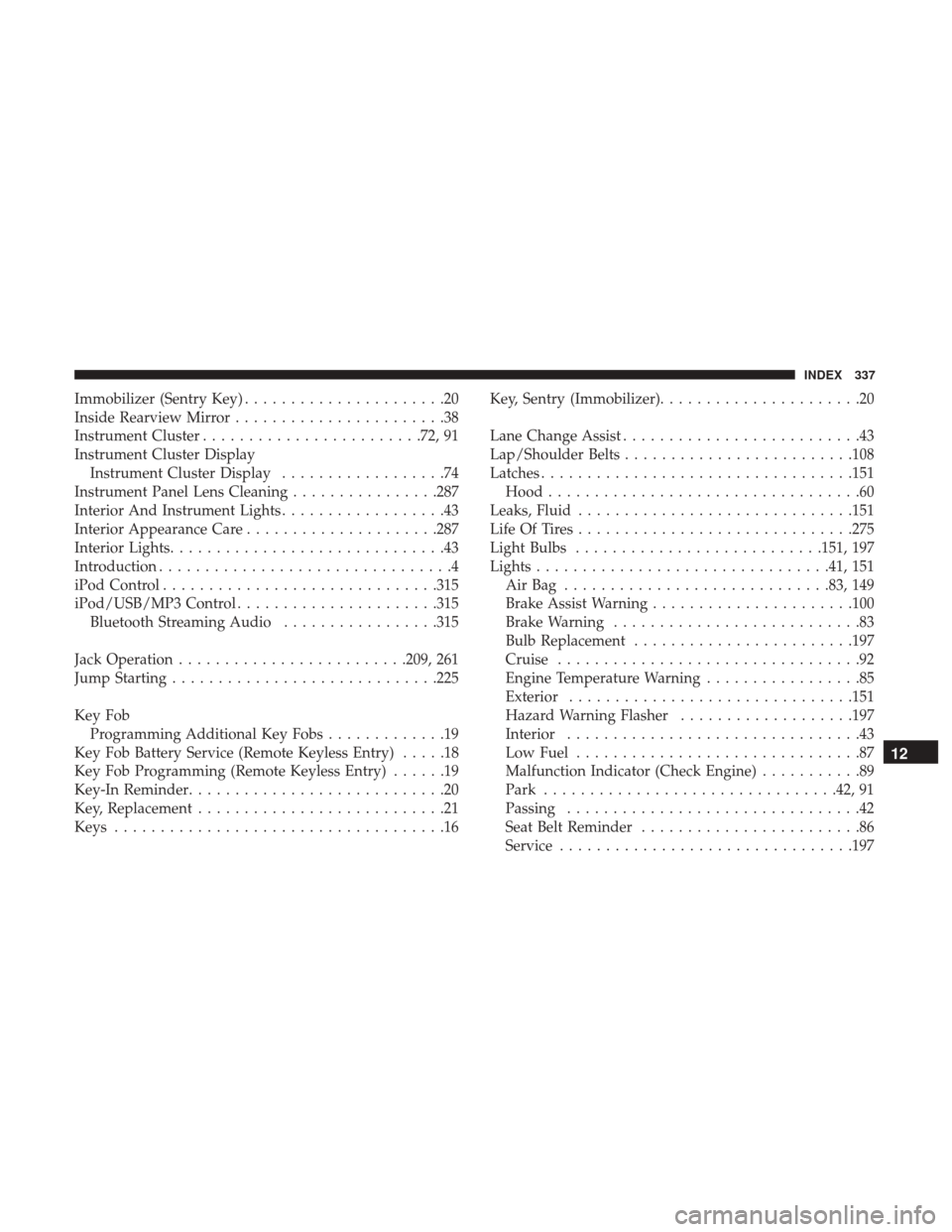
Immobilizer (Sentry Key)......................20
Inside Rearview Mirror .......................38
Instrument Cluster ....................... .72, 91
Instrument Cluster Display Instrument Cluster Display ..................74
Instrument Panel Lens Cleaning ................287
Interior And Instrument Lights ..................43
Interior Appearance Care .....................287
Interior Lights ..............................43
Introduction ................................4
iPod Control ............................. .315
iPod/USB/MP3 Control ..................... .315
Bluetooth Streaming Audio .................315
Jack Operation ........................ .209, 261
Jump Starting ............................ .225
Key Fob Programming Additional Key Fobs .............19
Key Fob Battery Service (Remote Keyless Entry) .....18
Key Fob Programming (Remote Keyless Entry) ......19
Key-In Reminder ............................20
Key, Replacement ...........................21
Keys ....................................16 Key, Sentry (Immobilizer)
......................20
Lane Change Assist ..........................43
Lap/Shoulder Belts ........................ .108
Latches ................................. .151
Hood ..................................60
Leaks, Fluid ............................. .151
Life Of Tires ............................. .275
Light Bulbs .......................... .151, 197
Lights ............................... .41, 151
AirBag ............................ .83, 149
Brake Assist Warning ..................... .100
Brake Warning ...........................83
Bulb Replacement ....................... .197
Cruise .................................92
Engine Temperature Warning .................85
Exterior .............................. .151
Hazard Warning Flasher ...................197
Interior ................................43
Low Fuel ...............................87
Malfunction Indicator (Check Engine) ...........89
Park ............................... .42,
91
Passing ................................42
Seat Belt Reminder ........................86
Service ............................... .197
12
INDEX 337
Page 340 of 347
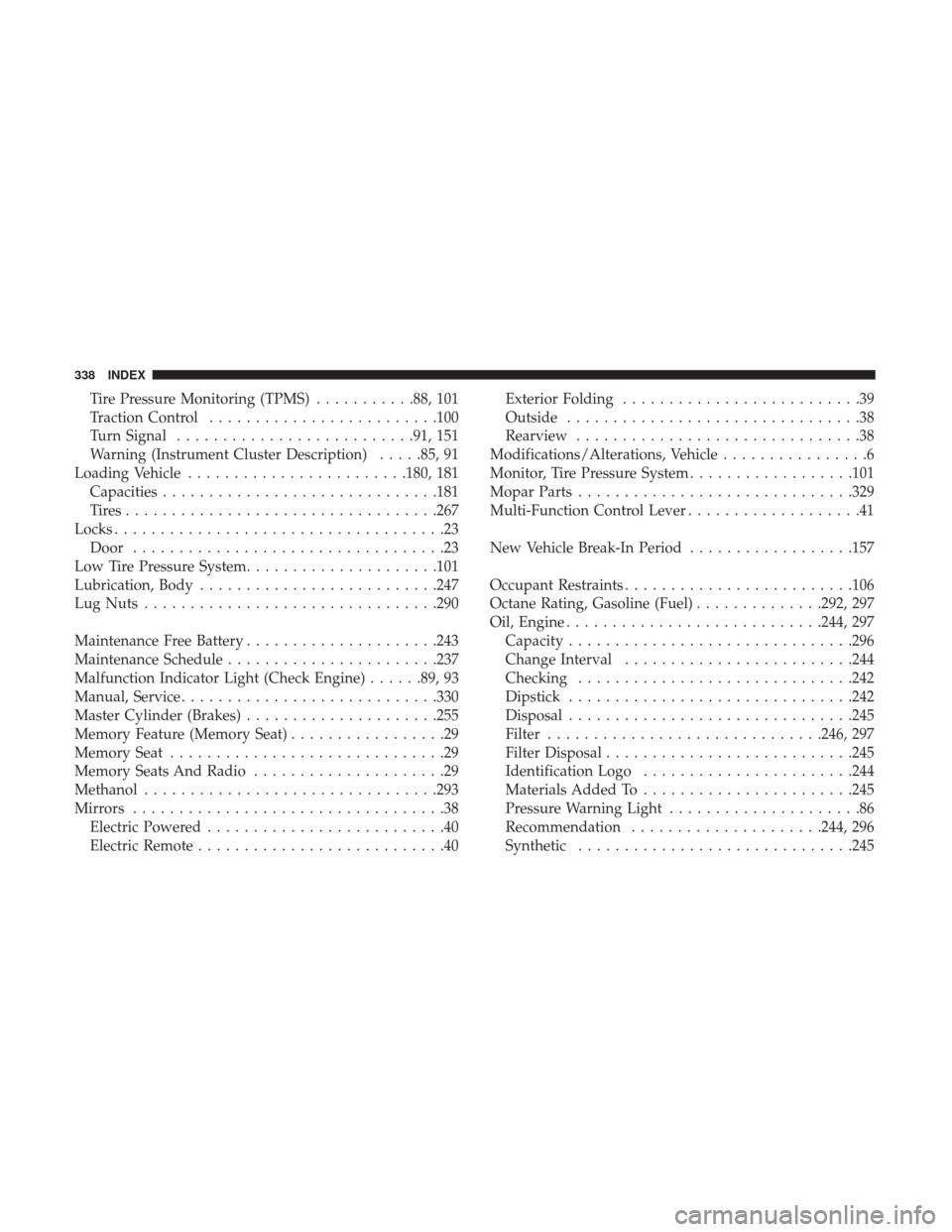
Tire Pressure Monitoring (TPMS)...........88, 101
Traction Control ........................ .100
Turn Signal ......................... .91, 151
Warning (Instrument Cluster Description) .....85, 91
Loading Vehicle ....................... .180, 181
Capacities ............................. .181
Tires................................. .267
Locks ....................................23
Door ..................................23
Low Tire Pressure System .....................101
Lubrication, Body ......................... .247
Lug Nuts ............................... .290
Maintenance Free Battery .....................243
Maintenance Schedule ...................... .237
Malfunction Indicator Light (Check Engine) ......89, 93
Manual, Service ........................... .330
Master Cylinder (Brakes) .....................255
Memory Feature (Memory Seat) .................29
Memory Seat ..............................29
Memory Seats And Radio .....................29
Methanol ............................... .293
Mirrors ..................................38
Electric Powered ..........................40
Electric Remote ...........................40 Exterior Folding
..........................39
Outside ................................38
Rearview ...............................38
Modifications/Alterations, Vehicle ................6
Monitor, Tire Pressure System ..................101
Mopar Parts ............................. .329
Multi-Function Control Lever ...................41
New Vehicle Break-In Period ..................157
Occupant Restraints ........................ .106
Octane Rating, Gasoline (Fuel) ..............292, 297
Oil, Engine ........................... .244, 297
Capacity .............................. .296
Change Interval ........................ .244
Checking ............................. .242
Dipstick .............................. .242
Disposal .............................. .245
Filter ............................. .246,
297
Filter Disposal .......................... .245
Identification Logo ...................... .244
Materials Added To ...................... .245
Pressure Warning Light .....................86
Recommendation .....................244, 296
Synthetic ............................. .245
338 INDEX
Page 346 of 347

INSTALLATION OF RADIO TRANSMITTING
EQUIPMENTSpecial design considerations are incorporated into this
vehicle’s electronic system to provide immunity to radio
frequency signals. Mobile two-way radios and telephone
equipment must be installed properly by trained person-
nel. The following must be observed during installation.
The positive power connection should be made directly
to the battery and fused as close to the battery as possible.
The negative power connection should be made to body
sheet metal adjacent to the negative battery connection.
This connection should not be fused.
Antennas for two-way radios should be mounted on the
roof or the rear area of the vehicle. Care should be used
in mounting antennas with magnet bases. Magnets may
affect the accuracy or operation of the compass on
vehicles so equipped.The antenna cable should be as short as practical and
routed away from the vehicle wiring when possible. Use
only fully shielded coaxial cable.
Carefully match the antenna and cable to the radio to
ensure a low Standing Wave Ratio (SWR).
Mobile radio equipment with output power greater than
normal may require special precautions.
All installations should be checked for possible interfer-
ence between the communications equipment and the
vehicle’s electronic systems.