low oil pressure Ram ProMaster City 2019 Owner's Manual
[x] Cancel search | Manufacturer: RAM, Model Year: 2019, Model line: ProMaster City, Model: Ram ProMaster City 2019Pages: 348, PDF Size: 3.75 MB
Page 73 of 348
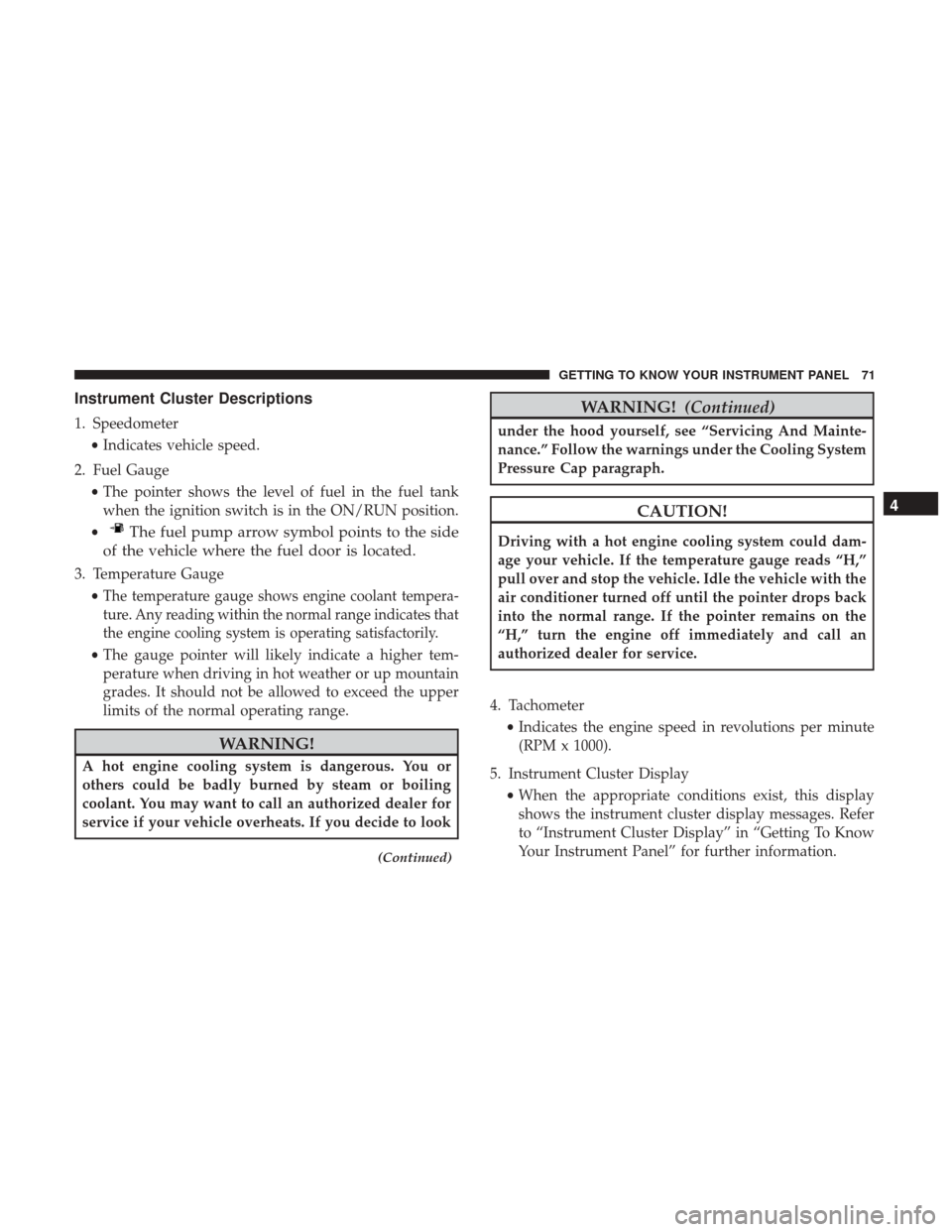
Instrument Cluster Descriptions
1. Speedometer•Indicates vehicle speed.
2. Fuel Gauge •The pointer shows the level of fuel in the fuel tank
when the ignition switch is in the ON/RUN position.
•
The fuel pump arrow symbol points to the side
of the vehicle where the fuel door is located.
3. Temperature Gauge
•
The temperature gauge shows engine coolant tempera-
ture. Any reading within the normal range indicates that
the engine cooling system is operating satisfactorily.
• The gauge pointer will likely indicate a higher tem-
perature when driving in hot weather or up mountain
grades. It should not be allowed to exceed the upper
limits of the normal operating range.
WARNING!
A hot engine cooling system is dangerous. You or
others could be badly burned by steam or boiling
coolant. You may want to call an authorized dealer for
service if your vehicle overheats. If you decide to look
(Continued)
WARNING! (Continued)
under the hood yourself, see “Servicing And Mainte-
nance.” Follow the warnings under the Cooling System
Pressure Cap paragraph.
CAUTION!
Driving with a hot engine cooling system could dam-
age your vehicle. If the temperature gauge reads “H,”
pull over and stop the vehicle. Idle the vehicle with the
air conditioner turned off until the pointer drops back
into the normal range. If the pointer remains on the
“H,” turn the engine off immediately and call an
authorized dealer for service.
4. Tachometer •Indicates the engine speed in revolutions per minute
(RPM x 1000).
5. Instrument Cluster Display •When the appropriate conditions exist, this display
shows the instrument cluster display messages. Refer
to “Instrument Cluster Display” in “Getting To Know
Your Instrument Panel” for further information.
4
GETTING TO KNOW YOUR INSTRUMENT PANEL 71
Page 79 of 348
the transmission into NEUTRAL and idle the vehicle. If the
temperature reading does not return to normal, turn the
engine off immediately and call for service.
Refer to “If Your Engine Overheats” in “In Case Of
Emergency” for further information.
— Oil Pressure Warning Light
This warning light will illuminate to indicate low engine
oil pressure. If the light turns on while driving, stop the
vehicle, shut off the engine as soon as possible, and contact
an authorized dealer. A chime will sound when this light
turns on.
Do not operate the vehicle until the cause is corrected. This
light does not indicate how much oil is in the engine. The
engine oil level must be checked under the hood.
— Transmission Temperature Warning Light — If
Equipped
This warning light will illuminate to warn of a high
transmission fluid temperature. This may occur with
strenuous usage such as trailer towing. If this light turns
on, stop the vehicle and run the engine at idle or slightly
faster, with the transmission in PARK or NEUTRAL, until
the light turns off. Once the light turns off, you may
continue to drive normally.
WARNING!
If you continue operating the vehicle when the Trans-
mission Temperature Warning Light is illuminated you
could cause the fluid to boil over, come in contact with
hot engine or exhaust components and cause a fire.
CAUTION!
Continuous driving with the Transmission Tempera-
ture Warning Light illuminated will eventually cause
severe transmission damage or transmission failure.
— Seat Belt Reminder Warning Light
When the ignition is first placed in the ON/RUN or
MAR/ON/RUN position, if the driver ’s seat belt is un-
buckled, a chime will sound and the light will turn on.
When driving, if the driver or front passenger seat belt
remains unbuckled, the Seat Belt Reminder Light will flash
or remain on continuously and a chime will sound. Refer to
“Occupant Restraint Systems” in “Safety” for further infor-
mation.
4
GETTING TO KNOW YOUR INSTRUMENT PANEL 77
Page 80 of 348
— Transmission Fault Warning Light
This light will illuminate (together with a message in the
instrument cluster display and a buzzer) to indicate a
transmission fault. Contact your authorized dealer if the
message remains after restarting the engine.
— Engine Oil Level Warning Light
This warning light appears on the panel when the engine
oil level falls below the minimum recommended value.
Restore the correct engine oil level or contact your autho-
rized dealer for service.
Yellow Warning Lights
— Anti-Lock Brake (ABS) Warning Light
This light monitors the Anti-Lock Brake System (ABS). The
light will turn on when the ignition is placed in the
ON/RUN or MAR/ON/RUN position and may stay on
for as long as four seconds.
If the ABS light remains on or turns on while driving, then
the Anti-Lock portion of the brake system is not function-
ing and service is required. However, the conventional
brake system will continue to operate normally if the brake
warning light is not on.If the ABS light is on, the brake system should be serviced
as soon as possible to restore the benefits of Anti-Lock
Brakes. If the ABS light does not turn on when the ignition
is placed in the ON/RUN or MAR/ON/RUN position,
have the light inspected by an authorized dealer.
— Low Fuel Warning Light
When the fuel level reaches approximately 2–3 gal (9–11 L)
this light will turn on, and remain on until fuel is added.
— Generic Warning Light
The Generic Warning Light will illuminate if any of the
following conditions occur: Engine Oil Pressure Sensor
Failure, External Light Failure, Parking Sensor Failure, Fuel
Cut-Off Fail/Intervention, Generic Failure on Trailer, or Air
Bag telltale recovery.
The telltale will blink in case of Air Bag Warning Light
Failure. Contact an authorized dealer immediately for
service.
78 GETTING TO KNOW YOUR INSTRUMENT PANEL
Page 235 of 348
SCHEDULED SERVICING
Your vehicle is equipped with an automatic oil change
indicator system. The oil change indicator system will
remind you that it is time to take your vehicle in for
scheduled maintenance.
Based on engine operation conditions, the oil change
indicator message will illuminate. This means that service
is required for your vehicle. Operating conditions such as
frequent short-trips, trailer tow, extended engine idle time,
extremely hot or cold ambient temperatures will influence
when the “Oil Change Required” message is displayed.
Severe Operating Conditions can cause the change oil
message to illuminate as early as 3,500 miles (5,600 km)
since last reset. Have your vehicle serviced as soon as
possible, within the next 500 miles (805 km).
Your authorized dealer will reset the oil change indicator
message after completing the scheduled oil change. If a
scheduled oil change is performed by someone other than
your authorized dealer, the message can be reset by
referring to the steps described under “Oil Change Reset”
in “Instrument Cluster Display” in “Getting To Know Your
Instrument Panel” for further information.NOTE:
Under no circumstances should oil change inter-
vals exceed 10,000 miles (16,000 km), 350 hours of engine
run time or twelve months, whichever comes first. The 350
hours of engine run or idle time is generally only a concern
for fleet customers.
Severe Duty All Models
Change Engine Oil at 4,000 miles (6,500 km) or 350 hours of
engine run time if the vehicle is operated in a dusty and off
road environment or is operated predominantly at idle, or
only very low engine RPM’s. This type of vehicle use is
considered Severe Duty.
Once A Month Or Before A Long Trip:
• Check engine oil level.
• Check windshield washer fluid level.
• Check tire pressure and look for unusual wear or
damage. Rotate tires at the first sign of irregular wear,
even if it occurs before the oil indicator system turns on.
• Check the fluid levels of the coolant reservoir and brake
master cylinder, fill as needed.
• Check function of all interior and exterior lights.
8
SERVICING AND MAINTENANCE 233
Page 240 of 348
Checking Oil Level
To assure proper engine lubrication, the engine oil must be
maintained at the correct level. Check the oil level at
regular intervals, such as every fuel stop. The best time to
check the engine oil level is about five minutes after a fully
warmed up engine is shut off.
Checking the oil while the vehicle is on level ground will
improve the accuracy of the oil level readings.
There are three possible dipstick types,
•Crosshatched zone.
• Crosshatched zone marked SAFE.
• Crosshatched zone marked with MIN at the low end of
the range and MAX at the high end of the range.
• Crosshatched zone marked with dimples at the MIN and
the MAX ends of the range.
NOTE: Always maintain the oil level within the crosshatch
markings on the dipstick.
Adding 1 quart (1.0 liters) of oil when the reading is at the
low end of the dipstick range will raise the oil level to the
high end of the range marking.
CAUTION!
Overfilling or underfilling the crankcase will cause
aeration or loss of oil pressure. This could damage your
engine.
Adding Washer Fluid
The windshield and rear window washers share the same
fluid reservoir. The fluid reservoir is located in the front of
the engine compartment. Be sure to check the fluid level in
the reservoir at regular intervals. Fill the reservoir with
windshield washer solvent (not radiator antifreeze) and
operate the system for a few seconds to flush out the
residual water.
When refilling the washer fluid reservoir, take some
washer fluid and apply it to a cloth or towel and wipe clean
the wiper blades, this will help blade performance.
To prevent freeze-up of your windshield washer system in
cold weather, select a solution or mixture that meets or
exceeds the temperature range of your climate. This rating
information can be found on most washer fluid containers.
238 SERVICING AND MAINTENANCE
Page 244 of 348
high quality filters should be used to assure most efficient
service. Mopar engine oil filters are high quality oil filters
and are recommended.
Engine Air Cleaner Filter
Refer to the “Maintenance Plan” in this section for the
proper maintenance intervals.
NOTE:Be sure to follow the “Severe Duty Conditions”
maintenance interval if applicable.
WARNING!
The air induction system (air cleaner, hoses, etc.) can
provide a measure of protection in the case of engine
backfire. Do not remove the air induction system (air
cleaner, hoses, etc.) unless such removal is necessary
for repair or maintenance. Make sure that no one is
near the engine compartment before starting the ve-
hicle with the air induction system (air cleaner, hoses,
etc.) removed. Failure to do so can result in serious
personal injury.
Engine Air Cleaner Filter Selection
The quality of replacement engine air cleaner filters varies
considerably. Only high quality filters should be used to assure most efficient service. Mopar engine air cleaner
filters are a high quality filter and are recommended.
Air Conditioner Maintenance
For best possible performance, your air conditioner should
be checked and serviced by an authorized dealer at the
start of each warm season. This service should include
cleaning of the condenser fins and a performance test.
Drive belt tension should also be checked at this time.
WARNING!
•
Use only refrigerants and compressor lubricants ap-
proved by the manufacturer for your air conditioning
system. Some unapproved refrigerants are flam-
mable and can explode, injuring you. Other unap-
proved refrigerants or lubricants can cause the sys-
tem to fail, requiring costly repairs. Refer to
Warranty Information Book, for further warranty
information.
• The air conditioning system contains refrigerant un-
der high pressure. To avoid risk of personal injury or
damage to the system, adding refrigerant or any
repair requiring lines to be disconnected should be
done by an experienced technician.
242 SERVICING AND MAINTENANCE
Page 329 of 348
Body Mechanism Lubrication..................243
B-Pillar Location .......................... .262
Brake Assist System .........................89
Brake Fluid .............................. .294
Brake, Parking ............................ .152
Brake System ......................... .250, 286
Anti-Lock (ABS) ..........................88
Fluid Check ........................ .251, 294
Master Cylinder ........................ .251
Parking .............................. .152
Warning Light ...........................74
Brake/Transmission Interlock ..................155
Bulb Replacement ......................... .191
Bulbs, Light .......................... .145, 191
Camera, Rear ............................ .171
Capacities, Fluid .......................... .292
Caps, Filler Fuel ................................. .172
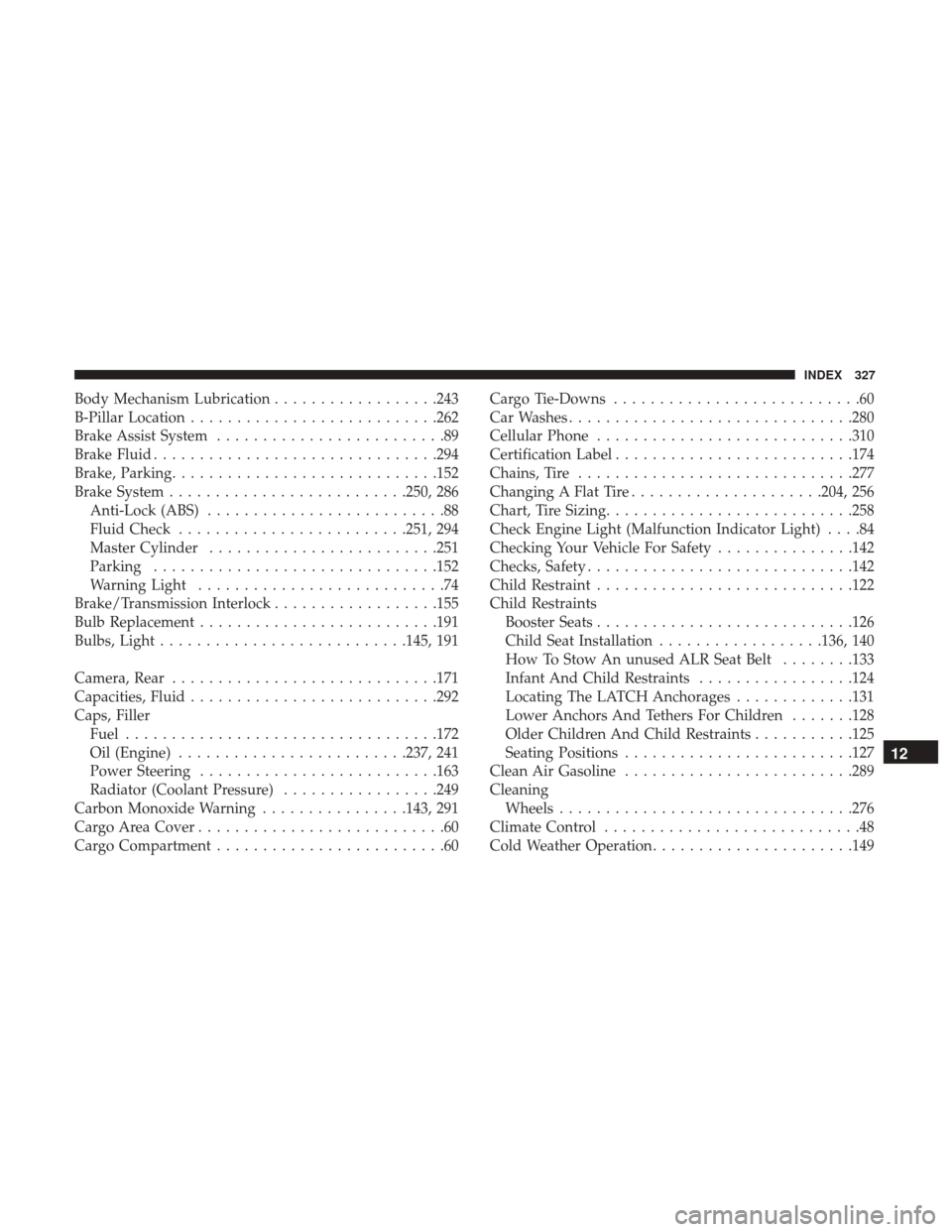
Oil (Engine) ........................ .237, 241
Power Steering ......................... .163
Radiator (Coolant Pressure) .................249
Carbon Monoxide Warning ................143, 291
Cargo Area Cover ...........................60
Cargo Compartment .........................60 Cargo Tie-Downs
...........................60
Car Washes .............................. .280
Cellular Phone ........................... .310
Certification Label ......................... .174
Chains, Tire ............................. .277
Changing A Flat Tire .....................204, 256
Chart, Tire Sizing .......................... .258
Check Engine Light (Malfunction Indicator Light) ....84
Checking Your Vehicle For Safety ...............142
Checks, Safety ............................ .142
Child Restraint ........................... .122
Child Restraints Booster Seats ........................... .126
Child Seat Installation ..................136,
140
How To Stow An unused ALR Seat Belt ........133
Infant And Child Restraints .................124
Locating The LATCH Anchorages .............131
Lower Anchors And Tethers For Children .......128
Older Children And Child Restraints ...........125
Seating Positions ........................ .127
Clean Air Gasoline ........................ .289
Cleaning Wheels ............................... .276
Climate Control ............................48
Cold Weather Operation ..................... .149
12
INDEX 327
Page 330 of 348
Compact Spare Tire........................ .274
Contract, Service .......................... .322
Cooling Pressure Cap (Radiator Cap) ............249
Cooling System ........................... .246
Adding Coolant (Antifreeze) .................248
Coolant Level .......................... .249
Cooling Capacity ........................ .292
Disposal Of Used Coolant ..................249
Drain, Flush, And Refill ....................247
Inspection ......................... .246, 249
Points To Remember ..................... .250
Pressure Cap ........................... .249
Radiator Cap .......................... .249
Selection Of Coolant (Antifreeze) ..........247, 292
Corrosion Protection ....................... .280
Cruise Light ...............................82
Cupholders ...............................63
Customer Assistance ....................... .320
Customer Programmable Features ...............297
Cybersecurity ............................ .296
Dealer Service ............................ .240
Defroster, Windshield ....................... .144
Diagnostic System, Onboard ....................83 Dipsticks
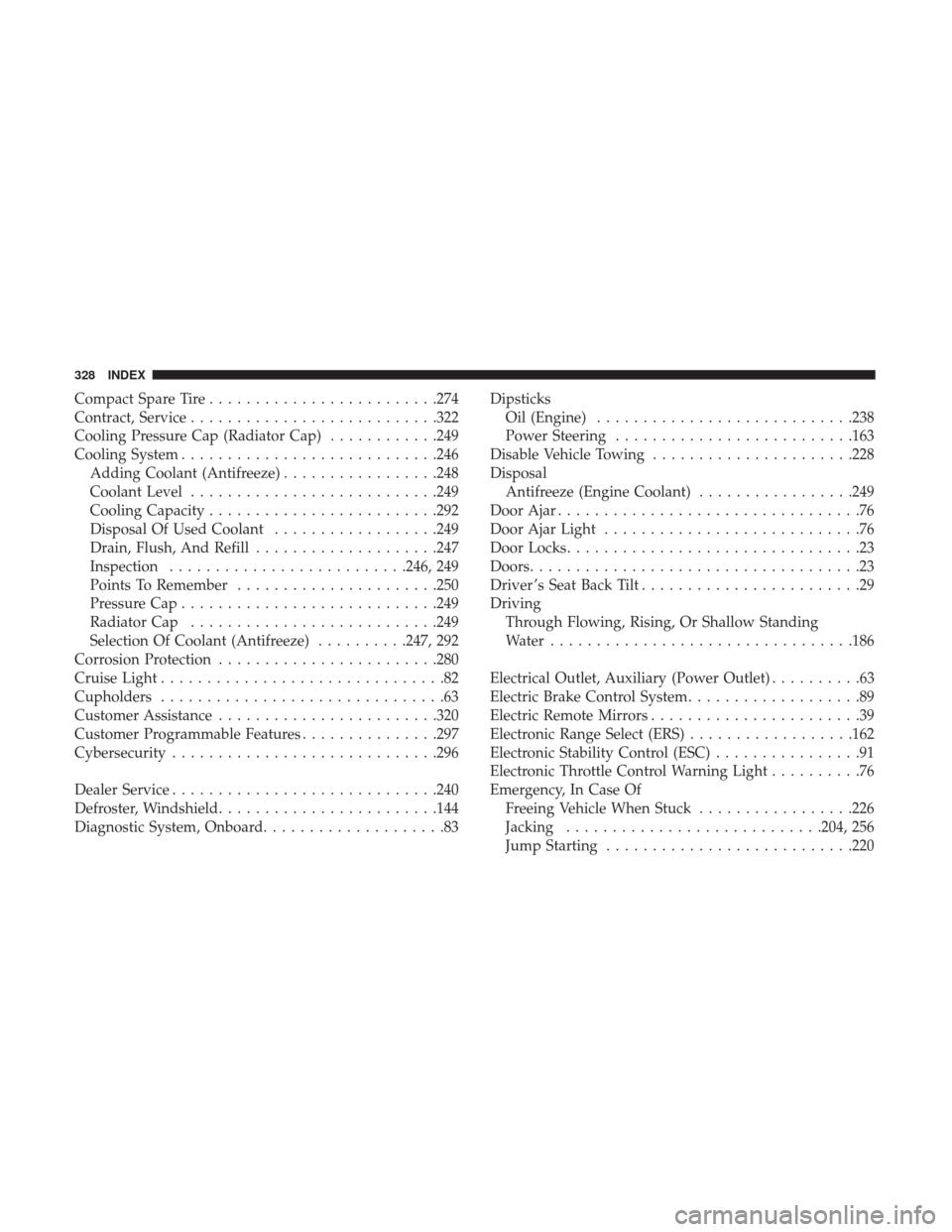
Oil (Engine) ........................... .238
Power Steering ......................... .163
Disable Vehicle Towing ..................... .228
Disposal Antifreeze (Engine Coolant) .................249
Door Ajar .................................76
Door Ajar Light ............................76
Door Locks ................................23
Doors ....................................23
Driver ’s Seat Back Tilt ........................29
Driving Through Flowing, Rising, Or Shallow Standing
Water ................................ .186
Electrical Outlet, Auxiliary (Power Outlet) ..........63
Electric Brake Control System ...................89
Electric Remote Mirrors .......................39
Electronic Range Select (ERS )..................162
Electr
onic Stability Control (ESC) ................91
Electronic Throttle Control Warning Light ..........76
Emergency, In Case Of Freeing Vehicle When Stuck .................226
Jacking ........................... .204, 256
Jump Starting .......................... .220
328 INDEX
Page 334 of 348
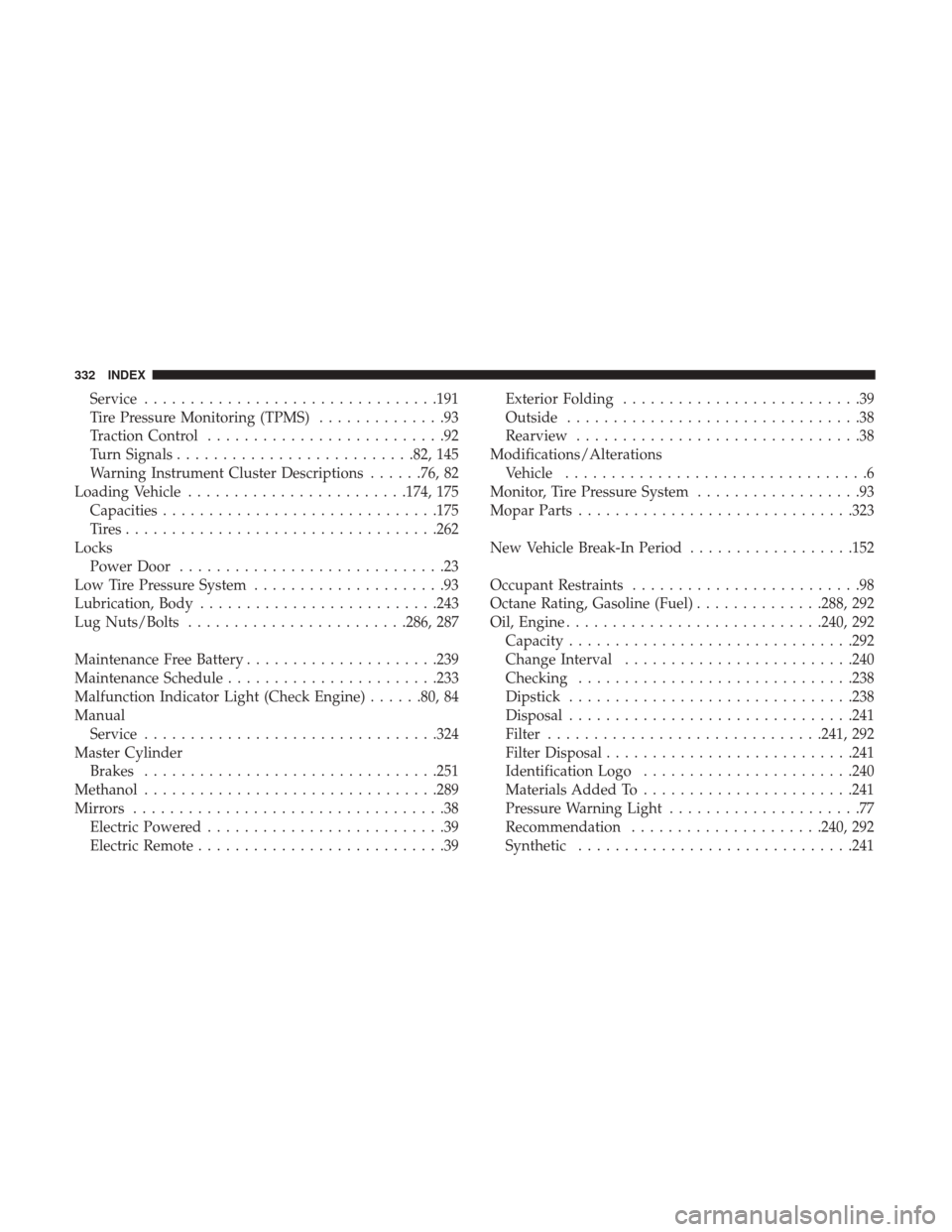
Service............................... .191
Tire Pressure Monitoring (TPMS) ..............93
Traction Control ..........................92
Turn Signals ......................... .82, 145
Warning Instrument Cluster Descriptions ......76, 82
Loading Vehicle ....................... .174, 175
Capacities ............................. .175
Tires................................. .262
Locks Power Door .............................23
Low Tire Pressure System .....................93
Lubrication, Body ......................... .243
Lug Nuts/Bolts ....................... .286, 287
Maintenance Free Battery .....................239
Maintenance Schedule ...................... .233
Malfunction Indicator Light (Check Engine) ......80, 84
Manual Service ............................... .324
Master Cylinder Brakes ............................... .251
Methanol ............................... .289
Mirrors ..................................38
Electric Powered ..........................39
Electric Remote ...........................39 Exterior Folding
..........................39
Outside ................................38
Rearview ...............................38
Modifications/Alterations Vehicle .................................6
Monitor, Tire Pressure System ..................93
Mopar Parts ............................. .323
New Vehicle Break-In Period ..................152
Occupant Restraints .........................98
Octane Rating, Gasoline (Fuel) ..............288, 292
Oil, Engine ........................... .240, 292
Capacity .............................. .292
Change Interval ........................ .240
Checking ............................. .238
Dipstick .............................. .238
Disposal .............................. .241
Filter ............................. .241, 292
Filter Disposal .......................... .241
Identification
Logo...................... .240
Materials Added To ...................... .241
Pressure Warning Light .....................77
Recommendation .....................240, 292
Synthetic ............................. .241
332 INDEX