warning Ram ProMaster City 2020 Workshop Manual
[x] Cancel search | Manufacturer: RAM, Model Year: 2020, Model line: ProMaster City, Model: Ram ProMaster City 2020Pages: 350, PDF Size: 13.27 MB
Page 108 of 350

SAFETY 105
Base SystemThis is the TPMS warning indicator located in the
instrument cluster.
The TPMS uses wireless technology with wheel rim
mounted electronic sensors to monitor tire pressure levels.
Sensors, mounted to each wheel as part of the valve stem,
transmit tire pressure readings to the Receiver Module.
NOTE:
It is particularly important for you to check the tire pressure
in all of the tires on your vehicle regularly and to maintain
the proper pressure.
The TPMS consists of the following components:
• Receiver Module
• Four Tire Pressure Monitoring sensors
• Tire Pressure Monitoring System Warning Light
Tire Pressure Monitoring Low Pressure Warnings
The Tire Pressure Monitoring System Warning Light will
illuminate in the instrument cluster, an audible chime will be
activated, and the “Check tire pressure” text message will
display when one or more of the four active road tire pres -
sures are low. Should this occur, you should stop as soon as possible, check the inflation pressure of each tire on your
vehicle, and inflate each tire to the vehicle’s recommended
cold placard pressure value. The system will automatically
update and the Tire Pressure Monitoring Light will extin
-
guish once the updated tire pressures have been received.
The vehicle may need to be driven for up to 20 minutes
above 15 mph (24 km/h) to receive this information.
Check TPMS Warnings
The Tire Pressure Monitoring Warning Light will flash on
and off for 75 seconds and remain on solid when a system
fault is detected, an audible chime will be activated and a
proper text message will be displayed. If the ignition key is
cycled, this sequence will repeat providing the system fault
still exists. The Tire Pressure Monitoring Warning Light will
turn off when the fault condition no longer exists. A system
fault can occur with any of the following scenarios:
1. Jamming due to electronic devices or driving next to facil -
ities emitting the same radio frequencies as the TPM
sensors.
2. Installing some form of aftermarket window tinting that affects radio wave signals.
3. Snow or ice around the wheels or wheel housings.
4
2020_RAM_PROMASTER_CITY_OM_USA=GUID-7B6A7FCA-79B0-423F-95C5-ED2A949C3D13=1=en=.book Page 105
Page 112 of 350
SAFETY 109
8. Do not lean against the door or window. If your vehiclehas side air bags, and deployment occurs, the side air
bags will inflate forcefully into the space between occu -
pants and the door and occupants could be injured.
9. If the air bag system in this vehicle needs to be modified to accommodate a disabled person, refer to the
“Customer Assistance” section for customer service
contact information.Seat Belt Systems
Buckle up even though you are an excellent driver, even on
short trips. Someone on the road may be a poor driver and
could cause a collision that includes you. This can happen far
away from home or on your own street.
Research has shown that seat belts save lives, and they can
reduce the seriousness of injuries in a collision. Some of the
worst injuries happen when people are thrown from the
vehicle. Seat belts reduce the possibility of ejection and the
risk of injury caused by striking the inside of the vehicle.
Everyone in a motor vehicle should be belted at all times.
Enhanced Seat Belt Use Reminder System (BeltAlert)
Driver and Passenger BeltAlert — If Equipped
BeltAlert is a feature intended to remind the driver and
outboard front seat passenger (if equipped with outboard
front passenger seat BeltAlert) to buckle their seat belts. The
BeltAlert feature is active whenever the ignition switch is in
the AVV/START or MAR/RUN position.
WARNING!
• Never place a rear-facing child restraint in front of an air bag. A deploying passenger front air bag can cause
death or serious injury to a child 12 years or younger,
including a child in a rear-facing child restraint.
• Never install a rear-facing child restraint in the front seat of a vehicle. Only use a rear-facing child restraint
in the rear seat. If the vehicle does not have a rear seat,
do not transport a rear-facing child restraint in that
vehicle.
4
2020_RAM_PROMASTER_CITY_OM_USA=GUID-7B6A7FCA-79B0-423F-95C5-ED2A949C3D13=1=en=.book Page 109
Page 113 of 350

110 SAFETY
Initial Indication
If the driver is unbuckled when the ignition switch is first in the
AVV/START or MAR/RUN position, a chime will signal for a few
seconds. If the driver or outboard front seat passenger (if equipped
with outboard front passenger seat BeltAlert) is unbuckled when
the ignition switch is first in the AVV/START or MAR/RUN posi-
tion the Seat Belt Reminder Light will turn on and remain on until
both outboard front seat belts are buckled. The outboard front
passenger seat BeltAlert is not active when an outboard front
passenger seat is unoccupied.
BeltAlert Warning Sequence
The BeltAlert warning sequence is activated when the vehicle is
moving above a specified vehicle speed range and the driver or
outboard front seat passenger is unbuckled (if equipped with
outboard front passenger seat BeltAlert) (the outboard front
passenger seat BeltAlert is not active when the outboard front
passenger seat is unoccupied). The BeltAlert warning sequence
starts by blinking the Seat Belt Reminder Light and sounding an
intermittent chime. Once the BeltAlert warning sequence has
completed, the Seat Belt Reminder Light will remain on until the
seat belts are buckled. The BeltAlert warning sequence may repeat
based on vehicle speed until the driver and occupied outboard front
seat passenger seat belts are buckled. The driver should instruct all
occupants to buckle their seat belts.
Change of Status
If the driver or outboard front seat passenger (if equipped
with outboard front passenger seat BeltAlert) unbuckles
their seat belt while the vehicle is traveling, the BeltAlert
warning sequence will begin until the seat belts are buckled
again.
The outboard front passenger seat BeltAlert is not active
when the outboard front passenger seat is unoccupied.
BeltAlert may be triggered when an animal or other items are
placed on the outboard front passenger seat or when the seat
is folded flat (if equipped). It is recommended that pets be
restrained in the rear seat (if equipped) in pet harnesses or
pet carriers that are secured by seat belts, and cargo is prop
-
erly stowed.
BeltAlert can be activated or deactivated by an authorized
dealer. FCA US LLC does not recommend deactivating
BeltAlert.
NOTE:
If BeltAlert has been deactivated and the driver or outboard
front seat passenger (if equipped with outboard front
passenger seat BeltAlert) is unbuckled the Seat Belt
Reminder Light will turn on and remain on until the driver
and outboard front seat passenger seat belts are buckled.
2020_RAM_PROMASTER_CITY_OM_USA=GUID-7B6A7FCA-79B0-423F-95C5-ED2A949C3D13=1=en=.book Page 110
Page 114 of 350
SAFETY 111
(Continued)
Lap/Shoulder Belts
All seating positions in your vehicle are equipped with lap/
shoulder belts.
The seat belt webbing retractor will lock only during very
sudden stops or collisions. This feature allows the shoulder
part of the seat belt to move freely with you under normal
conditions. However, in a collision the seat belt will lock and
reduce your risk of striking the inside of the vehicle or being
thrown out of the vehicle.
WARNING!
• Relying on the air bags alone could lead to more severe injuries in a collision. The air bags work with your seat
belt to restrain you properly. In some collisions, the air
bags won’t deploy at all. Always wear your seat belt
even though you have air bags.
• In a collision, you and your passengers can suffer much greater injuries if you are not properly buckled up. You
can strike the interior of your vehicle or other passen -
gers, or you can be thrown out of the vehicle. Always be
sure you and others in your vehicle are buckled up
properly.
• It is dangerous to ride in a cargo area, inside or outside of a vehicle. In a collision, people riding in these areas
are more likely to be seriously injured or killed.
• Do not allow people to ride in any area of your vehicle that is not equipped with seats and seat belts.
• Be sure everyone in your vehicle is in a seat and using a seat belt properly. Occupants, including the driver,
should always wear their seat belts whether or not an
air bag is also provided at their seating position to
minimize the risk of severe injury or death in the event
of a crash.
• Wearing your seat belt incorrectly could make your injuries in a collision much worse. You might suffer
internal injuries, or you could even slide out of the seat
belt. Follow these instructions to wear your seat belt
safely and to keep your passengers safe, too.
• Two people should never be belted into a single seat belt. People belted together can crash into one another
in a collision, hurting one another badly. Never use a
lap/shoulder belt or a lap belt for more than one person,
no matter what their size.
WARNING! (Continued)
4
2020_RAM_PROMASTER_CITY_OM_USA=GUID-7B6A7FCA-79B0-423F-95C5-ED2A949C3D13=1=en=.book Page 111
Page 115 of 350
112 SAFETY
(Continued)
WARNING!
• A lap belt worn too high can increase the risk of injury in a collision. The seat belt forces won’t be at the strong
hip and pelvic bones, but across your abdomen. Always
wear the lap part of your seat belt as low as possible and
keep it snug.
• A twisted seat belt may not protect you properly. In a collision, it could even cut into you. Be sure the seat belt
is flat against your body, without twists. If you can’t
straighten a seat belt in your vehicle, take it to an autho -
rized dealer immediately and have it fixed.
• A seat belt that is buckled into the wrong buckle will not protect you properly. The lap portion could ride too
high on your body, possibly causing internal injuries.
Always buckle your seat belt into the buckle nearest
you.
• A seat belt that is too loose will not protect you prop -
erly. In a sudden stop, you could move too far forward,
increasing the possibility of injury. Wear your seat belt
snugly.
• A seat belt that is worn under your arm is dangerous. Your body could strike the inside surfaces of the
vehicle in a collision, increasing head and neck injury.
A seat belt worn under the arm can cause internal inju -
ries. Ribs aren’t as strong as shoulder bones. Wear the
seat belt over your shoulder so that your strongest
bones will take the force in a collision.
• A shoulder belt placed behind you will not protect you from injury during a collision. You are more likely to
hit your head in a collision if you do not wear your
shoulder belt. The lap and shoulder belt are meant to be
used together.
• A frayed or torn seat belt could rip apart in a collision and leave you with no protection. Inspect the seat belt
system periodically, checking for cuts, frays, or loose
parts. Damaged parts must be replaced immediately.
Do not disassemble or modify the seat belt system. Seat
belt assemblies must be replaced after a collision.
WARNING! (Continued)
2020_RAM_PROMASTER_CITY_OM_USA=GUID-7B6A7FCA-79B0-423F-95C5-ED2A949C3D13=1=en=.book Page 112
Page 119 of 350
116 SAFETY
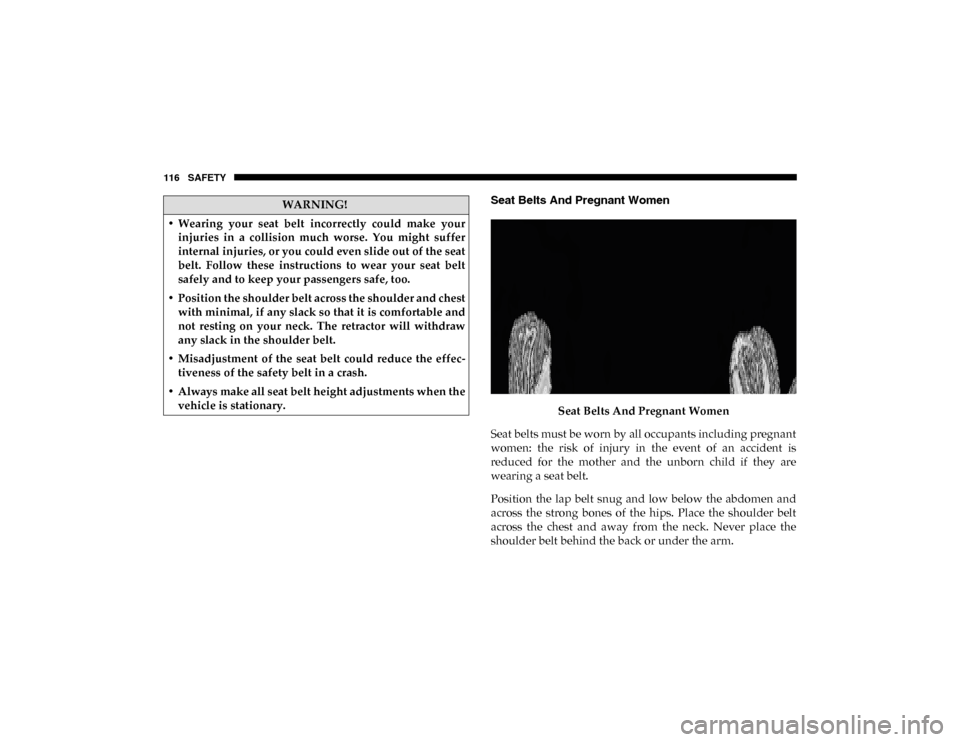
Seat Belts And Pregnant Women Seat Belts And Pregnant Women
Seat belts must be worn by all occupants including pregnant
women: the risk of injury in the event of an accident is
reduced for the mother and the unborn child if they are
wearing a seat belt.
Position the lap belt snug and low below the abdomen and
across the strong bones of the hips. Place the shoulder belt
across the chest and away from the neck. Never place the
shoulder belt behind the back or under the arm.WARNING!
• Wearing your seat belt incorrectly could make your injuries in a collision much worse. You might suffer
internal injuries, or you could even slide out of the seat
belt. Follow these instructions to wear your seat belt
safely and to keep your passengers safe, too.
• Position the shoulder belt across the shoulder and chest with minimal, if any slack so that it is comfortable and
not resting on your neck. The retractor will withdraw
any slack in the shoulder belt.
• Misadjustment of the seat belt could reduce the effec -
tiveness of the safety belt in a crash.
• Always make all seat belt height adjustments when the vehicle is stationary.
2020_RAM_PROMASTER_CITY_OM_USA=GUID-7B6A7FCA-79B0-423F-95C5-ED2A949C3D13=1=en=.book Page 116
Page 122 of 350
SAFETY 119
(Continued)
If the passenger seating position is equipped with an ALR
and is being used for normal usage, only pull the seat belt
webbing out far enough to comfortably wrap around the
occupant’s mid-section so as to not activate the ALR. If the
ALR is activated, you will hear a clicking sound as the seat
belt retracts. Allow the webbing to retract completely in this
case and then carefully pull out only the amount of webbing
necessary to comfortably wrap around the occupant’s
mid-section. Slide the latch plate into the buckle until you
hear a "click."
In Automatic Locking Mode, the shoulder belt is automati-
cally pre-locked. The seat belt will still retract to remove any
slack in the shoulder belt. Use the Automatic Locking Mode
anytime a child restraint is installed in a seating position that
has a seat belt with this feature. Children 12 years old and
under should always be properly restrained in the rear seat
of a vehicle with a rear seat. How To Engage The Automatic Locking Mode
1. Buckle the combination lap and shoulder belt.
2. Grasp the shoulder portion and pull downward until the
entire seat belt is extracted.
3. Allow the seat belt to retract. As the seat belt retracts, you will hear a clicking sound. This indicates the seat belt is
now in the Automatic Locking Mode.
WARNING!
• Never place a rear-facing child restraint in front of an air bag. A deploying passenger front air bag can cause
death or serious injury to a child 12 years or younger,
including a child in a rear-facing child restraint.
• Never install a rear-facing child restraint in the frontseat of a vehicle. Only use a rear-facing child restraint
in the rear seat. If the vehicle does not have a rear seat,
do not transport a rear-facing child restraint in that
vehicle.
WARNING! (Continued)
4
2020_RAM_PROMASTER_CITY_OM_USA=GUID-7B6A7FCA-79B0-423F-95C5-ED2A949C3D13=1=en=.book Page 119
Page 123 of 350
120 SAFETY
How To Disengage The Automatic Locking Mode
Unbuckle the combination lap/shoulder belt and allow it to
retract completely to disengage the Automatic Locking
Mode and activate the vehicle sensitive (emergency) locking
mode.Supplemental Restraint Systems (SRS)
Some of the safety features described in this section may be
standard equipment on some models, or may be optional
equipment on others. If you are not sure, ask an authorized
dealer.
The air bag system must be ready to protect you in a colli-
sion. The Occupant Restraint Controller (ORC) monitors the
internal circuits and interconnecting wiring associated with
the electrical Air Bag System Components. Your vehicle may
be equipped with the following Air Bag System Compo -
nents:
Air Bag System Components
• Occupant Restraint Controller (ORC)
• Air Bag Warning Light
• Steering Wheel and Column
• Instrument Panel
• Knee Impact Bolsters
• Driver and Front Passenger Air Bags
• Seat Belt Buckle Switch
WARNING!
• The seat belt assembly must be replaced if the switch -
able Automatic Locking Retractor (ALR) feature or any
other seat belt function is not working properly when
checked according to the procedures in the Service
Manual.
• Failure to replace the seat belt assembly could increase the risk of injury in collisions.
• Do not use the Automatic Locking Mode to restrain occupants who are wearing the seat belt or children
who are using booster seats. The locked mode is only
used to install rear-facing or forward-facing child
restraints that have a harness for restraining the child.
2020_RAM_PROMASTER_CITY_OM_USA=GUID-7B6A7FCA-79B0-423F-95C5-ED2A949C3D13=1=en=.book Page 120
Page 124 of 350
SAFETY 121
• Supplemental Side Air Bags
• Supplemental Knee Air Bags
• Front and Side Impact Sensors
• Seat Belt Pretensioners
Air Bag Warning Light
The Occupant Restraint Controller (ORC) monitors the
readiness of the electronic parts of the air bag system
whenever the ignition switch is in the AVV/START or
MAR/ACC/ON/RUN position. If the ignition switch is in the
STOP/OFF/LOCK position the air bag system is not on and the air
bags will not inflate.
The ORC contains a backup power supply system that may
deploy the air bag system even if the battery loses power or
it becomes disconnected prior to deployment.
The ORC turns on the Air Bag Warning Light in the instrument
panel for approximately four to eight seconds for a self-check when
the ignition switch is in the MAR/ACC/ON/RUN position. After
the self-check, the Air Bag Warning Light will turn off. If the ORC
detects a malfunction in any part of the system, it turns on the Air
Bag Warning Light, either momentarily or continuously. A single
chime will sound to alert you if the light comes on again after initial
startup.
The ORC also includes diagnostics that will illuminate the
instrument panel Air Bag Warning Light if a malfunction is
detected that could affect the air bag system. The diagnostics
also record the nature of the malfunction. While the air bag
system is designed to be maintenance free, if any of the
following occurs, have an authorized dealer service the air
bag system immediately.
• The Air Bag Warning Light does not come on during the
four to eight seconds when the ignition switch is first in the
MAR/ACC/ON/RUN position.
• The Air Bag Warning Light remains on after the four to eight-second interval.
• The Air Bag Warning Light comes on intermittently or remains on while driving.
NOTE:
If the speedometer, tachometer, or any engine related gauges
are not working, the Occupant Restraint Controller (ORC)
may also be disabled. In this condition the air bags may not
be ready to inflate for your protection. Have an authorized
dealer service the air bag system immediately.
4
2020_RAM_PROMASTER_CITY_OM_USA=GUID-7B6A7FCA-79B0-423F-95C5-ED2A949C3D13=1=en=.book Page 121
Page 125 of 350
122 SAFETY
(Continued)
Front Air Bags
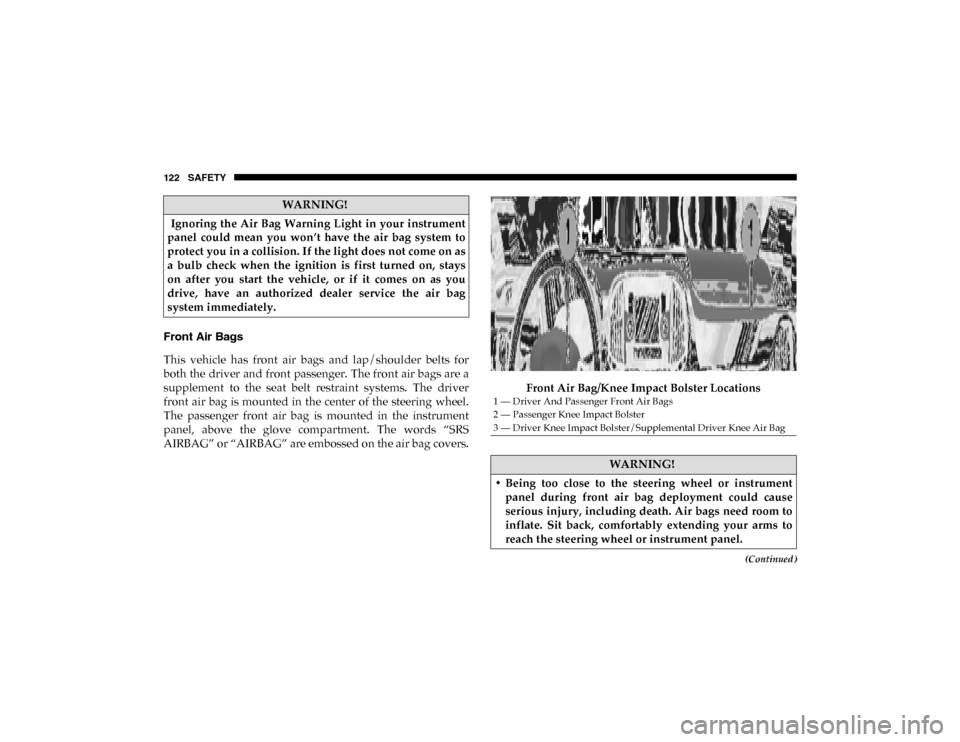
This vehicle has front air bags and lap/shoulder belts for
both the driver and front passenger. The front air bags are a
supplement to the seat belt restraint systems. The driver
front air bag is mounted in the center of the steering wheel.
The passenger front air bag is mounted in the instrument
panel, above the glove compartment. The words “SRS
AIRBAG” or “AIRBAG” are embossed on the air bag covers.Front Air Bag/Knee Impact Bolster Locations
WARNING!
Ignoring the Air Bag Warning Light in your instrument
panel could mean you won’t have the air bag system to
protect you in a collision. If the light does not come on as
a bulb check when the ignition is first turned on, stays
on after you start the vehicle, or if it comes on as you
drive, have an authorized dealer service the air bag
system immediately.
1 — Driver And Passenger Front Air Bags
2 — Passenger Knee Impact Bolster
3 — Driver Knee Impact Bolster/Supplemental Driver Knee Air Bag
WARNING!
• Being too close to the steering wheel or instrument panel during front air bag deployment could cause
serious injury, including death. Air bags need room to
inflate. Sit back, comfortably extending your arms to
reach the steering wheel or instrument panel.
2020_RAM_PROMASTER_CITY_OM_USA=GUID-7B6A7FCA-79B0-423F-95C5-ED2A949C3D13=1=en=.book Page 122