display RENAULT CAPTUR 2014 1.G Owner's Guide
[x] Cancel search | Manufacturer: RENAULT, Model Year: 2014, Model line: CAPTUR, Model: RENAULT CAPTUR 2014 1.GPages: 244, PDF Size: 5.64 MB
Page 123 of 244
2.43
AUTOMATIC TRANSMISSION (1/3)
Operation
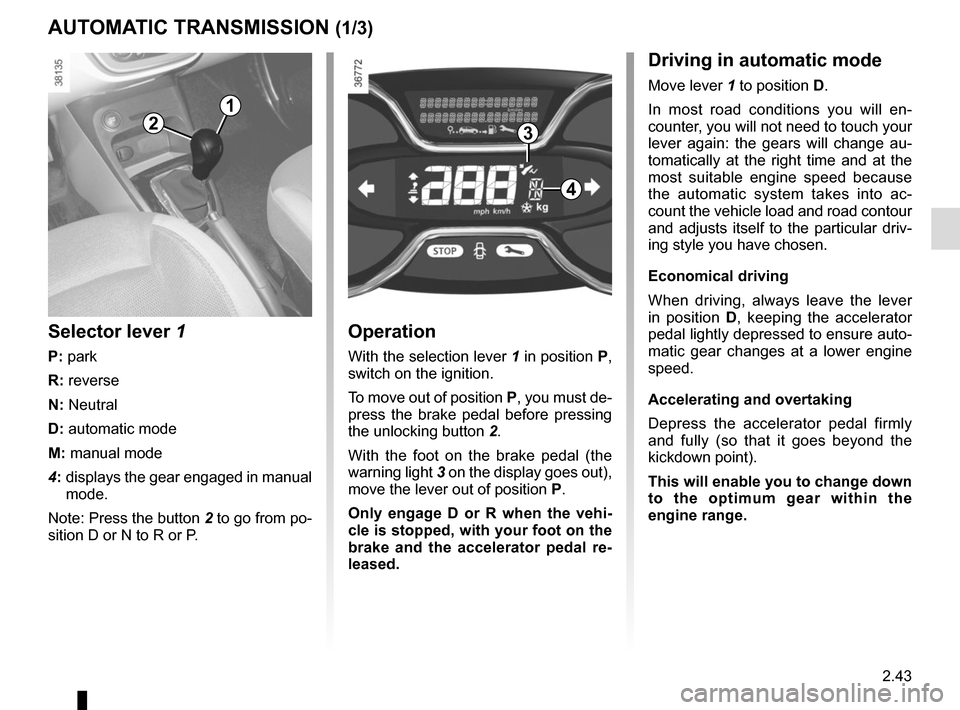
With the selection lever 1 in position P,
switch on the ignition.
To move out of position P, you must de-
press the brake pedal before pressing
the unlocking button 2.
With the foot on the brake pedal (the
warning light 3 on the display goes out),
move the lever out of position P.
Only engage D or R when the vehi-
cle is stopped, with your foot on the
brake and the accelerator pedal re-
leased.
Selector lever 1
P: park
R: reverse
N: Neutral
D: automatic mode
M: manual mode
4: displays the gear engaged in manual
mode.
Note: Press the button 2 to go from po-
sition D or N to R or P.
1
4
32
Driving in automatic mode
Move lever 1 to position D.
In most road conditions you will en-
counter, you will not need to touch your
lever again: the gears will change au-
tomatically at the right time and at the
most suitable engine speed because
the automatic system takes into ac-
count the vehicle load and road contour
and adjusts itself to the particular driv-
ing style you have chosen.
Economical driving
When driving, always leave the lever
in position D, keeping the accelerator
pedal lightly depressed to ensure auto-
matic gear changes at a lower engine
speed.
Accelerating and overtaking
Depress the accelerator pedal firmly
and fully (so that it goes beyond the
kickdown point).
This will enable you to change down
to the optimum gear within the
engine range.
Page 124 of 244
2.44
AUTOMATIC TRANSMISSION (2/3)
Special cases
In certain driving conditions (for exam-
ple, engine protection, operation of the
Electronic Stability Programme: the au-
tomatic system may change gear auto-
matically.
Likewise, to prevent incorrect manoeu-
vres, a gear change may be refused by
the automatic system: in this case the
gear display flashes for a few seconds
as a warning.
Special circumstances
– If the bends and road surface do
not allow you to stay in automatic
mode (e.g. in the mountains), we
recommend that you change to
manual mode. This will prevent the
automatic gearbox from changing
gear repeatedly when climbing, and
permit engine braking on long de-
scents.
– In cold weather , start the engine
and wait a few seconds before
moving the selector lever from posi-
tion P or N and engaging it in D or R
to prevent the engine stalling.
Driving in manual mode
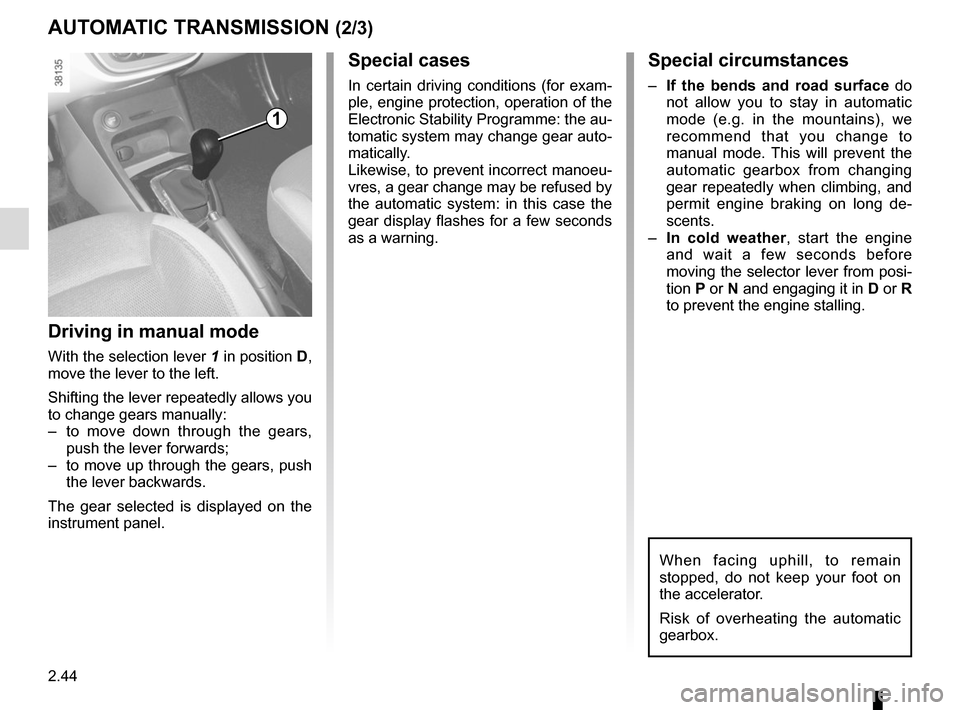
With the selection lever 1 in position D,
move the lever to the left.
Shifting the lever repeatedly allows you
to change gears manually:
– to move down through the gears, push the lever forwards;
– to move up through the gears, push the lever backwards.
The gear selected is displayed on the
instrument panel.
1
When facing uphill, to remain
stopped, do not keep your foot on
the accelerator.
Risk of overheating the automatic
gearbox.
Page 138 of 244
3.12
ELECTRIC WINDOWS (1/2)
These systems operate with the igni-
tion on or off, until one of the front doors
is opened (limited to about 3 minutes).
Electric windowsPress or pull the switch to raise or lower
a window to the desired height (the rear
windows do not open fully);
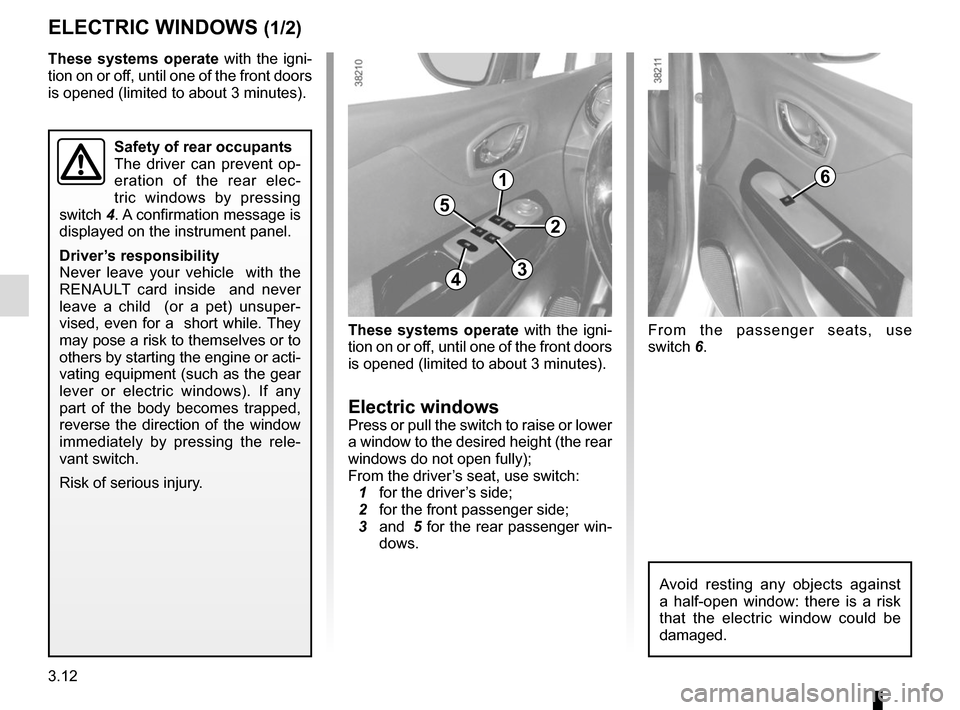
From the driver’s seat, use switch:
1 for the driver’s side;
2 for the front passenger side;
3 and 5 for the rear passenger win-
dows.
1
2
34
5
6
From the passenger seats, use
switch 6.
Avoid resting any objects against
a half-open window: there is a risk
that the electric window could be
damaged.
Safety of rear occupants
The driver can prevent op-
eration of the rear elec-
tric windows by pressing
switch 4. A confirmation message is
displayed on the instrument panel.
Driver’s responsibility
Never leave your vehicle with the
RENAULT card inside and never
leave a child (or a pet) unsuper-
vised, even for a short while. They
may pose a risk to themselves or to
others by starting the engine or acti-
vating equipment (such as the gear
lever or electric windows). If any
part of the body becomes trapped,
reverse the direction of the window
immediately by pressing the rele-
vant switch.
Risk of serious injury.
These systems operate with the igni-
tion on or off, until one of the front doors
is opened (limited to about 3 minutes).
Page 162 of 244
4.4
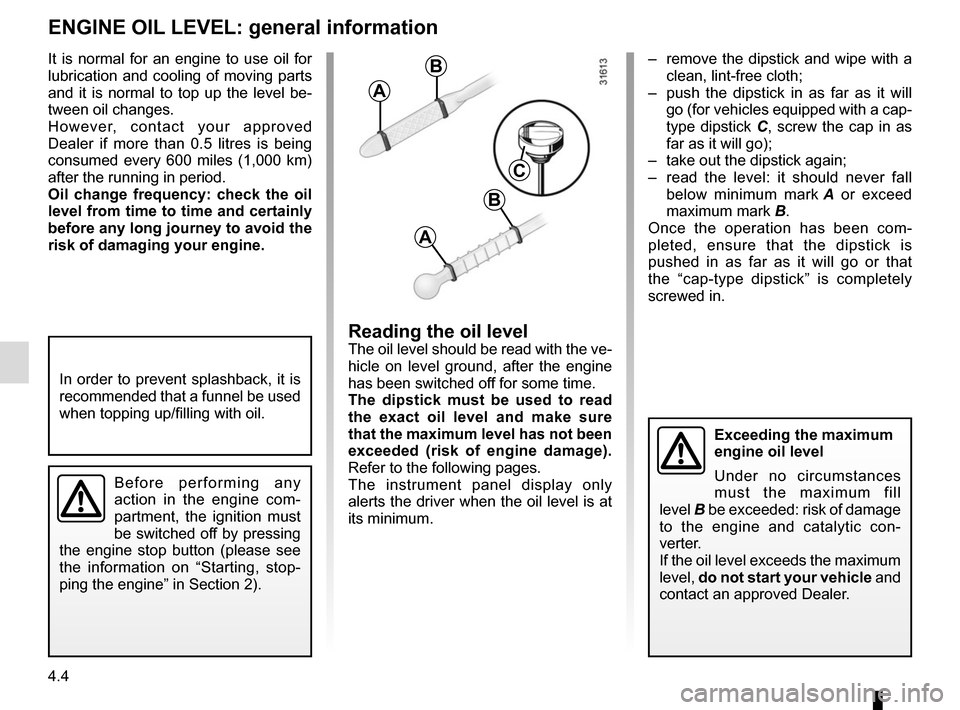
– remove the dipstick and wipe with a clean, lint-free cloth;
– push the dipstick in as far as it will go (for vehicles equipped with a cap-
type dipstick C, screw the cap in as
far as it will go);
– take out the dipstick again;
– read the level: it should never fall below minimum mark A or exceed
maximum mark B.
Once the operation has been com-
pleted, ensure that the dipstick is
pushed in as far as it will go or that
the “cap-type dipstick” is completely
screwed in.
Reading the oil levelThe oil level should be read with the ve-
hicle on level ground, after the engine
has been switched off for some time.
The dipstick must be used to read
the exact oil level and make sure
that the maximum level has not been
exceeded (risk of engine damage).
Refer to the following pages.
The instrument panel display only
alerts the driver when the oil level is at
its minimum.
It is normal for an engine to use oil for
lubrication and cooling of moving parts
and it is normal to top up the level be-
tween oil changes.
However, contact your approved
Dealer if more than 0.5 litres is being
consumed every 600 miles (1,000 km)
after the running in period.
Oil change frequency: check the oil
level from time to time and certainly
before any long journey to avoid the
risk of damaging your engine.
ENGINE OIL LEVEL: general information
A
B
A
B
C
In order to prevent splashback, it is
recommended that a funnel be used
when topping up/filling with oil.
Before performing any
action in the engine com-
partment, the ignition must
be switched off by pressing
the engine stop button (please see
the information on “Starting, stop-
ping the engine” in Section 2).
Exceeding the maximum
engine oil level
Under no circumstances
must the maximum fill
level B be exceeded: risk of damage
to the engine and catalytic con-
verter.
If the oil level exceeds the maximum
level, do not start your vehicle and
contact an approved Dealer.
Page 173 of 244
4.15
Glass instrument panel(e.g.: instrument panel, clock, exterior
temperature display, radio display, mul-
timedia or multifunction display etc.)
Use a soft cloth (or cotton wool).
If this does not clean them properly,
use a soft cloth (or cotton wool) slightly
moistened with soapy water and then
wipe clean with another soft damp cloth
or cotton wool.
Finally, carefully dry off with a soft dry
cloth.
Do not use products containing alco-
hol and/or spray fluids on the area.
Seat belts
These must be kept clean.
Use products selected by our Technical
Department (Approved outlets) or
warm, soapy water and a sponge and
wipe with a dry cloth.
Detergents or dyes must not be used
under any circumstances.
INTERIOR TRIM MAINTENANCE (1/2)
Textiles (seats, door trim, etc)
For vehicles fitted with removable seat
covers, refer to the information on “Seat
covers” in Section 4.
Vacuum-clean the textiles regularly.
Liquid stain
Use soapy water.
Dab lightly (never rub) with a soft cloth,
rinse and remove the excess.
Solid or pasty stain
Carefully remove the excess solid or
pasty material immediately with a
spatula (working from the edges to the
centre to avoid spreading the stain).
Clean as for a liquid stain.
Special instructions for sweets or
chewing gum
Put an ice cube on the stain to solidify
it, then proceed as for a solid stain.
A well-maintained vehicle will last
longer. It is therefore recommended to
maintain the interior of the vehicle regu-
larly.
A stain should always be dealt with
swiftly.
Whatever type of stain is on the trim,
use
cold (or warm) soapy water with
natural soap.
Detergents (washing-up liquid, pow-
dered products, alcohol-based prod-
ucts) should not be used.
Use a soft cloth.
Rinse and soak up the excess.
For further recommendations for
maintaining the interior, and/or for
any unsatisfactory results, please
see an authorised dealer.
Page 237 of 244

A
ABS ..............................................................1.44, \
2.27 → 2.31
accessories.............................................................\
......")
7.1
ALPHABETICAL INDEX (1/5)
A
ABS ..............................................................1.44, \
2.27 → 2.31
accessories.............................................................\
........... 5.27
accessories socket ............................................................ 3.20
additional methods of restraint .......................................... 1.25 side protection ............................................................. 1.24
to the front seat belts .......................................1.19 → 1.22
to the rear seat belts .................................................... 1.23
adjusting your driving position ......................1.14 → 1.18, 3.21
advice on antipollution ....................................................... 2.18
air bag...........................................................1.19 → 1.25, 1.42
activating the front passenger air bags ........................ 1.37
deactivating the front passenger air bags .................... 1.35
air conditioning ........................................................ 3.4 → 3.11
air vents ...................................................................... 3.2 – 3.3
anti-corrosion check ..............................................6.14 → 6.18
anti-corrosion protection .................................................... 4.13
anti-lock braking system: ABS ...............................2.27 → 2.31
antipollution advice .................................................................\
......... 2.18
armrest: front ..................................................................\
............ 3.16
ashtray ................................................................\
............... 3.20
ASR (traction control) ............................................2.27 → 2.31
audible and visual signals.................................................. 1.65
automatic gearbox (use) ........................................2.43 → 2.45
automatic gearbox selector lever...........................2.43 → 2.45
B
battery............................................................ 4.12, 5.24 – 5.25 troubleshooting ................................................. 5.24 – 5.25
bonnet..................................................................\
....... 4.2 – 4.3
brake fluid ........................................................................\
.... 4.8
bulbs changing ..........................................................5.13 \
→ 5.19C
catalytic converter................................................... 2.10 – 2.11
central door locking ............................. 1.4
→ 1.8, 1.11 → 1.13
changing a bulb .....................................................5.13 → 5.19
changing a wheel........................................................\
5.8 – 5.9
changing gear ...............................................2.12, 2.43 → 2.45
child restraint/seat .............................1.26 – 1.27, 1.29 → 1.35
child safety........1.7, 1.10, 1.22, 1.26 – 1.27, 1.29 → 1.35, 2.3,
3.12 – 3.13
child seats..........................................1.26 – 1.27, 1.2\
9 → 1.34
children ................................. 1.2, 1.7, 1.26 – 1.27, 3.12 – 3.13
children (safety) .......................................................... 1.2, 1.10
cigar lighter ........................................................................\
3.20
cleaning: inside the vehicle .............................................. 4.15 – 4.16
clock ....................................................................... 1.59 – 1.60
closing the doors .....................................................1.9 → 1.13
control instruments ............................1.42 → 1.49, 1.59 – 1.60
controls ...............................................................\
...1.38 → 1.41
courtesy light ............................................................ 3.14, 5.18
courtesy mirrors ................................................................. 3.19
cruise control ................................................1.45, 2.35 → 2.38
cruise control-speed limiter....................................2.32 → 2.38
D
dashboard..............................................................1\
.38 → 1.41
deadlocking the doors ......................................................... 1.8
demisting rear screen ..................................................3.4, 3.7 → 3.10
windscreen ..................................................3.5, 3.7 → 3.10
dimensions .............................................................\
............. 6.4
dipstick................................................................\
................. 4.4
display ................................................................\
...1.42 → 1.47
doors/tailgate .........................................................\
..1.2 → 1.13
driver assistance....................................................2.2\
7 → 2.42
driver’s position
.....................................................1.38 → 1.45