wheel RENAULT DUSTER 2016 User Guide
[x] Cancel search | Manufacturer: RENAULT, Model Year: 2016, Model line: DUSTER, Model: RENAULT DUSTER 2016Pages: 256, PDF Size: 6.49 MB
Page 84 of 256
2.8
STOP AND START function (2/3)
Conditions preventing the
standby of the engine
Certain conditions prevent the system
from using the engine standby function,
including when:
– reverse gear is engaged;
– the bonnet is not locked;
– the outdoor temperature is too low or too high (less than around 0 °C or
higher than around 30 °C);
– the battery is not sufficiently char- ged;
– if available, the vehicle is in “4WD Lock” mode (please see the section
“Transmission: 4-wheel drive (4WD)”
in Section 2);
– for vehicles with an automatic or sequential gearbox, the gradient is
steeper than approximately 12%;
– the engine temperature is too low;
– the anti-pollution system is required;
or
– ...
The warning light
lights up on
the instrument panel to alert you that
engine standby is not available.
To fill up with fuel, the engine must
be stopped (and not on standby):
always stop the engine (please see
“Starting, stopping the engine”).
Deactivate the Stop and
Start function for any opera-
tion performed in the engine
compartment.
Preventing the engine from
standing by
In certain situations, when negotiating
a junction for instance, it is possible to
keep the engine running so as to be
ready to move off quickly.
Automatic or sequential gearbox
Keep the vehicle stationary without
pressing too hard on the brake pedal.
Manual gearbox
Keep the clutch pedal pressed right
down.
Conditions for coming out of
engine standby
For automatic or sequential gear-
box:
– The brake pedal is released, position D or M engaged or,
– the brake pedal is released with the gear lever in position N and the
handbrake off, or
– the brake pedal is pressed again, with position N engaged and the
handbrake applied, or
– position R is engaged, or
– the accelerator pedal is pressed.
For manual gearboxes:
– The gearbox is in neutral and the clutch pedal is slightly depressed, or
– the engine is in gear and the clutch pedal is pressed right down.
Page 99 of 256
2.23
TYRE PRESSURE LOSS WARNING (2/7)
SYSTEM A
Operating principle
This system detects a loss of pressure
in one of the tyres by measuring the
wheel speed while driving.
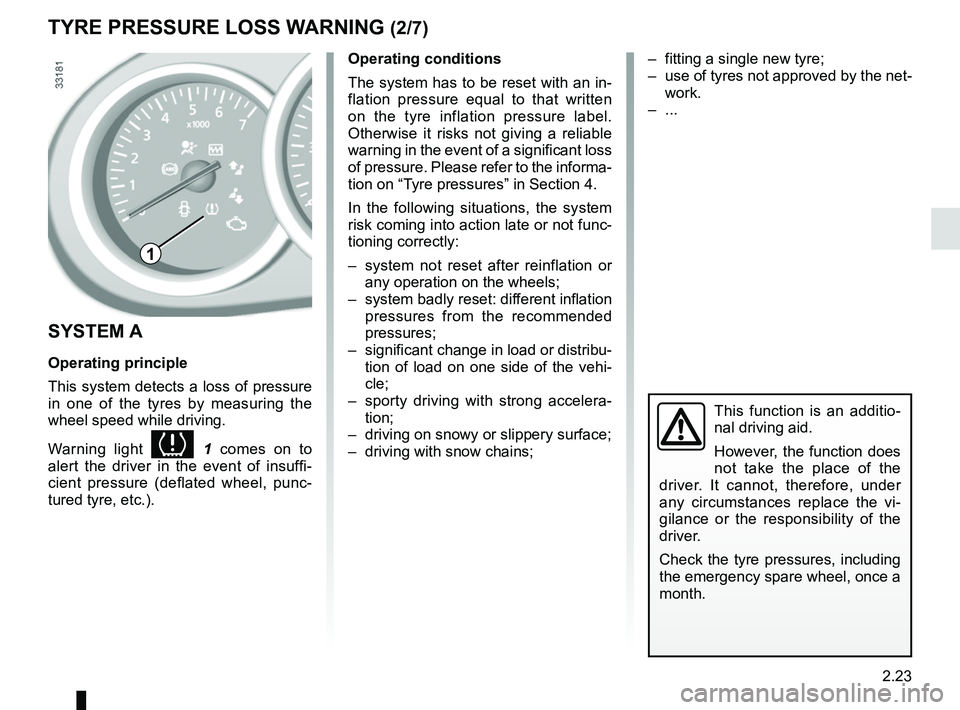
Warning light
1 comes on to
alert the driver in the event of insuffi-
cient pressure (deflated wheel, punc-
tured tyre, etc.). Operating conditions
The system has to be reset with an in-
flation pressure equal to that written
on the tyre inflation pressure label.
Otherwise it risks not giving a reliable
warning in the event of a significant loss
of pressure. Please refer to the informa-
tion on “Tyre pressures” in Section 4.
In the following situations, the system
risk coming into action late or not func-
tioning correctly:
– system not reset after reinflation or
any operation on the wheels;
– system badly reset: different inflation pressures from the recommended
pressures;
– significant change in load or distribu- tion of load on one side of the vehi-
cle;
– sporty driving with strong accelera- tion;
– driving on snowy or slippery surface;
– driving with snow chains; – fitting a single new tyre;
– use of tyres not approved by the net-
work.
– ...
1
This function is an additio-
nal driving aid.
However, the function does
not take the place of the
driver. It cannot, therefore, under
any circumstances replace the vi-
gilance or the responsibility of the
driver.
Check the tyre pressures, including
the emergency spare wheel, once a
month.
Page 100 of 256
2.24
TYRE PRESSURE LOSS WARNING (3/7)
SYSTEM A (cntd.)
Resetting the standard level for the
tyre pressures
This should be done:
– after each reinflation or readjustment of the pressure of one of the tyres;
– when the standard tyre pressure needs to be changed to adapt to
usage conditions (empty, carrying a
load, motorway driving, etc.);
– after changing a wheel;
– after using the tyre inflation kit;
– after changing wheels around.
It should always be done after checking
the tyre pressure of all four tyres when
cold.
Tyre pressures must correspond to the
current usage of the vehicle (empty,
carrying a load, motorway driving, etc.).
Display
Inflate tyres and SEt tP
The warning light
comes on (not
flashing).
This indicates that at least one tyre is
flat or punctured.
In the event of a flat tyre, inflate the rel-
evant tyre.
In the event of a puncture, change the
tyre or consult an authorised dealer.
Check and readjust the pressure of the
four tyres when cold, and launch the
reset of the tyre pressure reference
value.
Warning light
goes out after
launching the reinitialisation of the tyre
pressure reference value.
2
3
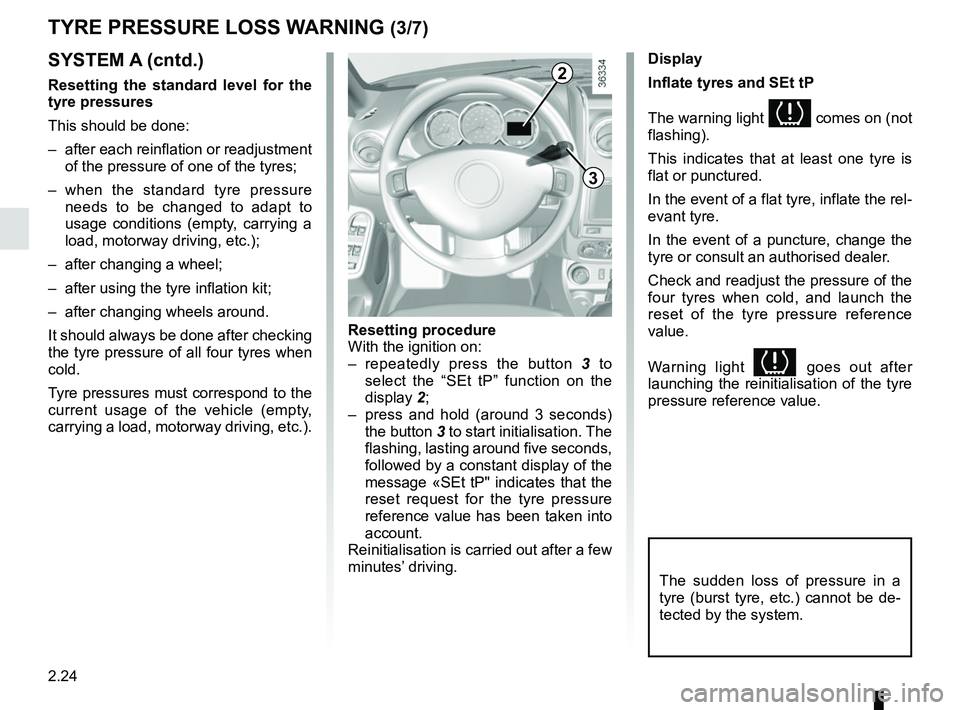
Resetting procedure
With the ignition on:
– repeatedly press the button 3 to
select the “SEt tP” function on the
display 2;
– press and hold (around 3 seconds) the button 3 to start initialisation. The
flashing, lasting around five seconds,
followed by a constant display of the
message «SEt tP" indicates that the
reset request for the tyre pressure
reference value has been taken into
account.
Reinitialisation is carried out after a few
minutes’ driving.
The sudden loss of pressure in a
tyre (burst tyre, etc.) cannot be de-
tected by the system.
Page 101 of 256
2.25
TYRE PRESSURE LOSS WARNING (4/7)
SYSTEM A (cntd.)
Relaunch SEt tP
Warning light
flashes for several
seconds, then stays on.
It indicates that the request to reset the
reference tyre pressure value must be
relaunched.
System unavailable
Warning light
flashes for several
seconds, then stays on.
Indicates that the vehicle is fitted with
an emergency spare wheel which is
smaller than the other four and is fitted
to the vehicle.
System to be checked
The warning light
flashes for
several seconds, then stays on, along
with the orange warning light
Ò.
They indicate a system fault. Please
consult an authorised dealer. Readjustment of tyre pressures
The tyre pressures must be adjusted
when cold
(please refer to the label lo-
cated on the edge of the driver’s door).
If tyre pressures cannot be checked
when the tyres are cold, the recom-
mended pressures should be increased
by 0.2 to 0.3 bar (3 PSI).
Never deflate a hot tyre.
After each reinflation or readjustment of
the tyre pressure, launch the reinitiali-
sation of the tyre pressure reference
value.
Replacing wheels/tyres
Only use equipment approved by the
brand network, or the system risks
being activated late or not operating
correctly. Please see the information on
“Tyres” in Section 5. After each change of wheel/tyre, rea-
djust the tyre pressure and launch the
reset of the tyre pressure reference
value.
Emergency spare wheel
If fitted on the vehicle, readjust the tyre
pressure and launch the reinitialisation
of the tyre pressure reference value.
Inflation kit
Only use equipment approved by the
brand network, or the system risks
being activated late or not operating
correctly. Please refer to “Tyre inflation
kit” in Section 5.
After using the tyre inflation kit, readjust
the tyre pressure and launch the reini-
tialisation of the tyre pressure reference
value.
Page 102 of 256
2.26
TYRE PRESSURE LOSS WARNING (5/7)
SYSTEM B
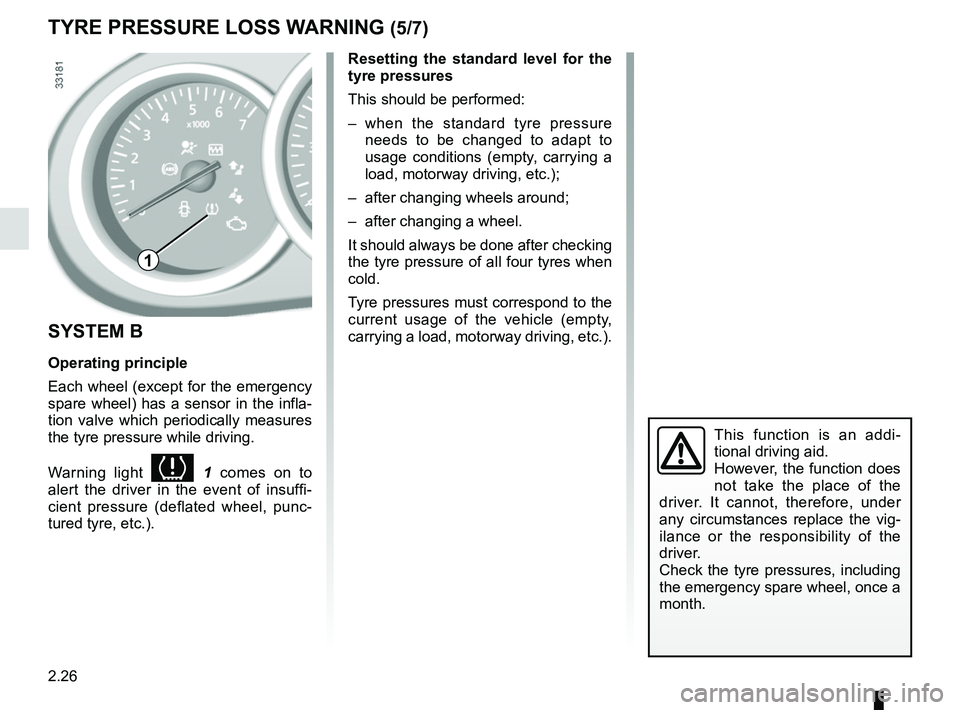
Operating principle
Each wheel (except for the emergency
spare wheel) has a sensor in the infla-
tion valve which periodically measures
the tyre pressure while driving.
Warning light
1 comes on to
alert the driver in the event of insuffi-
cient pressure (deflated wheel, punc-
tured tyre, etc.). Resetting the standard level for the
tyre pressures
This should be performed:
– when the standard tyre pressure
needs to be changed to adapt to
usage conditions (empty, carrying a
load, motorway driving, etc.);
– after changing wheels around;
– after changing a wheel.
It should always be done after checking
the tyre pressure of all four tyres when
cold.
Tyre pressures must correspond to the
current usage of the vehicle (empty,
carrying a load, motorway driving, etc.).
This function is an addi-
tional driving aid.
However, the function does
not take the place of the
driver. It cannot, therefore, under
any circumstances replace the vig-
ilance or the responsibility of the
driver.
Check the tyre pressures, including
the emergency spare wheel, once a
month.
1
Page 103 of 256
2.27
TYRE PRESSURE LOSS WARNING (6/7)
Note:
The standard tyre pressure cannot be
less than that recommended and indi-
cated on the door frame.
Display
Check tyre pressure
The warning light
comes on (not
flashing).
This indicates that at least one tyre is
flat.
Check and, if necessary, readjust the
pressures of the four wheels when cold.
The warning light
goes off after a
few minutes’ driving. Puncture
The warning light
and the red
warning light
Ò come on steady,
together with a beep.
They indicate that at least one wheel
is punctured or severely underinflated.
Replace it or contact an authorised
dealer if it is punctured. Top up the tyre
pressure if the wheel is deflated.
SYSTEM B (cntd.)
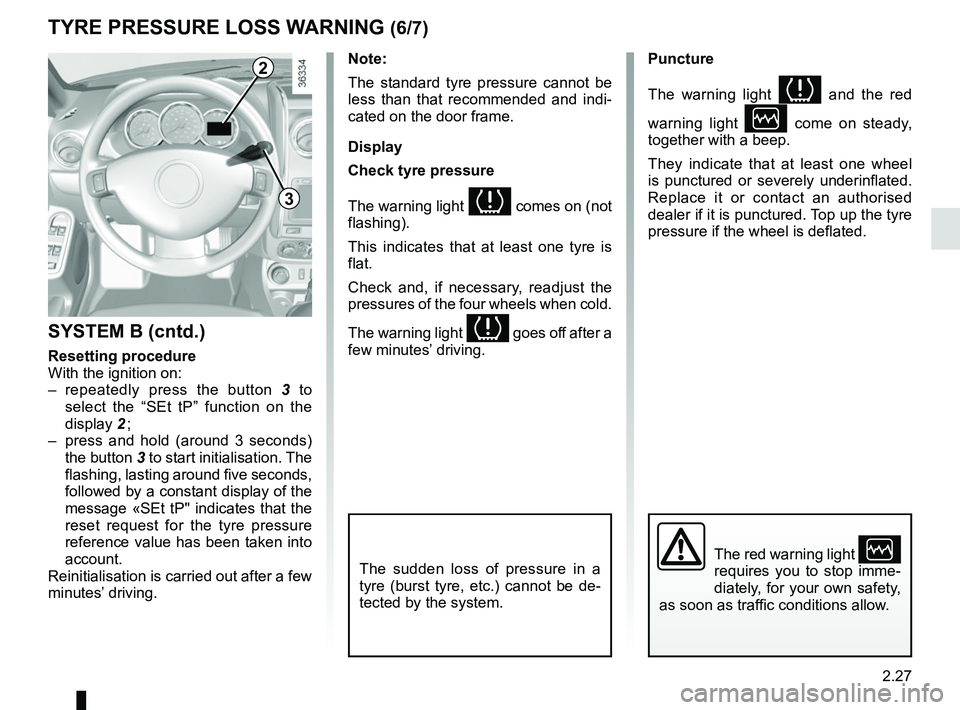
Resetting procedure
With the ignition on:
– repeatedly press the button 3 to
select the “SEt tP” function on the
display 2 ;
– press and hold (around 3 seconds) the button 3 to start initialisation. The
flashing, lasting around five seconds,
followed by a constant display of the
message «SEt tP" indicates that the
reset request for the tyre pressure
reference value has been taken into
account.
Reinitialisation is carried out after a few
minutes’ driving.
The sudden loss of pressure in a
tyre (burst tyre, etc.) cannot be de-
tected by the system.The red warning light Ò
requires you to stop imme-
diately, for your own safety,
as soon as traffic conditions allow.
2
3
Page 104 of 256
2.28
TYRE PRESSURE LOSS WARNING (7/7)
SYSTEM B (cntd.)
Check tyre sensors
The warning light
flashes for
several seconds, then stays on, along
with the orange warning light
Ò.
They indicate that at least one tyre is
not fitted with sensors (e.g. emergency
spare wheel). In other cases, contact
an authorised dealer.
Readjustment of tyre pressures
The tyre pressures must be adjusted
when cold (please refer to the label lo-
cated on the edge of the driver’s door).
If tyre pressures cannot be checked
when the tyres are cold, the recom-
mended pressures should be increased
by 0.2 to 0.3 bar (3 PSI).
Never deflate a hot tyre. Replacing wheels/tyres
This system requires specific equip-
ment (wheels, tyres, hubcaps, etc.).
Please see the information on “Tyres”
in Section 5.
Contact an authorised dealer to fit new
tyres and to find out about available ac-
cessories compatible with the system
and available from your dealer net-
work: the use of any other accessory
could affect the correct operation of the
system.
Emergency spare wheel
If the vehicle is equipped with an emer-
gency spare wheel, it will not have a
sensor.
When fitted to the vehicle, the warn-
ing light
and the orange warning
light
Ò are displayed on the instru-
ment panel. Inflation kit
Because the valves are specially de-
signed, only use equipment approved
by the approved network. Please refer
to “Tyre inflation kit” in Section 5.
Page 106 of 256
2.30
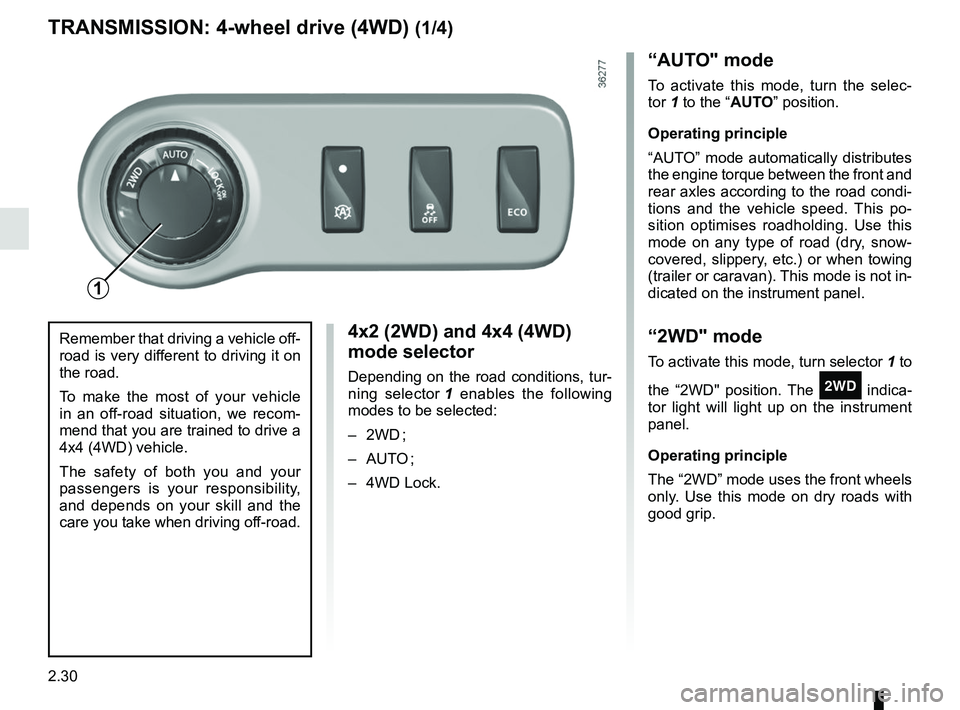
4x2 (2WD) and 4x4 (4WD)
mode selector
Depending on the road conditions, tur-
ning selector 1 enables the following
modes to be selected:
– 2WD ;
– AUTO ;
– 4WD Lock.
TRANSMISSION: 4-wheel drive (4WD) (1/4)
“AUTO" mode
To activate this mode, turn the selec-
tor 1 to the “AUTO” position.
Operating principle
“AUTO” mode automatically distributes
the engine torque between the front and
rear axles according to the road condi-
tions and the vehicle speed. This po-
sition optimises roadholding. Use this
mode on any type of road (dry, snow-
covered, slippery, etc.) or when towing
(trailer or caravan). This mode is not in-
dicated on the instrument panel.
“2WD" mode
To activate this mode, turn selector 1 to
the “2WD" position. The
‘ indica-
tor light will light up on the instrument
panel.
Operating principle
The “2WD” mode uses the front wheels
only. Use this mode on dry roads with
good grip.
Remember that driving a vehicle off-
road is very different to driving it on
the road.
To make the most of your vehicle
in an off-road situation, we recom-
mend that you are trained to drive a
4x4 (4WD) vehicle.
The safety of both you and your
passengers is your responsibility,
and depends on your skill and the
care you take when driving off-road.
1
Page 107 of 256
2.31
TRANSMISSION: 4-wheel drive (4WD) (2/4)
This problem may be resolved by chan-
ging the tyres. Always use four identi-
cal tyres (same brand, profile, etc.) and
with similar wear.
In the event of excessive wheelspin,
the mechanical components may be
overheating.
If this happens:
– at first, the
’ warning light
flashes. “4WD Lock” mode is still
active, however we recommend that
you stop as soon as possible to allow
the system to cool down (until the
warning light stops flashing);
– if the wheels still spin, the system au- tomatically switches to “2WD” mode
to protect the mechanical compo-
nents.
The
‘ warning light flashes. The
mode cannot be changed while the
light is flashing.
After one minute, the system switches
to “2WD” or “AUTO” mode depending
on the position of the selector.
Note: if the vehicle is travelling at a
speed of more than approximately
49.6 mph (80 km/h) or if it is travel-
ling at a speed of between 37.2 and
49.6 mph (60 and 80 km/h) for more
than one minute in «4WD Lock" mode,
the system automatically switches back
to "AUTO" mode. The warning light
’ goes out.
Special features of the
4-wheel drive transmission
The vehicle may make more noise when
the “AUTO" or "4WD Lock" modes are
activated. This is normal. If the system
detects a difference in the dimensions
of the front and rear wheels (eg. un-
derinflation, severe wear on an axle),
the system automatically switches to
"2WD" mode.
The
‘ and Ò warning lights on
the instrument panel come on. Drive as
soon as possible at a moderate speed
to an approved dealer.
To deactivate this mode, turn selector
1
to the “AUTO” position. The
‘ indi-
cator light on the instrument panel goes
out.
“4WD Lock" mode
To activate this mode, turn selector 1 to
the “4WD Lock” position. The selector
the returns to the “AUTO” position. The
’ indicator light will light up on the
instrument panel.
Operating principle
“4WD Lock” mode distributes the
engine torque between the front and
rear axles in order to optimise the per-
formance capacity of the vehicle in off-
road situations. This mode should only
be used in extreme driving conditions
(mud, steep slopes, sand).
To deactivate this mode, turn selector 1
to the “4WD Lock” position again. The
indicator light on the instrument panel
goes out. When the engine is switched
off, the system stays in “4WD Lock”
mode for one minute.
Page 108 of 256
2.32
TRANSMISSION: 4-wheel drive (4WD) (3/4)
Electronic stability program and
traction control when driving off-
road
(vehicles equipped with ESC)
When driving on soft ground (sand,
mud, deep snow), we recommend that
you deactivate the ESC function by
pressing the “ ESC” switch.
In this case, only individual wheel bra-
king remains active. This function ap-
plies the brake to any wheel that is slip-
ping, allowing the engine torque to be
transferred to the wheels with the most
grip. This is particularly useful when
crossing a bridge.
All the ESC functions will be reactivated
when the vehicle speed reaches ap-
proximately 30 mph (50 km/h) (36 mph
(60 km/h) in 4WD Lock mode), when
the engine is restarted or when the
“ESC” button is pressed again.Operating faults
If the system detects an operating
fault, it automatically switches to “2WD”
mode, and the
‘ and Ò war-
ning lights come on.
Drive as soon as possible at a mode-
rate speed to an approved dealer.
For certain operating faults, the system
may not be able to switch to “2WD" or
"4WD Lock" mode. "AUTO" mode re-
mains active.
Contact an approved dealer as soon as
possible.
In this case, we recommend that you
stop as soon as possible to allow the
system to cool down (until the warning
light stops flashing).
Cooling may take up to five minutes.
If the system detects excessive whee-
lspin on the front wheels, it adapts the
engine to run in a way that reduces
wheelspin.
Anti-lock braking in “
LOCK” mode
(vehicles equipped with ABS)
When “4WD Lock" mode is active, the
ABS switches to off-road mode. In this
case, the wheels may lock intermit-
tently to achieve better grip, thus redu-
cing braking distances on soft ground.
When this mode is active:
– the vehicle’s manoeuvrability is limi- ted during braking. This operating
mode is therefore not recommended
in very low-grip conditions (eg. ice).
– there may be some noise. This is normal, and does not indicate an
operating fault.