wheel RENAULT DUSTER 2016 Service Manual
[x] Cancel search | Manufacturer: RENAULT, Model Year: 2016, Model line: DUSTER, Model: RENAULT DUSTER 2016Pages: 256, PDF Size: 6.49 MB
Page 191 of 256
5.13
TYRES (2/4)
Tyre pressures
Adhere to the tyre pressures (including
the emergency spare wheel). The tyre
pressures should be checked at least
once a month and additionally before
any long journey (refer to the label af-
fixed to the edge of the driver’s door).
Incorrect tyre pressures
lead to abnormal tyre wear
and unusually hot running.
These are factors which
may seriously affect safety and lead
to:
– poor road holding;
– risk of blowouts or throwing a tread.
The tyre pressure depends on the
load and speed of use; adjust the
pressures according to the condi-
tions of use (refer to the information
on “Tyre pressures” in Section 4).
Please be aware that a poorly tightened or missing valve cap can make
the tyres less airtight and may lead to pressure loss. Always use valve
caps of the same type as the originals and tighten them fully.
Pressures should be checked when the
tyres are cold; ignore higher pressures
which may be reached in hot weather
or following a fast journey.
If tyre pressures cannot be checked
when the tyres are cold, assume an in-
crease of 0.2 to 0.3 bar.
Never deflate a hot tyre.
Special note
Depending on the vehicle, there may
be an adapter which needs to be posi-
tioned on the valve before air is added.
Your vehicle is equipped with large
wheels. These are more sensitive to
imbalance. If you experience vibra-
tion while driving, contact an appro-
ved dealer.
Vehicle fitted with a tyre pressure
loss warning system
If under-inflated (puncture, low pres-
sure, etc.), the warning light
on
the instrument panel comes on. See
«Tyre pressure loss warning» in chap-
ter 2.
Page 192 of 256
5.14
TYRES (3/4)
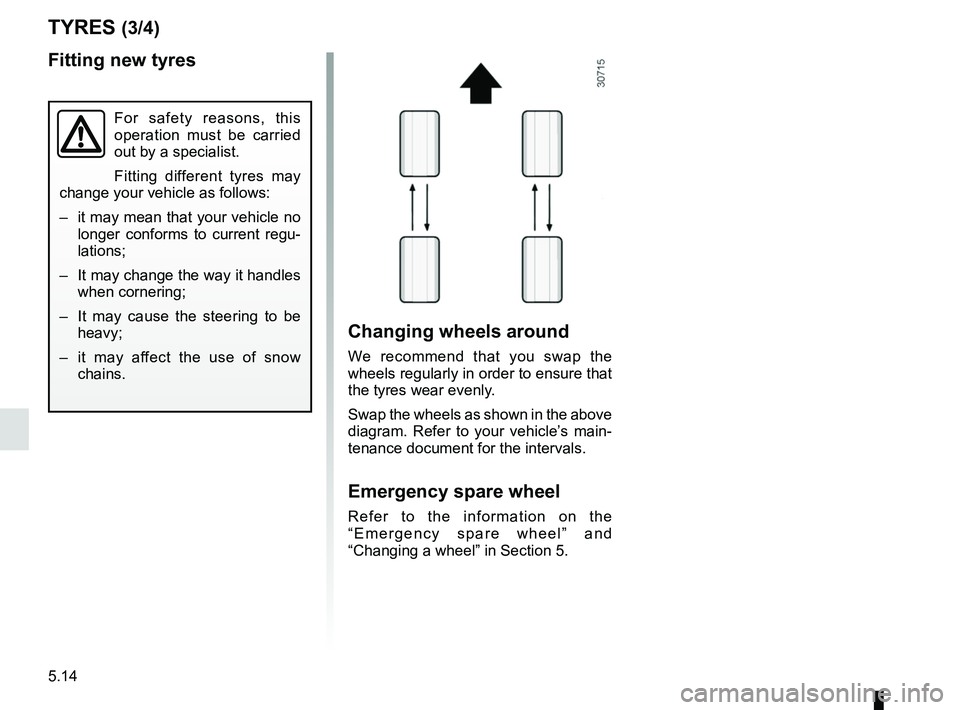
Changing wheels around
We recommend that you swap the
wheels regularly in order to ensure that
the tyres wear evenly.
Swap the wheels as shown in the above
diagram. Refer to your vehicle’s main-
tenance document for the intervals.
Emergency spare wheel
Refer to the information on the
“Emergency spare wheel” and
“Changing a wheel” in Section 5.
Fitting new tyres
For safety reasons, this
operation must be carried
out by a specialist.
Fitting different tyres may
change your vehicle as follows:
– it may mean that your vehicle no longer conforms to current regu-
lations;
– It may change the way it handles when cornering;
– It may cause the steering to be heavy;
– it may affect the use of snow chains.
Page 193 of 256
5.15
TYRES (4/4)
Snow or Winter tyres
We would recommend that these be
fitted to all four wheels to ensure that
your vehicle retains maximum adhe-
sion.
Warning: These tyres sometimes
have a specific direction of rotation
and a maximum speed index which
may be lower than the maximum
speed of your vehicle.
Studded tyres
This type of equipment may only be
used for a limited period and as laid
down by local legislation.
It is necessary to observe the speed
specified by current legislation.
These tyres must, at a minimum, be
fitted to the two front wheels.
In all cases, we would recommend
that you contact your approved
dealer who will be able to advise you
on the choice of equipment which is
most suitable for your vehicle.
Use in winter
Chains
2-wheel drive version (2WD)
Snow chains must be fitted to the
front wheels.
4-wheel drive version (4WD)
Snow chains may be fitted to only the
front wheels, or to all four wheels.
It is forbidden to fit snow
chains to only the rear
wheels.
Snow chains may only be
fitted to tyres of the same size as
those originally fitted to your vehicle.
Only certain chains can be fitted to
tyres.
Consult an approved dealer.
Page 209 of 256
5.31
Number Allocation
A Driver’s side window
winder
B 4-wheel drive (4WD)
transmission
C LPG
D Rear accessories socket
E Passenger compartment
ECU, starter
1 Front electric window
2 Left-hand main beam
headlight
3 Right-hand main beam
headlight
4 Left-hand dipped beam
headlight
5 Right-hand dipped beam
headlight
6 Rear lights
7 Front side lights
8 Rear electric windowsNumber Allocation
9 Rear fog lights
10 Horn
11 Automatic door locking
12 ABS-ESC, brake switch,
clutch switch
13 Interior lights, boot light,
glovebox light
14 Empty location
15 Windscreen wiper
16 Cruise control/Speed
limiter, unfastened
seat belt warning,
parking distance
control, multimedia, air
conditioning, heated seats,
automatic gearbox lever,
UCHNumber Allocation
17 Daytime running lights
18 Brake lights
19 Injection, instrument panel
or dashboard, passenger
compartment, sequential
gearbox lever
20 Airbag
21 4-wheel drive transmission
(4WD), LPG, automatic
gearbox, sequential
gearbox, reverse gear
22 Power-assisted steering
23 Heated rear windscreen,
heated seats, seatbelt
alarm, parking distance
control, additional
passenger compartment
heating, cruise control/
speed limiter, heated
windscreen
FUSES (4/8)
Page 212 of 256
5.34
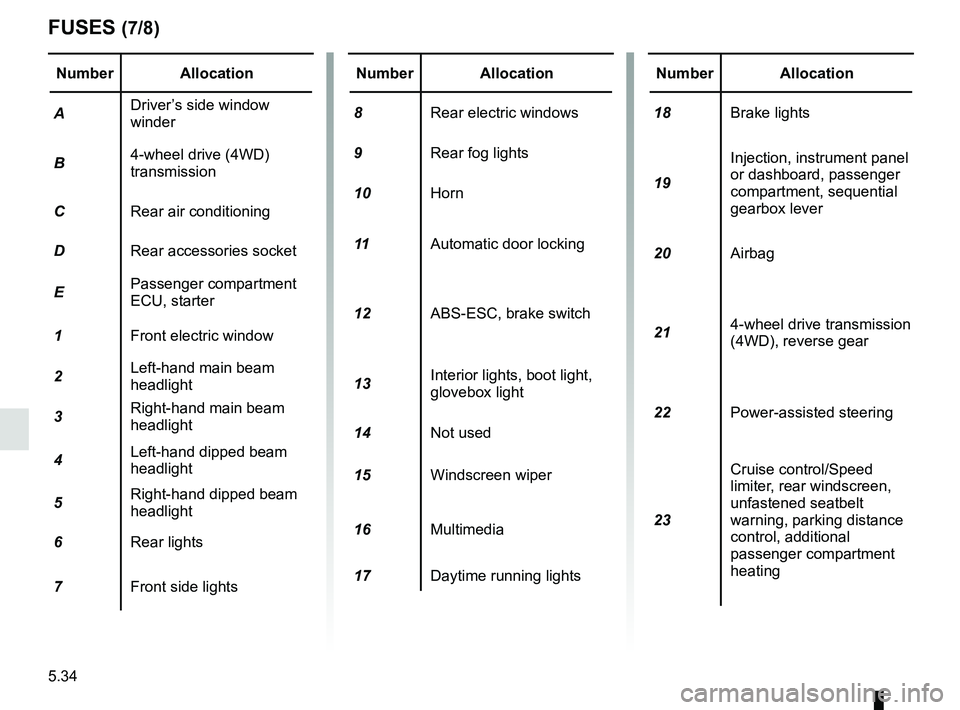
FUSES (7/8)
Number Allocation
A Driver’s side window
winder
B 4-wheel drive (4WD)
transmission
C Rear air conditioning
D Rear accessories socket
E Passenger compartment
ECU, starter
1 Front electric window
2 Left-hand main beam
headlight
3 Right-hand main beam
headlight
4 Left-hand dipped beam
headlight
5 Right-hand dipped beam
headlight
6 Rear lights
7 Front side lightsNumber Allocation
8 Rear electric windows
9 Rear fog lights
10 Horn
11 Automatic door locking
12 ABS-ESC, brake switch
13 Interior lights, boot light,
glovebox light
14 Not used
15 Windscreen wiper
16 Multimedia
17 Daytime running lightsNumber Allocation
18 Brake lights
19 Injection, instrument panel
or dashboard, passenger
compartment, sequential
gearbox lever
20 Airbag
21 4-wheel drive transmission
(4WD), reverse gear
22 Power-assisted steering
23 Cruise control/Speed
limiter, rear windscreen,
unfastened seatbelt
warning, parking distance
control, additional
passenger compartment
heating
Page 219 of 256
5.41
TOWING: breakdown (2/3)
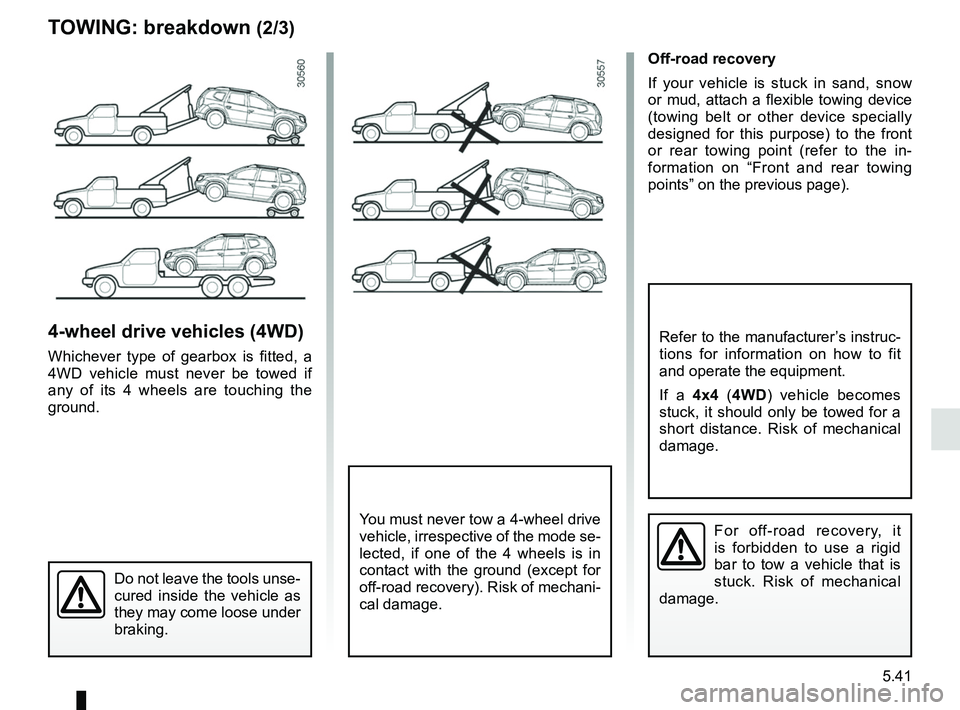
4-wheel drive vehicles (4WD)
Whichever type of gearbox is fitted, a
4WD vehicle must never be towed if
any of its 4 wheels are touching the
ground.
Off-road recovery
If your vehicle is stuck in sand, snow
or mud, attach a flexible towing device
(towing belt or other device specially
designed for this purpose) to the front
or rear towing point (refer to the in-
formation on “Front and rear towing
points” on the previous page).
For off-road recovery, it
is forbidden to use a rigid
bar to tow a vehicle that is
stuck. Risk of mechanical
damage.You must never tow a 4-wheel drive
vehicle, irrespective of the mode se-
lected, if one of the 4 wheels is in
contact with the ground (except for
off-road recovery). Risk of mechani-
cal damage.
Refer to the manufacturer’s instruc-
tions for information on how to fit
and operate the equipment.
If a 4x4 ( 4WD) vehicle becomes
stuck, it should only be towed for a
short distance. Risk of mechanical
damage.
Do not leave the tools unse-
cured inside the vehicle as
they may come loose under
braking.
Page 220 of 256
5.42
TOWING: breakdown (3/3)
When storing the tools,
ensure they are securely re-
placed in the luggage com-
partment, in their original
position.
Do not leave the tools unsecured
inside the vehicle as they may come
loose under braking.
4
5
Towing a vehicle with an
automatic gearbox
When the engine is switched off, the
gearbox is no longer lubricated. It is
preferable to tow this type of vehicle
on a trailer or, for 4x2 (2WD) vehicles
only, tow it with the rear wheels off the
ground.
Under exceptional circumstances
and for 4x2 ( 2WD), vehicles only, you
may tow the vehicle with all four wheels
on the ground, only going forward, with
the gear lever in neutral position N and
for a distance not exceeding 30 miles
(50 km).
If the gear lever cannot be put into the
N position, please consult an authori-
sed dealer.
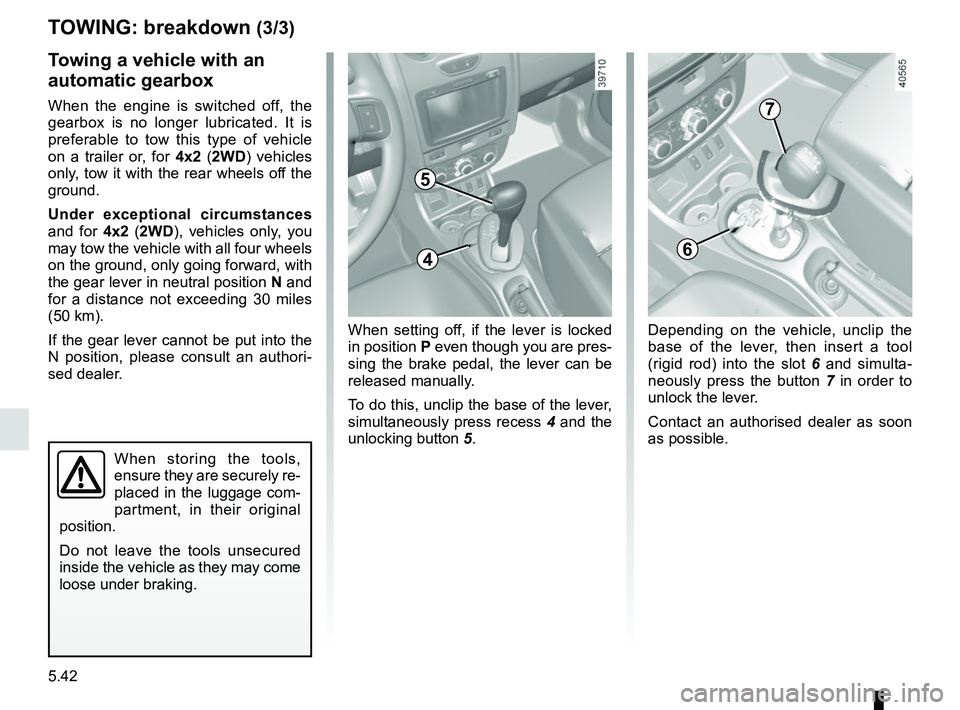
When setting off, if the lever is locked
in position P even though you are pres-
sing the brake pedal, the lever can be
released manually.
To do this, unclip the base of the lever,
simultaneously press recess 4 and the
unlocking button 5. Depending on the vehicle, unclip the
base of the lever, then insert a tool
(rigid rod) into the slot
6 and simulta-
neously press the button 7 in order to
unlock the lever.
Contact an authorised dealer as soon
as possible.
6
7
Page 223 of 256

The following advice will enable you to carry out quick, temporary repai\
rs. For safety reasons you should always contact
an approved dealer as soon as possible.
The star")
5.45
OPERATING FAULTS (1/5)
The following advice will enable you to carry out quick, temporary repai\
rs. For safety reasons you should always contact
an approved dealer as soon as possible.
The starter is activatedPOSSIBLE CAUSESWHAT TO DO
Warning lights dim or fail to come on;
the starter does not run. Battery terminals disconnected,
oxidised or incorrectly secured.Retighten them, reconnect them or clean
them if they are oxidised.
Battery discharged or worn. Connect another battery to the faulty bat-
tery. Refer to the information on “Battery:
troubleshooting” in Section 5 or replace the
battery if necessary.
Do not push the vehicle if the steering
column is locked.
The engine will not start. Starting conditions are not fulfilled.Refer to the information on “Starting/stop-
ping the engine in Section 2.
The steering column remains locked. Steering wheel locked. To unlock, gently move the key and the
steering wheel (refer to the information on
the “Ignition switch” in Section 2).
Page 225 of 256
5.47
OPERATING FAULTS (3/5)
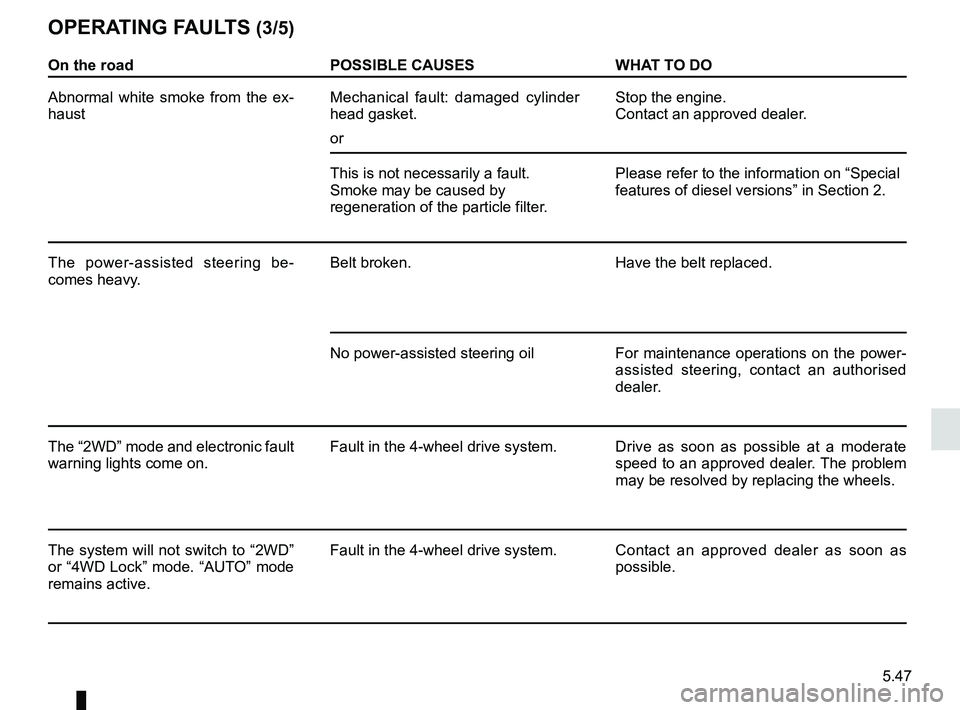
On the roadPOSSIBLE CAUSES WHAT TO DO
Abnormal white smoke from the ex-
haust Mechanical fault: damaged cylinder
head gasket.
or Stop the engine.
Contact an approved dealer.
This is not necessarily a fault.
Smoke may be caused by
regeneration of the particle filter. Please refer to the information on “Special
features of diesel versions” in Section 2.
The power-assisted steering be-
comes heavy. Belt broken.
Have the belt replaced.
No power-assisted steering oil For maintenance operations on the power-
assisted steering, contact an authorised
dealer.
The “2WD” mode and electronic fault
warning lights come on. Fault in the 4-wheel drive system.
Drive as soon as possible at a moderate
speed to an approved dealer. The problem
may be resolved by replacing the wheels.
The system will not switch to “2WD”
or “4WD Lock” mode. “AUTO” mode
remains active. Fault in the 4-wheel drive system.
Contact an approved dealer as soon as
possible.
Page 249 of 256

A
ABS ....................................................................\
...2.34 → 2.37
accessories.............................................................\
....")
7.1
ALPHABETICAL INDEX (1/5)
A
ABS ....................................................................\
...2.34 → 2.37
accessories.............................................................\
........... 5.44
accessories socket ............................................................ 3.14
adjusting your driving position ...............................1.13 → 1.16
advice on antipollution ....................................................... 2.20
air bag.................................................................\
...1.17 → 1.21
deactivating the front passenger air bags .................... 1.33
air conditioning ..........................................................3.2 → 3.7
air vents ...................................................................... 3.2 – 3.3
anti-corrosion check ..............................................6.15 → 6.19
anti-corrosion protection .................................................... 4.16
anti-lock braking system: ABS ...............................2.34 → 2.37
antipollution advice .................................................................\
......... 2.20
armrest ................................................................\
.............. 3.19
ashtrays ...............................................................\
.............. 3.14
automatic gearbox (use) ...............................2.45 → 2.48, 5.42
automatic gearbox selector lever...........................2.45 → 2.48
B
battery.................................................................\
.... 4.14 – 4.15 troubleshooting ................................................. 5.36 – 5.37
battery (remote control) ..................................................... 5.38
bonnet..................................................................\
....... 4.2 – 4.3
brake fluid ........................................................................\
.... 4.8
bulbs changing ..........................................................5.16 \
→ 5.27
C
capacity of mechanical components........................... 4.4, 4.14
catalytic converter.....................................................\
......... 2.10
central door locking .................................................... 1.5 – 1.6
changing a bulb .....................................................5.16 → 5.27
changing a wheel.................................................... 5.10 – 5.11
changing fuel while driving ....................................2.12 → 2.14changing gear ...............................................2.29, 2.45
→ 2.48
child booster seat ..................................................1.22 → 1.24
child restraint/seat .................................................1.22 → 1.32
child safety.................. 1.2, 1.8 – 1.9, 1.22 → 1.32, 3.8 → 3.10
child seats.............................................................\
.1.22 → 1.32
children ....................................................... 1.5 – 1.6, 1.8 – 1.9
children (safety) .......................................................3.8 → 3.10
cigar lighter ........................................................................\
3.14
cleaning: inside the vehicle .............................................. 4.18 – 4.19
clock ..................................................................\
................ 1.57
closing the doors ........................................................ 1.8 – 1.9
control instruments ............................1.41 → 1.55, 1.59 – 1.60
controls ...............................................................\
...1.37 → 1.40
courtesy light .......................................................... 3.11 – 3.12
cruise control .........................................................2.41 → 2.44
cruise control-speed limiter....................................2.38 → 2.44
D
dashboard..............................................................1\
.37 → 1.40
dimensions .............................................................\
............. 6.5
dipstick................................................................\
................. 4.4
doors...................................................................\
.......1.5 → 1.9
driver’s position .....................................................1.37 → 1.40
driving .........2.2 → 2.6, 2.10 – 2.11, 2.15 → 2.19, 2.29 → 2.50
E
ECO driving ..................................... 1.41 → 1.47, 2.15 → 2.19
electric beam height adjustment ............................. 1.61 – 1.62
electric door locking .................................................... 1.5 – 1.6
electric windows ......................................................3.8 →
3.10
electronic stability control: ESC .............................2.34 → 2.37
emergency brake assist.........................................2.34 → 2.37
emergency braking ................................................2.34 → 2.37
emergency spare wheel ........................5.3 – 5.4, 5.12 → 5.15