warning light RENAULT DUSTER 2016 Repair Manual
[x] Cancel search | Manufacturer: RENAULT, Model Year: 2016, Model line: DUSTER, Model: RENAULT DUSTER 2016Pages: 256, PDF Size: 6.49 MB
Page 188 of 256
5.10
CHANGING A WHEEL (1/2)
Switch on the hazard warn-
ing lights.
Park the vehicle away from
traffic on flat ground with a
good level of grip. Engage the hand-
brake and put into gear (first or re-
verse).
Ask the passengers to leave the ve-
hicle and to keep away from traffic.
If you have a puncture, re-
place the wheel as soon as
possible.
A tyre which has been punc-
tured should always be inspected
(and repaired, where possible) by a
specialist.
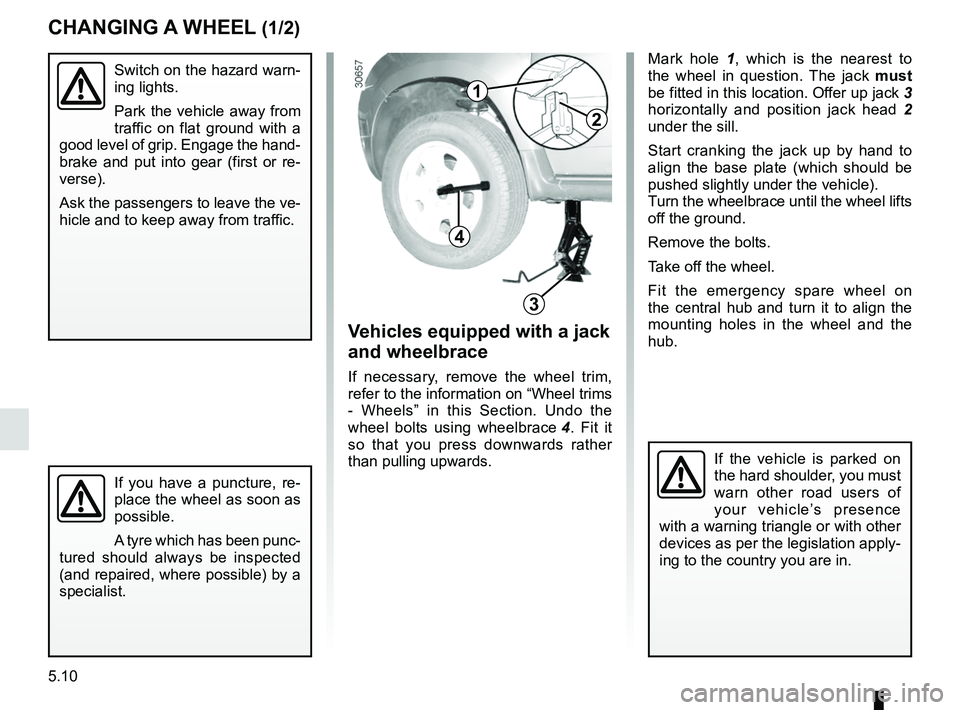
Vehicles equipped with a jack
and wheelbrace
If necessary, remove the wheel trim,
refer to the information on “Wheel trims
- Wheels” in this Section. Undo the
wheel bolts using wheelbrace 4. Fit it
so that you press downwards rather
than pulling upwards. Mark hole 1
, which is the nearest to
the wheel in question. The jack must
be fitted in this location. Offer up jack 3
horizontally and position jack head 2
under the sill.
Start cranking the jack up by hand to
align the base plate (which should be
pushed slightly under the vehicle).
Turn the wheelbrace until the wheel lifts
off the ground.
Remove the bolts.
Take off the wheel.
Fit the emergency spare wheel on
the central hub and turn it to align the
mounting holes in the wheel and the
hub.
If the vehicle is parked on
the hard shoulder, you must
warn other road users of
your vehicle’s presence
with a warning triangle or with other
devices as per the legislation apply-
ing to the country you are in.
1
2
3
4
Page 189 of 256
5.11
CHANGING A WHEEL (2/2)
If the vehicle is parked on
the hard shoulder, you must
warn other road users of
your vehicle’s presence
with a warning triangle or with other
devices as per the legislation apply-
ing to the country you are in.
Note: ensure that the emergency
spare wheel or punctured wheel and
the wheel tray are correctly posi-
tioned so that the luggage compart-
ment carpet can be properly fitted.
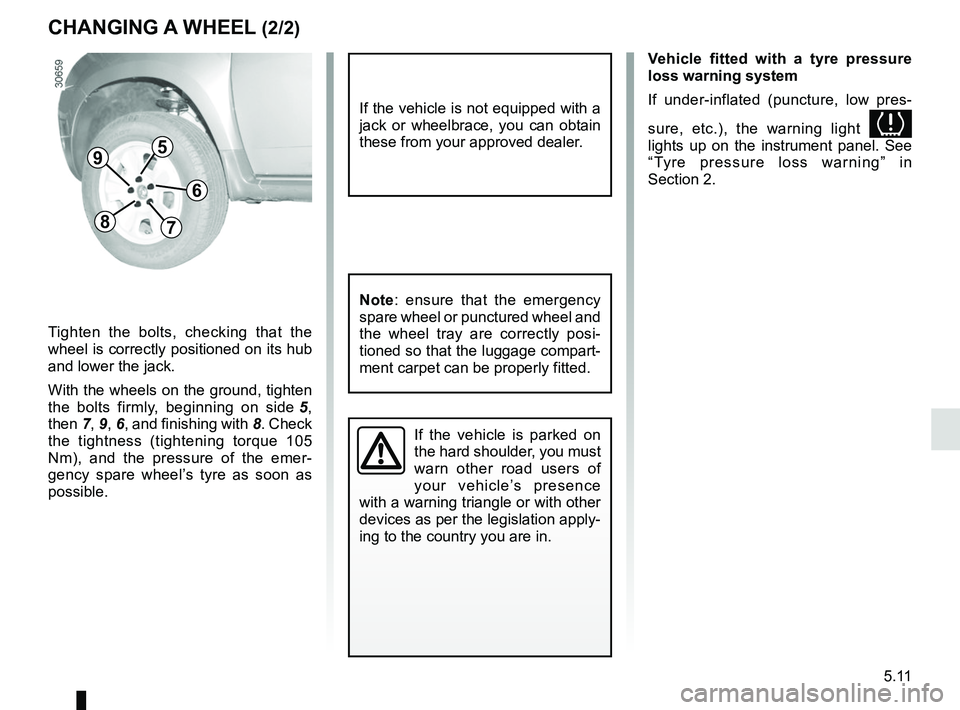
Tighten the bolts, checking that the
wheel is correctly positioned on its hub
and lower the jack.
With the wheels on the ground, tighten
the bolts firmly, beginning on side 5,
then 7, 9, 6, and finishing with 8. Check
the tightness (tightening torque 105
Nm), and the pressure of the emer-
gency spare wheel’s tyre as soon as
possible.
If the vehicle is not equipped with a
jack or wheelbrace, you can obtain
these from your approved dealer.
5
6
78
9
Vehicle fitted with a tyre pressure
loss warning system
If under-inflated (puncture, low pres-
sure, etc.), the warning light
lights up on the instrument panel. See
“Tyre pressure loss warning” in
Section 2.
Page 191 of 256
5.13
TYRES (2/4)
Tyre pressures
Adhere to the tyre pressures (including
the emergency spare wheel). The tyre
pressures should be checked at least
once a month and additionally before
any long journey (refer to the label af-
fixed to the edge of the driver’s door).
Incorrect tyre pressures
lead to abnormal tyre wear
and unusually hot running.
These are factors which
may seriously affect safety and lead
to:
– poor road holding;
– risk of blowouts or throwing a tread.
The tyre pressure depends on the
load and speed of use; adjust the
pressures according to the condi-
tions of use (refer to the information
on “Tyre pressures” in Section 4).
Please be aware that a poorly tightened or missing valve cap can make
the tyres less airtight and may lead to pressure loss. Always use valve
caps of the same type as the originals and tighten them fully.
Pressures should be checked when the
tyres are cold; ignore higher pressures
which may be reached in hot weather
or following a fast journey.
If tyre pressures cannot be checked
when the tyres are cold, assume an in-
crease of 0.2 to 0.3 bar.
Never deflate a hot tyre.
Special note
Depending on the vehicle, there may
be an adapter which needs to be posi-
tioned on the valve before air is added.
Your vehicle is equipped with large
wheels. These are more sensitive to
imbalance. If you experience vibra-
tion while driving, contact an appro-
ved dealer.
Vehicle fitted with a tyre pressure
loss warning system
If under-inflated (puncture, low pres-
sure, etc.), the warning light
on
the instrument panel comes on. See
«Tyre pressure loss warning» in chap-
ter 2.
Page 209 of 256
5.31
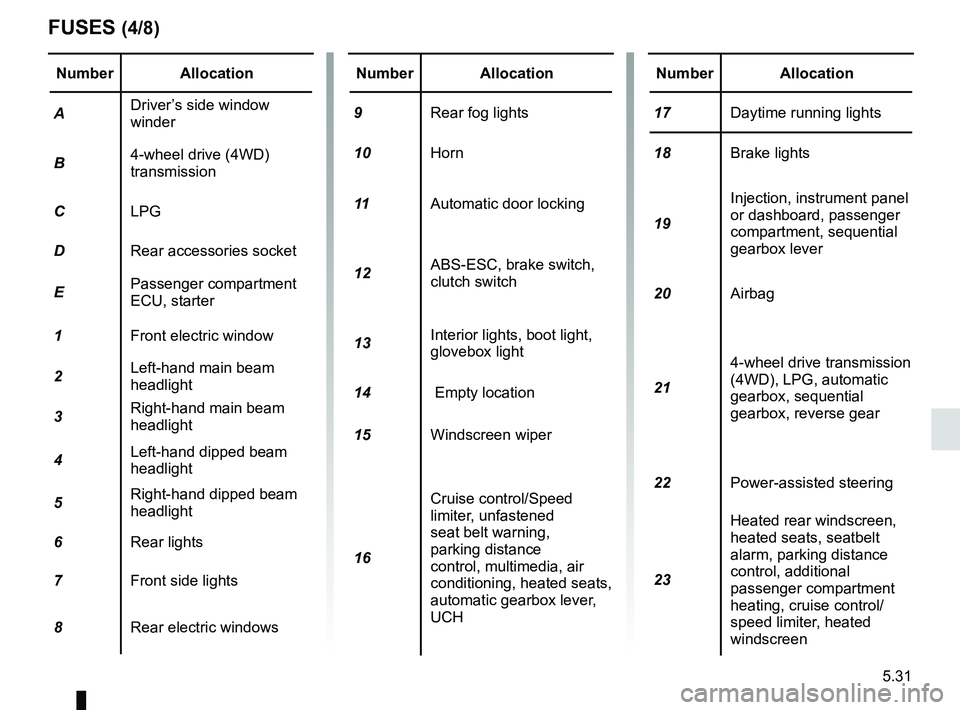
Number Allocation
A Driver’s side window
winder
B 4-wheel drive (4WD)
transmission
C LPG
D Rear accessories socket
E Passenger compartment
ECU, starter
1 Front electric window
2 Left-hand main beam
headlight
3 Right-hand main beam
headlight
4 Left-hand dipped beam
headlight
5 Right-hand dipped beam
headlight
6 Rear lights
7 Front side lights
8 Rear electric windowsNumber Allocation
9 Rear fog lights
10 Horn
11 Automatic door locking
12 ABS-ESC, brake switch,
clutch switch
13 Interior lights, boot light,
glovebox light
14 Empty location
15 Windscreen wiper
16 Cruise control/Speed
limiter, unfastened
seat belt warning,
parking distance
control, multimedia, air
conditioning, heated seats,
automatic gearbox lever,
UCHNumber Allocation
17 Daytime running lights
18 Brake lights
19 Injection, instrument panel
or dashboard, passenger
compartment, sequential
gearbox lever
20 Airbag
21 4-wheel drive transmission
(4WD), LPG, automatic
gearbox, sequential
gearbox, reverse gear
22 Power-assisted steering
23 Heated rear windscreen,
heated seats, seatbelt
alarm, parking distance
control, additional
passenger compartment
heating, cruise control/
speed limiter, heated
windscreen
FUSES (4/8)
Page 212 of 256
5.34
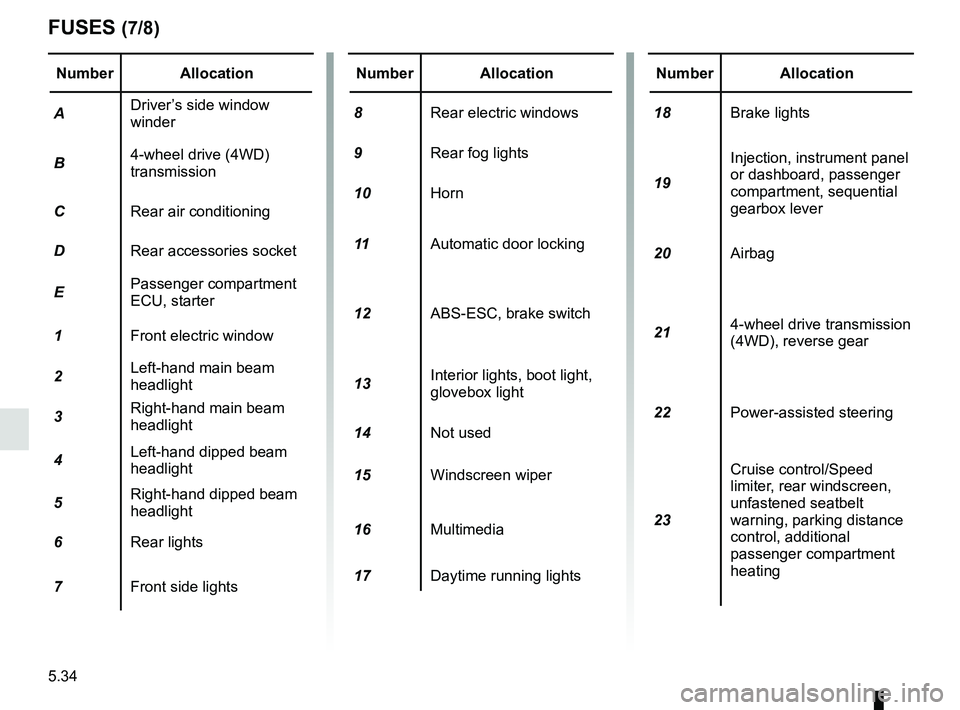
FUSES (7/8)
Number Allocation
A Driver’s side window
winder
B 4-wheel drive (4WD)
transmission
C Rear air conditioning
D Rear accessories socket
E Passenger compartment
ECU, starter
1 Front electric window
2 Left-hand main beam
headlight
3 Right-hand main beam
headlight
4 Left-hand dipped beam
headlight
5 Right-hand dipped beam
headlight
6 Rear lights
7 Front side lightsNumber Allocation
8 Rear electric windows
9 Rear fog lights
10 Horn
11 Automatic door locking
12 ABS-ESC, brake switch
13 Interior lights, boot light,
glovebox light
14 Not used
15 Windscreen wiper
16 Multimedia
17 Daytime running lightsNumber Allocation
18 Brake lights
19 Injection, instrument panel
or dashboard, passenger
compartment, sequential
gearbox lever
20 Airbag
21 4-wheel drive transmission
(4WD), reverse gear
22 Power-assisted steering
23 Cruise control/Speed
limiter, rear windscreen,
unfastened seatbelt
warning, parking distance
control, additional
passenger compartment
heating
Page 218 of 256
5.40
TOWING: breakdown (1/3)
Before any towing, put the gears into
neutral (neutral position for vehicles
equipped with a manual gearbox or N
position for vehicles equipped with an
automatic gearbox).
Unlock the steering column; the igni-
tion key must be in “M” position (ig-
nition) to enable signalling (“Stop”
lights, hazard warning lights, etc.).
Always switch on the lights when
driving at night.
Release the parking brake.
It is also essential to observe the towing
regulations imposed by current legisla-
tion in your country. Please contact an
authorised dealer.
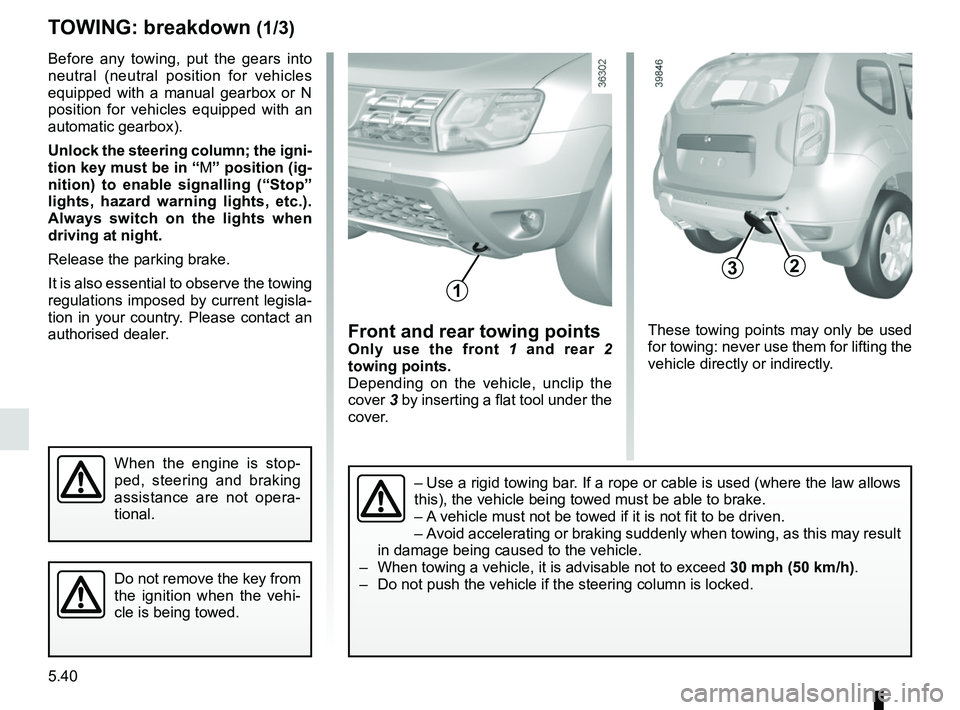
Front and rear towing pointsOnly use the front 1 and rear 2
towing points.
Depending on the vehicle, unclip the
cover 3 by inserting a flat tool under the
cover.
When the engine is stop-
ped, steering and braking
assistance are not opera-
tional.
Do not remove the key from
the ignition when the vehi-
cle is being towed.
– Use a rigid towing bar. If a rope or cable is used (where the law allows
this), the vehicle being towed must be able to brake.
– A vehicle must not be towed if it is not fit to be driven.
– Avoid accelerating or braking suddenly when towing, as this may result
in damage being caused to the vehicle.
– When towing a vehicle, it is advisable not to exceed 30 mph (50 km/h).
– Do not push the vehicle if the steering column is locked.
These towing points may only be used
for towing: never use them for lifting the
vehicle directly or indirectly.
1
23
Page 223 of 256

The following advice will enable you to carry out quick, temporary repai\
rs. For safety reasons you should always contact
an approved dealer as soon as possible.
The star")
5.45
OPERATING FAULTS (1/5)
The following advice will enable you to carry out quick, temporary repai\
rs. For safety reasons you should always contact
an approved dealer as soon as possible.
The starter is activatedPOSSIBLE CAUSESWHAT TO DO
Warning lights dim or fail to come on;
the starter does not run. Battery terminals disconnected,
oxidised or incorrectly secured.Retighten them, reconnect them or clean
them if they are oxidised.
Battery discharged or worn. Connect another battery to the faulty bat-
tery. Refer to the information on “Battery:
troubleshooting” in Section 5 or replace the
battery if necessary.
Do not push the vehicle if the steering
column is locked.
The engine will not start. Starting conditions are not fulfilled.Refer to the information on “Starting/stop-
ping the engine in Section 2.
The steering column remains locked. Steering wheel locked. To unlock, gently move the key and the
steering wheel (refer to the information on
the “Ignition switch” in Section 2).
Page 224 of 256
5.46
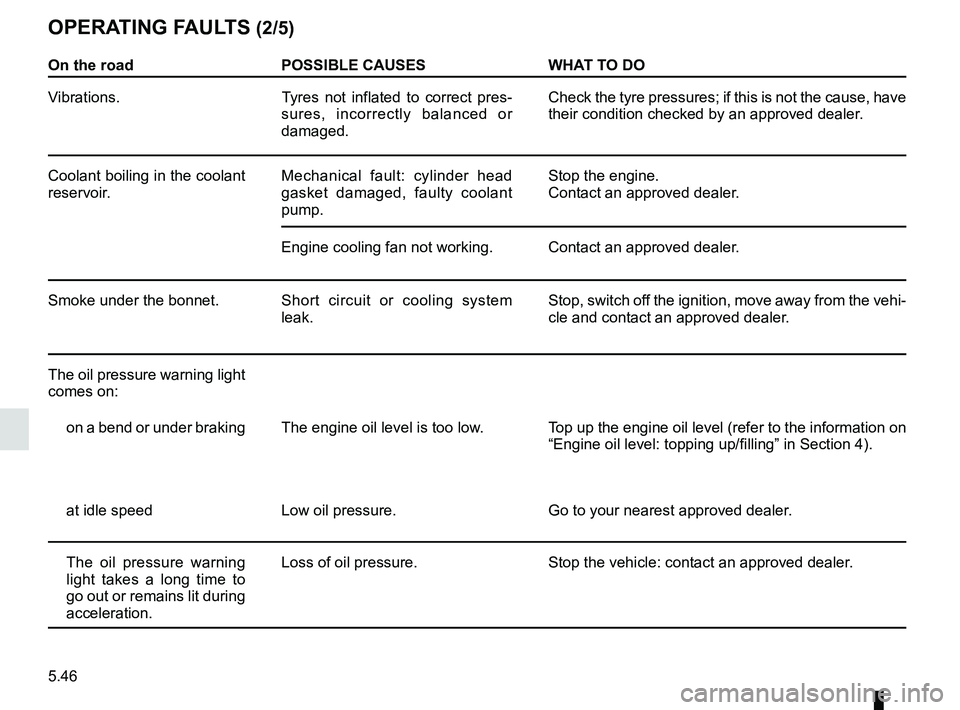
OPERATING FAULTS (2/5)
On the roadPOSSIBLE CAUSES WHAT TO DO
Vibrations. Tyres not inflated to correct pres-
sures, incorrectly balanced or
damaged. Check the tyre pressures; if this is not the cause, have
their condition checked by an approved dealer.
Coolant boiling in the coolant
reservoir. Mechanical fault: cylinder head
gasket damaged, faulty coolant
pump. Stop the engine.
Contact an approved dealer.
Engine cooling fan not working. Contact an approved dealer.
Smoke under the bonnet. Short circuit or cooling system
leak. Stop, switch off the ignition, move away from the vehi-
cle and contact an approved dealer.
The oil pressure warning light
comes on: on a bend or under braking The engine oil level is too low. Top up the engine oil level (refer to the information on “Engine oil level: topping up/filling” in Section 4).
at idle speed Low oil pressure. Go to your nearest approved dealer.
The oil pressure warning
light takes a long time to
go out or remains lit during
acceleration. Loss of oil pressure.
Stop the vehicle: contact an approved dealer.
Page 225 of 256
5.47
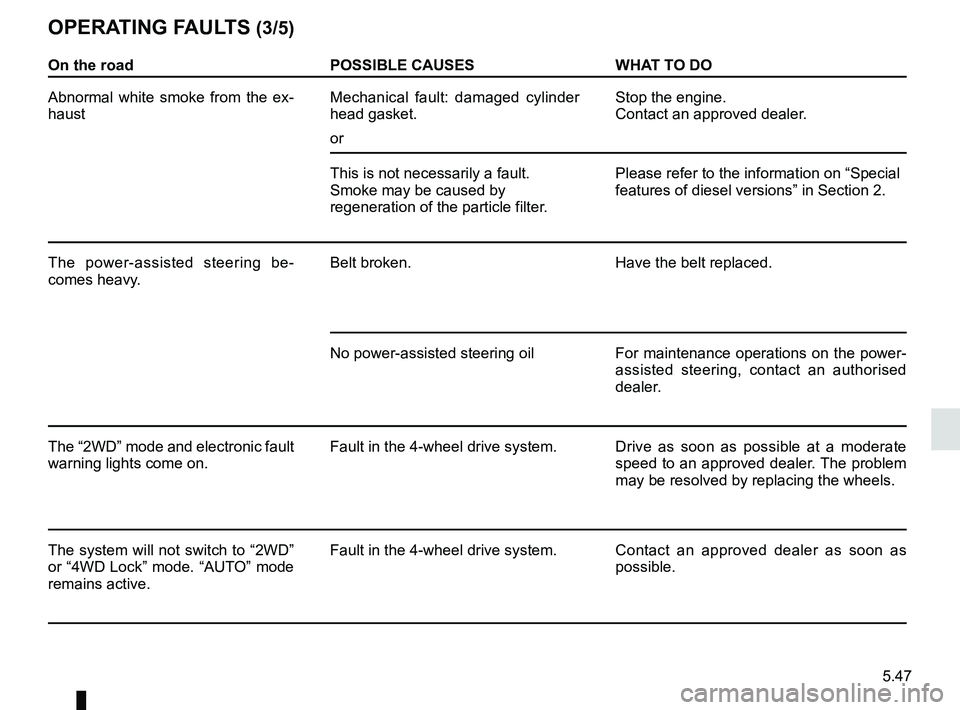
OPERATING FAULTS (3/5)
On the roadPOSSIBLE CAUSES WHAT TO DO
Abnormal white smoke from the ex-
haust Mechanical fault: damaged cylinder
head gasket.
or Stop the engine.
Contact an approved dealer.
This is not necessarily a fault.
Smoke may be caused by
regeneration of the particle filter. Please refer to the information on “Special
features of diesel versions” in Section 2.
The power-assisted steering be-
comes heavy. Belt broken.
Have the belt replaced.
No power-assisted steering oil For maintenance operations on the power-
assisted steering, contact an authorised
dealer.
The “2WD” mode and electronic fault
warning lights come on. Fault in the 4-wheel drive system.
Drive as soon as possible at a moderate
speed to an approved dealer. The problem
may be resolved by replacing the wheels.
The system will not switch to “2WD”
or “4WD Lock” mode. “AUTO” mode
remains active. Fault in the 4-wheel drive system.
Contact an approved dealer as soon as
possible.
Page 226 of 256

Radiator: If there is a significant lack of coolant, remember that it must never b\
e topped up using cold coolant while
the engine is very warm. After any procedure on th")
5.48
OPERATING FAULTS (4/5)
Radiator: If there is a significant lack of coolant, remember that it must never b\
e topped up using cold coolant while
the engine is very warm. After any procedure on the vehicle which has involved even partial drain\
ing of the cooling
system, it must be refilled with a new mixture prepared in the correct p\
roportions. Reminder: only products approved
by the Technical Department may be used for this purpose.
On the road POSSIBLE CAUSES WHAT TO DO
Whistling Roof aerial poorly positioned. Position the aerial.
The engine overheats. The coolant
temperature indicator light comes
on. Engine cooling fan not working. Stop the vehicle, switch off the engine and
contact an approved dealer.
Coolant leaks. Stop the vehicle, switch off the engine and
check the coolant reservoir: it should con-
tain fluid. If there is no coolant, consult an
approved dealer as soon as possible.
The oil change warning light remains
lit after an oil change. Warning not reset after oil change.
Reset the warning after changing the oil;
refer to the information in the paragraph on
the “On-board computer” in Section 1.