light RENAULT ESPACE 2012 J81 / 4.G User Guide
[x] Cancel search | Manufacturer: RENAULT, Model Year: 2012, Model line: ESPACE, Model: RENAULT ESPACE 2012 J81 / 4.GPages: 267, PDF Size: 8.95 MB
Page 26 of 267
seat belts .............................................. (up to the end of the DU)
adjusting your driving position ............................... (current page)
adjusting the seats ................................................. (current page)
1.20
ENG_UD25537_5
Ceintures de sécurité (X81 - Renault)
ENG_NU_932-3_X81ph3_Renault_1
Jaune NoirNoir texte
Seat belts
seaT BeLTs (1/3)
Always wear your seat belt when trav-
elling in your vehicle. You must also
comply with the legislation of the par -
ticular country you are in.
Before starting, first adjust your driv-
ing position, then ask all occupants
to adjust their seat belts to ensure
optimum protection.adjusting your driving
position
– s it well back in your seat (having
removed your coat or jacket etc.).
This is essential to ensure your back
is positioned correctly.
– a djust the distance between the
seat and the pedals. Your seat
should be as far back as possible
while still allowing you to depress
the clutch pedal fully. The seatback
should be adjusted so that your arms
are slightly bent when you hold the
steering wheel.
– adjust the position of your head- rest. For the maximum safety, your
head must be as close as possible to
the headrest.
The top of your head should be in
line with the top of the headrest.
– adjust the height of the seat. This adjustment allows you to select the
seat position which offers you the
best possible view.
– adjust the position of the steering wheel.
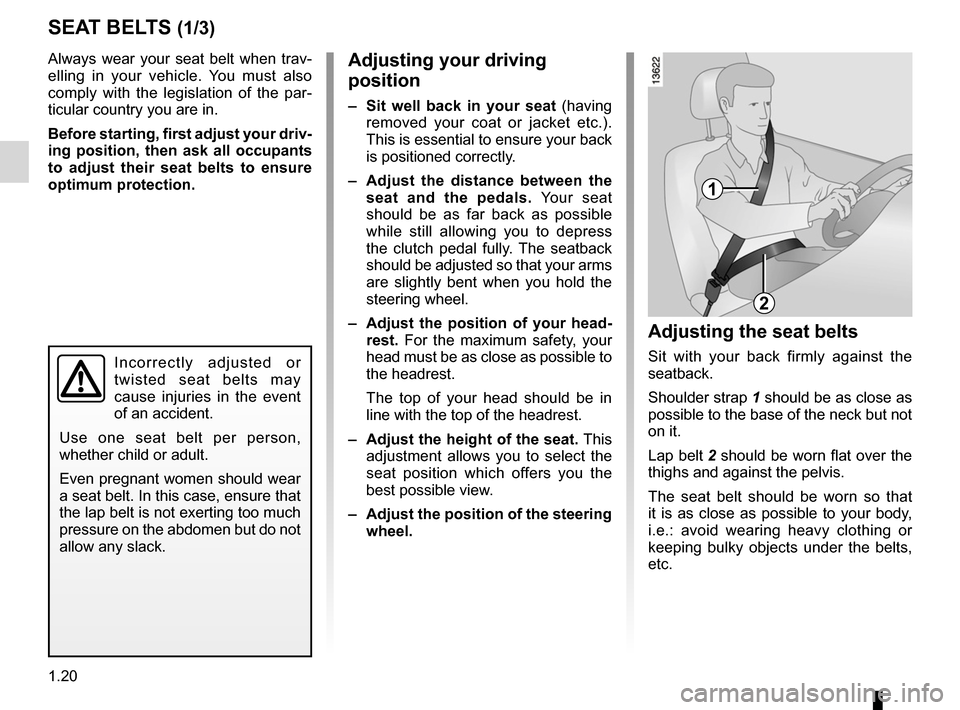
adjusting the seat belts
Sit with your back firmly against the
seatback.
Shoulder strap 1 should be as close as
possible to the base of the neck but not
on it.
Lap belt 2 should be worn flat over the
thighs and against the pelvis.
The seat belt should be worn so that
it is as close as possible to your body,
i.e.: avoid wearing heavy clothing or
keeping bulky objects under the belts,
etc.I n c o r r e c t l y a d j u s t e d o r
twisted seat belts may
cause injuries in the event
of an accident.
Use one seat belt per person,
whether child or adult.
Even pregnant women should wear
a seat belt. In this case, ensure that
the lap belt is not exerting too much
pressure on the abdomen but do not
allow any slack.
1
2
Page 27 of 267
JauneNoirNoir texte
1.21
ENG_UD25537_5
Ceintures de sécurité (X81 - Renault)
ENG_NU_932-3_X81ph3_Renault_1
sea T BeLTs (2/3)
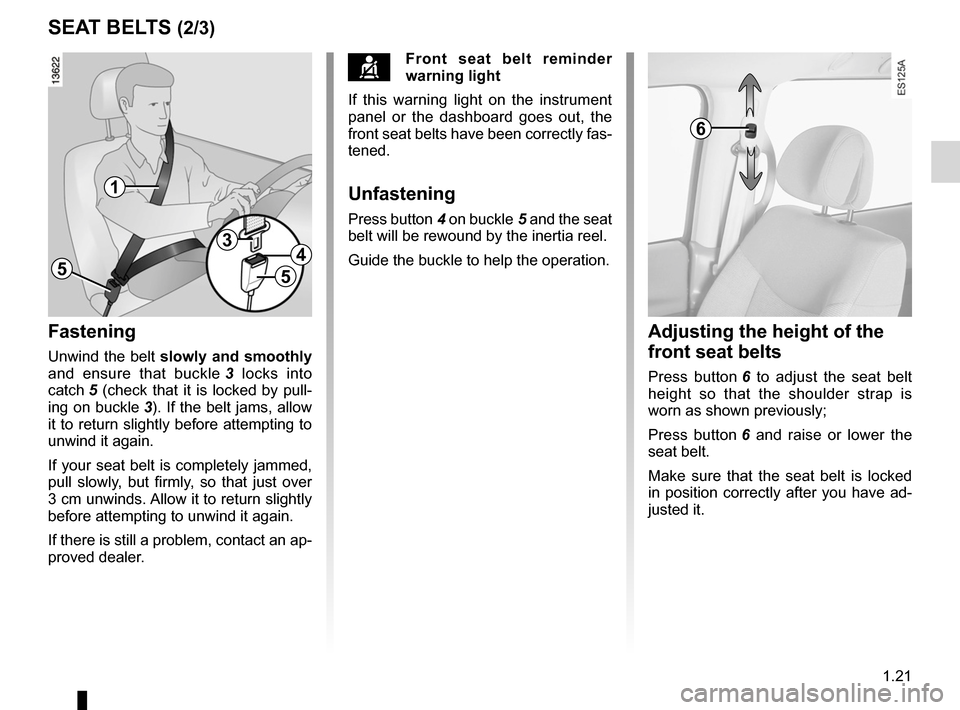
fastening
Unwind the belt slowly and smoothly
and ensure that buckle 3 locks into
catch 5 (check that it is locked by pull -
ing on buckle 3). If the belt jams, allow
it to return slightly before attempting to
unwind it again.
If your seat belt is completely jammed,
pull slowly, but firmly, so that just over
3 cm unwinds. Allow it to return slightly
before attempting to unwind it again.
If there is still a problem, contact an ap-
proved dealer.
çf ront seat belt reminder
warning light
If this warning light on the instrument
panel or the dashboard goes out, the
front seat belts have been correctly fas-
tened.
Unfastening
Press button 4 on buckle 5 and the seat
belt will be rewound by the inertia reel.
Guide the buckle to help the operation.
1
5
34
5
adjusting the height of the
front seat belts
Press button 6 to adjust the seat belt
height so that the shoulder strap is
worn as shown previously;
Press button 6 and raise or lower the
seat belt.
Make sure that the seat belt is locked
in position correctly after you have ad-
justed it.
6
Page 30 of 267

ENG_NU_932-3_X81ph3_Renault_1
Jaune NoirNoir texte
MeTHOds Of resTraInT In addITIOn TO THe frOnT sea")
1.24
ENG_UD20337_1
Dispositifs de retenue complémentaires à la ceinture (X81 - J81 -\
Renault)
ENG_NU_932-3_X81ph3_Renault_1
Jaune NoirNoir texte
MeTHOds Of resTraInT In addITIOn TO THe frOnT sea T BeLTs (2/4)
force limiter
Above a certain level of impact force,
this mechanism is used to limit the force
of the belt against the body so that it is
at an acceptable level.
B a
The air bag system uses
pyrotechnic principles. This
explains why, when the air
bag inflates, it will gener -
ate heat, produce smoke (this does
not mean that a fire is about to start)
and make a noise upon detonation.
In a situation where an air bag is
required, it will inflate immediately
and this may cause some minor, su-
perficial grazing to the skin or other
problems.
air bags for driver A and
front passenger B
An air bag may be provided for both the
driver and the front passenger.
An “Air bag” marking on the steering
wheel, dashboard and, depending on
the vehicle, the lower section of the
windscreen inform you of the presence
of additional means of restraint (air
bags, pretensioners, etc.) in the pas -
senger compartment. Each air bag system consists of:
–
an air bag and gas generator fitted
on the steering wheel for the driver
and in the dashboard for the front
passenger;
– a shared electronic unit which in -
cludes the impact detector and a
monitoring system which controls
the ignition module for the gas gen-
erator;
– a single
å warning light on the
instrument panel.
Page 31 of 267

ENG_NU_932-3_X81ph3_Renault_1
Operation
This system is only operational when")
JauneNoirNoir texte
1.25
ENG_UD20337_1
Dispositifs de retenue complémentaires à la ceinture (X81 - J81 -\
Renault)
ENG_NU_932-3_X81ph3_Renault_1
Operation
This system is only operational when
the ignition is switched on.
If a severe frontal impact occurs, the
air bag(s) inflate(s) rapidly, cushion -
ing the impact of the driver’s head and
chest against the steering wheel and
the front passenger’s head against the
dashboard. The air bag then deflates
immediately so that the passengers are
not impeded in any way when they get
out of the vehicle.
special feature of the front air
bag
There are two volumes of operation de-
pending on the severity of the impact:
– low volume air bag, this is the first
stage of operation;
– large volume air bag, the air bag
seams rip so that a larger volume of
gas is released into the bag (for the
most severe impacts).
MeTHOds Of resTraInT In addITIOn TO THe frOnT sea T BeLTs (3/4)
Operating faults
åThis warning light will light up
on the instrument panel when
the ignition is switched on and then go
out after a few seconds.
If it does not light up when the ignition
is switched on, or comes on when the
engine is running, there is a fault in the
system.
Contact your approved dealer as soon
as possible. Your protection will be re-
duced until this fault is rectified.
Page 32 of 267

ENG_NU_932-3_X81ph3_Renault_1
MeTHOds Of resTraInT In addITIOn TO THe frOnT sea T BeLTs (4/4)
all of")
1.26
ENG_UD20337_1
Dispositifs de retenue complémentaires à la ceinture (X81 - J81 -\
Renault)
ENG_NU_932-3_X81ph3_Renault_1
MeTHOds Of resTraInT In addITIOn TO THe frOnT sea T BeLTs (4/4)
all of the warnings below are given so that the air bag is not obstructed in any way when it is inflated and also to prevent
the risk of serious injuries caused by items which may be dislodged when\
the air bag inflates.
Warnings concerning the driver’s air bag
– Do not modify the steering wheel or the steering wheel boss.
– Do not cover the steering wheel boss under any circumstances.
– Do not attach any objects (badge, logo, clock, telephone cradle, etc.) to the steering wheel boss.
– The steering wheel must not be removed (except by qualified personnel from our Network).
– Do not sit too close to the steering wheel when driving: sit with your arms slightly bent (see Section 1 “Adjusting your driving
position”). This will allow sufficient space for the air bag to deploy correctly and be fully effective.
Warnings concerning the passenger air bag
– Do not attach or glue any objects (badge, logo, clock, telephone cradle, etc.) to the dashboard in the air bag zone.
– Do not place anything between the dashboard and the passenger (animal, umbrella, walking stick, parcels, etc.).
– The passenger must not put his or her feet on the dashboard or seat as there is a risk that serious injuries may occur. As a
general rule, keep all body parts (knees, hands, head, etc.) away from\
the dashboard.
– The devices in addition to the front passenger seat belt should be reactivated as soon as a child seat is removed, to ensure
the protection of the passenger in the event of an impact.
a rear-facInG cHILd sea T MUsT nOT Be fITTed TO THe frOnT P assenGer seaT UnLess
THe addITIOnaL resTraInT sYsTeMs, I.e. THe P assenGer aIr BaG, are deacTIV aTed.
(Refer to the information on “Child safety: deactivating/activating \
the front passenger air bag” in Section 1).
Page 43 of 267

ENG_NU_932-3_X81ph3_Renault_1
X = Seat not suitable for fitting child seats.
U = S")
JauneNoirNoir texte
1.37
ENG_UD24085_2
Sécurité enfants : installation du siège enfant (X81 - J81 - R\
enault)
ENG_NU_932-3_X81ph3_Renault_1
X = Seat not suitable for fitting child seats.
U = Seat which allows a child seat with “Universal” approval to be installed using a seat belt; check that it can be fitted.
IUf/IL = On equipped vehicles, seat which allows an approved “Universal”/“semi-universal” or “vehicle specific” child seat to be
attached using the ISOFIX system; check that it can be fitted.
(2) The size of the child seat with the ISOFIX mounting is indicated by the
ü symbol followed by a letter (a, B, B1, c, d, e, f,
G).
(3) Only a rear-facing child seat may be installed in this seat.
(4) Raise the seat to the maximum and position it as far back as possible, t\
ilting the seatback slightly (approximately 25°).
(5) Only vehicles equipped with a seat with seat base height adjustment are \
authorised for fitting child seats.
(6)
A carrycot can be installed across the vehicle and will take up two seats. Position the child with his or her feet nearest the door.
(7) Forward-facing child seat; position the seatback of the child seat in contact with the seatback of the vehicle seat. Adjust the
height of the headrest or remove it if necessary; do not push the seat in front of the child more than halfway back on its runners
and do not recline the seatback more than 25°.
(8) To install a large rear-facing ISOFIX child seat (size C) in the 2nd row, fit the seats in the centred position or use the centre seat.
(9)
A child over 10 years of age, weighing more than 36 kg or taller than 1.36 m can be strapped directly into the seat like an adult.
cHILd safeTY : fitting a child seat (4/4)
Page 44 of 267
air bagdeactivating the front passenger air bags ........ (current page)
front passenger air bag deactivation ..................... (current page)
1.38
ENG_UD20343_1
Sécurité enfants : désactivation/activation airbag passager ava\
nt (X81 - J81 - Renault)
ENG_NU_932-3_X81ph3_Renault_1
Jaune NoirNoir texte
Deactivating/activating the front passenger air bag
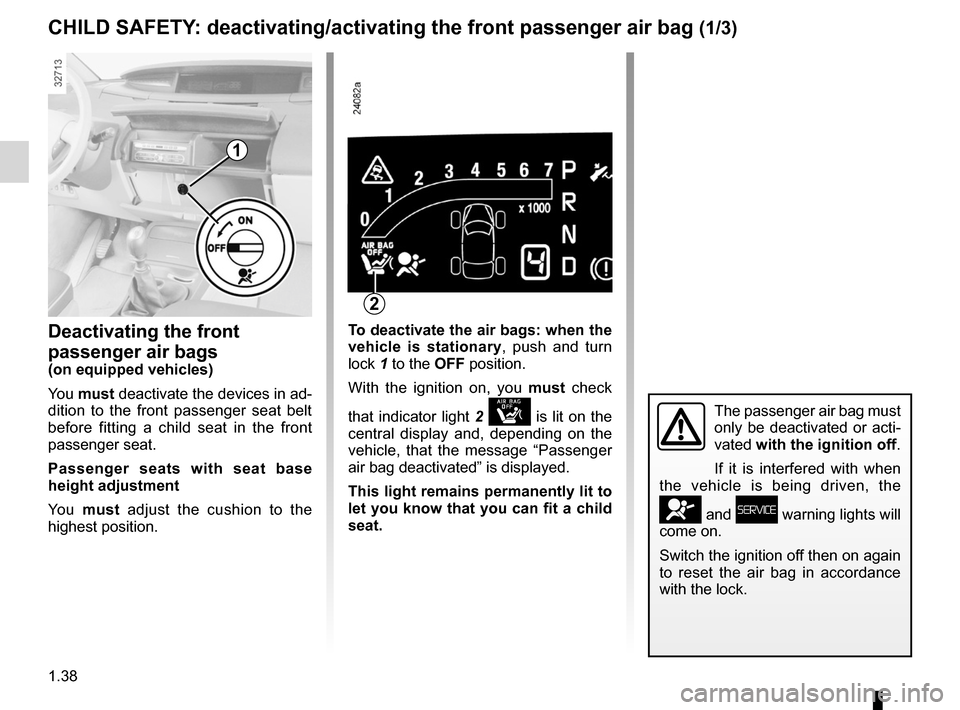
deactivating the front
passenger air bags
(on equipped vehicles)
You must deactivate the devices in ad-
dition to the front passenger seat belt
before fitting a child seat in the front
passenger seat.
Passenger seats with seat base
height adjustment
You must adjust the cushion to the
highest position. To deactivate the air bags: when the
vehicle is stationary
, push and turn
lock 1 to the Off position.
With the ignition on, you must check
that indicator light 2
ã is lit on the
central display and, depending on the
vehicle, that the message “Passenger
air bag deactivated” is displayed.
This light remains permanently lit to
let you know that you can fit a child
seat.
cHILd safeTY : deactivating/activating the front passenger air bag (1/3)
1
2
The passenger air bag must
only be deactivated or acti-
vated with the ignition off.
If it is interfered with when
the vehicle is being driven, the
å and ú warning lights will
come on.
Switch the ignition off then on again
to reset the air bag in accordance
with the lock.
Page 46 of 267

ENG_NU_932-3_X81ph3_Renault_1
Operating faults
It is forbidden to fit a rear-facin")
1.40
ENG_UD20343_1
Sécurité enfants : désactivation/activation airbag passager ava\
nt (X81 - J81 - Renault)
ENG_NU_932-3_X81ph3_Renault_1
Operating faults
It is forbidden to fit a rear-facing child
seat to the front passenger seat if the
air bag activation/deactivation system
is faulty.
Allowing any other passenger to sit in
that seat is not recommended.
Contact your approved dealer as soon
as possible.
activating the front
passenger air bags
You should reactivate the air bag as
soon as you remove the child seat from
the front passenger seat to ensure the
protection of the front passenger in the
event of an impact.
To reactivate the air bags: when the
vehicle is stationary , push and turn
lock 1 to the On position.
With the ignition on, it is essential to
check that warning light 2,
ã, is off.
The front passenger seat belt additional
restraint systems are activated.
1
2
cHILd safeTY : deactivating/activating the front passenger air bag (3/3)
The passenger air bag must
only be deactivated or acti-
vated with the ignition off.
If it is interfered with when
the vehicle is being driven, the
å and ú warning lights will
come on.
Switch the ignition off then on again
to reset the air bag in accordance
with the lock.
danGer
Since operation of the front
passenger air bag is not
compatible with the position
of a rear-facing child seat, neVer
fit a rear-facing child seat on a front
passenger seat with an active front
air bag. The child may suffer very
serious injuries if the air bag is trig-
gered.
Page 49 of 267
JauneNoirNoir texte
1.43
ENG_UD24086_2
Poste de conduite à gauche (X81 - J81 - Renault)
ENG_NU_932-3_X81ph3_Renault_1
drIVer’s POsITIOn, LefT-Hand drIVe (continued)
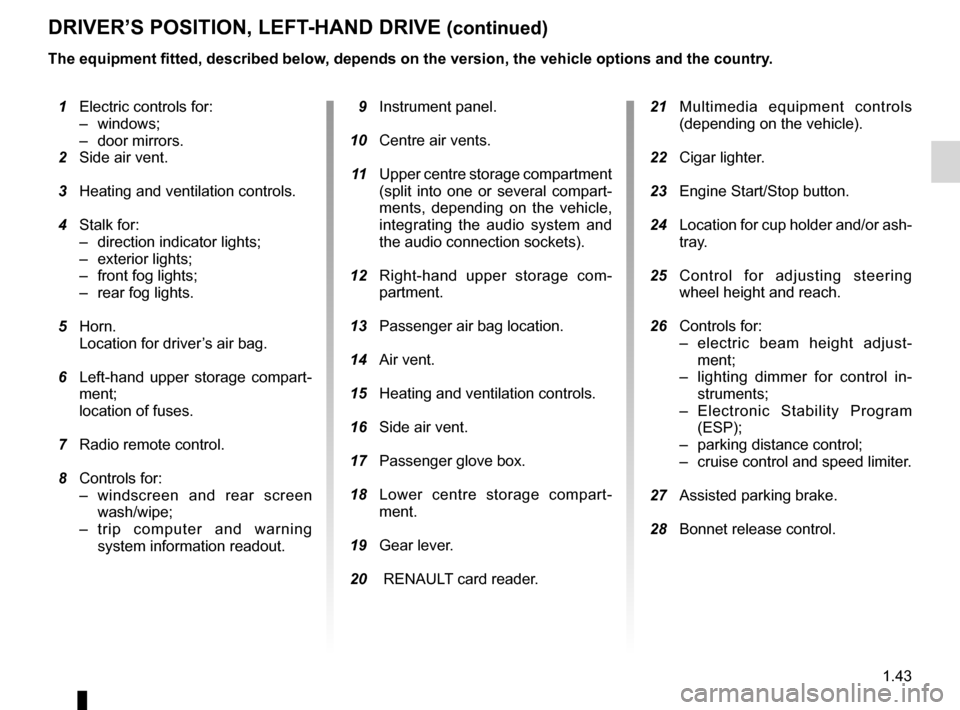
1 Electric controls for:
– windows;
– door mirrors.
2 Side air vent.
3 Heating and ventilation controls.
4 Stalk for:
– direction indicator lights;
– exterior lights;
– front fog lights;
– rear fog lights.
5 Horn.
Location for driver’s air bag.
6 Left-hand upper storage compart -
ment;
location of fuses.
7 Radio remote control.
8 Controls for:
– windscreen and rear screen
wash/wipe;
– trip computer and warning
system information readout.
9 Instrument panel.
10 Centre air vents.
11 Upper centre storage compartment
(split into one or several compart-
ments, depending on the vehicle,
integrating the audio system and
the audio connection sockets).
12 Right-hand upper storage com -
partment.
13 Passenger air bag location.
14 Air vent.
15 Heating and ventilation controls.
16 Side air vent.
17 Passenger glove box.
18 Lower centre storage compart -
ment.
19 Gear lever.
20 RENAULT card reader. 21 Multimedia equipment controls
(depending on the vehicle).
22 Cigar lighter.
23 Engine Start/Stop button.
24 Location for cup holder and/or ash-
tray.
25 Control for adjusting steering
wheel height and reach.
26 Controls for:
– electric beam height adjust -
ment;
– lighting dimmer for control in -
struments;
– Electronic Stability Program
(ESP);
– parking distance control;
– cruise control and speed limiter.
27 Assisted parking brake.
28 Bonnet release control.
The equipment fitted, described below, depends on the version, the vehicle options and the country.
Page 51 of 267
accessories socket ................................................ (current page)
JauneNoirNoir texte
1.45
ENG_UD24087_2
Poste de conduite à droite (X81 - J81 - Renault)
ENG_NU_932-3_X81ph3_Renault_1
drIVer’s POsITIOn, rIGHT-Hand drIVe (continued)
1 Side air vent.
2 Heating and ventilation controls.
3 Air vent.
4 Location for passenger air bag.
5 Left-hand upper storage compart -
ment; fuse location.
6 Upper central storage compart -
ment (one or more compartments
depending on the vehicle, incorpo -
rating the audio system and audio
connection sockets).
7 Centre air vents.
8 Instrument panel.
9 Stalk for:
– direction indicator lights;
– exterior lights;
– front fog lights;
– rear fog lights.
10 Right-hand upper storage com -
partment.
11 Horn.
Location for driver’s air bag.
12 Radio remote control.
13 Controls for:
– windscreen and rear screen
wash/wipe;
– trip computer and warning
system information readout.
14 Heating and ventilation controls.
15 Side air vent.
16 Electric controls for windows and
door mirrors.
17 Assisted parking brake.
18 Controls for:
– electric beam height adjust -
ment;
– lighting dimmer for control in -
struments;
– Electronic Stability Program
(E.S.P.);
– parking distance control.
– Cruise control and speed limiter. 19 Control for adjusting steering
wheel height and reach.
20 Gear lever.
21 RENAULT card reader.
22 Multimedia equipment controls
(depending on vehicle).
23 Cigar lighter.
24 Engine Start/Stop button.
25 Location for cup holder and/or ash-
tray.
26 Lower centre storage compart -
ment.
27 Passenger glove box.
28 Bonnet release control.
The equipment fitted, described below, depends on the version, the vehicle options and the country.