warning RENAULT ESPACE 2012 J81 / 4.G Owner's Guide
[x] Cancel search | Manufacturer: RENAULT, Model Year: 2012, Model line: ESPACE, Model: RENAULT ESPACE 2012 J81 / 4.GPages: 267, PDF Size: 8.95 MB
Page 81 of 267
JauneNoirNoir texte
1.75
ENG_UD24089_2
Réservoir à carburant (X81 - J81 - Renault)
ENG_NU_932-3_X81ph3_Renault_1
Vehicles running on ethanol -
based fuel
It is essential to use unleaded petrol or
fuel containing a maximum of 85% eth-
anol (E85).
In very cold conditions, it may be very
difficult or even impossible to start the
engine. To avoid this problem, use un-
leaded petrol or, on equipped vehicles,
use the heater integrated in the engine:
connect the special end of the exten -
sion piece supplied into the socket in -
tegrated into the radiator grille and the
other end into a 220V socket for at least
6 hours before starting.
nB: you may notice an increase in fuel
consumption with this type of fuel.
fUeL T anK (2/3)
filling with fuel
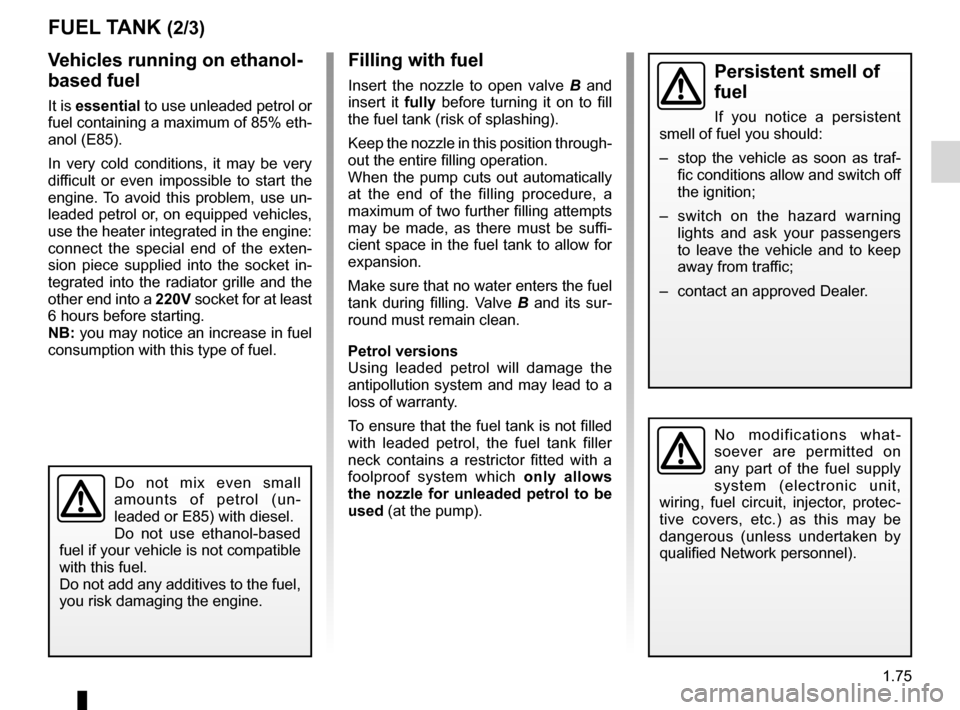
Insert the nozzle to open valve B and
insert it fully before turning it on to fill
the fuel tank (risk of splashing).
Keep the nozzle in this position through -
out the entire filling operation.
When the pump cuts out automatically
at the end of the filling procedure, a
maximum of two further filling attempts
may be made, as there must be suffi -
cient space in the fuel tank to allow for
expansion.
Make sure that no water enters the fuel
tank during filling. Valve B and its sur-
round must remain clean.
Petrol versions
Using leaded petrol will damage the
antipollution system and may lead to a
loss of warranty.
To ensure that the fuel tank is not filled
with leaded petrol, the fuel tank filler
neck contains a restrictor fitted with a
foolproof system which only allows
the nozzle for unleaded petrol to be
used (at the pump).
No modifications what -
soever are permitted on
any part of the fuel supply
system (electronic unit,
wiring, fuel circuit, injector, protec -
tive covers, etc.) as this may be
dangerous (unless undertaken by
qualified Network personnel).
Persistent smell of
fuel
If you notice a persistent
smell of fuel you should:
– stop the vehicle as soon as traf-
fic conditions allow and switch off
the ignition;
– switch on the hazard warning
lights and ask your passengers
to leave the vehicle and to keep
away from traffic;
– contact an approved Dealer.
Do not mix even small
amounts of petrol (un -
leaded or E85) with diesel.
Do not use ethanol-based
fuel if your vehicle is not compatible
with this fuel.
Do not add any additives to the fuel,
you risk damaging the engine.
Page 86 of 267
2.4
ENG_UD25550_3
Démarrage/arrêt moteur avec carte RENAULT mains libres (X81 - J81 - Renault)
ENG_NU_932-3_X81ph3_Renault_2
Jaune NoirNoir texte
STARTING/STOPPING THE ENGINE (2/3)
Limited use
– When the engine is running, a ve -
hicle door is open and the card is
outside the vehicle (for example
when the driver gets out to open the
garage door): the engine continues
to run.
– When the engine is running, the ve-
hicle doors are closed and the card
is outside the vehicle (for example
when a passenger leaves the ve -
hicle and takes the RENAULT card
with them): the message “card not
detected” appears on the instrument
panel. The warning light flashes on
emergency card reader 3 and a beep
sounds when the vehicle is restarted
to warn you.
– The RENAULT card's operation
may be affected by interference
from nearby devices, such as exte -
rior installations or equipment oper -
ating on the same frequency as the
RENAULT card.
When you leave your vehi -
cle, especially if you have
your RENAULT card with
you, check that the engine
is completely switched off.
Hands-Free mode operating
fault
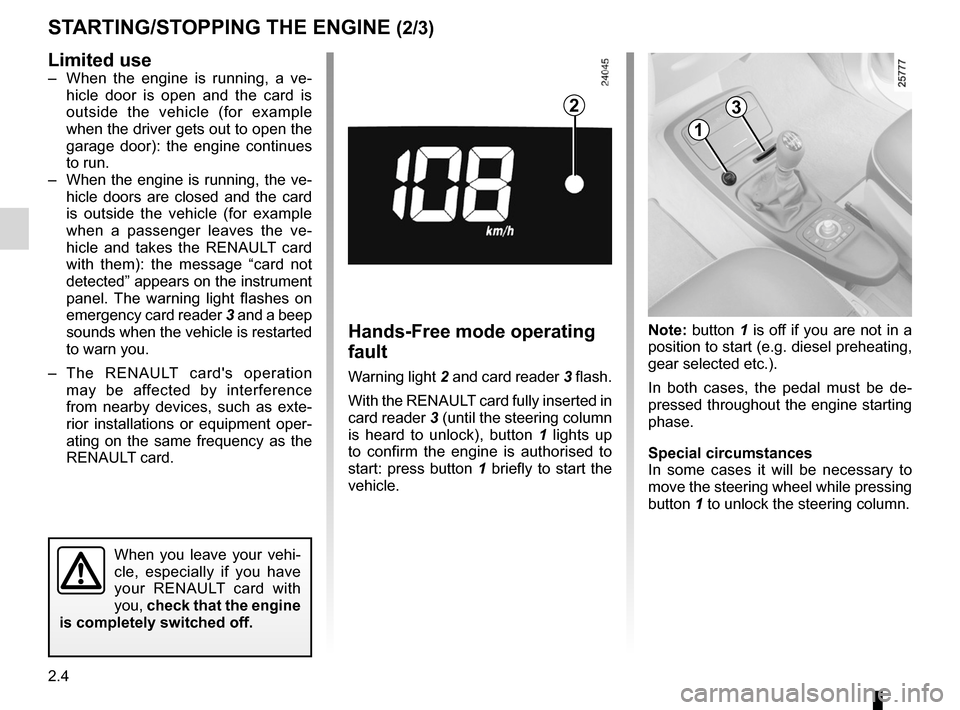
Warning light 2 and card reader 3 flash.
With the RENAULT card fully inserted in
card reader 3 (until the steering column
is heard to unlock), button 1 lights up
to confirm the engine is authorised to
start: press button 1 briefly to start the
vehicle. Note: button
1 is off if you are not in a
position to start (e.g. diesel preheating,
gear selected etc.).
In both cases, the pedal must be de -
pressed throughout the engine starting
phase.
Special circumstances
In some cases it will be necessary to
move the steering wheel while pressing
button 1 to unlock the steering column.
23
1
Page 87 of 267
JauneNoirNoir texte
2.5
ENG_UD25550_3
Démarrage/arrêt moteur avec carte RENAULT mains libres (X81 - J81 - Renault)
ENG_NU_932-3_X81ph3_Renault_2
3
1
STARTING/STOPPING THE ENGINE (3/3)
“Engine start” position
(continued)
For diesel versions, wait for the pre -
heating warning light
É to go out
on the instrument panel before press -
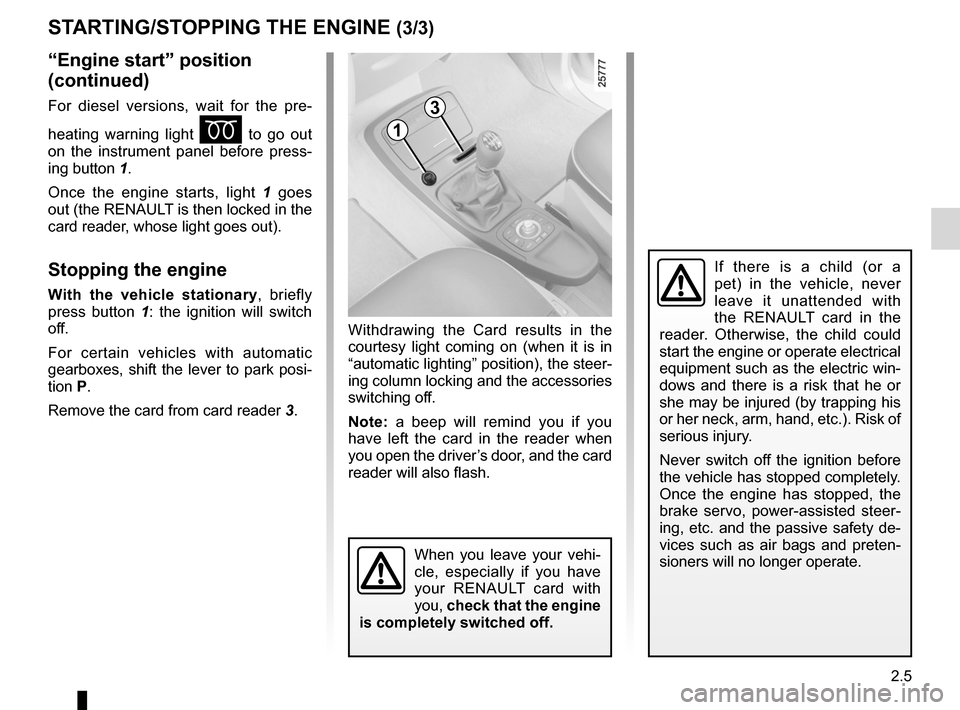
ing button 1.
Once the engine starts, light 1 goes
out (the RENAULT is then locked in the
card reader, whose light goes out).
Stopping the engine
With the vehicle stationary , briefly
press button 1 : the ignition will switch
off.
For certain vehicles with automatic
gearboxes, shift the lever to park posi-
tion P.
Remove the card from card reader 3.Withdrawing the Card results in the
courtesy light coming on (when it is in
“automatic lighting” position), the steer-
ing column locking and the accessories
switching off.
Note:
a beep will remind you if you
have left the card in the reader when
you open the driver’s door, and the card
reader will also flash.
When you leave your vehi -
cle, especially if you have
your RENAULT card with
you, check that the engine
is completely switched off.
If there is a child (or a
pet) in the vehicle, never
leave it unattended with
the RENAULT card in the
reader. Otherwise, the child could
start the engine or operate electrical
equipment such as the electric win-
dows and there is a risk that he or
she may be injured (by trapping his
or her neck, arm, hand, etc.). Risk of
serious injury.
Never switch off the ignition before
the vehicle has stopped completely.
Once the engine has stopped, the
brake servo, power-assisted steer -
ing, etc. and the passive safety de-
vices such as air bags and preten -
sioners will no longer operate.
Page 88 of 267

ENG_NU_932-3_X81ph3_Renault_2
Special features of petrol versions
SPEcIAL FEATURES OF PETROL vERSIONS")
2.6
ENG_UD13142_3
Particularités des versions essence (X45 - H45 - X95 - B95 - D95 - R\
enault)
ENG_NU_932-3_X81ph3_Renault_2
Special features of petrol versions
SPEcIAL FEATURES OF PETROL vERSIONS
Do not park the vehicle or
run the engine in locations
where combustible sub -
stances or materials such
as grass or leaves can come into
contact with the hot exhaust system.
The following operating conditions
should be avoided:
– driving for long periods when the low
fuel level warning light is lit up,
– using leaded petrol,
– using fuel or lubrication additives
which are not approved.
Or operating faults such as:
– faulty ignition system, running out of
fuel or disconnected spark plugs re-
sulting in the engine misfiring or cut-
ting out when driving;
– loss of power,
may cause the catalytic converter to
overheat, reducing its efficiency which
may irreparably damage it and cause
heat damage to the vehicle. If you notice any of the above operating
faults, have the necessary repairs car-
ried out as soon as possible by an ap-
proved dealer.
These faults may be avoided by regu
-
larly taking your vehicle to an approved
Dealer at the intervals specified in the
Maintenance Service Booklet.
Starting problems
To avoid damaging the catalytic con -
verter, do not keep trying to start the
engine (using the start button, or by
pushing or towing the vehicle) without
having identified and corrected the
cause of the fault.
If the fault cannot be identified, do not
continue to try and start the engine, but
contact an approved dealer.
Page 89 of 267
driving ................................................... (up to the end of the DU)
special features of diesel versions ........(up to the end of the DU)
2.7
ENG_UD20364_1
Particularités versions diesel (X81 - J81 - Renault)
ENG_NU_932-3_X81ph3_Renault_2
Special features of diesel versions
SPEcIAL FEATURES OF DIESEL vERSIONS
Diesel engine speed
Diesel engines are fitted with injection
equipment which prevents the engine
speed being exceeded irrespective of
the gear selected.
If the
ú warning light comes on,
accompanied by the message “Check
antipollution”, consult an approved
dealer as soon as possible.
When driving, depending on the fuel
grade used, it is possible that white
smoke may be emitted.
This is due to the exhaust particle filter
being cleaned automatically, and does
not affect the way the vehicle runs.
Precautions to be taken in
winter
To avoid faults in icy weather:
– Ensure that the battery is always well
charged.
– Always keep the diesel tank rela -
tively full to avoid water vapour con-
densing in it and accumulating at the
bottom of the tank.
Do not park the vehicle or
run the engine in locations
where combustible sub -
stances or materials such
as grass or leaves can come into
contact with the hot exhaust system.
Running out of fuel
After filling the tank if you have run
completely out of fuel , the engine
may be started normally on condition
that the battery is fully charged: see the
information on the “Fuel tank” in Section
1 to find out more about the special fea-
tures of diesel versions fitted with com-
monrail (high-pressure) injection.
However, if the engine fails to start after
a few seconds and several attempts,
contact an approved dealer.
Page 92 of 267
2.10
ENG_UD20366_1
Frein de parking assisté (X81 - J81 - Renault)
ENG_NU_932-3_X81ph3_Renault_2
ASSISTED PARKING BRAKE (continued)
v ersions with an automatic
gearbox
Never leave your vehicle without
moving the selector lever to position N
or P.
For safety reasons, if the lever is not in
one of these positions and the driver’s
door is open or incorrectly shut, the au-
tomatic release function is deactivated.
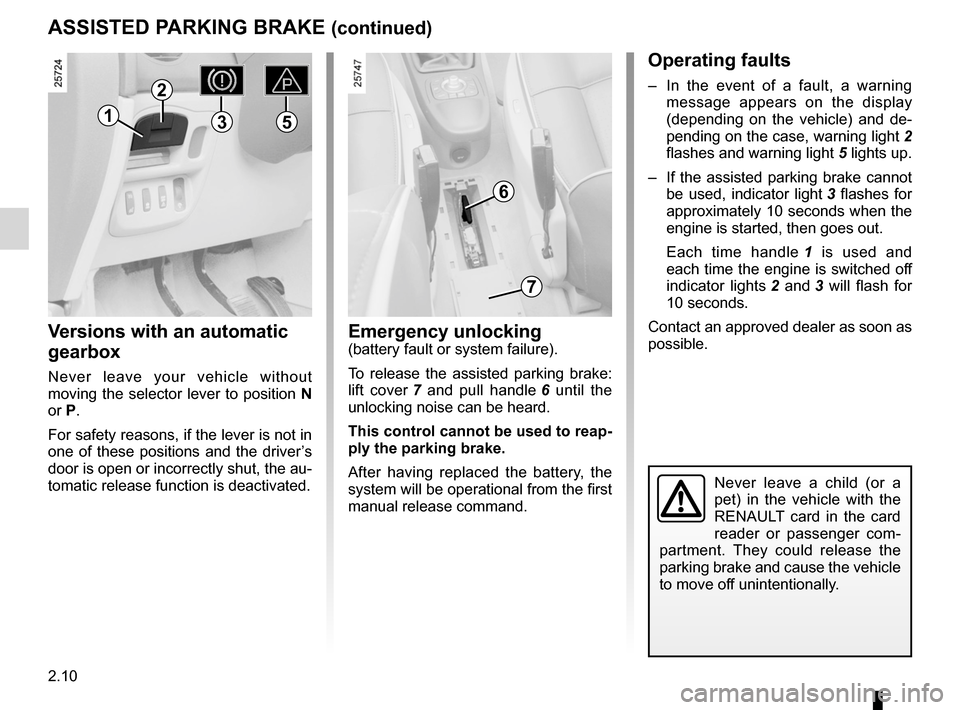
Emergency unlocking(battery fault or system failure).
To release the assisted parking brake:
lift cover 7 and pull handle 6 until the
unlocking noise can be heard.
This control cannot be used to reap-
ply the parking brake.
After having replaced the battery, the
system will be operational from the first
manual release command.
Operating faults
– In the event of a fault, a warning
message appears on the display
(depending on the vehicle) and de -
pending on the case, warning light 2
flashes and warning light 5 lights up.
– If the assisted parking brake cannot
be used, indicator light 3 flashes for
approximately 10 seconds when the
engine is started, then goes out.
Each time handle 1 is used and
each time the engine is switched off
indicator lights 2 and 3 will flash for
10 seconds.
Contact an approved dealer as soon as
possible.
Never leave a child (or a
pet) in the vehicle with the
RENAULT card in the card
reader or passenger com -
partment. They could release the
parking brake and cause the vehicle
to move off unintentionally.
1
2
6
7
35
Page 95 of 267
ENG_NU_932-3_X81ph3_Renault_2
– Brake as little as possible by suitably
anti")
JauneNoirNoir texte
2.13
ENG_UD20368_1
Conseils antipollution, économies de carburant, conduite (X81 - J81 \
- Renault)ENG_NU_932-3_X81ph3_Renault_2
– Brake as little as possible by suitably
anticipating an obstacle or bend and
then simply releasing the accelerator
pedal.
– Avoid sudden acceleration.
– Do not try to maintain the same
speed up a hill, accelerate no more
than you would on the level. Keep
your foot in the same position on the
accelerator pedal.
– Double declutching and accelerating
before switching off are unnecessary
in modern vehicles.
– Bad weather, flooded roads.
ADvIcE: antipollution, fuel economy and driving (continued)
Do not drive through floods if
the water is above the lower
edge of the wheel rims.
Exhaust gas monitoring
system
The exhaust gas monitoring system will
detect any operating faults in the vehi-
cle’s antipollution system.
If this system malfunctions, toxic sub-
stances may be released into the at -
mosphere or damage may occur.
ÄThis warning light on the in -
strument panel will indicate if
there are any faults in the system:
This lights up when the ignition is
switched on and goes out when the
engine is started.
– If it lights up continuously, consult
your approved dealer as soon as
possible;
– if it flashes, reduce the engine speed
until the light stops flashing. Contact
your approved dealer as soon as
possible.
Driving– Drive carefully for the first few miles
until the engine reaches its normal
operating temperature, rather than
let it warm up while the vehicle is sta-
tionary.
– Speed is expensive.
– Sporty driving uses a lot of fuel: drive
with a light right foot.
– Do not overrev the engine in the in-
termediate gears.
Always use the highest gear possi -
ble without labouring the engine.
On versions with an automatic trans-
mission, it is preferable to keep the
gear lever in position D.
Obstructions to the driver
On the driver ’s side, only
use mats adapted to the ve-
hicle that attach to the pre-
installed parts, and regularly check
their mounting. Do not place several
mats on top of each other.
Risk of pedals jamming
Page 99 of 267
\
ENG_NU_932-3_X81ph3_Renault_2
TYRE PRESSURE MONITOR
Fitting tyres(replacing tyres or fi")
JauneNoirNoir texte
2.17
ENG_UD20370_1
Système de surveillance de pression des pneus (X81 - J81 - Renault)\
ENG_NU_932-3_X81ph3_Renault_2
TYRE PRESSURE MONITOR
Fitting tyres(replacing tyres or fitting winter
tyres)
Since replacing tyres requires special
precautions, we advise you to contact
your approved dealer.
Reading the tyre pressure on the in-
strument panel (if fitted to the vehicle).
After the vehicle’s tyre pressures have
been checked, the warning messages
on the instrument panel and/or the
values read on the trip computer and
warning system are updated once you
exceed 15 mph (25 km/h).
Non-interchangeability of
wheels
Each of the sensors incor -
porated in the valves 1 is
dedicated to a single wheel:
under no circumstances
should you swap the wheels.
There is a risk of incorrect informa-
tion which could have serious con -
sequences.
To mark the correct position of the
wheel, note the colour of ring 2 (after
cleaning, if necessary) on each valve:
A yellow ring
B black ring
C red ring
D green ring
AB
Dc1
2
1
Page 101 of 267
\
ENG_NU_932-3_X81ph3_Renault_2
TYRE PRESSURE MONITOR
“check tyre pressure”
A shaded w")
JauneNoirNoir texte
2.19
ENG_UD20370_1
Système de surveillance de pression des pneus (X81 - J81 - Renault)\
ENG_NU_932-3_X81ph3_Renault_2
TYRE PRESSURE MONITOR
“check tyre pressure”
A shaded wheel B indicates a deflated
tyre.
“Inflate tyres to motorway
pressure”
The tyre pressure is not suitable for the
speed of travel. Slow down or inflate
all four tyres to “motorway pressure”
(refer to the label located on the label
on the edge of the driver’s door).
“Wheel sensors missing”
One wheel A disappears, indicating
that the sensor on this wheel is missing
or faulty (e.g. if the emergency spare
wheel is fitted).
“Stop! Tyre puncture”
Replace the wheel B concerned or call
your approved dealer.
This message appears along with the
û warning light.
Operating faults
In certain conditions involving readjust-
ment of tyre pressures, the fault mes -
sage may continue to be displayed (for
approximately 1 hour and 45 minutes
after the vehicle has stopped).
A
B
Examples of messages which may appear on the display
Page 102 of 267
Electronic Stability Program: ESP ........ (up to the end of the DU)
ESP: Electronic Stability Program ........ (up to the end of the DU)
2.20
ENG_UD20371_1
Contrôle dynamique de conduite : E.S.P. avec contrôle de sous-virage (X81 - J81 - Renault)
ENG_NU_932-3_X81ph3_Renault_2
Electronic Stability Program: ESP
ELEcTRONIc STABILITY PROGRAM: ESP
This system helps to keep control of
the vehicle in critical driving situations
(avoiding an obstacle, loss of grip when
cornering, etc.) and works in conjunc -
tion with the understeer control system.
This function is an addi -
tional aid in the event of
critical driving conditions,
enabling the vehicle behav -
iour to be adapted to suit the driving
conditions.
However, the function does not take
the place of the driver. It does not
increase the vehicle’s limits and
should not encourage you to
drive more quickly.
Therefore, it can under no circum -
stances replace the vigilance or re-
sponsibility of the driver when ma -
noeuvring the vehicle (the driver
must always be ready for sudden in-
cidents which may occur when driv-
ing).
Operating principle
A sensor in the steering wheel detects
the direction selected by the driver.
Other sensors throughout the vehicle
measure the actual direction.
The system compares the direction se-
lected by the driver and the actual di -
rection of the vehicle and corrects this
as necessary by applying the brakes
selectively and/or acting on the engine
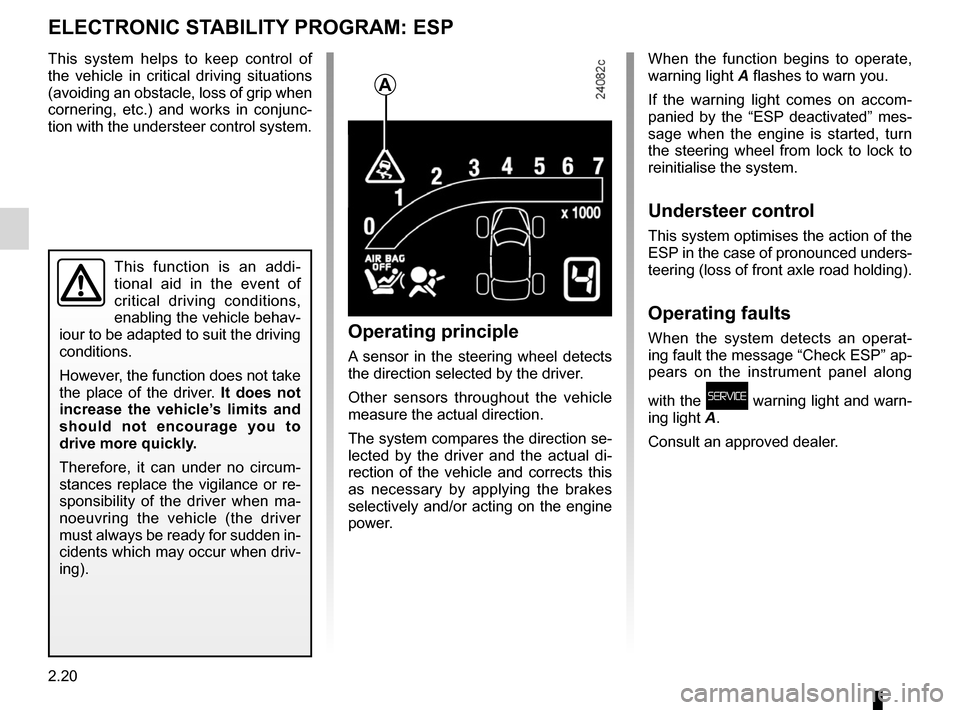
power. When the function begins to operate,
warning light
A flashes to warn you.
If the warning light comes on accom -
panied by the “ESP deactivated” mes -
sage when the engine is started, turn
the steering wheel from lock to lock to
reinitialise the system.
Understeer control
This system optimises the action of the
ESP in the case of pronounced unders-
teering (loss of front axle road holding).
Operating faults
When the system detects an operat -
ing fault the message “Check ESP” ap-
pears on the instrument panel along
with the
ú warning light and warn-
ing light A.
Consult an approved dealer.
A