vin RENAULT ESPACE 2016 5.G Owners Manual
[x] Cancel search | Manufacturer: RENAULT, Model Year: 2016, Model line: ESPACE, Model: RENAULT ESPACE 2016 5.GPages: 318, PDF Size: 3.32 MB
Page 186 of 318
2.78
AUTOMATIC GEARBOX (5/6)
Special cases
As position P is automatically en-
gaged when the engine is stopped, it is
sometimes necessary to place the vehi-
cle in position N for some car washes,
for example.
Position N can be engaged before
opening the driver’s door, and a maxi-
mum of around 25 seconds after the
engine is stopped.
After this time or after opening the
driver’s door, it will be necessary to turn
on the ignition again to disengage posi-
tion P.
In the event of a loss of in-
formation on the instrument
panel, stop and immobilise
the vehicle using the elec-
tronic parking brake or button P.
Special cases
In certain driving cases (eg: protect-
ing the engine), a gear change can be
performed automatically in the event of
over-revving or approaching under-rev-
ving. Permanent manual mode remains
activated. Similarly, to avoid making the
"wrong move", a gear change may be
refused by the gearbox. In this case,
the display for the requested gear + or –
flashes for a few seconds to warn you.
Parking the vehicleUpon stopping the engine by press-
ing the engine stop button, position P
is automatically engaged, along with
the electronic parking brake for vehi-
cles equipped with this device. P is dis-
played on the instrument panel and the
warning light on button P comes on.
Never leave the vehicle with
the engine running without
previously engaging the
Park position P.
With the engine running, the automatic
gearbox in D or R or N or M and with-
out your foot on the brake, messages
“P not engaged” and “Select P” are dis-
played on the instrument panel as soon
as the driver’s door is open.
With the engine stopped, the automatic
gearbox in N (neutral), the message “P
not engaged” is displayed on the instru-
ment panel.
Special feature related to the Stop and Start function: if you are going\
to unfasten the driver's seat belt before the
engine goes into standby due to the Stop and Start function, make sure t\
he gearbox is in position P. The P warning
light will light up on the instrument panel to confirm this. Risk of loss of immobilisation.
Page 187 of 318
2.79
AUTOMATIC GEARBOX (6/6)
Special circumstances
– If the bends and road surface
do not allow you to stay in auto-
matic mode (e.g. in the mountains),
we recommend that you change
to either temporary or permanent
manual mode.
This will prevent the automatic gear-
box from changing gear repeatedly
when climbing, and permit engine
braking on long descents.
– In cold weather, wait a few seconds
before disengaging position P or N
and engage the lever in D or R to
prevent the engine stalling.
Operating faults
– When driving , if the “Check auto
gearbox” message appears on the
instrument panel, it indicates a fault.
Contact your approved Dealer as
soon as possible.
– When driving , if the message
“Gearbox overheating” appears on
the instrument panel, stop the ve-
hicle to allow the gearbox to cool
down.
Contact your approved Dealer as
soon as possible.
– If a vehicle with an automatic
gearbox breaks down, please refer
to the information on “Towing” in
Section 5.
An impact to the under-
side of the vehicle while
manoeuvring (e.g.: strik-
ing a post, raised kerb or
other street furniture) may result in
damage to the vehicle (e.g.: defor-
mation of an axle).
To avoid any risk of accident, have
your vehicle checked by an ap-
proved Dealer.
In very cold weather, the system
may prevent the gears from being
shifted in manual mode until the
gearbox reaches the right tempera-
ture.
Page 190 of 318
3.2
MULTI-SENSE (1/2)
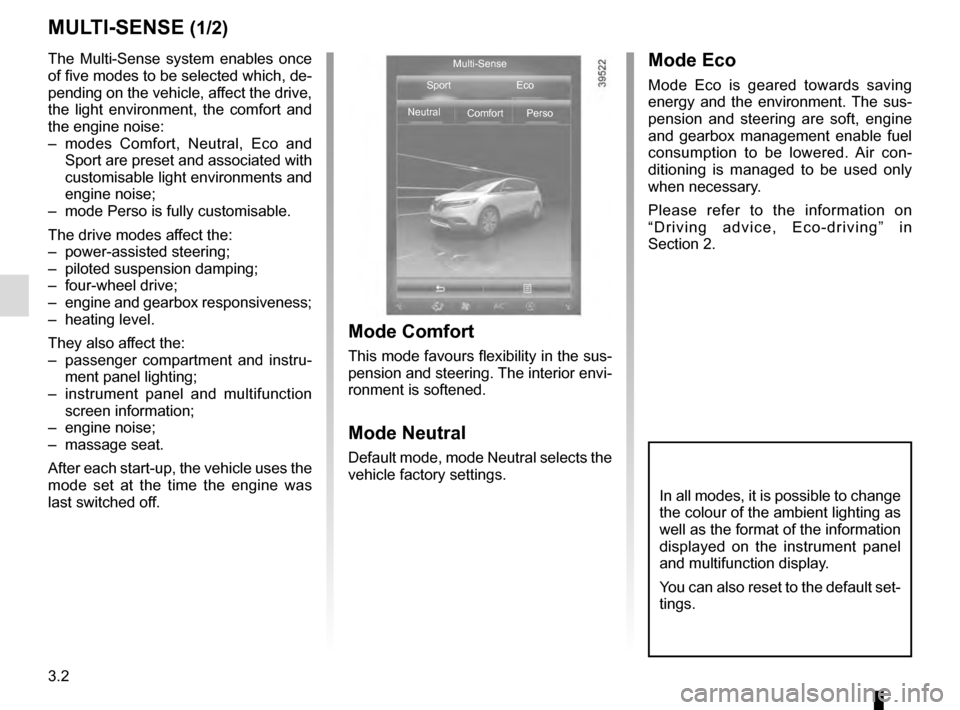
The Multi-Sense system enables once
of five modes to be selected which, de-
pending on the vehicle, affect the drive,
the light environment, the comfort and
the engine noise:
– modes Comfort, Neutral, Eco and Sport are preset and associated with
customisable light environments and
engine noise;
– mode Perso is fully customisable.
The drive modes affect the:
– power-assisted steering;
– piloted suspension damping;
– four-wheel drive;
– engine and gearbox responsiveness;
– heating level.
They also affect the:
– passenger compartment and instru- ment panel lighting;
– instrument panel and multifunction screen information;
– engine noise;
– massage seat.
After each start-up, the vehicle uses the
mode set at the time the engine was
last switched off.
Mode Comfort
This mode favours flexibility in the sus-
pension and steering. The interior envi-
ronment is softened.
Mode Neutral
Default mode, mode Neutral selects the
vehicle factory settings.
Mode Eco
Mode Eco is geared towards saving
energy and the environment. The sus-
pension and steering are soft, engine
and gearbox management enable fuel
consumption to be lowered. Air con-
ditioning is managed to be used only
when necessary.
Please refer to the information on
“Driving advice, Eco-driving” in
Section 2.
Multi-Sense
Sport Eco
Neutral Comfort Perso
In all modes, it is possible to change
the colour of the ambient lighting as
well as the format of the information
displayed on the instrument panel
and multifunction display.
You can also reset to the default set-
tings.
Page 199 of 318
3.11
AUTOMATIC CLIMATE CONTROL (5/5)
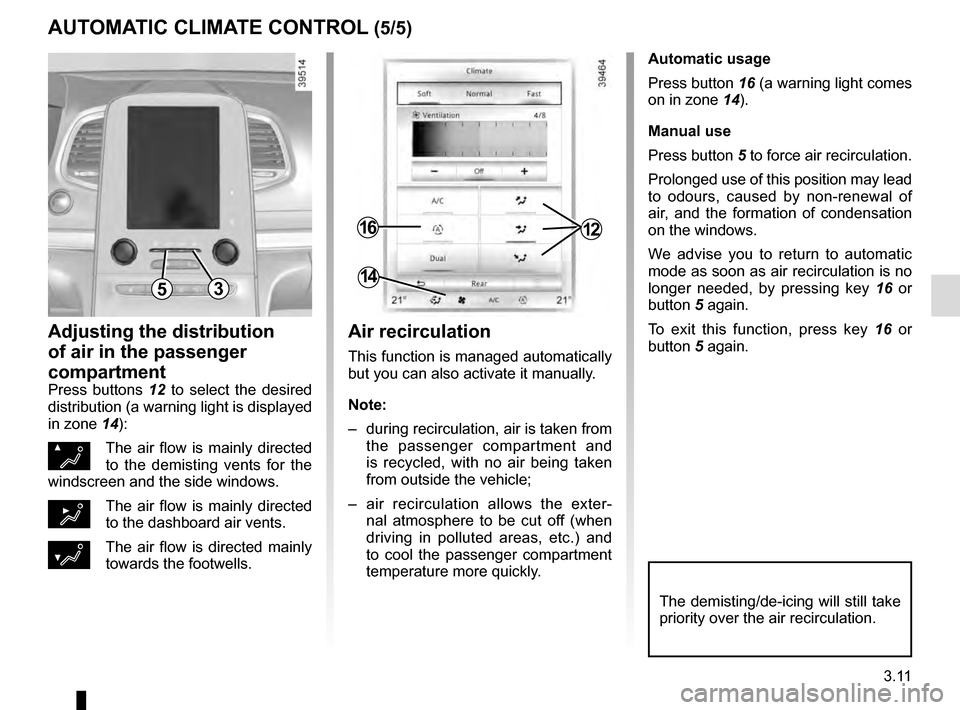
Automatic usage
Press button 16 (a warning light comes
on in zone 14).
Manual use
Press button 5 to force air recirculation.
Prolonged use of this position may lead
to odours, caused by non-renewal of
air, and the formation of condensation
on the windows.
We advise you to return to automatic
mode as soon as air recirculation is no
longer needed, by pressing key 16 or
button 5 again.
To exit this function, press key 16 or
button 5 again.
Adjusting the distribution
of air in the passenger
compartment
Press buttons 12 to select the desired
distribution (a warning light is displayed
in zone 14):
ØThe air flow is mainly directed
to the demisting vents for the
windscreen and the side windows.
½The air flow is mainly directed
to the dashboard air vents.
¿The air flow is directed mainly
towards the footwells.
The demisting/de-icing will still take
priority over the air recirculation.
53
1216
14
Air recirculation
This function is managed automatically
but you can also activate it manually.
Note:
– during recirculation, air is taken from the passenger compartment and
is recycled, with no air being taken
from outside the vehicle;
– air recirculation allows the exter- nal atmosphere to be cut off (when
driving in polluted areas, etc.) and
to cool the passenger compartment
temperature more quickly.
Page 202 of 318
3.14
AIR CONDITIONING: information and advice on use
Do not add anything to the
vehicle’s ventilation circuit
(for example, to remove
bad odours).
There is a risk of damage or of
fire.
Do not open the refriger-
ant fluid circuit. The fluid
may damage eyes or skin.
Fuel consumption
You will normally notice an increase in
fuel consumption (especially in town)
when the air conditioning is operating.
For vehicles fitted with air conditioning
with no automatic mode, switch off the
system when it is not required.
Advice for reducing consumption
and helping to preserve the environ-
ment
Drive with the air vents open and the
windows closed.
If the vehicle has been parked in the
sun, open the doors for a few moments
to let the hot air escape before starting
the engine.
Maintenance
Refer to the Maintenance Document
for your vehicle for the inspection fre-
quency.
Operating faults
As a general rule, contact your ap-
proved dealer in the event of an oper-
ating fault.
– Reduction in de-icing, demisting or air conditioning performance.
This may be caused by the passen-
ger compartment filter cartridge be-
coming clogged.
– No cold air is being produced .
Check that the controls are set cor-
rectly and that the fuses are sound.
Otherwise, switch off the system.
Presence of water under the
vehicle
After prolonged use of the air condi-
tioning system, it is normal for water
to be present under the vehicle. This is
caused by condensation.
Advice on use
In some situations, (air conditioning
off, air recirculation activated, ventila-
tion speed at zero or low, etc.) you may
notice that condensation starts to form
on the windows and windscreen.
If there is condensation, use the “Clear
View” function to remove it, then use
the air conditioning in automatic mode
to stop it forming again.
Vehicles equipped with the
ECOmode: once activated, ECO
mode can reduce the perform-
ance of the automatic air condition-
ing. Please refer to the information
on “Driving advice, Eco-driving” in
Section 2.
Page 205 of 318
3.17
Operating faults
In case of a fault when closing a
window, the system reverts to normal
mode: pull the switch as many times as
necessary until the window closes com-
pletely, hold the switch (still on the clo-
sing side) for around one second, then
completely lower then raise the window
to reset the system.
If necessary, contact an approved
Dealer.
ELECTRIC WINDOWS (2/2)Remote control window
closing
(vehicles with 4 one-touch electric win-
dows).
When you lock the doors from the out-
side, press the locking button on the
RENAULTcard twice in quick suc-
cession, or on the driver’s door in
hands-free mode, and all the windows
will close automatically (and, depen-
ding on the vehicle, the sunroof).
It is recommended that the user only
operates the system when the vehi-
cle can be seen clearly and no one is
inside.
When closing the windows,
ensure that no part of the
body (arm, hand, etc.) is
protruding from the vehicle.
Risk of serious injury.
One-touch mode
This mode works in addition to the ope-
ration of the electric windows described
previously.
Briefly press or pull the window switch
fully: the window is fully lowered or
raised. Pressing the switch again stops
the window moving.
Note: if the window detects resistance
when closing (e.g.: branch of a tree,
etc.) it stops and then lowers again by a
few centimetres.
Page 206 of 318
3.18
ELECTRIC SUNROOF (1/3)
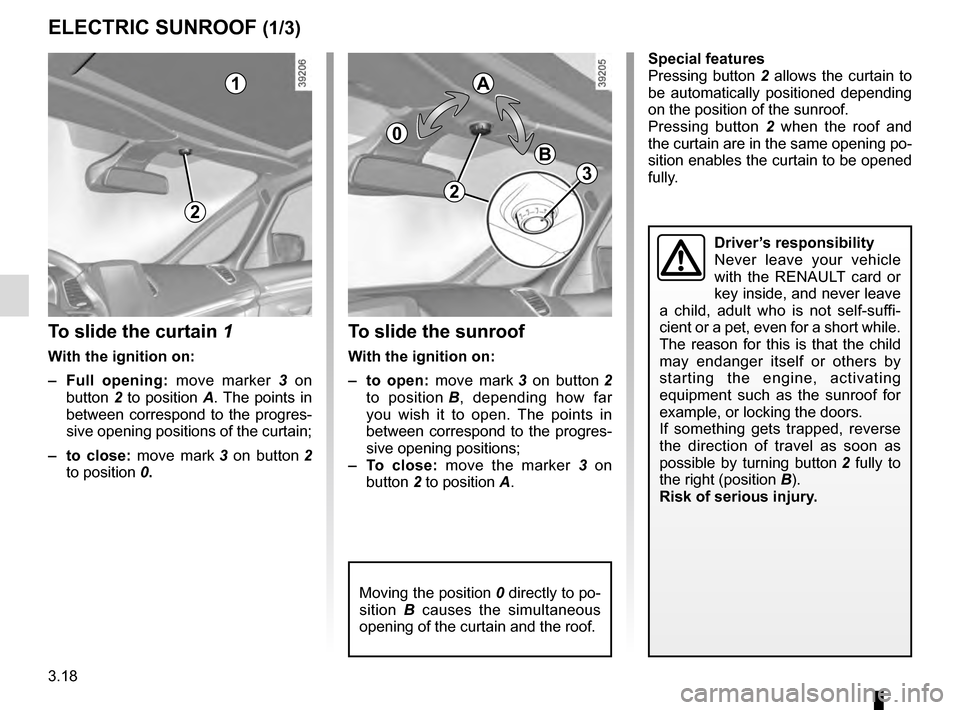
To slide the curtain 1
With the ignition on:
– Full opening: move marker 3 on
button 2 to position A. The points in
between correspond to the progres-
sive opening positions of the curtain;
– to close: move mark 3 on button 2
to position 0.
To slide the sunroof
With the ignition on:
– to open: move mark 3 on button 2
to position B, depending how far
you wish it to open. The points in
between correspond to the progres-
sive opening positions;
– To close: move the marker 3 on
button 2 to position A.
1
2
0
A
B
Moving the position 0 directly to po-
sition B causes the simultaneous
opening of the curtain and the roof.
Driver’s responsibility
Never leave your vehicle
with the RENAULT card or
key inside, and never leave
a child, adult who is not self-suffi-
cient or a pet, even for a short while.
The reason for this is that the child
may endanger itself or others by
starting the engine, activating
equipment such as the sunroof for
example, or locking the doors.
If something gets trapped, reverse
the direction of travel as soon as
possible by turning button 2 fully to
the right (position B).
Risk of serious injury.
Special features
Pressing button 2 allows the curtain to
be automatically positioned depending
on the position of the sunroof.
Pressing button 2 when the roof and
the curtain are in the same opening po-
sition enables the curtain to be opened
fully.
2
3
Page 207 of 318
3.19
ELECTRIC SUNROOF (2/3)Closing the sunroof by
remote control
(depending on the vehicle)
If you press the locking button on
the card twice in quick succession
RENAULT,, the windows and the elec-
tric sunroof will close automatically.
It is recommended that the user only
operates the system when the vehi-
cle can be seen clearly and no one is
inside.
Precautions during use
– Vehicle with loaded roof bars.
As a general rule, if there is a load
on the roof, use of the sunroof is not
recommended.
Before using the sunroof, check the
objects and/or accessories (bike
racks, roof boxes, etc.) attached to
the roof bars: they should be pro-
perly arranged and secured and
should not interfere with the opera-
tion of the sunroof.
Contact an approved dealer for de-
tails of possible conversions;
– check that the sunroof is properly
closed before leaving your vehicle;
– clean the seal every three months using products recommended by our
Technical Department;
– do not open the sunroof immedia-
tely after it has rained or immediately
after washing the vehicle.
When closing the sunroof,
ensure that no part of the
body (arm, hand, etc.) is
protruding from the vehicle.
Risk of serious injury.
Special features
Your vehicle is fitted with an anti-pinch
facility: when the sunroof encounters
resistance whilst closing (arm, tree
branch etc.), it stops and then moves
back a few centimetres.
After closing the sunroof by remote
control, pressing button 2 allows the
sunroof to return to its previous posi-
tion.
Page 211 of 318
3.23
SUN VISOR, BLINDS
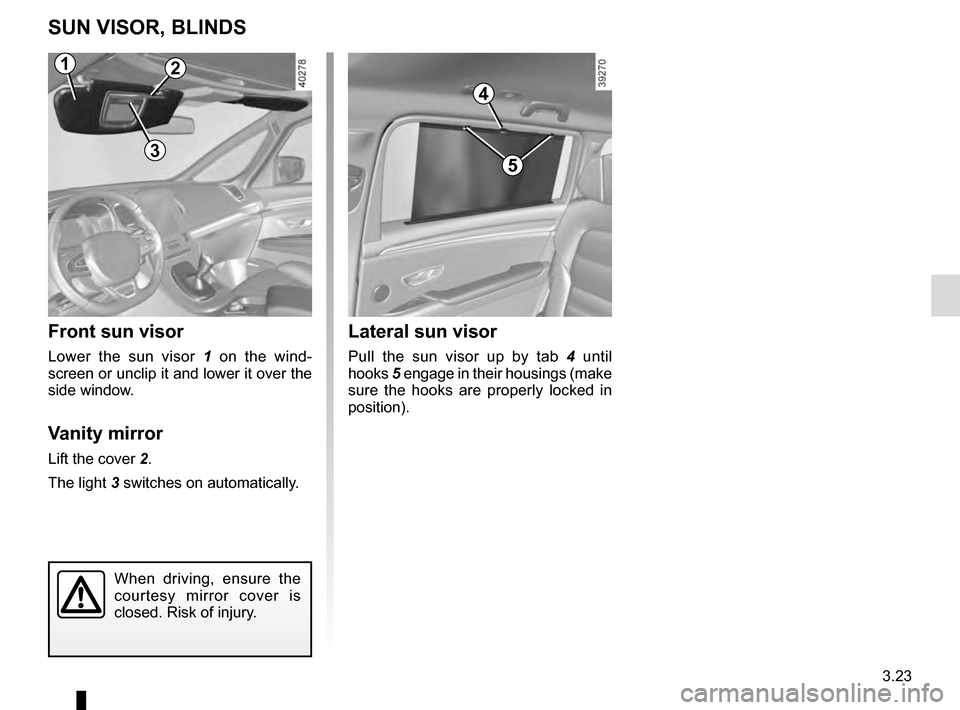
Front sun visor
Lower the sun visor 1 on the wind-
screen or unclip it and lower it over the
side window.
Vanity mirror
Lift the cover 2.
The light 3 switches on automatically.
Lateral sun visor
Pull the sun visor up by tab 4 until
hooks 5 engage in their housings (make
sure the hooks are properly locked in
position).
4
5
2
3
When driving, ensure the
courtesy mirror cover is
closed. Risk of injury.
1
Page 212 of 318
3.24
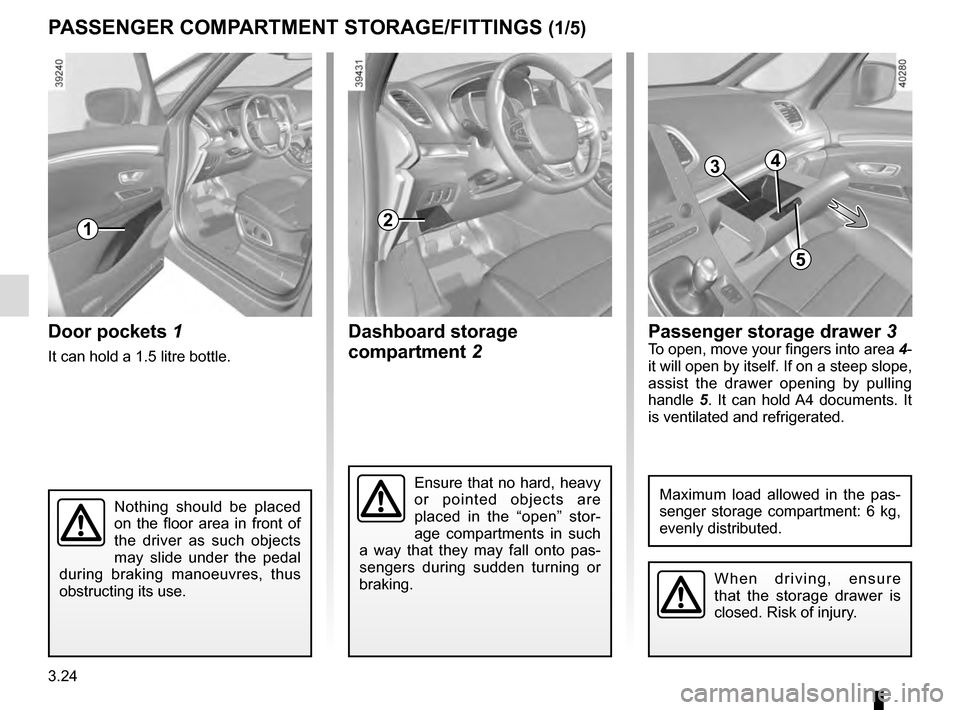
Dashboard storage
compartment 2Door pockets 1
It can hold a 1.5 litre bottle.
PASSENGER COMPARTMENT STORAGE/FITTINGS (1/5)
1
Nothing should be placed
on the floor area in front of
the driver as such objects
may slide under the pedal
during braking manoeuvres, thus
obstructing its use.
Ensure that no hard, heavy
or pointed objects are
placed in the “open” stor-
age compartments in such
a way that they may fall onto pas-
sengers during sudden turning or
braking.
2
Passenger storage drawer 3To open, move your fingers into area 4-
it will open by itself. If on a steep slope,
assist the drawer opening by pulling
handle 5. It can hold A4 documents. It
is ventilated and refrigerated.
Maximum load allowed in the pas-
senger storage compartment: 6 kg,
evenly distributed.
When driving, ensure
that the storage drawer is
closed. Risk of injury.
34
5