belt RENAULT FLUENCE 2012 1.G Owner's Manual
[x] Cancel search | Manufacturer: RENAULT, Model Year: 2012, Model line: FLUENCE, Model: RENAULT FLUENCE 2012 1.GPages: 241, PDF Size: 6.5 MB
Page 43 of 241

ENG_NU_891_892-7_L38-B32_Renault_1
ChILD sAFETY : Fitting a child seat (7/9)
² Seat")
JauneNoirNoir texte
1.39
ENG_UD23757_3
Sécurité enfants : installation du siège enfant (L38 - X38 - R\
enault)
ENG_NU_891_892-7_L38-B32_Renault_1
ChILD sAFETY : Fitting a child seat (7/9)
² Seat not suitable for fitting child
seats.
Child seat attached using the belt
¬ Seat which allows a child seat
with “Universal” approval to be attached
by a seat belt.
Child seat attached using the IsOFIX
mounting
ü Seat which allows an ISOFIX
child seat to be fitted.
± The rear seats are fitted with
an anchorage point which allows a
forward-facing ISOFIX child seat with
universal approval to be fitted. The an-
chorage points are located in the lug -
gage compartment and are visible.
The size of the ISOFIX child seat is in-
dicated by a letter:
– A, B and B1: for forward-facing seats
in group 1 (9 to 18 kg);
– C: rear-facing seats in group 1 (9 to
18 kg);
– D and E: shell seat or rear-facing
seats in group 0 or 0+ (less than
13 kg);
– F and G: cots in group 0 (less than
10 kg).
Using a child safety system
which is not approved for
this vehicle will not correctly
protect the baby or child.
They risk serious or even fatal injury.
Four-door versions WIThOUT front passenger air bag
Page 45 of 241

ENG_NU_891_892-7_L38-B32_Renault_1
X = Seat not suitable for fitting child seats.
U")
JauneNoirNoir texte
1.41
ENG_UD23757_3
Sécurité enfants : installation du siège enfant (L38 - X38 - R\
enault)
ENG_NU_891_892-7_L38-B32_Renault_1
X = Seat not suitable for fitting child seats.
U = Seat which allows a child seat with “Universal” approval to be ins\
talled using a seat belt; check that it can be fitted.
IUF/IL = On equipped vehicles, seat which allows an approved “Universal/semi-universal” or vehicle specific” child seat to be at-
tached using the ISOFIX system; check that it can be fitted.
(2) Only a rear-facing child seat can be fitted in this seat: raise the seat to the maximum and position it as far back as possible,
tilting the seatback slightly (approximately 25°).
(3) A carrycot can be installed across the vehicle and will take up at least two seats. Position the child with his or her feet nearest
the door.
(4) Move the front seat as far forward as possible to install a rear-facing child seat, then move back the seat in front as far as it will
go, although without allowing it to come into contact with the child sea\
t.
(5) Forward-facing child seat; position the seatback of the child seat in contact with the seatback of the vehicle seat. Adjust the
headrest, or remove it if necessary. Do not push the front seat more than halfway back on its runners and do not recline the
seatback more than 25°.
ChILD sAFETY : Fitting a child seat (9/9)
Page 46 of 241

air bagdeactivating the front passenger air bags ........ (current page)
front passenger air bag deactivation ..................... (current page)
child restraint/seat ................................ (up to the end of the DU)
child safety ............................................ (up to the end of the DU)
child restraint/seat ................................ (up to the end of the DU)
transporting children ............................. (up to the end of the DU)
1.42
ENG_UD17911_3
Sécurité enfants : désactivation/activation airbag passager ava\
nt (L38 - X38 - Renault)
ENG_NU_891_892-7_L38-B32_Renault_1
Jaune NoirNoir texte
deactivating/activating the front passenger air bag
2
Deactivating the front
passenger air bags
(on equipped vehicles)
You must deactivate certain devices
in addition to the front passenger seat
belt before fitting a child seat in the front
passenger seat. To deactivate the air bags: with the
vehicle stationary
, push and turn
lock 1 to the OFF position.
With the ignition on, it is essential to
check that warning light 2
¹ is lit
on the central display and, depend -
ing on the vehicle, that the message
“Passenger airbag off” is displayed.
This light remains permanently lit to
let you know that you can fit a child
seat.
ChILD sAFETY : deactivating/activating the front passenger air bag (1/3)
1
The passenger air bag must
only be deactivated or acti-
vated with the ignition off.
If it is interfered with when
the vehicle is being driven, indicator
lights
å and © will come
on.
Switch the ignition off then on again
to reset the air bag in accordance
with the lock.
Page 51 of 241
JauneNoirNoir texte
1.47
ENG_UD13633_1
Poste de conduite direction à gauche (L38 - X38 - Renault)
ENG_NU_891_892-7_L38-B32_Renault_1
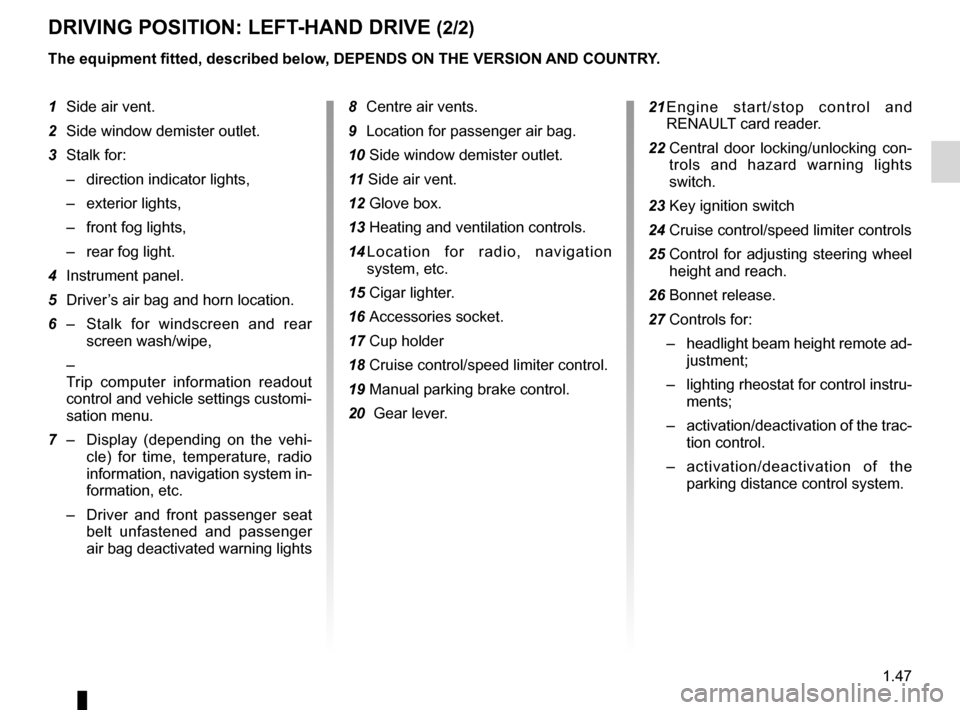
DRIVINg pOsITION: LEFT -hAND DRIVE (2/2)
The equipment fitted, described below, DEpENDs ON ThE VERsION AND COUNTRY.
1 Side air vent.
2 Side window demister outlet.
3 Stalk for:
– direction indicator lights,
– exterior lights,
– front fog lights,
– rear fog light.
4 Instrument panel.
5 Driver’s air bag and horn location.
6 – Stalk for windscreen and rear
screen wash/wipe,
–
Trip computer information readout
control and vehicle settings customi-
sation menu.
7 – Display (depending on the vehi -
cle) for time, temperature, radio
information, navigation system in-
formation, etc.
– Driver and front passenger seat
belt unfastened and passenger
air bag deactivated warning lights 8
Centre air vents.
9 Location for passenger air bag.
10 Side window demister outlet.
11 Side air vent.
12 Glove box.
13 Heating and ventilation controls.
14 L o c a t i o n f o r r a d i o , n a v i g a t i o n
system, etc.
15 Cigar lighter.
16 Accessories socket.
17 Cup holder
18 Cruise control/speed limiter control.
19 Manual parking brake control.
20 Gear lever. 21
E n g i n e s t a r t / s t o p c o n t r o l a n d
RENAULT card reader.
22 Central door locking/unlocking con -
trols and hazard warning lights
switch.
23 Key ignition switch
24 Cruise control/speed limiter controls
25 Control for adjusting steering wheel
height and reach.
26 Bonnet release.
27 Controls for:
– headlight beam height remote ad-
justment;
– lighting rheostat for control instru-
ments;
– activation/deactivation of the trac-
tion control.
– activation/deactivation of the
parking distance control system.
Page 53 of 241
JauneNoirNoir texte
1.49
ENG_UD13634_1
Poste de conduite direction à droite (L38 - X38 - Renault)
ENG_NU_891_892-7_L38-B32_Renault_1
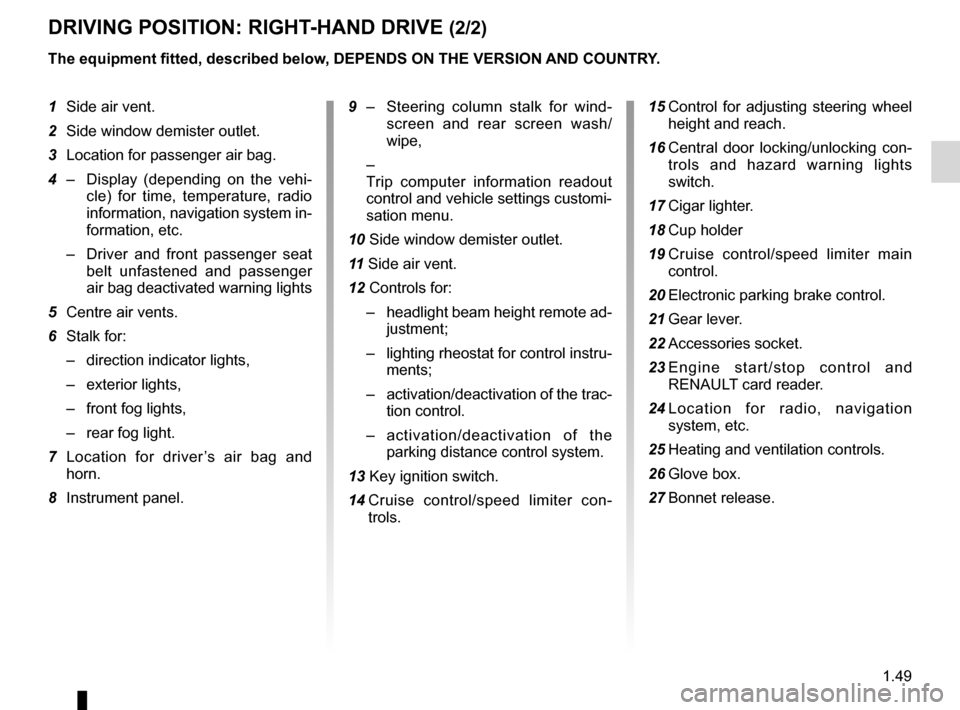
DRIVINg pOsITION: RIghT -hAND DRIVE (2/2)
The equipment fitted, described below, DEpENDs ON ThE VERsION AND COUNTRY.
1 Side air vent.
2 Side window demister outlet.
3 Location for passenger air bag.
4 – Display (depending on the vehi -
cle) for time, temperature, radio
information, navigation system in-
formation, etc.
– Driver and front passenger seat
belt unfastened and passenger
air bag deactivated warning lights
5 Centre air vents.
6 Stalk for:
– direction indicator lights,
– exterior lights,
– front fog lights,
– rear fog light.
7 Location for driver ’s air bag and
horn.
8 Instrument panel.
9 – Steering column stalk for wind -
screen and rear screen wash/
wipe,
–
Trip computer information readout
control and vehicle settings customi-
sation menu.
10 Side window demister outlet.
11 Side air vent.
12 Controls for:
– headlight beam height remote ad-
justment;
– lighting rheostat for control instru-
ments;
– activation/deactivation of the trac-
tion control.
– activation/deactivation of the
parking distance control system.
13 Key ignition switch.
14 Cruise control/speed limiter con -
trols. 15
Control for adjusting steering wheel
height and reach.
16 Central door locking/unlocking con -
trols and hazard warning lights
switch.
17 Cigar lighter.
18 Cup holder
19 Cruise control/speed limiter main
control.
20 Electronic parking brake control.
21 Gear lever.
22 Accessories socket.
23 E n g i n e s t a r t / s t o p c o n t r o l a n d
RENAULT card reader.
24 L o c a t i o n f o r r a d i o , n a v i g a t i o n
system, etc.
25 Heating and ventilation controls.
26 Glove box.
27 Bonnet release.
Page 56 of 241
warning buzzer ...................................................... (current page)
battery .................................................................... (current page)
seat belts ............................................................... (current page)
filter particle filter ..................................................... (current page)
engine oil ............................................................... (current page)
speed limiter .......................................................... (current page)
cruise control ......................................................... (current page)
fuel filling ................................................................. (current page)
1.52
ENG_UD27258_6
Témoins lumineux (L38 - X38 - Renault)
ENG_NU_891_892-7_L38-B32_Renault_1
Jaune NoirNoir texte
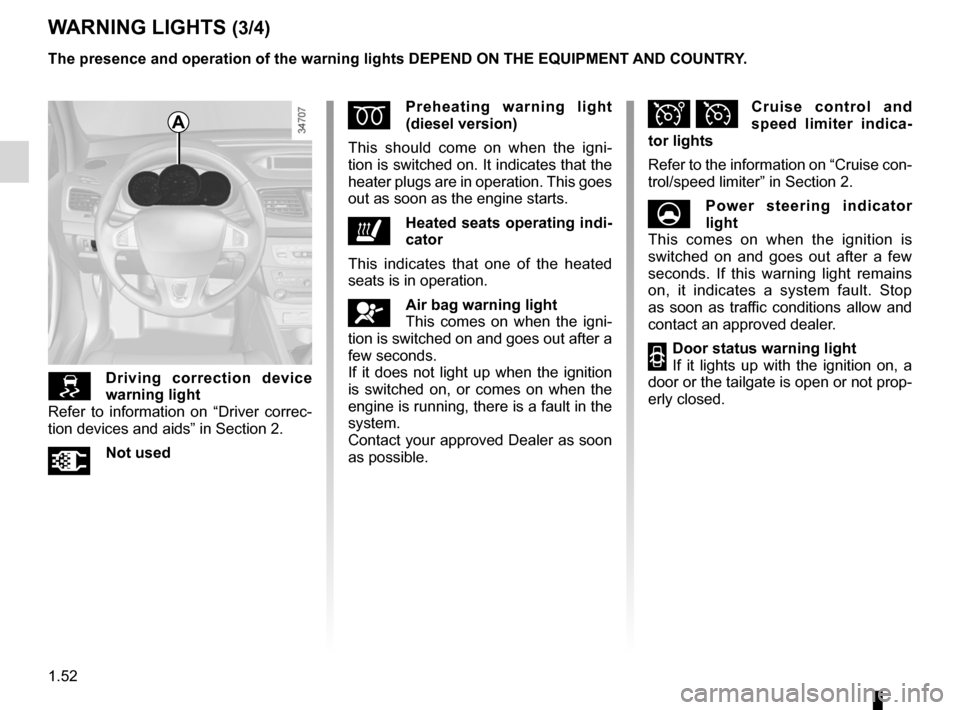
WARNINg LIghTs (3/4)
Î ÏCruise control and
speed limiter indica -
tor lights
Refer to the information on “Cruise con-
trol/speed limiter” in Section 2.
Up ower steering indicator
light
This comes on when the ignition is
switched on and goes out after a few
seconds. If this warning light remains
on, it indicates a system fault. Stop
as soon as traffic conditions allow and
contact an approved dealer.
2Door status warning light
If it lights up with the ignition on, a
door or the tailgate is open or not prop-
erly closed.
Driving correction device
warning light
Refer to information on “Driver correc -
tion devices and aids” in Section 2.
Ü Not used
The presence and operation of the warning lights DEpEND ON ThE EQUIpMENT AND COUNTRY.
Ép reheating warning light
(diesel version)
This should come on when the igni -
tion is switched on. It indicates that the
heater plugs are in operation. This goes
out as soon as the engine starts.
ðheated seats operating indi -
cator
This indicates that one of the heated
seats is in operation.
åAir bag warning light
This comes on when the igni -
tion is switched on and goes out after a
few seconds.
If it does not light up when the ignition
is switched on, or comes on when the
engine is running, there is a fault in the
system.
Contact your approved Dealer as soon
as possible.
A
Page 57 of 241
JauneNoirNoir texte
1.53
ENG_UD27258_6
Témoins lumineux (L38 - X38 - Renault)
ENG_NU_891_892-7_L38-B32_Renault_1
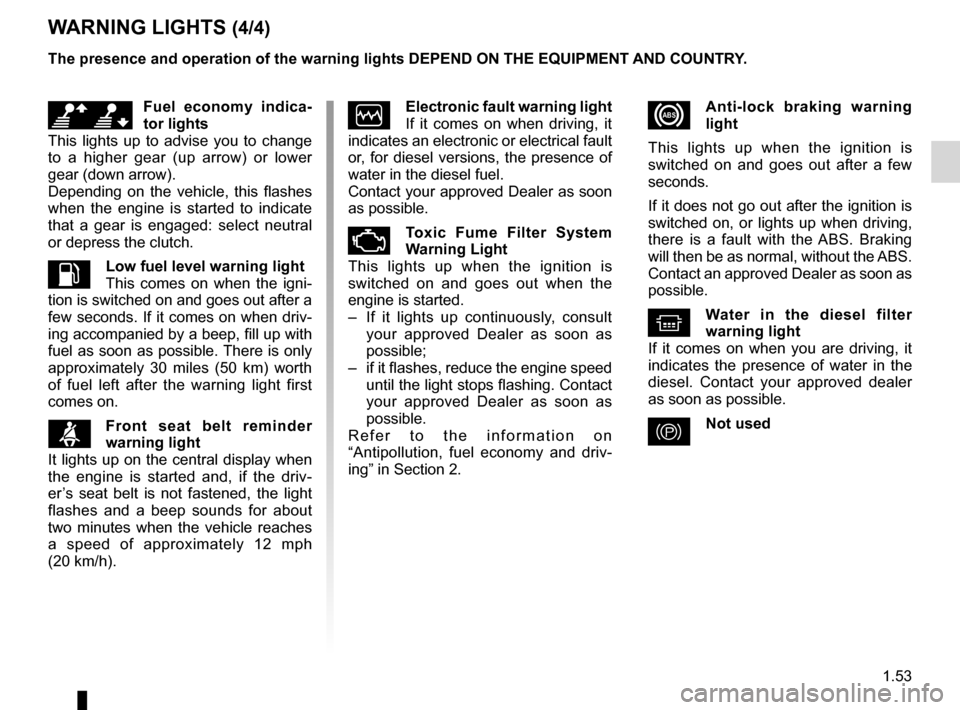
xAnti-lock braking warning
light
This lights up when the ignition is
switched on and goes out after a few
seconds.
If it does not go out after the ignition is
switched on, or lights up when driving,
there is a fault with the ABS. Braking
will then be as normal, without the ABS.
Contact an approved Dealer as soon as
possible.
^Water in the diesel filter
warning light
If it comes on when you are driving, it
indicates the presence of water in the
diesel. Contact your approved dealer
as soon as possible.
}Not used
ÒElectronic fault warning light
If it comes on when driving, it
indicates an electronic or electrical fault
or, for diesel versions, the presence of
water in the diesel fuel.
Contact your approved Dealer as soon
as possible.
ÄToxic Fume Filter system
Warning Light
This lights up when the ignition is
switched on and goes out when the
engine is started.
– If it lights up continuously, consult
your approved Dealer as soon as
possible;
– if it flashes, reduce the engine speed
until the light stops flashing. Contact
your approved Dealer as soon as
possible.
R e f e r t o t h e i n f o r m a t i o n o n
“Antipollution, fuel economy and driv -
ing” in Section 2.
W ARNINg LIghTs (4/4)
The presence and operation of the warning lights DEpEND ON ThE EQUIpMENT AND COUNTRY.
\[Fuel economy indica -
tor lights
This lights up to advise you to change
to a higher gear (up arrow) or lower
gear (down arrow).
Depending on the vehicle, this flashes
when the engine is started to indicate
that a gear is engaged: select neutral
or depress the clutch.
LLow fuel level warning light
This comes on when the igni -
tion is switched on and goes out after a
few seconds. If it comes on when driv-
ing accompanied by a beep, fill up with
fuel as soon as possible. There is only
approximately 30 miles (50 km) worth
of fuel left after the warning light first
comes on.
ßFront seat belt reminder
warning light
It lights up on the central display when
the engine is started and, if the driv -
er’s seat belt is not fastened, the light
flashes and a beep sounds for about
two minutes when the vehicle reaches
a speed of approximately 12 mph
(20 km/h).
Page 71 of 241

ENG_NU_891_892-7_L38-B32_Renault_1
TRIp COMpUTER AND WARNINg sYsTEM: operating fau")
1.67
ENG_UD23768_1
Ordinateur de bord : messages d’anomalies de fonctionnement (L38 - X\
38 - X32 - B32 - Renault)
ENG_NU_891_892-7_L38-B32_Renault_1
TRIp COMpUTER AND WARNINg sYsTEM: operating fault messages
These appear with the © warning light and mean that you should drive very carefully to an approved dealer as soon
as possible. If you fail to follow this recommendation, you risk damagin\
g your vehicle.
They disappear when the display selection key is pressed or after several seconds and are stored in the computer log. The
©
warning light stays on. Examples of operating fault messages are given i\
n the following pages.
Examples of messages Interpreting the display selected
« Clean diesel filter » Indicates the presence of water in the diesel filter.
« Check lighting »Indicates a fault in the directional headlights.
« Check vehicle » Indicates a fault on one of the pedal sensors or in the battery management
system.
« Check airbag » Indicates a fault in the restraint system in addition to the seat belts. In the event
of an accident, it is possible that they may not be triggered.
« Check antipollution system »Indicates a fault in the vehicle’s particle filter system.
« Check injection system » Indicates an engine fault.
Page 149 of 241
3.21
ENG_UD21355_2
Banquette arrière (L38 - X38 - Renault)
ENG_NU_891_892-7_L38-B32_Renault_3
Rear bench seat
w hen refitting the seat -
back , make sure it is cor -
rectly locked in place.
If seat covers are fitted ,
make sure these do not prevent the
seatback latch from locking in.
Make sure that the seat belts are
positioned correctly.
Reposition the headrests.
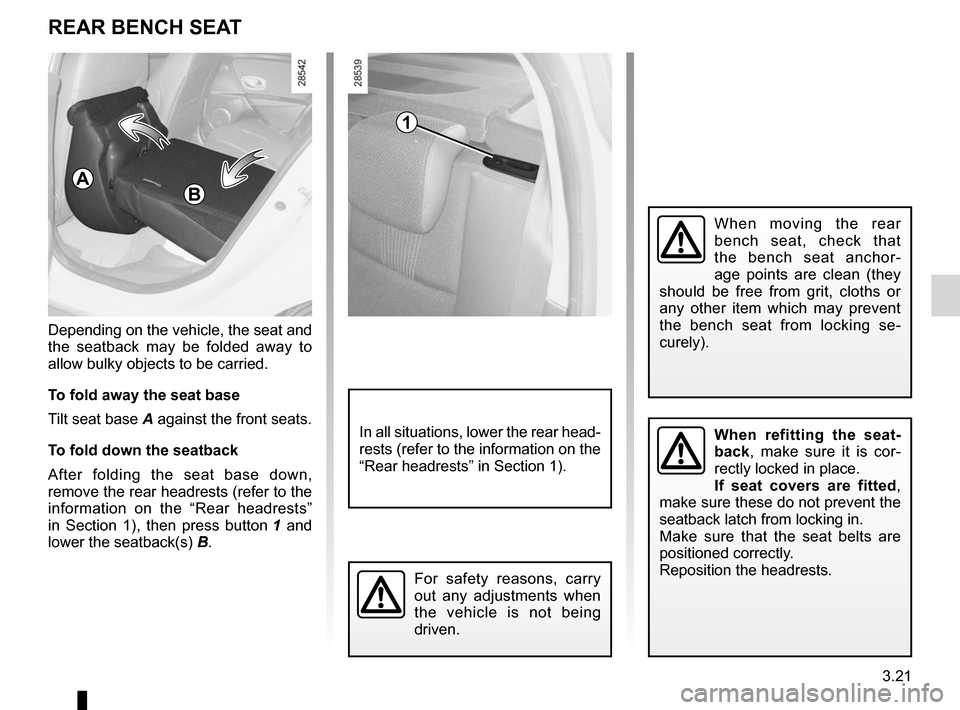
Depending on the vehicle, the seat and
the seatback may be folded away to
allow bulky objects to be carried.
To fold away the seat base
Tilt seat base A against the front seats.
To fold down the seatback
After folding the seat base down,
remove the rear headrests (refer to the
information on the “Rear headrests”
in Section 1), then press button 1 and
lower the seatback(s) B.
In all situations, lower the rear head-
rests (refer to the information on the
“Rear headrests” in Section 1).
For safety reasons, carry
out any adjustments when
the vehicle is not being
driven.
1
BA
REAR BENch SEAT
When moving the rear
bench seat, check that
the bench seat anchor -
age points are clean (they
should be free from grit, cloths or
any other item which may prevent
the bench seat from locking se -
curely).
Page 153 of 241
transporting objectsin the luggage compartment ........... (up to the end of the DU)
towing rings .......................................... (up to the end of the DU)
towing towing equipment ............................ (up to the end of the DU)
towing equipment fitting ............................................... (up to the end of the DU)
towing a caravan .................................. (up to the end of the DU)
3.25
ENG_UD21629_3
Transport d’objets dans le coffre (L38 - X38 - Renault)
ENG_NU_891_892-7_L38-B32_Renault_3
Transporting objects in the luggage compartment/Towing (towing equipment)
TRANSPoRTINg oBjEcTS IN ThE luggAgE coMPARTMENT/TowINg (towing equipment)
A
Always position the heavi -
est items directly on the
floor. Use the lashing points
on the floor of the luggage
compartment, if these are fitted to
the vehicle. The luggage should be
loaded in such a way that no items
will be thrown forward and strike the
occupants if the driver has to brake
suddenly. Fasten the rear seat belts,
even if the seats are not occupied.
c
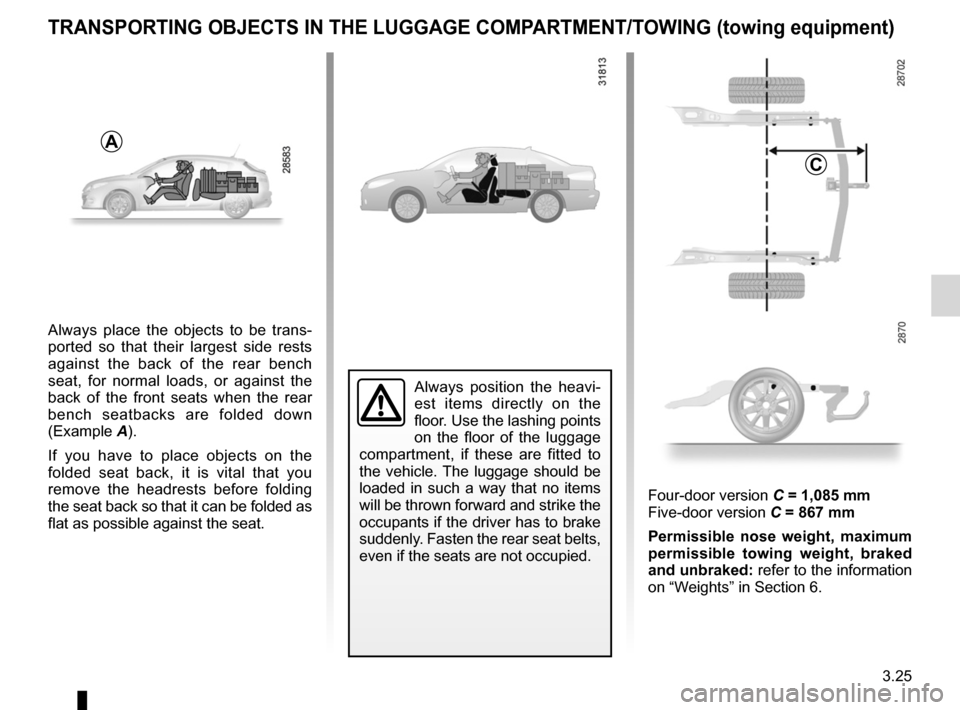
Always place the objects to be trans -
ported so that their largest side rests
against the back of the rear bench
seat, for normal loads, or against the
back of the front seats when the rear
bench seatbacks are folded down
(Example A).
If you have to place objects on the
folded seat back, it is vital that you
remove the headrests before folding
the seat back so that it can be folded as
flat as possible against the seat. Four-door version
C = 1,085 mm
Five-door version C = 867 mm
Permissible nose weight, maximum
permissible towing weight, braked
and unbraked: refer to the information
on “Weights” in Section 6.