height RENAULT FLUENCE ZERO EMISSION 2012 1.G User Guide
[x] Cancel search | Manufacturer: RENAULT, Model Year: 2012, Model line: FLUENCE ZERO EMISSION, Model: RENAULT FLUENCE ZERO EMISSION 2012 1.GPages: 195, PDF Size: 5.23 MB
Page 115 of 195
electric windows ................................... (up to the end of the DU)
child safety ............................................................. (current page)
children (safety) ..................................................... (current page)
3.12
ENG_UD28762_3
Lève-vitres électriques (L38 - X38 - Renault)
ENG_NU_914-4_L38e_Renault_3
Jaune NoirNoir texte
These systems operate with the igni -
tion on or off, until one of the front doors
is opened (limited to about 3 minutes).
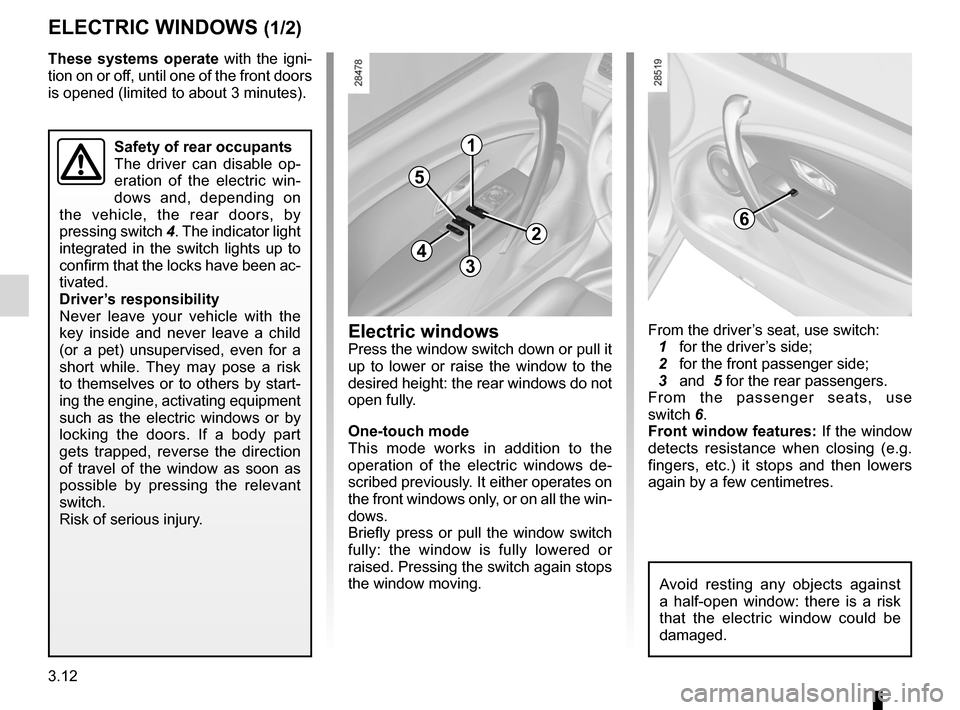
From the driver’s seat, use switch:
1 for the driver’s side;
2 for the front passenger side;
3 and 5 for the rear passengers.
From the passenger seats, use
switch 6.
Front window features: If the window
detects resistance when closing (e.g.
fingers, etc.) it stops and then lowers
again by a few centimetres.
Electric windows
ElEcTRIc wINDowS (1/2)
Electric windows
Press the window switch down or pull it
up to lower or raise the window to the
desired height: the rear windows do not
open fully.
one-touch mode
This mode works in addition to the
operation of the electric windows de -
scribed previously. It either operates on
the front windows only, or on all the win-
dows.
Briefly press or pull the window switch
fully: the window is fully lowered or
raised. Pressing the switch again stops
the window moving.
1
2
34
5
6
Safety of rear occupants
The driver can disable op -
eration of the electric win -
dows and, depending on
the vehicle, the rear doors, by
pressing switch 4. The indicator light
integrated in the switch lights up to
confirm that the locks have been ac-
tivated.
Driver’s responsibility
Never leave your vehicle with the
key inside and never leave a child
(or a pet) unsupervised, even for a
short while. They may pose a risk
to themselves or to others by start-
ing the engine, activating equipment
such as the electric windows or by
locking the doors. If a body part
gets trapped, reverse the direction
of travel of the window as soon as
possible by pressing the relevant
switch.
Risk of serious injury.
Avoid resting any objects against
a half-open window: there is a risk
that the electric window could be
damaged.
Page 130 of 195
brake fluid .............................................................. (current page)
levels: brake fluid ........................................................ (current page)
tanks and reservoirs brake fluid ........................................................ (current page)
windscreen washer ................................................ (current page)
levels: windscreen washer reservoir ........................... (current page)
tanks and reservoirs: windscreen washer .......................................... (current page)
JauneNoirNoir texte
4.5
ENG_UD23025_2
Niveaux (L38 électrique - Renault)
ENG_NU_914-4_L38e_Renault_4
brake fluid
windscreen washer reservoir
Windscreen washer reservoir
t opping up
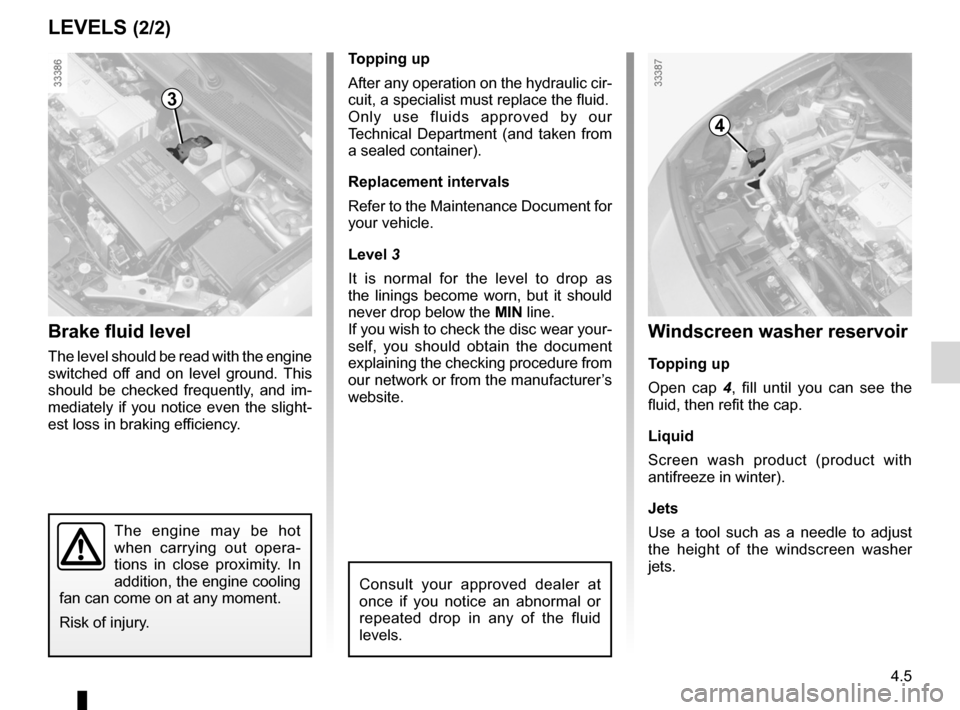
Open cap 4 , fill until you can see the
fluid, then refit the cap.
Liquid
Screen wash product (product with
antifreeze in winter).
Jets
Use a tool such as a needle to adjust
the height of the windscreen washer
jets.
4
3
Brake fluid level
The level should be read with the engine
switched off and on level ground. This
should be checked frequently, and im -
mediately if you notice even the slight-
est loss in braking efficiency.
Consult your approved dealer at
once if you notice an abnormal or
repeated drop in any of the fluid
levels.
t opping up
After any operation on the hydraulic cir-
cuit, a specialist must replace the fluid.
Only use fluids approved by our
Technical Department (and taken from
a sealed container).
Replacement intervals
Refer to the Maintenance Document for
your vehicle.
Level 3
It is normal for the level to drop as
the linings become worn, but it should
never drop below the MIn line.
If you wish to check the disc wear your-
self, you should obtain the document
explaining the checking procedure from
our network or from the manufacturer’s
website.
LeveLs (2/2)
The engine may be hot
when carrying out opera -
tions in close proximity. In
addition, the engine cooling
fan can come on at any moment.
Risk of injury.
Page 191 of 195
7.2
FRA_UD29442_4
Index (L38 - X38 - Renault)
ENG_NU_914-4_L38e_Renault_7
Jaune NoirNoir texte
AlphAbeticAl index (2/5)
driver’s position ..................................................... 1.50 → 1.56
driving .................................................... 2.2 → 2.6, 2.9 → 2.21
driving position settings ............................................................ 1.26 → 1.28
e
electric beam height adjustment ........................................ 1.74
»400 volt» electrical circuit ........................................ 1.2 → 1.7
electric vehicle vehicle range ........................................................ 2.5 – 2.6
noise .............................................................................. 1.6
charge ................................................................ 1.8 → 1.13
driving ............................................................ 1.6, 2.5 – 2.6
quick change of traction battery ................................... 1.14
presentation .........................................................1.2 → 1.6
important recommendations ................................... 1.7, 1.9
electric windows ..................................................... 3.12 – 3.13
electrical installation ............................................................ 1.9
Electronic Stability Program: ESP ........................... 2.9 → 2.12
emergency brake assist ........................................... 2.9 → 2.12
emergency braking .................................................. 2.9 → 2.12
energy recovery ......................................................................... 2.8
saving ............................................................................ 2.5
charge meter (function) .................................................. 2.8
consumption .................................................................. 2.8
energy saving ............................................................. 2.5 – 2.6
energy consumption ............................... 1.57 – 1.58, 2.5 – 2.6
energy recovery ................................................................... 2.5
engine specifications ........................................................... 6.3
environment ........................................................................\
. 2.7
ESP: Electronic Stability Program ........................... 2.9 → 2.12
external temperature ......................................................... 1.49F
faults
operating faults ................................................ 5.31 → 5.34
fittings .................................................................... 3.16 → 3.18
fog lights ........................................................................\
.... 5.16
front passenger air bag deactivation ................................. 1.46
front seat adjustment ......................................................... 1.25
front seats adjustment ................................... 1.22 – 1.23, 1.25 → 1.28
with manual controls .................................................... 1.25
fuses ....................................................................... 5.21 – 5.22
G
gear lever .................................................................... 2.3 – 2.4
glove box ........................................................................\
... 3.18
h
handbrake ........................................................................\
.... 2.4
hands-free telephone integrated control ............................ 3.22
hazard warning lights signal ................................... 1.70 – 1.71
headlight beam adjustment ............................................... 1.74
headlight flashers .............................................................. 1.70
headlight washer ............................................................... 1.76
headrest ................................................................. 1.22 → 1.24
heating and air conditioning system .................................. 3.11
heating, air conditioning: programming ............. 2.6, 3.9 – 3.10
heating system ........................................................ 3.4 → 3.10
heating/air conditioning programming ...................... 3.9 – 3.10
horn ........................................................................\
........... 1.70
horn: flash ............................................................................. 1.70
sounding the horn ........................................................ 1.70
hubcap tool ........................................................................\
.. 5.3
i
indicators .................................................................. 1.70, 5.14