Dash RENAULT KADJAR 2015 1.G User Guide
[x] Cancel search | Manufacturer: RENAULT, Model Year: 2015, Model line: KADJAR, Model: RENAULT KADJAR 2015 1.GPages: 298, PDF Size: 6.69 MB
Page 186 of 298
3.8
AUTOMATIC CLIMATE CONTROL (2/6)
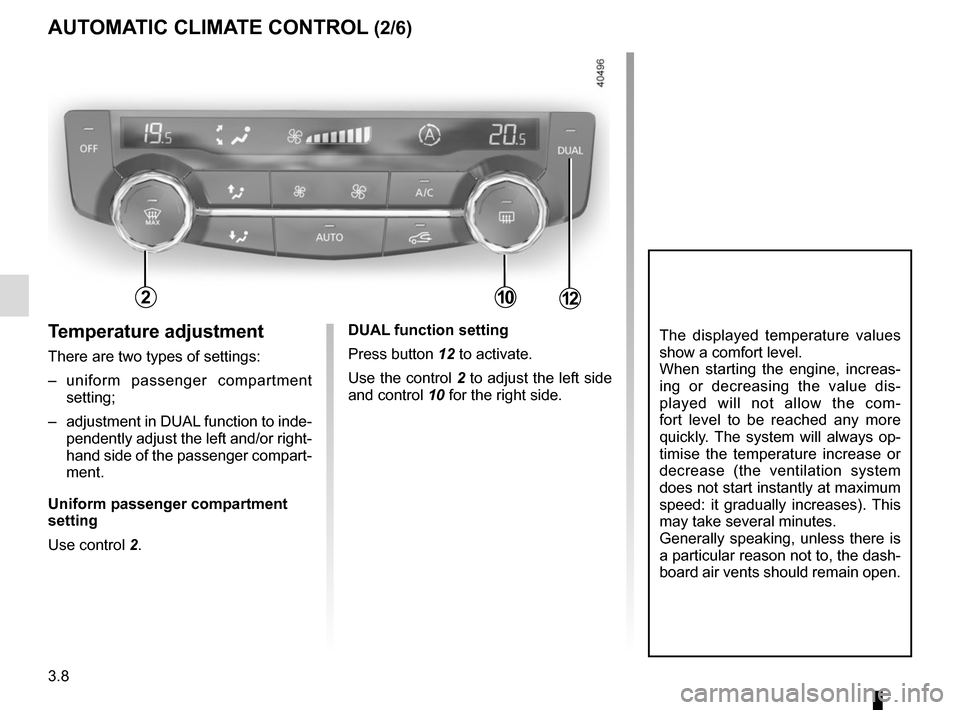
Temperature adjustment
There are two types of settings:
– uniform passenger compartment setting;
– adjustment in DUAL function to inde- pendently adjust the left and/or right-
hand side of the passenger compart-
ment.
Uniform passenger compartment
setting
Use control 2.
The displayed temperature values
show a comfort level.
When starting the engine, increas-
ing or decreasing the value dis-
played will not allow the com-
fort level to be reached any more
quickly. The system will always op-
timise the temperature increase or
decrease (the ventilation system
does not start instantly at maximum
speed: it gradually increases). This
may take several minutes.
Generally speaking, unless there is
a particular reason not to, the dash-
board air vents should remain open.DUAL function setting
Press button 12 to activate.
Use the control 2 to adjust the left side
and control 10 for the right side.
21012
Page 188 of 298
3.10
45
B
AUTOMATIC CLIMATE CONTROL (4/6)
6311
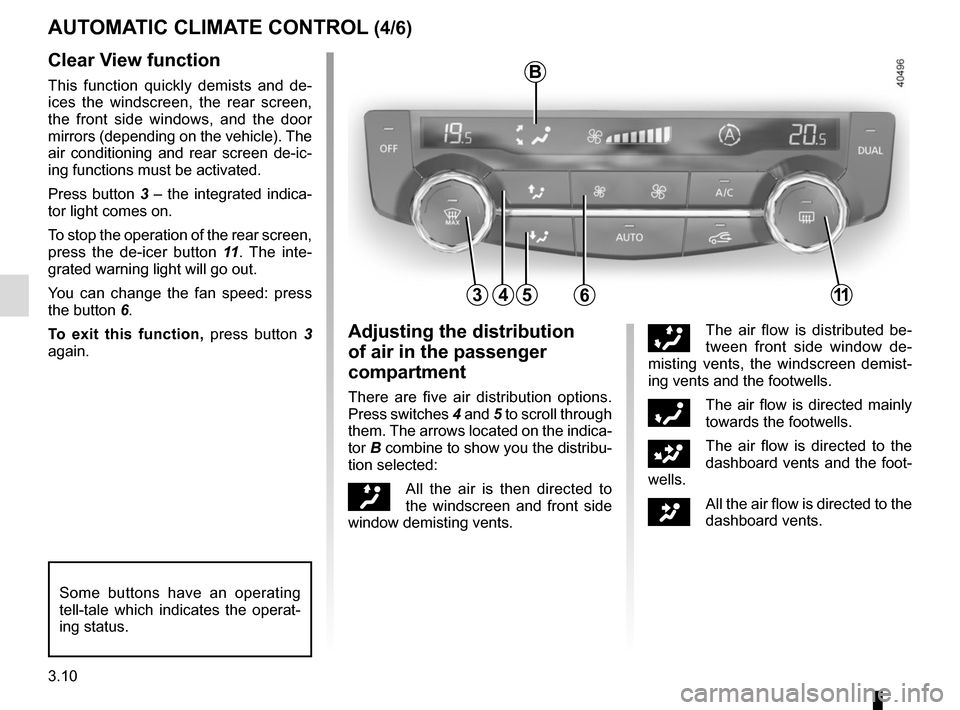
Clear View function
This function quickly demists and de-
ices the windscreen, the rear screen,
the front side windows, and the door
mirrors (depending on the vehicle). The
air conditioning and rear screen de-ic-
ing functions must be activated.
Press button 3 – the integrated indica-
tor light comes on.
To stop the operation of the rear screen,
press the de-icer button 11. The inte-
grated warning light will go out.
You can change the fan speed: press
the button 6.
To exit this function, press button 3
again.
Some buttons have an operating
tell-tale which indicates the operat-
ing status.
Adjusting the distribution
of air in the passenger
compartment
There are five air distribution options.
Press switches 4 and 5 to scroll through
them. The arrows located on the indica-
tor B combine to show you the distribu-
tion selected:
õAll the air is then directed to
the windscreen and front side
window demisting vents.
÷The air flow is distributed be-
tween front side window de-
misting vents, the windscreen demist-
ing vents and the footwells.
óThe air flow is directed mainly
towards the footwells.
GThe air flow is directed to the
dashboard vents and the foot-
wells.
JAll the air flow is directed to the
dashboard vents.
Page 231 of 298
4.17
You are strongly recom-
mended not to use high-
pressure or spray cleaning
equipment inside the pas-
senger compartment: use of such
equipment could impair the correct
functioning of the electrical or elec-
tronic components in the vehicle, or
have other detrimental effects.
INTERIOR TRIM MAINTENANCE (2/2)
You should not:
You are strongly advised not to po-
sition objects such as deodorants,
scents, etc. near air vents, as this could
damage your dashboard trim.
Removal/replacing removable
equipment originally fitted in
the vehicle
If you need to remove equipment in
order to clean the passenger com-
partment (for example, mats), always
ensure that they are correctly refitted
and are the right way around (the driv-
er’s mat should be fitted on the driver’s
side, etc.) and fit them with the compo-
nents supplied with the equipment (for
example, the driver mat should always
be fixed using the pre-fitted mounting
components).
With the vehicle stationary, ensure that
nothing will impede driving (anything
obstructing the pedals, heel wedged by
the mat, etc.).
Page 238 of 298
5.6
TYRE PRESSURE KIT (3/3)
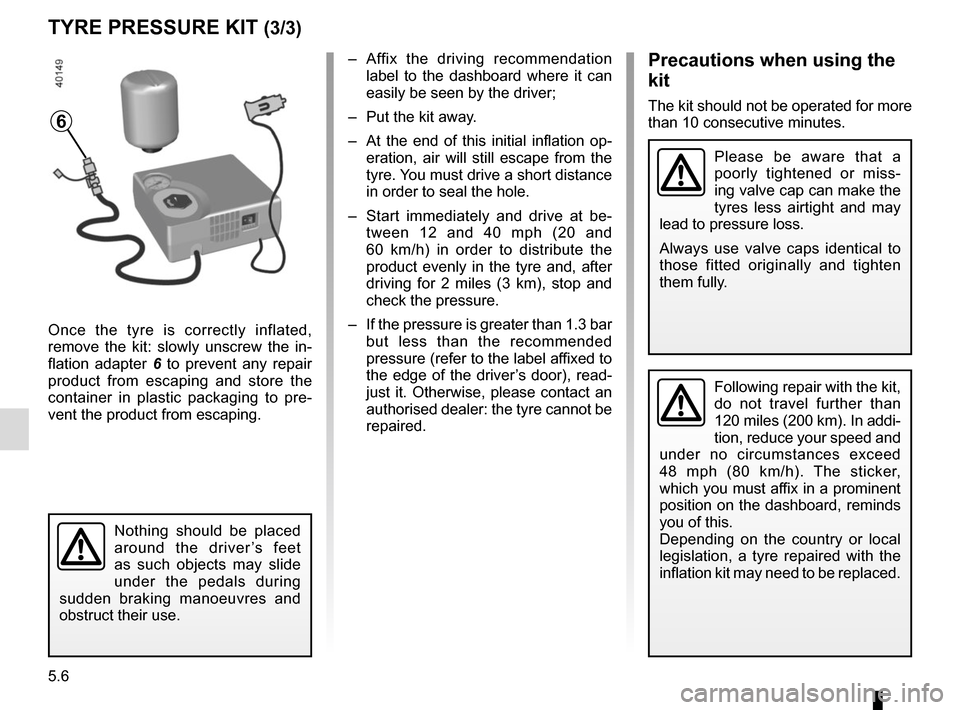
Once the tyre is correctly inflated,
remove the kit: slowly unscrew the in-
flation adapter 6 to prevent any repair
product from escaping and store the
container in plastic packaging to pre-
vent the product from escaping.
– Affix the driving recommendation label to the dashboard where it can
easily be seen by the driver;
– Put the kit away.
– At the end of this initial inflation op- eration, air will still escape from the
tyre. You must drive a short distance
in order to seal the hole.
– Start immediately and drive at be- tween 12 and 40 mph (20 and
60 km/h) in order to distribute the
product evenly in the tyre and, after
driving for 2 miles (3 km), stop and
check the pressure.
– If the pressure is greater than 1.3 bar but less than the recommended
pressure (refer to the label affixed to
the edge of the driver’s door), read-
just it. Otherwise, please contact an
authorised dealer: the tyre cannot be
repaired.Precautions when using the
kit
The kit should not be operated for more
than 10 consecutive minutes.
Nothing should be placed
around the driver’s feet
as such objects may slide
under the pedals during
sudden braking manoeuvres and
obstruct their use.
Please be aware that a
poorly tightened or miss-
ing valve cap can make the
tyres less airtight and may
lead to pressure loss.
Always use valve caps identical to
those fitted originally and tighten
them fully.
Following repair with the kit,
do not travel further than
120 miles (200 km). In addi-
tion, reduce your speed and
under no circumstances exceed
48 mph (80 km/h). The sticker,
which you must affix in a prominent
position on the dashboard, reminds
you of this.
Depending on the country or local
legislation, a tyre repaired with the
inflation kit may need to be replaced.
6
Page 291 of 298

A
ABS ..............................................................1.56, \
2.29 → 2.38
accessories.............................................................\
......")
7.1
ALPHABETICAL INDEX (1/5)
A
ABS ..............................................................1.56, \
2.29 → 2.38
accessories.............................................................\
........... 5.28
accessories socket ............................................................ 3.23
additional methods of restraint .......................................... 1.33 side protection ............................................................. 1.32
to the front seat belts .......................................1.27 → 1.30
to the rear seat belts .................................................... 1.31
adjusting your driving position ..1.19 – 1.21, 1.23 → 1.26, 3.24
advice on antipollution ....................................................... 2.24
air bag...........................................................1.27 → 1.33, 1.54
activating the front passenger air bags ........................ 1.49
deactivating the front passenger air bags .................... 1.47
air conditioning ........................................................3.4 → 3.13
air vents ...................................................................... 3.2 – 3.3
anti-corrosion check ..............................................6.14 → 6.18
anti-corrosion protection .................................................... 4.14
anti-lock braking system: ABS ...............................2.29 → 2.38
antipollution advice .................................................................\
......... 2.24
armrest: front ..................................................................\
............ 3.19
ashtray ................................................................\
............... 3.23
ASR (traction control) ............................................2.29 → 2.38
assisted parking.....................................................2.6\
7 → 2.70
audible and visual signals.................................................. 1.84
automatic gearbox (use) ........................................2.71 → 2.73
automatic gearbox selector lever...........................2.71 → 2.73
B
battery................................................. 4.12 – 4.13, 5.26 – 5.27 troubleshooting ................................................. 5.26 – 5.27
battery (remote control) ..................................................... 5.22
blind spot warning signal .......................................2.46 → 2.49
blind spot: warning signal ......................................2.46 → 2.49
bonnet..................................................................\
....... 4.2 – 4.3 brake fluid ........................................................................\
.... 4.8
bulbs changing ..........................................................5.14 \
→ 5.20
C
catalytic converter................................................... 2.12 – 2.13
central door locking .................1.2 – 1.3, 1.5, 1.8 → 1.15, 1.18
changing a bulb .....................................................5.14 → 5.20
changing a wheel...................................................... 5.9 – 5.10
changing gear ...............................................2.14, 2.71 → 2.73
child restraint/seat ....................1.34 – 1.35, 1.37 → 1.43, 1.47
child safety...............1.30, 1.34 – 1.35, 1.37 → 1.43, 1.47, 2.5,
3.15 – 3.16
child seats..........................................1.34 – 1.35, 1.3\
7 → 1.43
children ........................................ 1.6, 1.34 – 1.35, 3.15 – 3.16
children (safety) ................................................................... 1.6
cigar lighter ........................................................................\
3.23
cleaning: inside the vehicle .............................................. 4.16 – 4.17
clock ..................................................................\
................ 1.75
closing the doors ...................................................1.13 → 1.18
control instruments .......................................1.54 → 1.63, 1.75
controls ...............................................................\
...1.50 → 1.53
courtesy light ............................................................ 3.17, 5.20
courtesy mirrors ................................................................. 3.18
cruise control ................................................1.57, 2.56 → 2.59
cruise control-speed limiter.............. 2.50 → 2.52, 2.56 → 2.59
customised vehicle settings ................................... 1.72 – 1.73
customising the vehicle settings ............................ 1.72 – 1.73
D
dashboard..............................................................1\
.50 → 1.53
deadlocking the doors ................................................ 1.5, 1.12
demisting rear screen .........................................................3.4 → 3.12
windscreen .........................................................3.4 → 3.12