Reverse RENAULT KADJAR 2015 1.G User Guide
[x] Cancel search | Manufacturer: RENAULT, Model Year: 2015, Model line: KADJAR, Model: RENAULT KADJAR 2015 1.GPages: 298, PDF Size: 6.69 MB
Page 172 of 298
2.68
Choice of manoeuvre
The system can perform four types of
manoeuvres:
– parallel parking;
– perpendicular parking;
– angle parking;
– moving out of a parallel parking space.
From the multifunction screen, select
the manoeuvre to be performed.
Note: When starting the vehicle, or
after successfully completed parallel
parking using the system, the default
manoeuvre proposed by the system is
assistance in exiting a parallel parking
space. In other cases, the default ma-
noeuvre can be set from the multifunc-
tion screen.
ASSISTED PARKING (2/4)
Operation
Parking
As long as the vehicle speed is less
than 20 mph (30 km/h), the system
looks for available parking spaces on
both sides of the vehicle.
Once a space has been found, it is dis-
played on the multifunction screen, indi-
cated by a small letter “P”. Drive slowly,
with the indicators activated on the side
of the space, until the message “Stop”
is displayed, alongside a beep.
The space is then indicated on the mul-
tifunction screen by a capital “P”.
– Stop the vehicle;
– select reverse gear.
Warning light
\f lights up on the in-
strument panel, along with a beep.
– release the steering wheel;
– follow the system instructions pro- vided on the multifunction screen. Your speed should not exceed around 4
mph (7 km/h).
Once the warning light
\f on the
instrument panel goes off and a beep
sounds, the manoeuvre has been com-
pleted.
Page 175 of 298
2.71
AUTOMATIC TRANSMISSION (1/3)
Operation
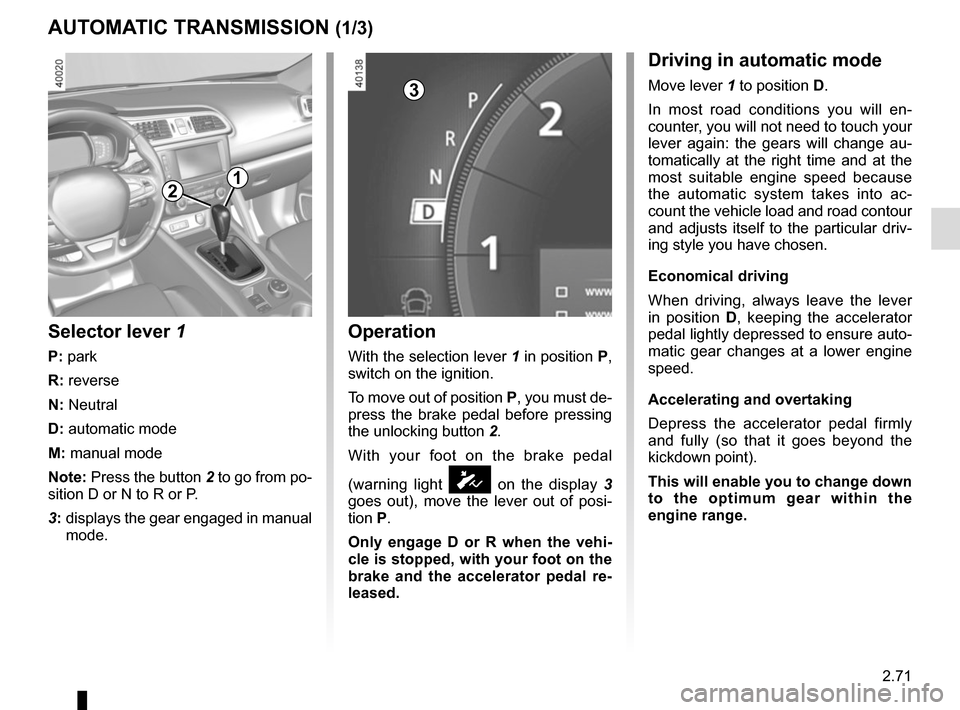
With the selection lever 1 in position P,
switch on the ignition.
To move out of position P, you must de-
press the brake pedal before pressing
the unlocking button 2.
With your foot on the brake pedal
(warning light
Ó on the display 3
goes out), move the lever out of posi-
tion P.
Only engage D or R when the vehi-
cle is stopped, with your foot on the
brake and the accelerator pedal re-
leased.
Selector lever 1
P: park
R: reverse
N: Neutral
D: automatic mode
M: manual mode
Note: Press the button 2 to go from po-
sition D or N to R or P.
3: displays the gear engaged in manual
mode.
12
Driving in automatic mode
Move lever 1 to position D.
In most road conditions you will en-
counter, you will not need to touch your
lever again: the gears will change au-
tomatically at the right time and at the
most suitable engine speed because
the automatic system takes into ac-
count the vehicle load and road contour
and adjusts itself to the particular driv-
ing style you have chosen.
Economical driving
When driving, always leave the lever
in position D, keeping the accelerator
pedal lightly depressed to ensure auto-
matic gear changes at a lower engine
speed.
Accelerating and overtaking
Depress the accelerator pedal firmly
and fully (so that it goes beyond the
kickdown point).
This will enable you to change down
to the optimum gear within the
engine range.3
Page 193 of 298
3.15
ELECTRIC WINDOWS (1/2)
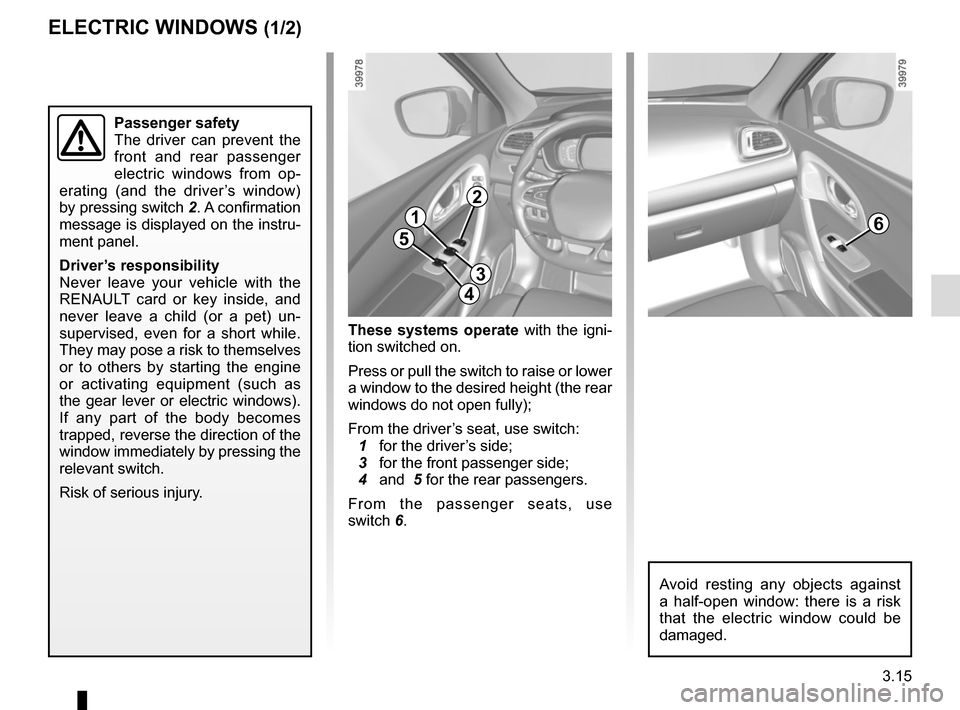
These systems operate with the igni-
tion switched on.
Press or pull the switch to raise or lower
a window to the desired height (the rear
windows do not open fully);
From the driver’s seat, use switch:
1 for the driver’s side;
3 for the front passenger side;
4 and 5 for the rear passengers.
From the passenger seats, use
switch 6.
1
3
4
56
Avoid resting any objects against
a half-open window: there is a risk
that the electric window could be
damaged.
Passenger safety
The driver can prevent the
front and rear passenger
electric windows from op-
erating (and the driver’s window)
by pressing switch 2. A confirmation
message is displayed on the instru-
ment panel.
Driver’s responsibility
Never leave your vehicle with the
RENAULT card or key inside, and
never leave a child (or a pet) un-
supervised, even for a short while.
They may pose a risk to themselves
or to others by starting the engine
or activating equipment (such as
the gear lever or electric windows).
If any part of the body becomes
trapped, reverse the direction of the
window immediately by pressing the
relevant switch.
Risk of serious injury.
2
Page 203 of 298
3.25
To replace the seatback, proceed in
the reverse order to removal.
Refit the seatback and click it back into
place.
REAR BENCH SEAT (1/2)
For safety reasons, carry
out any adjustments when
the vehicle is not being
driven.
When moving the rear
seats, ensure that nothing
obstructs the anchorage
points (passenger’s arm or
leg, a pet, gravel, cloth, toys, etc.).
A
1
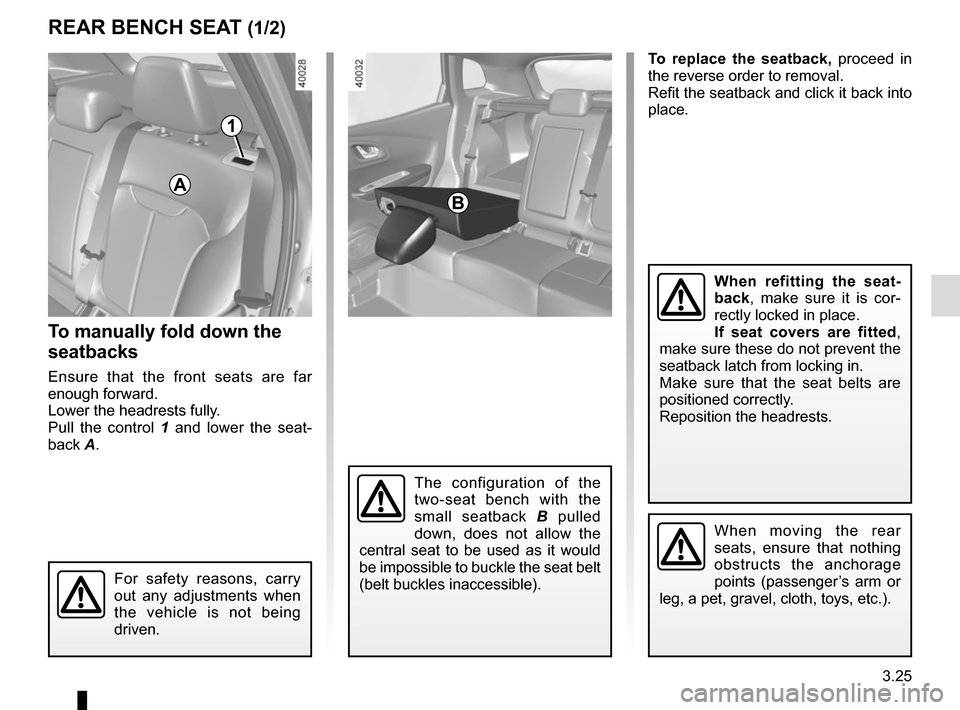
The configuration of the
two-seat bench with the
small seatback B pulled
down, does not allow the
central seat to be used as it would
be impossible to buckle the seat belt
(belt buckles inaccessible).
When refitting the seat-
back, make sure it is cor-
rectly locked in place.
If seat covers are fitted ,
make sure these do not prevent the
seatback latch from locking in.
Make sure that the seat belts are
positioned correctly.
Reposition the headrests.
To manually fold down the
seatbacks
Ensure that the front seats are far
enough forward.
Lower the headrests fully.
Pull the control 1 and lower the seat-
back A.
B
Page 241 of 298

5.9
Continue to crank the jack so that the
baseplate is correctly positioned (it
should be underneath the vehicle and
aligned with the jack head).
Switch on the hazard warn-
ing lights.
Keep the vehicle away from
traffic and on a level surface
where it will not slip.
Apply the parking brake and engage
a gear (first or reverse, or P for auto-
matic transmissions).
Ask all the passengers to leave the
vehicle and keep them away from
traffic.
CHANGING A WHEEL (1/2)
Vehicles equipped with a jack
and wheelbrace
If necessary, remove the wheel trim.
Use the wheelbrace 1 to slacken off the
wheel bolts. Position it so as to be able
to push from above.
Crank up the jack 3 by hand to align
the jack head between the 2 jacking
points 2 closest to the relevant wheel.
If the vehicle is not equipped with a
jack or wheelbrace, you can obtain
these from your approved dealer.
If the vehicle is parked on
the hard shoulder, you must
warn other road users of
your vehicle’s presence
with a warning triangle or with other
devices as per the legislation apply-
ing to the country you are in.
1
2
3
Page 250 of 298
5.18
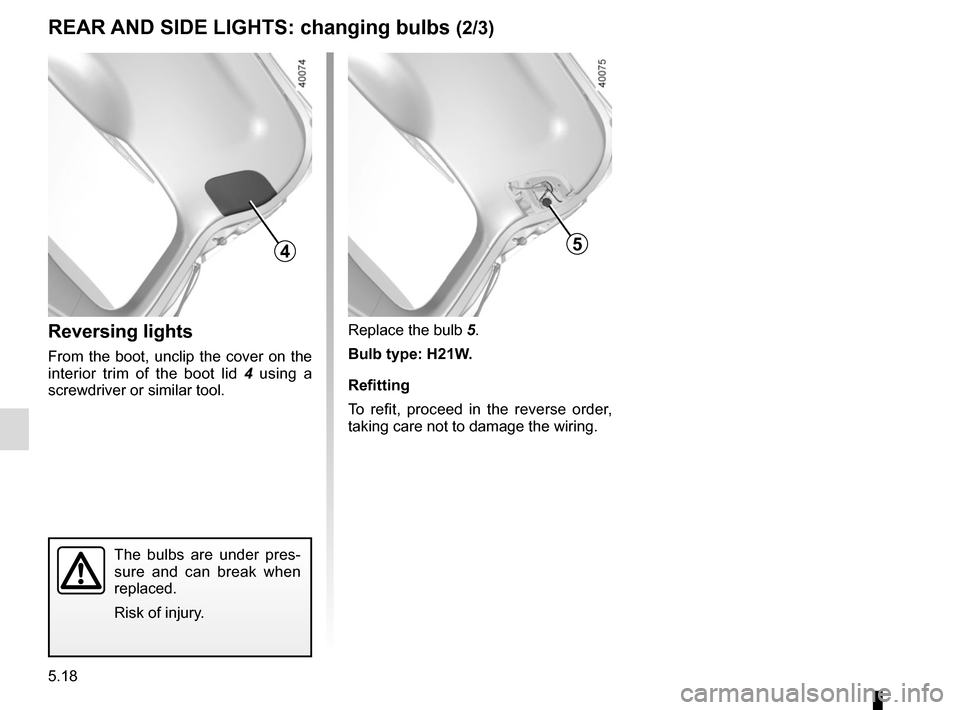
Replace the bulb 5.
Bulb type: H21W.
Refitting
To refit, proceed in the reverse order,
taking care not to damage the wiring.
The bulbs are under pres-
sure and can break when
replaced.
Risk of injury.
Reversing lights
From the boot, unclip the cover on the
interior trim of the boot lid 4 using a
screwdriver or similar tool.
REAR AND SIDE LIGHTS: changing bulbs (2/3)
54
Page 253 of 298

5.21
Operating faults
If the battery is too weak to ensure cor-
rect operation, you can start and lock/
unlock the vehicle (please refer to the
information on “Locking/unlocking the
opening elements” in Section 1).
RENAULT CARD: battery
Replacing the battery
When the message “Keycard battery
low” appears on the instrument panel,
replace the battery in the RENAULT
card:
– slide the rear casing 1 downwards
while pressing on zone A;
– remove the battery cover 2;
– remove the battery by pressing on
one side and lifting the other;
– replace it according to the direc-
tion and template shown inside the
cover.
Do not throw away your
used batteries; give them to
an organisation responsible
for collecting and recycling
batteries.
When refitting, proceed in the reverse
order, then press one of the buttons on
the card four times, close to the vehicle:
the message will disappear.
Note: it is not advisable to touch the
electronic circuit or contacts on the
RENAULT card when replacing the bat-
tery.
The batteries are available from ap-
proved Dealers, and their service
life approximately two years. Check
that there is no dye on the battery:
risk of an incorrect electrical contact.
2
A
1
Page 259 of 298
5.27
Starting the vehicle using the
battery from another vehicle
If you have to use the battery from an-
other vehicle to start, obtain suitable
jump leads (with a large cross section)
from an approved dealer or, if you al-
ready have jump leads, ensure that
they are in perfect condition.
The two batteries must have an iden-
tical nominal voltage of 12 volts. The
battery supplying the current should
have a capacity (amp-hours, Ah) which
is at least the same as that of the dis-
charged battery.
Ensure that there is no risk of contact
between the two vehicles (risk of short
circuiting when the positive terminals
are connected) and that the discharged
battery is properly connected. Switch
off your vehicle ignition.
Start the engine of the vehicle supply-
ing the current and run it at a moderate
speed.
BATTERY: troubleshooting (2/2)
1
B
A
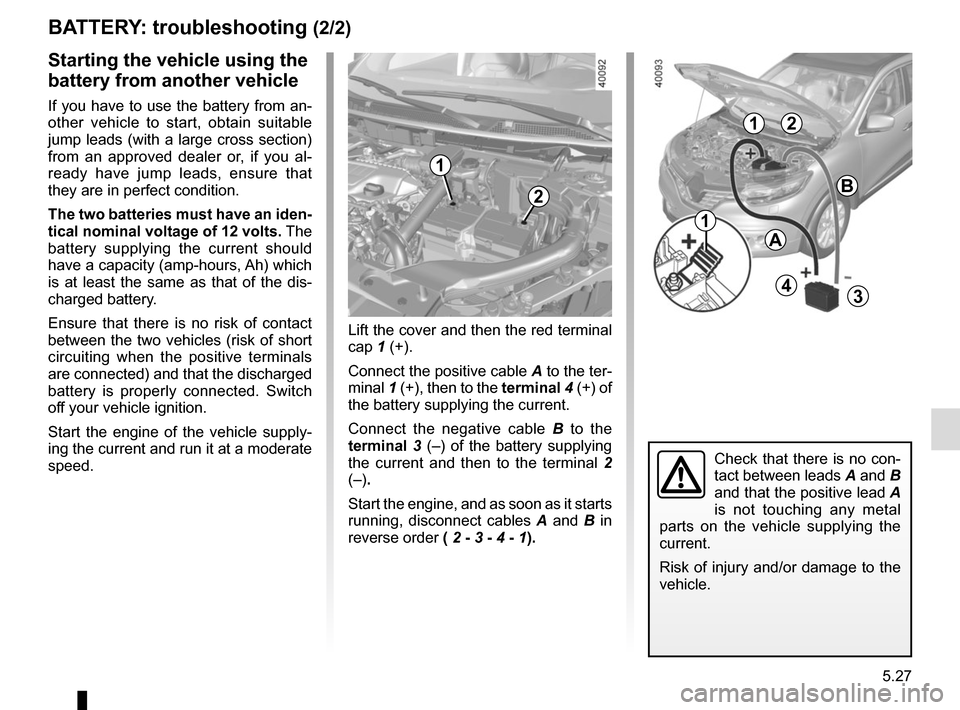
Lift the cover and then the red terminal
cap 1 (+).
Connect the positive cable A to the ter-
minal 1 (+), then to the terminal 4 (+) of
the battery supplying the current.
Connect the negative cable B to the
terminal 3 (–) of the battery supplying
the current and then to the terminal 2
(–).
Start the engine, and as soon as it starts
running, disconnect cables A and B in
reverse order ( 2 - 3 - 4 - 1).
2
43
2
Check that there is no con-
tact between leads A and B
and that the positive lead A
is not touching any metal
parts on the vehicle supplying the
current.
Risk of injury and/or damage to the
vehicle.
1
1
Page 279 of 298

6.7
Original parts are based on strict specifications and are subject to hig\
hly-specialised tests. Therefore, they are of at least the same
level of quality as the parts fitted originally.
If you always fit genuine replacement parts to your vehicle, you will en\
sure that it performs well. Furthermore, repairs carried out
within the manufacturer’s Network using original parts are guaranteed according to the condition\
s set out on the reverse of the
repair order.
REPLACEMENT PARTS AND REPAIRS
Page 294 of 298
7.4
ALPHABETICAL INDEX (4/5)
multimedia equipment ....................................................... 3.35
N
navigation system .............................................................. 3.35
O
oil change ................................................................... 4.5 – 4.6
opening the doors ..................................................1.13 → 1.17
operating faults ................................ 1.54 → 1.59, 5.33 → 5.39
overspeed warning ................................................2.53 → 2.55
P
paintwork maintenance ..................................................... 4.14 – 4.15
parking assistance: assisted parking .....................2.67 → 2.70
parking distance control.........................................2.60 → 2.64
power-assisted steering.................................................\
.... 1.74
pretensioners .........................................................1\
.27 → 1.30
puncture............................................. 5.2 – 5.3, 5.7, 5.9 – 5.10
R
radio...................................................................\
................ 3.35
radio frequency remote control/key use ....................................................................\
...1.2 → 1.4
rear bench seat....................................................... 3.25 – 3.26
rear parcel shelf ................................................................. 3.28
rear seats..............................................................\
............. 1.25 functions ........................................................... 3.25 – 3.26
rear view mirrors ....................................................1.76 → 1.78
remote control door locking batteries ..............................................................\
......... 5.22
remote control door locking unit ................................1.2 → 1.4
RENAULT ANTI-INTRUDER DEVICE (RAID) ................... 1.18
RENAULT card battery ................................................................\
.......... 5.21
use ................................................... 1.6 → 1.12, 2.5 → 2.7RENAULT card battery ...................................................... 5.21
replacement parts ................................................................ 6.7
reverse gear selecting ..................................................2.14, 2.71 → 2.73
reversing sensor ....................................................2.60 → 2.64
roof bars ................................................................. 3.33 – 3.34
roof rack roof bars ............................................................ 3.33 – 3.34
running in .................................................................... 2.2 – 2.3
S
seat belt pretensioners front seat belt ...................................................1.27 → 1.30
seat belts ......................................................1.23 → 1.30, 1.33
service sheets..........................................................\
6.8 → 6.13
side protection devices ...................................................... 1.32
sign detection: overspeed warning ........................2.53 → 2.55
signals and lights ...................................................1.79 → 1.86
special features of diesel versions.....................................\
2.13
special features of petrol vehicles ..................................... 2.12
speed limiter .................................................1.57, 2.50 → 2.52
spoiler ................................................................\
................ 3.34
starting the engine ................................................... 2.3 → 2.11
steering wheel adjustment .............................................................\
...... 1.74
Stop & Start .................................................... 1.57, 2.8 → 2.11
Stop & Start function................................................ 2.8 → 2.11
stopping the engine ...................................................2.4 → 2.7
storage compartment.............................................3.18 → 3.22
storage compartments ...........................................3.18 → 3.22
sun visor ........................................................................\
.... 3.18
switching on the vehicle ignition .........................2.3, 2.5 → 2.7
T
tailgate ..........................................................3.27,\
3.29 → 3.31