Automatic RENAULT KADJAR 2016 1.G Workshop Manual
[x] Cancel search | Manufacturer: RENAULT, Model Year: 2016, Model line: KADJAR, Model: RENAULT KADJAR 2016 1.GPages: 300, PDF Size: 3.29 MB
Page 188 of 300
3.10
45
B
AUTOMATIC CLIMATE CONTROL (4/6)
6311
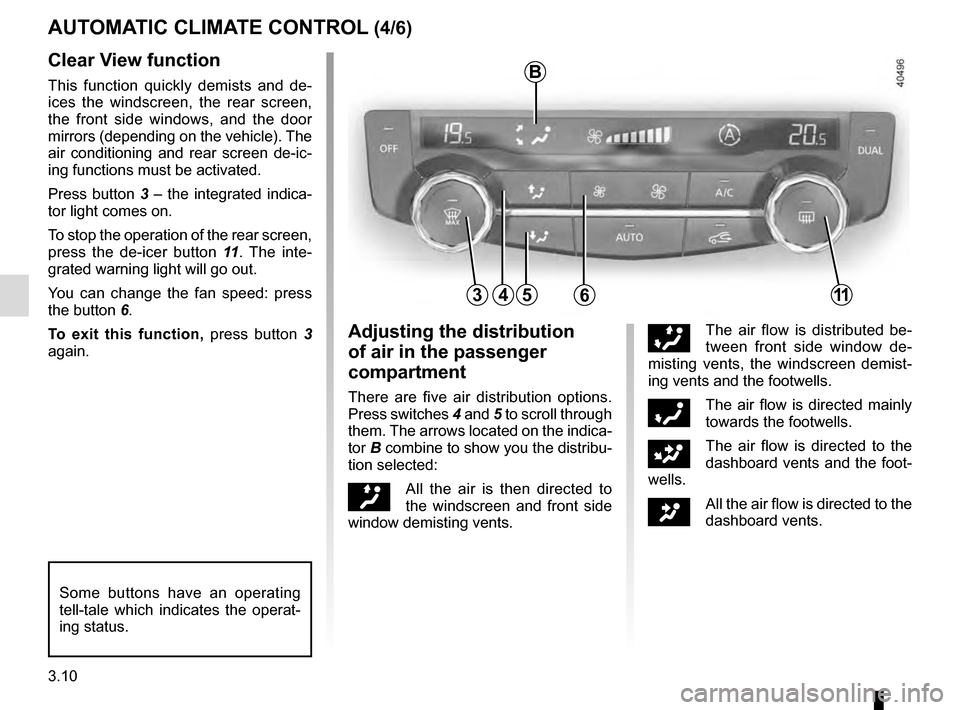
Clear View function
This function quickly demists and de-
ices the windscreen, the rear screen,
the front side windows, and the door
mirrors (depending on the vehicle). The
air conditioning and rear screen de-ic-
ing functions must be activated.
Press button 3 – the integrated indica-
tor light comes on.
To stop the operation of the rear screen,
press the de-icer button 11. The inte-
grated warning light will go out.
You can change the fan speed: press
the button 6.
To exit this function, press button 3
again.
Some buttons have an operating
tell-tale which indicates the operat-
ing status.
Adjusting the distribution
of air in the passenger
compartment
There are five air distribution options.
Press switches 4 and 5 to scroll through
them. The arrows located on the indica-
tor B combine to show you the distribu-
tion selected:
õAll the air is then directed to
the windscreen and front side
window demisting vents.
÷The air flow is distributed be-
tween front side window de-
misting vents, the windscreen demist-
ing vents and the footwells.
óThe air flow is directed mainly
towards the footwells.
GThe air flow is directed to the
dashboard vents and the foot-
wells.
JAll the air flow is directed to the
dashboard vents.
Page 189 of 300
3.11
AUTOMATIC CLIMATE CONTROL (5/6)
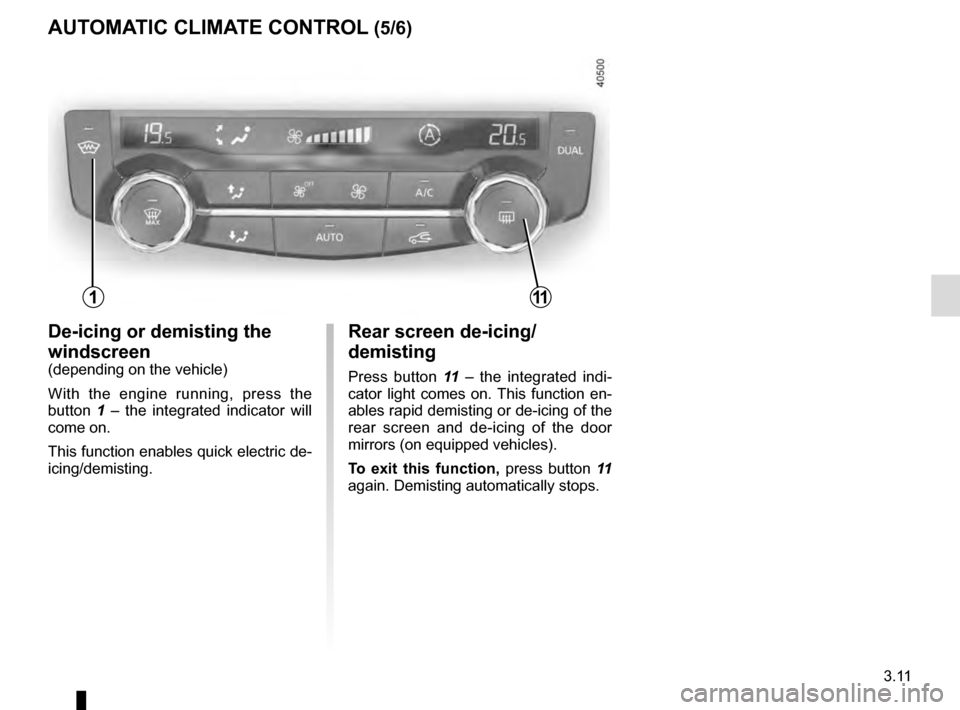
Rear screen de-icing/
demisting
Press button 11 – the integrated indi-
cator light comes on. This function en-
ables rapid demisting or de-icing of the
rear screen and de-icing of the door
mirrors (on equipped vehicles).
To exit this function, press button 11
again. Demisting automatically stops.
De-icing or demisting the
windscreen
(depending on the vehicle)
With the engine running, press the
button 1 – the integrated indicator will
come on.
This function enables quick electric de-
icing/demisting.
111
Page 190 of 300
3.12
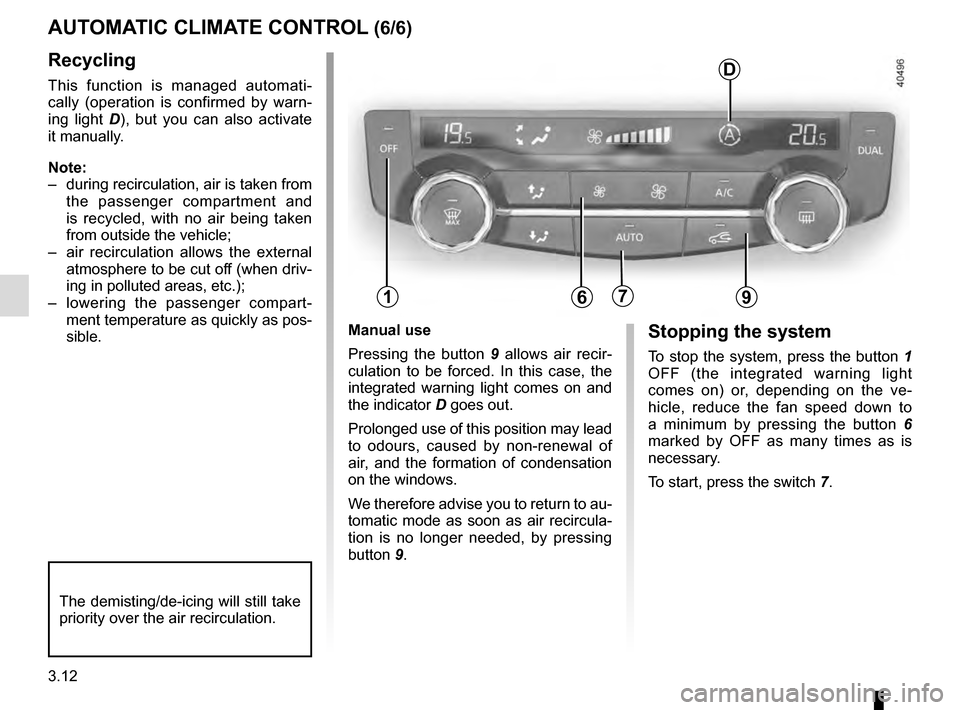
Manual use
Pressing the button 9 allows air recir-
culation to be forced. In this case, the
integrated warning light comes on and
the indicator D goes out.
Prolonged use of this position may lead
to odours, caused by non-renewal of
air, and the formation of condensation
on the windows.
We therefore advise you to return to au-
tomatic mode as soon as air recircula-
tion is no longer needed, by pressing
button 9.Stopping the system
To stop the system, press the button 1
OFF (the integrated warning light
comes on) or, depending on the ve-
hicle, reduce the fan speed down to
a minimum by pressing the button 6
marked by OFF as many times as is
necessary.
To start, press the switch 7.
Recycling
This function is managed automati-
cally (operation is confirmed by warn-
ing light D), but you can also activate
it manually.
Note:
– during recirculation, air is taken from the passenger compartment and
is recycled, with no air being taken
from outside the vehicle;
– air recirculation allows the external atmosphere to be cut off (when driv-
ing in polluted areas, etc.);
– lowering the passenger compart- ment temperature as quickly as pos-
sible.
AUTOMATIC CLIMATE CONTROL (6/6)
The demisting/de-icing will still take
priority over the air recirculation.
179
D
6
Page 191 of 300
3.13
Operating faults
As a general rule, contact your ap-
proved dealer in the event of an oper-
ating fault.
– Reduction in de-icing, demisting or air conditioning performance.
This may be caused by the passen-
ger compartment filter cartridge be-
coming clogged.
– No cold air is being produced .
Check that the controls are set cor-
rectly and that the fuses are sound.
Otherwise, switch off the system.
Presence of water under the
vehicle
After prolonged use of the air condi-
tioning system, it is normal for water
to be present under the vehicle. This is
caused by condensation.
AIR CONDITIONING: information and advice on use
Do not open the refriger-
ant fluid circuit. The fluid
may damage eyes or skin.
Fuel consumption
You will normally notice an increase in
fuel consumption (especially in town)
when the air conditioning is operating.
For vehicles fitted with air conditioning
with no automatic mode, switch off the
system when it is not required.
Advice for reducing consumption
and helping to preserve the environ-
ment
Drive with the air vents open and the
windows closed.
If the vehicle has been parked in the
sun, open the doors for a few moments
to let the hot air escape before starting
the engine.
Advice on use
In some situations, (air conditioning
off, air recirculation activated, ventila-
tion speed at zero or low, etc.) you may
notice that condensation starts to form
on the windows and windscreen.
If there is condensation, use the “Clear
View” function to remove it, then use
the air conditioning in automatic mode
to stop it forming again.
Maintenance
Refer to the Maintenance Document
for your vehicle for the inspection fre-
quency.
Do not add anything to the
vehicle’s ventilation circuit
(for example, to remove
bad odours).
There is a risk of damage or of
fire.
Page 194 of 300
3.16
One-touch mode
Depending on the vehicle, this mode
works in addition to the operation of the
electric windows described previously.
It is only fitted to the driver’s window.
Briefly press or pull switch 1 fully: the
window is fully lowered or raised.
Pressing the switch again stops the
window moving.
Note: if the window detects resistance
when closing (e.g.: branch of a tree,
etc.) it stops and then lowers again by a
few centimetres.
ELECTRIC WINDOWS (2/2)/FIXED SUNROOF
Operating faults
In case of a fault when closing a window,
the system reverts to normal mode:
pull the switch concerned up as often
as necessary to fully close the window
(the window will close gradually), hold
the switch (still on the closure side) for
one second then lower and raise the
window fully to reinitialise the system.
If necessary, contact your authorised
dealer.
Fixed glass roof
Opening the blind
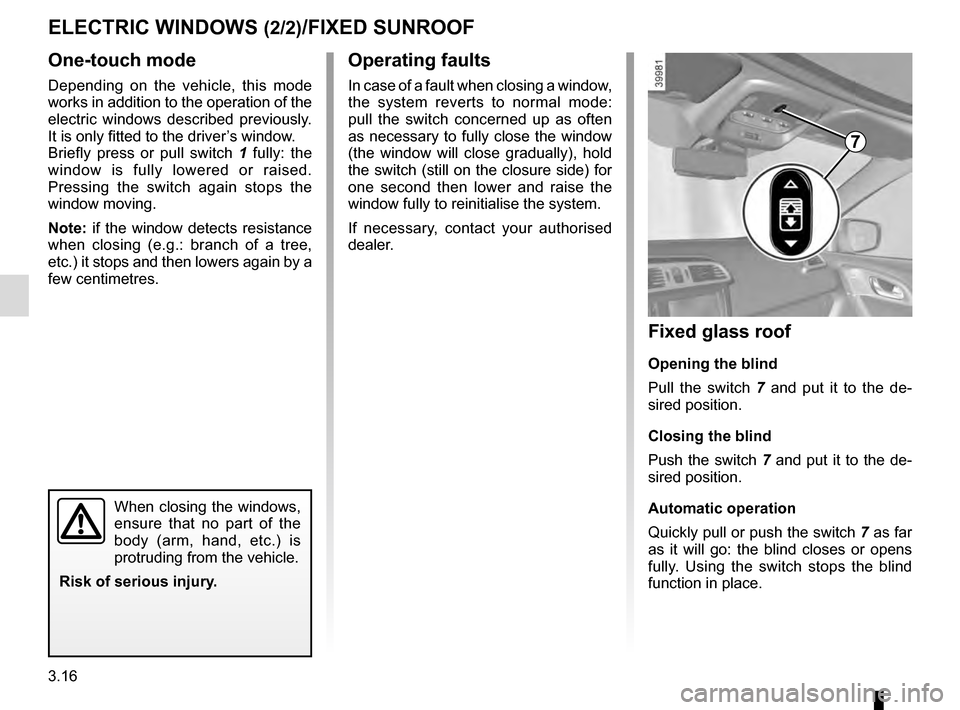
Pull the switch 7 and put it to the de-
sired position.
Closing the blind
Push the switch 7 and put it to the de-
sired position.
Automatic operation
Quickly pull or push the switch 7 as far
as it will go: the blind closes or opens
fully. Using the switch stops the blind
function in place.
7
When closing the windows,
ensure that no part of the
body (arm, hand, etc.) is
protruding from the vehicle.
Risk of serious injury.
Page 204 of 300
3.26
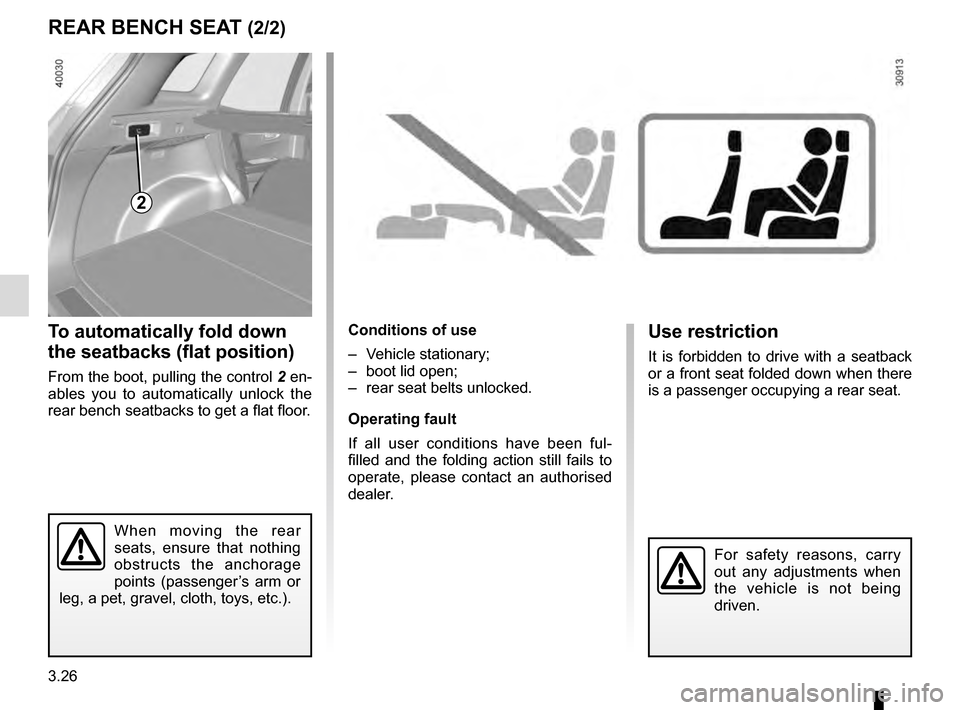
To automatically fold down
the seatbacks (flat position)
From the boot, pulling the control 2 en-
ables you to automatically unlock the
rear bench seatbacks to get a flat floor.
Conditions of use
– Vehicle stationary;
– boot lid open;
– rear seat belts unlocked.
Operating fault
If all user conditions have been ful-
filled and the folding action still fails to
operate, please contact an authorised
dealer.
REAR BENCH SEAT (2/2)
2
When moving the rear
seats, ensure that nothing
obstructs the anchorage
points (passenger’s arm or
leg, a pet, gravel, cloth, toys, etc.).
Use restriction
It is forbidden to drive with a seatback
or a front seat folded down when there
is a passenger occupying a rear seat.
For safety reasons, carry
out any adjustments when
the vehicle is not being
driven.
Page 219 of 300
4.3
BONNET (2/2)
Closing the bonnet
Before closing the bonnet, make sure
that nothing has been left in the engine
compartment.
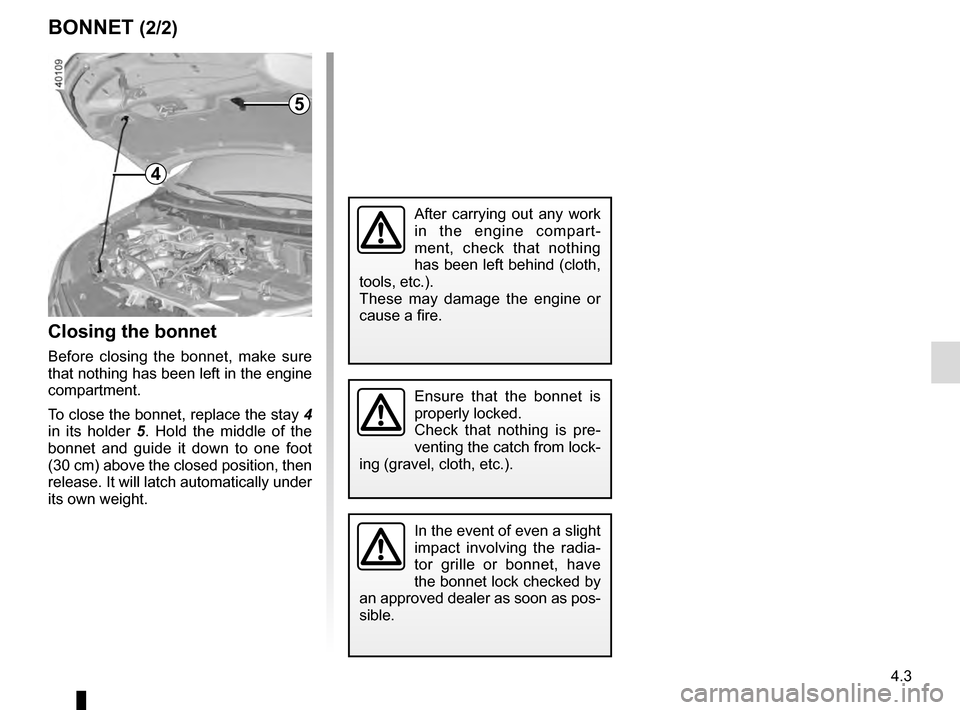
To close the bonnet, replace the stay 4
in its holder 5 . Hold the middle of the
bonnet and guide it down to one foot
(30 cm) above the closed position, then
release. It will latch automatically under
its own weight.
After carrying out any work
in the engine compart-
ment, check that nothing
has been left behind (cloth,
tools, etc.).
These may damage the engine or
cause a fire.
Ensure that the bonnet is
properly locked.
Check that nothing is pre-
venting the catch from lock-
ing (gravel, cloth, etc.).
In the event of even a slight
impact involving the radia-
tor grille or bonnet, have
the bonnet lock checked by
an approved dealer as soon as pos-
sible.
4
5
Page 265 of 300
5.31
TOWING: breakdown recovery (1/2)
Before towing, put the gearbox in neu-
tral, unlock the steering column and re-
lease the parking brake.
For vehicles fitted with an automa-
tic gearbox, if it is not possible to put
the gear lever into position N, please
consult an authorised dealer.
Steering column unlocking
Insert the key into the ignition or, de-
pending on the vehicle, having the
RENAULT card on you, press the
engine start button for approximately
2 seconds.
Reposition the lever to neutral (posi-
tion N for vehicles fitted with an auto-
matic gearbox).
The steering column unlocks, the ac-
cessory functions are powered: you
can use the vehicle’s lights (direction
indicators, brake lights, etc.). At night
the vehicle must have its lights on.
Depending on the vehicle, once you
have finished towing, press the engine
start button twice (risk of running down
the battery). The speed specified by current legisla-
tion for towing must always be obser-
ved. If your vehicle is the towing vehi-
cle, do not exceed the maximum towing
weight for your vehicle (refer to the in-
formation on “Weights” in Section 6).
Towing a vehicle with an
automatic gearbox
Transport the vehicle on a trailer or tow
it with the front wheels off the ground.
In exceptional circumstances
, you
may tow it with all four wheels on the
ground, only in a forward gear, with the
gear in neutral position N over a maxi-
mum distance of 50 miles and not ex-
ceeding a speed of 15 mph (25 km/h).
1
2
Do not remove the key from
the ignition when the vehi-
cle is being towed.
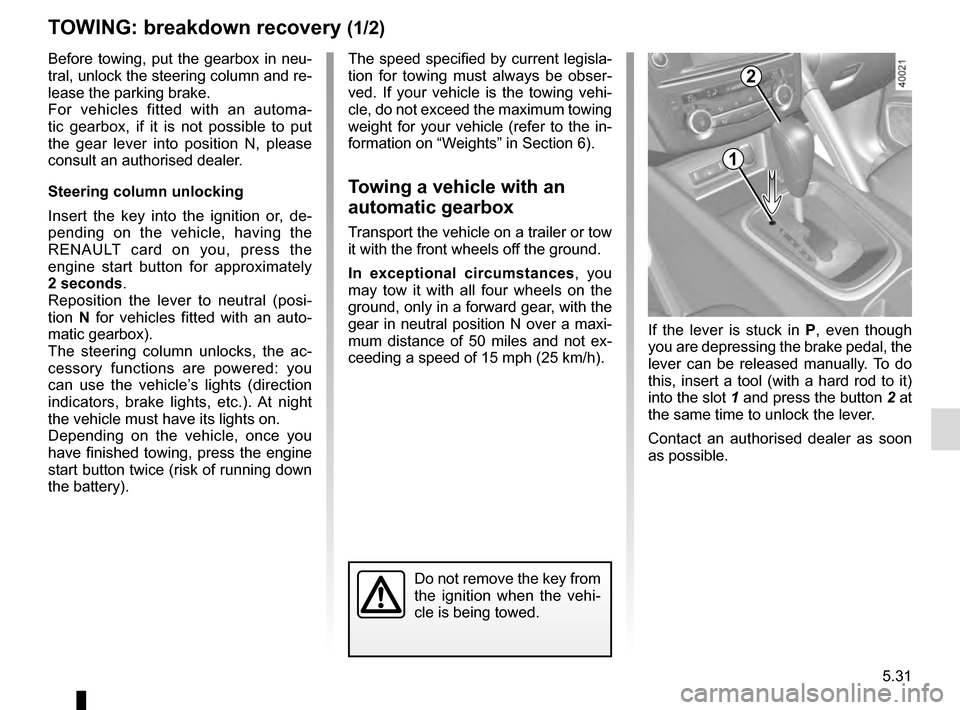
If the lever is stuck in P , even though
you are depressing the brake pedal, the
lever can be released manually. To do
this, insert a tool (with a hard rod to it)
into the slot 1 and press the button 2 at
the same time to unlock the lever.
Contact an authorised dealer as soon
as possible.
Page 293 of 300

A
ABS ..............................................................1.56, \
2.29 → 2.38
accessories.............................................................\
......")
7.1
ALPHABETICAL INDEX (1/5)
A
ABS ..............................................................1.56, \
2.29 → 2.38
accessories.............................................................\
........... 5.28
accessories socket ............................................................ 3.23
additional methods of restraint .......................................... 1.33 side protection ............................................................. 1.32
to the front seat belts .......................................1.27 → 1.30
to the rear seat belts .................................................... 1.31
adjusting your driving position ..1.19 – 1.21, 1.23 → 1.26, 3.24
advice on antipollution ....................................................... 2.24
air bag...........................................................1.27 → 1.33, 1.54
activating the front passenger air bags ........................ 1.49
deactivating the front passenger air bags .................... 1.47
air conditioning ........................................................3.4 → 3.13
air vents ...................................................................... 3.2 – 3.3
anti-corrosion check ..............................................6.14 → 6.18
anti-corrosion protection .................................................... 4.14
anti-lock braking system: ABS ...............................2.29 → 2.38
antipollution advice .................................................................\
......... 2.24
armrest: front ..................................................................\
............ 3.19
ashtray ................................................................\
............... 3.23
ASR (traction control) ............................................2.29 → 2.38
assisted parking.....................................................2.6\
7 → 2.70
audible and visual signals.................................................. 1.84
automatic gearbox (use) ........................................2.71 → 2.73
automatic gearbox selector lever...........................2.71 → 2.73
B
battery................................................. 4.12 – 4.13, 5.26 – 5.27 troubleshooting ................................................. 5.26 – 5.27
battery (remote control) ..................................................... 5.22
blind spot warning signal .......................................2.46 → 2.49
blind spot: warning signal ......................................2.46 → 2.49
bonnet..................................................................\
....... 4.2 – 4.3 brake fluid ........................................................................\
.... 4.8
bulbs changing ..........................................................5.14 \
→ 5.20
C
catalytic converter................................................... 2.12 – 2.13
central door locking .................1.2 – 1.3, 1.5, 1.8 → 1.15, 1.18
changing a bulb .....................................................5.14 → 5.20
changing a wheel...................................................... 5.9 – 5.10
changing gear ...............................................2.14, 2.71 → 2.73
child restraint/seat ....................1.34 – 1.35, 1.37 → 1.43, 1.47
child safety...............1.30, 1.34 – 1.35, 1.37 → 1.43, 1.47, 2.5,
3.15 – 3.16
child seats..........................................1.34 – 1.35, 1.3\
7 → 1.43
children ........................................ 1.6, 1.34 – 1.35, 3.15 – 3.16
children (safety) ................................................................... 1.6
cigar lighter ........................................................................\
3.23
cleaning: inside the vehicle .............................................. 4.16 – 4.17
clock ..................................................................\
................ 1.75
closing the doors ...................................................1.13 → 1.18
control instruments .......................................1.54 → 1.63, 1.75
controls ...............................................................\
...1.50 → 1.53
courtesy light ............................................................ 3.17, 5.20
courtesy mirrors ................................................................. 3.18
cruise control ................................................1.57, 2.56 → 2.59
cruise control-speed limiter.............. 2.50 → 2.52, 2.56 → 2.59
customised vehicle settings ................................... 1.72 – 1.73
customising the vehicle settings ............................ 1.72 – 1.73
D
dashboard..............................................................1\
.50 → 1.53
deadlocking the doors ................................................ 1.5, 1.12
demisting rear screen .........................................................3.4 → 3.12
windscreen .........................................................3.4 → 3.12