ECU RENAULT KANGOO 2012 X61 / 2.G User Guide
[x] Cancel search | Manufacturer: RENAULT, Model Year: 2012, Model line: KANGOO, Model: RENAULT KANGOO 2012 X61 / 2.GPages: 237, PDF Size: 8.62 MB
Page 46 of 237
1.40
ENG_UD22997_5
Sécurité enfants : installation du siège enfant (X61 - F61 - K61 - Renault)
ENG_NU_813-11_FK61_Renault_1
Jaune NoirNoir texte
CHILD SAFeTy: Fitting a child seat (2/5)
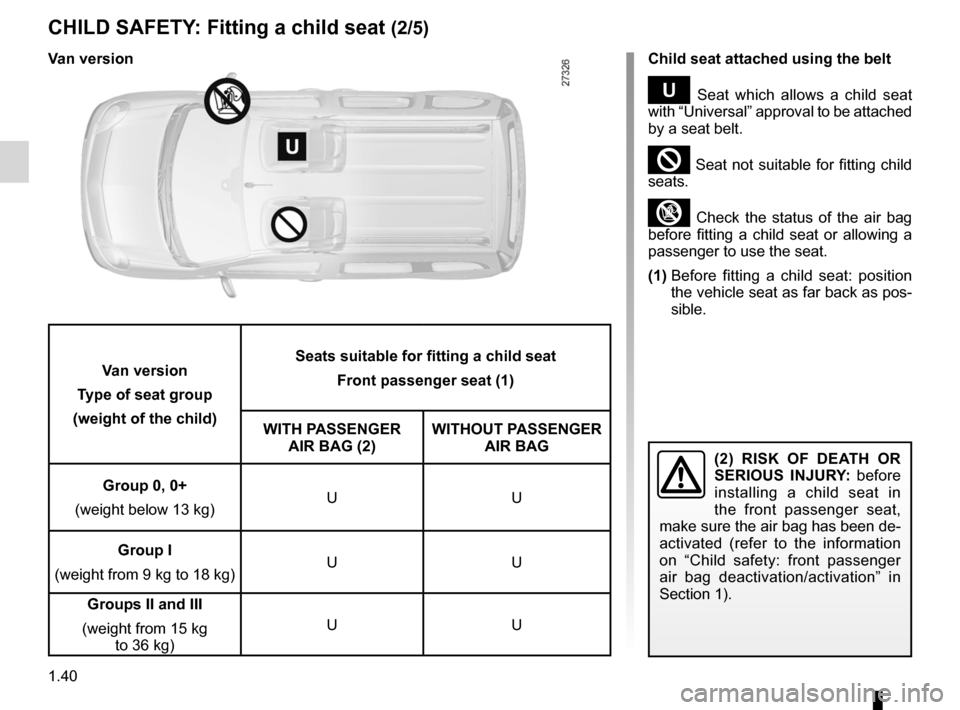
Child seat attached using the belt
¬ Seat which allows a child seat
with “Universal” approval to be attached
by a seat belt.
² Seat not suitable for fitting child
seats.
³ Check the status of the air bag
before fitting a child seat or allowing a
passenger to use the seat.
(1) Before fitting a child seat: position
the vehicle seat as far back as pos-
sible.
van version
Type of seat group
(weight of the child) Seats suitable for fitting a child seat
Front passenger seat (1)
WITH p ASSeNGeR
AIR BAG (2) WITHOUT p
ASSeNGeR
AIR BAG
Group 0, 0+
(weight below 13 kg) U
U
Group I
(weight from 9 kg to 18 kg) U
U
Groups II and III
(weight from 15 kg to 36 kg) U
U
(2) RISK OF DeATH OR
S eRIOUS INJUR y: before
installing a child seat in
the front passenger seat,
make sure the air bag has been de-
activated (refer to the information
on “Child safety: front passenger
air bag deactivation/activation” in
Section 1).
v an version
Page 47 of 237
JauneNoirNoir texte
1.41
ENG_UD22997_5
Sécurité enfants : installation du siège enfant (X61 - F61 - K61 - Renault)
ENG_NU_813-11_FK61_Renault_1
CHILD SAFeTy: Fitting a child seat (3/5)
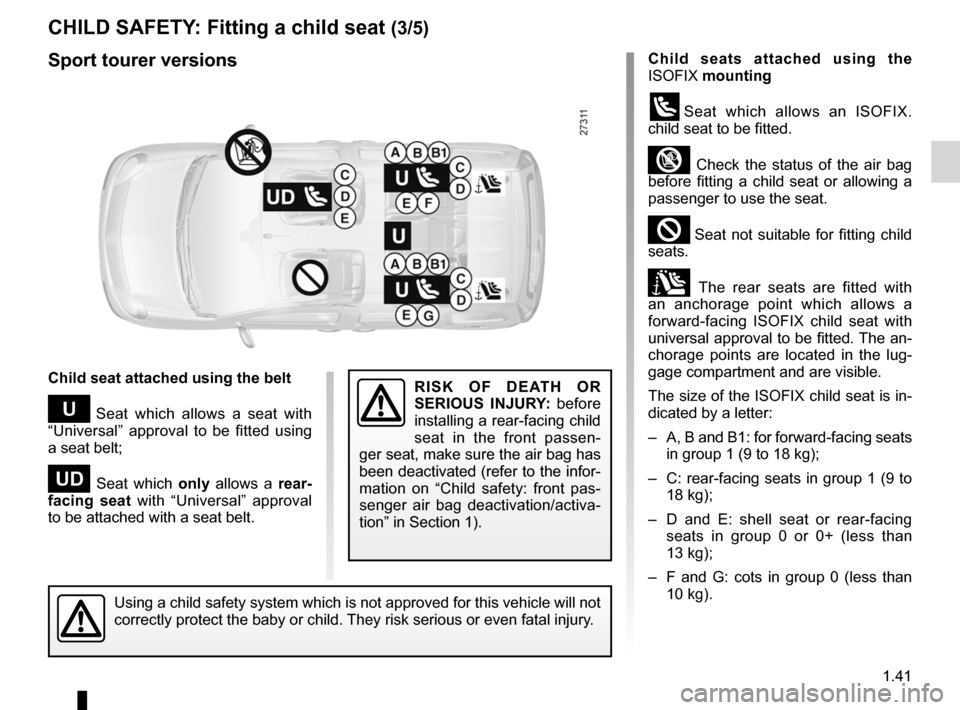
Child seats attached using the
ISOFIX mounting
üSeat which allows an ISOFIX.
child seat to be fitted.
³ Check the status of the air bag
before fitting a child seat or allowing a
passenger to use the seat.
² Seat not suitable for fitting child
seats.
± The rear seats are fitted with
an anchorage point which allows a
forward-facing ISOFIX child seat with
universal approval to be fitted. The an-
chorage points are located in the lug -
gage compartment and are visible.
The size of the ISOFIX child seat is in-
dicated by a letter:
– A, B and B1: for forward-facing seats
in group 1 (9 to 18 kg);
– C: rear-facing seats in group 1 (9 to
18 kg);
– D and E: shell seat or rear-facing
seats in group 0 or 0+ (less than
13 kg);
– F and G: cots in group 0 (less than
10 kg).
Child seat attached using the belt
¬
Seat which allows a seat with
“Universal” approval to be fitted using
a seat belt;
− Seat which only allows a rear-
facing seat with “Universal” approval
to be attached with a seat belt.
Using a child safety system which is not approved for this vehicle will not
correctly protect the baby or child. They risk serious or even fatal injury.
R I S K O F D eAT H O R
S eRIOUS INJUR y: before
installing a rear-facing child
seat in the front passen -
ger seat, make sure the air bag has
been deactivated (refer to the infor-
mation on “Child safety: front pas -
senger air bag deactivation/activa -
tion” in Section 1).
Sport tourer versions
Page 48 of 237
1.42
ENG_UD22997_5
Sécurité enfants : installation du siège enfant (X61 - F61 - K61 - Renault)
ENG_NU_813-11_FK61_Renault_1
Jaune NoirNoir texte
CHILD SAFeTy: Fitting a child seat (4/5)
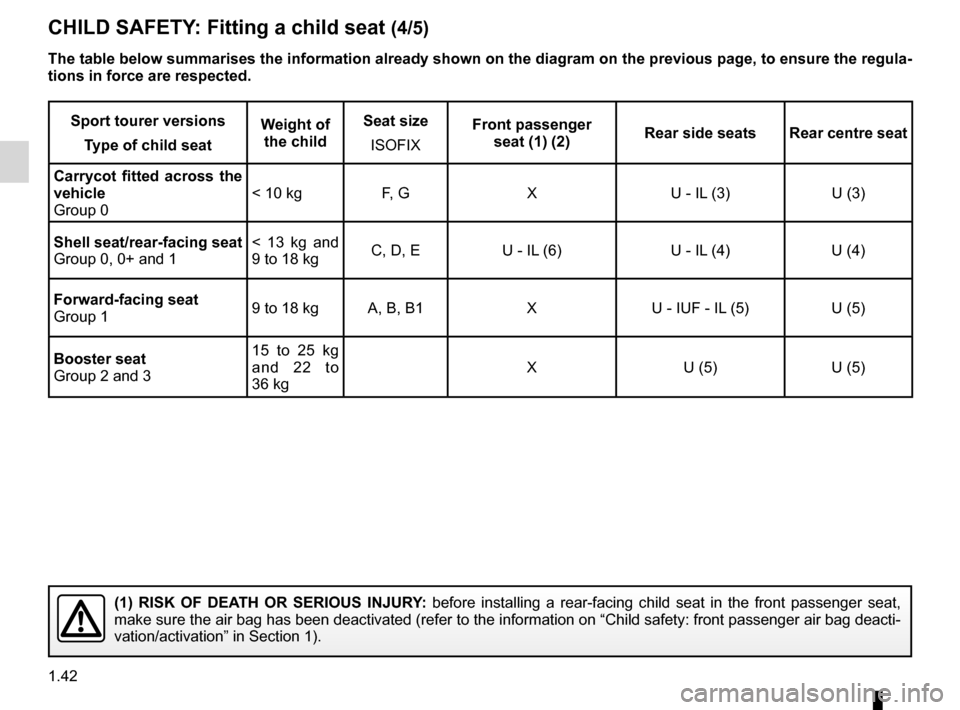
Sport tourer versions
Type of child seat Weight of
the child Seat size
ISOFIX Front passenger
seat (1) (2) Rear side seats
Rear centre seat
Carrycot fitted across the
vehicle
Group 0 < 10 kg
F, G XU - IL (3) U (3)
Shell seat/rear-facing seat
Group 0, 0+ and 1 < 13 kg and
9 to 18 kg
C, D, E
U - IL (6) U - IL (4)U (4)
Forward-facing seat
Group 1 9 to 18 kg
A, B, B1 XU - IUF - IL (5) U (5)
Booster seat
Group 2 and 3 15 to 25 kg
a n d 2 2 t o
36 kg
X
U (5)U (5)
(1) RISK OF DeATH OR SeRIOUS INJUR y: before installing a rear-facing child seat in the front passenger seat,
make sure the air bag has been deactivated (refer to the information on “Child safety: front passenger air bag deacti-
vation/activation” in Section 1).
The table below summarises the information already shown on the diagram on the previous page, to ensure the regula-
tions in force are respected.
Page 49 of 237
JauneNoirNoir texte
1.43
ENG_UD22997_5
Sécurité enfants : installation du siège enfant (X61 - F61 - K61 - Renault)
ENG_NU_813-11_FK61_Renault_1
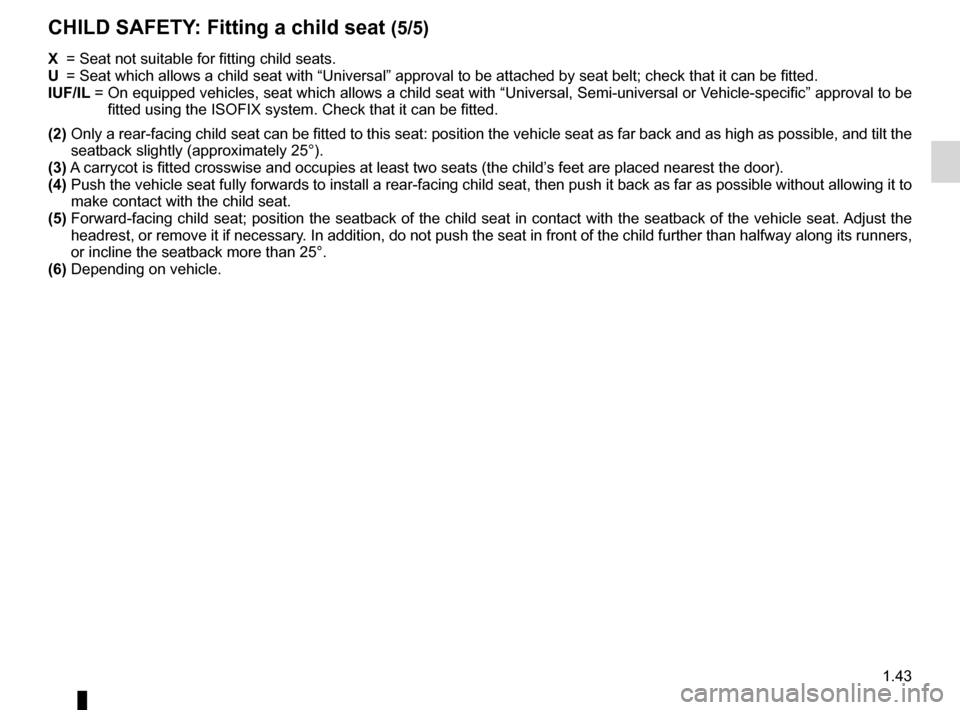
X = Seat not suitable for fitting child seats.
U = Seat which allows a child seat with “Universal” approval to be attached by seat belt; check that it can be fitted.
IUF/IL = On equipped vehicles, seat which allows a child seat with “Universal, Semi-universal or Vehicle-specific” approval to be
fitted using the ISOFIX system. Check that it can be fitted.
(2) Only a rear-facing child seat can be fitted to this seat: position the vehicle seat as far back and as high as possible, and tilt the
seatback slightly (approximately 25°).
(3) A carrycot is fitted crosswise and occupies at least two seats (the child’s feet are placed nearest the door).
(4) Push the vehicle seat fully forwards to install a rear-facing child seat, then push it back as far as possible without allowing it to
make contact with the child seat.
(5) Forward-facing child seat; position the seatback of the child seat in contact with the seatback of the vehicle seat. Adjust the
headrest, or remove it if necessary. In addition, do not push the seat in front of the child further than halfway along its runners,
or incline the seatback more than 25°.
(6) Depending on vehicle.
CHILD SAFeTy: Fitting a child seat (5/5)
Page 50 of 237
air bagdeactivating the front passenger air bags
(up to the end of the DU)
air bag activating the front passenger air bags
(up to the end of the DU)
child safety ............................................ (up to the end of the DU)
child restraint/seat ................................ (up to the end of the DU)
transporting children ............................. (up to the end of the DU)
front passenger air bag deactivation .... (up to the end of the DU)
child restraint/seat ................................ (up to the end of the DU)
1.44
ENG_UD29619_5
Sécurité enfants : désactivation/activation airbag passager avant (X61 - F61 - K61 - Renault)
ENG_NU_813-11_FK61_Renault_1
Jaune NoirNoir texte
Deactivating/activating the front passenger airbag
Deactivating the front
passenger air bags
(on equipped vehicles)
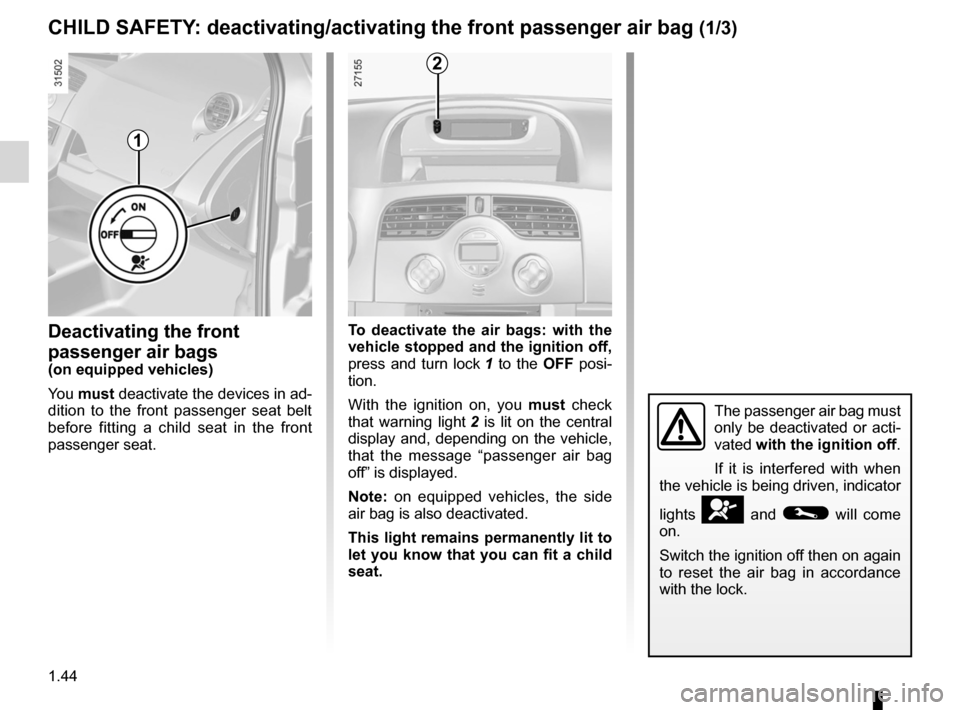
You must deactivate the devices in ad-
dition to the front passenger seat belt
before fitting a child seat in the front
passenger seat. To deactivate the air bags: with the
vehicle stopped and the ignition off,
press and turn lock 1 to the
OFF posi-
tion.
With the ignition on, you must check
that warning light 2 is lit on the central
display and, depending on the vehicle,
that the message “passenger air bag
off” is displayed.
Note: on equipped vehicles, the side
air bag is also deactivated.
This light remains permanently lit to
let you know that you can fit a child
seat.
CHILD SAFeTy: deactivating/activating the front passenger air bag (1/3)
The passenger air bag must
only be deactivated or acti-
vated with the ignition off.
If it is interfered with when
the vehicle is being driven, indicator
lights
å and © will come
on.
Switch the ignition off then on again
to reset the air bag in accordance
with the lock.
1
2
Page 51 of 237
JauneNoirNoir texte
1.45
ENG_UD29619_5
Sécurité enfants : désactivation/activation airbag passager avant (X61 - F61 - K61 - Renault)
ENG_NU_813-11_FK61_Renault_1
CHILD SAFeTy: deactivating/activating the front passenger air bag (2/3)
3
A
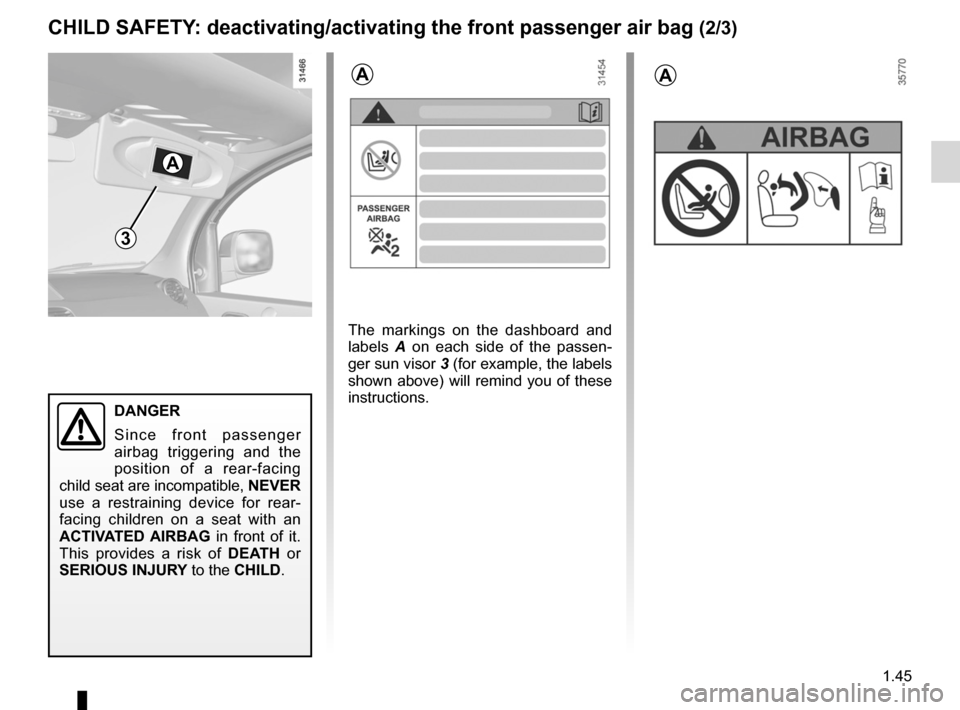
The markings on the dashboard and
labels A on each side of the passen -
ger sun visor 3 (for example, the labels
shown above) will remind you of these
instructions.
AA
DANGeR
S i n c e f r o n t p a s s e n g e r
airbag triggering and the
position of a rear-facing
child seat are incompatible, NeveR
use a restraining device for rear -
facing children on a seat with an
ACTI vAT eD AIRBAG in front of it.
This provides a risk of DeATH or
SeRIOUS INJUR y to the CHILD.
Page 52 of 237
1.46
ENG_UD29619_5
Sécurité enfants : désactivation/activation airbag passager avant (X61 - F61 - K61 - Renault)
ENG_NU_813-11_FK61_Renault_1
The passenger air bag must
only be deactivated or acti-
vated with the ignition off.
If it is interfered with when
the vehicle is being driven, indicator
lights
å and © will come
on.
Switch the ignition off then on again
to reset the air bag in accordance
with the lock.
Operating faults
In the event that the front passenger air
bag activation/deactivation system is
faulty, child seats must not be fitted to
the front seat.
Allowing any other passenger to sit in
that seat is not recommended.
Contact your approved Dealer as soon
as possible.
Activation of the front
passenger air bag
You should reactivate the air bag as
soon as you remove the child seat from
the front passenger seat to ensure the
protection of the front passenger in the
event of an impact.
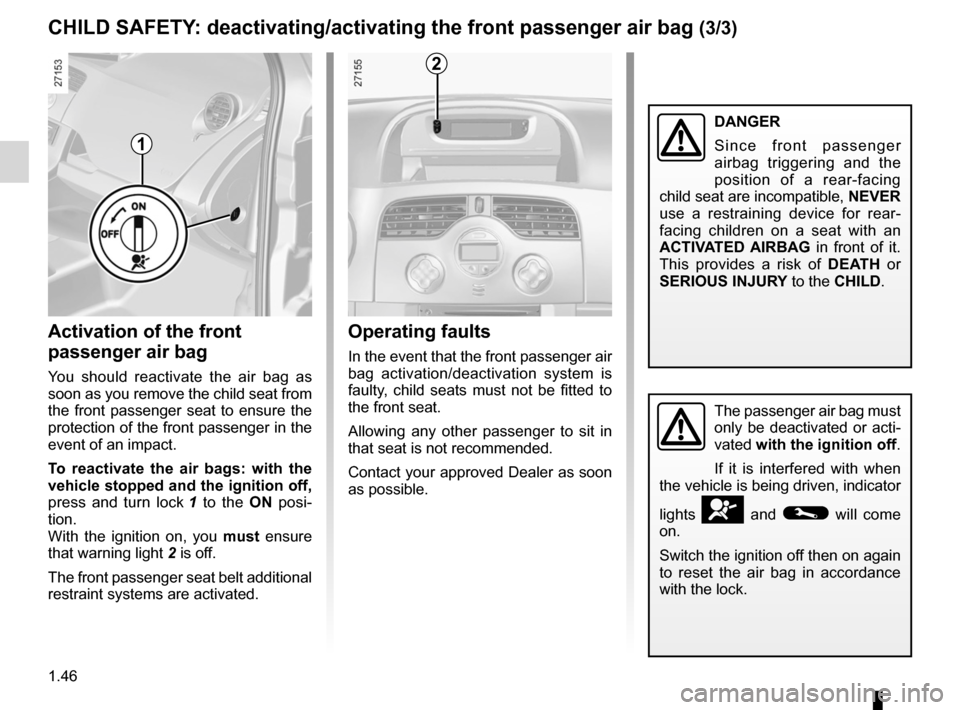
To reactivate the air bags: with the
vehicle stopped and the ignition off,
press and turn lock 1 to the ON posi -
tion.
With the ignition on, you must ensure
that warning light 2 is off.
The front passenger seat belt additional
restraint systems are activated.
CHILD SAFeTy: deactivating/activating the front passenger air bag (3/3)
1
2
DANGeR
S i n c e f r o n t p a s s e n g e r
airbag triggering and the
position of a rear-facing
child seat are incompatible, NeveR
use a restraining device for rear -
facing children on a seat with an
ACTI vAT eD AIRBAG in front of it.
This provides a risk of DeATH or
SeRIOUS INJUR y to the CHILD.
Page 137 of 237
sunroof.................................................. (up to the end of the DU)
3.21
ENG_UD9535_2
Toit ouvrant à commande manuelle (X61 - F61 - K61 - Renault)
ENG_NU_813-11_FK61_Renault_3
Manual sunroof
MAnUAL sUnrOOF
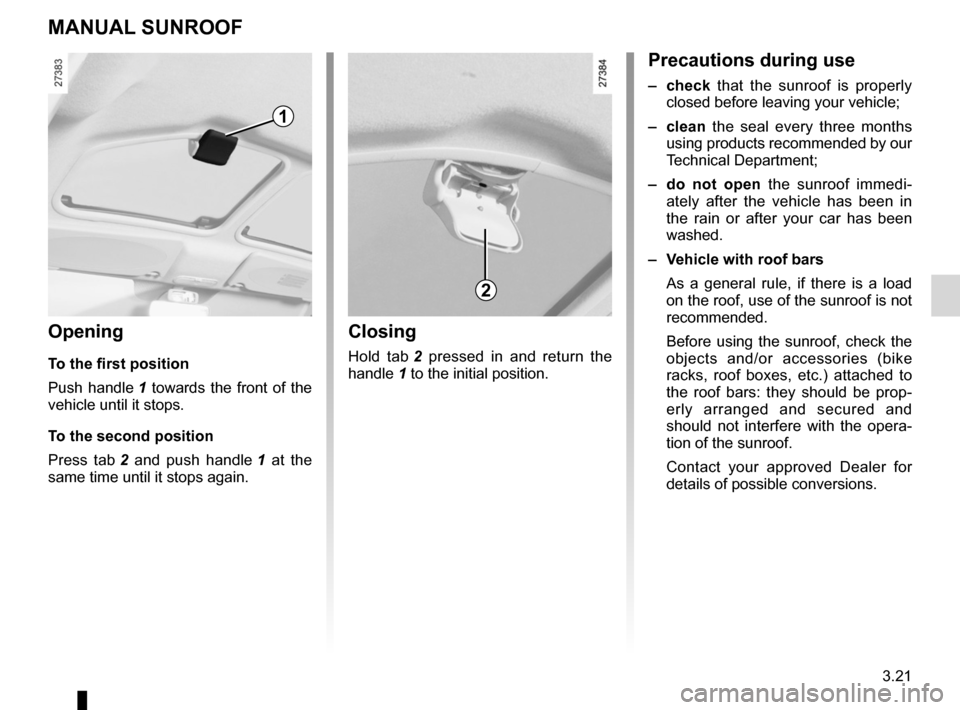
Opening
t o the first position
Push handle 1 towards the front of the
vehicle until it stops.
t o the second position
Press tab 2 and push handle 1 at the
same time until it stops again.
1
2
Precautions during use
– check that the sunroof is properly
closed before leaving your vehicle;
– clean the seal every three months
using products recommended by our
Technical Department;
– do not open the sunroof immedi -
ately after the vehicle has been in
the rain or after your car has been
washed.
– v ehicle with roof bars
As a general rule, if there is a load
on the roof, use of the sunroof is not
recommended.
Before using the sunroof, check the
objects and/or accessories (bike
racks, roof boxes, etc.) attached to
the roof bars: they should be prop -
erly arranged and secured and
should not interfere with the opera -
tion of the sunroof.
Contact your approved Dealer for
details of possible conversions.
Closing
Hold tab 2 pressed in and return the
handle 1 to the initial position.
Page 149 of 237
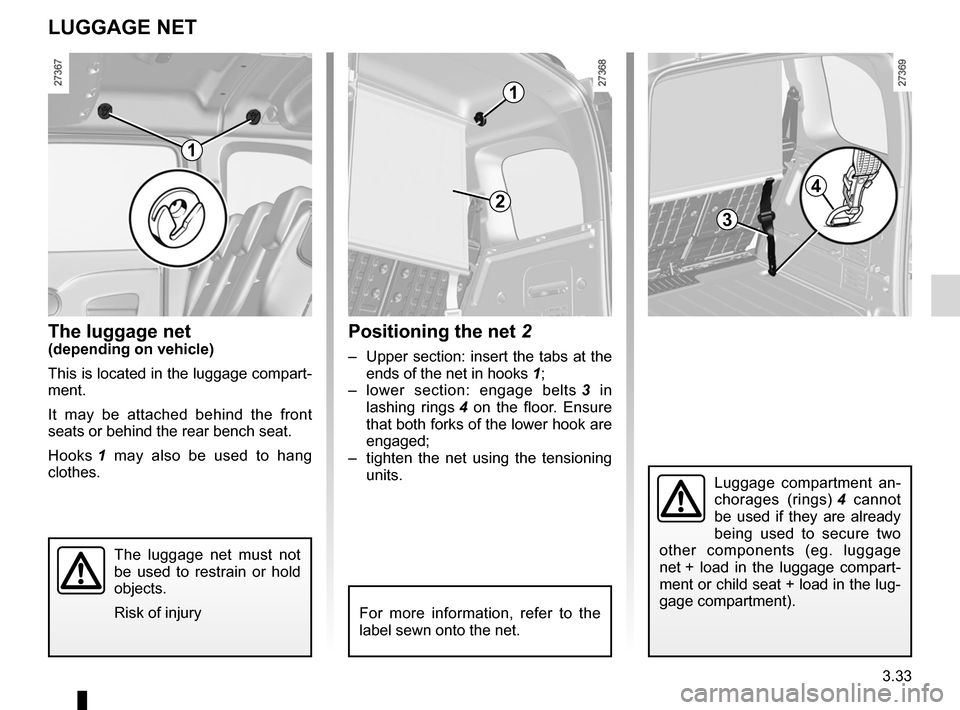
luggage retaining net ............................................. (current page)
3.33
ENG_UD12999_2
Filet de retenue de bagages (X61 - F61 - K61 - Renault)
ENG_NU_813-11_FK61_Renault_3
Luggage net
the luggage net(depending on vehicle)
This is located in the luggage compart-
ment.
It may be attached behind the front
seats or behind the rear bench seat.
Hooks 1 may also be used to hang
clothes.
LUGGAGe net
For more information, refer to the
label sewn onto the net.
1
1
3
4
Positioning the net 2
– Upper section: insert the tabs at the
ends of the net in hooks 1;
– lower section: engage belts 3 in
lashing rings 4 on the floor. Ensure
that both forks of the lower hook are
engaged;
– tighten the net using the tensioning
units.
Luggage compartment an -
chorages (rings) 4 cannot
be used if they are already
being used to secure two
other components (eg. luggage
net + load in the luggage compart -
ment or child seat + load in the lug-
gage compartment).
2
The luggage net must not
be used to restrain or hold
objects.
Risk of injury
Page 159 of 237
\
ENG_NU_813-11_FK61_Renault_4
e ngine oil change: if you
are changing the oil wh")
JauneNoirNoir texte
4.7
ENG_UD17476_1
Niveau huile moteur : appoint, remplissage (X61 - F61 - K61 - Renault)\
ENG_NU_813-11_FK61_Renault_4
e ngine oil change: if you
are changing the oil when
the engine is hot, be careful
not to scald yourself if the
oil overflows.
Consult your approved Dealer at
once if you notice an abnormal or
repeated drop in any of the fluid
levels.
Never run the engine in an
enclosed space as exhaust
gases are poisonous.
Filling: take care when
topping up the oil that
no oil drips onto engine
components - risk of fire.
Remember to refit the cap securely
as there is a risk of fire if oil splashes
onto hot engine components.
The engine may be hot
when carrying out opera -
tions in close proximity. In
addition, the engine cooling
fan can come on at any moment.
Risk of injury.
engIne oIl level: topping up/filling (2/2)engIne oIl CHAnge
oil change
S e r v i c e i n t e r v a l : r e f e r t o t h e
Maintenance Document for your vehi -
cle.
Average capacities for oil change
including oil filter
(for information)
1.6 16v engine : 4.8 litres
1.6 engine : 3.3 litres
1.5 dCi engine : 4.5 litres
engine oil grade
Refer to the Maintenance Document for
your vehicle.