ECU RENAULT KANGOO 2012 X61 / 2.G Owner's Manual
[x] Cancel search | Manufacturer: RENAULT, Model Year: 2012, Model line: KANGOO, Model: RENAULT KANGOO 2012 X61 / 2.GPages: 237, PDF Size: 8.62 MB
Page 167 of 237
 (X44 - X77 - J77 - X85 - \
B90 - X61 - TEST - X77 ph2 - X95 - B95 - D95 - K95 - J95 - R95 - L90 Ph2 - F90 Ph2 - R90\")
JauneNoirNoir texte
4.15
ENG_UD26811_2
Entretien de la carrosserie (peinture mate) (X44 - X77 - J77 - X85 - \
B90 - X61 - TEST - X77 ph2 - X95 - B95 - D95 - K95 - J95 - R95 - L90 Ph2 - F90 Ph2 - R90\
Ph2 - X62
ENG_NU_813-11_FK61_Renault_4
Respect local regulations about wash -
ing vehicles (e.g. do not wash your ve-
hicle on a public highway).
Observe the vehicle stopping distances
when driving on gravelled surfaces to
prevent paint damage.
Repair, or have repaired quickly, areas
where the paint has been damaged, to
prevent corrosion spreading.
Remember to visit the body shop pe -
riodically in order to maintain your
anti-corrosion warranty. Refer to the
Maintenance Document.
If it is necessary to clean mechani -
cal components, hinges, etc., spray
them with products approved by our
Technical Department to protect them
after they have been cleaned.
BoDyWoRk MAIntenAnCe (2/2)
We have selected special products
to care for your vehicle and you can
obtain these from the manufactur -
er’s accessory outlets.
Using a roller type car wash
Return the windscreen wiper stalk to
the Park position (refer to the informa-
tion on the “Windscreen washer, wiper”
in Section 1). Check the mounting of
external accessories, additional lights
and mirrors, and ensure that the wiper
blades are secured with adhesive tape.
Remove the radio aerial mast if your
vehicle is fitted with this equipment.
Remember to remove the tape and refit
the antenna after washing.
Cleaning the headlights
As the headlights are made of plastic
“glass”, use a soft cloth or cotton wool
to clean them. If this does not clean
them properly, moisten the cloth with
soapy water, then wipe clean with a soft
damp cloth or cotton wool.
Finally, carefully dry off with a soft dry
cloth.
Cleaning products containing alco -
hol must not be used.
vehicles with a matte paint
finish
This type of paint requires certain pre-
cautions.
Do not do the following
– use wax-based products (polishing);
– rub hard;
– wash the vehicle in a roller-type car
wash;
– wash the vehicle using a high-pres-
sure device;
– attach stickers to the paintwork (risk
of leaving marks).
y ou should do the following
Wash the vehicle by hand using plenty
of water, using a soft cloth or a gentle
sponge.
Page 175 of 237
 (X61 - F61 - K61 - Renault)\
ENG_NU_813-11_FK61_Renault_5
Once the tyre is inflated correctly:
– stop using the kit;")
JauneNoirNoir texte
5.5
ENG_UD29751_1
Kit de gonflage des pneumatiques (2 kits) (X61 - F61 - K61 - Renault)\
ENG_NU_813-11_FK61_Renault_5
Once the tyre is inflated correctly:
– stop using the kit;
– close the integrated cap on the bottle
again;
– disconnect adapter 8;
tyre InFlatIOn KIt (3/5)
– affix the driving recommendation
label 10 to the dashboard where it
can easily be seen by the driver;
– store the kit;
– at the end of this initial inflation op -
eration, air will still escape from the
tyre; you must drive a short distance
in order to seal the hole;
– start immediately and drive at be -
tween 12 and 40 mph (20 and
60 km/h) in order to distribute the
product evenly in the tyre and, after
driving for 2 miles, stop and check
the pressure;
– if the pressure is greater than 1.3 bar
but less than the recommended
pressure (refer to the label affixed to
the edge of the driver’s door), read-
just it; otherwise, please contact an
authorised dealer: the tyre cannot be
repaired.
n ote: after using the inflation kit, you
should visit an approved Dealer to re -
place the inflation hose and the bottle
of repair product.
Following repair with the kit,
do not travel further than
120 miles (200 km). In addi -
tion, reduce your speed and
under no circumstances exceed
48 mph (80 km/h). The label, which
you must affix in a prominent posi -
tion on the dashboard, reminds you
of this. Depending on the country or
local legislation, a tyre repaired with
the tyre pressure kit will need to be
replaced.
Nothing should be placed
around the driver ’s feet
as such objects may slide
under the pedals during
sudden braking manoeuvres and
obstruct their use.
10
8
Please be aware that a
poorly tightened or miss -
ing valve cap can make the
tyres less airtight and lead
to pressure loss.
Always use valve caps identical to
those fitted originally and tighten
them fully.
Precautions when using the
kit
The kit should not be operated for more
than 15 consecutive minutes.
e
Page 177 of 237
 (X61 - F61 - K61 - Renault)\
ENG_NU_813-11_FK61_Renault_5
tyre InFlatIOn KIt (5/5)
Precautions when using the kit
The k")
JauneNoirNoir texte
5.7
ENG_UD29751_1
Kit de gonflage des pneumatiques (2 kits) (X61 - F61 - K61 - Renault)\
ENG_NU_813-11_FK61_Renault_5
tyre InFlatIOn KIt (5/5)
Precautions when using the kit
The kit should not be operated for more
than 15 consecutive minutes.
Nothing should be placed
around the driver ’s feet
as such objects may slide
under the pedals during
sudden braking manoeuvres and
obstruct their use.
Please be aware that a
poorly tightened or miss -
ing valve cap can make the
tyres less airtight and lead
to pressure loss.
Always use valve caps identical to
those fitted originally and tighten
them fully.
Following repair with the kit,
do not travel further than
120 miles (200 km). In addi -
tion, reduce your speed and
under no circumstances exceed
48 mph (80 km/h). The sticker,
which you must affix in a prominent
position on the dashboard, reminds
you of this.
Depending on the country or local
legislation, a tyre repaired with the
inflation kit may need to be replaced.
11
If a minimum pressure of 1.8 bar is
not reached after 15 minutes, repair
is not possible; do not drive the ve-
hicle but contact an approved dealer. Once the tyre is correctly inflated,
remove the kit: slowly unscrew the in
-
flation adapter 11 to prevent any repair
product from escaping and store the
container in plastic packaging to pre -
vent the product from escaping.
– Affix the driving recommendation
label to the dashboard where it can
easily be seen by the driver;
– Put the kit away.
– At the end of this initial inflation op-
eration, air will still escape from the
tyre. You must drive a short distance
in order to seal the hole.
– Start immediately and drive at be -
tween 12 and 40 mph (20 and
60 km/h) in order to distribute the
product evenly in the tyre and, after
driving for 2 miles (3 km), stop and
check the pressure.
– If the pressure is greater than 1.3 bar
but less than the recommended
pressure (refer to the label affixed to
the edge of the driver’s door), read-
just it. Otherwise, please contact an
authorised dealer: the tyre cannot be
repaired.
F
Page 178 of 237
tool kit .................................................................... (current page)
hubcap tool ............................................................ (current page)
wheelbrace ............................................................ (current page)
puncture ................................................................. (current page)
jack ........................................................................\
(current page)
towing hitch ............................................................ (current page)
wheelbrace ............................................................ (current page)
5.8
ENG_UD21490_4
Bloc outils (X61 - F61 - K61 - Renault)
ENG_NU_813-11_FK61_Renault_5
Tool kit
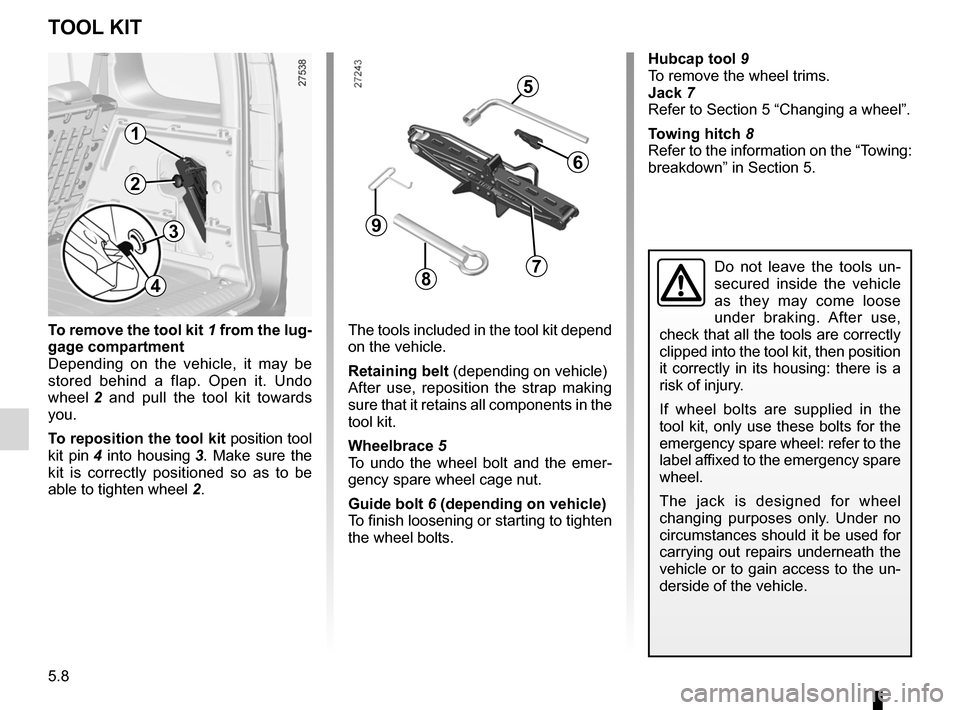
The tools included in the tool kit depend
on the vehicle.
retaining belt (depending on vehicle)
After use, reposition the strap making
sure that it retains all components in the
tool kit.
wheelbrace 5
To undo the wheel bolt and the emer -
gency spare wheel cage nut.
guide bolt 6 (depending on vehicle)
To finish loosening or starting to tighten
the wheel bolts.
t
o remove the tool kit 1 from the lug-
gage compartment
Depending on the vehicle, it may be
stored behind a flap. Open it. Undo
wheel 2 and pull the tool kit towards
you.
t o reposition the tool kit position tool
kit pin 4 into housing 3. Make sure the
kit is correctly positioned so as to be
able to tighten wheel 2.
tOOl KIt
5
6
9
1
3
2
87Do not leave the tools un -
secured inside the vehicle
as they may come loose
under braking. After use,
check that all the tools are correctly
clipped into the tool kit, then position
it correctly in its housing: there is a
risk of injury.
If wheel bolts are supplied in the
tool kit, only use these bolts for the
emergency spare wheel: refer to the
label affixed to the emergency spare
wheel.
The jack is designed for wheel
changing purposes only. Under no
circumstances should it be used for
carrying out repairs underneath the
vehicle or to gain access to the un-
derside of the vehicle.
4
hubcap tool 9
To remove the wheel trims.
Jack 7
Refer to Section 5 “Changing a wheel”.
t owing hitch 8
Refer to the information on the “Towing:
breakdown” in Section 5.
Page 206 of 237
operating faults ..................................... (up to the end of the DU)
faults operating faults ............................... (up to the end of the DU)
5.36
ENG_UD14563_2
Anomalies de fonctionnement (X61 - F61 - K61 - Renault)
ENG_NU_813-11_FK61_Renault_5
Jaune NoirNoir texte
Operating faults
the starter is activated POssIBle causeswhat tO DO
Warning lights dim or fail to come on;
the starter does not run. Battery terminals disconnected,
oxidised or incorrectly secured.Retighten, reconnect or clean them if they
are oxidised.
Battery discharged or worn. Connect another battery to the faulty bat -
tery. Refer to the paragraph “Battery: trou-
bleshooting” in Section 5 or replace the bat-
tery if necessary.
Do not push the vehicle if the steering
column is locked.
The engine will not start. Starting conditions are not fulfilled.Refer to the information on “Starting/stop -
ping the engine” in Section 2.
The steering column remains locked. Steering wheel locked.To unlock, move the key and the steer -
ing wheel (refer to the information on the
“Ignition switch” in Section 2).
OPeratIng F aults (1/4)
the following advice will enable you to carry out quick, temporary repairs. For safety reasons, you should always contact
an approved Dealer as soon as possible.