instrument panel RENAULT KANGOO 2012 X61 / 2.G User Guide
[x] Cancel search | Manufacturer: RENAULT, Model Year: 2012, Model line: KANGOO, Model: RENAULT KANGOO 2012 X61 / 2.GPages: 237, PDF Size: 8.62 MB
Page 68 of 237
1.62
ENG_UD26556_3
Ordinateur de bord : paramètres de voyage (X85 - X61 - F61 - K61 - Renault)
ENG_NU_813-11_FK61_Renault_1
Jaune NoirNoir texte
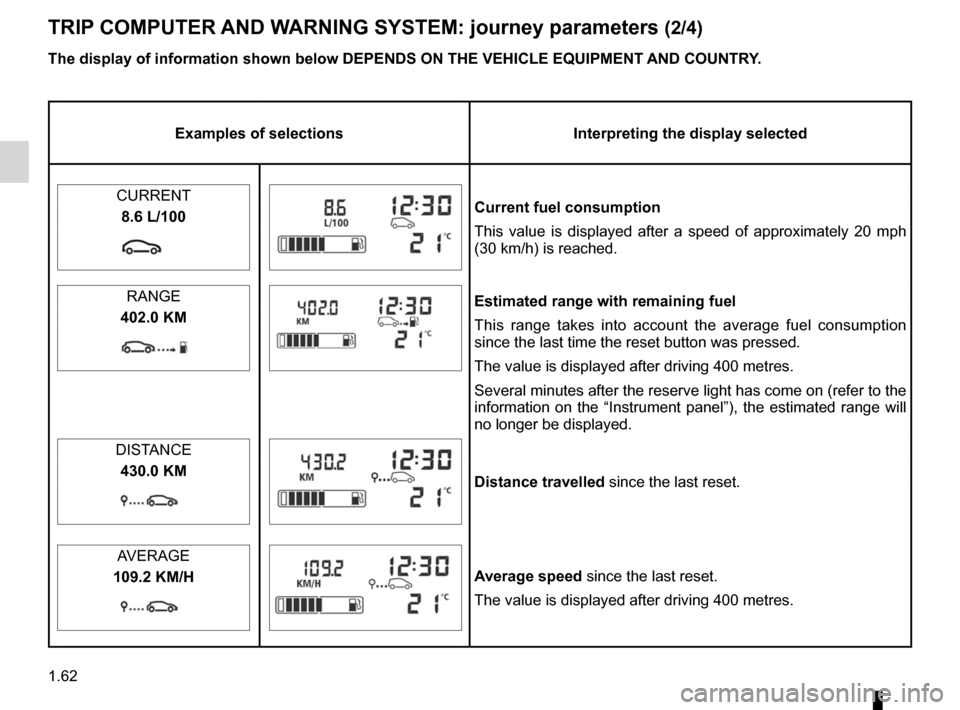
TRIp COMpUTeR AND WARNING SySTeM: journey parameters (2/4)
examples of selectionsInterpreting the display selected
CURRENT
Current fuel consumption
This value is displayed after a speed of approximately 20 mph
(30 km/h) is reached.
8.6 L/100
RANGEestimated range with remaining fuel
This range takes into account the average fuel consumption
since the last time the reset button was pressed.
The value is displayed after driving 400 metres.
Several minutes after the reserve light has come on (refer to the
information on the “Instrument panel”), the estimated range will
no longer be displayed.
402.0 KM
DISTANCE
Distance travelled since the last reset.
430.0 KM
AVERAGE
Average speed since the last reset.
The value is displayed after driving 400 metres.
109.2 KM/H
The display of information shown below DepeNDS ON THe veHICLe eQUIpMeNT AND COUNTR
y.
Page 71 of 237
trip computer and warning system........(up to the end of the DU)
warning lights ........................................ (up to the end of the DU)
instrument panel messages ..................(up to the end of the DU)
instrument panel ................................... (up to the end of the DU)
1.65
ENG_UD23313_2
Ordinateur de bord : messages d’information (X61 - F61 - K61 - Renault)
ENG_NU_813-11_FK61_Renault_1
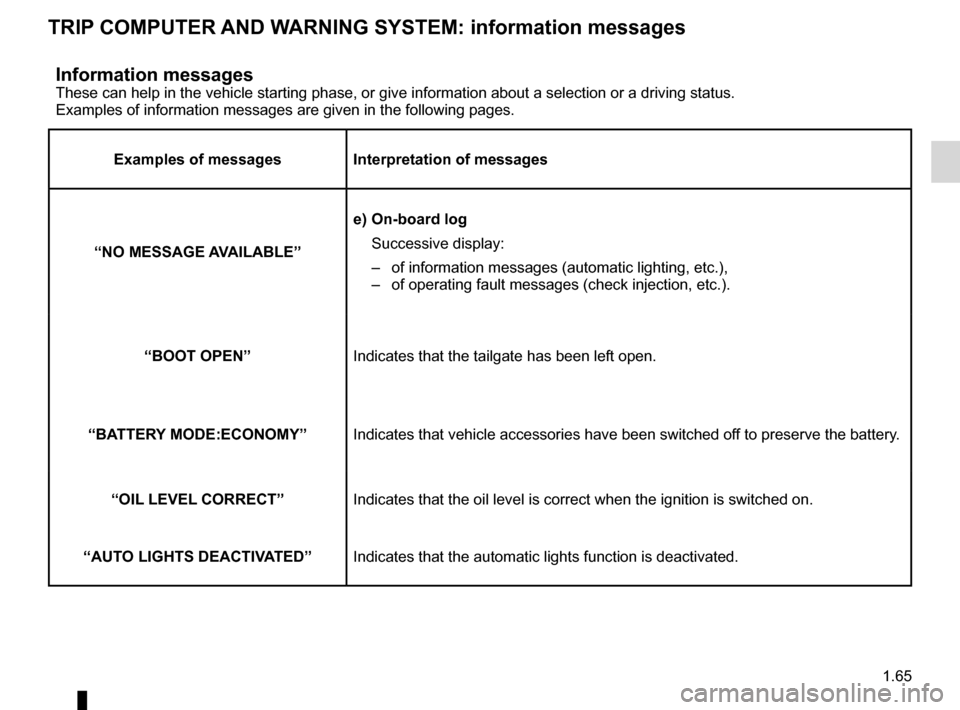
Information messagesThese can help in the vehicle starting phase, or give information about a selection or a driving status.
Examples of information messages are given in the following pages.
examples of messages Interpretation of messages
“NO MeSSAGe A vAILABLe” e)
On-board log
Successive display:
– of information messages (automatic lighting, etc.),
– of operating fault messages (check injection, etc.).
“BOOT OpeN ” Indicates that the tailgate has been left open.
“BATTeR y MODe:eCONOMy” Indicates that vehicle accessories have been switched off to preserve the battery.
“OIL LeveL CORReCT” Indicates that the oil level is correct when the ignition is switched on.
“AUTO LIGHTS DeACTIv ATeD”Indicates that the automatic lights function is deactivated.
TRIp COMpUTeR AND WARNING SySTeM: information messages
Page 72 of 237
trip computer and warning system.........................(current page)
instrument panel messages ...................................(current page)
warning lights ......................................................... (current page)
instrument panel .................................................... (current page)
1.66
ENG_UD26591_3
Ordinateur de bord : messages d’anomalies de fonctionnement (X85 - X61 - F61 - K61 - Renault)
ENG_NU_813-11_FK61_Renault_1
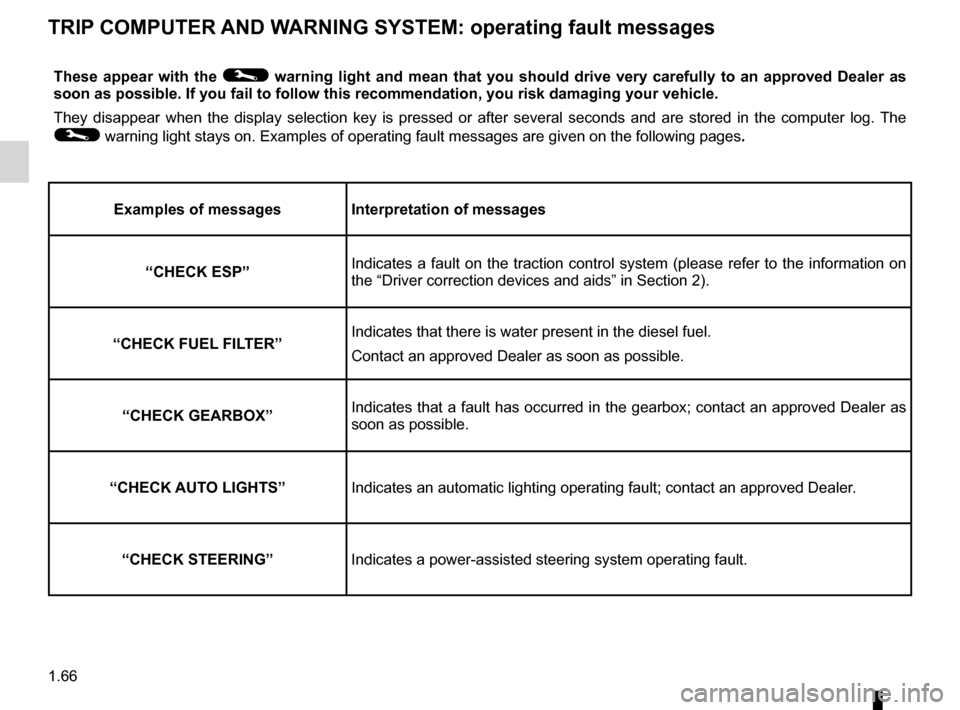
These appear with the © warning light and mean that you should drive very carefully to an approved Dealer as
soon as possible. If you fail to follow this recommendation, you risk damaging your vehicle.
They disappear when the display selection key is pressed or after several seconds and are stored in the computer log. The
© warning light stays on. Examples of operating fault messages are given on the following pages .
examples of messages Interpretation of messages
“CHeCK eSp” Indicates a fault on the traction control system (please refer to the information on
the “Driver correction devices and aids” in Section 2).
“CHeCK FUeL FILTeR” Indicates that there is water present in the diesel fuel.
Contact an approved Dealer as soon as possible.
“CHeCK GeARBOX ”Indicates that a fault has occurred in the gearbox; contact an approved Dealer as
soon as possible.
“CHeCK AUTO LIGHTS ”Indicates an automatic lighting operating fault; contact an approved Dealer .
“CHeCK STeeRING” Indicates a power-assisted steering system operating fault.
TRIp COMpUTeR AND WARNING SySTeM: operating fault messages
Page 73 of 237
trip computer and warning system.........................(current page)
warning lights ......................................................... (current page)
instrument panel messages ...................................(current page)
instrument panel .................................................... (current page)
1.67
ENG_UD23315_2
Ordinateur de bord : messages d’alerte (X61 - F61 - K61 - Renault)
ENG_NU_813-11_FK61_Renault_1
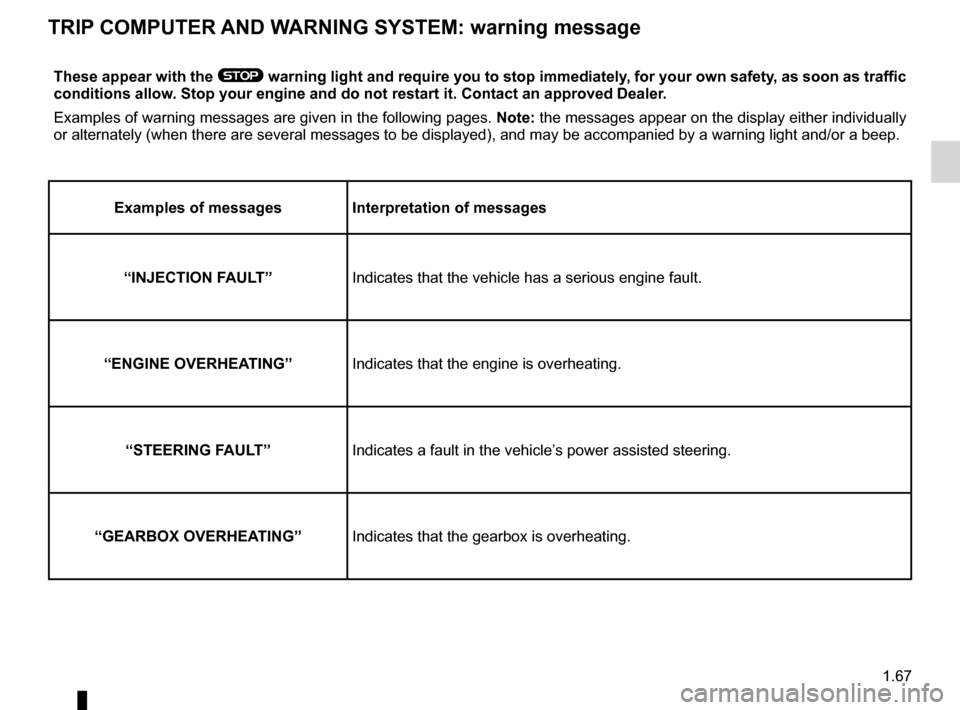
These appear with the ® warning light and require you to stop immediately, for your own safety, as soon as traffic
conditions allow. Stop your engine and do not restart it. Contact an approved Dealer.
Examples of warning messages are given in the following pages. Note: the messages appear on the display either individually
or alternately (when there are several messages to be displayed), and may be accompanied by a warning light and/or a beep.
examples of messages Interpretation of messages
“INJeCTION FAULT” Indicates that the vehicle has a serious engine fault.
“eNGINe OveRHeATING” Indicates that the engine is overheating.
“STeeRING FAULT” Indicates a fault in the vehicle’s power assisted steering.
“GeARBOX OveRHeATING” Indicates that the gearbox is overheating.
TRIp COMpUTeR AND WARNING SySTeM: warning message
Page 76 of 237
signals and lights .................................. (up to the end of the DU)
lights: side lights ......................................................... (current page)
lights: dipped beam headlights ................................... (current page)
lights: main beam headlights ...................................... (current page)
1.70
ENG_UD3885_1
Eclairage et signalisation extérieure (X61 - F61 - K61 - Renault)
ENG_NU_813-11_FK61_Renault_1
Jaune NoirNoir texte
áMain beam headlights
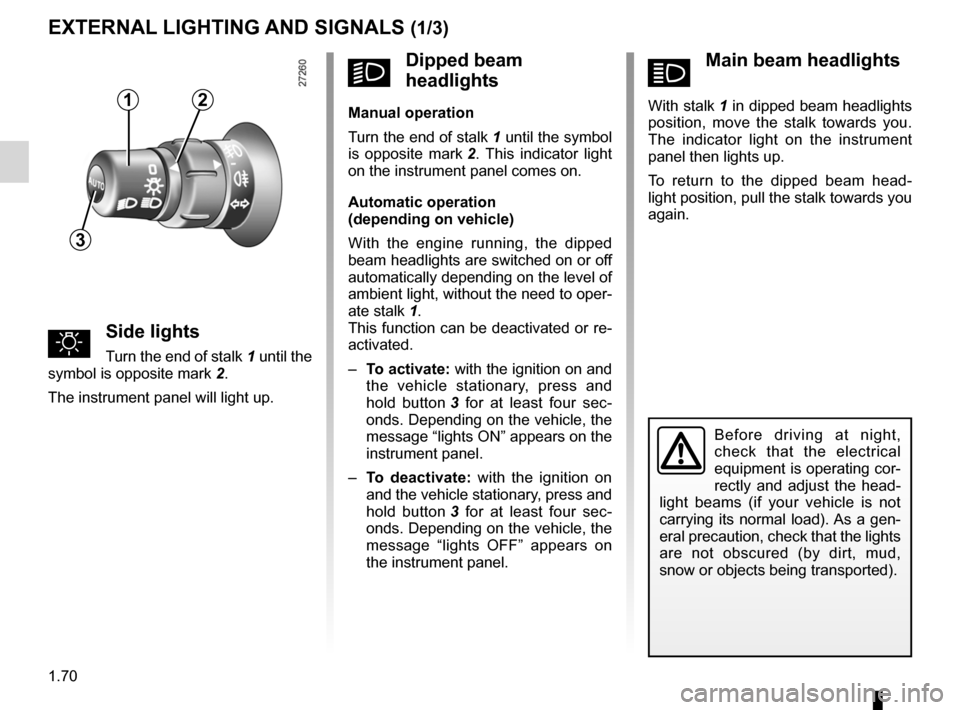
With stalk 1 in dipped beam headlights
position, move the stalk towards you.
The indicator light on the instrument
panel then lights up.
To return to the dipped beam head -
light position, pull the stalk towards you
again.
Éclairage et signalisation extérieure
uSide lights
Turn the end of stalk 1 until the
symbol is opposite mark 2.
The instrument panel will light up.
eXTeRNAL LIGHTING AND SIGNALS (1/3)
Before driving at night,
check that the electrical
equipment is operating cor-
rectly and adjust the head -
light beams (if your vehicle is not
carrying its normal load). As a gen-
eral precaution, check that the lights
are not obscured (by dirt, mud,
snow or objects being transported).
kDipped beam
headlights
Manual operation
Turn the end of stalk 1 until the symbol
is opposite mark 2 . This indicator light
on the instrument panel comes on.
Automatic operation
(depending on vehicle)
With the engine running, the dipped
beam headlights are switched on or off
automatically depending on the level of
ambient light, without the need to oper-
ate stalk 1.
This function can be deactivated or re-
activated.
– To activate: with the ignition on and
the vehicle stationary, press and
hold button 3 for at least four sec -
onds. Depending on the vehicle, the
message “lights ON” appears on the
instrument panel.
– To deactivate: with the ignition on
and the vehicle stationary, press and
hold button 3 for at least four sec -
onds. Depending on the vehicle, the
message “lights OFF” appears on
the instrument panel.12
3
Page 78 of 237
lights:fog lights .......................................................... (current page)
fog lights ................................................................ (current page)
1.72
ENG_UD3885_1
Eclairage et signalisation extérieure (X61 - F61 - K61 - Renault)
ENG_NU_813-11_FK61_Renault_1
fRear fog light
The front fog lights and the
side lights or dipped beam headlights
must be on.
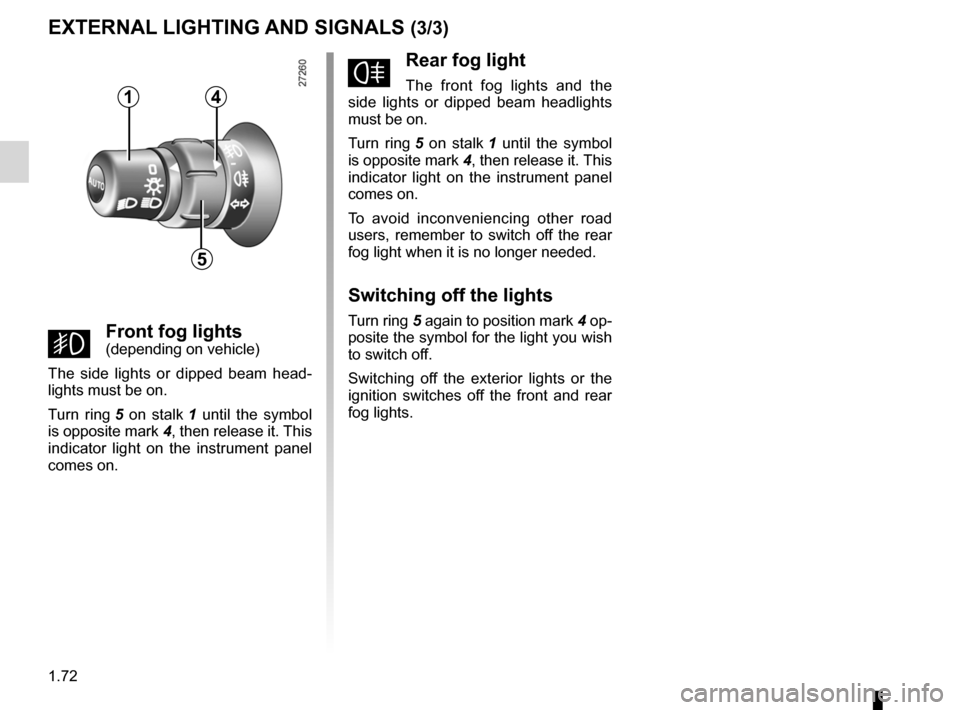
Turn ring 5 on stalk 1 until the symbol
is opposite mark 4, then release it. This
indicator light on the instrument panel
comes on.
To avoid inconveniencing other road
users, remember to switch off the rear
fog light when it is no longer needed.
Switching off the lights
Turn ring 5 again to position mark 4 op-
posite the symbol for the light you wish
to switch off.
Switching off the exterior lights or the
ignition switches off the front and rear
fog lights.
gFront fog lights(depending on vehicle)
The side lights or dipped beam head -
lights must be on.
Turn ring 5 on stalk 1 until the symbol
is opposite mark 4, then release it. This
indicator light on the instrument panel
comes on.
eXTeRNAL LIGHTING AND SIGNALS (3/3)
1
5
4
Page 90 of 237

stopping the engine .............................. (up to the end of the DU)
starting the engine ................................ (up to the end of the DU)
2.4
ENG_UD29639_2
Fonction Stop and Start (X61 - F61 - K61 - Renault)
ENG_NU_813-11_FK61_Renault_2
Jaune NoirNoir texte
Stop and start function
STOP AND START function (1/3)
Warning light is displayed on the
instrument panel. This notifies you that
the engine is on standby.
The vehicle equipment remain opera -
tional while the engine is stopped.
The engine will restart when you press
the clutch pedal and move into gear.
This system enables a reduced fuel
consumption and lower greenhouse
gas emissions.
The system is activated automatically
when the vehicle is started.
While driving, the system stops the
engine (standby) when the vehicle is
at a standstill (traffic jam, traffic lights,
etc).
System operating conditionsEngine standby is activated if:
– the vehicle has been driven since its
last stop;
– the gearbox is in neutral;
– the clutch pedal is released;
and
– the vehicle is travelling at less than 3
km/h. Special feature of the automatic
engine re-start
Under certain conditions, the engine
can restart on its own in order to guar-
antee your safety and comfort.
This can occur especially when:
–
the outdoor temperature is too low or
too high (less than around 0 °C or
higher than around 30 °C);
– the “Clear View” function is acti -
vated if fitted on the vehicle (please
see “Automatic Climate Control” in
Section 3);
– the battery is not sufficiently charged;
– the vehicle speed is above 7 km/h
(downhill slope, etc.);
– repeated pressing on the brake
pedal or braking system require -
ment;
– ...
Engine on standby - braking
assistance is no longer op-
erational.
Do not drive off when the
engine is on standby (warn-
ing light
is displayed
on the instrument panel).
Before getting out of the
vehicle, you must switch
off the ignition (please see
section on “Starting, stop -
ping the engine”).
If you get out of the vehicle, a beep
notifies you that the engine is on
standby and has not been switched
off.
Page 96 of 237
special features of diesel versions........(up to the end of the DU)
2.10
ENG_UD29640_4
Particularités versions diesel (X61 - F61 - K61 - Renault)
ENG_NU_813-11_FK61_Renault_2
Special features of diesel versions
Vehicles with particle filters
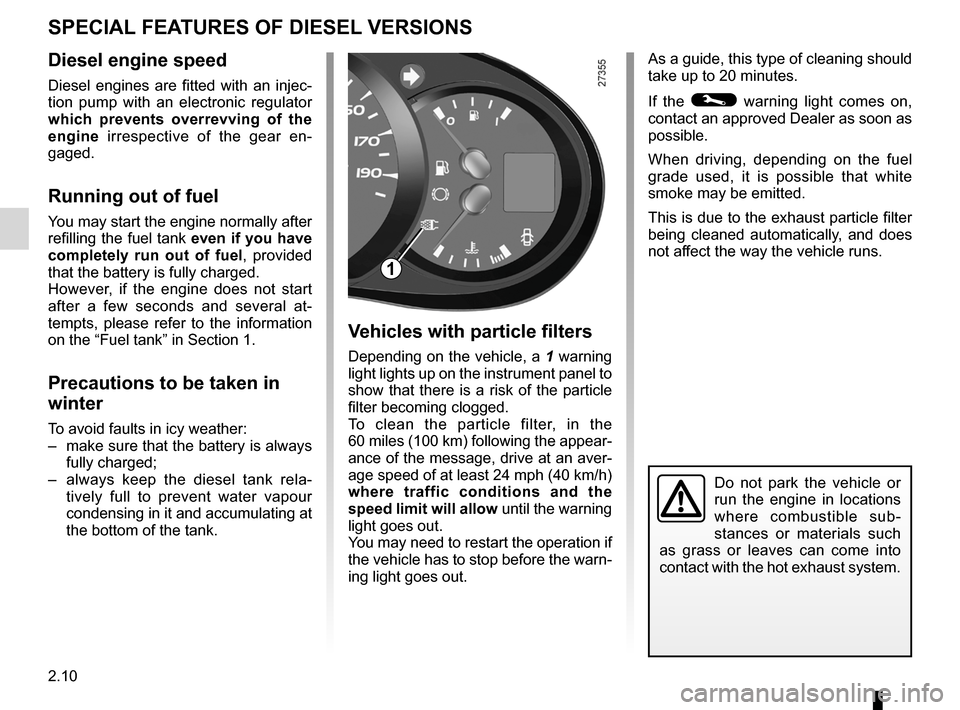
Depending on the vehicle, a 1 warning
light lights up on the instrument panel to
show that there is a risk of the particle
filter becoming clogged.
To clean the particle filter, in the
60 miles (100 km) following the appear -
ance of the message, drive at an aver-
age speed of at least 24 mph (40 km/h)
where traffic conditions and the
speed limit will allow until the warning
light goes out.
You may need to restart the operation if
the vehicle has to stop before the warn-
ing light goes out.
Diesel engine speed
Diesel engines are fitted with an injec -
tion pump with an electronic regulator
which prevents overrevving of the
engine irrespective of the gear en -
gaged.
Running out of fuel
You may start the engine normally after
refilling the fuel tank even if you have
completely run out of fuel , provided
that the battery is fully charged.
However, if the engine does not start
after a few seconds and several at -
tempts, please refer to the information
on the “Fuel tank” in Section 1.
Precautions to be taken in
winter
To avoid faults in icy weather:
– make sure that the battery is always
fully charged;
– always keep the diesel tank rela -
tively full to prevent water vapour
condensing in it and accumulating at
the bottom of the tank.
SPECIAl fEATURES Of DIESEl VERSIONS
1
As a guide, this type of cleaning should
take up to 20 minutes.
If the
© warning light comes on,
contact an approved Dealer as soon as
possible.
When driving, depending on the fuel
grade used, it is possible that white
smoke may be emitted.
This is due to the exhaust particle filter
being cleaned automatically, and does
not affect the way the vehicle runs.
Do not park the vehicle or
run the engine in locations
where combustible sub -
stances or materials such
as grass or leaves can come into
contact with the hot exhaust system.
Page 97 of 237
antipollutionadvice ............................................. (up to the end of the DU)
fuel advice on fuel economy .................. (up to the end of the DU)
fuel economy ........................................ (up to the end of the DU)
2.11
ENG_UD21480_4
Conseils : antipollution, économies de carburant, conduite (X83 - X61 - Renault)
ENG_NU_813-11_FK61_Renault_2
Advice on antipollution, fuel economy and driving
ADVICE: antipollution, fuel economy and driving (1/3)
Your vehicle complies with criteria for
recycling and recovering vehicles at the
end of their service life which will come
into force in 2015.
Some parts of your vehicle have there-
fore been designed to facilitate future
recycling.
These parts are easy to remove so
that they can be recovered and reproc-
essed by recycling companies.
By virtue of its design, moderate fuel
consumption and initial settings, your
vehicle also conforms to current anti-
pollution regulations. The manufac -
turer is actively striving to reduce pol -
lutant exhaust gas emissions and to
save energy. But the fuel consumption
of your vehicle and the level of pollutant
exhaust gas emissions are also your
responsibility. Ensure that it is main -
tained and used correctly. Have your vehicle adjusted and
checked by an approved Dealer, in ac-
cordance with the instructions given in
your maintenance schedule: they will
have all the equipment necessary for
ensuring that your vehicle is maintained
to its original standard.
Engine adjustments
–
ignition: this does not require ad -
justment.
spark plugs: for optimum fuel econ-
omy, efficiency and performance
the specifications laid down by our
Design Department must be strictly
applied. If the spark plugs have to
be changed, use the make, type
and gap specified for your vehicle’s
engine. Contact an approved dealer
for this.
– idle speed: this does not require ad-
justment.
– air filter, diesel filter: a clogged el-
ement hinders performance. It must
be replaced.
Aiding fuel economy
Depending on the vehicle, in order to
optimise consumption, an indicator light
on the instrument panel will inform you
of the best moment to upshift or down -
shift gears:
Š shift up a gear;
‰ shift down a gear.
Maintenance
It is important to remember that failure to
respect antipollution regulations could
lead to legal action being taken against
the vehicle owner. In addition, replacing
engine, fuel supply system and exhaust
components with parts other than those
originally recommended by the manu -
facturer may alter your vehicle so that
it no longer complies with antipollution
regulations.
Page 101 of 237
ASR (traction control) ........................... (up to the end of the DU)
ABS ...................................................... (up to the end of the DU)
traction control: ASR .............................(up to the end of the DU)
driving ................................................... (up to the end of the DU)
traction control: ASR .............................(up to the end of the DU)
anti-lock braking system: ABS ..............(up to the end of the DU)
ESP: Electronic Stability Program ........ (up to the end of the DU)
emergency brake assist ........................(up to the end of the DU)
emergency braking ............................... (up to the end of the DU)
Electronic Stability Program: ESP ........ (up to the end of the DU)
2.15
ENG_UD29758_3
Dispositifs de correction de conduite (X61 - F61 - K61 - Renault)
ENG_NU_813-11_FK61_Renault_2
AbS (anti-lock braking
system)
Under heavy braking, the ABS prevents
the wheels from locking, allowing the
stopping distance to be managed and
keeping control of the vehicle.
Under these circumstances, the vehi -
cle can be steered to avoid an obstacle
whilst braking. In addition, this system
can increase stopping distances, par -
ticularly on roads with low surface grip
(wet ground etc.).
You will feel a pulsation through the
brake pedal each time the system is
activated. The ABS does not in any way
improve the vehicle’s physical perform-
ance relating to the road surface and
roadholding. It is still essential to follow
the rules of good driving practice (such
as driving at a safe distance from the
vehicle in front, etc.).
Driver correction devices and aids
Operating faults:
– If the
x warning light on the in-
strument panel comes on while driv-
ing, braking is still operational ;
– If the
x and D warning
lights on the instrument panel come
on when driving, this indicates a
fault with the braking system.
In such cases, ABS, ESP and emer -
gency brake assist are also deactivated
and, depending on the vehicle, the
messages “CHECK ABS” and “CHECK
ESP” appear on the instrument panel.
Consult an approved dealer.
DRIVER CORRECTION DEVICES AND AIDS (1/3)
In an emergency, apply firm and
continuous pressure to the brake
pedal. There is no need to pump
it repeatedly. The ABS will modu -
late the force applied in the braking
system.
These functions are an ad-
ditional aid in the event of
critical driving conditions,
enabling the vehicle behav -
iour to be adapted to suit the driving
conditions.
However, the functions do not take
the place of the driver. They do
not increase the vehicle’s limits
and should not encourage you
to drive more quickly. Therefore,
they can under no circumstances
replace the vigilance or responsibil -
ity of the driver when manoeuvring
the vehicle (the driver must always
be ready for sudden incidents which
may occur when driving).
Yo u r b r a k i n g s y s t e m s
are partially operational.
However, it is dangerous
to brake suddenly and
it is essential to stop immediately,
as soon as traffic conditions allow.
Contact an approved dealer.
Depending on the vehicle, this is com-
posed of:
– t h e A bS ( a n t i - l o c k b r a k i n g
system);
– electronic stability control ESP
with understeer control and trac -
tion control ASR;
– emergency brake assist with, de -
pending on the vehicle, braking
anticipation.