belt RENAULT KANGOO 2016 X61 / 2.G Owner's Manual
[x] Cancel search | Manufacturer: RENAULT, Model Year: 2016, Model line: KANGOO, Model: RENAULT KANGOO 2016 X61 / 2.GPages: 173, PDF Size: 3.8 MB
Page 40 of 173

ENG_NU_854-2_X76LL_Renault_1
Jaune NoirNoir texte
CHILD SAFETY : Fitting a child seat (5/7)
The table below summ")
1.34
ENG_UD14057_2
Sécurité enfants : installation du siège enfant (X76 - Renault\
)
ENG_NU_854-2_X76LL_Renault_1
Jaune NoirNoir texte
CHILD SAFETY : Fitting a child seat (5/7)
The table below summarises the information already shown on the diagram on the previous page, to ensure the regula-
tions in force are respected.
(5) RISK OF DEATH OR SERIOUS INJURY: before fitting a rear-facing child seat on the front passenger seat,
check that the air bag has been deactivated (refer to the information on “Deactivating the front passenger air bag” in
Section
1).
Type of child seat 4- and 5-seat versions with single section rear bench seat
Standard front
passenger seat Rear side seats
Rear centre seat
Carrycot fitted across the vehicle
Group 0 X
U (2) X
Shell seat/rear-facing seat
Groups 0, 0+ and 1 L (1) (5)
U (3)X
Forward-facing seat (1)
Group 1 X
U (4) X
Booster seat (1)
Groups 2 and 3 X
U (4) X
X =
Seat not suitable for fitting child seats.
U = Seat allowing a child seat with “Universal” approval to be attached by seat belt; check that it can be fitted correctly.
L = Reserved for fitting a rear-facing child seat available only from our network, using a belt..
(1) Only
a rear-facing child seat can be fitted in this seat: position the vehicle seat as far back as possible, and gently tilt the seat-
back (approximately 25°).
(2)
A
carrycot can be installed across the vehicle and will take up at least two seats. Position the child with his or her feet nearest
the door.
(3) Move
the front seat as far forward as possible to install a rear-facing child seat, then move back the seat or seats in front in
accordance with the child seat instructions.
(4) Forward-facing
child seat; position the seatback of the child seat in contact with the seatback of the vehicle seat. Adjust the
height of the headrest or remove it if necessary; do not push the seat in front of the child more than halfway back on its runners
and do not recline the seatback more than 25°.
Page 41 of 173

ENG_NU_854-2_X76LL_Renault_1
³ Check the status of the air bag
before fitting a")
JauneNoirNoir texte
1.35
ENG_UD14057_2
Sécurité enfants : installation du siège enfant (X76 - Renault\
)
ENG_NU_854-2_X76LL_Renault_1
³ Check the status of the air bag
before fitting a child seat or allowing a
passenger to use the seat.
Child seat attached using the belt
U = Seat which allows a seat with “uni -
versal” approval to be attached using a
belt.
L = S
eat reserved for fitting a rear -
facing child seat available only from
our network, using a belt.
Using a child safety system
which is not approved for
this vehicle will not cor-
rectly protect the baby or
child. They risk serious or even fatal
injury.
R I S K O F D E AT H O R
SERIOUS INJURY: before
fitting a rear-facing child
seat on the front passen-
ger seat, check that the air bag has
been deactivated (refer to the infor-
mation on “Deactivating the front
passenger air bag” in Section 1).
CHILD SAFETY : Fitting a child seat (6/7)
Page 42 of 173

ENG_NU_854-2_X76LL_Renault_1
The table below summarises the information already shown on the diagram on the prev")
1.36
ENG_UD14057_2
Sécurité enfants : installation du siège enfant (X76 - Renault\
)
ENG_NU_854-2_X76LL_Renault_1
The table below summarises the information already shown on the diagram on the previous page, to ensure the regula-
tions in force are respected.
(5) RISK OF DEATH OR SERIOUS INJURY: before fitting a rear-facing child seat on the front passenger seat,
check that the air bag has been deactivated (refer to the information on “Deactivating the front passenger air bag” in
Section
1).
Type of child seat 5-seat version with 1/3-2/3 bench seat
Standard front
passenger seat Rear side seats
Rear centre seat
Carrycot fitted across the vehicle
Group 0 X
U (2)U (2)
Shell seat/rear-facing seat
Groups 0, 0+ and 1 L (1) (5)
U (3)U (3)
Forward-facing seat (1)
Group 1 X
U (4)U (4)
Booster seat (1)
Groups 2 and 3 X
U (4)U (4)
X =
Seat not suitable for fitting child seats.
U = Seat allowing a child seat with “Universal” approval to be attached by seat belt; check that it can be fitted correctly.
L = Reserved for fitting a rear-facing child seat available only from our network, using a belt.
(1) Only
a rear-facing child seat can be fitted in this seat: position the vehicle seat as far back as possible, and gently tilt the seat-
back (approximately 25°).
(2)
A
carrycot can be installed across the vehicle and will take up at least two seats. Position the child with his or her feet nearest
the door.
(3) Move
the front seat as far forward as possible to install a rear-facing child seat, then move back the seat or seats in front in
accordance with the child seat instructions.
(4) Forward-facing
child seat; position the seatback of the child seat in contact with the seatback of the vehicle seat. Adjust the
height of the headrest or remove it if necessary; do not push the seat in front of the child more than halfway back on its runners
and do not recline the seatback more than 25°.
CHILD SAFETY : Fitting a child seat (7/7)
Page 43 of 173
child safety............................................ (up to the end of the DU)
transporting children ............................. (up to the end of the DU)
child restraint/seat ................................ (up to the end of the DU)
child restraint/seat ................................ (up to the end of the DU)
air bag deactivating the front passenger air bags ........ (current page)
front passenger air bag deactivation ..................... (current page) 1.37
ENG_UD8776_1
Sécurité enfants : désactivation/Activation airbag passager (X\
76 - Renault)
ENG_NU_854-2_X76LL_Renault_1
Deactivating/activating the front passenger air bag
CHILD SAFETY : deactivating/activating the front passenger air bag (1/2)
Deactivating the front
passenger air bags
(on equipped vehicles)
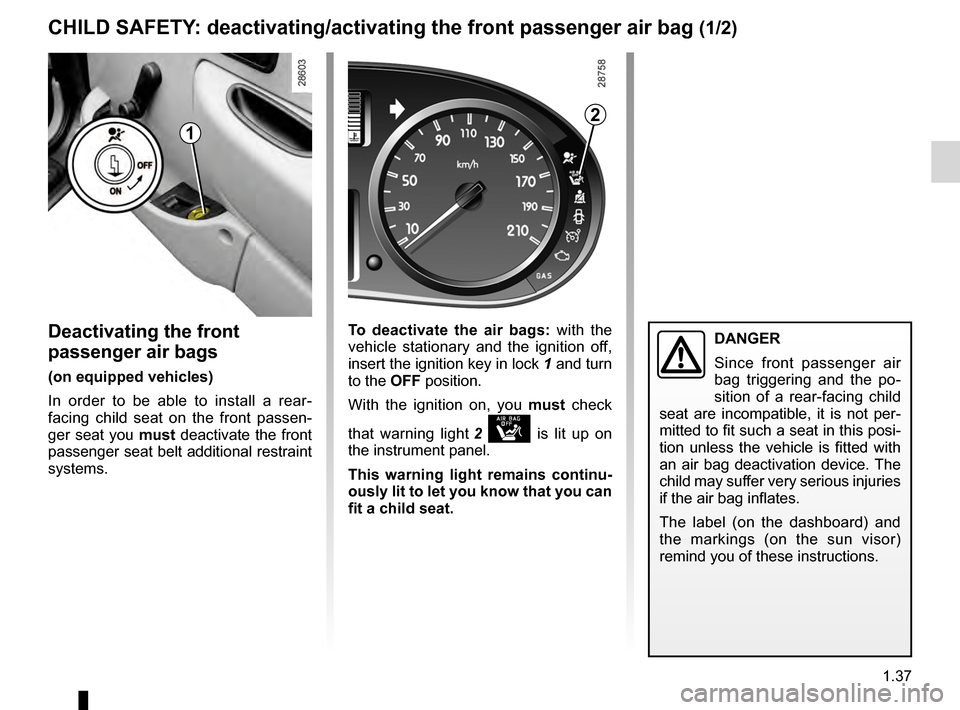
In order to be able to install a rear-
facing child seat on the front passen-
ger seat you must deactivate the front
passenger seat belt additional restraint
systems. To deactivate the air bags:
with the
vehicle stationary and the ignition off,
insert
the ignition key in lock 1 and turn
to the OFF position.
With the ignition on, you must check
t
hat warning light 2
ã is lit up on
the instrument panel.
This warning light remains continu-
ously lit to let you know that you can
fit a child seat.
DANGER
Since front passenger air
bag triggering and the po-
sition of a rear-facing child
seat are incompatible, it is not per-
mitted to fit such a seat in this posi-
tion unless the vehicle is fitted with
an air bag deactivation device. The
child may suffer very serious injuries
if the air bag inflates.
The label (on the dashboard) and
the markings (on the sun visor)
remind you of these instructions.
2
1
Page 44 of 173

1.38
ENG_UD8776_1
Sécurité enfants : désactivation/Activation airbag passager (X\
76 - Renault)
ENG_NU_854-2_X76LL_Renaul")
air bagactivating the front passenger air bags ............ (current page)
1.38
ENG_UD8776_1
Sécurité enfants : désactivation/Activation airbag passager (X\
76 - Renault)
ENG_NU_854-2_X76LL_Renault_1
CHILD SAFETY : deactivating/activating the front passenger air bag (2/2)
Activating the front
passenger air bags
You should reactivate the air bag as
soon as you remove the child seat from
the front passenger seat to ensure the
protection of the front passenger in the
event of an impact.
To reactivate the air bags: with the
vehicle stationary and the ignition off,
insert
the ignition key in lock 1 and turn
to the ON position.
With the ignition on, check that warning
light
2
ã is off. The front passenger
seat belt additional restraint systems
are activated.
The passenger air bag must
only be deactivated or acti-
vated when the vehicle is
stationary.
I f a n y o p e r a t i o n i s c a r r i e d
out with the ignition on, the
å
and
ø warning lights come on:
the passenger air bag is deacti-
vated.
Switch the ignition off then on again
to reset the air bag in accordance
with the lock position.
Operating faults
It is forbidden to fit a rear-facing child
seat to the front passenger seat if the
air bag activation/deactivation system
is faulty.
Allowing any other passenger to sit in
that seat is not recommended.
Contact your approved Dealer as soon
as possible.
2
1
Page 49 of 173
rear screendemisting ......................................................... (current page)
Jaune NoirNoir texte
1.43
ENG_UD7264_1
Tableau de bord : témoins lumineux (X76 - Renault)
ENG_NU_854-2_X76LL_Renault_1
INSTRUMENT PANEL: warning lights (2/4)
6
Electronic fault and water
present in diesel fuel warn-
ing light (on petrol and diesel
versions) and preheating warning
light (on diesel versions)
Electronic fault warning light (on
petrol and diesel versions). If it comes
on while driving, it indicates an electri-
cal or electronic fault or that water is
present in the fuel. Contact your ap-
proved Dealer as soon as possible.
Preheating and water present in
diesel fuel warning light (on diesel
version).
This light should come on when the ig-
nition key is in position M; it indicates
that the heater plugs are in operation.
It goes out after preheating is sufficient
and the engine can be started.
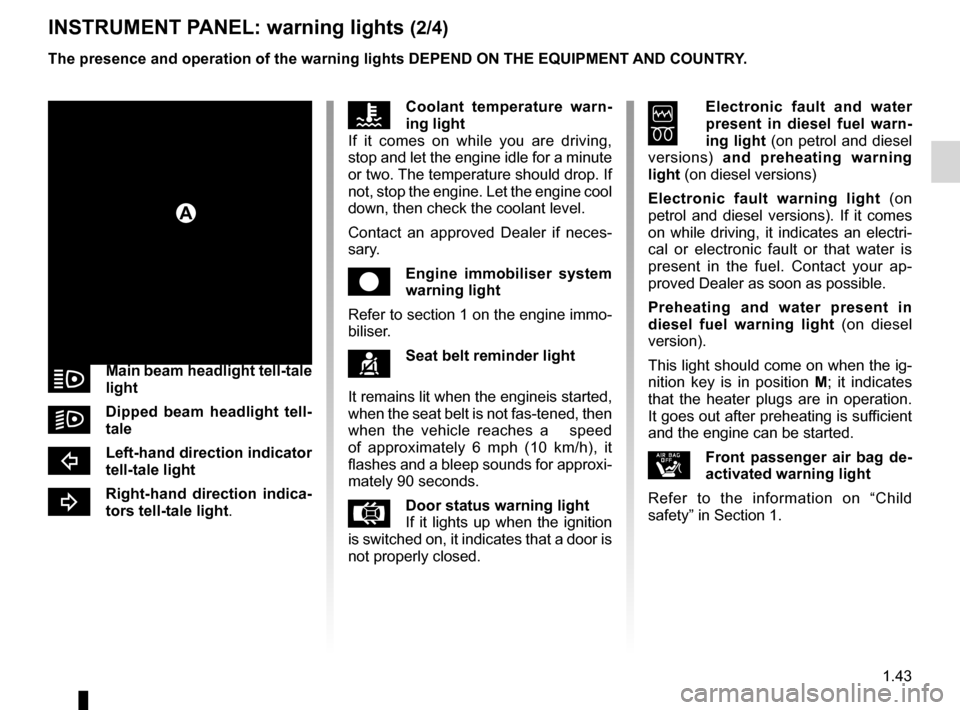
ãFront passenger air bag de-
activated warning light
Refer to the information on “Child
safety” in Section 1.
The presence and operation of the warning lights DEPEND ON THE EQUIPMENT\
AND COUNTRY.
A
oMain beam headlight tell-tale
light
mDipped beam headlight tell-
tale
cLeft-hand direction indicator
tell-tale light
bRight-hand direction indica-
tors tell-tale light .
ÔCoolant temperature warn-
ing light
If it comes on while you are driving,
stop and let the engine idle for a minute
or two. The temperature should drop. If
not, stop the engine. Let the engine cool
down, then check the coolant level.
Contact an approved Dealer if neces-
sary.
êEngine immobiliser system
warning light
Refer to section 1 on the engine immo-
biliser.
çSeat belt reminder light
It remains lit when the engineis started,
when the seat belt is not fas-tened, then
when the vehicle reaches a speed
of approximately 6 mph (10 km/h), it
flashes and a bleep sounds for approxi-
mately 90 seconds.
vDoor status warning light
If it lights up when the ignition
is switched on, it indicates that a door is
not properly closed.
Page 94 of 173
rear bench seat..................................... (up to the end of the DU)
rear seatsfunctions ......................................... (up to the end of the DU)
3.20
ENG_UD7301_1
Banquette arrière : fonctionnalité (X76 - Renault)
ENG_NU_854-2_X76LL_Renault_3
Jaune NoirNoir texte
Rear bench seat
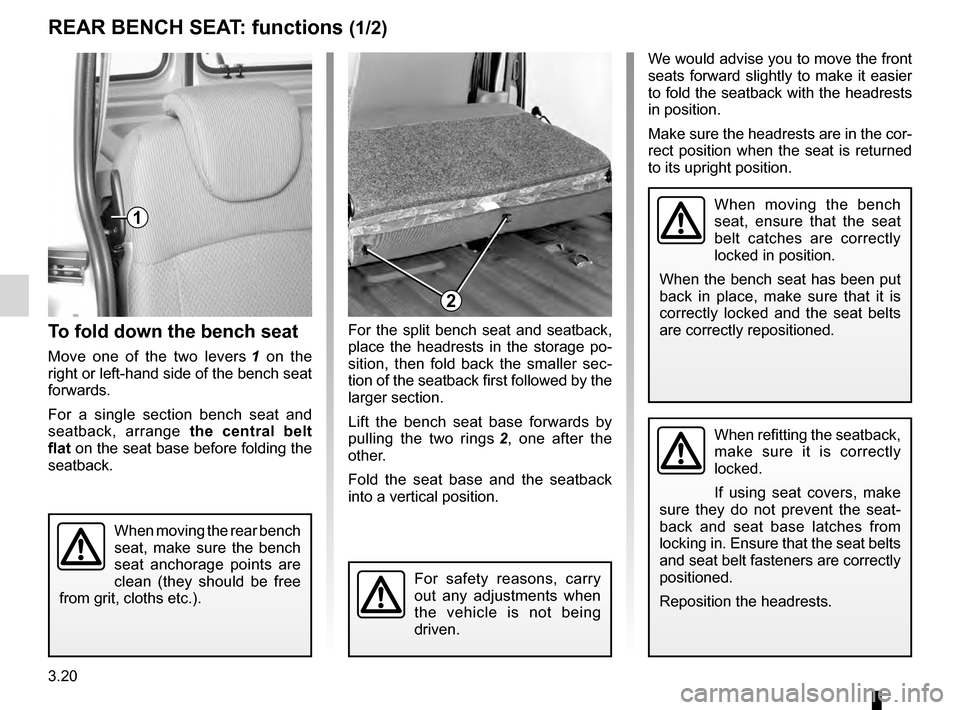
We would advise you to move the front
seats forward slightly to make it easier
to fold the seatback with the headrests
in position.
Make sure the headrests are in the cor-
rect position when the seat is returned
to its upright position.
For the split bench seat and seatback,
place the headrests in the storage po-
sition, then fold back the smaller sec-
tion of the seatback first followed by the
larger section.
Lift the bench seat base forwards by
p
ulling the two rings 2 , one after the
other.
Fold the seat base and the seatback
into a vertical position.
t o fold down the bench seat
Move one of the two levers 1 on the
right or left-hand side of the bench seat
forwards.
For a single section bench seat and
seatback, arrange the central belt
flat on the seat base before folding the
seatback.
reAr BenCH seA t: functions (1/2)
1
2
For safety reasons, carry
out any adjustments when
the vehicle is not being
driven.
When moving the bench
seat, ensure that the seat
belt catches are correctly
locked in position.
When the bench seat has been put
back in place, make sure that it is
correctly locked and the seat belts
are correctly repositioned.
When moving the rear bench
seat, make sure the bench
seat anchorage points are
clean (they should be free
from grit, cloths etc.).
When refitting the seatback,
make sure it is correctly
locked.
If using seat covers, make
sure they do not prevent the seat-
back and seat base latches from
locking in. Ensure that the seat belts
and seat belt fasteners are correctly
positioned.
Reposition the headrests.
Page 95 of 173

JauneNoirNoir texte
3.21
ENG_UD7301_1
Banquette arrière : fonctionnalité (X76 - Renault)
ENG_NU_854-2_X76LL_Renault_3
To maintain the rear bench seat in the
r
aised position, attach retainer 4 to
rod
3 of the passenger headrest.
t ransporting bulky objects
The small section may be folded down
completely and yet still leave space to
accommodate a maximum of two pas-
sengers on the large section.
Conversely, you can use the small sec-
tion to accommodate one passenger
providing that only the seatback of the
large section is folded down. The seat
belts are only guaranteed to operate
correctly when the seat base is latched
in position.
reAr BenCH seA t: functions (2/2)
3
4
For safety reasons, carry
out any adjustments when
the vehicle is not being
driven.
Page 96 of 173
transporting objectsin the luggage compartment ........... (up to the end of the DU)
3.22
ENG_UD7302_1
Transports d objets dans le coffre (X76 - Renault)
ENG_NU_854-2_X76LL_Renault_3
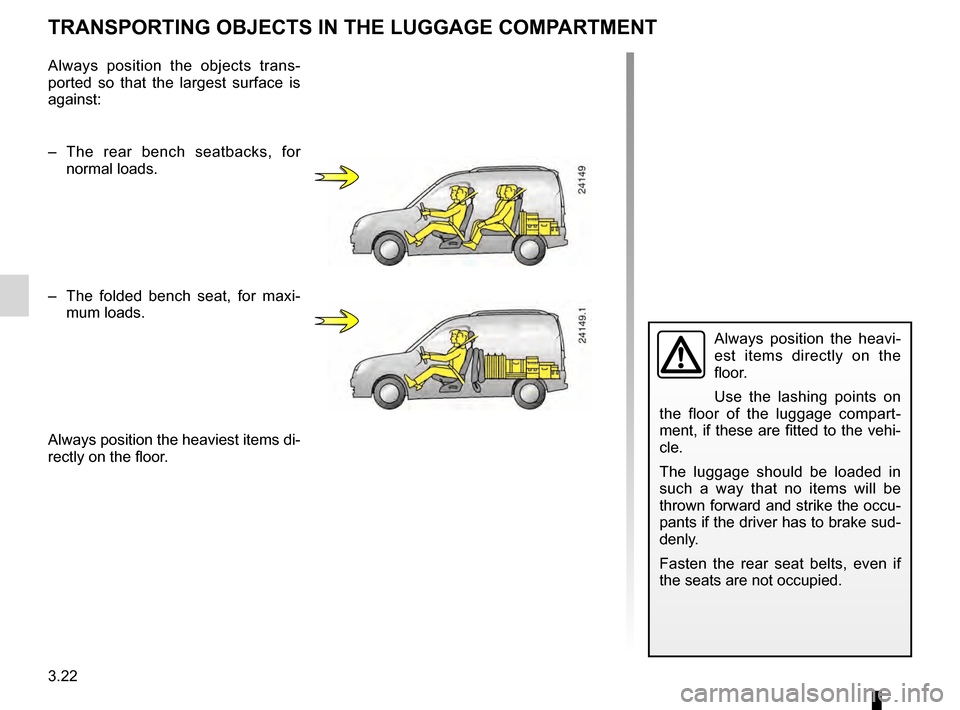
Always position the objects trans-
ported so that the largest surface is
against:
–
The rear bench seatbacks, for
normal loads.
– The folded bench seat, for maxi-
mum loads.
Always position the heaviest items di-
rectly on the floor.
Transporting objects in the luggage compartment
trAnsPOrtinG OBjeCts in tHe LuGGAGe COMPArtMent
Always position the heavi-
est items directly on the
floor.
Use the lashing points on
the floor of the luggage compart-
ment, if these are fitted to the vehi-
cle.
The luggage should be loaded in
such a way that no items will be
thrown forward and strike the occu-
pants if the driver has to brake sud-
denly.
Fasten the rear seat belts, even if
the seats are not occupied.
Page 98 of 173
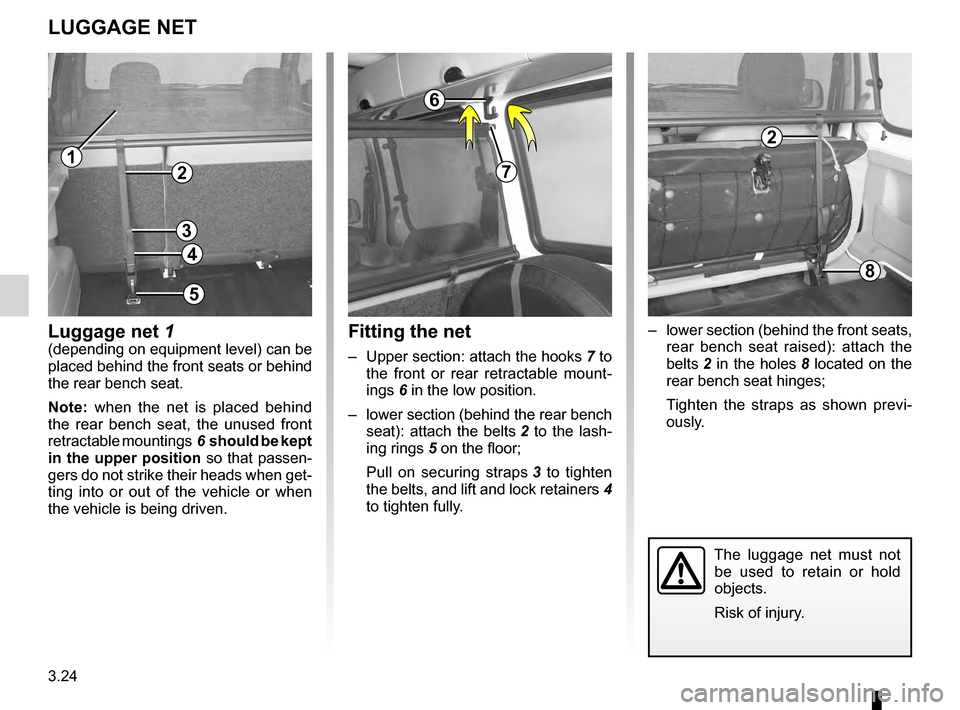
luggage retaining net ............................ (up to the end of the DU)
3.24
ENG_UD14906_2
Filet de retenue de bagages (X76 - Renault)
ENG_NU_854-2_X76LL_Renault_3
Luggage net
– lower section (behind the front seats,
rear bench seat raised): attach the
belts
2 in the holes 8 located on the
rear bench seat hinges;
Tighten the straps as shown previ-
ously.
Fitting the net
– Upper section: attach the hooks 7 to
the front or rear retractable mount-
ings
6 in the low position.
–
lower section (behind the rear bench
seat):
attach the belts 2 to the lash-
ing rings
5 on the floor;
P
ull on securing straps 3 to tighten
the
belts, and lift and lock retainers 4
to tighten fully.
Luggage net 1(depending on equipment level) can be
placed behind the front seats or behind
the rear bench seat.
no
te: when the net is placed behind
the rear bench seat, the unused front
retractable
mountings 6 should be kept
in the upper position so that passen-
gers do not strike their heads when get-
ting into or out of the vehicle or when
the vehicle is being driven.
LuGGAGe net
12
3
4
5
6
2
8
7
The luggage net must not
be used to retain or hold
objects.
Risk of injury.