lights RENAULT KANGOO 2016 X61 / 2.G Owner's Manual
[x] Cancel search | Manufacturer: RENAULT, Model Year: 2016, Model line: KANGOO, Model: RENAULT KANGOO 2016 X61 / 2.GPages: 173, PDF Size: 3.8 MB
Page 73 of 173
ABS ...................................................... (up to the end of the DU)
anti-lock braking system: ABS .............. (up to the end of the DU) 2.11
ENG_UD7283_1
Système antiblocage des roues : ABS (X76 - Renault)
ENG_NU_854-2_X76LL_Renault_2
Anti-lock braking system
ANtI-locK BRAKING SyStEM: ABS
Depending on the vehicle, this is com-
posed of:
–
ABS (anti-lock braking system);
– emergency brake assist with, de -
pending on the vehicle, braking
anticipation;
These functions are an ad-
ditional aid in the event of
critical driving conditions,
enabling the vehicle behav-
iour to be adapted to suit the driving
conditions.
However, the functions do not take
the place of the driver. th
ey do
not increase the vehicle’s limits
and should not encourage you
to drive more quickly. Therefore,
they can under no circumstances
replace the vigilance or responsibil-
ity of the driver when manoeuvring
the vehicle (the driver must always
be ready for sudden incidents which
may occur when driving).
ABS (Anti-lock Braking
System)
Under heavy braking, the ABS prevents
the wheels from locking, allowing the
stopping distance to be managed and
keeping control of the vehicle.
Under these circumstances, the vehi-
cle can be steered to avoid an obstacle
whilst braking. In addition, this system
can increase stopping distances, par-
ticularly on roads with low surface grip
(wet ground etc.).
You will feel a pulsation through the
brake pedal each time the system is
activated. The ABS does not in any way
improve the vehicle’s physical perform-
ance relating to the road surface and
roadholding. It is still essential to follow
the rules of good driving practice (such
as driving at a safe distance from the
vehicle in front etc.).
In an emergency, apply firm and
continuous pressure to the brake
pedal. There is no need to pump
it repeatedly. The ABS will modu-
late the force applied in the braking
system.
operating faults:
– If the
x warning light on the in-
strument panel comes on while driv-
ing, braking is still operational ;
–
If the
x and D warning
lights on the instrument panel come
on when driving, this indicates a
fault with the braking system.
In such cases, the ABS and emergency
brake assist are also deactivated and,
depending on the vehicle, the mes-
sages “check ABS” and “check brak-
ing system” appear on the instrument
panel.
Consult an approved dealer.
Yo u r b r a k i n g s y s t e m s
are partially operational.
However, it is dangerous
to brake suddenly and
it is essential to stop immediately,
as soon as traffic conditions allow.
Contact an approved dealer.
Page 74 of 173
emergency brake assist........................ (up to the end of the DU)
emergency braking ............................... (up to the end of the DU)
2.12
ENG_UD7284_1
Assistance au freinage d urgence (X76 - Renault)
ENG_NU_854-2_X76LL_Renault_2
Emergency brake assist
EMERGENcy BRAKE ASSISt
Emergency brake assist
This is an additional system to ABS
which helps reduce vehicle stopping
distances.
o
perating principle
The system detects an emergency
braking situation. In this case, the brak-
ing assistance immediately develops
maximum power and may trigger ABS
regulation.
ABS braking is maintained as long as
the brake pedal is not released.
hazard warning lights
switching on
Depending on the vehicle, these may
light up in the event of sudden decel-
eration.
These functions are an ad-
ditional aid in the event of
critical driving conditions,
enabling the vehicle behav-
iour to be adapted to suit the driving
conditions.
However, the functions do not take
the place of the driver. th
ey do
not increase the vehicle’s limits
and should not encourage you
to drive more quickly. Therefore,
they can under no circumstances
replace the vigilance or responsibil-
ity of the driver when manoeuvring
the vehicle (the driver must always
be ready for sudden incidents which
may occur when driving).
Page 86 of 173
lighting:interior ............................................. (up to the end of the DU)
courtesy light ........................................ (up to the end of the DU)
map reading lights ................................ (up to the end of the DU)
3.12
ENG_UD7292_1
Eclairage intérieur (X76 - Renault)
ENG_NU_854-2_X76LL_Renault_3
Interior lighting
special features
Depending on the vehicle, remote un-
locking of the doors triggers timed light-
ing of the passenger compartment. If
one of the front or rear doors is opened,
the period for which the light is switched
on will start again.
Then the courtesy light and the luggage
compartment light dim and go out.
The lighting timer will cut out for vari-
ous reasons:
–
if a door has been open for 15 min -
utes;
–
if all the doors have been closed for
15 seconds:
–
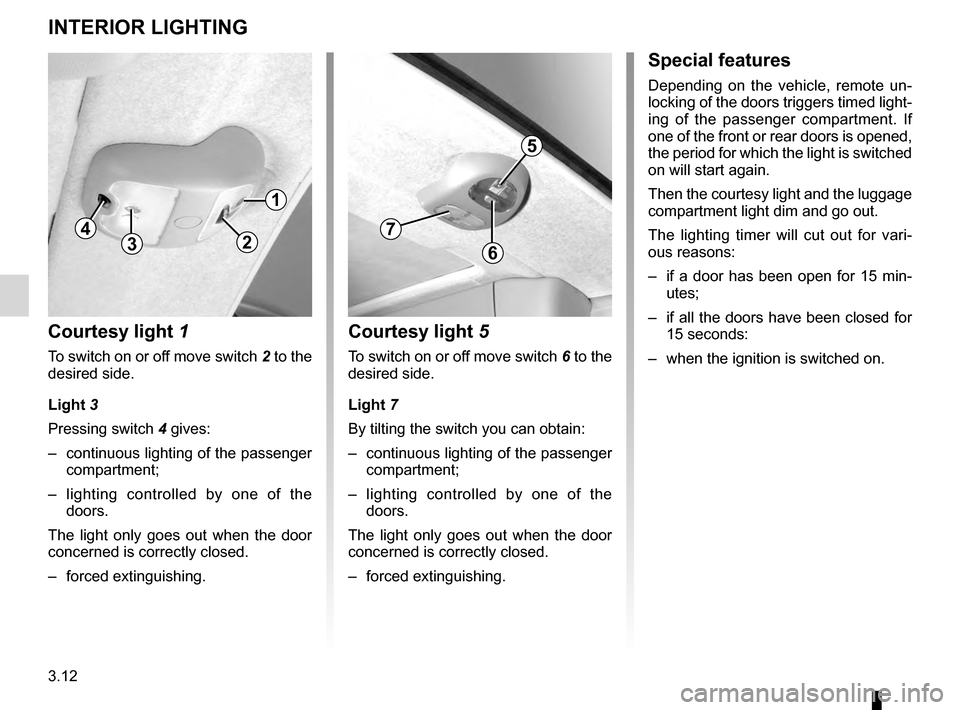
when the ignition is switched on.Courtesy light 5
To switch on or off move switch 6 to the
desired side.
Light
7
By tilting the switch you can obtain:
–
continuous lighting of the passenger
compartment;
–
lighting controlled by one of the
doors.
The light only goes out when the door
concerned is correctly closed.
–
forced extinguishing.
Courtesy light 1
To switch on or off move switch 2 to the
desired side.
Light
3
Pressing switch
4 gives:
–
continuous lighting of the passenger
compartment;
–
lighting controlled by one of the
doors.
The light only goes out when the door
concerned is correctly closed.
–
forced extinguishing.
interiOr LiGHtinG
432
1
5
6
7
Page 101 of 173
maintenance:mechanical ...................................... (up to the end of the DU)
engine oil .............................................. (up to the end of the DU)
dipstick.................................................. (up to the end of the DU)
engine oil level ...................................... (up to the end of the DU) 4.3
ENG_UD13985_2
Niveau huile moteur (X76 - Renault)
ENG_NU_854-2_X76LL_Renault_4
Engine oil level
general information
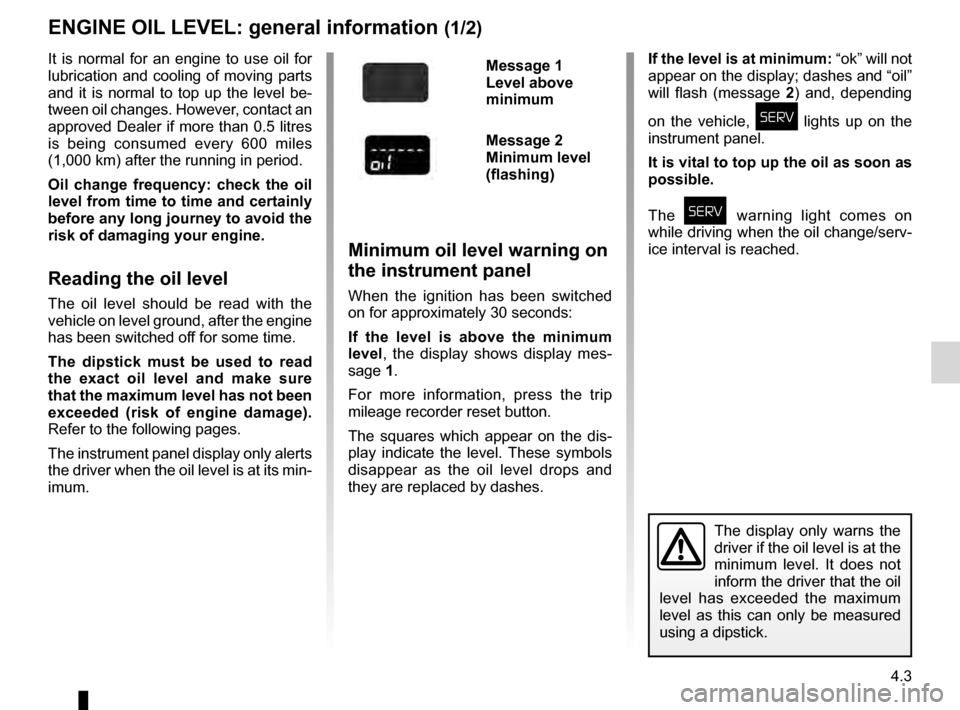
If the level is at minimum: “ok” will not
appear on the display; dashes and “oil”
will flash (message 2) and, depending
on the vehicle,
ø lights up on the
instrument panel.
It is vital to top up the oil as soon as
possible.
The
ø warning light comes on
while driving when the oil change/serv-
ice interval is reached.
Message 1
Level above
minimum
Message 2
Minimum level
(flashing)
Minimum oil level warning on
the instrument panel
When the ignition has been switched
on for approximately 30 seconds:
If the level is above the minimum
level , the display shows display mes-
sage
1.
For more information, press the trip
mileage recorder reset button.
The squares which appear on the dis-
play indicate the level. These symbols
disappear as the oil level drops and
they are replaced by dashes.
engIne OIL LeveL: general information (1/2)
The display only warns the
driver if the oil level is at the
minimum level. It does not
inform the driver that the oil
level has exceeded the maximum
level as this can only be measured
using a dipstick.
It is normal for an engine to use oil for
lubrication and cooling of moving parts
and it is normal to top up the level be-
tween oil changes. However, contact an
approved Dealer if more than 0.5 litres
is being consumed every 600 miles
(1,000 km) after the running in period.
Oil change frequency: check the oil
level from time to time and certainly
before any long journey to avoid the
risk of damaging your engine.
Reading the oil level
The oil level should be read with the
vehicle on level ground, after the engine
has been switched off for some time.
t h
e dipstick must be used to read
the exact oil level and make sure
that the maximum level has not been
exceeded (risk of engine damage).
Refer to the following pages.
The instrument panel display only alerts
the driver when the oil level is at its min-
imum.
Page 110 of 173
4.12
ENG_UD7309_1
Entretien de la carrosserie (X76 - Renault)
ENG_NU_854-2_X76LL_Renault_4
BOdywORk MAIntenAnCe (2/2)
– Before going through a roller type
car wash, return the windscreen
wiper stalk to park position (refer to
the information on the “Windscreen
wash/wipe” in Section 1). Check the
mounting of external accessories,
additional lights, door mirrors, etc.,
and be sure to hold the wiper blades
and radio aerial in place with adhe-
sive tape.
Remove the radio aerial mast if your
vehicle is fitted with this equipment.
–
Spray mechanical components,
hinges, etc. with products approved
by our Technical Department to
protect them after they have been
cleaned.
We have selected special products
to care for your vehicle and you can
obtain these from the manufactur-
er’s accessory outlets.
– Observe the vehicle stopping dis-
tances when driving on gravelled
surfaces to prevent paint damage.
–
Repair, or have repaired quickly,
areas where the paint has been dam-
aged, to prevent corrosion spread-
ing.
–
Remember to visit the body shop
periodically if your vehicle has an
anti-corrosion warranty. Refer to the
Maintenance Service Booklet.
–
Respect local regulations about
washing vehicles (e.g. do not wash
your vehicle on a public highway).
y ou should
– Wash your car frequently, with the
engine off , with cleaning products
recommended by our Technical
Department (never use abrasive
products) and be sure to jet-rinse
off:
–
spots of tree resin and industrial
grime;
–
bird droppings, which cause
a chemical reaction with the
paint that rapidly discolours
paintwork and may even cause
the paint to peel off;
Wash the vehicle immediately to
remove these marks since it is im-
possible to remove them by pol-
ishing;
–
salt, particularly in the wheel
arches and underneath the body
after driving in areas where the
roads have been gritted;
–
mud in the wheel arches and un -
derneath the body which form
damp patches.
Page 113 of 173

ENG_NU_854-2_X76LL_Renault_5
Section 5: Practical advice
Puncture . . . . . . . . . . . . . . . . . . . . . . . . . . . . . . . . . . . .\
. . . . . . .")
5.1
ENG_UD14022_2
Sommaire 5 (X76 - Renault)
ENG_NU_854-2_X76LL_Renault_5
Section 5: Practical advice
Puncture . . . . . . . . . . . . . . . . . . . . . . . . . . . . . . . . . . . .\
. . . . . . . . . . . . . . . . . . . . . . . . . . . . . . . . . . 5.2
Wheel trims . . . . . . . . . . . . . . . . . . . . . . . . . . . . . . . . . . . .\
. . . . . . . . . . . . . . . . . . . . . . . . . . . . . . . . 5.3
Changing a wheel . . . . . . . . . . . . . . . . . . . . . . . . . . . . . . . . . . . .\
. . . . . . . . . . . . . . . . . . . . . . . . . . . 5.4
Tyres . . . . . . . . . . . . . . . . . . . . . . . . . . . . . . . . . . . .\
. . . . . . . . . . . . . . . . . . . . . . . . . . . . . . . . . . . .\
. 5.5
Changing bulbs . . . . . . . . . . . . . . . . . . . . . . . . . . . . . . . . . . . .\
. . . . . . . . . . . . . . . . . . . . . . . . . . . . . 5.8
Front lights . . . . . . . . . . . . . . . . . . . . . . . . . . . . . . . . . . . . \
. . . . . . . . . . . . . . . . . . . . . . . . . . . 5.8
Fog lights . . . . . . . . . . . . . . . . . . . . . . . . . . . . . . . . . . . .\
. . . . . . . . . . . . . . . . . . . . . . . . . . . . 5.10
Rear lights: changing bulbs . . . . . . . . . . . . . . . . . . . . . . . . . . . . . . . . . . . . \
. . . . . . . . . . . . . . . . . . . . 5.1
1
Indicator lights . . . . . . . . . . . . . . . . . . . . . . . . . . . . . . . . . . . .\
. . . . . . . . . . . . . . . . . . . . . . . . 5.14
Interior lighting . . . . . . . . . . . . . . . . . . . . . . . . . . . . . . . . . . . .\
. . . . . . . . . . . . . . . . . . . . . . . . 5.15
Luggage compartment light . . . . . . . . . . . . . . . . . . . . . . . . . . . . . . . . . . . . \
. . . . . . . . . . . . . . . . . . . . 5.18
Battery: troubleshooting. . . . . . . . . . . . . . . . . . . . . . . . . . . . . . . . . . . . \
. . . . . . . . . . . . . . . . . . . . . . . 5.19
Fuses . . . . . . . . . . . . . . . . . . . . . . . . . . . . . . . . . . . . \
. . . . . . . . . . . . . . . . . . . . . . . . . . . . . . . . . . . . \
. 5.21
Wiper blades . . . . . . . . . . . . . . . . . . . . . . . . . . . . . . . . . . . .\
. . . . . . . . . . . . . . . . . . . . . . . . . . . . . . . 5.24
Towing: breakdown . . . . . . . . . . . . . . . . . . . . . . . . . . . . . . . . . . . .\
. . . . . . . . . . . . . . . . . . . . . . . . . . 5.26
Towing: towing equipment . . . . . . . . . . . . . . . . . . . . . . . . . . . . . . . . . . . . \
. . . . . . . . . . . . . . . . . . . . . 5.27
Fitting a radio . . . . . . . . . . . . . . . . . . . . . . . . . . . . . . . . . . . . \
. . . . . . . . . . . . . . . . . . . . . . . . . . . . . . . 5.28
Accessories . . . . . . . . . . . . . . . . . . . . . . . . . . . . . . . . . . . . \
. . . . . . . . . . . . . . . . . . . . . . . . . . . . . . . . 5.29
Fuel cut-off system in the event of a severe impact . . . . . . . . . . . . . . . . . . . . . . . . . . . . . . . . . . . .\
. 5.30
Radio frequency remote control: batteries. . . . . . . . . . . . . . . . . . . . . . . . . . . . . . . . . . . . \
. . . . . . . . . 5.31
Diesel filter . . . . . . . . . . . . . . . . . . . . . . . . . . . . . . . . . . . . \
. . . . . . . . . . . . . . . . . . . . . . . . . . . . . . . . . 5.32
Operating faults . . . . . . . . . . . . . . . . . . . . . . . . . . . . . . . . . . . . \
. . . . . . . . . . . . . . . . . . . . . . . . . . . . . 5.33
Page 116 of 173
changing a bulb .................................... (up to the end of the DU)
puncture................................................ (up to the end of the DU)
lifting the vehicle changing a wheel ............................ (up to the end of the DU)
5.4
ENG_UD7314_1
Changement de roue (X76 - Renault)
ENG_NU_854-2_X76LL_Renault_5
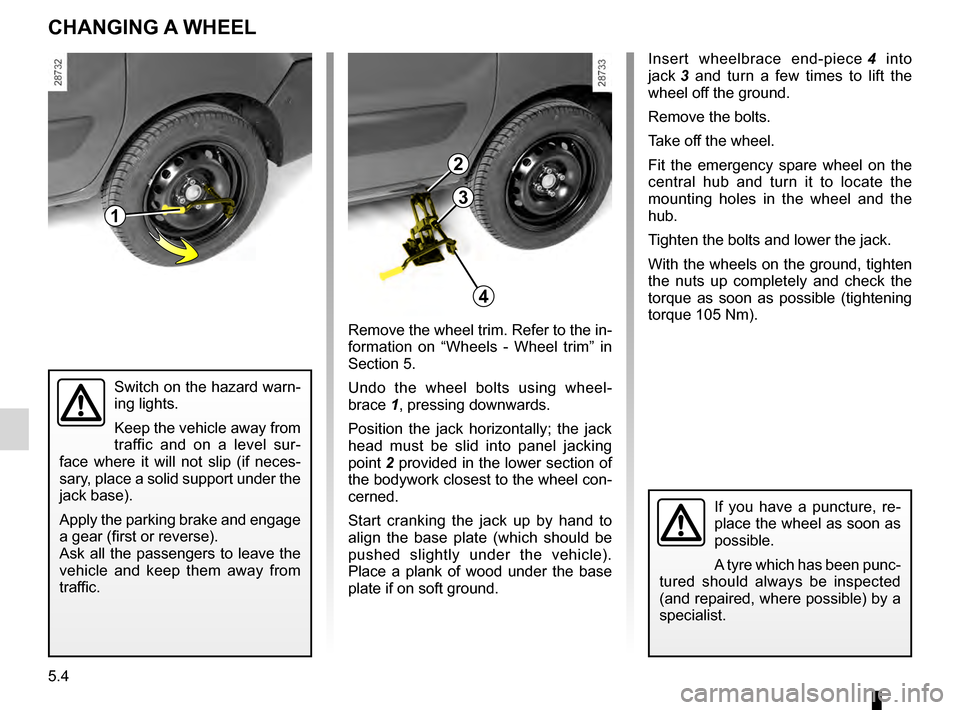
Insert wheelbrace end-piece 4 into
j
ack 3 and turn a few times to lift the
wheel off the ground.
Remove the bolts.
Take off the wheel.
Fit the emergency spare wheel on the
central hub and turn it to locate the
mounting holes in the wheel and the
hub.
Tighten the bolts and lower the jack.
With the wheels on the ground, tighten
the nuts up completely and check the
torque as soon as possible (tightening
torque 105 Nm).
Changing a wheel
If you have a puncture, re-
place the wheel as soon as
possible.
A tyre which has been punc-
tured should always be inspected
(and repaired, where possible) by a
specialist.
chAnging A WhEEl
1
2
4
3
Switch on the hazard warn-
ing lights.
Keep the vehicle away from
traffic and on a level sur-
face where it will not slip (if neces-
sary, place a solid support under the
jack base).
Apply the parking brake and engage
a gear (first or reverse).
Ask all the passengers to leave the
vehicle and keep them away from
traffic.
Remove the wheel trim. Refer to the in-
formation on “Wheels - Wheel trim” in
Section 5.
Undo the wheel bolts using wheel-
brace
1, pressing downwards.
Position the jack horizontally; the jack
head must be slid into panel jacking
point
2 provided in the lower section of
the bodywork closest to the wheel con-
cerned.
Start cranking the jack up by hand to
align the base plate (which should be
pushed slightly under the vehicle).
Place a plank of wood under the base
plate if on soft ground.
Page 120 of 173
bulbschanging ......................................... (up to the end of the DU)
changing a bulb .................................... (up to the end of the DU)
practical advice ..................................... (up to the end of the DU)
front lights changing bulbs ................................ (up to the end of the DU)
bulbs changing ......................................... (up to the end of the DU)
5.8
ENG_UD7316_1
Feux avant avec lampes halogènes : remplacement des lampes (X76 - Re\
nault)
ENG_NU_854-2_X76LL_Renault_5
Jaune NoirNoir texte
Changing bulbs
Front lights
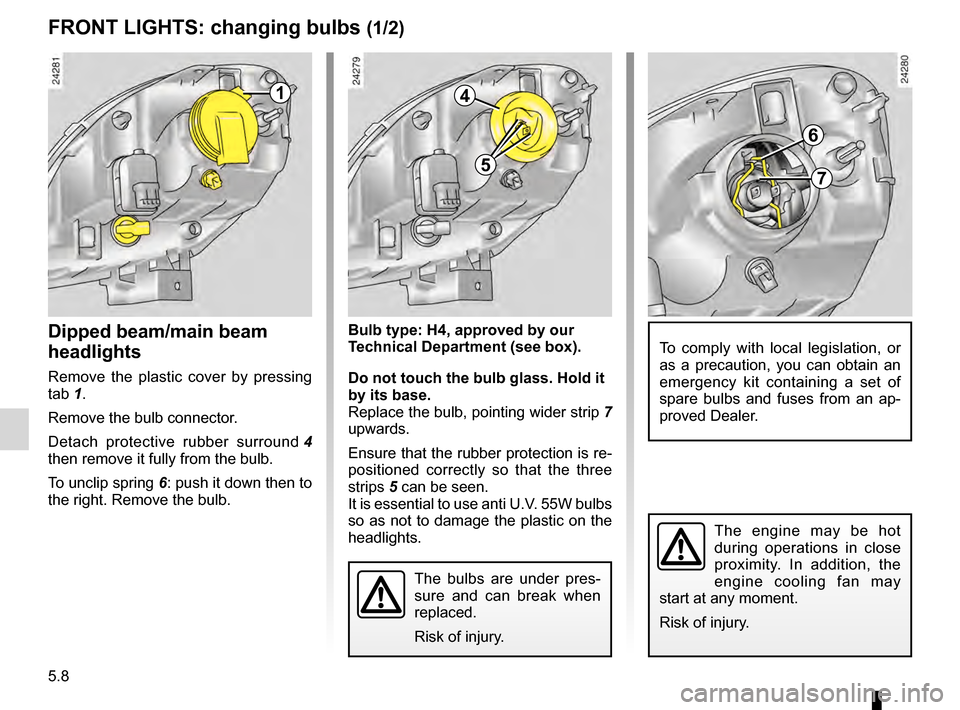
Bulb type: h4, approved by our
t echnical
Department (see box).
Do not touch the bulb glass. hold it
by
its base.
Replace the bulb, pointing wider strip 7
upwards.
Ensure that the rubber protection is re-
positioned correctly so that the three
strips
5 can be seen.
It is essential to use anti U.V. 55W bulbs
so as not to damage the plastic on the
headlights.
Dipped beam/main beam
headlights
Remove the plastic cover by pressing
tab
1.
Remove the bulb connector.
D
etach protective rubber surround 4
then remove it fully from the bulb.
T
o unclip spring 6: push it down then to
the right. Remove the bulb.
FrOnt lights : changing bulbs (1/2)
14
5
6
7
To comply with local legislation, or
as a precaution, you can obtain an
emergency kit containing a set of
spare bulbs and fuses from an ap-
proved Dealer.
The engine may be hot
during operations in close
proximity. In addition, the
engine cooling fan may
start at any moment.
Risk of injury.
The bulbs are under pres-
sure and can break when
replaced.
Risk of injury.
Page 121 of 173
indicators ............................................................... (current page)
indicators: direction indicators ........................................... (current page)
lights changing bulbs ................................................. (current page)
Jaune NoirNoir texte
5.9
ENG_UD7316_1
Feux avant avec lampes halogènes : remplacement des lampes (X76 - Re\
nault)
ENG_NU_854-2_X76LL_Renault_5
The bulbs are under pres-
sure and can break when
replaced.
Risk of injury.
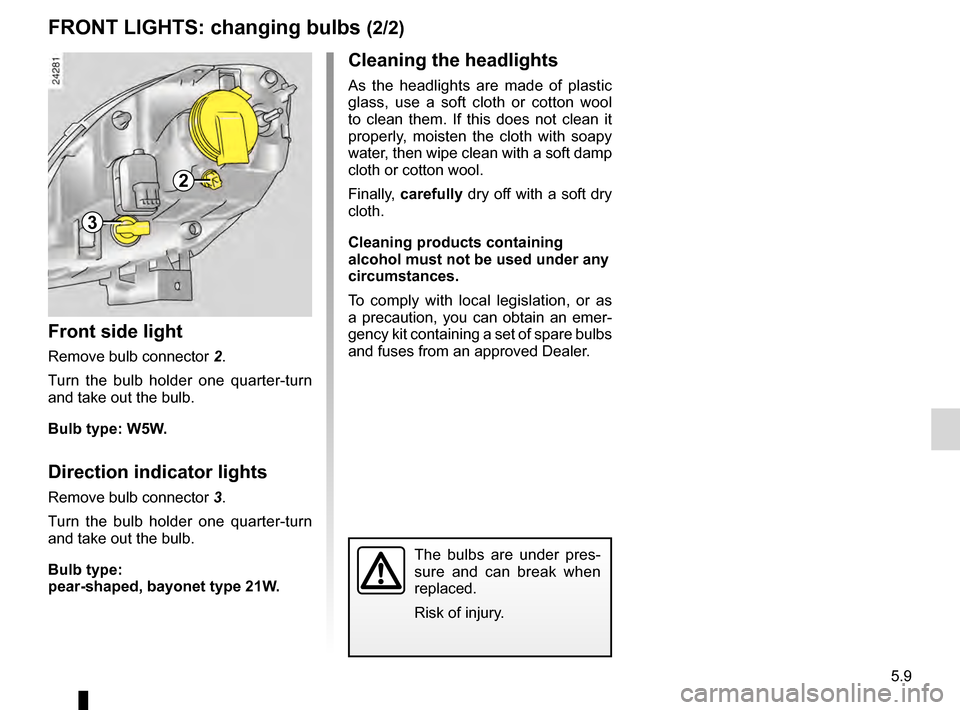
Front side light
Remove bulb connector 2.
Turn the bulb holder one quarter-turn
and take out the bulb.
Bulb
type: W5W.
Direction indicator lights
Remove bulb connector 3.
Turn the bulb holder one quarter-turn
and take out the bulb.
Bulb
type:
pear-shaped, bayonet type 21W.
FrOnt lights: changing bulbs (2/2)
2
3
cleaning the headlights
As the headlights are made of plastic
glass, use a soft cloth or cotton wool
to clean them. If this does not clean it
properly, moisten the cloth with soapy
water, then wipe clean with a soft damp
cloth or cotton wool.
Finally, carefully
dry off with a soft dry
cloth.
c
leaning products containing
alcohol
must not be used under any
circumstances.
To comply with local legislation, or as
a precaution, you can obtain an emer-
gency kit containing a set of spare bulbs
and fuses from an approved Dealer.
Page 122 of 173
bulbschanging ......................................... (up to the end of the DU)
fog lights ............................................... (up to the end of the DU)
changing a bulb .................................... (up to the end of the DU)
bulbs changing ......................................... (up to the end of the DU)
5.10
ENG_UD7317_1
Projecteurs antibrouillard : remplacement des lampes (X76 - Renault)
ENG_NU_854-2_X76LL_Renault_5
Additional lights
If you wish to fit fog lights or long range
headlights to your vehicle, consult an
approved dealer.
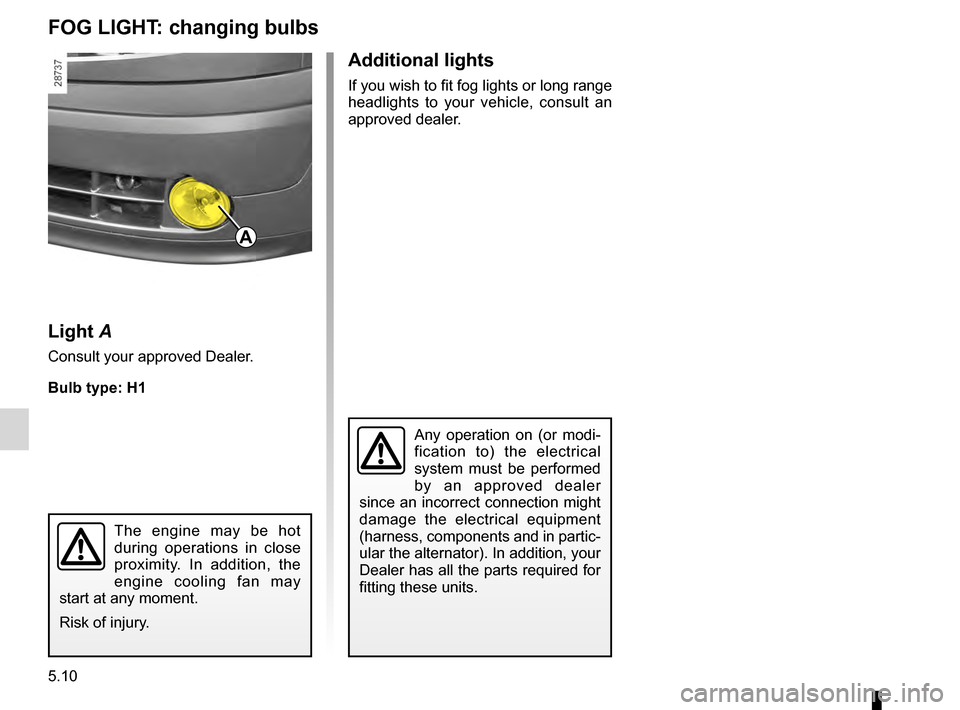
Fog lights
light A
Consult your approved Dealer.
Bulb type: h1
FOg light: changing bulbs
A
The engine may be hot
during operations in close
proximity. In addition, the
engine cooling fan may
start at any moment.
Risk of injury.
Any operation on (or modi-
fication to) the electrical
system must be performed
by an approved dealer
since an incorrect connection might
damage the electrical equipment
(harness, components and in partic-
ular the alternator). In addition, your
Dealer has all the parts required for
fitting these units.