brake RENAULT KANGOO 2018 Owner's Manual
[x] Cancel search | Manufacturer: RENAULT, Model Year: 2018, Model line: KANGOO, Model: RENAULT KANGOO 2018Pages: 264, PDF Size: 7.09 MB
Page 199 of 264
5.5
TYRE INFLATION KIT (2/4)
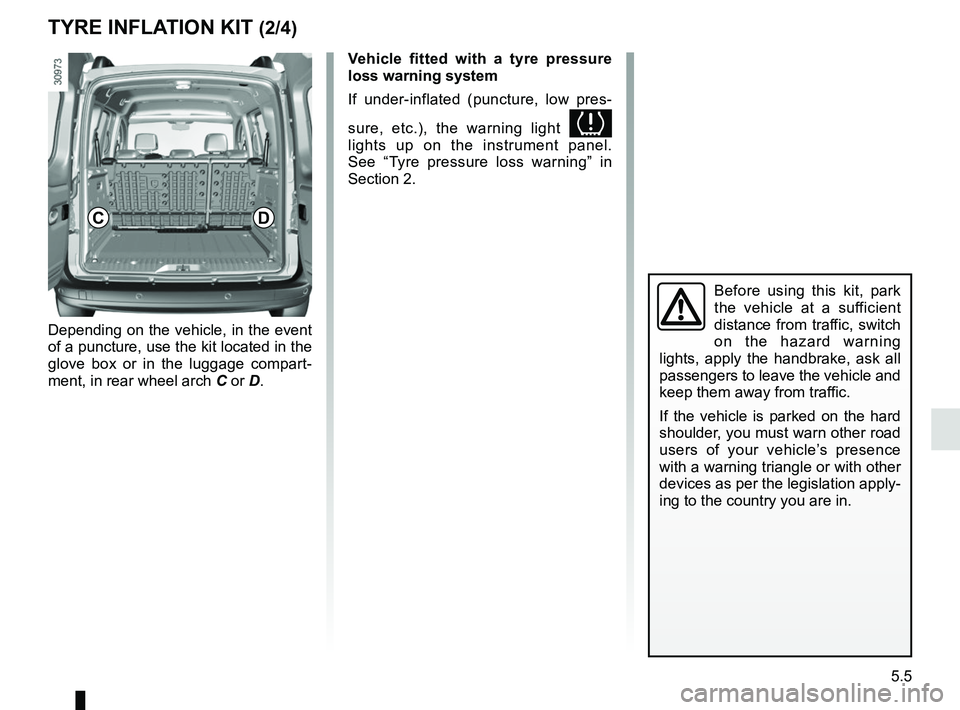
Depending on the vehicle, in the event
of a puncture, use the kit located in the
glove box or in the luggage compart-
ment, in rear wheel arch C or D.
Before using this kit, park
the vehicle at a sufficient
distance from traffic, switch
on the hazard warning
lights, apply the handbrake, ask all
passengers to leave the vehicle and
keep them away from traffic.
If the vehicle is parked on the hard
shoulder, you must warn other road
users of your vehicle’s presence
with a warning triangle or with other
devices as per the legislation apply-
ing to the country you are in.
C
Vehicle fitted with a tyre pressure
loss warning system
If under-inflated (puncture, low pres-
sure, etc.), the warning light
lights up on the instrument panel.
See “Tyre pressure loss warning” in
Section 2.
D
Page 200 of 264
5.6
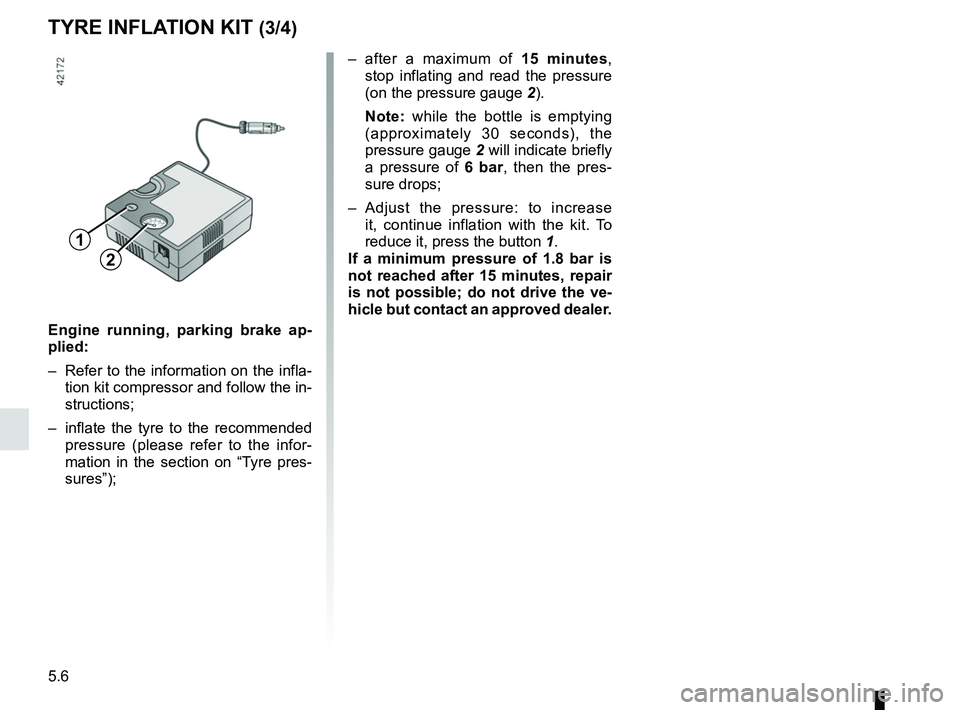
– after a maximum of 15 minutes, stop inflating and read the pressure
(on the pressure gauge 2).
Note: while the bottle is emptying
(approximately 30 seconds), the
pressure gauge 2 will indicate briefly
a pressure of 6 bar, then the pres-
sure drops;
– Adjust the pressure: to increase it, continue inflation with the kit. To
reduce it, press the button 1.
If a minimum pressure of 1.8 bar is
not reached after 15 minutes, repair
is not possible; do not drive the ve-
hicle but contact an approved dealer.
Engine running, parking brake ap-
plied:
– Refer to the information on the infla- tion kit compressor and follow the in-
structions;
– inflate the tyre to the recommended pressure (please refer to the infor-
mation in the section on “Tyre pres-
sures”);
TYRE INFLATION KIT (3/4)
2
1
Page 205 of 264
5.11
2
3
1
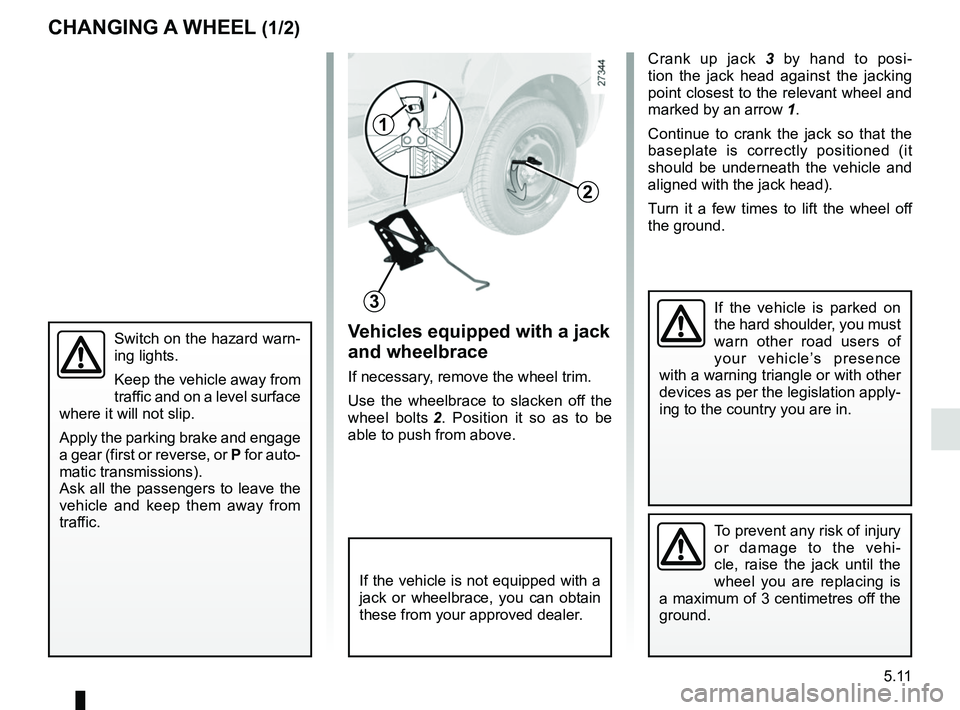
Vehicles equipped with a jack
and wheelbrace
If necessary, remove the wheel trim.
Use the wheelbrace to slacken off the
wheel bolts 2. Position it so as to be
able to push from above.
Switch on the hazard warn-
ing lights.
Keep the vehicle away from
traffic and on a level surface
where it will not slip.
Apply the parking brake and engage
a gear (first or reverse, or P for auto-
matic transmissions).
Ask all the passengers to leave the
vehicle and keep them away from
traffic.
CHANGING A WHEEL (1/2)
Crank up jack 3 by hand to posi-
tion the jack head against the jacking
point closest to the relevant wheel and
marked by an arrow 1.
Continue to crank the jack so that the
baseplate is correctly positioned (it
should be underneath the vehicle and
aligned with the jack head).
Turn it a few times to lift the wheel off
the ground.
To prevent any risk of injury
or damage to the vehi-
cle, raise the jack until the
wheel you are replacing is
a maximum of 3 centimetres off the
ground.
If the vehicle is parked on
the hard shoulder, you must
warn other road users of
your vehicle’s presence
with a warning triangle or with other
devices as per the legislation apply-
ing to the country you are in.
If the vehicle is not equipped with a
jack or wheelbrace, you can obtain
these from your approved dealer.
Page 213 of 264
5.19
The bulbs are under pres-
sure and can break when
replaced.
Risk of injury.
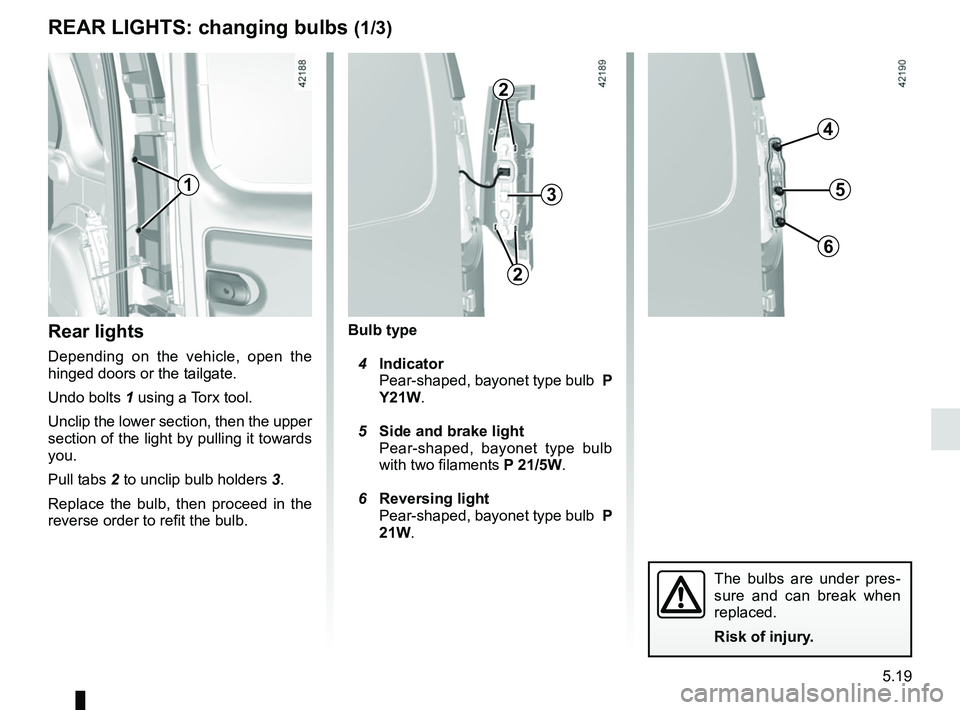
Bulb type
4 Indicator
Pear-shaped, bayonet type bulb P
Y21W.
5 Side and brake light
Pear-shaped, bayonet type bulb
with two filaments P 21/5W.
6 Reversing light
Pear-shaped, bayonet type bulb P
21W.Rear lights
Depending on the vehicle, open the
hinged doors or the tailgate.
Undo bolts 1 using a Torx tool.
Unclip the lower section, then the upper
section of the light by pulling it towards
you.
Pull tabs 2 to unclip bulb holders 3.
Replace the bulb, then proceed in the
reverse order to refit the bulb.
REAR LIGHTS: changing bulbs (1/3)
31
2
2
5
4
6
Page 214 of 264
5.20
REAR LIGHTS: changing bulbs (2/3)
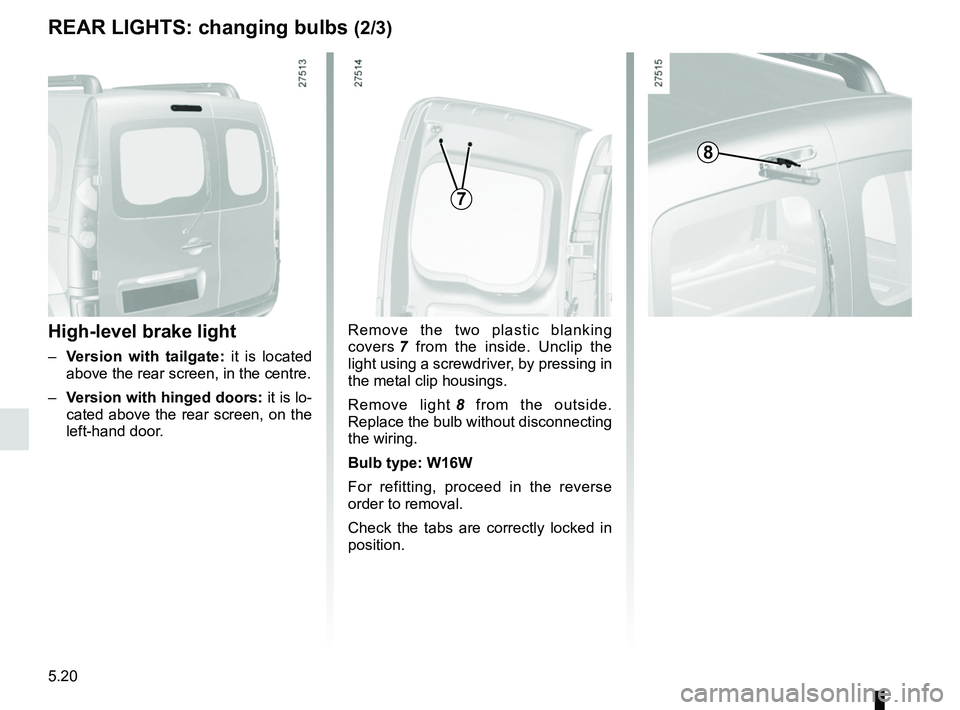
High-level brake light
– Version with tailgate: it is located
above the rear screen, in the centre.
– Version with hinged doors: it is lo-
cated above the rear screen, on the
left-hand door. Remove the two plastic blanking
covers 7
from the inside. Unclip the
light using a screwdriver, by pressing in
the metal clip housings.
Remove light 8 from the outside.
Replace the bulb without disconnecting
the wiring.
Bulb type: W16W
For refitting, proceed in the reverse
order to removal.
Check the tabs are correctly locked in
position.
7
8
Page 222 of 264

5.28
FUSES (2/2)
Number Allocation
1 Fuel pump
2 Not used
3 Passenger compartment
engine cooling fan
4 Passenger compartment
engine cooling fan
5 Rear windscreen wiper
6 Horn, diagnostic socket
7 Heated seats
8 Electric rear windows
9 Passenger compartment
ECU
10 Windscreen washer
11 Brake lights
12 Passenger compartment
unit, ABS, ESP
13 Electric windows, child
safety, heating and air
conditioning system, ECO
mode
14 Not used
15 StarterNumber Allocation
16 Brake lights, additional
equipment, navigation,
ABS, ESP, boot light, tyre
pressure warning light,
interior lights, rain and light
sensor
17 Radio, navigation system,
display, alarm
18 Additional equipment
19 Heated door mirrors
20 Hazard lights, rear fog lights
21 Central locking of opening
elements
22 Instrument panel
23 Rear accessories socket
24 ESC, radio, heating and air
conditioning system, heated
seats, stop lights
25 Front accessories socket
26 Towbar
27 Electric front windows
28 Rear-view mirror control
29 De-icing the rear screen and
rear view mirror
12
3456
78910
11121314
15161718
19202122
23242526
27
28
29
Allocation of fusesThe presence of certain fuses de-
pends on the vehicle equipment
level.
Page 225 of 264
5.31
Before towing, unlock the steering
column: with the clutch dipped, engage
first gear (lever in N or R positions for
vehicles with an automatic gearbox),
insert the key in the ignition-starter
switch.
Reposition the lever to neutral (position
N for vehicles fitted with an automatic
gearbox).
The column is unlocked, the acces-
sory functions are supplied: the vehi-
cle lights can be used (indicators, brake
lights etc.). At night the vehicle must
have its lights on. The speed specified by current legis-
lation for towing must always be ob-
served. If your vehicle is the towing
vehicle, do not exceed the maximum
towing weight for your vehicle (refer to
the information on “Weights” in Section
6).
Towing a vehicle with an
automatic gearbox
With the engine switched off:
the
gearbox is no longer lubricated. It is
preferable to tow this type of vehicle on
a trailer or tow it with the front wheels
off the ground.
Under exceptional circumstances ,
you may tow the vehicle with all four
wheels on the ground, only going
forward, with the gear lever in the
Neutral position, and for a distance
not exceeding 30 miles (50 km).
TOWING: breakdown (1/2)
When the engine is
stopped, steering and brak-
ing assistance are not op-
erational.
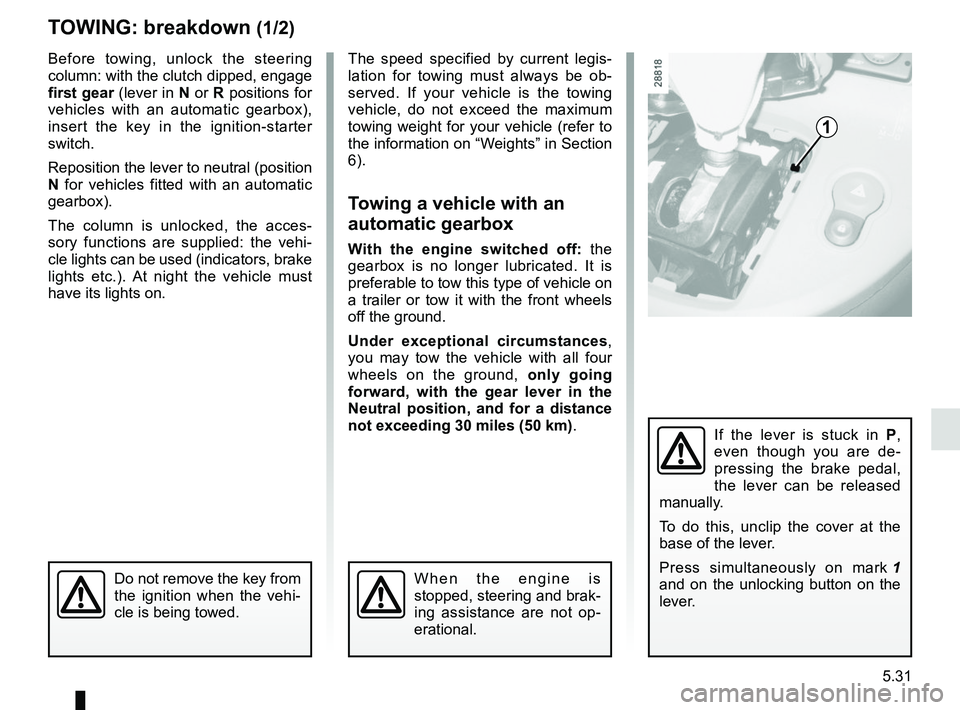
1
If the lever is stuck in P ,
even though you are de-
pressing the brake pedal,
the lever can be released
manually.
To do this, unclip the cover at the
base of the lever.
Press simultaneously on mark 1
and on the unlocking button on the
lever.
Do not remove the key from
the ignition when the vehi-
cle is being towed.
Page 226 of 264
5.32
TOWING: breakdown (2/2)
43
– Use a rigid towing bar.
If a rope or cable is used
(where the law allows this),
the vehicle being towed
must be able to brake.
– A vehicle must not be towed if it is not fit to be driven.
– Avoid accelerating or braking suddenly when towing, as this
may result in damage being
caused to the vehicle.
– When towing a vehicle, it is ad- visable not to exceed 15 mph
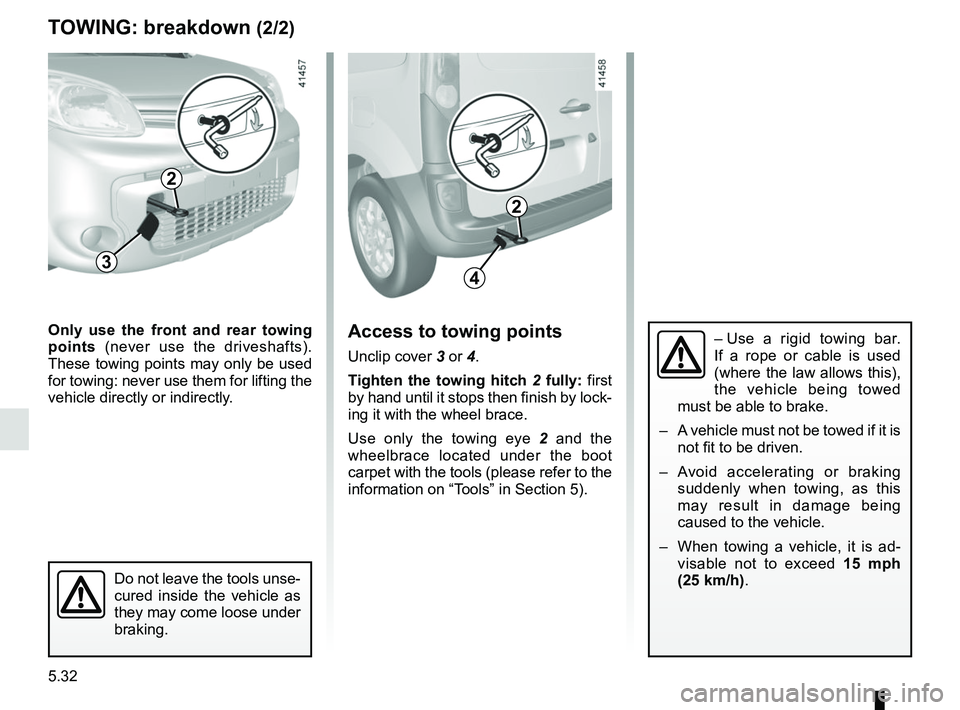
(25 km/h).Access to towing points
Unclip cover 3 or 4.
Tighten the towing hitch 2 fully: first
by hand until it stops then finish by lock-
ing it with the wheel brace.
Use only the towing eye 2 and the
wheelbrace located under the boot
carpet with the tools (please refer to the
information on “Tools” in Section 5).
2
2
Only use the front and rear towing
points (never use the driveshafts).
These towing points may only be used
for towing: never use them for lifting the
vehicle directly or indirectly.
Do not leave the tools unse-
cured inside the vehicle as
they may come loose under
braking.
Page 229 of 264

5.35
ACCESSORIES
Electrical and electronic accessories
Before installing this type of accessory (particularly for transmitters\
/receivers: frequency bandwidth, power level, po-
sition of the aerial, etc.), make sure it is compatible with your vehic\
le. You can get advice from an authorised dealer.
Connect accessories with a maximum power of 120 Watts only. Fire hazard. When several accessory sockets are
used at the same time, the total power of the connected accessories must\
not exceed 180 watts.
No work may be carried out on the vehicle’s electrical or radio circuits, except by authorised dealers: an incorre\
ctly connecte d
system may result in damage being caused to the electrical equipment and\
/or the components connected to it.
If the vehicle is fitted with any aftermarket electrical equipment, make\
sure that the installation is correctly protected by a fuse.
Establish the rating and position of this fuse.
Using the diagnostic socket
The use of electronic accessories on the diagnostic socket may cause ser\
ious disturbance to the vehicle’s electronic systems.
For your safety we recommend that you use only electronic accessories ap\
proved by the manufacturer, consult an Approved
Dealer. Serious accident risk.
Use of transmitting/receiving devices (telephones, CB equipment etc.).\
Telephones and CB equipment with integrated aerials may cause interferenc\
e to the electronic systems originally fitted to the
vehicle: it is advisable only to use equipment with an external aerial. \
Furthermore, we remind you of the need to conform
to the legislation in force concerning the use of such equipment.
Fitting aftermarket accessories
If you wish to install accessories on the vehicle: please contact an aut\
horised dealer. Also, to ensure the correct operation o f
your vehicle, and to avoid any risk to your safety, we recommend that you use only accessories specifically designed for y\
our
vehicle, which are the only accessories for which the manufacturer will \
provide a warranty.
If you are using an anti-theft device, only attach it to the brake pedal\
.
Obstructions to the driver
On the driver’s side, only use mats suitable for the vehicle, attached with the pre-fi\
tted components, and check the fitting re gu-
larly. Do not lay one mat on top of another. There is a risk of wedging the pedals.
Page 242 of 264

Total")
6.6
The weights indicated are for a basic vehicle without options: they vary\
depending on the your vehicle’s equipment.
Contact an approved Dealer.
Maximum permissible all-up weight (MMAC)
Total train weight (MTR)Van version Estate version
Weights are indicated on the vehicle identification plate (refer to the information on “Vehicle identification plates” in Section 6)
Braked Trailer Weight * found by calculating: MTR - MMAC
Unbraked trailer weight * 610 695
Permissible nose weight * 75
Maximum permissible load on roof 100 (including the carrying device)
* Towing weight (Towing a caravan, boat, etc.)
Towing is prohibited when the GTW - MAM calculation is equal to zero, or \
when the GTW is equal to zero (or is not listed) on th e
identification plate.
– It is important to respect local towing regulations in force, specifical\
ly those set out in the Highway Code. Please contact your
authorised dealer about adapting any towing equipment.
– When towing, under no circumstances may the total train weight (vehicle + trailer) be exceeded . However the following is
permitted:
– the Maximum permissible weight at the rear may be exceeded by no more th\
an 15%,
– the maximum permissible all-up weight may be exceeded by no more than 10\
% or 100 kg (whichever occurs first).
In either case, the maximum speed of the vehicle and trailer must not ex\
ceed 48 mph (80 km/h) (van versions) or 60 mph (100 km/h) (estate versions) and the tyre pressure must be increased\
by 0.2 bar (3 PSI).
– The engine output and climbing capability are reduced with altitude. We recommend that the maximum load be reduced by 10% at an altitude of 1,000 metres and by an additional 10% for each 1,000 m\
etres thereafter.
Load transfer on Estate versions, average wheelbase
Depending on the local legislation, if the Maximum Authorised Mass of the vehicle has not been reached, up to 300 kg can be\
transferred to the braked trailer, within the limits of the Gross Train Weight.
WEIGHTS (in kg)