check RENAULT KANGOO 2018 Repair Manual
[x] Cancel search | Manufacturer: RENAULT, Model Year: 2018, Model line: KANGOO, Model: RENAULT KANGOO 2018Pages: 264, PDF Size: 7.09 MB
Page 191 of 264
4.17
Using a roller type car wash
Return the windscreen wiper stalk to
the Park position (refer to the informa-
tion on the “Windscreen washer, wiper”
in Section 1). Check the mounting of
external accessories, additional lights
and mirrors, and ensure that the wiper
blades are secured with adhesive tape.
Remove the radio aerial mast if your
vehicle is fitted with this equipment.
Remember to remove the tape and refit
the antenna after washing.
Vehicles with a matte paint
finish
This type of paint requires certain pre-
cautions.
You should do the following
Wash the vehicle by hand using plenty
of water, using a soft cloth or a gentle
sponge.
Do not do the following
Use wax-based products (polishing).
Rub too hard.
Wash the vehicle in a roller-type car
wash.
Attach stickers to the paintwork (risk of
leaving marks).
Wash the vehicle
using a high-pressure
cleaning device.
BODYWORK MAINTENANCE (3/3)Cleaning the headlights
As the headlights are made of plastic
“glass”, use a soft cloth or cotton wool
to clean them. If this does not clean
them properly, moisten the cloth with
soapy water, then wipe clean with a soft
damp cloth or cotton wool.
Finally, carefully dry off with a soft dry
cloth.
Do not use cleaning products con-
taining alcohol or utensils (e.g.: a
scraper).
Page 197 of 264

If the emergency spare wheel has been stored for several years, have it \
checked by your Dealer to ensure that it is
safe to use.
Vehicle fitted with an eme")
5.3
PUNCTURE, EMERGENCY SPARE WHEEL (2/2)
If the emergency spare wheel has been stored for several years, have it \
checked by your Dealer to ensure that it is
safe to use.
Vehicle fitted with an emergency spare wheel that differs from the other \
wheels:
– Never fit more than one emergency spare wheel to the same vehicle.
– As the punctured wheel is wider than the emergency spare wheel, the vehi\
cle’s ground clearance is reduced.
– Replace the emergency spare wheel as soon as possible with a wheel ident\
ical to the original one.
– If wheel bolts are supplied with the emergency spare wheel, it is impera\
tive that they are used and that they are used for th e
emergency spare wheel only: refer to the label affixed to the emergency spare wheel.
– When this is fitted to the vehicle, which must only be a temporary measu\
re, the driving speed must not exceed the speed indicated on the label on the wheel.
– Fitting an emergency spare wheel may alter the way the vehicle usually r\
uns. Avoid sudden acceleration or deceleration and reduce your speed when cornering.
– If you need to use snow chains, fit the emergency spare wheel to the rea\
r axle and check the tyre pressure.
– The warning light
on the instrument panel flashes for several seconds, then stays on.
Page 198 of 264
5.4
TYRE INFLATION KIT (1/4)
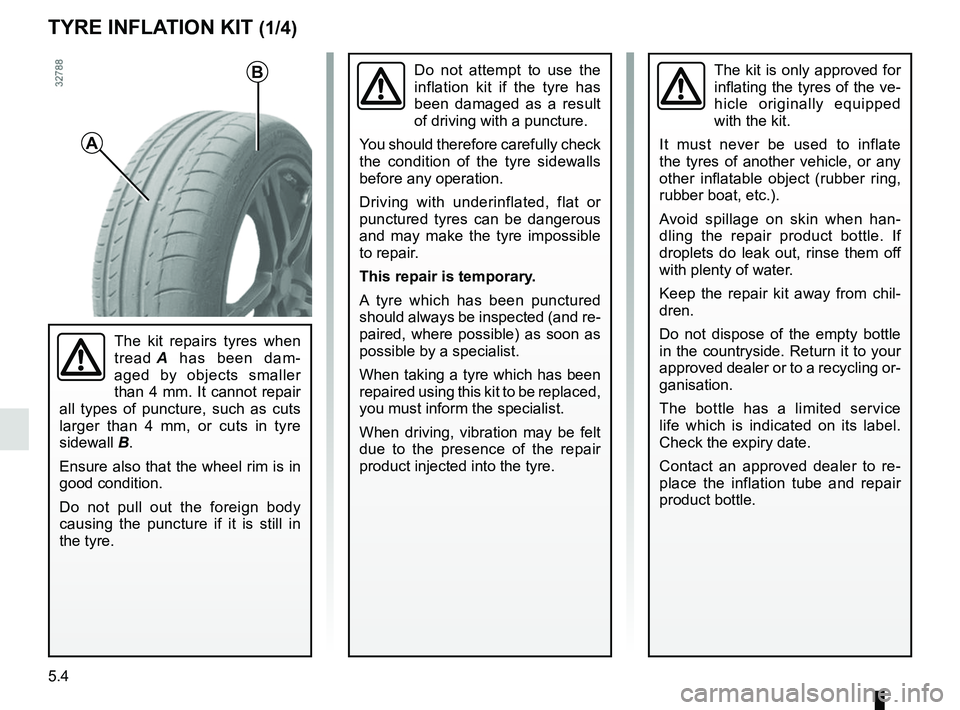
The kit repairs tyres when
tread A has been dam-
aged by objects smaller
than 4 mm. It cannot repair
all types of puncture, such as cuts
larger than 4 mm, or cuts in tyre
sidewall B.
Ensure also that the wheel rim is in
good condition.
Do not pull out the foreign body
causing the puncture if it is still in
the tyre.
Do not attempt to use the
inflation kit if the tyre has
been damaged as a result
of driving with a puncture.
You should therefore carefully check
the condition of the tyre sidewalls
before any operation.
Driving with underinflated, flat or
punctured tyres can be dangerous
and may make the tyre impossible
to repair.
This repair is temporary.
A tyre which has been punctured
should always be inspected (and re-
paired, where possible) as soon as
possible by a specialist.
When taking a tyre which has been
repaired using this kit to be replaced,
you must inform the specialist.
When driving, vibration may be felt
due to the presence of the repair
product injected into the tyre.The kit is only approved for
inflating the tyres of the ve-
hicle originally equipped
with the kit.
It must never be used to inflate
the tyres of another vehicle, or any
other inflatable object (rubber ring,
rubber boat, etc.).
Avoid spillage on skin when han-
dling the repair product bottle. If
droplets do leak out, rinse them off
with plenty of water.
Keep the repair kit away from chil-
dren.
Do not dispose of the empty bottle
in the countryside. Return it to your
approved dealer or to a recycling or-
ganisation.
The bottle has a limited service
life which is indicated on its label.
Check the expiry date.
Contact an approved dealer to re-
place the inflation tube and repair
product bottle.
A
B
Page 201 of 264
5.7
TYRE INFLATION KIT (4/4)
Please be aware that a
poorly tightened or miss-
ing valve cap can make the
tyres less airtight and lead
to pressure loss.
Always use valve caps identical to
those fitted originally and tighten
them fully.
Following repair with the kit,
do not travel further than
120 miles (200 km). In addi-
tion, reduce your speed and
under no circumstances exceed
48 mph (80 km/h). The sticker,
which you must affix in a prominent
position on the dashboard, reminds
you of this.
Depending on the country or local
legislation, a tyre repaired with the
inflation kit may need to be replaced.
Once the tyre is correctly inflated,
remove the kit: slowly unscrew the in-
flation end piece to prevent any product
spatter and store the container in plas-
tic packaging to prevent product leaks.
– Affix the driving recommendation label to the dashboard where it can
easily be seen by the driver;
– put the kit away;
– at the end of this initial inflation op- eration, air will still escape from the
tyre; you must drive a short distance
in order to seal the hole;
– start immediately and drive at be- tween 12.4 and 37.2 mph (20 and
60 km/h) in order to distribute the
product evenly in the tyre and, after
driving for 1.86 miles (3 km), stop
and check the pressure;
– if the pressure is greater than 1.3 bar but less than the recommended
pressure, re-adjust it (refer to the
label affixed to the edge of the driv-
er’s door), otherwise contact an ap-
proved dealer: repair is not possible. Precautions when using the kit
The kit should not be operated for more
than 15 consecutive minutes.
Nothing should be placed
around the driver’s feet
as such objects may slide
under the pedals during
sudden braking manoeuvres and
obstruct their use.
Page 202 of 264
5.8
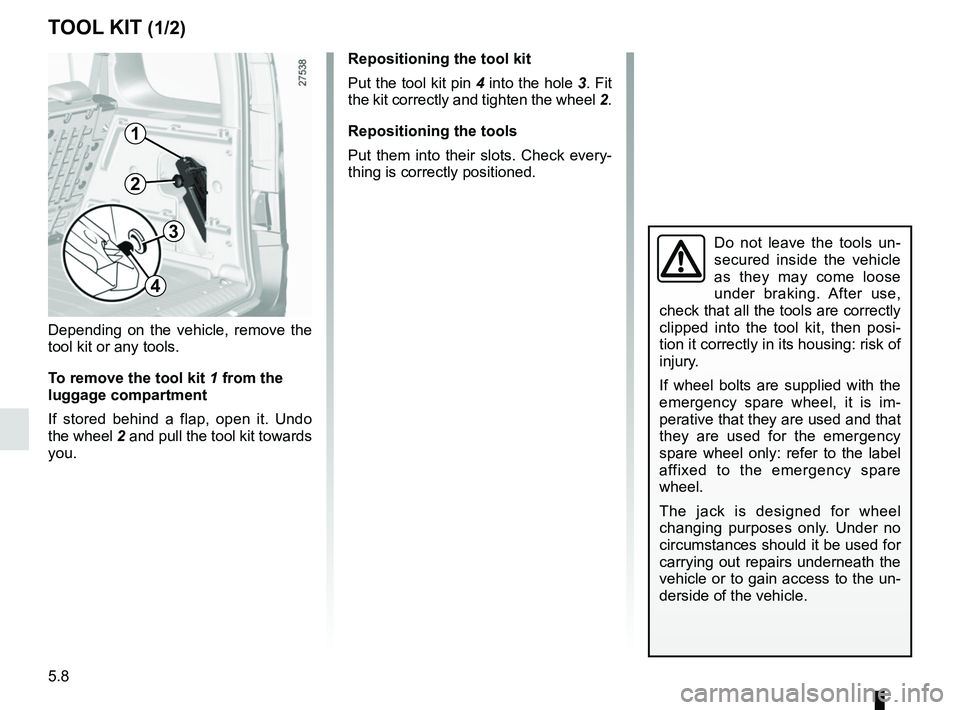
Depending on the vehicle, remove the
tool kit or any tools.
To remove the tool kit 1 from the
luggage compartment
If stored behind a flap, open it. Undo
the wheel 2 and pull the tool kit towards
you.
TOOL KIT (1/2)
1
3
2
4
Repositioning the tool kit
Put the tool kit pin 4 into the hole 3. Fit
the kit correctly and tighten the wheel 2.
Repositioning the tools
Put them into their slots. Check every-
thing is correctly positioned.
Do not leave the tools un-
secured inside the vehicle
as they may come loose
under braking. After use,
check that all the tools are correctly
clipped into the tool kit, then posi-
tion it correctly in its housing: risk of
injury.
If wheel bolts are supplied with the
emergency spare wheel, it is im-
perative that they are used and that
they are used for the emergency
spare wheel only: refer to the label
affixed to the emergency spare
wheel.
The jack is designed for wheel
changing purposes only. Under no
circumstances should it be used for
carrying out repairs underneath the
vehicle or to gain access to the un-
derside of the vehicle.
Page 206 of 264
5.12
Undo the bolts and take off the wheel.
For vehicles fitted with alloy wheels,
use the guide bolt located in the tool kit
to finish loosening and start tightening
the bolts.
Fit the emergency spare wheel on
the central hub and turn it to align the
mounting holes in the wheel and the
hub.
Tighten the bolts, checking that the
wheel is correctly positioned on its hub.
Lower the jack.
If bolts are supplied with the emergency
spare wheel, only use these bolts for
the emergency spare wheel.
With the wheel on the ground, tighten
the bolts fully and have the tightness of
the bolts checked and the emergency
spare wheel pressure checked as soon
as possible.
CHANGING A WHEEL (2/2)
Anti-theft bolts
If you use anti-theft bolts, fit these
nearest the valve (wheel trim may
not be able to fit).
If you have a puncture, re-
place the wheel as soon as
possible.
A tyre which has been punc-
tured should always be inspected
(and repaired, where possible) by a
specialist.
Vehicle fitted with a tyre pressure
loss warning system
If under-inflated (puncture, low pres-
sure, etc.), the warning light
lights up on the instrument panel. See
“Tyre pressure loss warning” in
Section 2.
Page 207 of 264
5.13
TYRES (1/3)Maintaining the tyres
The tyres must be in good condition
and the tread form must have sufficient
depth; tyres approved by our Technical
Department have tread wear indica-
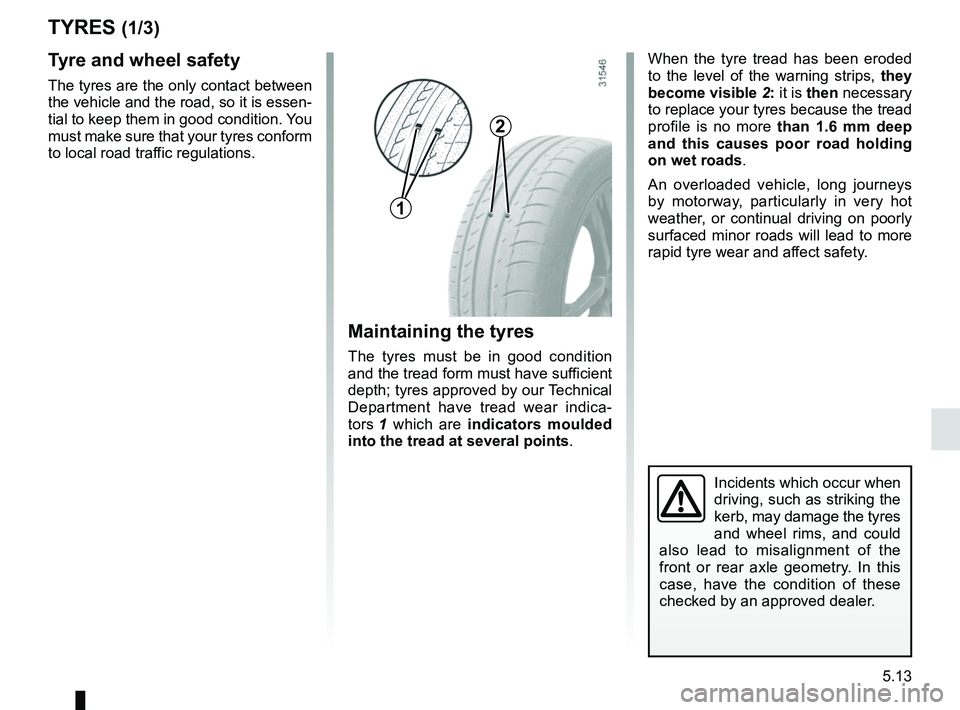
tors 1 which are indicators moulded
into the tread at several points .
Tyre and wheel safety
The tyres are the only contact between
the vehicle and the road, so it is essen-
tial to keep them in good condition. You
must make sure that your tyres conform
to local road traffic regulations. When the tyre tread has been eroded
to the level of the warning strips, they
become visible 2: it is then necessary
to replace your tyres because the tread
profile is no more than 1.6
mm deep
and this causes poor road holding
on wet roads.
An overloaded vehicle, long journeys
by motorway, particularly in very hot
weather, or continual driving on poorly
surfaced minor roads will lead to more
rapid tyre wear and affect safety.
Incidents which occur when
driving, such as striking the
kerb, may damage the tyres
and wheel rims, and could
also lead to misalignment of the
front or rear axle geometry. In this
case, have the condition of these
checked by an approved dealer.
1
2
Page 208 of 264
5.14
TYRES (2/3)
Pressures should be checked when the
tyres are cold; ignore higher pressures
which may be reached in hot weather
or following a fast journey.
If tyre pressures cannot be checked
when the tyres are cold, the normal
pressures must be increased by 0.2 to
0.3 bar (or 3 PSI).
Never deflate a hot tyre.Tyre pressuresRespect the tyre pressures (including
the emergency spare wheel). The tyre
pressures should be checked at least
once a month and additionally before
any long journey (refer to the label af-
fixed to the edge of the driver’s door,
described in the information on “Tyre
pressures” in Section 4).
Incorrect tyre pressures
lead to abnormal tyre wear
and unusually hot running.
These are factors which
may seriously affect safety and lead
to:
– poor road holding;
– risk of bursting or tread separa- tion.
The pressure depends on the load
and the speed of use. Adjust the
pressures according to the condi-
tions of use (refer to the information
on “Tyre pressures”).
Please be aware that a
poorly tightened or miss-
ing valve cap can make the
tyres less airtight and lead
to pressure loss.
Always use valve caps identical to
those fitted originally and tighten
them fully.
Vehicle fitted with a tyre pressure
loss warning system
If under-inflated (puncture, low pres-
sure, etc.), the warning light
lights up on the instrument panel. See
“Tyre pressure loss warning” in
Section 2.
Changing wheels around
This practice is not recommended.
Emergency spare wheel
Refer to the information on the
“Emergency spare wheel” and in-
structions on “Changing a wheel” in
Section 5.
Page 214 of 264
5.20
REAR LIGHTS: changing bulbs (2/3)
High-level brake light
– Version with tailgate: it is located
above the rear screen, in the centre.
– Version with hinged doors: it is lo-
cated above the rear screen, on the
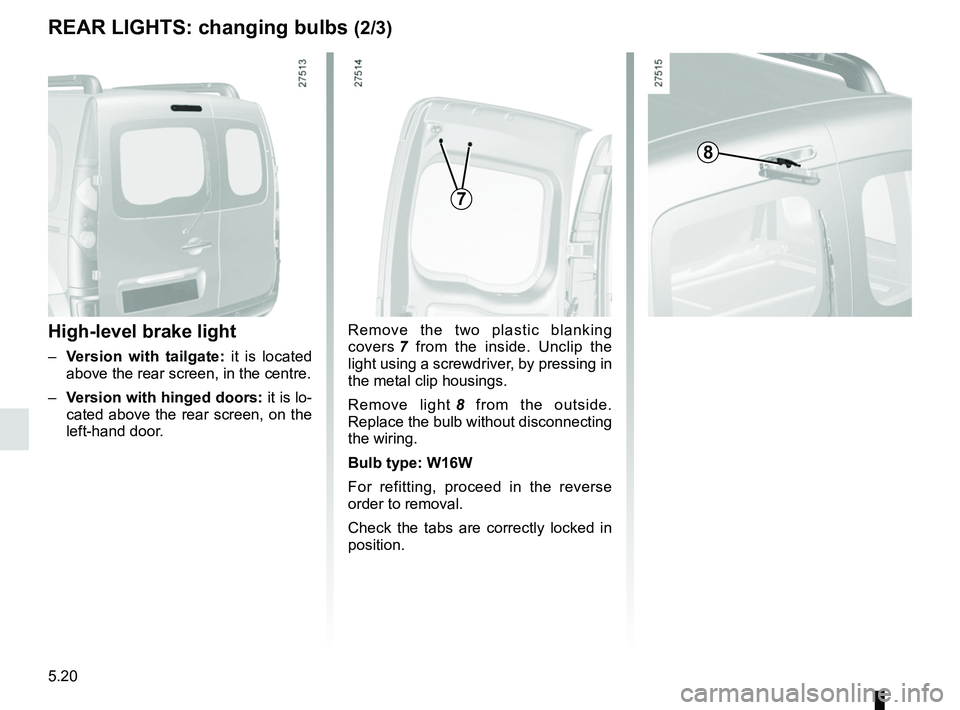
left-hand door. Remove the two plastic blanking
covers 7
from the inside. Unclip the
light using a screwdriver, by pressing in
the metal clip housings.
Remove light 8 from the outside.
Replace the bulb without disconnecting
the wiring.
Bulb type: W16W
For refitting, proceed in the reverse
order to removal.
Check the tabs are correctly locked in
position.
7
8
Page 220 of 264
5.26
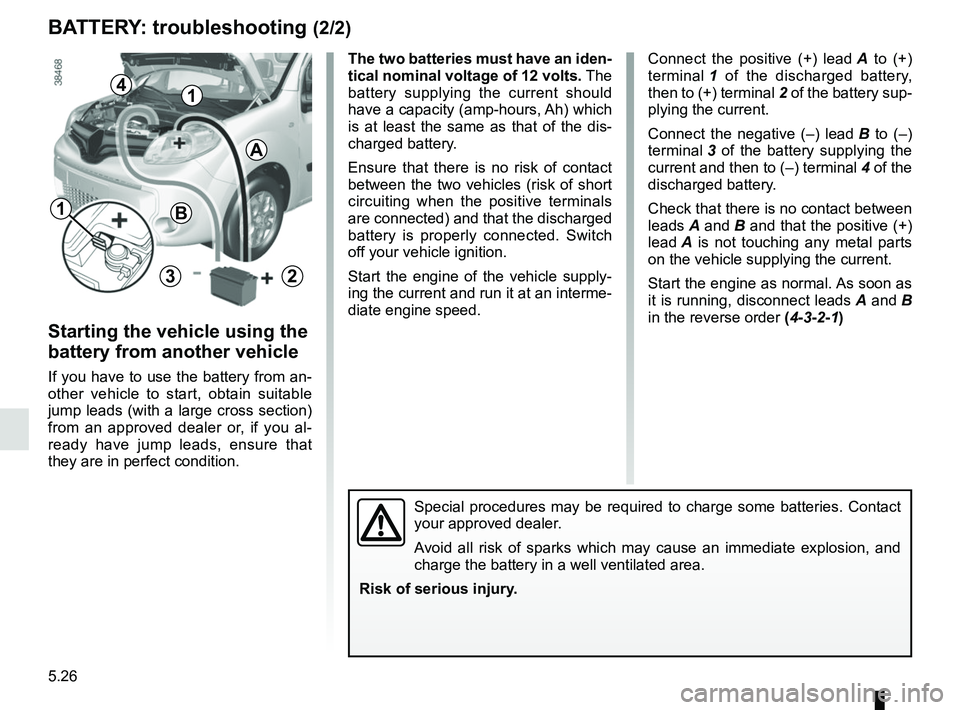
1
A
2
4
B
3
BATTERY: troubleshooting (2/2)
Connect the positive (+) lead A to (+)
terminal 1 of the discharged battery,
then to (+) terminal 2 of the battery sup-
plying the current.
Connect the negative (–) lead B to (–)
terminal 3 of the battery supplying the
current and then to (–) terminal 4 of the
discharged battery.
Check that there is no contact between
leads A and B and that the positive (+)
lead A is not touching any metal parts
on the vehicle supplying the current.
Start the engine as normal. As soon as
it is running, disconnect leads A and B
in the reverse order (4-3-2-1)
The two batteries must have an iden-
tical nominal voltage of 12 volts.
The
battery supplying the current should
have a capacity (amp-hours, Ah) which
is at least the same as that of the dis-
charged battery.
Ensure that there is no risk of contact
between the two vehicles (risk of short
circuiting when the positive terminals
are connected) and that the discharged
battery is properly connected. Switch
off your vehicle ignition.
Start the engine of the vehicle supply-
ing the current and run it at an interme-
diate engine speed.
Special procedures may be required to charge some batteries. Contact
your approved dealer.
Avoid all risk of sparks which may cause an immediate explosion, and
charge the battery in a well ventilated area.
Risk of serious injury.
1
Starting the vehicle using the
battery from another vehicle
If you have to use the battery from an-
other vehicle to start, obtain suitable
jump leads (with a large cross section)
from an approved dealer or, if you al-
ready have jump leads, ensure that
they are in perfect condition.