warning RENAULT KANGOO 2018 Repair Manual
[x] Cancel search | Manufacturer: RENAULT, Model Year: 2018, Model line: KANGOO, Model: RENAULT KANGOO 2018Pages: 264, PDF Size: 7.09 MB
Page 147 of 264

3.11
AUTOMATIC CLIMATE CONTROL (5/8)
In automatic mode, depending on
the outside air conditions, the ven-
tilation may not start immediately at
maximum power but will increase
progressively until the engine tem-
perature is warm enough to heat the
passenger compartment air. This
may take from a few seconds to se-
veral minutes.
Varying the ventilation speed
In automatic mode, the system uses
the most suitable amount of air to reach
and maintain the desired comfort level.
Automatic mode is switched off by pres-
sing buttons 8 and 10.
These buttons allow you to increase or
decrease ventilation speed.
Switching air conditioning on
or off
In automatic mode, the system switches
the air conditioning system on or off,
depending on the climate conditions.
Exit automatic mode by pressing
button 2: the AUTO warning light on
display 4 goes out. Note: the “Clear View” function auto-
matically activates the air conditioning.
Press button
5 to return to automatic
mode.
4
8
10
25
Page 176 of 264
4.2
BONNET (1/2)
1
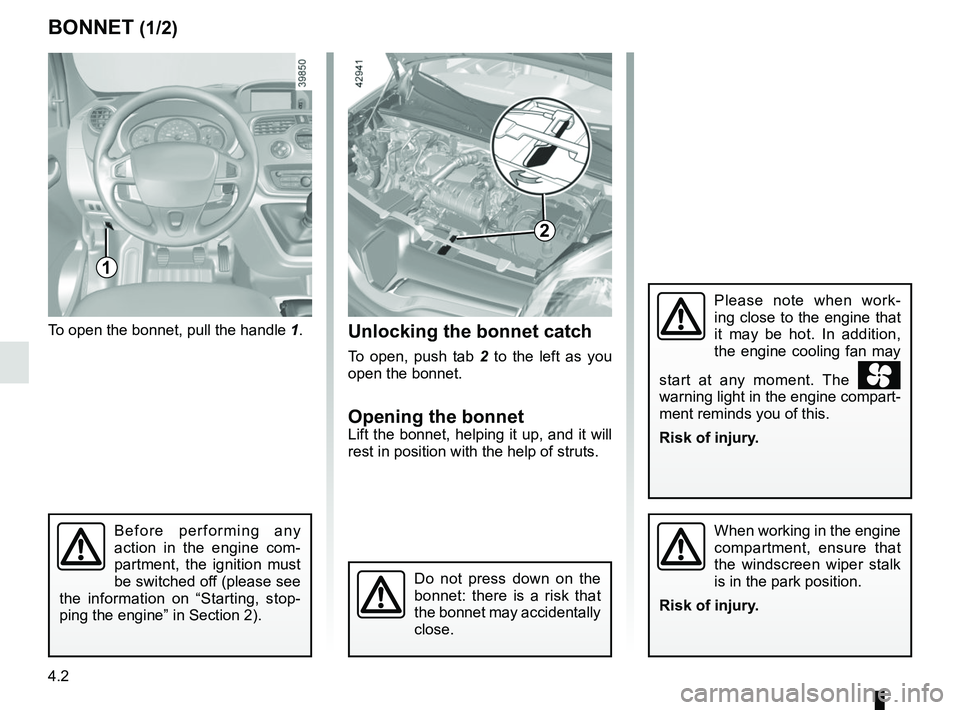
To open the bonnet, pull the handle 1.
Please note when work-
ing close to the engine that
it may be hot. In addition,
the engine cooling fan may
start at any moment. The
warning light in the engine compart-
ment reminds you of this.
Risk of injury.
Unlocking the bonnet catch
To open, push tab 2 to the left as you
open the bonnet.
Opening the bonnetLift the bonnet, helping it up, and it will
rest in position with the help of struts.
Do not press down on the
bonnet: there is a risk that
the bonnet may accidentally
close.
When working in the engine
compartment, ensure that
the windscreen wiper stalk
is in the park position.
Risk of injury.
2
Before performing any
action in the engine com-
partment, the ignition must
be switched off (please see
the information on “Starting, stop-
ping the engine” in Section 2).
Page 178 of 264
4.4
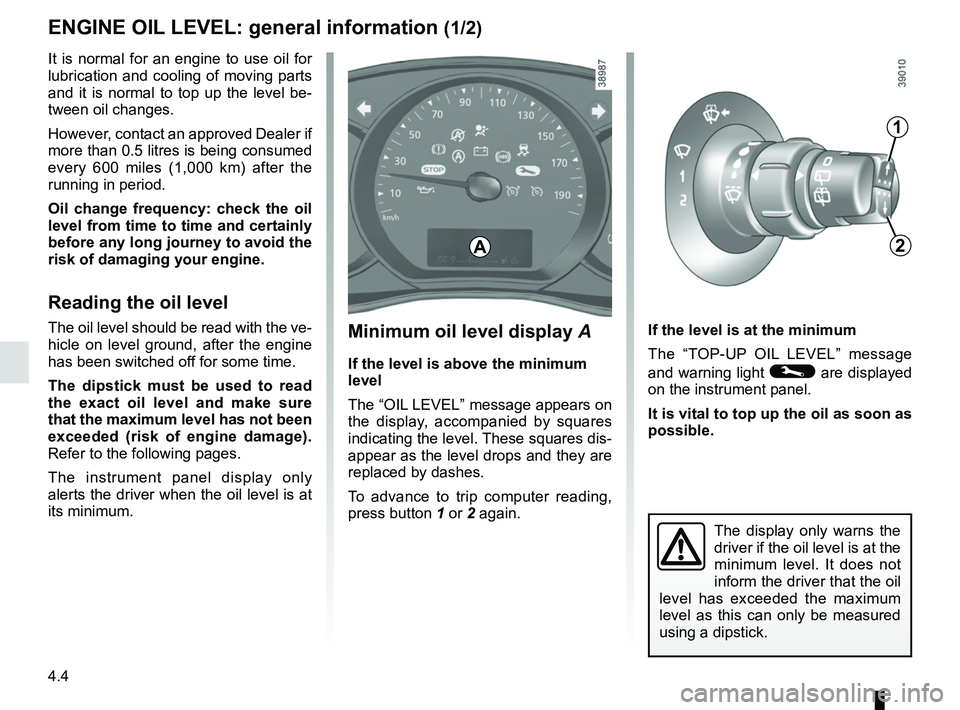
Minimum oil level display A
If the level is above the minimum
level
The “OIL LEVEL” message appears on
the display, accompanied by squares
indicating the level. These squares dis-
appear as the level drops and they are
replaced by dashes.
To advance to trip computer reading,
press button 1 or 2 again. If the level is at the minimum
The “TOP-UP OIL LEVEL” message
and warning light © are displayed
on the instrument panel.
It is vital to top up the oil as soon as
possible.
The display only warns the
driver if the oil level is at the
minimum level. It does not
inform the driver that the oil
level has exceeded the maximum
level as this can only be measured
using a dipstick.
It is normal for an engine to use oil for
lubrication and cooling of moving parts
and it is normal to top up the level be-
tween oil changes.
However, contact an approved Dealer if
more than 0.5 litres is being consumed
every 600 miles (1,000 km) after the
running in period.
Oil change frequency: check the oil
level from time to time and certainly
before any long journey to avoid the
risk of damaging your engine.
Reading the oil level
The oil level should be read with the ve-
hicle on level ground, after the engine
has been switched off for some time.
The dipstick must be used to read
the exact oil level and make sure
that the maximum level has not been
exceeded (risk of engine damage).
Refer to the following pages.
The instrument panel display only
alerts the driver when the oil level is at
its minimum.
1
2A
ENGINE OIL LEVEL: general information (1/2)
Page 179 of 264
4.5
Consult your approved Dealer at
once if you notice an abnormal or
repeated drop in any of the fluid
levels.
Please note when work-
ing close to the engine that
it may be hot. In addition,
the engine cooling fan may
start at any moment. The
warning light in the engine compart-
ment reminds you of this.
Risk of injury.
In order to prevent splashback, it is
recommended that a funnel be used
when topping up/filling with oil.
ENGINE OIL LEVEL: general information (2/2)
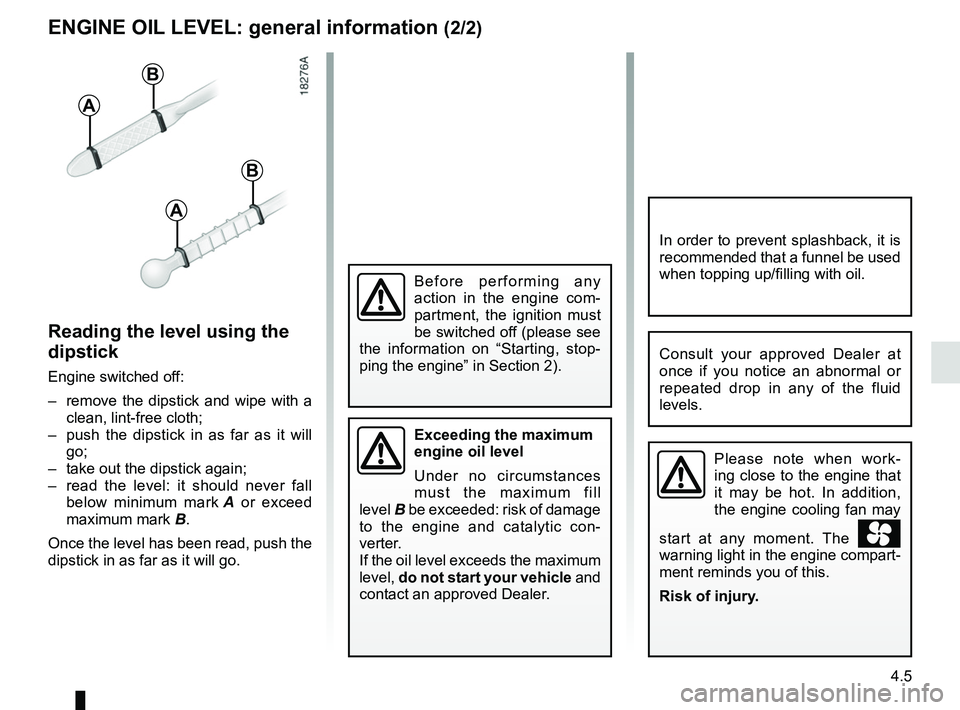
Reading the level using the
dipstick
Engine switched off:
– remove the dipstick and wipe with a clean, lint-free cloth;
– push the dipstick in as far as it will go;
– take out the dipstick again;
– read the level: it should never fall below minimum mark A or exceed
maximum mark B.
Once the level has been read, push the
dipstick in as far as it will go.
A
B
A
B
Exceeding the maximum
engine oil level
Under no circumstances
must the maximum fill
level B be exceeded: risk of damage
to the engine and catalytic con-
verter.
If the oil level exceeds the maximum
level, do not start your vehicle and
contact an approved Dealer.
Before performing any
action in the engine com-
partment, the ignition must
be switched off (please see
the information on “Starting, stop-
ping the engine” in Section 2).
Page 181 of 264
4.7
Engine oil grade
Refer to the Maintenance Service
Booklet for your vehicle.
Oil change
Service interval: refer to the
Maintenance Service Booklet for your
vehicle.
Oil change capacity
Please refer to the maintenance docu-
ment for your vehicle, or contact an au-
thorised dealer.
Always check the engine oil level using
the dipstick, as explained previously (it
should never fall below the minimum
level, or be over the maximum level on
the dipstick).
Engine oil change: if you
are changing the oil when
the engine is hot, be careful
not to scald yourself if the
oil overflows.
Consult your approved Dealer at
once if you notice an abnormal or
repeated drop in any of the fluid
levels.
Never run the engine in an
enclosed space as exhaust
gases are poisonous.
Filling: take care when
topping up the oil that
no oil drips onto engine
components - risk of fire.
Remember to refit the cap securely
as there is a risk of fire if oil splashes
onto hot engine components.
Please note when work-
ing close to the engine that
it may be hot. In addition,
the engine cooling fan may
start at any moment. The
warning light in the engine compart-
ment reminds you of this.
Risk of injury.
ENGINE OIL LEVEL: topping up/filling (2/2)ENGINE OIL CHANGE
Exceeding the maximum
engine oil level
Under no circumstances
must the maximum fill level
be exceeded: risk of damage to the
engine and catalytic converter.
If the oil level exceeds the maximum
level, do not start your vehicle and
contact an approved Dealer.
Page 185 of 264
4.11
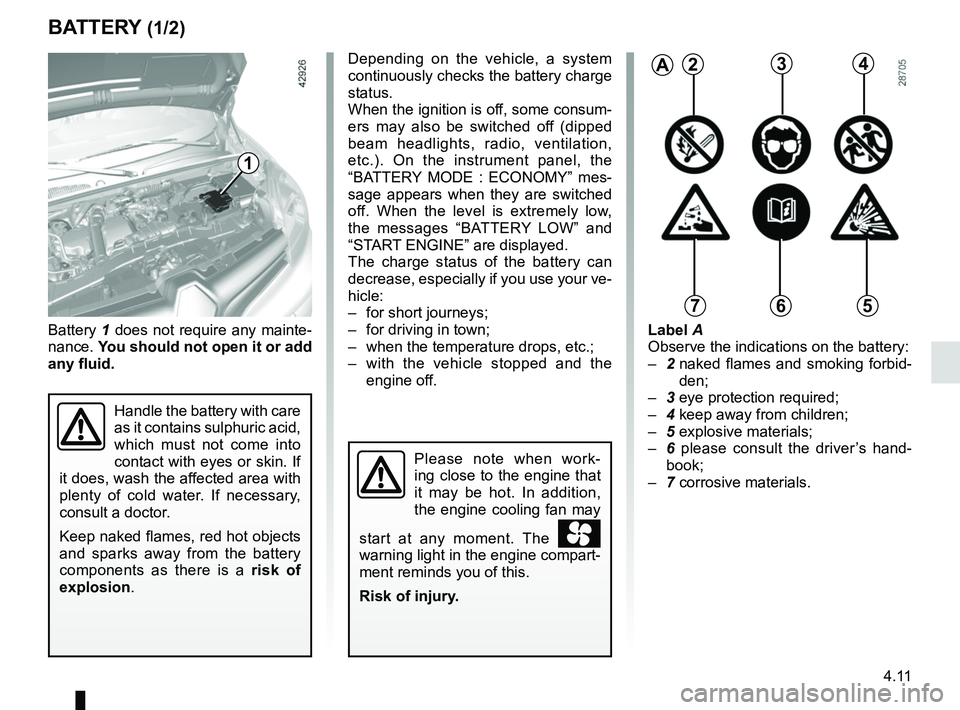
Label A
Observe the indications on the battery:
– 2 naked flames and smoking forbid-
den;
– 3 eye protection required;
– 4 keep away from children;
– 5 explosive materials;
– 6 please consult the driver’s hand-
book;
– 7 corrosive materials.
Battery
1 does not require any mainte-
nance. You should not open it or add
any fluid.
Handle the battery with care
as it contains sulphuric acid,
which must not come into
contact with eyes or skin. If
it does, wash the affected area with
plenty of cold water. If necessary,
consult a doctor.
Keep naked flames, red hot objects
and sparks away from the battery
components as there is a risk of
explosion .
BATTERY (1/2)
Depending on the vehicle, a system
continuously checks the battery charge
status.
When the ignition is off, some consum-
ers may also be switched off (dipped
beam headlights, radio, ventilation,
etc.). On the instrument panel, the
“BATTERY MODE : ECONOMY” mes-
sage appears when they are switched
off. When the level is extremely low,
the messages “BATTERY LOW” and
“START ENGINE” are displayed.
The charge status of the battery can
decrease, especially if you use your ve-
hicle:
– for short journeys;
– for driving in town;
– when the temperature drops, etc.;
– with the vehicle stopped and the
engine off.
Please note when work-
ing close to the engine that
it may be hot. In addition,
the engine cooling fan may
start at any moment. The
warning light in the engine compart-
ment reminds you of this.
Risk of injury.
1
A234
567
Page 187 of 264
4.13
TYRE PRESSURE WHEN cold (1/2)
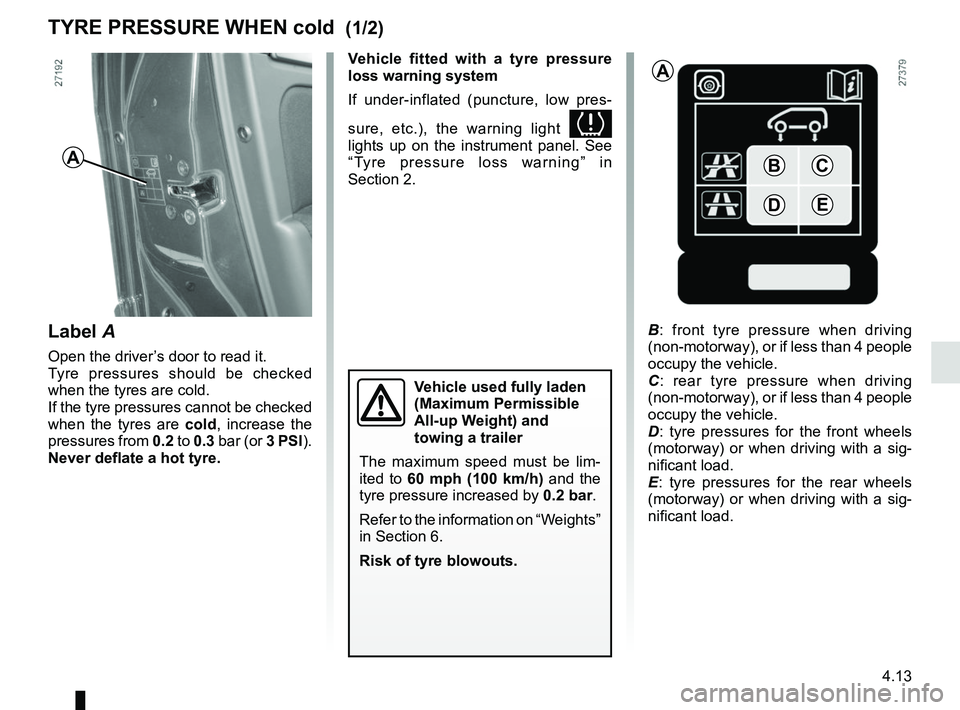
B: front tyre pressure when driving
(non-motorway), or if less than 4 people
occupy the vehicle.
C : rear tyre pressure when driving
(non-motorway), or if less than 4 people
occupy the vehicle.
D : tyre pressures for the front wheels
(motorway) or when driving with a sig-
nificant load.
E : tyre pressures for the rear wheels
(motorway) or when driving with a sig-
nificant load.
C
DE
BA
A
Label A
Open the driver’s door to read it.
Tyre pressures should be checked
when the tyres are cold.
If the tyre pressures cannot be checked
when the tyres are cold, increase the
pressures from 0.2 to 0.3 bar (or 3 PSI).
Never deflate a hot tyre. Vehicle fitted with a tyre pressure
loss warning system
If under-inflated (puncture, low pres-
sure, etc.), the warning light
lights up on the instrument panel. See
“Tyre pressure loss warning” in
Section 2.
Vehicle used fully laden
(Maximum Permissible
All-up Weight) and
towing a trailer
The maximum speed must be lim-
ited to 60 mph (100 km/h) and the
tyre pressure increased by 0.2 bar.
Refer to the information on “Weights”
in Section 6.
Risk of tyre blowouts.
Page 196 of 264
5.2
PUNCTURE, EMERGENCY SPARE WHEEL (1/2)
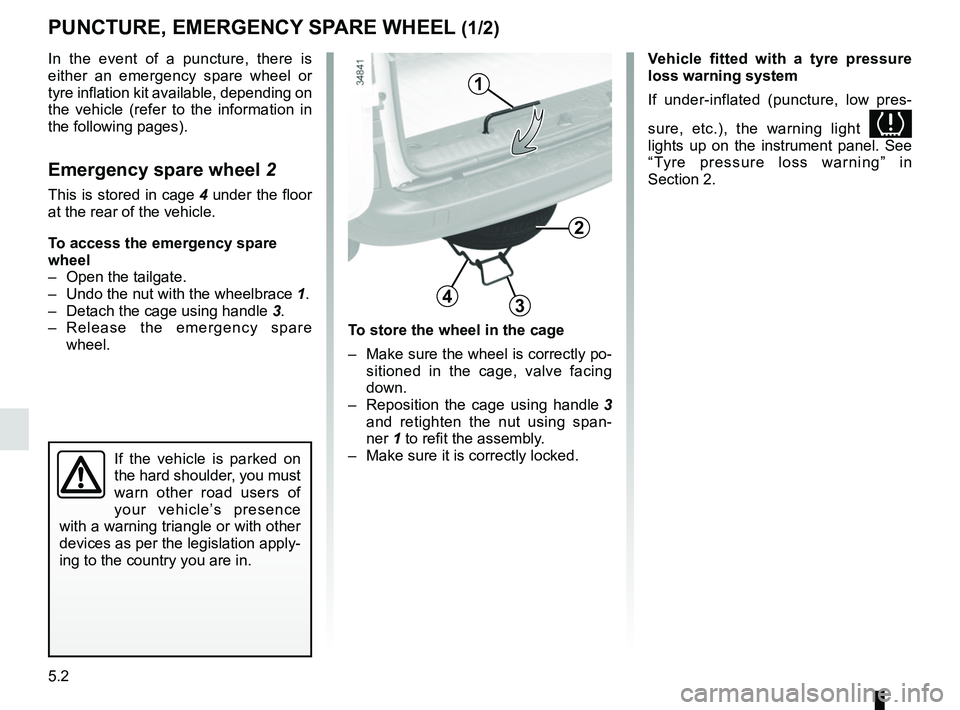
To store the wheel in the cage
– Make sure the wheel is correctly po-sitioned in the cage, valve facing
down.
– Reposition the cage using handle 3
and retighten the nut using span-
ner 1 to refit the assembly.
– Make sure it is correctly locked.
2
3
1
4
In the event of a puncture, there is
either an emergency spare wheel or
tyre inflation kit available, depending on
the vehicle (refer to the information in
the following pages).
Emergency spare wheel 2
This is stored in cage 4 under the floor
at the rear of the vehicle.
To access the emergency spare
wheel
– Open the tailgate.
– Undo the nut with the wheelbrace 1.
– Detach the cage using handle 3.
– Release the emergency spare wheel.
Vehicle fitted with a tyre pressure
loss warning system
If under-inflated (puncture, low pres-
sure, etc.), the warning light
lights up on the instrument panel. See
“Tyre pressure loss warning” in
Section 2.
If the vehicle is parked on
the hard shoulder, you must
warn other road users of
your vehicle’s presence
with a warning triangle or with other
devices as per the legislation apply-
ing to the country you are in.
Page 197 of 264

If the emergency spare wheel has been stored for several years, have it \
checked by your Dealer to ensure that it is
safe to use.
Vehicle fitted with an eme")
5.3
PUNCTURE, EMERGENCY SPARE WHEEL (2/2)
If the emergency spare wheel has been stored for several years, have it \
checked by your Dealer to ensure that it is
safe to use.
Vehicle fitted with an emergency spare wheel that differs from the other \
wheels:
– Never fit more than one emergency spare wheel to the same vehicle.
– As the punctured wheel is wider than the emergency spare wheel, the vehi\
cle’s ground clearance is reduced.
– Replace the emergency spare wheel as soon as possible with a wheel ident\
ical to the original one.
– If wheel bolts are supplied with the emergency spare wheel, it is impera\
tive that they are used and that they are used for th e
emergency spare wheel only: refer to the label affixed to the emergency spare wheel.
– When this is fitted to the vehicle, which must only be a temporary measu\
re, the driving speed must not exceed the speed indicated on the label on the wheel.
– Fitting an emergency spare wheel may alter the way the vehicle usually r\
uns. Avoid sudden acceleration or deceleration and reduce your speed when cornering.
– If you need to use snow chains, fit the emergency spare wheel to the rea\
r axle and check the tyre pressure.
– The warning light
on the instrument panel flashes for several seconds, then stays on.
Page 199 of 264
5.5
TYRE INFLATION KIT (2/4)
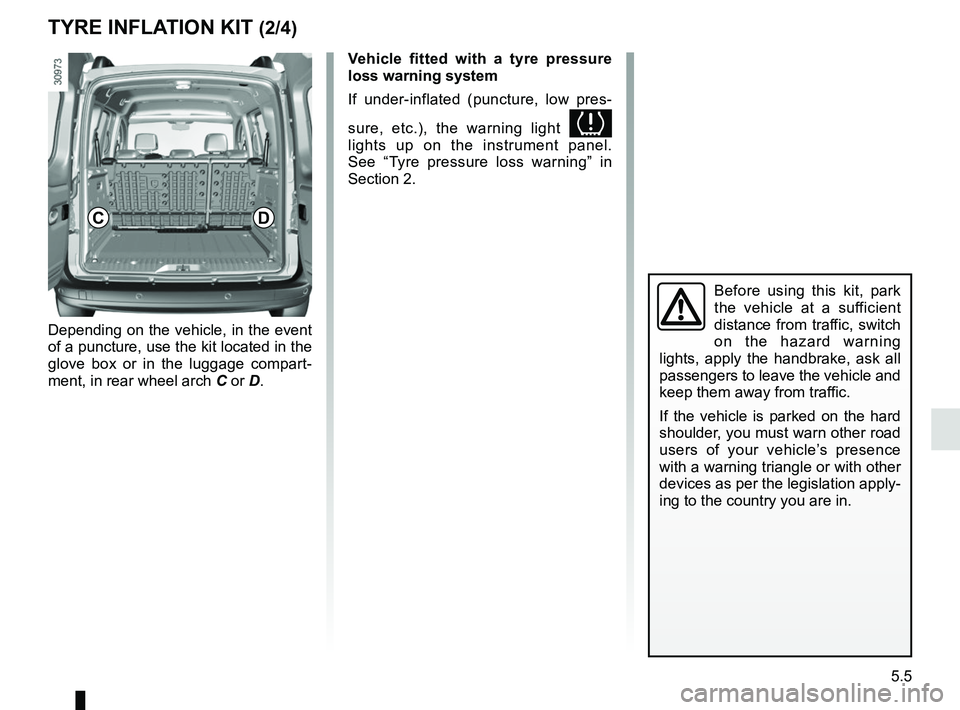
Depending on the vehicle, in the event
of a puncture, use the kit located in the
glove box or in the luggage compart-
ment, in rear wheel arch C or D.
Before using this kit, park
the vehicle at a sufficient
distance from traffic, switch
on the hazard warning
lights, apply the handbrake, ask all
passengers to leave the vehicle and
keep them away from traffic.
If the vehicle is parked on the hard
shoulder, you must warn other road
users of your vehicle’s presence
with a warning triangle or with other
devices as per the legislation apply-
ing to the country you are in.
C
Vehicle fitted with a tyre pressure
loss warning system
If under-inflated (puncture, low pres-
sure, etc.), the warning light
lights up on the instrument panel.
See “Tyre pressure loss warning” in
Section 2.
D