brake light RENAULT KANGOO Z.E. 2018 User Guide
[x] Cancel search | Manufacturer: RENAULT, Model Year: 2018, Model line: KANGOO Z.E., Model: RENAULT KANGOO Z.E. 2018Pages: 230, PDF Size: 5.03 MB
Page 117 of 230
2.17
Emergency brake assistThis is an additional system to ABS
which helps reduce vehicle stopping
distances.
Operating principle
The system detects an emergency
braking situation. In this case, the brak-
ing assistance immediately develops
maximum power and may trigger ABS
regulation.
ABS braking is maintained as long as
the brake pedal is not released.
Hazard warning lights switching on
Depending on the vehicle, these may
light up in the event of sudden decel-
eration.
Operating faultsWhen the system detects an operating
fault the message “BRAKING FAULT”
appears on the instrument panel along
with the
© warning light. Please
consult an authorised dealer.
DRIVER CORRECTION DEVICES AND AIDS (3/3)
Hill start assistance
Depending on the gradient of the in-
cline, this system assists the driver
when starting on a hill. It prevents the
vehicle from rolling backwards, de-
pending on the slope, by automatically
applying the brakes when the driver lifts
his/her foot off the brake pedal to de-
press the accelerator pedal.
System operation
It only operates when the gear lever is
in a position other than neutral and the
vehicle is completely stationary (brake
pedal depressed).
The system holds the vehicle for ap-
proximately 2 seconds. The brakes are
then gradually released (the vehicle will
move according to the slope).
The hill start assistance
system cannot completely
prevent the vehicle from
rolling backwards in all sit-
uations (extremely steep gradients,
etc.).
In all cases, the driver may depress
the brake pedal to prevent the ve-
hicle from rolling forwards or back-
wards.
The hill start assistance function
should not be used for prolonged
stops: use the brake pedal.
This function is not designed to im-
mobilise the vehicle permanently.
If necessary, use the brake pedal to
stop the vehicle.
The driver must remain particularly
vigilant when driving on slippery or
low-grip surfaces and/or on hills.
Risk of serious injury.
Page 124 of 230
2.24
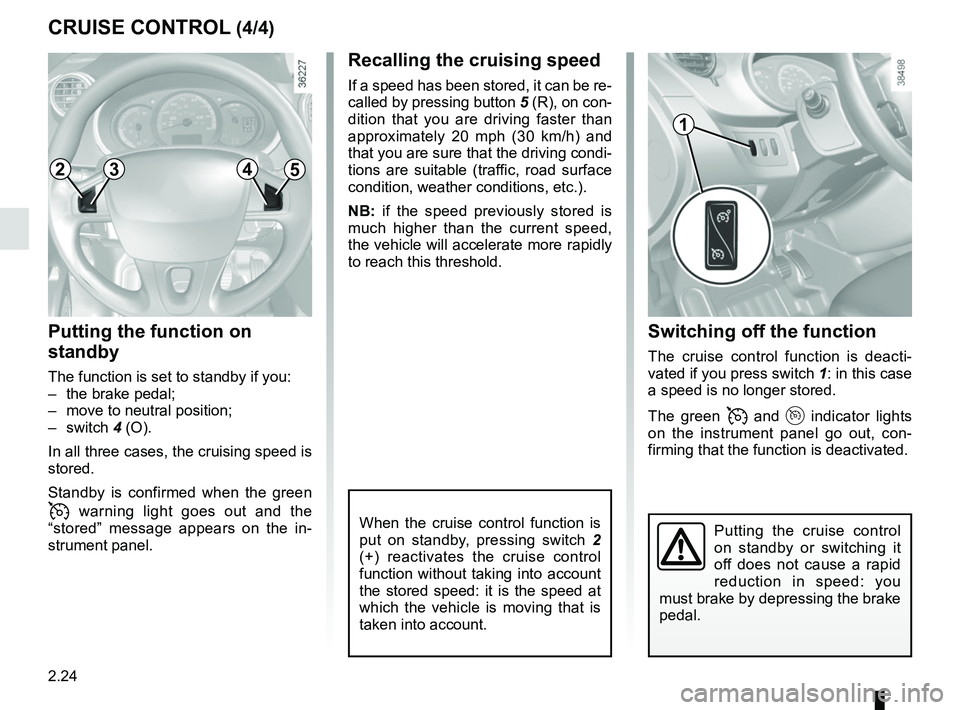
Switching off the function
The cruise control function is deacti-
vated if you press switch 1: in this case
a speed is no longer stored.
The green
and indicator lights
on the instrument panel go out, con-
firming that the function is deactivated.
Recalling the cruising speed
If a speed has been stored, it can be re-
called by pressing button 5 (R), on con-
dition that you are driving faster than
approximately 20 mph (30 km/h) and
that you are sure that the driving condi-
tions are suitable (traffic, road surface
condition, weather conditions, etc.).
NB: if the speed previously stored is
much higher than the current speed,
the vehicle will accelerate more rapidly
to reach this threshold.
When the cruise control function is
put on standby, pressing switch 2
(+) reactivates the cruise control
function without taking into account
the stored speed: it is the speed at
which the vehicle is moving that is
taken into account.
Putting the function on
standby
The function is set to standby if you:
– the brake pedal;
– move to neutral position;
– switch 4 (O).
In all three cases, the cruising speed is
stored.
Standby is confirmed when the green
warning light goes out and the
“stored” message appears on the in-
strument panel.
CRUISE CONTROL (4/4)
Putting the cruise control
on standby or switching it
off does not cause a rapid
reduction in speed: you
must brake by depressing the brake
pedal.
1
2453
Page 154 of 230
3.26
TRANSPORTING OBJECTS IN THE BOOT (2/2)/TOWING
If the towbar ball obscures the regis-
tration plate or the rear fog lights, it
should be removed when not in use.
In all cases, comply with local leg-
islation.
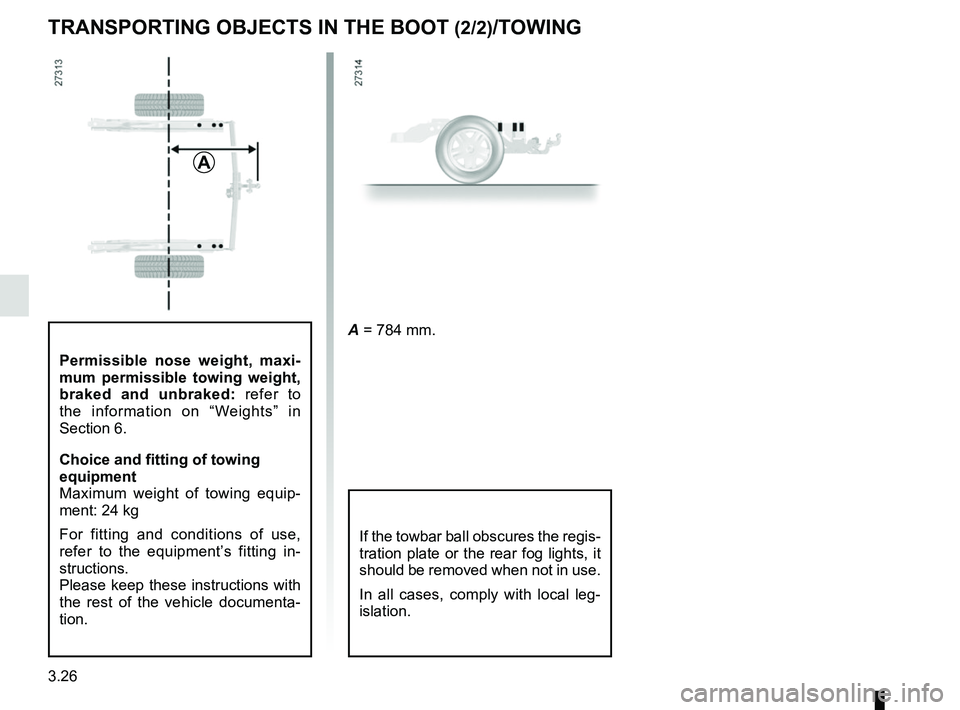
A = 784 mm.
A
Permissible nose weight, maxi-
mum permissible towing weight,
braked and unbraked: refer to
the information on “Weights” in
Section 6.
Choice and fitting of towing
equipment
Maximum weight of towing equip-
ment: 24 kg
For fitting and conditions of use,
refer to the equipment’s fitting in-
structions.
Please keep these instructions with
the rest of the vehicle documenta-
tion.
Page 159 of 230
4.5
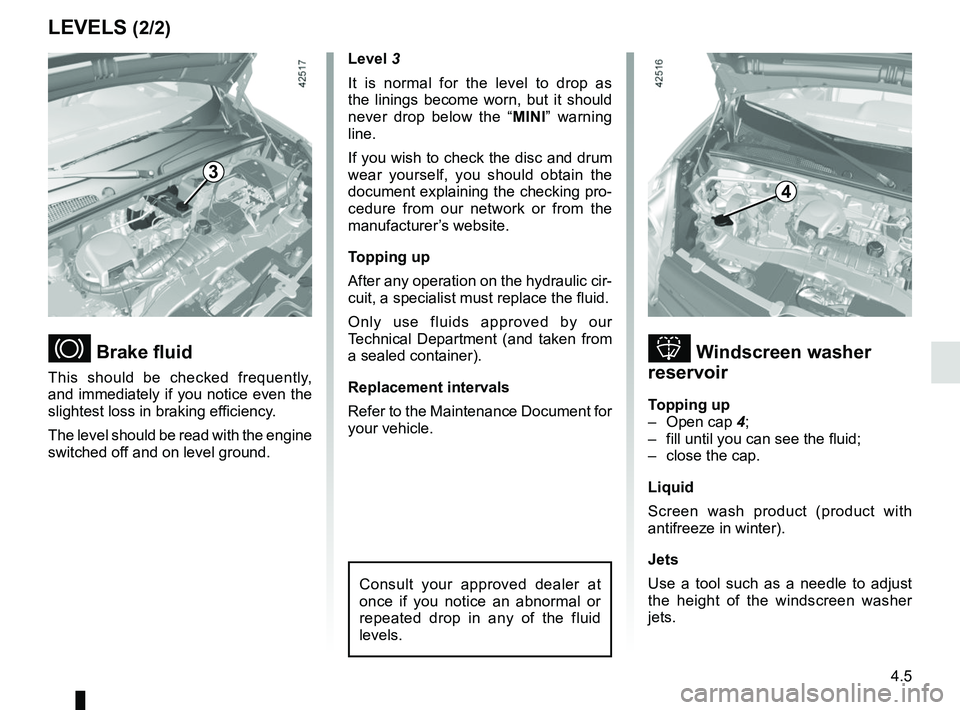
Windscreen washer
reservoir
Topping up
– Open cap 4;
– fill until you can see the fluid;
– close the cap.
Liquid
Screen wash product (product with
antifreeze in winter).
Jets
Use a tool such as a needle to adjust
the height of the windscreen washer
jets.
4
Level 3
It is normal for the level to drop as
the linings become worn, but it should
never drop below the “ MINI” warning
line.
If you wish to check the disc and drum
wear yourself, you should obtain the
document explaining the checking pro-
cedure from our network or from the
manufacturer’s website.
Topping up
After any operation on the hydraulic cir-
cuit, a specialist must replace the fluid.
Only use fluids approved by our
Technical Department (and taken from
a sealed container).
Replacement intervals
Refer to the Maintenance Document for
your vehicle.
Consult your approved dealer at
once if you notice an abnormal or
repeated drop in any of the fluid
levels.
Brake fluid
This should be checked frequently,
and immediately if you notice even the
slightest loss in braking efficiency.
The level should be read with the engine
switched off and on level ground.
3
LEVELS (2/2)
Page 172 of 230
5.4
TYRE INFLATION KIT (2/3)
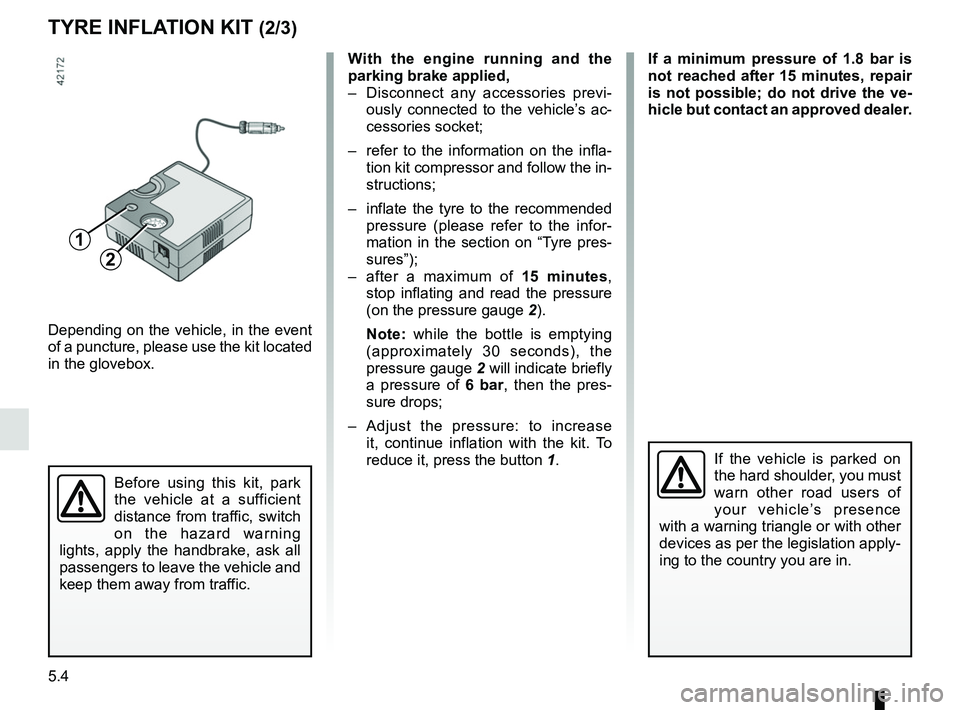
Depending on the vehicle, in the event
of a puncture, please use the kit located
in the glovebox.
Before using this kit, park
the vehicle at a sufficient
distance from traffic, switch
on the hazard warning
lights, apply the handbrake, ask all
passengers to leave the vehicle and
keep them away from traffic.
If the vehicle is parked on
the hard shoulder, you must
warn other road users of
your vehicle’s presence
with a warning triangle or with other
devices as per the legislation apply-
ing to the country you are in.
With the engine running and the
parking brake applied,
– Disconnect any accessories previ- ously connected to the vehicle’s ac-
cessories socket;
– refer to the information on the infla- tion kit compressor and follow the in-
structions;
– inflate the tyre to the recommended pressure (please refer to the infor-
mation in the section on “Tyre pres-
sures”);
– after a maximum of 15 minutes, stop inflating and read the pressure
(on the pressure gauge 2).
Note: while the bottle is emptying
(approximately 30 seconds), the
pressure gauge 2 will indicate briefly
a pressure of 6 bar, then the pres-
sure drops;
– Adjust the pressure: to increase it, continue inflation with the kit. To
reduce it, press the button 1.
2
1
If a minimum pressure of 1.8 bar is
not reached after 15 minutes, repair
is not possible; do not drive the ve-
hicle but contact an approved dealer.
Page 176 of 230
5.8
2
4
1
3
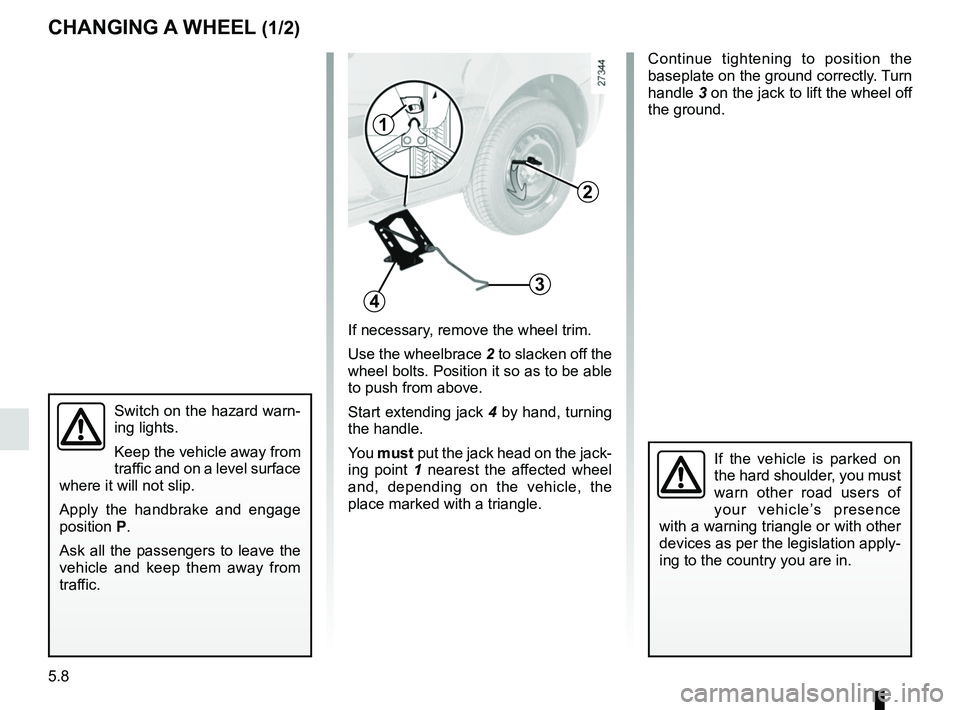
If necessary, remove the wheel trim.
Use the wheelbrace 2 to slacken off the
wheel bolts. Position it so as to be able
to push from above.
Start extending jack 4 by hand, turning
the handle.
You must put the jack head on the jack-
ing point 1 nearest the affected wheel
and, depending on the vehicle, the
place marked with a triangle.
Switch on the hazard warn-
ing lights.
Keep the vehicle away from
traffic and on a level surface
where it will not slip.
Apply the handbrake and engage
position P.
Ask all the passengers to leave the
vehicle and keep them away from
traffic.
CHANGING A WHEEL (1/2)
Continue tightening to position the
baseplate on the ground correctly. Turn
handle 3 on the jack to lift the wheel off
the ground.
If the vehicle is parked on
the hard shoulder, you must
warn other road users of
your vehicle’s presence
with a warning triangle or with other
devices as per the legislation apply-
ing to the country you are in.
Page 184 of 230
5.16
The bulbs are under pres-
sure and can break when
replaced.
Risk of injury.
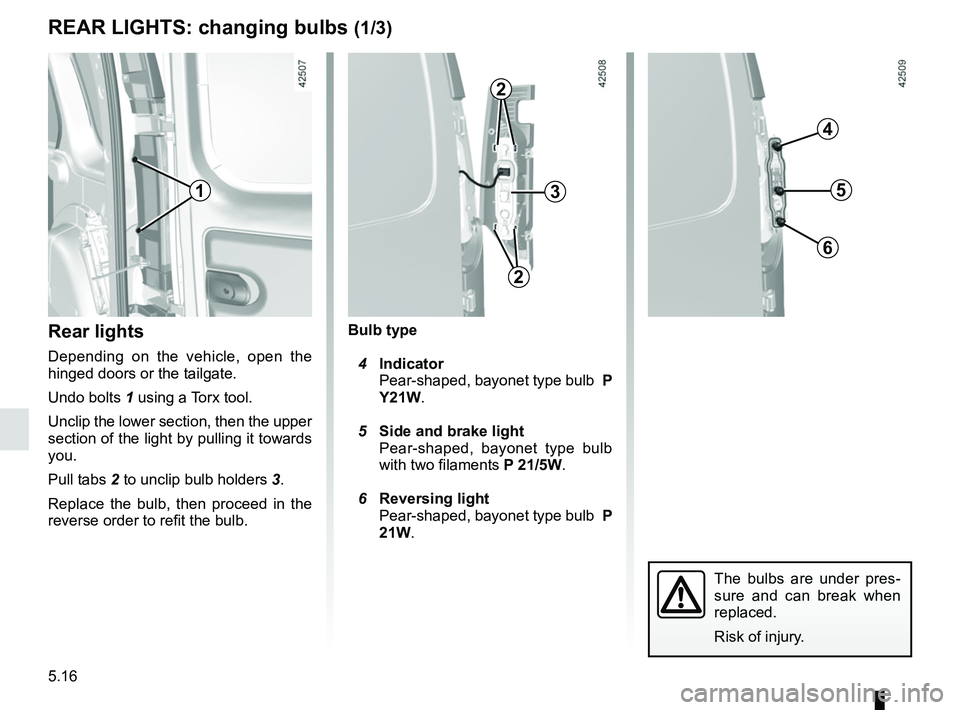
Bulb type
4 Indicator
Pear-shaped, bayonet type bulb P
Y21W.
5 Side and brake light
Pear-shaped, bayonet type bulb
with two filaments P 21/5W.
6 Reversing light
Pear-shaped, bayonet type bulb P
21W.Rear lights
Depending on the vehicle, open the
hinged doors or the tailgate.
Undo bolts 1 using a Torx tool.
Unclip the lower section, then the upper
section of the light by pulling it towards
you.
Pull tabs 2 to unclip bulb holders 3.
Replace the bulb, then proceed in the
reverse order to refit the bulb.
REAR LIGHTS: changing bulbs (1/3)
31
2
2
5
4
6
Page 185 of 230
5.17
REAR LIGHTS: changing bulbs (2/3)
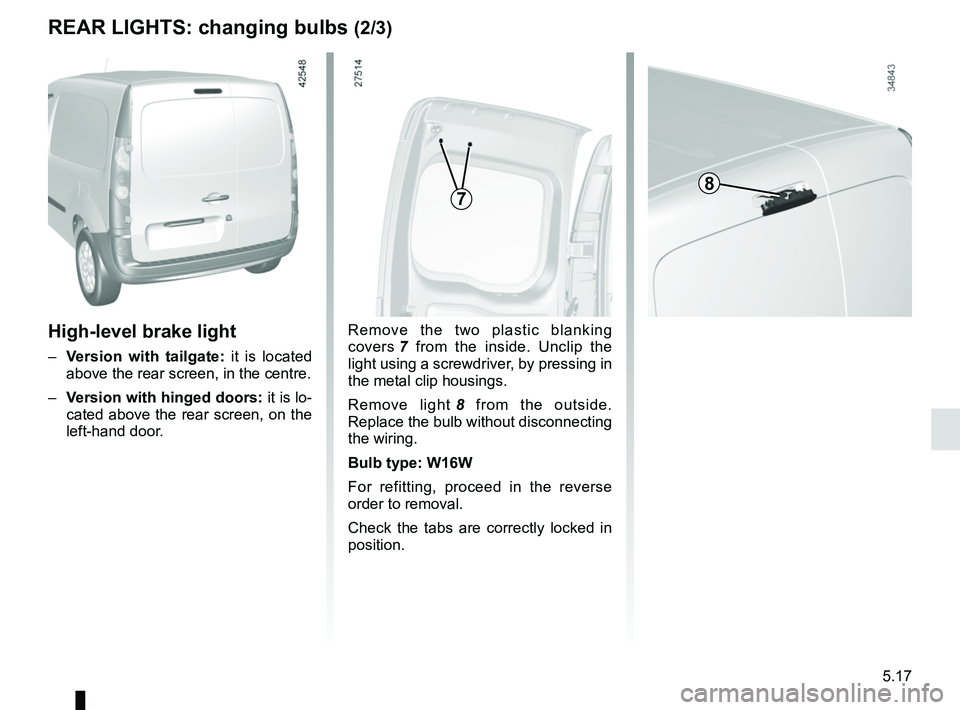
High-level brake light
– Version with tailgate: it is located
above the rear screen, in the centre.
– Version with hinged doors: it is lo-
cated above the rear screen, on the
left-hand door. Remove the two plastic blanking
covers 7
from the inside. Unclip the
light using a screwdriver, by pressing in
the metal clip housings.
Remove light 8 from the outside.
Replace the bulb without disconnecting
the wiring.
Bulb type: W16W
For refitting, proceed in the reverse
order to removal.
Check the tabs are correctly locked in
position.
78
Page 190 of 230

5.22
FUSES (2/2)
Number Allocation
1 Not used
2 Not used
3 Air conditioning, pedestrian
horn
4 heating, traction battery
5 Rear windscreen wiper
6 Horn, diagnostic socket
7 Heated seats, telematic box
8 Traction battery
9 Passenger compartment
ECU
10 Windscreen washer
11 Brake lights
12 Passenger compartment
ECU
13 Electric window, ECO mode
14 Heated rear screen
15 Starter
12
3456
78910
11121314
15161718
19202122
23242526
27
28
29
Allocation of fusesThe presence of certain fuses de-
pends on the vehicle equipment
level.
Number Allocation
16 Brake lights, additional
equipment, ABS, ESP,
luggage compartment light,
courtesy light, rain and light
sensor
17 Radio, navigation system,
display, alarm
18 Additional equipment
19 Heated door mirrors
20 Hazard lights, rear fog lights
21 Central locking of opening
elements
22 Instrument panel
23 Not used
24 Radio, heated seats, brake
lights
25 Front accessories socket
26 Towbar
27 Electric front windows
28 Rear-view mirror control
29 Passenger compartment
motor-driven fan assembly
Page 194 of 230
5.26
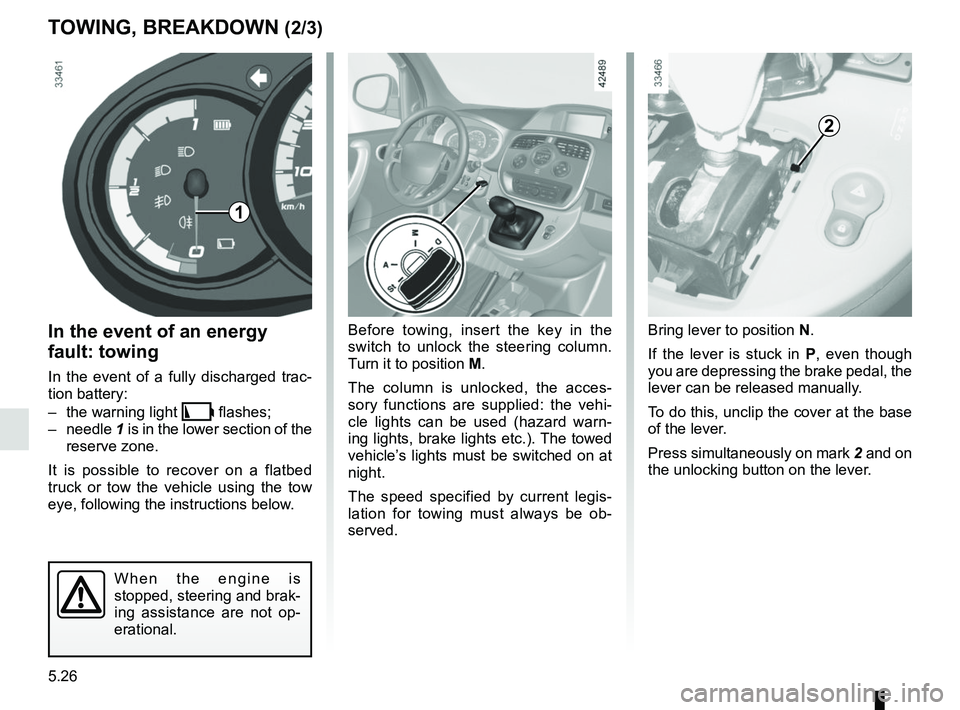
Bring lever to position N.
If the lever is stuck in P , even though
you are depressing the brake pedal, the
lever can be released manually.
To do this, unclip the cover at the base
of the lever.
Press simultaneously on mark 2 and on
the unlocking button on the lever.
TOWING, BREAKDOWN (2/3)
In the event of an energy
fault: towing
In the event of a fully discharged trac-
tion battery:
– the warning light
Ṏ flashes;
– needle 1 is in the lower section of the
reserve zone.
It is possible to recover on a flatbed
truck or tow the vehicle using the tow
eye, following the instructions below.
When the engine is
stopped, steering and brak-
ing assistance are not op-
erational.
Before towing, insert the key in the
switch to unlock the steering column.
Turn it to position M.
The column is unlocked, the acces-
sory functions are supplied: the vehi-
cle lights can be used (hazard warn-
ing lights, brake lights etc.). The towed
vehicle’s lights must be switched on at
night.
The speed specified by current legis-
lation for towing must always be ob-
served.
4
1
2