key RENAULT KANGOO Z.E. 2018 User Guide
[x] Cancel search | Manufacturer: RENAULT, Model Year: 2018, Model line: KANGOO Z.E., Model: RENAULT KANGOO Z.E. 2018Pages: 230, PDF Size: 5.03 MB
Page 77 of 230

1.71
DISPLAYS AND INDICATORS (3/3)
Display selection keys 5 or 6
Depending on the vehicle, pressing the
button repeatedly enables the informa-
tion on the display to be selected and
the trip mileage recorder to be reset (for
this, the trip mileage must be selected
on the display).– Display selection
Press briefly to move from the total
mileage to the trip mileage and vice
versa.
– Resetting the trip mileage re-
corder
Once trip mileage has been selected on
the display, press and hold the button.
Multifunction display
Total mileage recorder.
Trip mileage recorder.
Setting the time.
OR
Trip computer and warning system
Refer to the information on the “Trip
computer” in Section 1.
The presence and operation of the display and indicators DEPENDS ON THE \
LEVEL OF EQUIPMENT AND THE COUNTRY.
5
6
Page 78 of 230

1.72
TRIP COMPUTER: general information (1/2)
Trip computer and warning
system A
Depending on the vehicle, this includes
the following functions:
– distance travelled;
– journey parameters;
– information messages;
– operating fault messages (associ-
ated with the
© warning light);
– warning messages (connected to the
® warning light).
All these functions are described on the
following pages. a) Total mileage and trip mileage re-
corder;
b) journey parameters: – Total energy consumption since
the last reset;
– average energy consumption;
– current energy consumption;
– Total energy consumption since
the vehicle first entered into serv-
ice;
– estimated range;
– distance travelled;
– average speed.
c) mileage before service;
d) cruise control and speed limiter pro- grammed speed;
e) Reset the tyre pressure
f) trip log, operating faults and informa- tion message readout.
A
1
2
Display selection keys 1
and 2
Scroll through the following informa-
tion upwards (button 1) or downwards
(button 2 ) by pressing briefly and suc-
cessively (the display depends on the
vehicle equipment and country).
Page 85 of 230

1.79
These appear with the © warning light and mean that you should drive very carefully to an approv\
ed Dealer as
soon as possible. If you fail to follow this recommendation, you risk da\
maging your vehicle.
They disappear when the display selection key is pressed or after severa\
l seconds and are stored in the computer log. The
© warning light stays on. Examples of operating fault messages are given \
on the following pages .
Examples of messages Interpretation of messages
“BRAKES TO BE CHECKED” Indicates wear or the need to check the braking system.
“BATT CHARGE IMPOSSIBLE” Indicates a fault on the traction battery recharge system.
“CHECK AUTO LIGHTS” Indicates a fault in the automatic lights operation.
TRIP COMPUTER AND WARNING SYSTEM: operating fault messages
Page 99 of 230
1.93
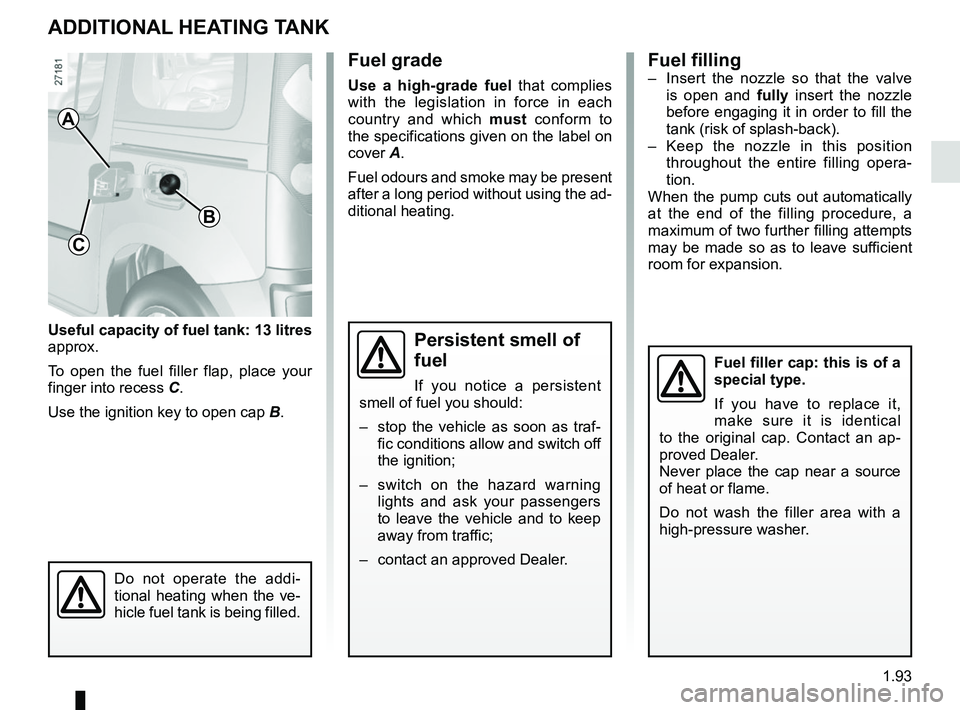
Useful capacity of fuel tank: 13 litres
approx.
To open the fuel filler flap, place your
finger into recess C.
Use the ignition key to open cap B.
ADDITIONAL HEATING TANK
Fuel grade
Use a high-grade fuel that complies
with the legislation in force in each
country and which must conform to
the specifications given on the label on
cover A.
Fuel odours and smoke may be present
after a long period without using the ad-
ditional heating.
A
C
B
Fuel filler cap: this is of a
special type.
If you have to replace it,
make sure it is identical
to the original cap. Contact an ap-
proved Dealer.
Never place the cap near a source
of heat or flame.
Do not wash the filler area with a
high-pressure washer.
Fuel filling– Insert the nozzle so that the valve is open and fully insert the nozzle
before engaging it in order to fill the
tank (risk of splash-back).
– Keep the nozzle in this position throughout the entire filling opera-
tion.
When the pump cuts out automatically
at the end of the filling procedure, a
maximum of two further filling attempts
may be made so as to leave sufficient
room for expansion.
Persistent smell of
fuel
If you notice a persistent
smell of fuel you should:
– stop the vehicle as soon as traf- fic conditions allow and switch off
the ignition;
– switch on the hazard warning lights and ask your passengers
to leave the vehicle and to keep
away from traffic;
– contact an approved Dealer.
Do not operate the addi-
tional heating when the ve-
hicle fuel tank is being filled.
Page 102 of 230
2.2
STARTING, STOPPING THE ENGINE (1/2)
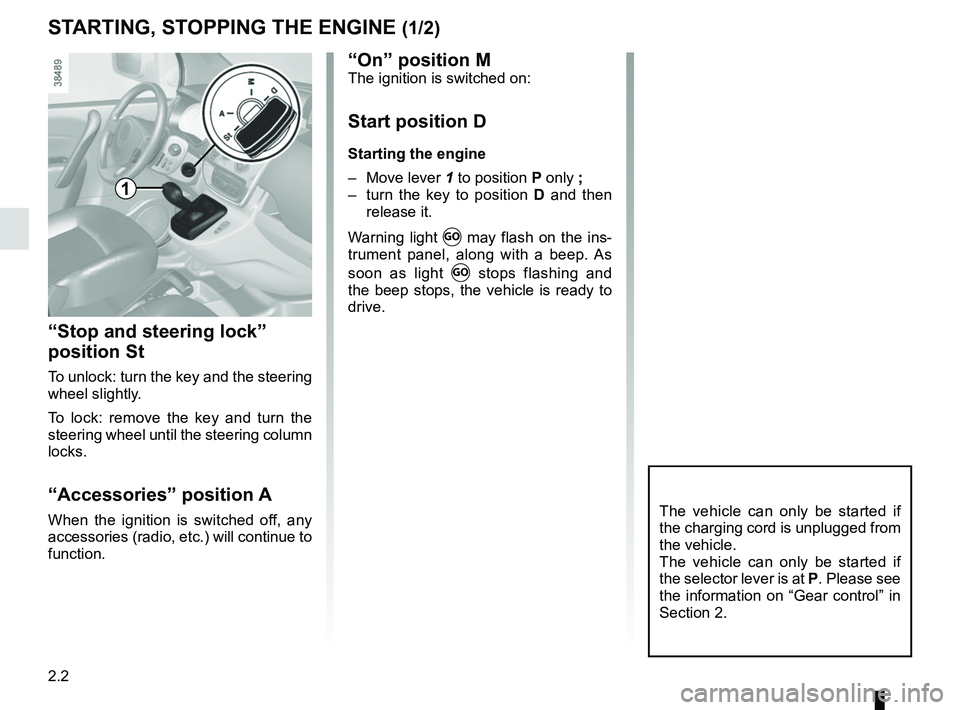
“Stop and steering lock”
position St
To unlock: turn the key and the steering
wheel slightly.
To lock: remove the key and turn the
steering wheel until the steering column
locks.
“Accessories” position A
When the ignition is switched off, any
accessories (radio, etc.) will continue to
function.The vehicle can only be started if
the charging cord is unplugged from
the vehicle.
The vehicle can only be started if
the selector lever is at P. Please see
the information on “Gear control” in
Section 2.
1
“On” position MThe ignition is switched on:
Start position D
Starting the engine
– Move lever 1 to position P only ;
– turn the key to position D and then
release it.
Warning light
Ṑ may flash on the ins-
trument panel, along with a beep. As
soon as light
Ṑ stops flashing and
the beep stops, the vehicle is ready to
drive.
Page 103 of 230
2.3
Stopping the engine
With the engine running, turn the key
back to the “Stop” position St. Warning
light
Ṑ goes out.
Driver’s responsibility
when parking or stopping
the vehicle
Never leave an animal,
child or adult who is not self-suffi-
cient alone in your vehicle, even for
a short time.
They may pose a risk to themselves
or to others by starting the engine,
activating equipment such as the
electric windows or locking the
doors, for example.
Also, in hot and/or sunny weather,
please remember that the tempera-
ture inside the passenger compart-
ment increases very quickly.
RISK OF DEATH OR SERIOUS
INJURY.
Never switch off the igni-
tion before the vehicle has
come to a complete stop.
Switching off the engine di-
sables the assistance equipment:
brakes, power-assisted steering,
etc., and the passive safety devices
such as airbagsand pretensioners.
STARTING, STOPPING THE ENGINE (2/2)
Page 145 of 230
3.17
Electric windows
With the ignition on:
– press the switch for the window concerned to lower it to the desired
height;
– lift the switch for the window con- cerned to raise it to the desired
height.
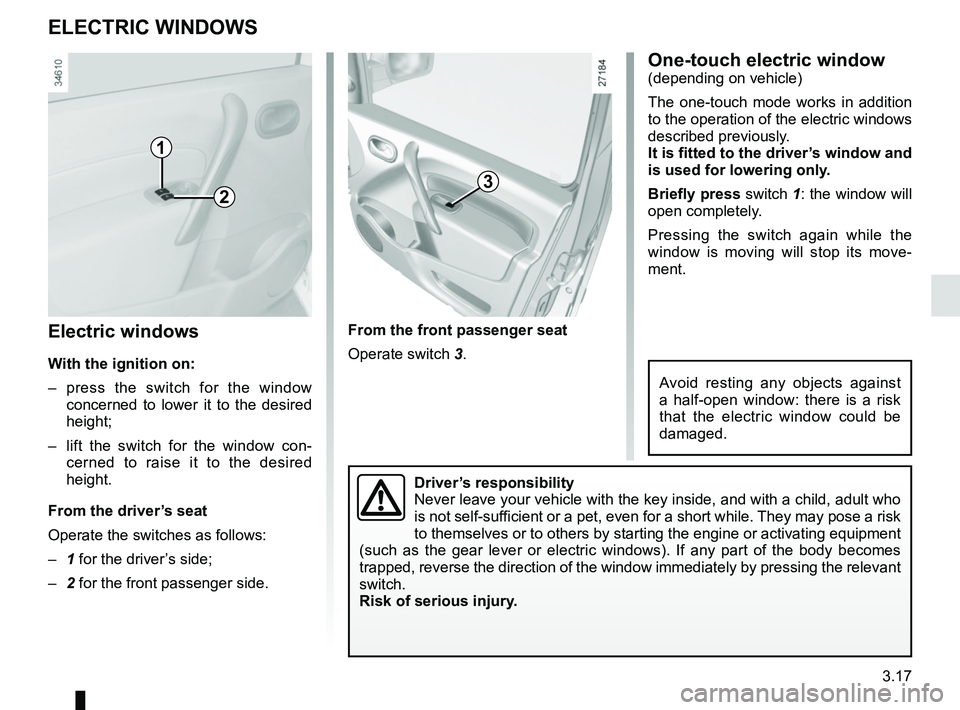
From the driver’s seat
Operate the switches as follows:
– 1 for the driver’s side;
– 2 for the front passenger side.
ELECTRIC WINDOWS
From the front passenger seat
Operate switch 3.
1
23
Driver’s responsibility
Never leave your vehicle with the key inside, and with a child, adult wh\
o
is not self-sufficient or a pet, even for a short while. They may pose a risk
to themselves or to others by starting the engine or activating equipmen\
t
(such as the gear lever or electric windows). If any part of the body \
becomes
trapped, reverse the direction of the window immediately by pressing the\
relevant
switch.
Risk of serious injury.
One-touch electric window(depending on vehicle)
The one-touch mode works in addition
to the operation of the electric windows
described previously.
It is fitted to the driver’s window and
is used for lowering only.
Briefly press switch 1: the window will
open completely.
Pressing the switch again while the
window is moving will stop its move-
ment.
Avoid resting any objects against
a half-open window: there is a risk
that the electric window could be
damaged.
Page 193 of 230
5.25
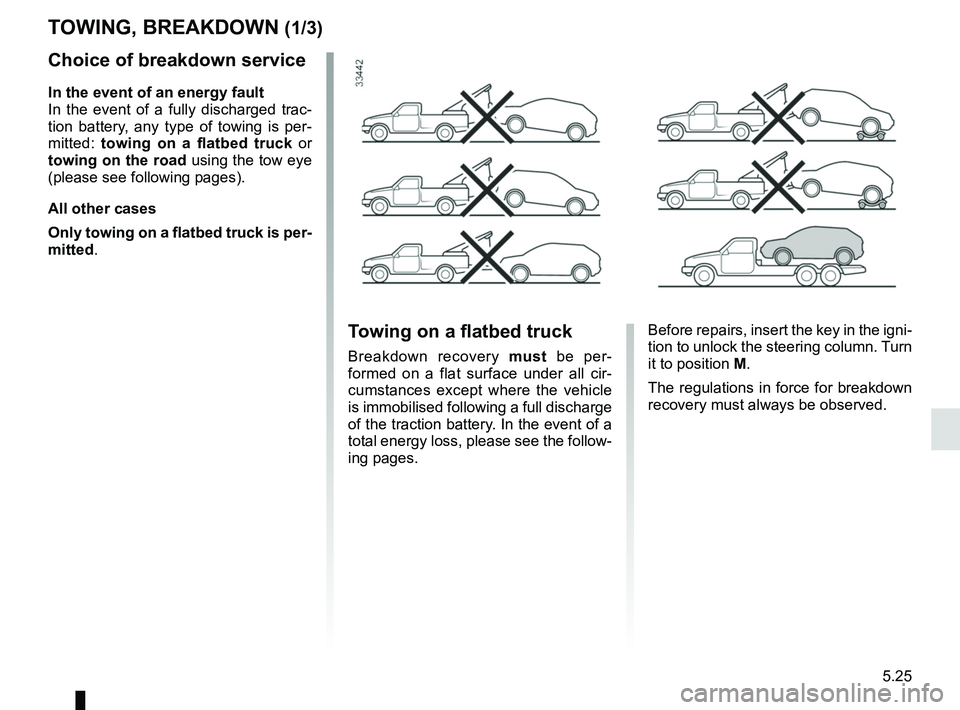
Choice of breakdown service
In the event of an energy fault
In the event of a fully discharged trac-
tion battery, any type of towing is per-
mitted: towing on a flatbed truck or
towing on the road using the tow eye
(please see following pages).
All other cases
Only towing on a flatbed truck is per-
mitted.
TOWING, BREAKDOWN (1/3)
Before repairs, insert the key in the igni-
tion to unlock the steering column. Turn
it to position M.
The regulations in force for breakdown
recovery must always be observed.Towing on a flatbed truck
Breakdown recovery must be per-
formed on a flat surface under all cir-
cumstances except where the vehicle
is immobilised following a full discharge
of the traction battery. In the event of a
total energy loss, please see the follow-
ing pages.
Page 194 of 230
5.26
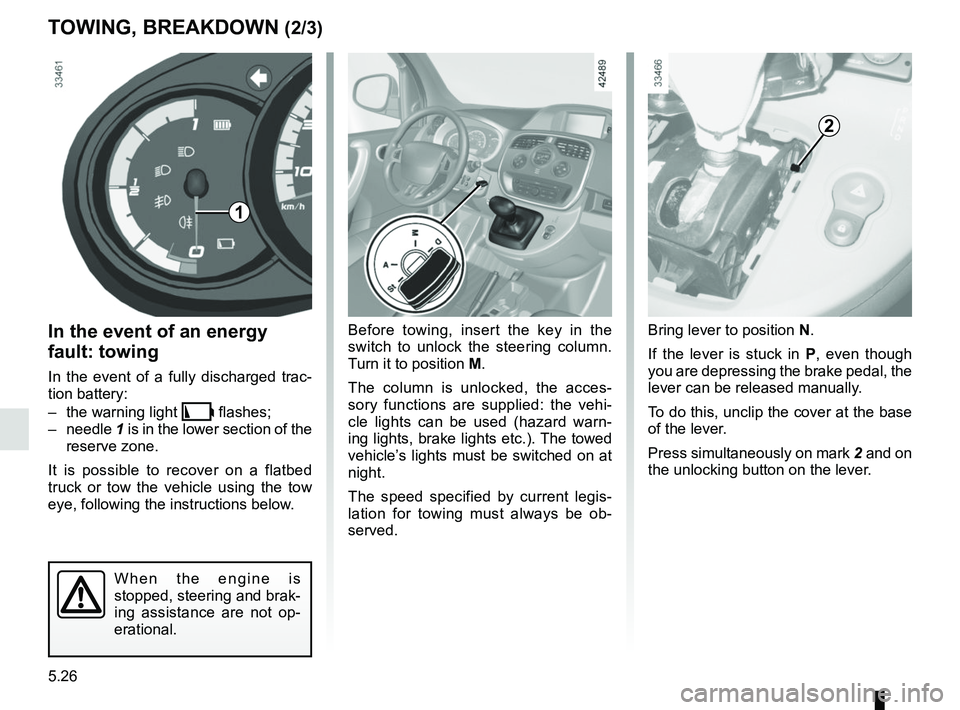
Bring lever to position N.
If the lever is stuck in P , even though
you are depressing the brake pedal, the
lever can be released manually.
To do this, unclip the cover at the base
of the lever.
Press simultaneously on mark 2 and on
the unlocking button on the lever.
TOWING, BREAKDOWN (2/3)
In the event of an energy
fault: towing
In the event of a fully discharged trac-
tion battery:
– the warning light
Ṏ flashes;
– needle 1 is in the lower section of the
reserve zone.
It is possible to recover on a flatbed
truck or tow the vehicle using the tow
eye, following the instructions below.
When the engine is
stopped, steering and brak-
ing assistance are not op-
erational.
Before towing, insert the key in the
switch to unlock the steering column.
Turn it to position M.
The column is unlocked, the acces-
sory functions are supplied: the vehi-
cle lights can be used (hazard warn-
ing lights, brake lights etc.). The towed
vehicle’s lights must be switched on at
night.
The speed specified by current legis-
lation for towing must always be ob-
served.
4
1
2
Page 195 of 230
5.27
TOWING, BREAKDOWN (3/3)
Do not leave the tools unse-
cured inside the vehicle as
they may come loose under
braking.
After use, check that all the tools
are correctly clipped into the tool kit,
then, depending on the vehicle, po-
sition it correctly in its housing.
Risk of injury.
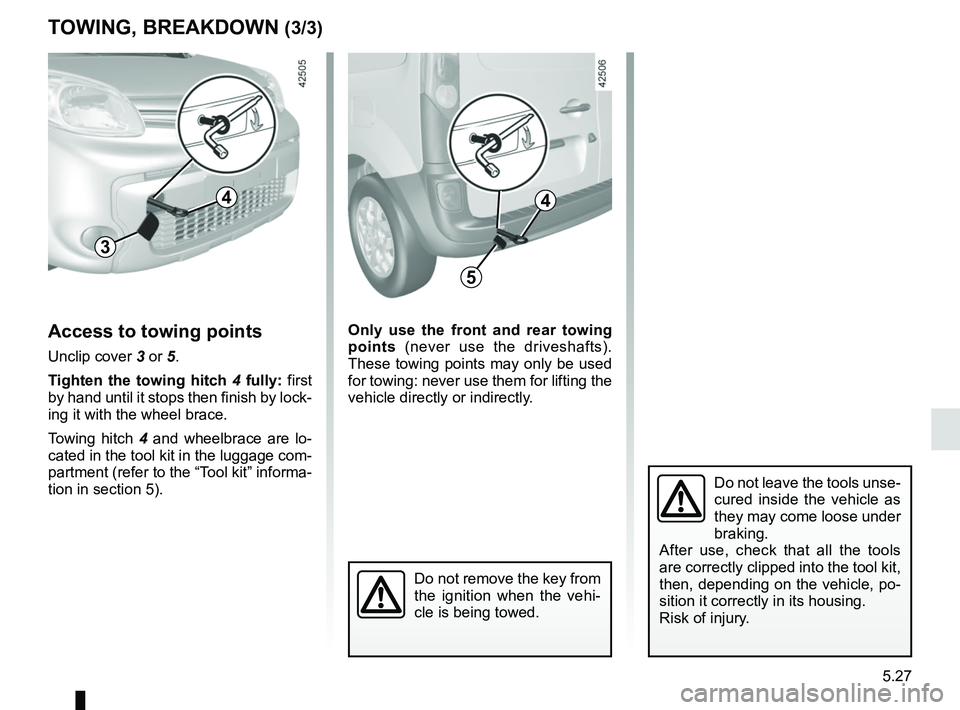
Only use the front and rear towing
points (never use the driveshafts).
These towing points may only be used
for towing: never use them for lifting the
vehicle directly or indirectly.
5
3
Access to towing points
Unclip cover 3 or 5.
Tighten the towing hitch 4 fully: first
by hand until it stops then finish by lock-
ing it with the wheel brace.
Towing hitch 4 and wheelbrace are lo-
cated in the tool kit in the luggage com-
partment (refer to the “Tool kit” informa-
tion in section 5).
Do not remove the key from
the ignition when the vehi-
cle is being towed.
44