charging RENAULT KANGOO Z.E. 2018 Owner's Manual
[x] Cancel search | Manufacturer: RENAULT, Model Year: 2018, Model line: KANGOO Z.E., Model: RENAULT KANGOO Z.E. 2018Pages: 230, PDF Size: 5.03 MB
Page 136 of 230
3.8
AIR CONDITIONING, HEATING: programming (1/2)
Adjusting the programming
This function enables the electric net-
work (and the not the traction battery)
to be used under certain conditions, in
order to obtain a comfortable tempera-
ture prior to using the vehicle.
It triggers the heating in cold weather
and the air conditioning in warm
weather.
1
Operating conditions
– The ignition must be switched off;
– the battery must be charged more than 90% for the function to be trig-
gered;
– the vehicle has to be plugged into the mains;
and
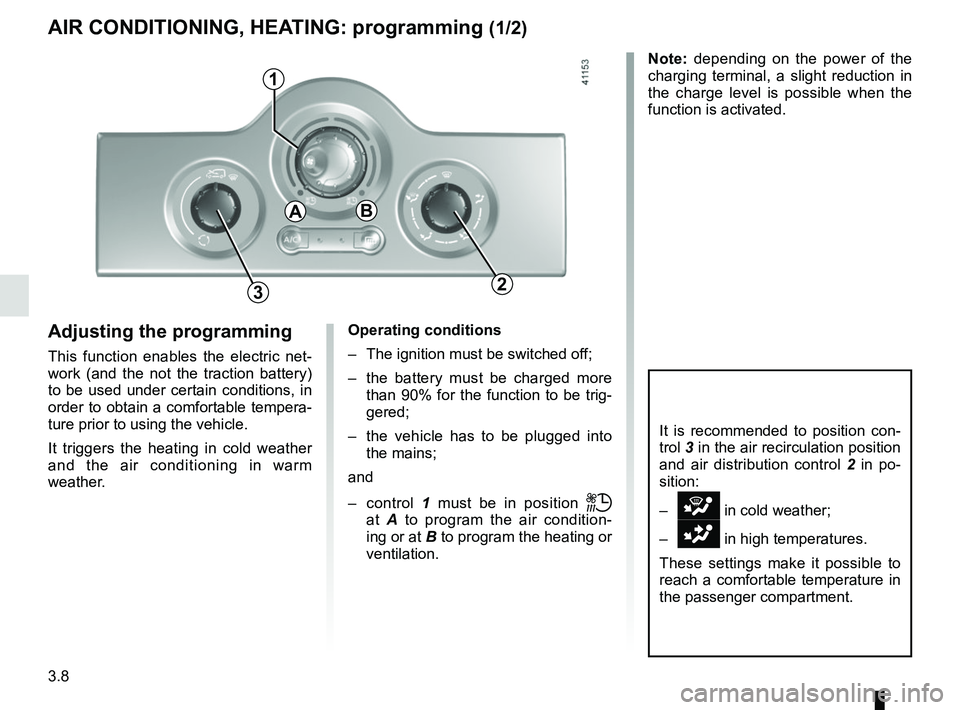
– control 1 must be in position
ṗ
at A to program the air condition-
ing or at B to program the heating or
ventilation.
3
It is recommended to position con-
trol 3 in the air recirculation position
and air distribution control 2 in po-
sition:
–
i in cold weather;
–
G in high temperatures.
These settings make it possible to
reach a comfortable temperature in
the passenger compartment.
AB
2
Note: depending on the power of the
charging terminal, a slight reduction in
the charge level is possible when the
function is activated.
Page 137 of 230
3.9
AIR CONDITIONING, HEATING: programming (2/2)
Activating the function
– With the ignition on, position the con-trol 1 in one of the
ṗ positions;
– turn off the ignition. The “COMFORT” message and the programmed time
are displayed on the instrument
panel for a few seconds;
– wait approximately one minute before charging your vehicle;
– plug in your vehicle to a power supply (refer to the information on “Electric
vehicle: charging” in section 1).
The function switches on during the
hour preceding the programmed time in
order to reach a comfortable tempera-
ture.
Automatically switching off the
function
– About 10 minutes after the pro- grammed time;
– if the charging socket is discon- nected;
– if control 1 is not in one of the
ṗ
positions.
4
5
C
D
Setting the start time for the
function
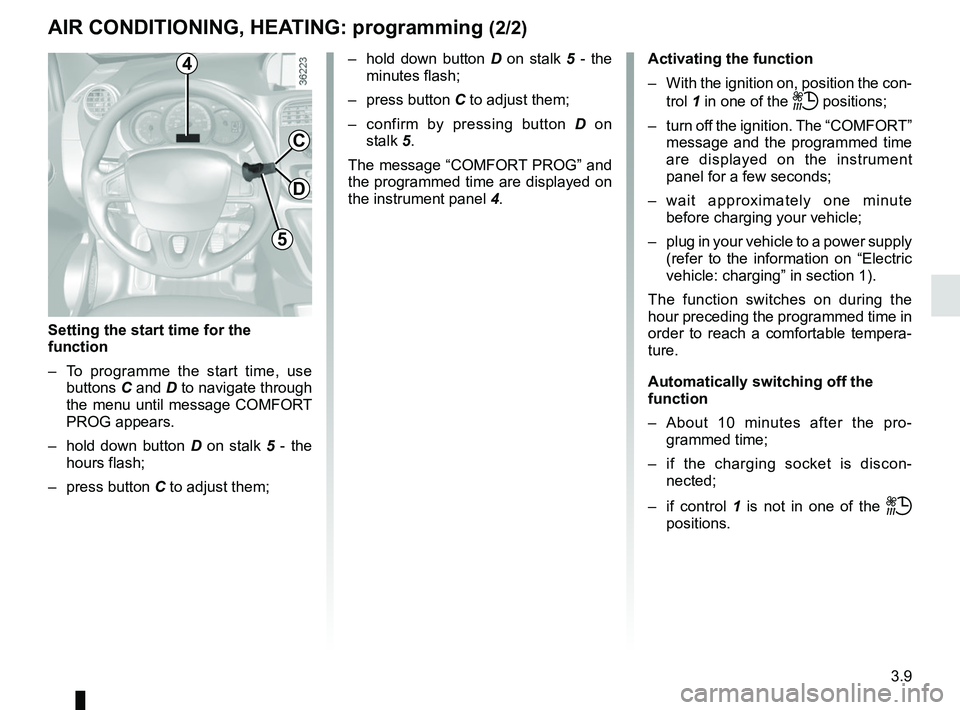
– To programme the start time, use buttons C and D to navigate through
the menu until message COMFORT
PROG appears.
– hold down button D on stalk 5 - the
hours flash;
– press button C to adjust them; – hold down button
D on stalk 5 - the
minutes flash;
– press button C to adjust them;
– confirm by pressing button D on
stalk 5.
The message “COMFORT PROG” and
the programmed time are displayed on
the instrument panel 4.
Page 156 of 230
4.2
BONNET (1/2)
1
Do not do any work under
the bonnet when the vehicle
is charging or when the igni-
tion is switched on.
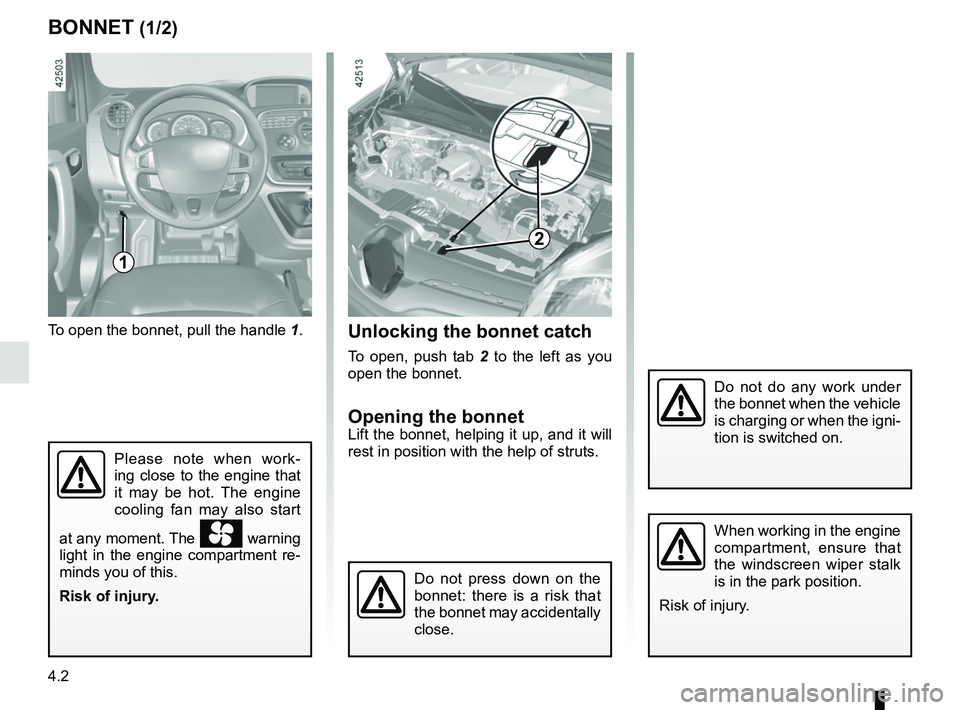
To open the bonnet, pull the handle 1.Unlocking the bonnet catch
To open, push tab 2 to the left as you
open the bonnet.
Opening the bonnetLift the bonnet, helping it up, and it will
rest in position with the help of struts.
Do not press down on the
bonnet: there is a risk that
the bonnet may accidentally
close.
When working in the engine
compartment, ensure that
the windscreen wiper stalk
is in the park position.
Risk of injury.
2
Please note when work-
ing close to the engine that
it may be hot. The engine
cooling fan may also start
at any moment. The
warning
light in the engine compartment re-
minds you of this.
Risk of injury.
Page 158 of 230
4.4
Replacement intervals
Refer to the Maintenance Document for
your vehicle.
LEVELS (1/2)
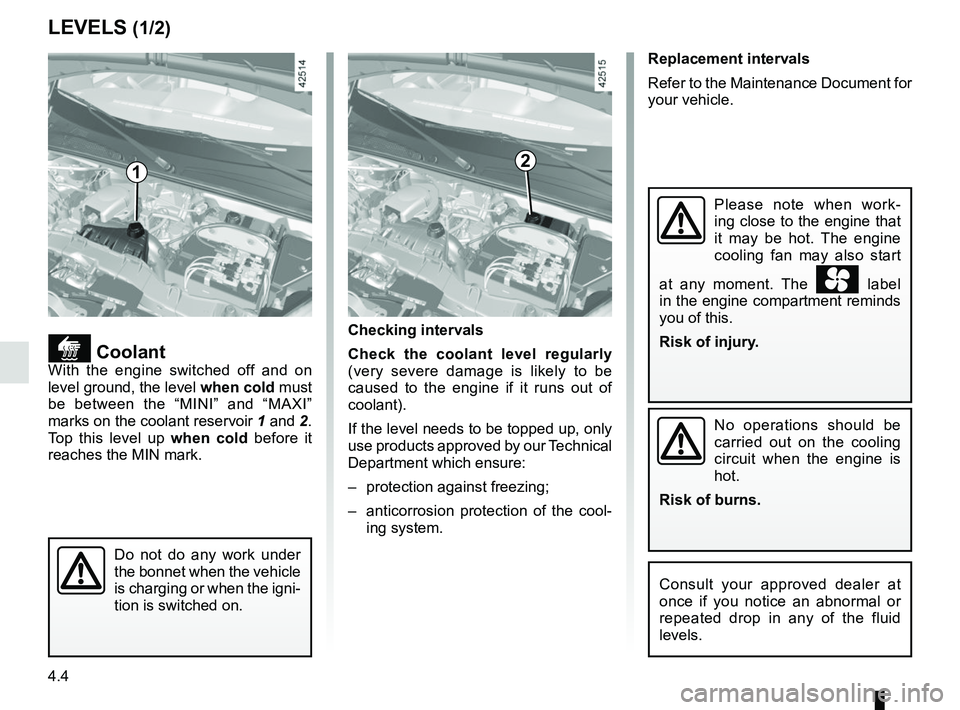
CoolantWith the engine switched off and on
level ground, the level when cold must
be between the “MINI” and “MAXI”
marks on the coolant reservoir 1 and 2.
Top this level up when cold before it
reaches the MIN mark. Checking intervals
Check the coolant level regularly
(very severe damage is likely to be
caused to the engine if it runs out of
coolant).
If the level needs to be topped up, only
use products approved by our Technical
Department which ensure:
– protection against freezing;
– anticorrosion protection of the cool-
ing system.
No operations should be
carried out on the cooling
circuit when the engine is
hot.
Risk of burns.
Consult your approved dealer at
once if you notice an abnormal or
repeated drop in any of the fluid
levels.
12
Do not do any work under
the bonnet when the vehicle
is charging or when the igni-
tion is switched on.
Please note when work-
ing close to the engine that
it may be hot. The engine
cooling fan may also start
at any moment. The
label
in the engine compartment reminds
you of this.
Risk of injury.
Page 161 of 230
4.7
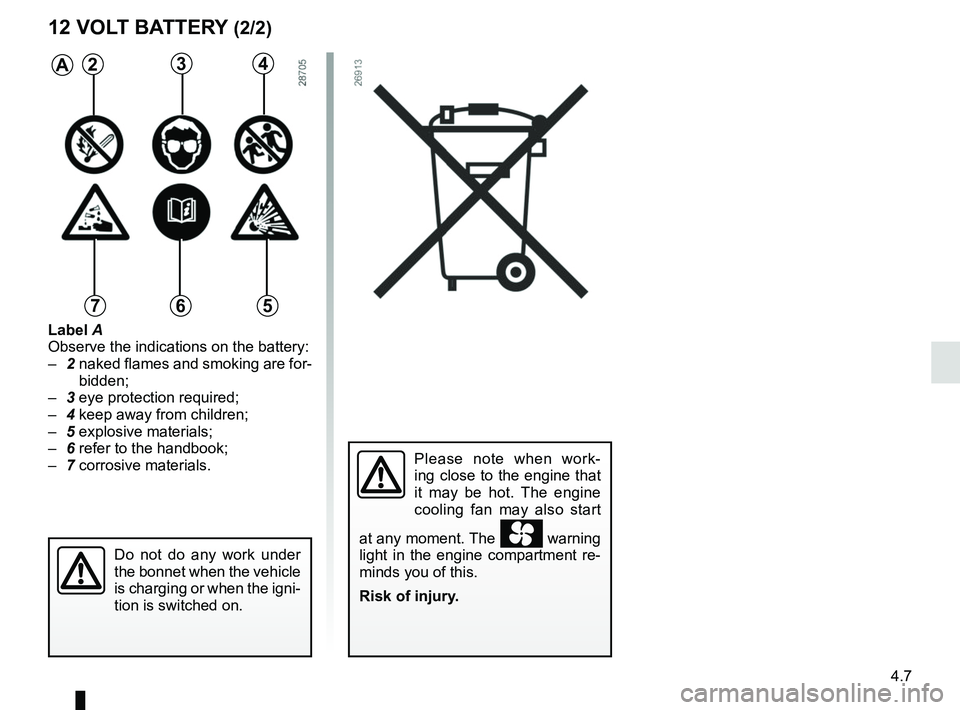
A234
567
Label A
Observe the indications on the battery:
– 2 naked flames and smoking are for-
bidden;
– 3 eye protection required;
– 4 keep away from children;
– 5 explosive materials;
– 6 refer to the handbook;
– 7 corrosive materials.
Please note when work-
ing close to the engine that
it may be hot. The engine
cooling fan may also start
at any moment. The
warning
light in the engine compartment re-
minds you of this.
Risk of injury.
12 VOLT BATTERY (2/2)
Do not do any work under
the bonnet when the vehicle
is charging or when the igni-
tion is switched on.
Page 166 of 230
4.12
Using a roller type car wash
Return the windscreen wiper stalk to
the Park position (refer to the informa-
tion on the “Windscreen washer, wiper”
in Section 1). Check the mounting of
external accessories, additional lights
and mirrors, and ensure that the wiper
blades are secured with adhesive tape.
Remove the radio aerial mast if your
vehicle is fitted with this equipment.
Remember to remove the tape and refit
the antenna after washing.
BODYWORK MAINTENANCE (3/3)Cleaning the headlights
As the headlights are made of plastic
“glass”, use a soft cloth or cotton wool
to clean them. If this does not clean
them properly, moisten the cloth with
soapy water, then wipe clean with a soft
damp cloth or cotton wool.
Finally, carefully dry off with a soft dry
cloth.
Do not use cleaning products con-
taining alcohol or utensils (e.g.: a
scraper).
Washing the vehicle
Never wash the engine
compartment, the charging
connection or the traction
battery with a high-pressure jet.
This risks damaging the electric cir-
cuit.
Never wash the vehicle while it is
charging.
Risk of electric shock and a risk to
life.
Vehicles with a matte paint
finish
This type of paint requires certain pre-
cautions.
Do not do the following
Use wax-based products (polishing).
Rub too hard.
Wash the vehicle in a roller-type car
wash.
Wash the vehicle using a high-pressure
device.
Attach stickers to the paintwork (risk of
leaving marks).
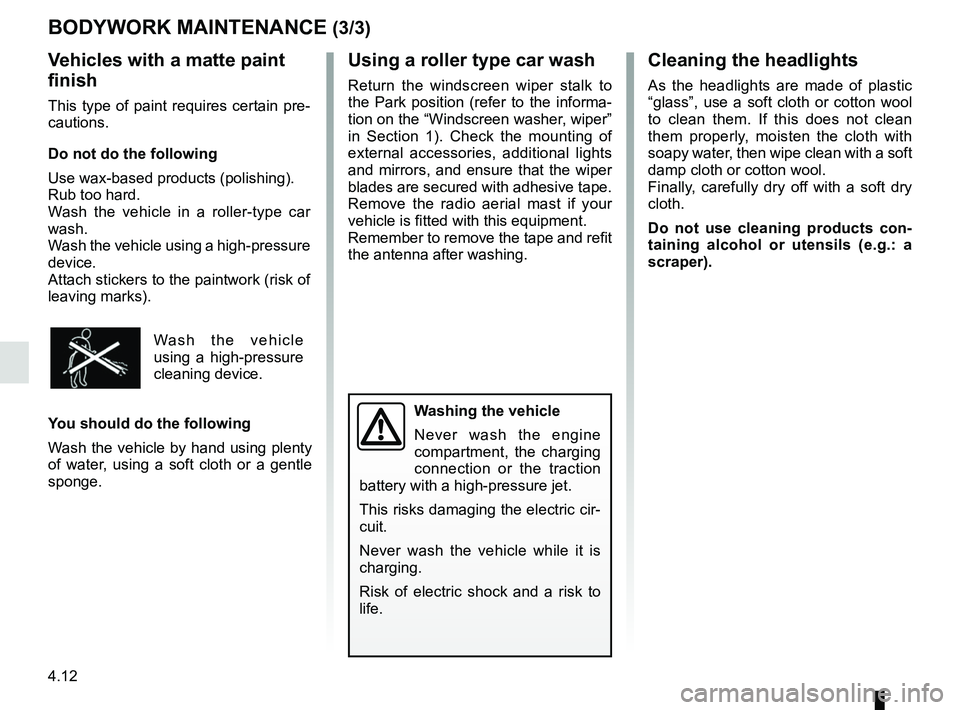
Wash the vehicle
using a high-pressure
cleaning device.
You should do the following
Wash the vehicle by hand using plenty
of water, using a soft cloth or a gentle
sponge.
Page 181 of 230
5.13
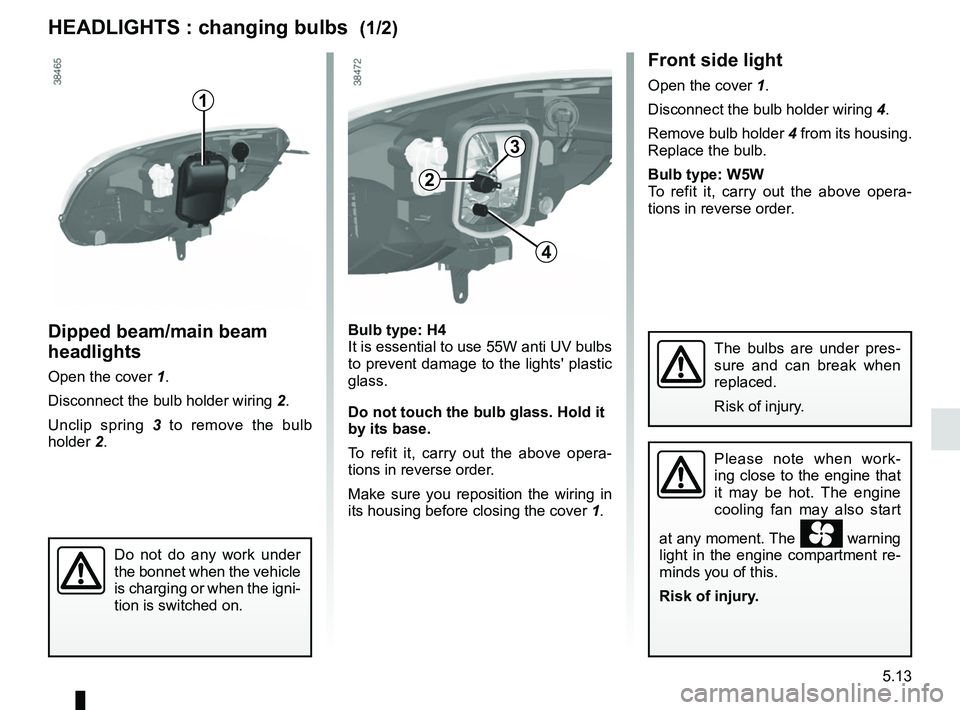
Front side light
Open the cover 1.
Disconnect the bulb holder wiring 4.
Remove bulb holder 4 from its housing.
Replace the bulb.
Bulb type: W5W
To refit it, carry out the above opera-
tions in reverse order.
Bulb type: H4 It is essential to use 55W anti UV bulbs
to prevent damage to the lights' plastic
glass.
Do not touch the bulb glass. Hold it
by its base.
To refit it, carry out the above opera-
tions in reverse order.
Make sure you reposition the wiring in
its housing before closing the cover 1.
The bulbs are under pres-
sure and can break when
replaced.
Risk of injury.
HEADLIGHTS : changing bulbs (1/2)
Please note when work-
ing close to the engine that
it may be hot. The engine
cooling fan may also start
at any moment. The
warning
light in the engine compartment re-
minds you of this.
Risk of injury.Do not do any work under
the bonnet when the vehicle
is charging or when the igni-
tion is switched on.
Dipped beam/main beam
headlights
Open the cover 1.
Disconnect the bulb holder wiring 2.
Unclip spring 3 to remove the bulb
holder 2.
2
1
4
3
Page 197 of 230

Electrical and electronic accessories
Before installing this type of accessory (particularly for transmitters\
/receivers: frequency bandwidth, power level, po-
sition of the ae")
5.29
ACCESSORIES (1/2)
Electrical and electronic accessories
Before installing this type of accessory (particularly for transmitters\
/receivers: frequency bandwidth, power level, po-
sition of the aerial, etc.), make sure it is compatible with your vehic\
le. You can get advice from an authorised dealer.
To install an accessory requiring intervention with the vehicle’s 12V electrical circuit, please follow these instructions:
– disconnect the charging cord from the traction battery;
– switch off the ignition;
– disconnect the 12V battery.
Risk of serious injury.
Connect accessories with a maximum power of 120 watts only. Fire hazard.
When several accessory sockets are used at the same time, the total powe\
r of the connected accessories must not exceed
180 watts.
No work may be carried out on the vehicle’s electrical or radio circuits, except by authorised dealers: an incorre\
ctly connecte d
system may result in damage being caused to the electrical equipment and\
/or the components connected to it.
If the vehicle is fitted with any aftermarket electrical equipment, make\
sure that the installation is correctly protected by a fuse.
Establish the rating and position of this fuse.
Page 200 of 230
5.32
FAULTSPOSSIBLE CAUSESWHAT TO DO
Impossible to charge the traction bat-
tery. No electrical current in domes-
tic sockets or poor connection of
cable to domestic socket.Check your installation (circuit breaker, pro-
grammer, etc.).
Check the connections (charging socket
etc.). Please refer to “Electric vehicle:
charging” in Section 1.
The exterior temperature is lower
than -26°C. Recharge your vehicle in a more suitable
environment. If necessary, refer to the para-
graph on “Towing, breakdown” in Section 5.
The cord is defective. Please see an authorised dealer to replace
it.
OPERATING FAULTS (1/5)
The following advice will enable you to carry out quick, temporary repai\
rs. For safety reasons, you should always contact
an approved Dealer as soon as possible.
Page 223 of 230

A
ABS ....................................................................\
...2.15 → 2.17
accessories............................................................. 5.29")
7.1
ALPHABETICAL INDEX (1/5)
A
ABS ....................................................................\
...2.15 → 2.17
accessories............................................................. 5.29 – 5.30
accessories socket ............................................................ 3.18
additional heating fuel........................................................ 1.93
additional heating tank....................................................... 1.93
additional methods of restraint .......................................... 1.45
additional heating ................................................... 3.10 – 3.11 additional heating fuel tank .......................................... 1.93
additional tank capacity ..................................................... 1.93
additional tank filling .......................................................... 1.93
air bag....................................................................1.41 → 1.45
activating the front passenger air bags ............1.58 → 1.60
deactivating the front passenger air bags ........1.58 → 1.60
air conditioning ......................................3.4 → 3.7, 3.12 – 3.13
air vents ...................................................................... 3.2 – 3.3
anti-corrosion check ..............................................6.14 → 6.18
anti-corrosion protection .................................................... 4.10
anti-lock braking system: ABS ...............................2.15 → 2.17
ashtrays ...............................................................\
.............. 3.18
audible and visual signals.................................................. 1.83
B
12 volt battery maintenance ......................................................... 4.6 – 4.7
12 volt battery ............................................1.2 → 1.7, 4.6 – 4.7
battery (remote control) ..................................................... 5.31
bonnet........................................................................\
. 4.2 – 4.3
brake fluid ........................................................................\
.... 4.5
brake lights changing bulbs .................................................. 5.16 – 5.17
bulbs changing ..........................................................5.13 → 5.20
C
central door locking ........................................................... 1.21 changing a bulb .................................5.13
→ 5.15, 5.19 – 5.20
changing a wheel................................................................. 5.8
changing gear ............................................................. 2.4 – 2.5
charge meter ....................................................1.70, 2.6 → 2.8
charging cord ..................................................1.9 → 1.16, 1.19
charging flap ............................................................1.8 → 1.16
charging socket ..................................... 1.2 → 1.7, 1.9 → 1.16
child minder mirror ............................................................. 3.16
child restraint/seat .............................1.46 – 1.47, 1.49 → 1.60
child safety.....1.17, 1.19, 1.23, 1.46 – 1.47, 1.49 → 1.60, 3.17
child seats..........................................1.46 – 1.47, 1.49 → 1.57
children ................................................................... 1.46 – 1.47
cigar lighter ........................................................................\
3.18
cleaning: inside the vehicle .............................................. 4.13 – 4.14
clock ..................................................................\
................ 1.81
closing the doors ...................................................1.22 → 1.25
connected services .............................................................. 1.3
control instruments ................................................1.69 → 1.77
controls ...............................................................\
...1.62 → 1.65
coolant ................................................................\
................. 4.4
courtesy light ..................................................................... 3.15
courtesy mirrors ................................................................. 3.16
cruise control .........................................................2.21 → 2.24
D
dashboard..............................................................1.62 → 1.65
deadlocking the doors ....................................................... 1.19
de-icing ...............................................................\
................. 3.5
dimensions ................................................................. 6.4 – 6.5
display ................................................................\
...1.66 → 1.71
doors......................................................................1.22 → 1.28
driver’s position .....................................................1.62 → 1.68
driving .................................................. 2.4 → 2.9, 2.11 → 2.26
driving position settings ............................................................1.37 →
1.40