warning lights RENAULT KANGOO Z.E. 2018 Owner's Manual
[x] Cancel search | Manufacturer: RENAULT, Model Year: 2018, Model line: KANGOO Z.E., Model: RENAULT KANGOO Z.E. 2018Pages: 230, PDF Size: 5.03 MB
Page 115 of 230
2.15
DRIVER CORRECTION DEVICES AND AIDS (1/3)
Depending on the vehicle, this is com-
posed of:
– of the ABS (anti-lock braking
system);
– electronic stability program (ESC) with understeer control and trac-
tion control;
– emergency brake assist;
– hill start assistance.
In an emergency, apply firm and
continuous pressure to the brake
pedal. There is no need to pump
it repeatedly. The ABS will modu-
late the force applied in the braking
system.
These functions are an ad-
ditional aid in the event of
critical driving conditions,
enabling the vehicle behav-
iour to be adapted to suit the driving
conditions.
However, the functions do not take
the place of the driver. They do
not increase the vehicle’s limits
and should not encourage you
to drive more quickly. Therefore,
they can under no circumstances
replace the vigilance or responsibil-
ity of the driver when manoeuvring
the vehicle (the driver must always
be ready for sudden incidents which
may occur when driving).
Your braking systems
are partially operational.
However, it is dangerous
to brake suddenly and
it is essential to stop immediately,
as soon as traffic conditions allow.
Contact an approved dealer.
ABS (anti-lock braking
system)
Under heavy braking, the ABS prevents
the wheels from locking, allowing the
stopping distance to be managed and
keeping control of the vehicle.
Under these circumstances, the vehi-
cle can be steered to avoid an obstacle
whilst braking. In addition, this system
can increase stopping distances, par-
ticularly on roads with low surface grip
(wet ground etc.).
You will feel a pulsation through the
brake pedal each time the system is
activated. The ABS does not in any way
improve the vehicle’s physical perform-
ance relating to the road surface and
roadholding. It is still essential to follow
the rules of good driving practice (such
as driving at a safe distance from the
vehicle in front, etc.). Operating faults:
– if the x warning light on the in-
strument panel comes on while driv-
ing, braking is still operational ;
– if the
x and D warning
lights on the instrument panel come
on while driving, this indicates a
fault in the braking system.
In such cases, ABS, ESC and emer-
gency brake assist are also deactivated
and, depending on the vehicle, the
messages “CHECK ABS”, “BRAKES
TO BE CHECKED” and “CHECK ESC”
appear on the instrument panel.
Consult an approved dealer.
Page 117 of 230
2.17
Emergency brake assistThis is an additional system to ABS
which helps reduce vehicle stopping
distances.
Operating principle
The system detects an emergency
braking situation. In this case, the brak-
ing assistance immediately develops
maximum power and may trigger ABS
regulation.
ABS braking is maintained as long as
the brake pedal is not released.
Hazard warning lights switching on
Depending on the vehicle, these may
light up in the event of sudden decel-
eration.
Operating faultsWhen the system detects an operating
fault the message “BRAKING FAULT”
appears on the instrument panel along
with the
© warning light. Please
consult an authorised dealer.
DRIVER CORRECTION DEVICES AND AIDS (3/3)
Hill start assistance
Depending on the gradient of the in-
cline, this system assists the driver
when starting on a hill. It prevents the
vehicle from rolling backwards, de-
pending on the slope, by automatically
applying the brakes when the driver lifts
his/her foot off the brake pedal to de-
press the accelerator pedal.
System operation
It only operates when the gear lever is
in a position other than neutral and the
vehicle is completely stationary (brake
pedal depressed).
The system holds the vehicle for ap-
proximately 2 seconds. The brakes are
then gradually released (the vehicle will
move according to the slope).
The hill start assistance
system cannot completely
prevent the vehicle from
rolling backwards in all sit-
uations (extremely steep gradients,
etc.).
In all cases, the driver may depress
the brake pedal to prevent the ve-
hicle from rolling forwards or back-
wards.
The hill start assistance function
should not be used for prolonged
stops: use the brake pedal.
This function is not designed to im-
mobilise the vehicle permanently.
If necessary, use the brake pedal to
stop the vehicle.
The driver must remain particularly
vigilant when driving on slippery or
low-grip surfaces and/or on hills.
Risk of serious injury.
Page 124 of 230
2.24
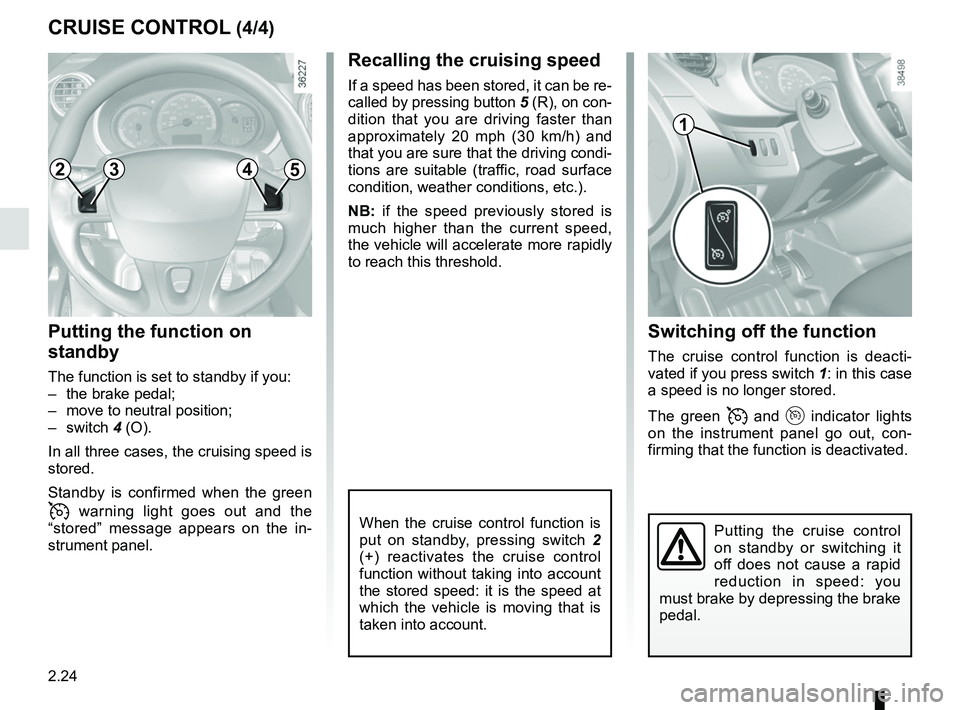
Switching off the function
The cruise control function is deacti-
vated if you press switch 1: in this case
a speed is no longer stored.
The green
and indicator lights
on the instrument panel go out, con-
firming that the function is deactivated.
Recalling the cruising speed
If a speed has been stored, it can be re-
called by pressing button 5 (R), on con-
dition that you are driving faster than
approximately 20 mph (30 km/h) and
that you are sure that the driving condi-
tions are suitable (traffic, road surface
condition, weather conditions, etc.).
NB: if the speed previously stored is
much higher than the current speed,
the vehicle will accelerate more rapidly
to reach this threshold.
When the cruise control function is
put on standby, pressing switch 2
(+) reactivates the cruise control
function without taking into account
the stored speed: it is the speed at
which the vehicle is moving that is
taken into account.
Putting the function on
standby
The function is set to standby if you:
– the brake pedal;
– move to neutral position;
– switch 4 (O).
In all three cases, the cruising speed is
stored.
Standby is confirmed when the green
warning light goes out and the
“stored” message appears on the in-
strument panel.
CRUISE CONTROL (4/4)
Putting the cruise control
on standby or switching it
off does not cause a rapid
reduction in speed: you
must brake by depressing the brake
pedal.
1
2453
Page 126 of 230
2.26
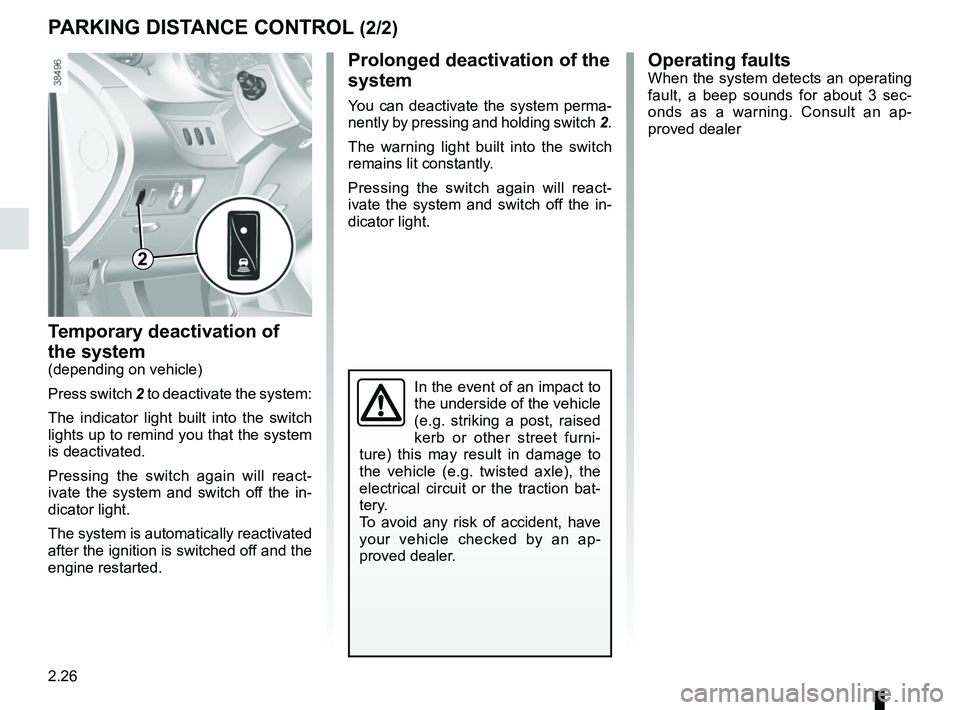
Temporary deactivation of
the system
(depending on vehicle)
Press switch 2 to deactivate the system:
The indicator light built into the switch
lights up to remind you that the system
is deactivated.
Pressing the switch again will react-
ivate the system and switch off the in-
dicator light.
The system is automatically reactivated
after the ignition is switched off and the
engine restarted.
PARKING DISTANCE CONTROL (2/2)
Operating faultsWhen the system detects an operating
fault, a beep sounds for about 3 sec-
onds as a warning. Consult an ap-
proved dealer
In the event of an impact to
the underside of the vehicle
(e.g. striking a post, raised
kerb or other street furni-
ture) this may result in damage to
the vehicle (e.g. twisted axle), the
electrical circuit or the traction bat-
tery.
To avoid any risk of accident, have
your vehicle checked by an ap-
proved dealer.
2
Prolonged deactivation of the
system
You can deactivate the system perma-
nently by pressing and holding switch 2.
The warning light built into the switch
remains lit constantly.
Pressing the switch again will react-
ivate the system and switch off the in-
dicator light.
Page 162 of 230
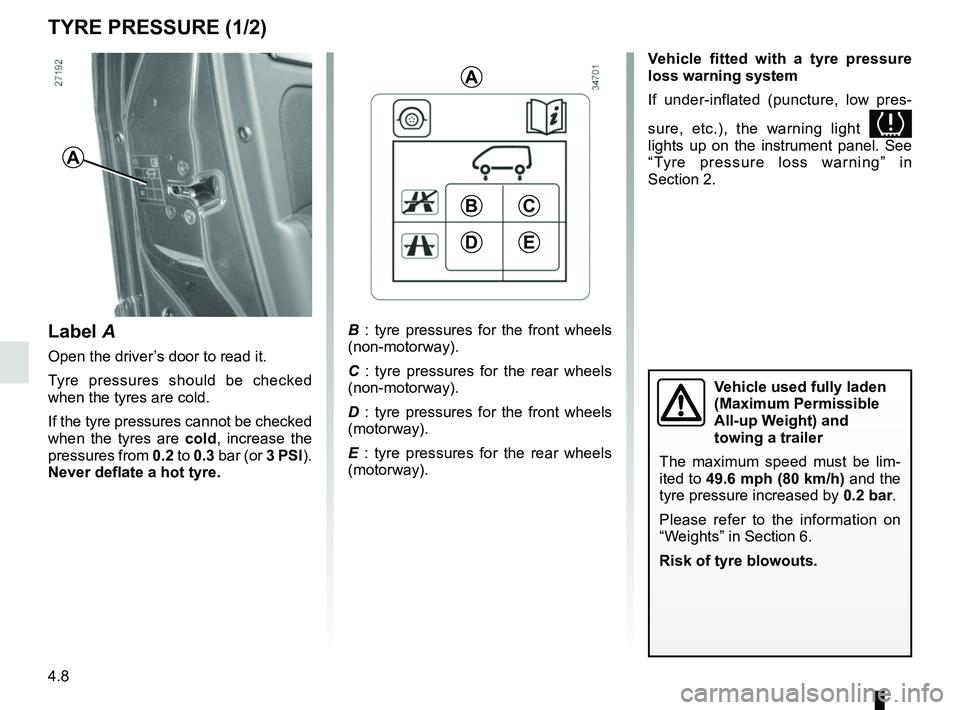
4.8
A
B : tyre pressures for the front wheels
(non-motorway).
C : tyre pressures for the rear wheels
(non-motorway).
D : tyre pressures for the front wheels
(motorway).
E : tyre pressures for the rear wheels
(motorway).
BC
ED
A
Label A
Open the driver’s door to read it.
Tyre pressures should be checked
when the tyres are cold.
If the tyre pressures cannot be checked
when the tyres are cold, increase the
pressures from 0.2 to 0.3 bar (or 3 PSI).
Never deflate a hot tyre.
TYRE PRESSURE (1/2)
Vehicle used fully laden
(Maximum Permissible
All-up Weight) and
towing a trailer
The maximum speed must be lim-
ited to 49.6 mph (80 km/h) and the tyre pressure increased by 0.2 bar.
Please refer to the information on
“Weights” in Section 6.
Risk of tyre blowouts.
Vehicle fitted with a tyre pressure
loss warning system
If under-inflated (puncture, low pres-
sure, etc.), the warning light
lights up on the instrument panel. See
“Tyre pressure loss warning” in
Section 2.
Page 172 of 230
5.4
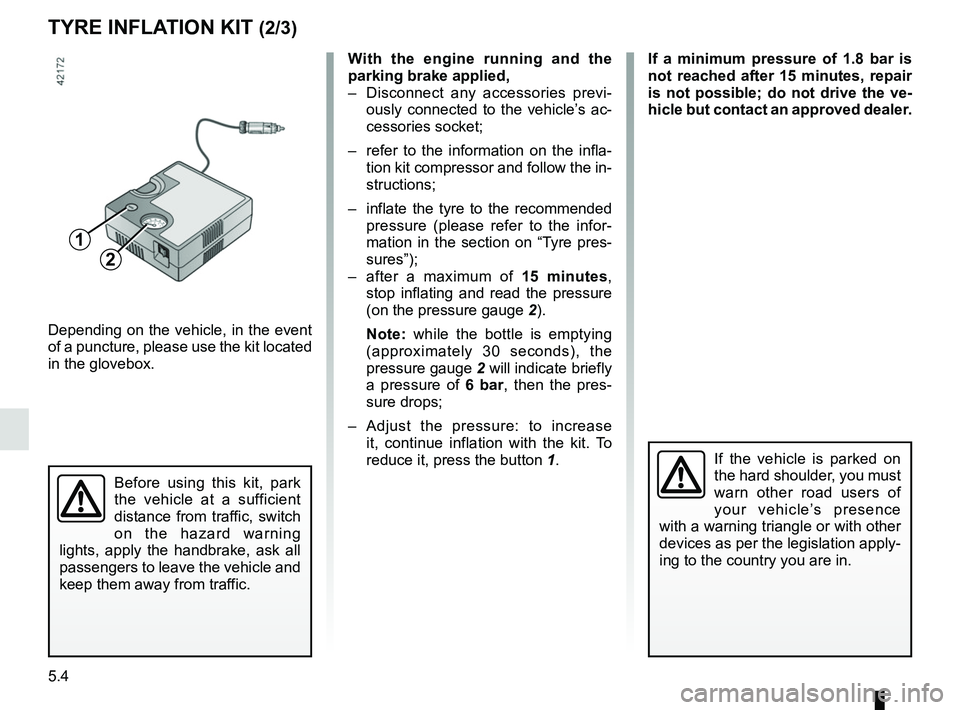
TYRE INFLATION KIT (2/3)
Depending on the vehicle, in the event
of a puncture, please use the kit located
in the glovebox.
Before using this kit, park
the vehicle at a sufficient
distance from traffic, switch
on the hazard warning
lights, apply the handbrake, ask all
passengers to leave the vehicle and
keep them away from traffic.
If the vehicle is parked on
the hard shoulder, you must
warn other road users of
your vehicle’s presence
with a warning triangle or with other
devices as per the legislation apply-
ing to the country you are in.
With the engine running and the
parking brake applied,
– Disconnect any accessories previ- ously connected to the vehicle’s ac-
cessories socket;
– refer to the information on the infla- tion kit compressor and follow the in-
structions;
– inflate the tyre to the recommended pressure (please refer to the infor-
mation in the section on “Tyre pres-
sures”);
– after a maximum of 15 minutes, stop inflating and read the pressure
(on the pressure gauge 2).
Note: while the bottle is emptying
(approximately 30 seconds), the
pressure gauge 2 will indicate briefly
a pressure of 6 bar, then the pres-
sure drops;
– Adjust the pressure: to increase it, continue inflation with the kit. To
reduce it, press the button 1.
2
1
If a minimum pressure of 1.8 bar is
not reached after 15 minutes, repair
is not possible; do not drive the ve-
hicle but contact an approved dealer.
Page 176 of 230
5.8
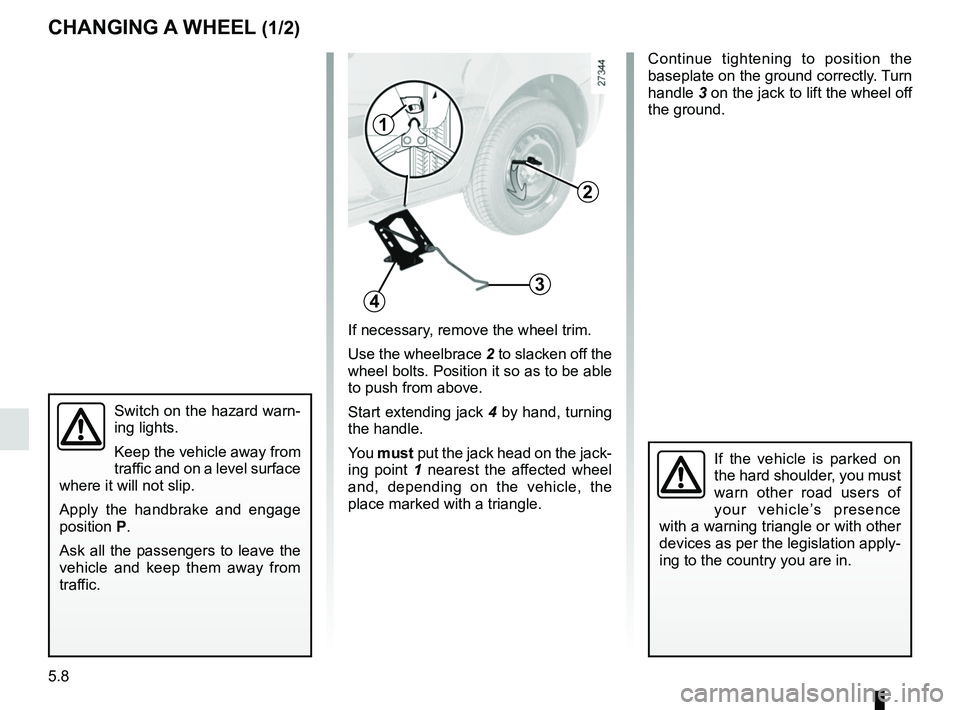
2
4
1
3
If necessary, remove the wheel trim.
Use the wheelbrace 2 to slacken off the
wheel bolts. Position it so as to be able
to push from above.
Start extending jack 4 by hand, turning
the handle.
You must put the jack head on the jack-
ing point 1 nearest the affected wheel
and, depending on the vehicle, the
place marked with a triangle.
Switch on the hazard warn-
ing lights.
Keep the vehicle away from
traffic and on a level surface
where it will not slip.
Apply the handbrake and engage
position P.
Ask all the passengers to leave the
vehicle and keep them away from
traffic.
CHANGING A WHEEL (1/2)
Continue tightening to position the
baseplate on the ground correctly. Turn
handle 3 on the jack to lift the wheel off
the ground.
If the vehicle is parked on
the hard shoulder, you must
warn other road users of
your vehicle’s presence
with a warning triangle or with other
devices as per the legislation apply-
ing to the country you are in.
Page 181 of 230
5.13
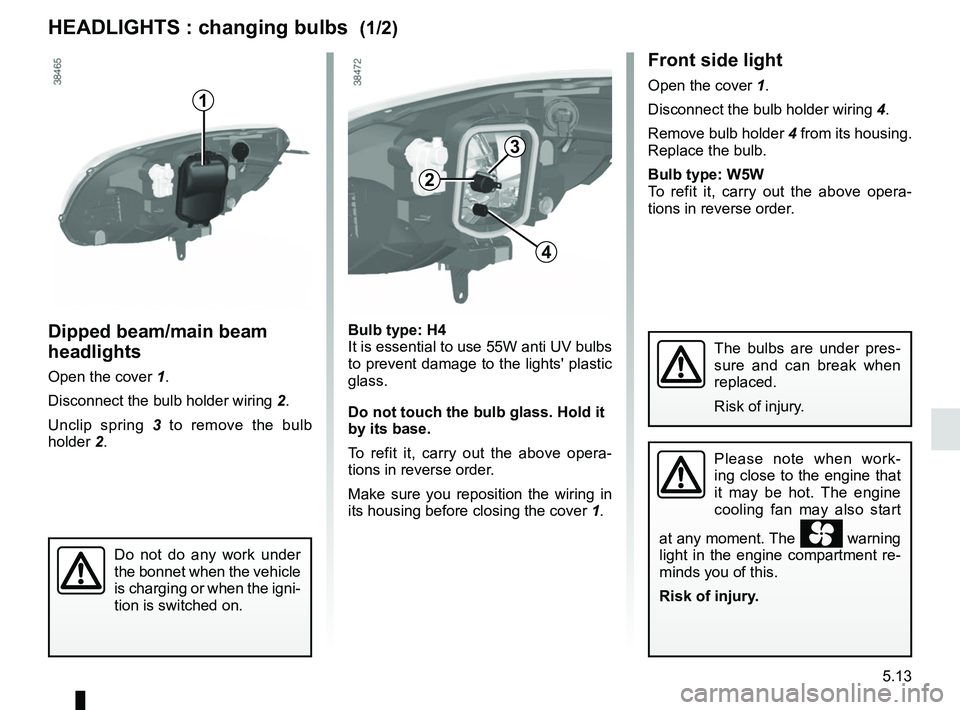
Front side light
Open the cover 1.
Disconnect the bulb holder wiring 4.
Remove bulb holder 4 from its housing.
Replace the bulb.
Bulb type: W5W
To refit it, carry out the above opera-
tions in reverse order.
Bulb type: H4 It is essential to use 55W anti UV bulbs
to prevent damage to the lights' plastic
glass.
Do not touch the bulb glass. Hold it
by its base.
To refit it, carry out the above opera-
tions in reverse order.
Make sure you reposition the wiring in
its housing before closing the cover 1.
The bulbs are under pres-
sure and can break when
replaced.
Risk of injury.
HEADLIGHTS : changing bulbs (1/2)
Please note when work-
ing close to the engine that
it may be hot. The engine
cooling fan may also start
at any moment. The
warning
light in the engine compartment re-
minds you of this.
Risk of injury.Do not do any work under
the bonnet when the vehicle
is charging or when the igni-
tion is switched on.
Dipped beam/main beam
headlights
Open the cover 1.
Disconnect the bulb holder wiring 2.
Unclip spring 3 to remove the bulb
holder 2.
2
1
4
3
Page 183 of 230
5.15
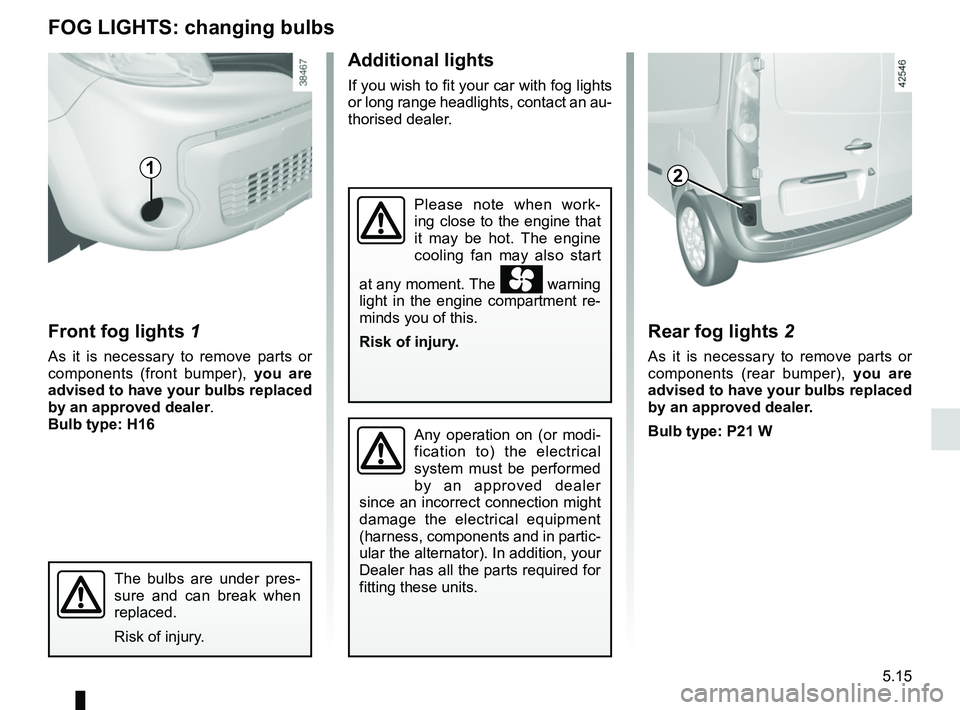
Front fog lights 1
As it is necessary to remove parts or
components (front bumper), you are
advised to have your bulbs replaced
by an approved dealer.
Bulb type: H16
Additional lights
If you wish to fit your car with fog lights
or long range headlights, contact an au-
thorised dealer.
FOG LIGHTS: changing bulbs
1
Please note when work-
ing close to the engine that
it may be hot. The engine
cooling fan may also start
at any moment. The
warning
light in the engine compartment re-
minds you of this.
Risk of injury.
Any operation on (or modi-
fication to) the electrical
system must be performed
by an approved dealer
since an incorrect connection might
damage the electrical equipment
(harness, components and in partic-
ular the alternator). In addition, your
Dealer has all the parts required for
fitting these units.
Rear fog lights 2
As it is necessary to remove parts or
components (rear bumper), you are
advised to have your bulbs replaced
by an approved dealer.
Bulb type: P21 W
2
The bulbs are under pres-
sure and can break when
replaced.
Risk of injury.
Page 194 of 230
5.26
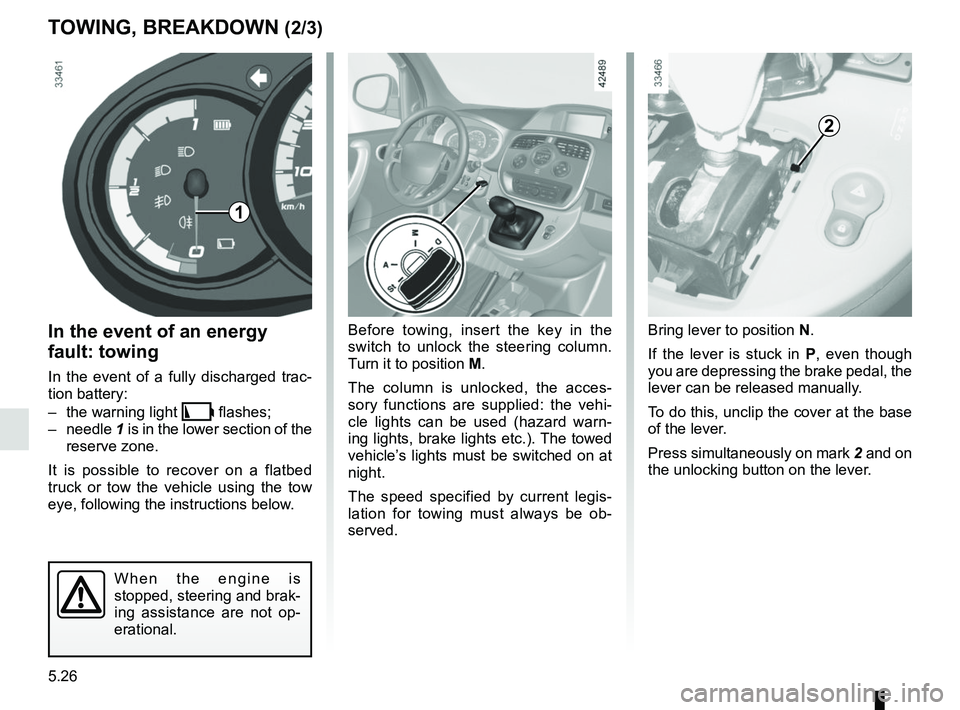
Bring lever to position N.
If the lever is stuck in P , even though
you are depressing the brake pedal, the
lever can be released manually.
To do this, unclip the cover at the base
of the lever.
Press simultaneously on mark 2 and on
the unlocking button on the lever.
TOWING, BREAKDOWN (2/3)
In the event of an energy
fault: towing
In the event of a fully discharged trac-
tion battery:
– the warning light
Ṏ flashes;
– needle 1 is in the lower section of the
reserve zone.
It is possible to recover on a flatbed
truck or tow the vehicle using the tow
eye, following the instructions below.
When the engine is
stopped, steering and brak-
ing assistance are not op-
erational.
Before towing, insert the key in the
switch to unlock the steering column.
Turn it to position M.
The column is unlocked, the acces-
sory functions are supplied: the vehi-
cle lights can be used (hazard warn-
ing lights, brake lights etc.). The towed
vehicle’s lights must be switched on at
night.
The speed specified by current legis-
lation for towing must always be ob-
served.
4
1
2