battery RENAULT KANGOO ZERO EMISSION 2012 X61 / 2.G Owner's Manual
[x] Cancel search | Manufacturer: RENAULT, Model Year: 2012, Model line: KANGOO ZERO EMISSION, Model: RENAULT KANGOO ZERO EMISSION 2012 X61 / 2.GPages: 213, PDF Size: 6.08 MB
Page 99 of 213
traction battery ....................................................... (current page)
energy consumption .............................................. (current page)
charge meter ......................................................... (current page)
energy range ................................................................ (current page)
energy consumption .................................................... (current page)
energy charge meter (function) .................................... (current page)
energy recovery ........................................................... (current page)
energy recovery ..................................................... (current page)
2.8
ENG_UD23007_2
Economètre (X61 électrique - Renault)
ENG_NU_911-4_F61e_Renault_2
Charge meter
cHargE MEtEr
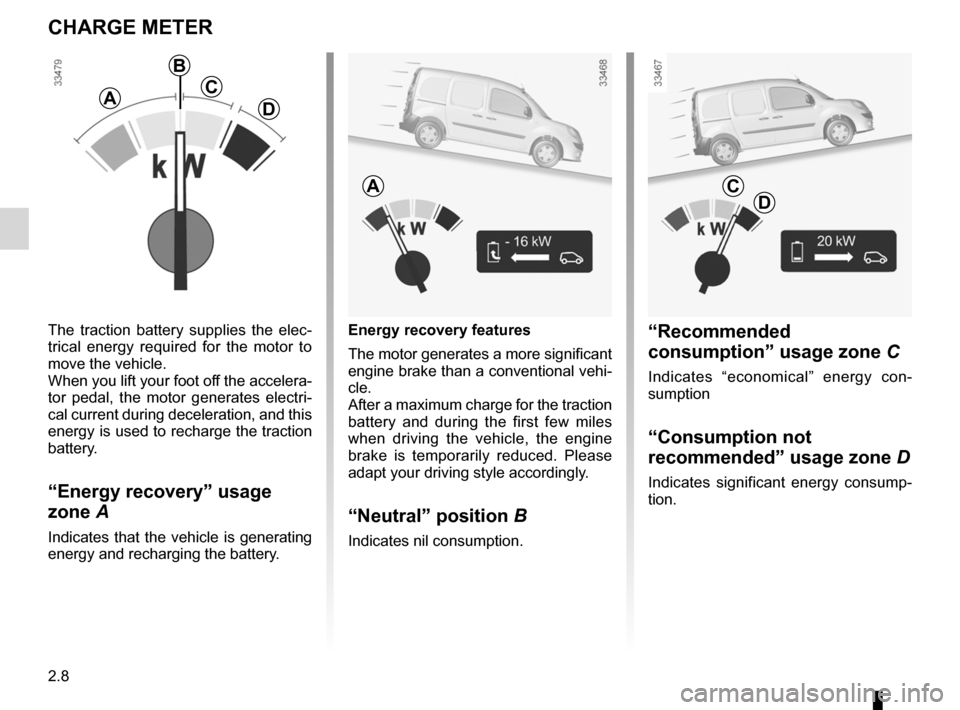
The traction battery supplies the elec -
trical energy required for the motor to
move the vehicle.
When you lift your foot off the accelera -
tor pedal, the motor generates electri -
cal current during deceleration, and this
energy is used to recharge the traction
battery.
“Energy recovery” usage
zone A
Indicates that the vehicle is generating
energy and recharging the battery. Energy recovery features
The motor generates a more significant
engine brake than a conventional vehi-
cle.
After a maximum charge for the traction
battery and during the first few miles
when driving the vehicle, the engine
brake is temporarily reduced. Please
adapt your driving style accordingly.
“neutral” position
B
Indicates nil consumption.
“recommended
consumption” usage zone C
Indicates “economical” energy con -
sumption
“consumption not
recommended” usage zone D
Indicates significant energy consump -
tion.
a
b
c
D
acD
Page 118 of 213

heating system ..................................... (up to the end of the DU)
heating, air conditioning: programming (up to the end of the DU)
ventilation ............................................. (up to the end of the DU)
3.7
ENG_UD23009_2
Chauffage, climatisation : préchambrage (X61 électrique - Renault)
ENG_NU_911-4_F61e_Renault_3
programming
Air ConditioninG/HeA tinG: programming (1/2)
Adjusting the programming
This function enables the electric net -
work (and the not the traction battery)
to be used under certain conditions, in
order to obtain a comfortable tempera-
ture prior to using the vehicle.
It triggers the heating in cold weather
and the fan in warm weather.
1
operating conditions
– the ignition must be switched off;
– the battery charging must be finished
for the function to be triggered;
– the vehicle has to be plugged into
the mains;
and
– control 1 must be position
ṗ.
2
In cold weather (< 0°C), you are rec-
ommended to position control 2 in
air recirculation position. This ena -
bles greater efficiency and lower
energy consumption in the passen-
ger compartment ambient tempera-
ture.
Page 128 of 213
cigar lighter ........................................... (up to the end of the DU)
ashtrays ................................................ (up to the end of the DU)
accessories socket ................................................ (current page)
3.17
ENG_UD23721_2
Cendriers (X61 - F61 - Renault)
ENG_NU_911-4_F61e_Renault_3
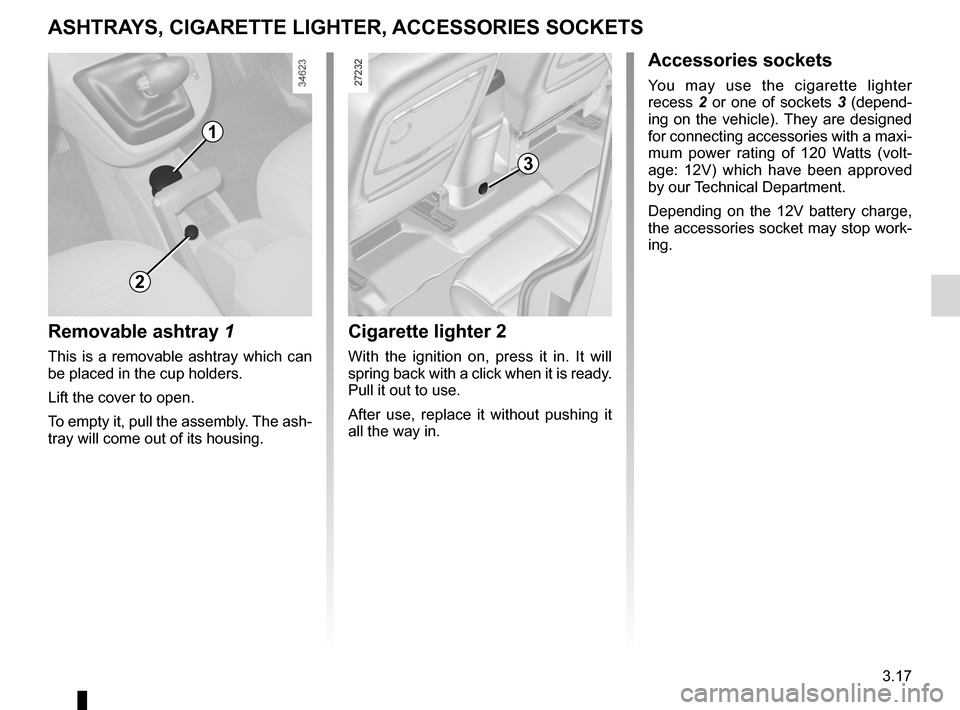
Ashtrays
removable ashtray 1
This is a removable ashtray which can
be placed in the cup holders.
Lift the cover to open.
To empty it, pull the assembly. The ash-
tray will come out of its housing.
AsHtrAys, CiGArette liGHter, ACCessories soCkets
1
3
Accessories sockets
You may use the cigarette lighter
recess 2 or one of sockets 3 (depend-
ing on the vehicle). They are designed
for connecting accessories with a maxi-
mum power rating of 120 Watts (volt -
age: 12V) which have been approved
by our Technical Department.
Depending on the 12V battery charge,
the accessories socket may stop work-
ing.
Cigarette lighter 2
With the ignition on, press it in. It will
spring back with a click when it is ready.
Pull it out to use.
After use, replace it without pushing it
all the way in.
2
Page 138 of 213
4.1
ENG_UD29095_4
Sommaire 4 (X61 - F61 - Renault)
ENG_NU_911-4_F61e_Renault_4
Section 4: Maintenance
Bonnet . . . . . . . . . . . . . . . . . . . . . . . . . . . . . . . . . . . . . . . . . . . . . . . . . . . . . . . . . . . . . . . . . . . . . . . . 4.2
Levels . . . . . . . . . . . . . . . . . . . . . . . . . . . . . . . . . . . . . . . . . . . . . . . . . . . . . . . . . . . . . . . . . . . . . . . . 4.4
coolant . . . . . . . . . . . . . . . . . . . . . . . . . . . . . . . . . . . . . . . . . . . . . . . . . . . . . . . . . . . . . . . . . . 4.4
brake fluid . . . . . . . . . . . . . . . . . . . . . . . . . . . . . . . . . . . . . . . . . . . . . . . . . . . . . . . . . . . . . . . . 4.5
windscreen washer reservoir . . . . . . . . . . . . . . . . . . . . . . . . . . . . . . . . . . . . . . . . . . . . . . . . . 4.5
12 volt battery . . . . . . . . . . . . . . . . . . . . . . . . . . . . . . . . . . . . . . . . . . . . . . . . . . . . . . . . . . . . . . . . . . 4.6
Tyre pressure. . . . . . . . . . . . . . . . . . . . . . . . . . . . . . . . . . . . . . . . . . . . . . . . . . . . . . . . . . . . . . . . . . . 4.8
Bodywork maintenance . . . . . . . . . . . . . . . . . . . . . . . . . . . . . . . . . . . . . . . . . . . . . . . . . . . . . . . . . . . 4.9
Interior trim maintenance . . . . . . . . . . . . . . . . . . . . . . . . . . . . . . . . . . . . . . . . . . . . . . . . . . . . . . . . . . 4.11
Page 143 of 213
12 volt battery ....................................... (up to the end of the DU)
12 volt battery maintenance ................................... (up to the end of the DU)
4.6
ENG_UD25386_3
Batterie (X61 électrique - Renault)
ENG_NU_911-4_F61e_Renault_4
Jaune NoirNoir texte
12 volt battery
Maintenance
Refer to the Maintenance Document for
your vehicle.
Handle the battery with care
as it contains sulphuric acid,
which must not come into
contact with eyes or skin. If
it does, wash the affected area with
plenty of cold water. If necessary,
consult a doctor.
Ensure that naked flames, red hot
objects and sparks do not come into
contact with the battery as there is a
risk of explosion.
12 vOL t BatteR y (1/2)
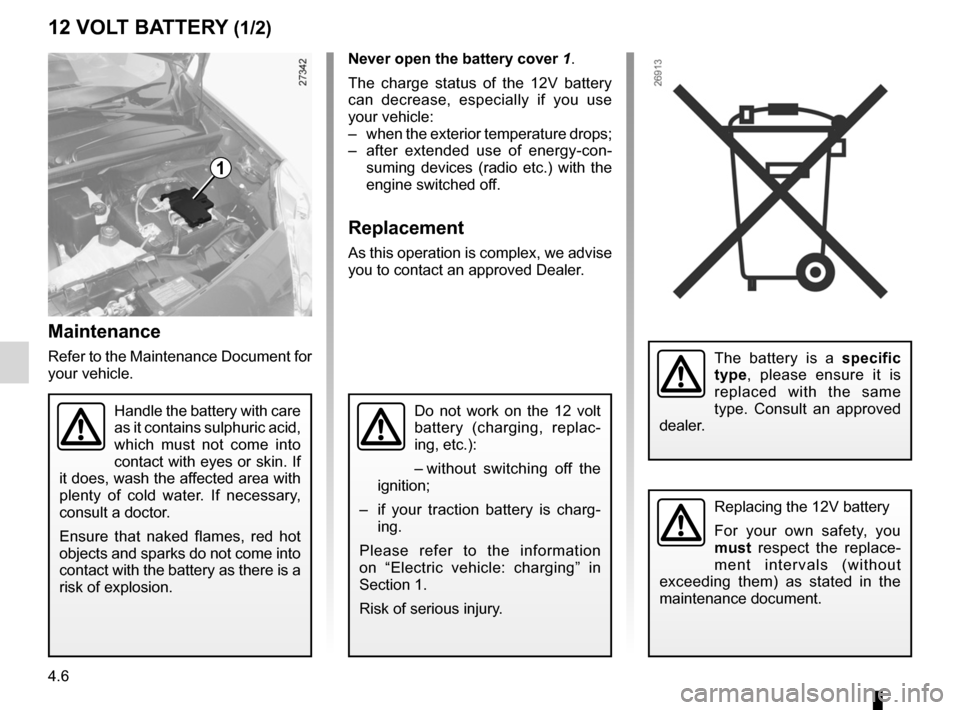
never open the battery cover 1.
The charge status of the 12V battery
can decrease, especially if you use
your vehicle:
– when the exterior temperature drops;
– after extended use of energy-con -
suming devices (radio etc.) with the
engine switched off.
Replacement
As this operation is complex, we advise
you to contact an approved Dealer.
1
The battery is a specific
type , please ensure it is
replaced with the same
type. Consult an approved
dealer.
Do not work on the 12 volt
battery (charging, replac -
ing, etc.):
– without switching off the
ignition;
– if your traction battery is charg -
ing.
Please refer to the information
on “Electric vehicle: charging” in
Section 1.
Risk of serious injury.
Replacing the 12V battery
For your own safety, you
must respect the replace -
m e n t i n te r v a l s ( w i th o u t
exceeding them) as stated in the
maintenance document.
Page 144 of 213
JauneNoirNoir texte
4.7
ENG_UD25386_3
Batterie (X61 électrique - Renault)
ENG_NU_911-4_F61e_Renault_4
a234
567
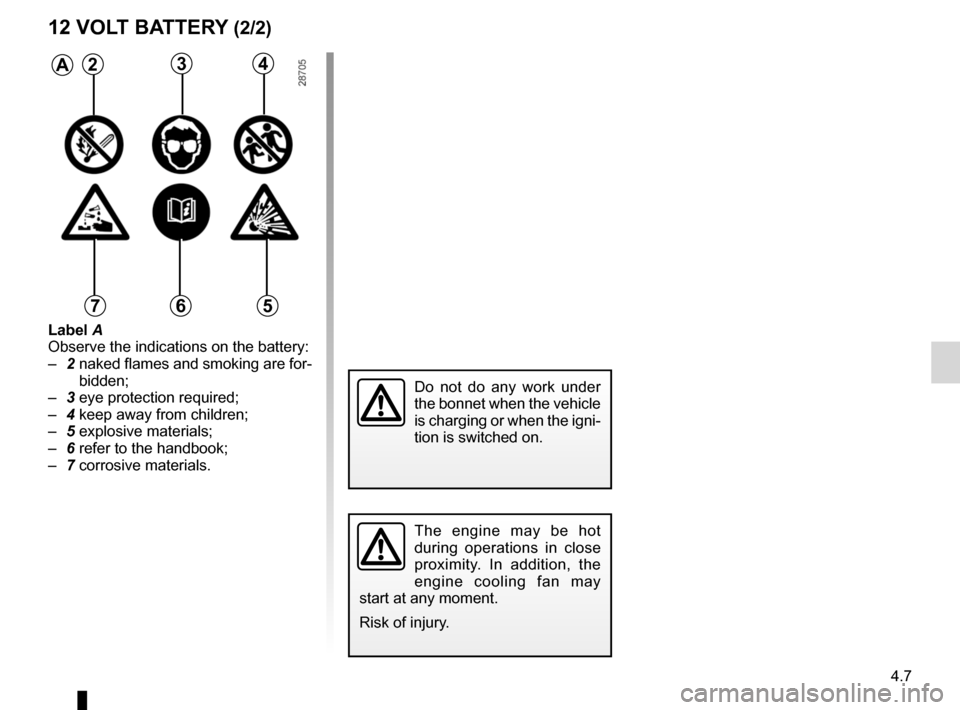
Label A
Observe the indications on the battery:
– 2 naked flames and smoking are for-
bidden;
– 3 eye protection required;
– 4 keep away from children;
– 5 explosive materials;
– 6 refer to the handbook;
– 7 corrosive materials.
The engine may be hot
during operations in close
proximity. In addition, the
engine cooling fan may
start at any moment.
Risk of injury.
12 vOL t BatteR y (2/2)
Do not do any work under
the bonnet when the vehicle
is charging or when the igni -
tion is switched on.
Page 147 of 213
4.10
ENG_UD26559_3
Entretien de la carosserie (X61 - X38 - X61 électrique - L38 électrique - X10 - Renault)
ENG_NU_911-4_F61e_Renault_4
using a roller type car wash
Return the windscreen wiper stalk to
the Park position (refer to the informa-
tion on the “Windscreen washer, wiper”
in Section 1). Check the mounting of
external accessories, additional lights
and mirrors, and ensure that the wiper
blades are secured with adhesive tape.
Remove the radio aerial mast if your
vehicle is fitted with this equipment.
Remember to remove the tape and refit
the antenna after washing.
Observe the vehicle stopping distances
when driving on gravelled surfaces to
prevent paint damage.
Repair, or have repaired quickly, areas
where the paint has been damaged, to
prevent corrosion spreading.
Remember to visit the body shop pe
-
riodically in order to maintain your
anti-corrosion warranty. Refer to the
Maintenance Document.
Respect local regulations about wash -
ing vehicles (e.g. do not wash your ve-
hicle on a public highway).
If it is necessary to clean mechani -
cal components, hinges, etc., spray
them with products approved by our
Technical Department to protect them
after they have been cleaned.
BODyWORk MaIntenanCe (2/2)
Cleaning the headlights
As the headlights are made of plastic
“glass”, use a soft cloth or cotton wool
to clean them. If this does not clean
them properly, moisten the cloth with
soapy water, then wipe clean with a soft
damp cloth or cotton wool.
Finally, carefully dry off with a soft dry
cloth.
Cleaning products containing alco -
hol must not be used.
vehicles with a matte paint
finish
This type of paint requires certain pre-
cautions.
Do not do the following
– use wax-based products (polishing);
– rub too hard;
– wash the vehicle in a roller-type car
wash;
– wash the vehicle using a high-pres-
sure device;
– attach stickers to the paintwork (risk
of leaving marks).
y ou should do the following
Wash the vehicle by hand using plenty
of water, using a soft cloth or a gentle
sponge.
We have selected special products
to care for your vehicle and you can
obtain these from the manufactur -
er’s accessory outlets.
Washing the vehicle
Never wash the engine
compartment, the charging
connection or the traction
battery with a high-pressure jet.
This risks damaging the electric cir-
cuit.
Never wash the vehicle while it is
charging.
Risk of electric shock and a risk to
life.
Page 150 of 213
5.1
ENG_UD29096_4
Sommaire 5 (X61 - F61 - Renault)
ENG_NU_911-4_F61e_Renault_5
Section 5: Practical advice
Puncture . . . . . . . . . . . . . . . . . . . . . . . . . . . . . . . . . . . . . . . . . . . . . . . . . . . . . . . . . . . . . . . . . . . . . . 5.2
Emergency spare wheel . . . . . . . . . . . . . . . . . . . . . . . . . . . . . . . . . . . . . . . . . . . . . . . . . . . . . . . . . . 5.2
Tyre inflation kit . . . . . . . . . . . . . . . . . . . . . . . . . . . . . . . . . . . . . . . . . . . . . . . . . . . . . . . . . . . . . . . . . 5.3
Tool kit . . . . . . . . . . . . . . . . . . . . . . . . . . . . . . . . . . . . . . . . . . . . . . . . . . . . . . . . . . . . . . . . . . . . . . . . 5.8
Wheels, trim . . . . . . . . . . . . . . . . . . . . . . . . . . . . . . . . . . . . . . . . . . . . . . . . . . . . . . . . . . . . . . . . . . . . 5.9
Changing a wheel . . . . . . . . . . . . . . . . . . . . . . . . . . . . . . . . . . . . . . . . . . . . . . . . . . . . . . . . . . . . . . . 5.10
Tyres . . . . . . . . . . . . . . . . . . . . . . . . . . . . . . . . . . . . . . . . . . . . . . . . . . . . . . . . . . . . . . . . . . . . . . . . . 5.12
Headlights: changing bulbs . . . . . . . . . . . . . . . . . . . . . . . . . . . . . . . . . . . . . . . . . . . . . . . . . . . . . . . . 5.15
Fog lights: changing bulbs . . . . . . . . . . . . . . . . . . . . . . . . . . . . . . . . . . . . . . . . . . . . . . . . . . . . . . . . . 5.17
Rear lights: changing bulbs . . . . . . . . . . . . . . . . . . . . . . . . . . . . . . . . . . . . . . . . . . . . . . . . . . . . . . . . 5.18
Indicator lights: changing bulbs . . . . . . . . . . . . . . . . . . . . . . . . . . . . . . . . . . . . . . . . . . . . . . . . . . . . . 5.21
Interior lights: changing bulbs . . . . . . . . . . . . . . . . . . . . . . . . . . . . . . . . . . . . . . . . . . . . . . . . . . . . . . 5.22
12 volt battery: breakdowns . . . . . . . . . . . . . . . . . . . . . . . . . . . . . . . . . . . . . . . . . . . . . . . . . . . . . . . . 5.24
Fuses . . . . . . . . . . . . . . . . . . . . . . . . . . . . . . . . . . . . . . . . . . . . . . . . . . . . . . . . . . . . . . . . . . . . . . . . . 5.26
Wiper blades . . . . . . . . . . . . . . . . . . . . . . . . . . . . . . . . . . . . . . . . . . . . . . . . . . . . . . . . . . . . . . . . . . . 5.28
Towing/breakdown . . . . . . . . . . . . . . . . . . . . . . . . . . . . . . . . . . . . . . . . . . . . . . . . . . . . . . . . . . . . . . . 5.30
Fitted audio equipment . . . . . . . . . . . . . . . . . . . . . . . . . . . . . . . . . . . . . . . . . . . . . . . . . . . . . . . . . . . 5.33
Accessories . . . . . . . . . . . . . . . . . . . . . . . . . . . . . . . . . . . . . . . . . . . . . . . . . . . . . . . . . . . . . . . . . . . . 5.35
Radio frequency remote control unit: batteries . . . . . . . . . . . . . . . . . . . . . . . . . . . . . . . . . . . . . . . . . 5.36
Operating faults . . . . . . . . . . . . . . . . . . . . . . . . . . . . . . . . . . . . . . . . . . . . . . . . . . . . . . . . . . . . . . . . . 5.37
Page 173 of 213
batterytroubleshooting ............................... (up to the end of the DU)
12 volt battery ....................................... (up to the end of the DU)
12 volt battery breakdown recovery ....................... (up to the end of the DU)
5.24
ENG_UD26209_3
Batterie : dépannage (X61 - F61 - Renault)
ENG_NU_911-4_F61e_Renault_5
Jaune NoirNoir texte
12 volt battery: breakdown
12 VOlt Battery: breakdown recovery (1/2)
to avoid all risk of sparks:
– Switch off the vehicle ignition.
– Ensure that any electrical consumers
(courtesy lights, etc.) are switched
off before disconnecting or recon -
necting the battery.
– When charging, stop the charger
before connecting or disconnecting
the battery.
– Do not place metal objects on the
battery to avoid creating a short cir-
cuit between the terminals.
– Make sure that you reconnect the
battery terminals after refitting.
connecting a battery charger
the battery charger must be com -
patible with a battery with nominal
voltage of 12 volts.
Before disconnecting the battery, check
that:
– the ignition is switched off;
– the gear control is in position P
(please see the information on “Gear
control”;
– the charging cable is disconnected.
Special procedures may be
required to charge some
batteries. Contact your ap -
proved dealer.
Avoid all risk of sparks which may
cause an immediate explosion, and
charge the battery in a well-venti -
lated area. Risk of serious injury.
Handle the battery with care
as it contains sulphuric acid,
which must not come into
contact with eyes or skin. If
it does, wash the affected area with
plenty of cold water. If necessary,
consult a doctor.
Ensure that naked flames, red hot
objects and sparks do not come into
contact with the battery as there is a
risk of explosion.
The engine may be hot when car -
rying out operations in close prox -
imity. In addition, the engine cooling
fan can come on at any moment.
Risk of injury.
Disconnect the leads connected to both
battery terminals, starting with the
negative terminal.
Follow the instructions given by the
manufacturer of the battery charger
you are using.
Do not work on the 12 volt
battery (charging, replac -
ing, etc.):
– without switching off the
ignition;
– if your traction battery is charg -
ing.
Please refer to the information
on “Electric vehicle: charging” in
Section 1.
Risk of serious injury.
Page 174 of 213
JauneNoirNoir texte
5.25
ENG_UD26209_3
Batterie : dépannage (X61 - F61 - Renault)
ENG_NU_911-4_F61e_Renault_5
1
a
2
4
B
3
12 VOlt Battery: breakdown recovery (2/2)
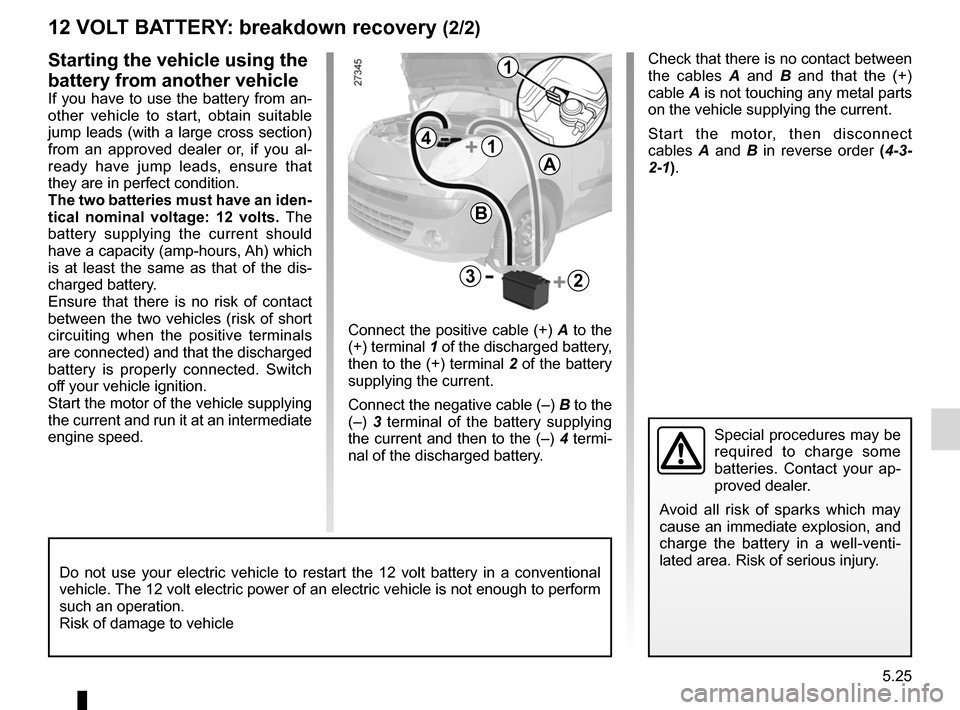
Check that there is no contact between
the cables A and B and that the (+)
cable A is not touching any metal parts
on the vehicle supplying the current.
Start the motor, then disconnect
cables A and B in reverse order (4 -3 -
2-1).starting the vehicle using the
battery from another vehicle
If you have to use the battery from an-
other vehicle to start, obtain suitable
jump leads (with a large cross section)
from an approved dealer or, if you al -
ready have jump leads, ensure that
they are in perfect condition.
the two batteries must have an iden-
tical nominal voltage: 12 volts. The
battery supplying the current should
have a capacity (amp-hours, Ah) which
is at least the same as that of the dis-
charged battery.
Ensure that there is no risk of contact
between the two vehicles (risk of short
circuiting when the positive terminals
are connected) and that the discharged
battery is properly connected. Switch
off your vehicle ignition.
Start the motor of the vehicle supplying
the current and run it at an intermediate
engine speed.
Special procedures may be
required to charge some
batteries. Contact your ap -
proved dealer.
Avoid all risk of sparks which may
cause an immediate explosion, and
charge the battery in a well-venti -
lated area. Risk of serious injury.
1
Connect the positive cable (+) A to the
(+) terminal 1 of the discharged battery,
then to the (+) terminal 2 of the battery
supplying the current.
Connect the negative cable (–) B to the
(–) 3 terminal of the battery supplying
the current and then to the (–) 4 termi-
nal of the discharged battery.
Do not use your electric vehicle to restart the 12 volt battery in a conventional
vehicle. The 12 volt electric power of an electric vehicle is not enough to perform
such an operation.
Risk of damage to vehicle