Door RENAULT KOLEOS 2012 1.G User Guide
[x] Cancel search | Manufacturer: RENAULT, Model Year: 2012, Model line: KOLEOS, Model: RENAULT KOLEOS 2012 1.GPages: 233, PDF Size: 7.81 MB
Page 17 of 233
opening the doors ................................. (up to the end of the DU)
closing the doors .................................. (up to the end of the DU)
unlocking the doors .............................. (up to the end of the DU)
central door locking .............................. (up to the end of the DU)
1.11
ENG_UD23661_6
Verrouillage et déverouillage des portes (X45 - H45 - Renault)
ENG_NU_977-2_H45_Ph2_Renault_1
LOcKINg, UNLOcKINg ThE dOORs (1/2)
Locking/unlocking the doors
from the outside
This is done using the RENAULT
Card; refer to the information on the
RENAULT Card" in Section 1.
In certain cases, the RENAULT card
may not work:
– when the RENAULT card battery is
drained, flat battery, etc.
– use of appliances operating on the
same frequency as the card (mobile
phone, etc.);
– vehicle located in a high electromag-
netic radiation zone.
It is then possible:
– to use the key integrated into the
card to unlock the front left-hand
door;
– to lock each of the doors manually
(see the following page);
– to use the interior door locking/un -
locking control (refer to the following
pages).
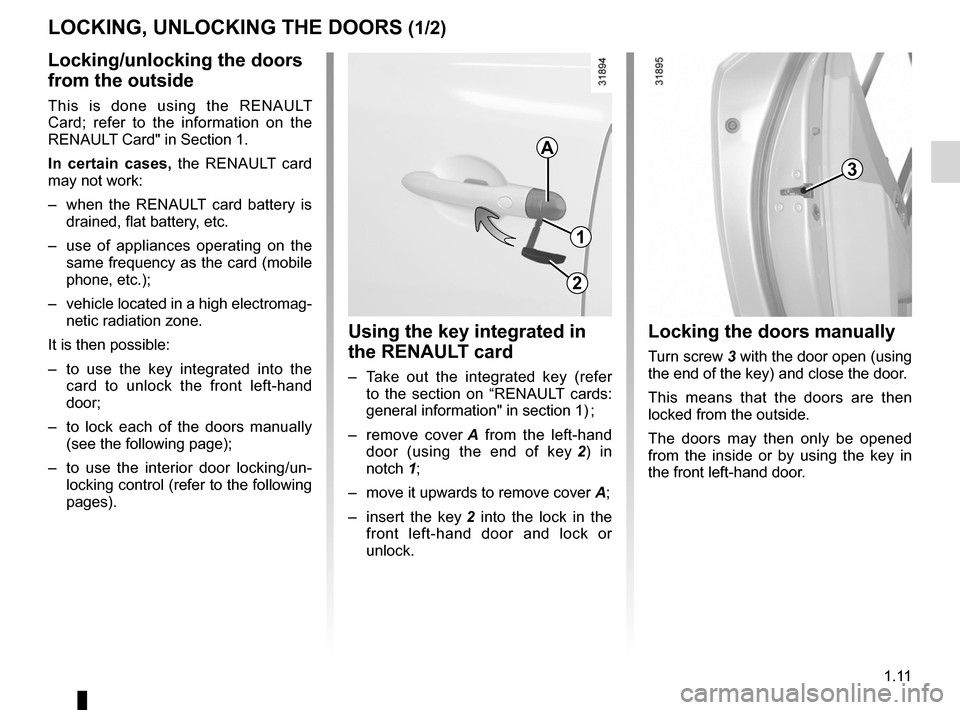
Locking the doors manually
Turn screw 3 with the door open (using
the end of the key) and close the door.
This means that the doors are then
locked from the outside.
The doors may then only be opened
from the inside or by using the key in
the front left-hand door.
Using the key integrated in
the RENAULT card
– Take out the integrated key (refer
to the section on “RENAULT cards:
general information" in section 1) ;
– remove cover A from the left-hand
door (using the end of key 2 ) in
notch 1;
– move it upwards to remove cover A;
– insert the key 2 into the lock in the
front left-hand door and lock or
unlock.
A
1
2
3
Page 18 of 233
1.12
ENG_UD23661_6
Verrouillage et déverouillage des portes (X45 - H45 - Renault)
ENG_NU_977-2_H45_Ph2_Renault_1
LOcKINg, UNLOcKINg ThE dOORs (2/2)
Locking the opening
elements without the
RENAULT card
(if the RENAULT card is not working, for
example)
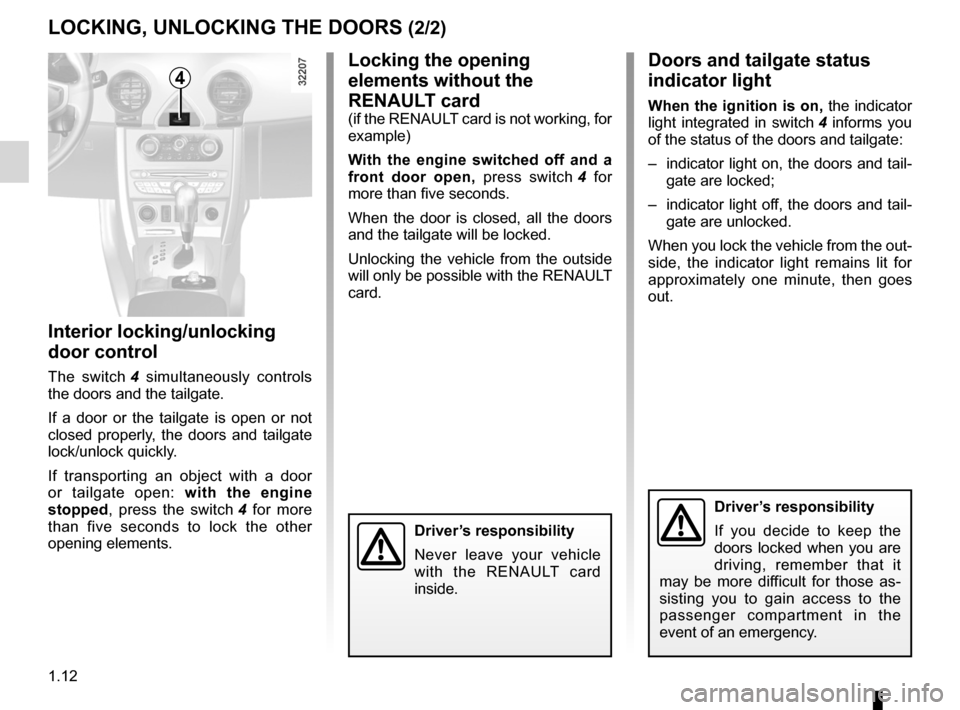
With the engine switched off and a
front door open, press switch 4 for
more than five seconds.
When the door is closed, all the doors
and the tailgate will be locked.
Unlocking the vehicle from the outside
will only be possible with the RENAULT
card.
doors and tailgate status
indicator light
When the ignition is on, the indicator
light integrated in switch 4 informs you
of the status of the doors and tailgate:
– indicator light on, the doors and tail-
gate are locked;
– indicator light off, the doors and tail-
gate are unlocked.
When you lock the vehicle from the out-
side, the indicator light remains lit for
approximately one minute, then goes
out.
Interior locking/unlocking
door control
The switch 4 simultaneously controls
the doors and the tailgate.
If a door or the tailgate is open or not
closed properly, the doors and tailgate
lock/unlock quickly.
If transporting an object with a door
or tailgate open: with the engine
stopped , press the switch 4 for more
than five seconds to lock the other
opening elements.
4
driver’s responsibility
Never leave your vehicle
with the RENAULT card
inside.
driver’s responsibility
If you decide to keep the
doors locked when you are
driving, remember that it
may be more difficult for those as -
sisting you to gain access to the
passenger compartment in the
event of an emergency.
Page 19 of 233
RENAULT ANTI-INTRUDER DEVICE (RAID) (up to the end of the DU)
central door locking .............................. (up to the end of the DU)
doors ..................................................... (up to the end of the DU)
locking the doors .................................. (up to the end of the DU)
1.13
ENG_UD27286_6
Condamnation automatique des ouvrants en roulage (X45 - H45 - Renault)
ENG_NU_977-2_H45_Ph2_Renault_1
Automatic locking of opening elements when driving
RAId (RENAULT ANTI-INTRUdER dEvIcE)
Operating principle
When the vehicle is started, the system
automatically locks the doors when the
vehicle reaches approximately 6 mph
(10 km/h).
The door can be unlocked:
– by pressing door unlocking button 1.
– by opening a front door (vehicle sta-
tionary).
Note: if a door is opened or closed,
it will automatically lock again when
the vehicle reaches a speed of 6 mph
(10 km/h). To activate this function:
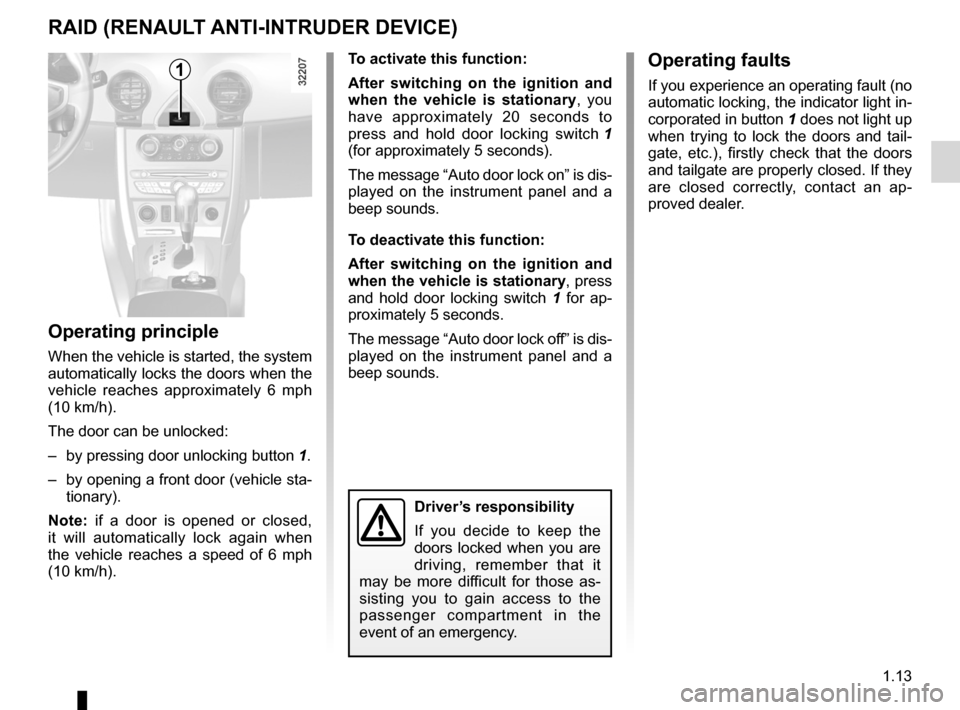
After switching on the ignition and
when the vehicle is stationary
, you
have approximately 20 seconds to
press and hold door locking switch 1
(for approximately 5 seconds).
The message “Auto door lock on” is dis-
played on the instrument panel and a
beep sounds.
To deactivate this function:
After switching on the ignition and
when the vehicle is stationary, press
and hold door locking switch 1 for ap -
proximately 5 seconds.
The message “Auto door lock off” is dis-
played on the instrument panel and a
beep sounds.
Operating faults
If you experience an operating fault (no
automatic locking, the indicator light in-
corporated in button 1 does not light up
when trying to lock the doors and tail -
gate, etc.), firstly check that the doors
and tailgate are properly closed. If they
are closed correctly, contact an ap -
proved dealer.1
driver’s responsibility
If you decide to keep the
doors locked when you are
driving, remember that it
may be more difficult for those as -
sisting you to gain access to the
passenger compartment in the
event of an emergency.
Page 32 of 233
air bag................................................... (up to the end of the DU)
additional methods of restraint side protection ................................ (up to the end of the DU)
methods of restraint in addition to the seat belts
(up to the end of the DU)
1.26
ENG_UD20769_2
Dispositif de protection lat rale (X45 - H45 - Renault)
ENG_NU_977-2_H45_Ph2_Renault_1
side protection
sIdE pROTEcTION dEvIcEs
side air bags
This air bag is fitted to each of the front
seats and is inflated at the sides of
the seats (door side) to protect the oc-
cupants in the event of a severe side
impact.
curtain air bags
These are air bags fitted along the sides
of the vehicle in the ceiling which trigger
along the front and rear side windows
to protect the passengers in case of a
severe side impact.
Warnings concerning the side air bag
– fitting seat covers: seats equipped with an air bag require covers
specifically designed for your vehicle. Contact an approved dealer to find
out if these covers are sold at approved accessory outlets. The use of
any covers other than those designed for your vehicle (and including those de-
signed for another vehicle) may affect the operation of the air bags and reduce
your protection.
– Do not place any accessories, objects or even pets between the seatback, the
door and the internal fittings. Do not cover the seatback with any items such as
clothes or accessories. This may prevent the air bag from operating correctly
or cause injury when the air bag is deployed.
– No work or modification whatsoever may be carried out on the seat or internal
fittings, except by qualified personnel from an approved Dealer.
– These air bags operate through slits in the front seatbacks (door side): never
insert any objects in these slits.
Page 34 of 233
child safety............................................ (up to the end of the DU)
child restraint/seat ................................ (up to the end of the DU)
child restraint/seat ................................ (up to the end of the DU)
child restraint/seat ................................ (up to the end of the DU)
child seats ............................................. (up to the end of the DU)
transporting children ............................. (up to the end of the DU)
children ................................................. (up to the end of the DU)
1.28
ENG_UD27170_5
S curit enfants : g n ralit s (X35 - L35 - X45 - H45 - X65 - X81 - X85 - X83 - B95 - D95 - K95 - J95 - R95 - L38 - X38 - X32 - Renault)
ENG_NU_977-2_H45_Ph2_Renault_1
Jaune NoirNoir texte
Child safety: general information
chILd sAfETY : general information (1/2)
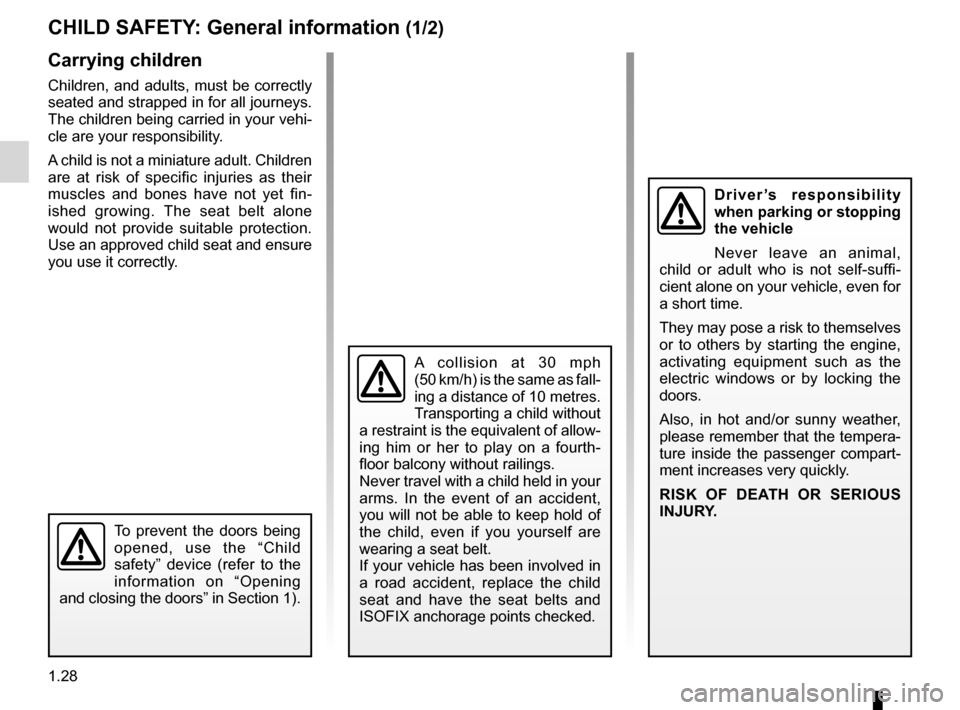
carrying children
Children, and adults, must be correctly
seated and strapped in for all journeys.
The children being carried in your vehi-
cle are your responsibility.
A child is not a miniature adult. Children
are at risk of specific injuries as their
muscles and bones have not yet fin -
ished growing. The seat belt alone
would not provide suitable protection.
Use an approved child seat and ensure
you use it correctly.
A collision at 30 mph
(50 km/h) is the same as fall-
ing a distance of 10 metres.
Transporting a child without
a restraint is the equivalent of allow-
ing him or her to play on a fourth -
floor balcony without railings.
Never travel with a child held in your
arms. In the event of an accident,
you will not be able to keep hold of
the child, even if you yourself are
wearing a seat belt.
If your vehicle has been involved in
a road accident, replace the child
seat and have the seat belts and
ISOFIX anchorage points checked.
To prevent the doors being
opened, use the “Child
safety” device (refer to the
information on “Opening
and closing the doors” in Section 1).
d r i v e r ’s r e s p o n s i b i l i t y
when parking or stopping
the vehicle
Never leave an animal,
child or adult who is not self-suffi -
cient alone on your vehicle, even for
a short time.
They may pose a risk to themselves
or to others by starting the engine,
activating equipment such as the
electric windows or by locking the
doors.
Also, in hot and/or sunny weather,
please remember that the tempera-
ture inside the passenger compart-
ment increases very quickly.
RI sK O f d EAT h OR sERIOU s
INJURY.
Page 39 of 233
child restraint/seat ................................ (up to the end of the DU)
child restraint/seat ................................ (up to the end of the DU)
child restraint/seat ................................ (up to the end of the DU)
child safety ............................................ (up to the end of the DU)
child seats ............................................. (up to the end of the DU)
transporting children ............................. (up to the end of the DU)
1.33
ENG_UD23487_5
Sécurité enfants : installation du siège enfant (X45 - H45 - Renault)
ENG_NU_977-2_H45_Ph2_Renault_1
fitting a child seat
chILd sAfETY : fitting a child seat (1/3)
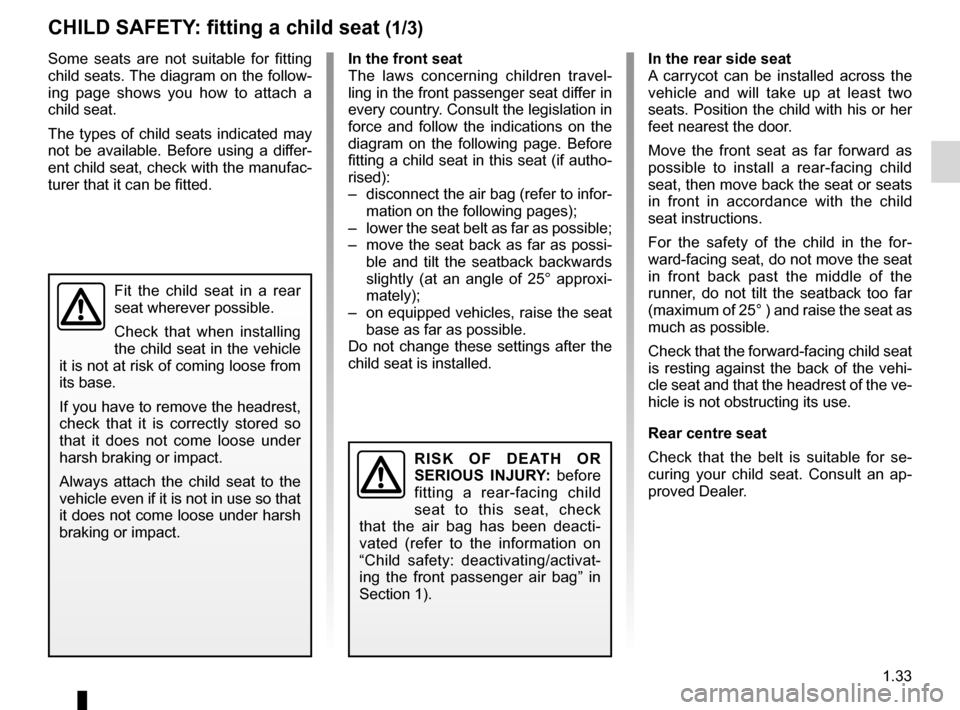
In the rear side seat
A carrycot can be installed across the
vehicle and will take up at least two
seats. Position the child with his or her
feet nearest the door.
Move the front seat as far forward as
possible to install a rear-facing child
seat, then move back the seat or seats
in front in accordance with the child
seat instructions.
For the safety of the child in the for -
ward-facing seat, do not move the seat
in front back past the middle of the
runner, do not tilt the seatback too far
(maximum of 25° ) and raise the seat as
much as possible.
Check that the forward-facing child seat
is resting against the back of the vehi-
cle seat and that the headrest of the ve-
hicle is not obstructing its use.
Rear centre seat
Check that the belt is suitable for se -
curing your child seat. Consult an ap -
proved Dealer.
R I sK O f dE AT h O R
s ERIOU s INJURY: before
fitting a rear-facing child
seat to this seat, check
that the air bag has been deacti -
vated (refer to the information on
“Child safety: deactivating/activat -
ing the front passenger air bag” in
Section 1).
Some seats are not suitable for fitting
child seats. The diagram on the follow -
ing page shows you how to attach a
child seat.
The types of child seats indicated may
not be available. Before using a differ-
ent child seat, check with the manufac-
turer that it can be fitted.
Fit the child seat in a rear
seat wherever possible.
Check that when installing
the child seat in the vehicle
it is not at risk of coming loose from
its base.
If you have to remove the headrest,
check that it is correctly stored so
that it does not come loose under
harsh braking or impact.
Always attach the child seat to the
vehicle even if it is not in use so that
it does not come loose under harsh
braking or impact.
In the front seat
The laws concerning children travel -
ling in the front passenger seat differ in
every country. Consult the legislation in
force and follow the indications on the
diagram on the following page. Before
fitting a child seat in this seat (if autho-
rised):
– disconnect the air bag (refer to infor-
mation on the following pages);
– lower the seat belt as far as possible;
– move the seat back as far as possi-
ble and tilt the seatback backwards
slightly (at an angle of 25° approxi -
mately);
– on equipped vehicles, raise the seat
base as far as possible.
Do not change these settings after the
child seat is installed.
Page 41 of 233
JauneNoirNoir texte
1.35
ENG_UD23487_5
Sécurité enfants : installation du siège enfant (X45 - H45 - Renault)
ENG_NU_977-2_H45_Ph2_Renault_1
chILd sAfETY : fitting a child seat (3/3)
(5) RIsK Of dEATh OR sERIOUs INJURY: before fitting a rear-facing child seat in the front passenger seat, check
that the air bag has been deactivated (refer to the information on “Child safety: deactivating/activating the front pas-
senger air bag” at the end of the paragraph).
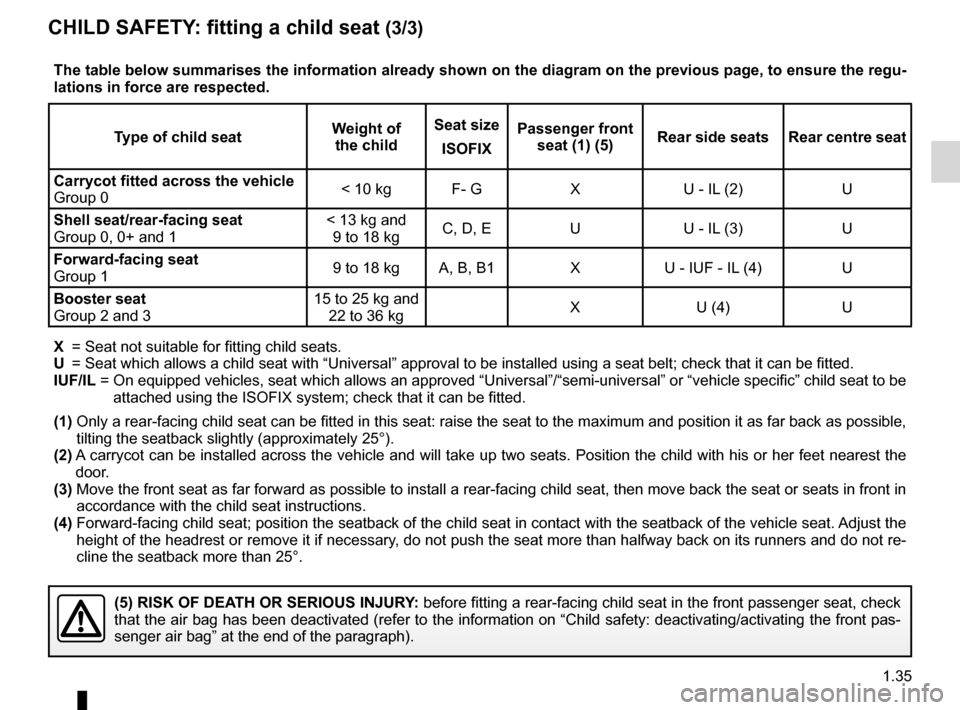
The table below summarises the information already shown on the diagram on the previous page, to ensure the regu-
lations in force are respected.
Type of child seat Weight of
the child seat size
IsOfIX passenger front
seat (1) (5) Rear side seats
Rear centre seat
carrycot fitted across the vehicle
Group 0 < 10 kg
F- G XU - IL (2) U
shell seat/rear-facing seat
Group 0, 0+ and 1 < 13 kg and
9 to 18 kg C, D, E
UU - IL (3) U
forward-facing seat
Group 1 9 to 18 kg
A, B, B1 XU - IUF - IL (4) U
Booster seat
Group 2 and 3 15 to 25 kg and
22 to 36 kg X
U (4) U
X = Seat not suitable for fitting child seats.
U = Seat which allows a child seat with “Universal” approval to be installed using a seat belt; check that it can be fitted.
IUf/IL = On equipped vehicles, seat which allows an approved “Universal”/“semi-universal” or “vehicle specific” child seat to be
attached using the ISOFIX system; check that it can be fitted.
(1) Only a rear-facing child seat can be fitted in this seat: raise the seat to the maximum and position it as far back as possible,
tilting the seatback slightly (approximately 25°).
(2) A carrycot can be installed across the vehicle and will take up two seats. Position the child with his or her feet nearest the
door.
(3) Move the front seat as far forward as possible to install a rear-facing child seat, then move back the seat or seats in front in
accordance with the child seat instructions.
(4) Forward-facing child seat; position the seatback of the child seat in contact with the seatback of the vehicle seat. Adjust the
height of the headrest or remove it if necessary, do not push the seat more than halfway back on its runners and do not re-
cline the seatback more than 25°.
Page 47 of 233
JauneNoirNoir texte
1.41
ENG_UD27144_6
Poste de conduite direction gauche (X45 - H45 - Renault)
ENG_NU_977-2_H45_Ph2_Renault_1
dRIvINg pOsITION: LEfT -hANd dRIvE (2/2)
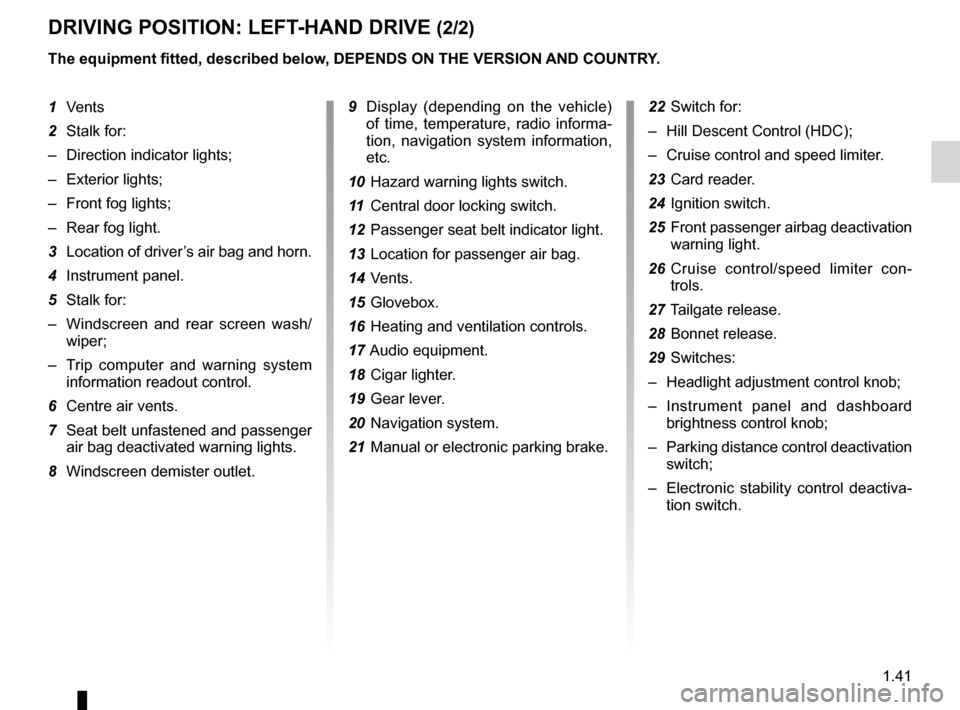
The equipment fitted, described below, dEpENds ON ThE vERsION ANd cOUNTRY.
9 Display (depending on the vehicle)
of time, temperature, radio informa -
tion, navigation system information,
etc.
10 Hazard warning lights switch.
11 Central door locking switch.
12 Passenger seat belt indicator light.
13 Location for passenger air bag.
14 Vents.
15 Glovebox.
16 Heating and ventilation controls.
17 Audio equipment.
18 Cigar lighter.
19 Gear lever.
20 Navigation system.
21 Manual or electronic parking brake. 22
Switch for:
– Hill Descent Control (HDC);
– Cruise control and speed limiter.
23 Card reader.
24 Ignition switch.
25 Front passenger airbag deactivation
warning light.
26 Cruise control/speed limiter con -
trols.
27 Tailgate release.
28 Bonnet release.
29 Switches:
– Headlight adjustment control knob;
– Instrument panel and dashboard
brightness control knob;
– Parking distance control deactivation
switch;
– Electronic stability control deactiva -
tion switch.
1
Vents
2 Stalk for:
– Direction indicator lights;
– Exterior lights;
– Front fog lights;
– Rear fog light.
3 Location of driver’s air bag and horn.
4 Instrument panel.
5 Stalk for:
– Windscreen and rear screen wash/
wiper;
– Trip computer and warning system
information readout control.
6 Centre air vents.
7 Seat belt unfastened and passenger
air bag deactivated warning lights.
8 Windscreen demister outlet.
Page 49 of 233
JauneNoirNoir texte
1.43
ENG_UD27145_6
Poste de conduite direction droite (X45 - H45 - Renault)
ENG_NU_977-2_H45_Ph2_Renault_1
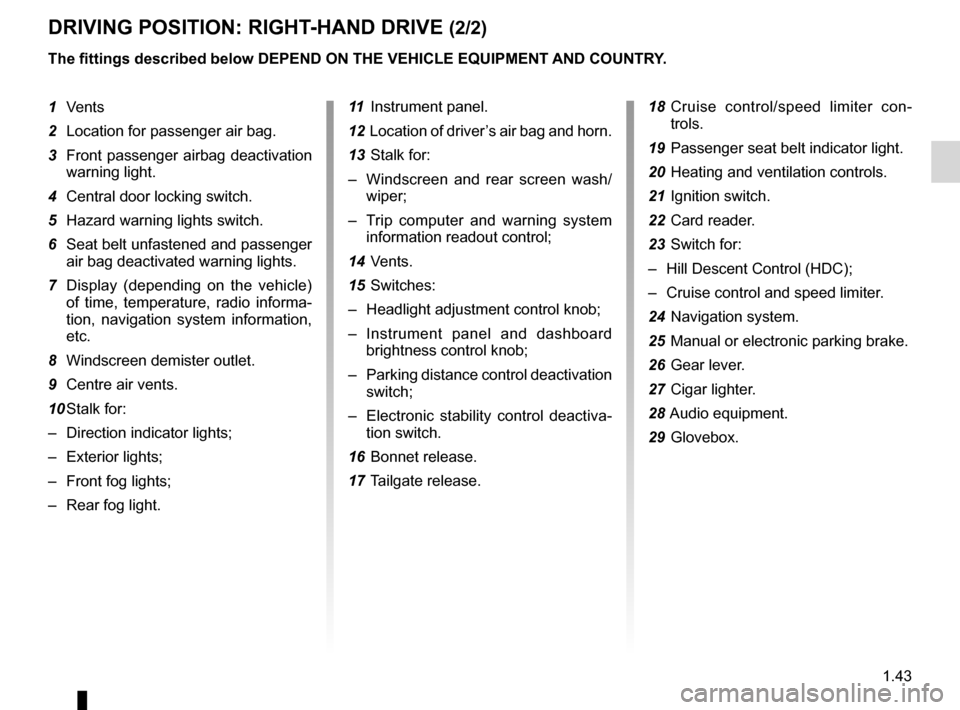
dRIvINg pOsITION: RIghT -hANd dRIvE (2/2)
The fittings described below dEpENd ON ThE vEhIcLE EQUIpMENT ANd cOUNTRY.
11 Instrument panel.
12 Location of driver’s air bag and horn.
13 Stalk for:
– Windscreen and rear screen wash/
wiper;
– Trip computer and warning system
information readout control;
14 Vents.
15 Switches:
– Headlight adjustment control knob;
– Instrument panel and dashboard
brightness control knob;
– Parking distance control deactivation
switch;
– Electronic stability control deactiva -
tion switch.
16 Bonnet release.
17 Tailgate release. 18
Cruise control/speed limiter con -
trols.
19 Passenger seat belt indicator light.
20 Heating and ventilation controls.
21 Ignition switch.
22 Card reader.
23 Switch for:
– Hill Descent Control (HDC);
– Cruise control and speed limiter.
24 Navigation system.
25 Manual or electronic parking brake.
26 Gear lever.
27 Cigar lighter.
28 Audio equipment.
29 Glovebox.
1
Vents
2 Location for passenger air bag.
3 Front passenger airbag deactivation
warning light.
4 Central door locking switch.
5 Hazard warning lights switch.
6 Seat belt unfastened and passenger
air bag deactivated warning lights.
7 Display (depending on the vehicle)
of time, temperature, radio informa -
tion, navigation system information,
etc.
8 Windscreen demister outlet.
9 Centre air vents.
10 Stalk for:
– Direction indicator lights;
– Exterior lights;
– Front fog lights;
– Rear fog light.
Page 55 of 233
engine oil level ....................................................... (current page)
JauneNoirNoir texte
1.49
ENG_UD23488_3
Tableau de bord : afficheurs et indicateurs (X45 - H45 - Renault)
ENG_NU_977-2_H45_Ph2_Renault_1
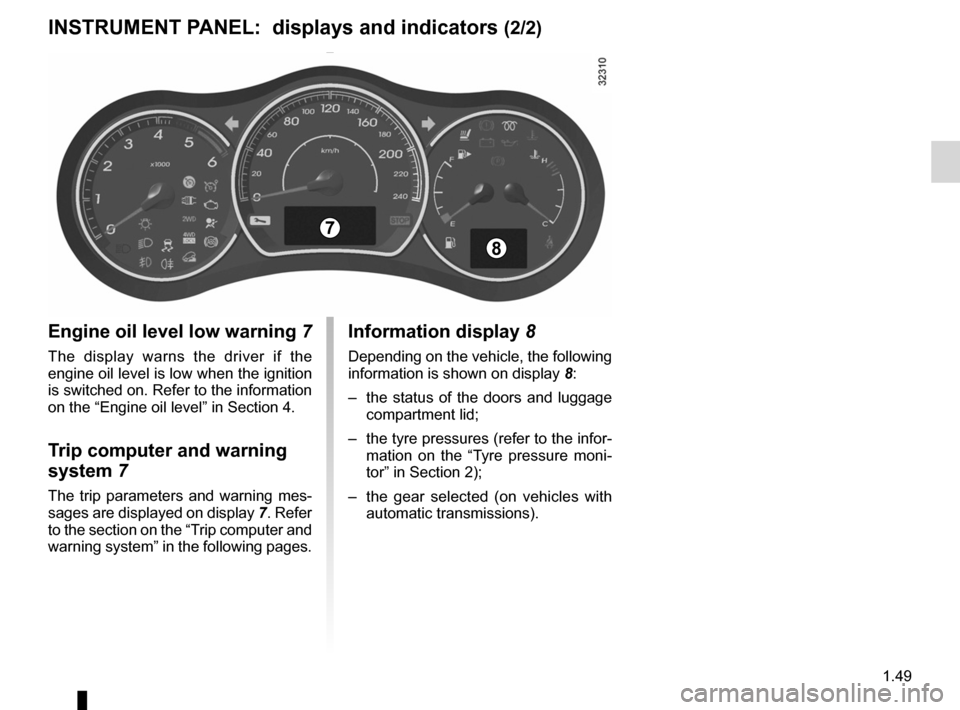
INsTRUMENT p ANEL: displays and indicators (2/2)
Engine oil level low warning 7
The display warns the driver if the
engine oil level is low when the ignition
is switched on. Refer to the information
on the “Engine oil level” in Section 4.
Trip computer and warning
system 7
The trip parameters and warning mes-
sages are displayed on display 7. Refer
to the section on the “Trip computer and
warning system” in the following pages.
Information display 8
Depending on the vehicle, the following
information is shown on display 8:
– the status of the doors and luggage
compartment lid;
– the tyre pressures (refer to the infor-
mation on the “Tyre pressure moni -
tor” in Section 2);
– the gear selected (on vehicles with
automatic transmissions).
7
8