fuel RENAULT KOLEOS 2012 1.G Owner's Manual
[x] Cancel search | Manufacturer: RENAULT, Model Year: 2012, Model line: KOLEOS, Model: RENAULT KOLEOS 2012 1.GPages: 233, PDF Size: 7.81 MB
Page 133 of 233
air conditioning ..................................... (up to the end of the DU)
heating and air conditioning system ..... (up to the end of the DU)
air conditioning ..................................... (up to the end of the DU)
3.13
ENG_UD20984_3
Air conditionn : informations et conseils d utilisation (X45 - H45 - Renault)
ENG_NU_977-2_H45_Ph2_Renault_3
Air conditioning: information and advice on use
AIR coNDITIoNINg: information and advice on use
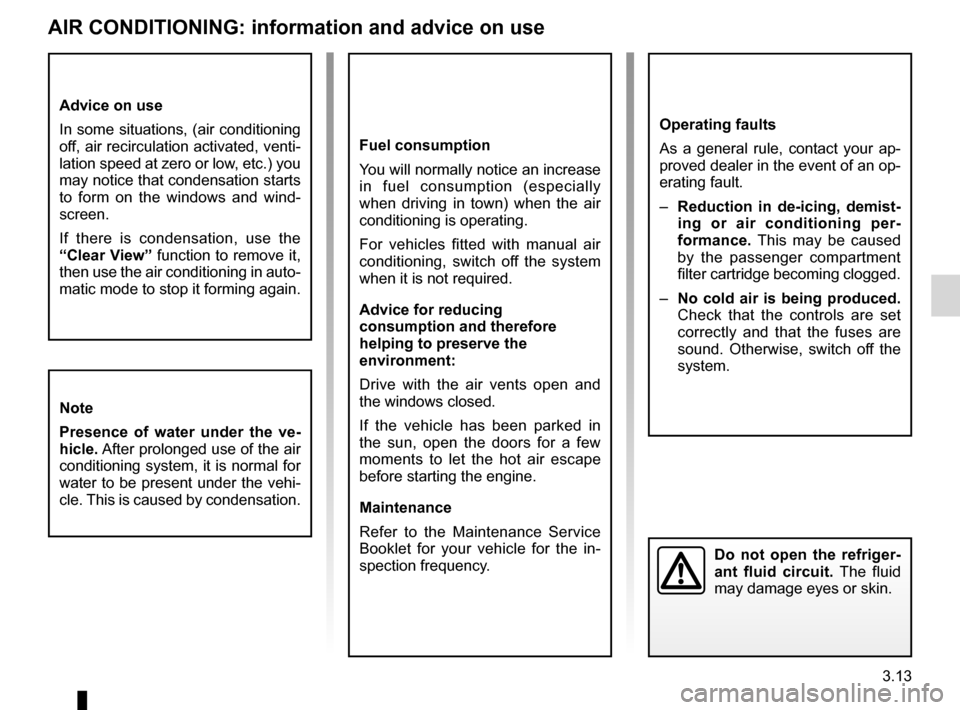
Fuel consumption
You will normally notice an increase
in fuel consumption (especially
when driving in town) when the air
conditioning is operating.
For vehicles fitted with manual air
conditioning, switch off the system
when it is not required.
Advice for reducing
consumption and therefore
helping to preserve the
environment:
Drive with the air vents open and
the windows closed.
If the vehicle has been parked in
the sun, open the doors for a few
moments to let the hot air escape
before starting the engine.
Maintenance
Refer to the Maintenance Service
Booklet for your vehicle for the in -
spection frequency.
operating faults
As a general rule, contact your ap-
proved dealer in the event of an op-
erating fault.
– Reduction in de-icing, demist -
ing or air conditioning per -
formance. This may be caused
by the passenger compartment
filter cartridge becoming clogged.
– No cold air is being produced.
Check that the controls are set
correctly and that the fuses are
sound. Otherwise, switch off the
system.
Advice on use
In some situations, (air conditioning
off, air recirculation activated, venti-
lation speed at zero or low, etc.) you
may notice that condensation starts
to form on the windows and wind -
screen.
If there is condensation, use the
“clear View” function to remove it,
then use the air conditioning in auto-
matic mode to stop it forming again.
Do not open the refriger -
ant fluid circuit. The fluid
may damage eyes or skin.
Note
Presence of water under the ve -
hicle. After prolonged use of the air
conditioning system, it is normal for
water to be present under the vehi-
cle. This is caused by condensation.
Page 170 of 233
maintenance:bodywork ........................................ (up to the end of the DU)
washing ................................................ (up to the end of the DU)
paintwork maintenance ................................... (up to the end of the DU)
anti-corrosion protection ....................... (up to the end of the DU)
cleaning: outside the vehicle .......................... (up to the end of the DU)
4.12
ENG_UD22865_9
Entretien de la carrosserie (X45 - H45 - J77 - X81 - X85 - B85 - C85 - S85 - X91 - B91 - K91 - D91 - X83 - X61 - X77 ph2 - K85 - X95 - B95 - D95 - K95 - J95 - R95 - L38 -
ENG_NU_977-2_H45_Ph2_Renault_4
Jaune NoirNoir texte
Bodywork maintenance
BODyWORk MAIntenAnCe (1/2)
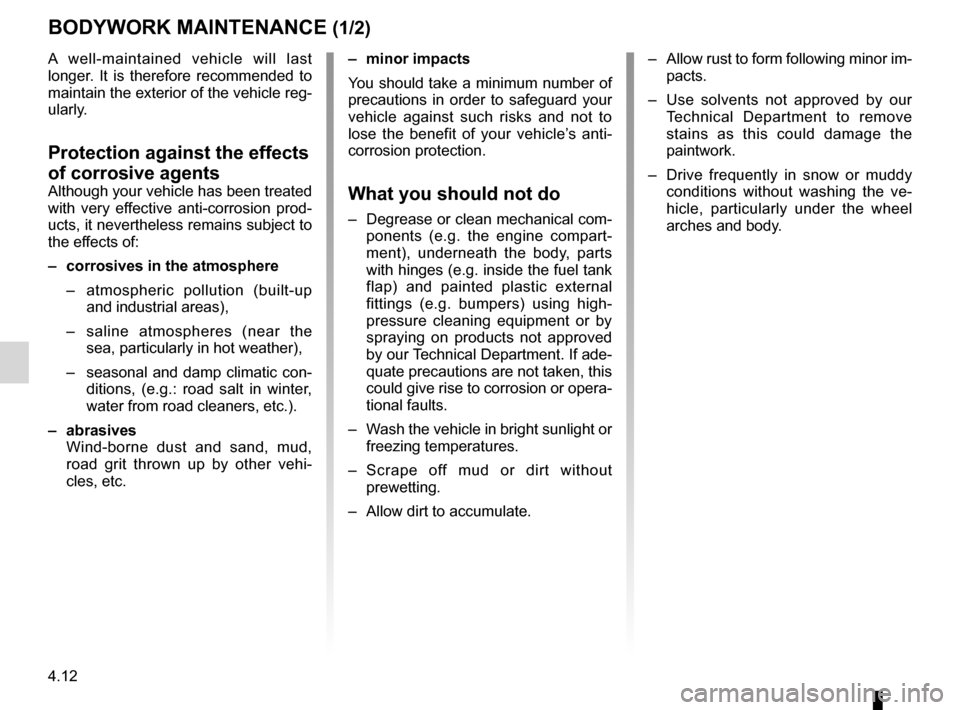
– Allow rust to form following minor im-
pacts.
– Use solvents not approved by our
Technical Department to remove
stains as this could damage the
paintwork.
– Drive frequently in snow or muddy
conditions without washing the ve -
hicle, particularly under the wheel
arches and body.
–
minor impacts
You should take a minimum number of
precautions in order to safeguard your
vehicle against such risks and not to
lose the benefit of your vehicle’s anti -
corrosion protection.
What you should not do
– Degrease or clean mechanical com-
ponents (e.g. the engine compart -
ment), underneath the body, parts
with hinges (e.g. inside the fuel tank
flap) and painted plastic external
fittings (e.g. bumpers) using high-
pressure cleaning equipment or by
spraying on products not approved
by our Technical Department. If ade-
quate precautions are not taken, this
could give rise to corrosion or opera-
tional faults.
– Wash the vehicle in bright sunlight or
freezing temperatures.
– Scrape off mud or dirt without
prewetting.
– Allow dirt to accumulate.
A well-maintained vehicle will last
longer. It is therefore recommended to
maintain the exterior of the vehicle reg-
ularly.
protection against the effects
of corrosive agents
Although your vehicle has been treated
with very effective anti-corrosion prod
-
ucts, it nevertheless remains subject to
the effects of:
– corrosives in the atmosphere
– atmospheric pollution (built-up
and industrial areas),
– saline atmospheres (near the
sea, particularly in hot weather),
– seasonal and damp climatic con-
ditions, (e.g.: road salt in winter,
water from road cleaners, etc.).
– abrasives
Wind-borne dust and sand, mud,
road grit thrown up by other vehi -
cles, etc.
Page 213 of 233
enginetechnical specifications ................... (up to the end of the DU)
technical specifications ......................... (up to the end of the DU)
engine specifications ............................ (up to the end of the DU)
6.5
ENG_UD23904_4
Caractéristiques moteurs (X45 - H45 - Renault)
ENG_NU_977-2_H45_Ph2_Renault_6
Engine specifications
engine specifications
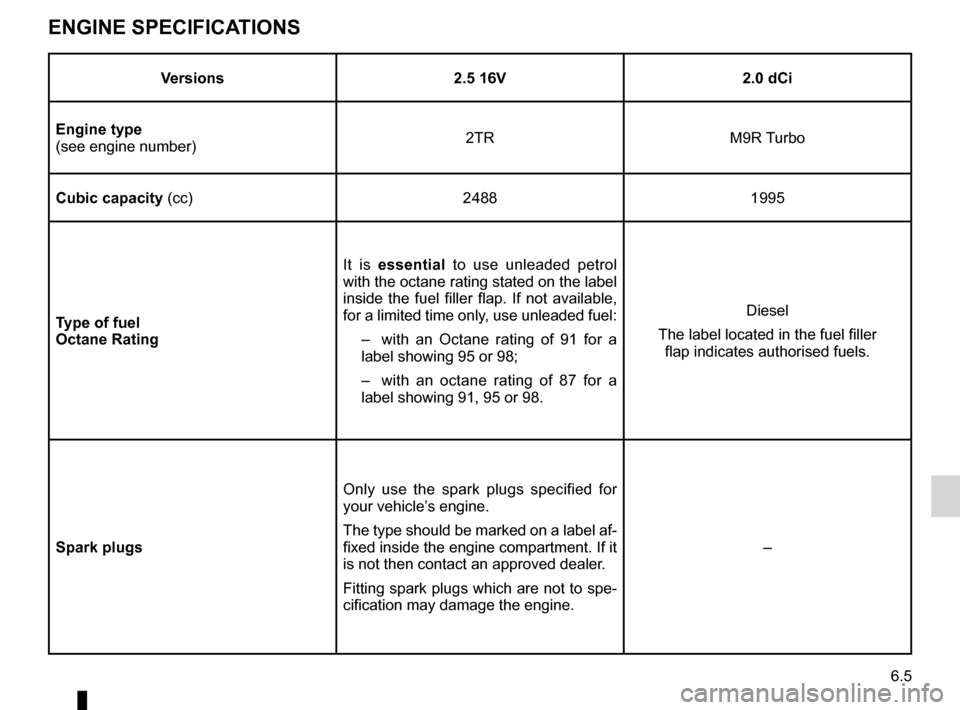
Versions 2.5 16V2.0 dci
engine type
(see engine number) 2TR
M9R Turbo
cubic capacity (cc) 2 488 1 995
t ype of fuel
octane Rating It is
essential to use unleaded petrol
with the octane rating stated on the label
inside the fuel filler flap. If not available,
for a limited time only, use unleaded fuel:
– with an Octane rating of 91 for a
label showing 95 or 98;
– with an octane rating of 87 for a
label showing 91, 95 or 98. Diesel
The label located in the fuel filler flap indicates authorised fuels.
spark plugs Only use the spark plugs specified for
your vehicle’s engine.
The type should be marked on a label af-
fixed inside the engine compartment. If it
is not then contact an approved dealer.
Fitting spark plugs which are not to spe-
cification may damage the engine. –
Page 228 of 233
7.2
ENG_UD27169_2
Index (X45 - H45 - Renault)
ENG_NU_977-2_H45_Ph2_Renault_7
Jaune NoirNoir texte
AlphAbeticAl index (2/5)
driver’s position ................................. 1.40 – 1.41, 1.44 → 1.47
driving ................................................ 2.2 → 2.16, 2.18 → 2.41
driving position settings ............................................................. 1.17 – 1.18
e
electric beam height adjustment ........................................ 1.66
electric windows ..................................................... 3.14 – 3.15
electronic parking brake ........................................ 2.10 → 2.13
Electronic Stability Program: ESP .........................2.24 → 2.28
emergency key ........................................................... 1.2 – 1.3
emergency spare wheel ............................................. 5.2 – 5.3
engine technical specifications .................................................. 6.5
engine oil ................................................................... 4.4 → 4.6
engine oil level ................................................................... 1.49
engine specifications ........................................................... 6.5
engine start/stop button .............................................. 2.3 – 2.4
environment ....................................................................... 2.17
ESP: Electronic Stability Program .........................2.24 → 2.28
external lights and signals ................................................. 1.66
F
4 wheel drive (4WD) .............................................. 2.21 → 2.23
faults operating faults ................................................ 5.29 → 5.33
filter air filter ........................................................................... 4.9
diesel filter ...................................................................... 4.9
particle filter .......................................................... 1.46, 2.8
passenger compartment filter ........................................ 4.9
fittings .................................................................... 3.22 → 3.27
fog lights ............................................................................ 5.11
front passenger air bag deactivation ................................. 1.36
front seat adjustment electric controls ............................................................ 1.15manual controls
................................................ 1.15 – 1.16
front seats adjustment .......................................................1.14 → 1.16
fuel advice on fuel economy ............................................... 2.14
capacity ............................................................ 1.70 → 1.72
filling ........................................................ 1.46, 1.70 → 1.72
grade ................................................................ 1.70 → 1.72
fuel economy ......................................................... 2.14 → 2.16
fuel filler cap .......................................................... 1.70 → 1.72
fuel level ............................................................................ 1.48
fuel priming bulb ......................................................... 1.72, 2.8
fuel repriming ..................................................................... 1.72
fuel tank capacity ............................................................ 1.70 → 1.72
fuel tank capacity ................................................... 1.70 → 1.72
fuses ....................................................................... 5.18 – 5.19
G
gear lever ............................................................................. 2.9
glove box ........................................................................... 3.22
h
handbrake ............................................................................ 2.9
hands-free telephone integrated control ............................ 3.38
hazard warning lights signal .................................. 1.62 → 1.65
headlight beam adjustment ............................................... 1.66
headlight flashers .............................................................. 1.62
headrest .................................................................... 1.14, 3.29
heating and air conditioning system ........................ 3.7 → 3.13
heating system ........................................................ 3.4 → 3.12
hill start .............................................................................. 2.28
Hill Start Assistance (HSA) ................................................ 2.28
horn ................................................................................... 1.62
horn: flash ............................................................................. 1.62