wheel RENAULT KOLEOS 2012 1.G Owner's Manual
[x] Cancel search | Manufacturer: RENAULT, Model Year: 2012, Model line: KOLEOS, Model: RENAULT KOLEOS 2012 1.GPages: 233, PDF Size: 7.81 MB
Page 102 of 233
ESP: Electronic Stability Program ........ (up to the end of the DU)
ABS ...................................................... (up to the end of the DU)
anti-lock braking system: ABS ..............(up to the end of the DU)
Electronic Stability Program: ESP ........ (up to the end of the DU)
driving ................................................... (up to the end of the DU)
2.24
ENG_UD27148_7
Dispositifs de correction et d’assistance la conduite (X45 - H45 - Renault)
ENG_NU_977-2_H45_Ph2_Renault_2
Jaune NoirNoir texte
Driver correction devices
DRIvER CORRECTION DEvICES (1/5)
Depending on the vehicle, this is com-
posed of:
– the anti-lock braking system ABS;
– the electronic stability control
ESC with traction control ASR;
– the emergency brake assist;
– the hill descent control;
– the hill start assistance. Operating faults:
–
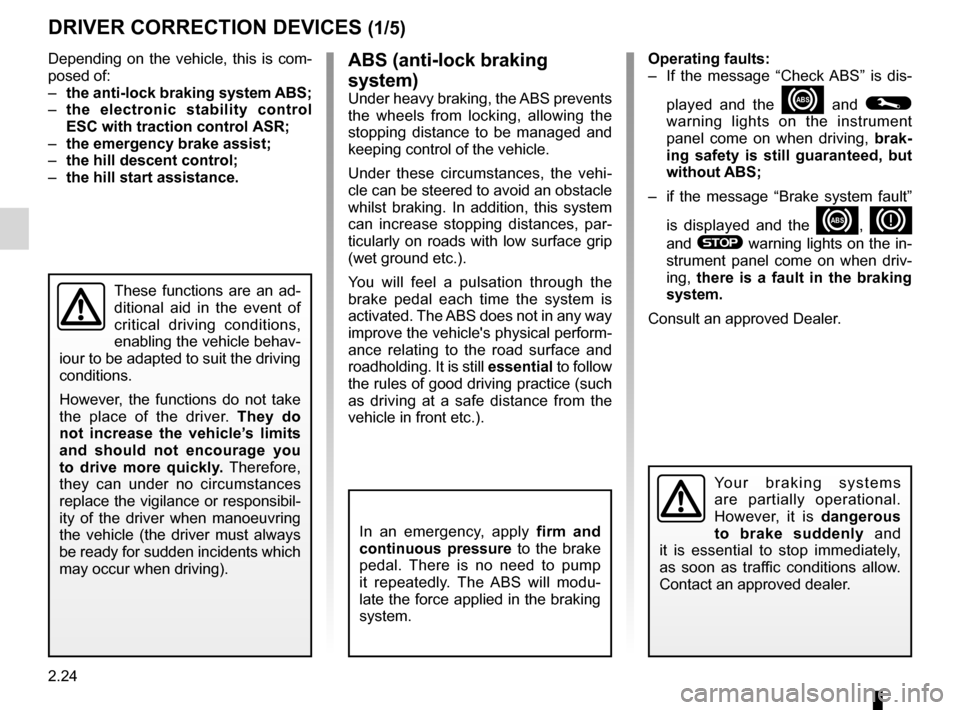
If the message “ Check ABS” is dis-
played and the
x and ©
warning lights on the instrument
panel come on when driving, brak-
ing safety is still guaranteed, but
without ABS;
– if the message “Brake system fault”
is displayed and the
x, D
and
® warning lights on the in-
strument panel come on when driv -
ing, there is a fault in the braking
system.
Consult an approved Dealer.
These functions are an ad-
ditional aid in the event of
critical driving conditions,
enabling the vehicle behav -
iour to be adapted to suit the driving
conditions.
However, the functions do not take
the place of the driver. They do
not increase the vehicle’s limits
and should not encourage you
to drive more quickly. Therefore,
they can under no circumstances
replace the vigilance or responsibil -
ity of the driver when manoeuvring
the vehicle (the driver must always
be ready for sudden incidents which
may occur when driving).
ABS (anti-lock braking
system)
Under heavy braking, the ABS prevents
the wheels from locking, allowing the
stopping distance to be managed and
keeping control of the vehicle.
Under these circumstances, the vehi -
cle can be steered to avoid an obstacle
whilst braking. In addition, this system
can increase stopping distances, par -
ticularly on roads with low surface grip
(wet ground etc.).
You will feel a pulsation through the
brake pedal each time the system is
activated. The ABS does not in any way
improve the vehicle's physical perform-
ance relating to the road surface and
roadholding. It is still essential to follow
the rules of good driving practice (such
as driving at a safe distance from the
vehicle in front etc.).
In an emergency, apply firm and
continuous pressure to the brake
pedal. There is no need to pump
it repeatedly. The ABS will modu -
late the force applied in the braking
system.
Yo u r b r a k i n g s y s t e m s
are partially operational.
However, it is dangerous
to brake suddenly and
it is essential to stop immediately,
as soon as traffic conditions allow.
Contact an approved dealer.
Page 103 of 233
JauneNoirNoir texte
2.25
ENG_UD27148_7
Dispositifs de correction et d’assistance la conduite (X45 - H45 - Renault)
ENG_NU_977-2_H45_Ph2_Renault_2
DRIvER CORRECTION DEvICES (2/5)
Electronic stability control
ESC with understeer control
and traction control ASR
Electronic stability control ESC
This system helps you to keep control
of the vehicle in critical driving condi -
tions (avoiding an obstacle, loss of grip
on a bend, etc.).
Operating principle
A sensor in the steering wheel detects
the direction selected by the driver.
Other sensors throughout the vehicle
measure the actual direction.
The system compares the direction se-
lected by the driver and the actual di -
rection of the vehicle and corrects this
as necessary by applying the brakes
selectively and/or acting on the engine
power. Traction control
ASR
This system helps to limit wheelspin of
the drive wheels and to control the ve-
hicle when pulling away accelerating or
decelerating.
Operating principle
Using the wheel sensors, the system
measures and compares the speed of
the drive wheels at all times and slows
down their over-rotation. If a wheel is
starting to slip, the system brakes au -
tomatically until the drive supplied be -
comes compatible with the level of grip
under the wheel again.
The system also adjusts the engine
speed to the grip available under the
wheels, independently of the pressure
exerted on the accelerator pedal.
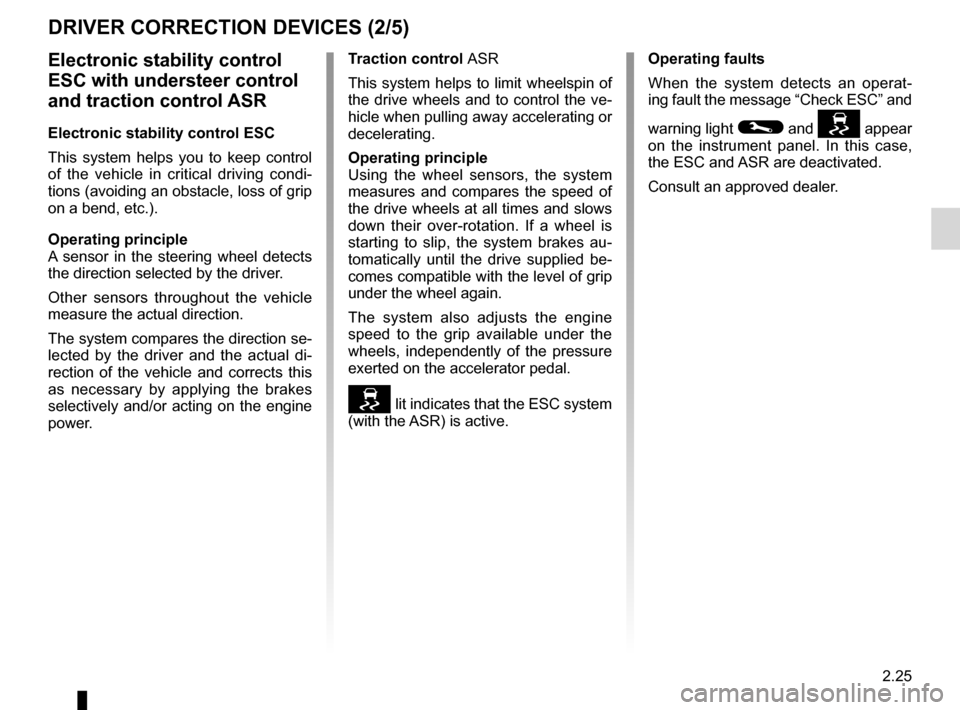
lit indicates that the ESC system
(with the ASR) is active. Operating faults
When the system detects an operat
-
ing fault the message “Check ESC” and
warning light
© and appear
on the instrument panel. In this case,
the ESC and ASR are deactivated.
Consult an approved dealer.
Page 104 of 233

2.26
ENG_UD27148_7
Dispositifs de correction et d’assistance la conduite (X45 - H45 - Renault)
ENG_NU_977-2_H45_Ph2_Renault_2
Jaune NoirNoir texte
DRIvER CORRECTION DEvICES (3/5)
If you deactivate this function, the
traction control (ASR) system will
also be deactivated.
As the ESC and ASR provide enhanced
safety, it is not advisable to drive with
the function switched off. Correct
this as soon as possible by pressing
switch 1 again.
Note: the system is automatically reac-
tivated each time the engine is switched
off.
1
Disabling the ESC function
(including traction control (ASR)
system)
In some situations (driving on very wet
ground: snow, mud, etc. or driving with
snow chains fitted), the system may
reduce the engine output to limit wheel -
spin. If this is not required, it is possible
to deactivate the function by pressing
switch 1.
The message “ESC off” is displayed on
the instrument panel to inform you.
Emergency brake assist
This system supplements the ABS
and helps reduce vehicle stopping dis-
tances.
Operating principle
Depending on the speed at which the
brake pedal is depressed, the system
will detect emergency braking. In this
case, the braking assistance immedi -
ately develops maximum power and
may trigger ABS regulation.
ABS braking is maintained as long as
the brake pedal is applied.
Hazard warning lights switching on
Depending on the vehicle, these may
light up in the event of sudden decel -
eration.
Page 118 of 233
2.40
ENG_UD27292_7
Bo tes de vitesses automatiques ou variation continue (X45 - H45 - Renault)
ENG_NU_977-2_H45_Ph2_Renault_2
Jaune NoirNoir texte
AUTOMATIC OR CONTINUOUSLY vARIABLE TRANSMISSION (2/3)
Driving in manual mode
With the selector lever in position D,
move the lever to the left. Shifting the
lever repeatedly allows you to change
gears manually:
– backwards to shift down the gears;
– forwards to shift up the gears.
The gear selected is displayed on the
instrument panel.
Special cases
Under certain driving conditions (e.g.
engine protection, or electronic stability
control (ESC) operational etc.) the au -
tomatic system may change gear auto-
matically.
Likewise, to prevent incorrect manoeu -
vres, a gear change may be refused by
the automatic system: in this case the
gear display flashes for a few seconds
as a warning.
Special circumstances
– If the bends and road surface do
not allow you to stay in automatic
mode (e.g. in the mountains), we
recommend that you change to
manual mode.
This will prevent repeated gear
changes when climbing and will
enable engine braking on long de -
scents.
– In very cold weather, to avoid stall-
ing the engine, start the engine and
wait a few seconds before moving
the lever from position P or N to po-
sition D or R.
– v ehicles not fitted with traction
control: to avoid wheelspin when
starting on a slippery or low grip sur-
face, change to manual mode and
select second gear before moving
off.
Parking the vehicle
When the vehicle is stopped, move the
lever to position P while keeping your
foot on the brake pedal: the gearbox is
in neutral and the drive wheels are me-
chanically locked by the driveshaft.
Depending on the vehicle, apply the
handbrake or check that the elec -
tronic parking brake is on (refer to
the information on the Parking brake in
Section 2).
In very cold weather, the system may prevent the gears from being shifted in
manual mode until the gearbox reaches the right temperature.
An impact to the under -
side of the vehicle while
manoeuvring (e.g.: strik -
ing a post, raised kerb or
other street furniture) may result in
damage to the vehicle (e.g.: defor -
mation of an axle).
To avoid any risk of accident, have
your vehicle checked by an ap -
proved Dealer.
Page 168 of 233
tyre pressure......................................... (up to the end of the DU)
tyre pressures ....................................... (up to the end of the DU)
tyres ...................................................... (up to the end of the DU)
4.10
ENG_UD8606_2
Pression pneus (X45 - H45 - Renault)
ENG_NU_977-2_H45_Ph2_Renault_4
Tyre pressures
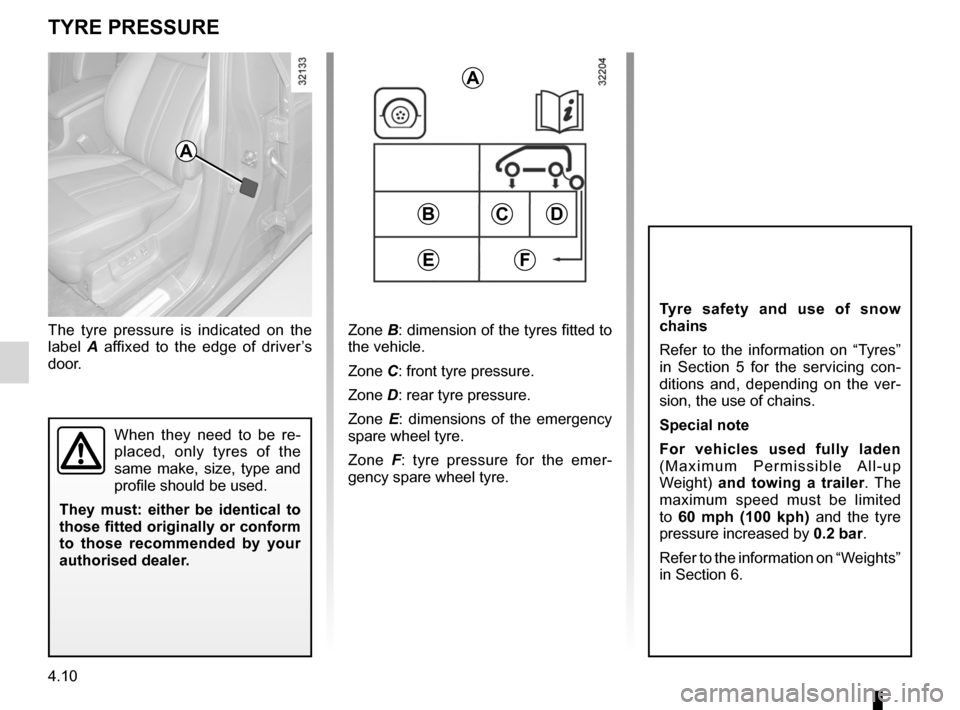
The tyre pressure is indicated on the
label A affixed to the edge of driver’s
door.Zone B: dimension of the tyres fitted to
the vehicle.
Zone C: front tyre pressure.
Zone D: rear tyre pressure.
Zone E : dimensions of the emergency
spare wheel tyre.
Zone F : tyre pressure for the emer -
gency spare wheel tyre.
A
A
BCD
eF
tyRe pReSSuRe
t yre safety and use of snow
chains
Refer to the information on “Tyres”
in Section 5 for the servicing con -
ditions and, depending on the ver -
sion, the use of chains.
Special note
For vehicles used fully laden
( M a x i m u m P e r m i s s i b l e A l l - u p
Weight) and towing a trailer . The
maximum speed must be limited
to 60 mph (100 kph) and the tyre
pressure increased by 0.2 bar.
Refer to the information on “Weights”
in Section 6.
When they need to be re -
placed, only tyres of the
same make, size, type and
profile should be used.
t hey must: either be identical to
those fitted originally or conform
to those recommended by your
authorised dealer.
Page 170 of 233
maintenance:bodywork ........................................ (up to the end of the DU)
washing ................................................ (up to the end of the DU)
paintwork maintenance ................................... (up to the end of the DU)
anti-corrosion protection ....................... (up to the end of the DU)
cleaning: outside the vehicle .......................... (up to the end of the DU)
4.12
ENG_UD22865_9
Entretien de la carrosserie (X45 - H45 - J77 - X81 - X85 - B85 - C85 - S85 - X91 - B91 - K91 - D91 - X83 - X61 - X77 ph2 - K85 - X95 - B95 - D95 - K95 - J95 - R95 - L38 -
ENG_NU_977-2_H45_Ph2_Renault_4
Jaune NoirNoir texte
Bodywork maintenance
BODyWORk MAIntenAnCe (1/2)
– Allow rust to form following minor im-
pacts.
– Use solvents not approved by our
Technical Department to remove
stains as this could damage the
paintwork.
– Drive frequently in snow or muddy
conditions without washing the ve -
hicle, particularly under the wheel
arches and body.
–
minor impacts
You should take a minimum number of
precautions in order to safeguard your
vehicle against such risks and not to
lose the benefit of your vehicle’s anti -
corrosion protection.
What you should not do
– Degrease or clean mechanical com-
ponents (e.g. the engine compart -
ment), underneath the body, parts
with hinges (e.g. inside the fuel tank
flap) and painted plastic external
fittings (e.g. bumpers) using high-
pressure cleaning equipment or by
spraying on products not approved
by our Technical Department. If ade-
quate precautions are not taken, this
could give rise to corrosion or opera-
tional faults.
– Wash the vehicle in bright sunlight or
freezing temperatures.
– Scrape off mud or dirt without
prewetting.
– Allow dirt to accumulate.
A well-maintained vehicle will last
longer. It is therefore recommended to
maintain the exterior of the vehicle reg-
ularly.
protection against the effects
of corrosive agents
Although your vehicle has been treated
with very effective anti-corrosion prod
-
ucts, it nevertheless remains subject to
the effects of:
– corrosives in the atmosphere
– atmospheric pollution (built-up
and industrial areas),
– saline atmospheres (near the
sea, particularly in hot weather),
– seasonal and damp climatic con-
ditions, (e.g.: road salt in winter,
water from road cleaners, etc.).
– abrasives
Wind-borne dust and sand, mud,
road grit thrown up by other vehi -
cles, etc.
Page 171 of 233
JauneNoirNoir texte
4.13
ENG_UD22865_9
Entretien de la carrosserie (X45 - H45 - J77 - X81 - X85 - B85 - C85 - S85 - X91 - B91 - K91 - D91 - X83 - X61 - X77 ph2 - K85 - X95 - B95 - D95 - K95 - J95 - R95 - L38 -
ENG_NU_977-2_H45_Ph2_Renault_4
– Before going through a roller type car
wash, return the windscreen wiper
stalk to the Park position (refer to
the information on the “Windscreen
wash/wipe” in Section 1). Check the
mounting of external accessories,
additional lights and mirrors, and
ensure that the wiper blades are se-
cured with adhesive tape.
Remove the radio aerial mast if your
vehicle is fitted with this equipment.
Remember to remove the tape and
refit the antenna after washing.
– Spray mechanical components,
hinges, etc. with products approved
by our Technical Department to
protect them after they have been
cleaned.
BODyWORk MAIntenAnCe (2/2)
We have selected special products
to care for your vehicle and you can
obtain these from the manufactur -
er’s accessory outlets.
y ou should
– Observe the vehicle stopping dis -
tances when driving on gravelled
surfaces to prevent paint damage.
– Repair, or have repaired quickly,
areas where the paint has been
damaged, to prevent corrosion
spreading.
– Remember to visit the body shop
periodically if your vehicle has an
anti-corrosion warranty. Refer to the
Maintenance Service Booklet.
– Respect local regulations about
washing vehicles (e.g. do not wash
your vehicle on a public highway). –
Wash your car frequently, with the
engine off , with cleaning products
recommended by our Technical
Department (never use abrasive
products) and be sure to jet-rinse off:
– spots of tree resin and industrial
grime;
– bird droppings , which cause a
chemical reaction with the paint
that rapidly discolours paint -
work and may even cause the
paint to peel off;
Wash the vehicle immediately to
remove these marks since it is im-
possible to remove them by pol -
ishing;
– salt, particularly in the wheel
arches and underneath the body
after driving in areas where the
roads have been gritted;
– mud in the wheel arches and un-
derneath the body which forms
damp patches.
Page 175 of 233
5.1
ENG_UD27167_2
Contents 5 (X45 - H45 - Renault)
ENG_NU_977-2_H45_Ph2_Renault_5
Section 5: Practical advice
Puncture . . . . . . . . . . . . . . . . . . . . . . . . . . . . . . . . . . . . . . . . . . . . . . . . . . . . . . . . . . . . . . . . . . . . . . 5.2
Emergency spare wheel . . . . . . . . . . . . . . . . . . . . . . . . . . . . . . . . . . . . . . . . . . . . . . . . . . . . . . . . . . 5.2
Tool kit . . . . . . . . . . . . . . . . . . . . . . . . . . . . . . . . . . . . . . . . . . . . . . . . . . . . . . . . . . . . . . . . . . . . . . . . 5.3
Changing a wheel . . . . . . . . . . . . . . . . . . . . . . . . . . . . . . . . . . . . . . . . . . . . . . . . . . . . . . . . . . . . . . . 5.4
Tyres (tyre and wheel safety, use in winter) . . . . . . . . . . . . . . . . . . . . . . . . . . . . . . . . . . . . . . . . . . . 5.6
Headlights (changing bulbs) . . . . . . . . . . . . . . . . . . . . . . . . . . . . . . . . . . . . . . . . . . . . . . . . . . . . . . . 5.9
Rear lights and side lights (changing bulbs) . . . . . . . . . . . . . . . . . . . . . . . . . . . . . . . . . . . . . . . . . . . 5.12
Interior lights (changing bulbs) . . . . . . . . . . . . . . . . . . . . . . . . . . . . . . . . . . . . . . . . . . . . . . . . . . . . . 5.15
Fuses . . . . . . . . . . . . . . . . . . . . . . . . . . . . . . . . . . . . . . . . . . . . . . . . . . . . . . . . . . . . . . . . . . . . . . . . . 5.18
battery: troubleshooting . . . . . . . . . . . . . . . . . . . . . . . . . . . . . . . . . . . . . . . . . . . . . . . . . . . . . . . . . . . 5.20
RENAULT card: battery . . . . . . . . . . . . . . . . . . . . . . . . . . . . . . . . . . . . . . . . . . . . . . . . . . . . . . . . . . . 5.22
Accessories . . . . . . . . . . . . . . . . . . . . . . . . . . . . . . . . . . . . . . . . . . . . . . . . . . . . . . . . . . . . . . . . . . . . 5.23
Wipers (replacing blades) . . . . . . . . . . . . . . . . . . . . . . . . . . . . . . . . . . . . . . . . . . . . . . . . . . . . . . . . . 5.24
Towing . . . . . . . . . . . . . . . . . . . . . . . . . . . . . . . . . . . . . . . . . . . . . . . . . . . . . . . . . . . . . . . . . . . . . . . . 5.25
Operating faults . . . . . . . . . . . . . . . . . . . . . . . . . . . . . . . . . . . . . . . . . . . . . . . . . . . . . . . . . . . . . . . . . 5.29
Page 176 of 233
puncture................................................ (up to the end of the DU)
emergency spare wheel ....................... (up to the end of the DU)
5.2
ENG_UD21003_4
Crevaison (X45 - H45 - Renault)
ENG_NU_977-2_H45_Ph2_Renault_5
Puncture
Emergency spare wheel
Puncture, emergency sP are wheel
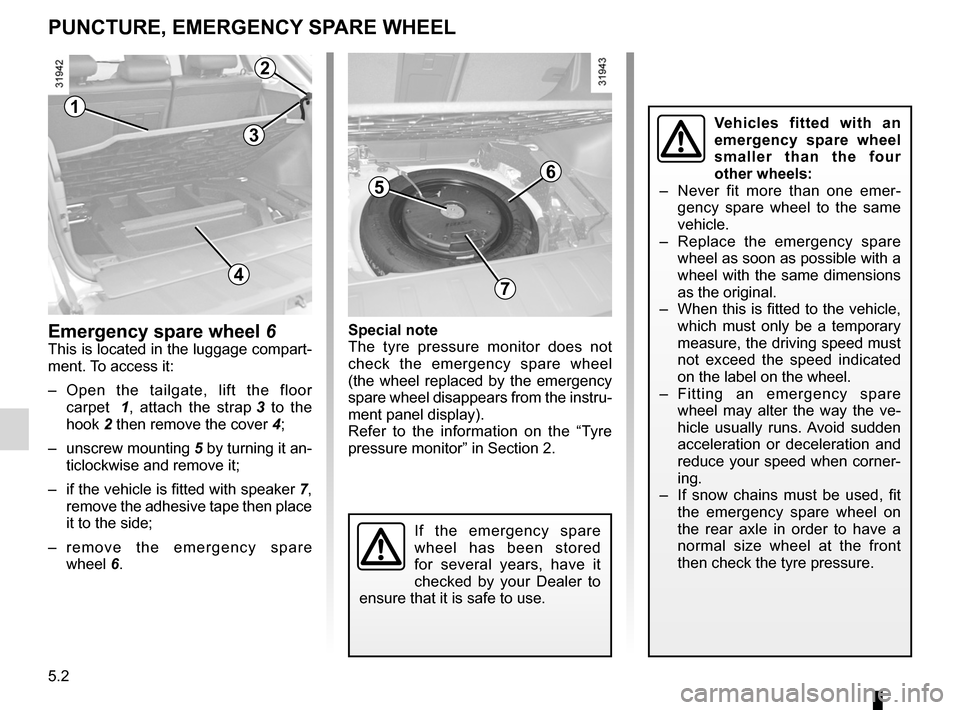
emergency spare wheel 6This is located in the luggage compart-
ment. To access it:
– Open the tailgate, lift the floor
carpet 1 , attach the strap 3 to the
hook 2 then remove the cover 4;
– unscrew mounting 5 by turning it an-
ticlockwise and remove it;
– if the vehicle is fitted with speaker 7,
remove the adhesive tape then place
it to the side;
– r e m o v e t h e e m e r g e n c y s p a r e
wheel 6.
Vehicles fitted with an
emergency spare wheel
smaller than the four
other wheels:
– Never fit more than one emer -
gency spare wheel to the same
vehicle.
– Replace the emergency spare
wheel as soon as possible with a
wheel with the same dimensions
as the original.
– When this is fitted to the vehicle,
which must only be a temporary
measure, the driving speed must
not exceed the speed indicated
on the label on the wheel.
– Fitting an emergency spare
wheel may alter the way the ve -
hicle usually runs. Avoid sudden
acceleration or deceleration and
reduce your speed when corner-
ing.
– If snow chains must be used, fit
the emergency spare wheel on
the rear axle in order to have a
normal size wheel at the front
then check the tyre pressure.
If the emergency spare
wheel has been stored
for several years, have it
checked by your Dealer to
ensure that it is safe to use.
2
3
1
4
56
7
special note
The tyre pressure monitor does not
check the emergency spare wheel
(the wheel replaced by the emergency
spare wheel disappears from the instru-
ment panel display).
Refer to the information on the “Tyre
pressure monitor” in Section 2.
Page 177 of 233
tool kit ................................................... (up to the end of the DU)
jack ....................................................... (up to the end of the DU)
wheelbrace ........................................... (up to the end of the DU)
wheelbrace ........................................... (up to the end of the DU)
puncture ................................................ (up to the end of the DU)
emergency spare wheel ....................... (up to the end of the DU)
5.3
ENG_UD21004_4
Bloc outils (X45 - H45 - Renault)
ENG_NU_977-2_H45_Ph2_Renault_5
Tool kit
t OOl KIt
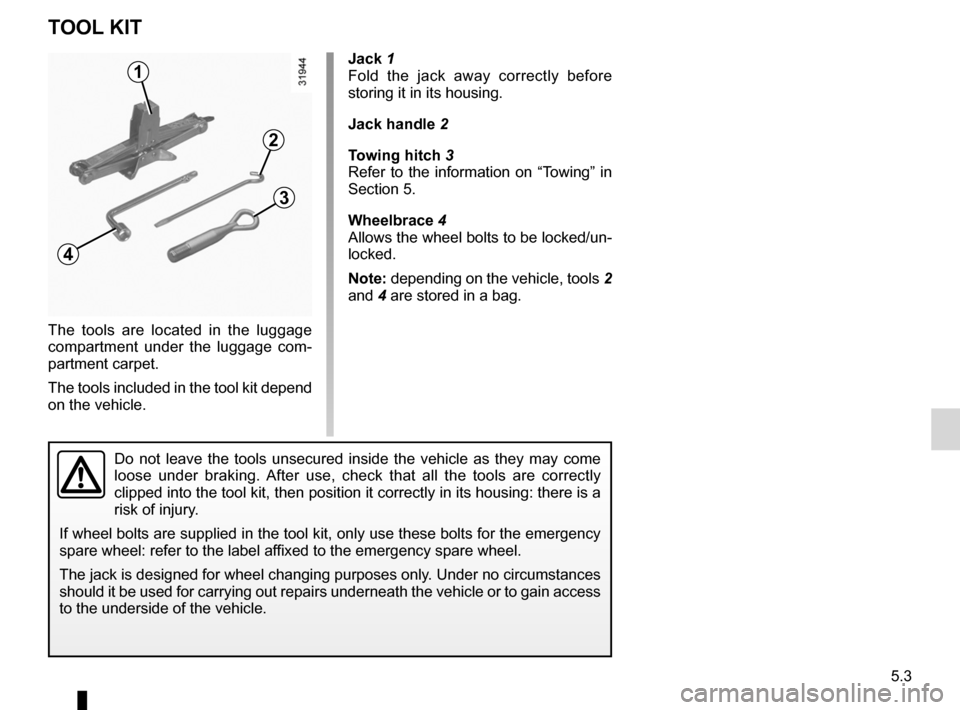
The tools are located in the luggage
compartment under the luggage com -
partment carpet.
The tools included in the tool kit depend
on the vehicle. Jack 1
Fold the jack away correctly before
storing it in its housing.
Jack handle 2
t
owing hitch 3
Refer to the information on “Towing” in
Section 5.
wheelbrace 4
Allows the wheel bolts to be locked/un-
locked.
note: depending on the vehicle, tools 2
and 4 are stored in a bag.
Do not leave the tools unsecured inside the vehicle as they may come
loose under braking. After use, check that all the tools are correctly
clipped into the tool kit, then position it correctly in its housing: there is a
risk of injury.
If wheel bolts are supplied in the tool kit, only use these bolts for the emergency
spare wheel: refer to the label affixed to the emergency spare wheel.
The jack is designed for wheel changing purposes only. Under no circumstances
should it be used for carrying out repairs underneath the vehicle or to gain access
to the underside of the vehicle.
1
2
3
4