Air RENAULT KOLEOS 2012 1.G Service Manual
[x] Cancel search | Manufacturer: RENAULT, Model Year: 2012, Model line: KOLEOS, Model: RENAULT KOLEOS 2012 1.GPages: 233, PDF Size: 7.81 MB
Page 129 of 233

JauneNoirNoir texte
3.9
ENG_UD20983_3
Conditionnement d’air automatique bizone (X45 - H45 - Renault)
ENG_NU_977-2_H45_Ph2_Renault_3
AuT oMATIc clIMATE coNTRol (3/6)
Varying the ventilation speed
In automatic mode, the system uses
the most suitable amount of air to reach
and maintain the desired comfort level.
Use control 6 to increase or reduce the
ventilation speed.
In this case, automatic mode is
switched off.
Switching air conditioning on
or off
In automatic mode, the system switches
the air conditioning system on or off,
depending on the climate conditions.
Press button 4 to switch the air condi -
tioning on (indicator light on) or (indica -
tor light off).
Note: activating the “Clear View” func-
tion automatically activates the air con-
ditioning. Press button 3 to activate au-
tomatic mode again.
564
The displayed temperature values
show a comfort level.
When the vehicle is started in cold
or hot weather, increasing or de -
creasing the values displayed does
not mean that the temperature is
reached more quickly. Whatever the
indicated temperature may be, the
system optimises the increase or
decrease in temperature (the venti-
lation system does not start instantly
at maximum speed: it gradually in -
creases until the engine tempera -
ture is sufficient, which may take
from a few seconds to several min-
utes).
Generally speaking, unless there is
a particular fault, the dashboard air
vents should remain open.
3
Page 130 of 233
rear screen de-icing/demisting .............................. (current page)
windscreen de-icing/demisting .............................. (current page)
3.10
ENG_UD20983_3
Conditionnement d’air automatique bizone (X45 - H45 - Renault)
ENG_NU_977-2_H45_Ph2_Renault_3
Jaune NoirNoir texte
AuToMATIc clIMATE coNTRol (4/6)
In cold weather, the ventilation
system does not come on automati-
cally at maximum speed in auto -
matic mode: the speed is increased
gradually until the engine is warm
enough to heat the air in the pas -
senger compartment. This may take
from a few seconds to several min-
utes.
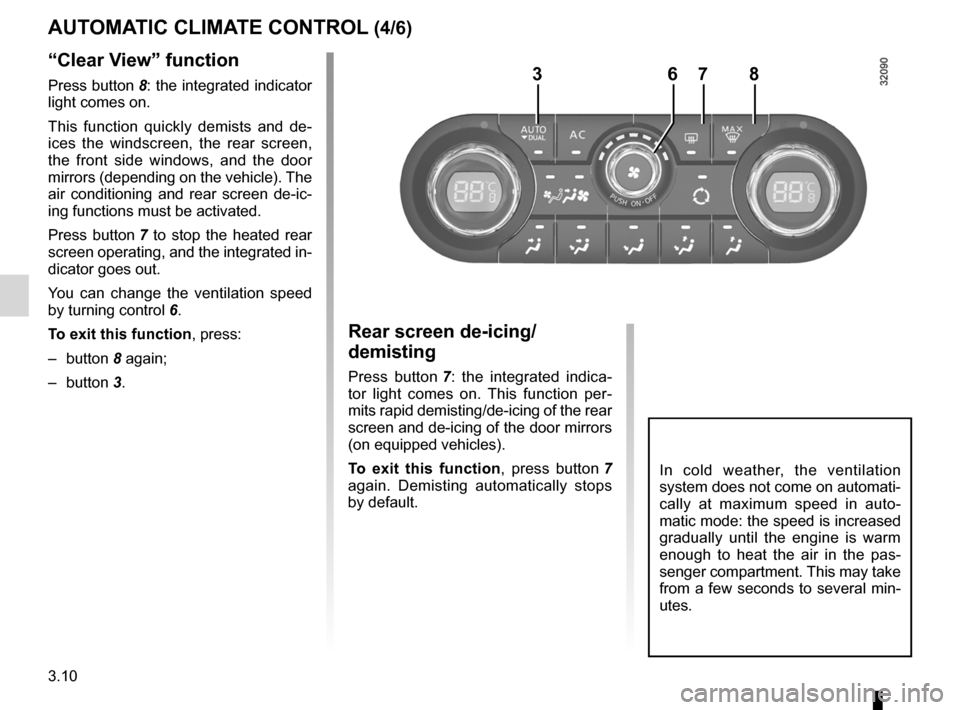
“clear View” function
Press button 8: the integrated indicator
light comes on.
This function quickly demists and de -
ices the windscreen, the rear screen,
the front side windows, and the door
mirrors (depending on the vehicle). The
air conditioning and rear screen de -ic -
ing functions must be activated.
Press button 7 to stop the heated rear
screen operating, and the integrated in-
dicator goes out.
You can change the ventilation speed
by turning control 6.
To exit this function , press:
– button 8 again;
– button 3.
Rear screen de-icing/
demisting
Press button 7 : the integrated indica -
tor light comes on. This function per -
mits rapid demisting/de-icing of the rear
screen and de-icing of the door mirrors
(on equipped vehicles).
To exit this function , press button 7
again. Demisting automatically stops
by default.
3786
Page 131 of 233
JauneNoirNoir texte
3.11
ENG_UD20983_3
Conditionnement d’air automatique bizone (X45 - H45 - Renault)
ENG_NU_977-2_H45_Ph2_Renault_3
AuT oMATIc clIMATE coNTRol (5/6)
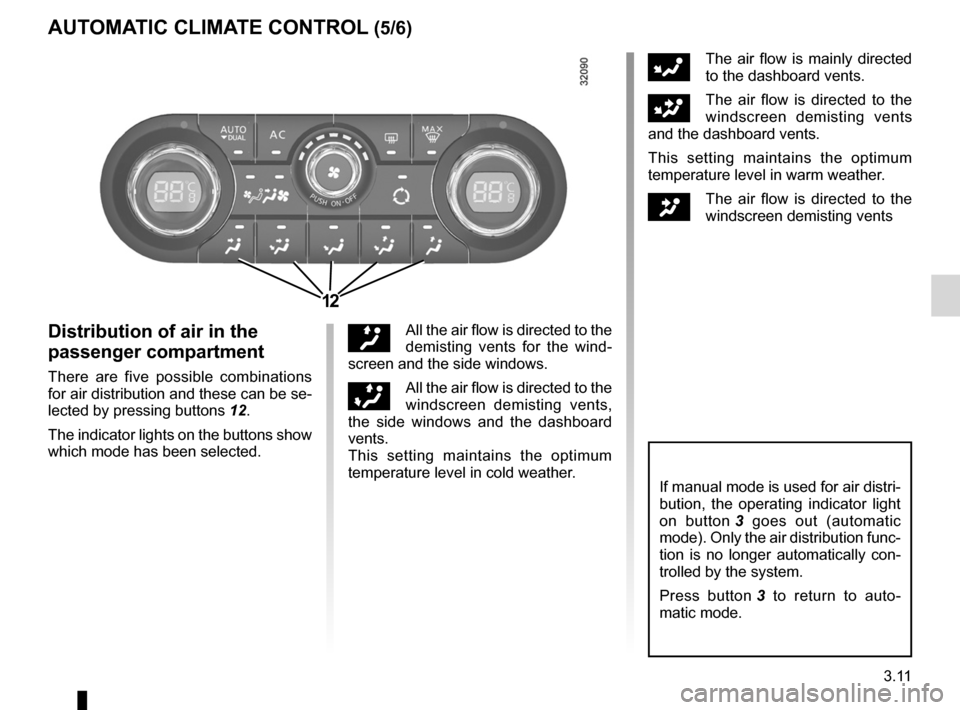
Distribution of air in the
passenger compartment
There are five possible combinations
for air distribution and these can be se-
lected by pressing buttons 12.
The indicator lights on the buttons show
which mode has been selected.
õ All the air flow is directed to the
demisting vents for the wind -
screen and the side windows.
÷All the air flow is directed to the
windscreen demisting vents,
the side windows and the dashboard
vents.
This setting maintains the optimum
temperature level in cold weather.
FThe air flow is mainly directed
to the dashboard vents.
GThe air flow is directed to the
windscreen demisting vents
and the dashboard vents.
This setting maintains the optimum
temperature level in warm weather.
JThe air flow is directed to the
windscreen demisting vents
If manual mode is used for air distri-
bution, the operating indicator light
on button 3 goes out (automatic
mode). Only the air distribution func-
tion is no longer automatically con-
trolled by the system.
Press button 3 to return to auto -
matic mode.
12
Page 132 of 233
3.12
ENG_UD20983_3
Conditionnement d’air automatique bizone (X45 - H45 - Renault)
ENG_NU_977-2_H45_Ph2_Renault_3
AuT oMATIc clIMATE coNTRol (6/6)
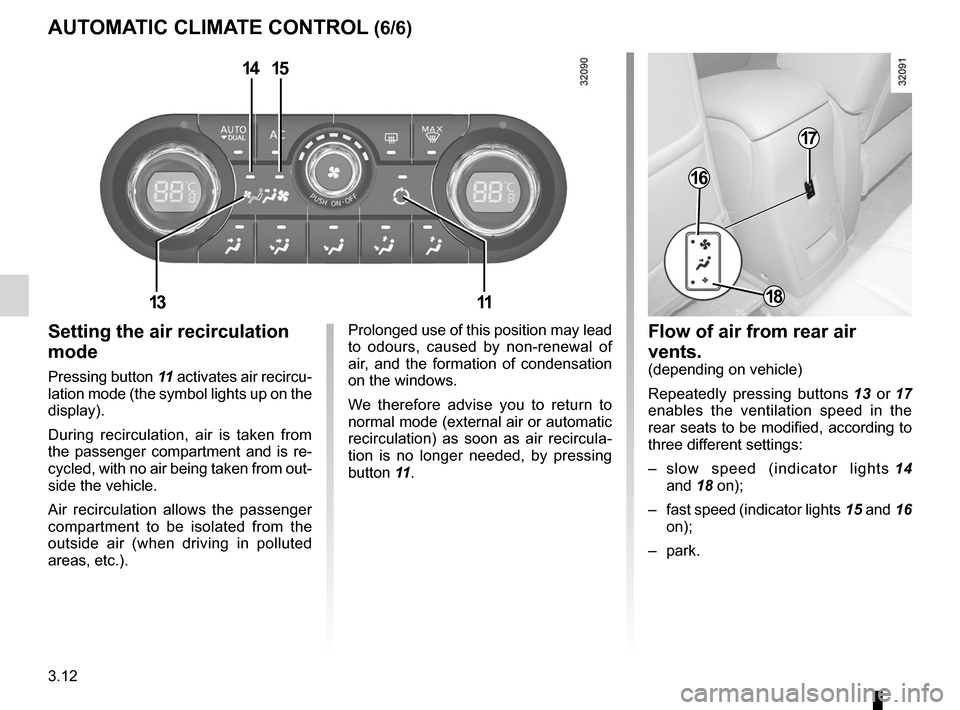
Setting the air recirculation
mode
Pressing button 11 activates air recircu-
lation mode (the symbol lights up on the
display).
During recirculation, air is taken from
the passenger compartment and is re-
cycled, with no air being taken from out-
side the vehicle.
Air recirculation allows the passenger
compartment to be isolated from the
outside air (when driving in polluted
areas, etc.). Prolonged use of this position may lead
to odours, caused by non-renewal of
air, and the formation of condensation
on the windows.
We therefore advise you to return to
normal mode (external air or automatic
recirculation) as soon as air recircula
-
tion is no longer needed, by pressing
button 11.
Flow of air from rear air
vents.
(depending on vehicle)
Repeatedly pressing buttons 13 or 17
enables the ventilation speed in the
rear seats to be modified, according to
three different settings:
– slow speed (indicator lights 14
and 18 on);
– fast speed (indicator lights 15 and 16
on);
– park.
1415
1311
16
17
18
Page 133 of 233
air conditioning ..................................... (up to the end of the DU)
heating and air conditioning system ..... (up to the end of the DU)
air conditioning ..................................... (up to the end of the DU)
3.13
ENG_UD20984_3
Air conditionn : informations et conseils d utilisation (X45 - H45 - Renault)
ENG_NU_977-2_H45_Ph2_Renault_3
Air conditioning: information and advice on use
AIR coNDITIoNINg: information and advice on use
Fuel consumption
You will normally notice an increase
in fuel consumption (especially
when driving in town) when the air
conditioning is operating.
For vehicles fitted with manual air
conditioning, switch off the system
when it is not required.
Advice for reducing
consumption and therefore
helping to preserve the
environment:
Drive with the air vents open and
the windows closed.
If the vehicle has been parked in
the sun, open the doors for a few
moments to let the hot air escape
before starting the engine.
Maintenance
Refer to the Maintenance Service
Booklet for your vehicle for the in -
spection frequency.
operating faults
As a general rule, contact your ap-
proved dealer in the event of an op-
erating fault.
– Reduction in de-icing, demist -
ing or air conditioning per -
formance. This may be caused
by the passenger compartment
filter cartridge becoming clogged.
– No cold air is being produced.
Check that the controls are set
correctly and that the fuses are
sound. Otherwise, switch off the
system.
Advice on use
In some situations, (air conditioning
off, air recirculation activated, venti-
lation speed at zero or low, etc.) you
may notice that condensation starts
to form on the windows and wind -
screen.
If there is condensation, use the
“clear View” function to remove it,
then use the air conditioning in auto-
matic mode to stop it forming again.
Do not open the refriger -
ant fluid circuit. The fluid
may damage eyes or skin.
Note
Presence of water under the ve -
hicle. After prolonged use of the air
conditioning system, it is normal for
water to be present under the vehi-
cle. This is caused by condensation.
Page 140 of 233
lighting:interior ............................................. (up to the end of the DU)
courtesy light ........................................ (up to the end of the DU)
map reading lights ................................ (up to the end of the DU)
3.20
ENG_UD23659_3
Eclairage intérieur (X45 - H45 - Renault)
ENG_NU_977-2_H45_Ph2_Renault_3
Jaune NoirNoir texte
Interior lighting
INTERIoR lIghTINg (1/2)
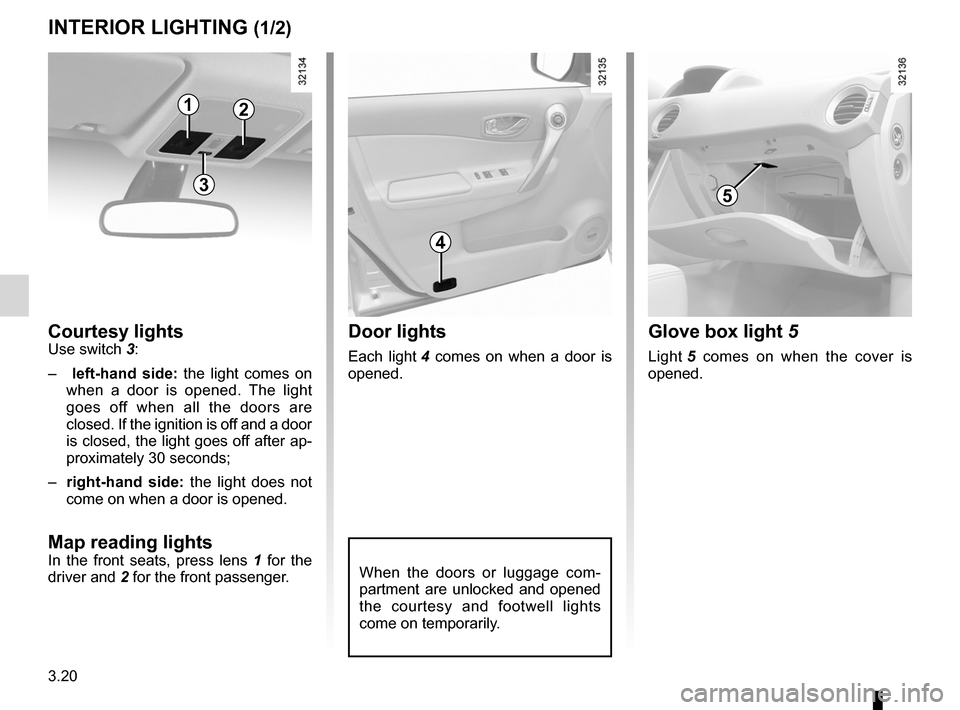
courtesy lightsUse switch 3:
– left-hand side: the light comes on
when a door is opened. The light
goes off when all the doors are
closed. If the ignition is off and a door
is closed, the light goes off after ap-
proximately 30 seconds;
– right-hand side: the light does not
come on when a door is opened.
Map reading lightsIn the front seats, press lens 1 for the
driver and 2 for the front passenger.
Door lights
Each light 4 comes on when a door is
opened.
glove box light 5
Light 5 comes on when the cover is
opened.
When the doors or luggage com -
partment are unlocked and opened
the courtesy and footwell lights
come on temporarily.
12
3
4
5
Page 141 of 233
JauneNoirNoir texte
3.21
ENG_UD23659_3
Eclairage intérieur (X45 - H45 - Renault)
ENG_NU_977-2_H45_Ph2_Renault_3
INTERIoR lIghTINg (2/2)
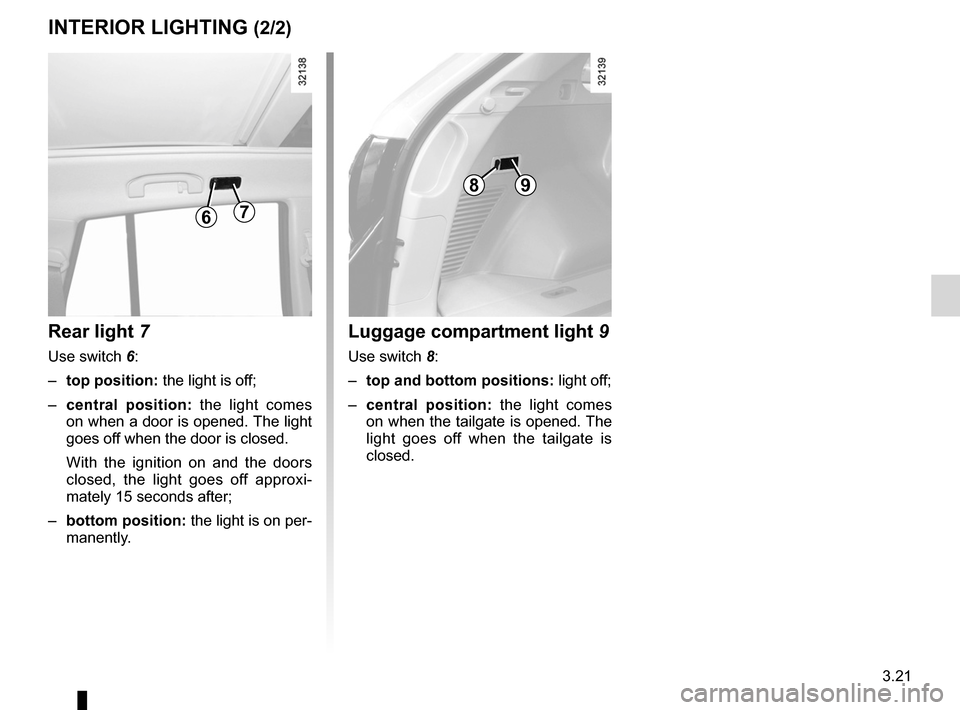
Rear light 7
Use switch 6:
– top position: the light is off;
– central position: the light comes
on when a door is opened. The light
goes off when the door is closed.
With the ignition on and the doors
closed, the light goes off approxi -
mately 15 seconds after;
– bottom position: the light is on per-
manently.
luggage compartment light 9
Use switch 8:
– top and bottom positions: light off;
– central position: the light comes
on when the tailgate is opened. The
light goes off when the tailgate is
closed.
67
89
Page 142 of 233
glove box ............................................................... (current page)
storage compartments .......................... (up to the end of the DU)
storage compartment ............................(up to the end of the DU)
fittings ................................................... (up to the end of the DU)
3.22
ENG_UD23672_6
Rangements, aménagements habitacle (X45 - H45 - Renault)
ENG_NU_977-2_H45_Ph2_Renault_3
Jaune NoirNoir texte
Passenger compartment storage/fittings
PASSENgER coMPARTMENT ST oRAgE, FITTINgS (1/6)
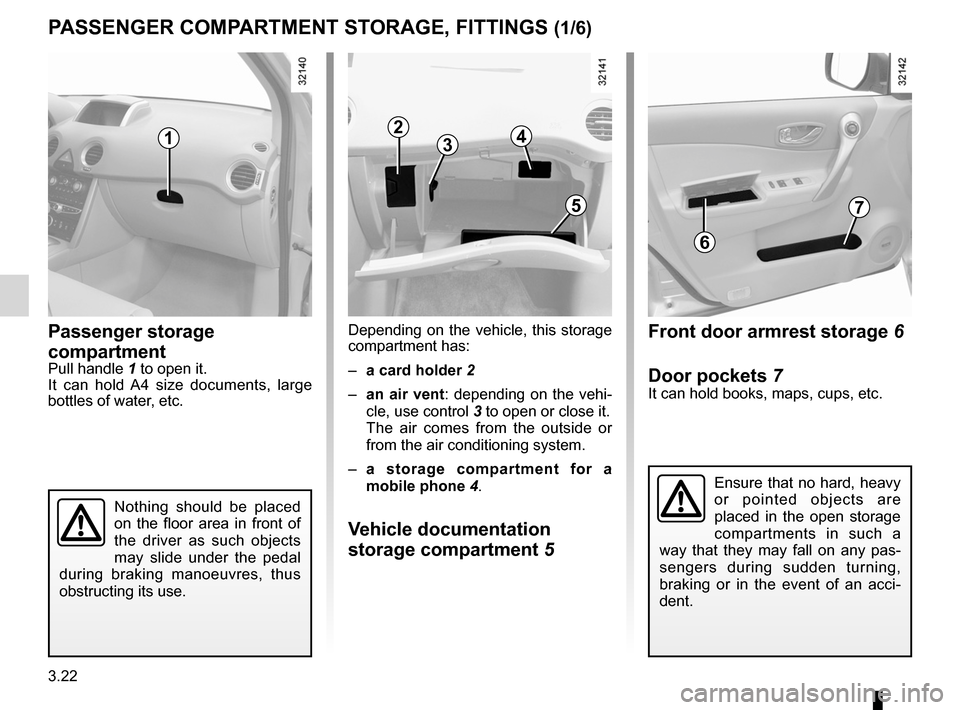
Passenger storage
compartment
Pull handle 1 to open it.
It can hold A4 size documents, large
bottles of water, etc. Depending on the vehicle, this storage
compartment has:
–
a card holder 2
– an air vent: depending on the vehi-
cle, use control 3 to open or close it.
The air comes from the outside or
from the air conditioning system.
– a storage compartment for a
mobile phone 4.
Vehicle documentation
storage compartment 5
Front door armrest storage 6
Door pockets 7
It can hold books, maps, cups, etc.
Ensure that no hard, heavy
or pointed objects are
placed in the open storage
compartments in such a
way that they may fall on any pas -
sengers during sudden turning,
braking or in the event of an acci -
dent.
12
34
5
6
7
Nothing should be placed
on the floor area in front of
the driver as such objects
may slide under the pedal
during braking manoeuvres, thus
obstructing its use.
Page 167 of 233
levels:windscreen washer reservoir ........................... (current page)
windscreen washer ................................................ (current page)
filter air filter ............................................................. (current page)
filter passenger compartment filter .......................... (current page)
filter diesel filter ........................................................ (current page)
tanks and reservoirs: windscreen washer .......................................... (current page)
JauneNoirNoir texte
4.9
ENG_UD20999_4
Niveaux / filtres (X45 - H45 - Renault)
ENG_NU_977-2_H45_Ph2_Renault_4
windscreen/headlight washer reservoir
Filters
LeVeLS (3/3)/FIL teRS
note
Depending on the vehicle, to find
out the fluid level, open cap 3 , pull
out the dipstick and read the level
again.
3
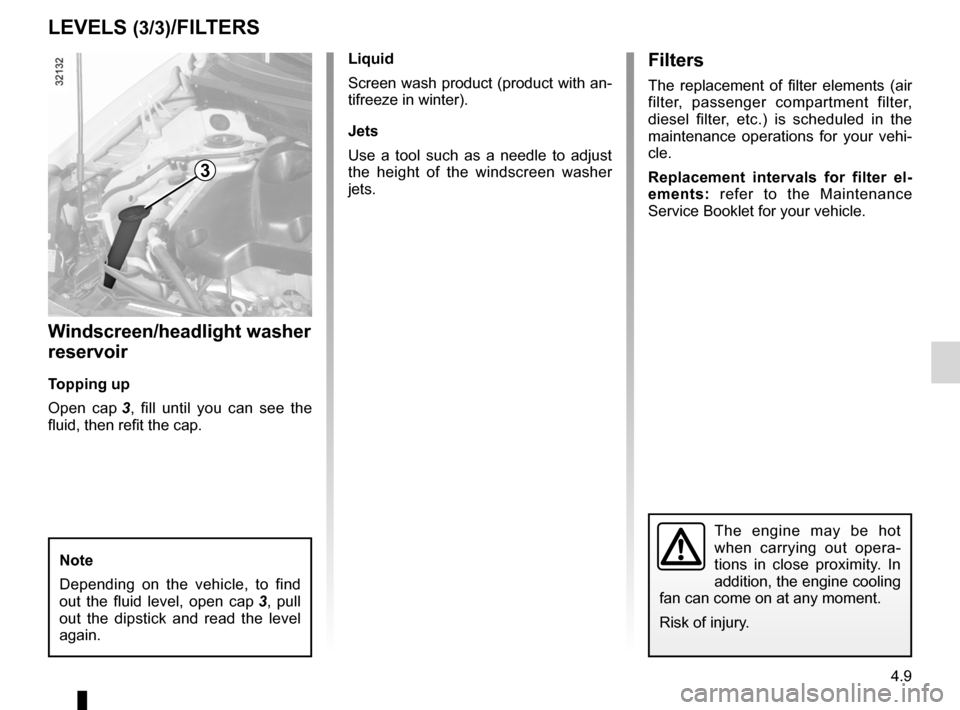
Windscreen/headlight washer
reservoir
t opping up
Open cap 3 , fill until you can see the
fluid, then refit the cap. Liquid
Screen wash product (product with an-
tifreeze in winter).
Jets
Use a tool such as a needle to adjust
the height of the windscreen washer
jets.
Filters
The replacement of filter elements (air
filter, passenger compartment filter,
diesel filter, etc.) is scheduled in the
maintenance operations for your vehi
-
cle.
Replacement intervals for filter el -
ements: refer to the Maintenance
Service Booklet for your vehicle.
The engine may be hot
when carrying out opera -
tions in close proximity. In
addition, the engine cooling
fan can come on at any moment.
Risk of injury.
Page 171 of 233
JauneNoirNoir texte
4.13
ENG_UD22865_9
Entretien de la carrosserie (X45 - H45 - J77 - X81 - X85 - B85 - C85 - S85 - X91 - B91 - K91 - D91 - X83 - X61 - X77 ph2 - K85 - X95 - B95 - D95 - K95 - J95 - R95 - L38 -
ENG_NU_977-2_H45_Ph2_Renault_4
– Before going through a roller type car
wash, return the windscreen wiper
stalk to the Park position (refer to
the information on the “Windscreen
wash/wipe” in Section 1). Check the
mounting of external accessories,
additional lights and mirrors, and
ensure that the wiper blades are se-
cured with adhesive tape.
Remove the radio aerial mast if your
vehicle is fitted with this equipment.
Remember to remove the tape and
refit the antenna after washing.
– Spray mechanical components,
hinges, etc. with products approved
by our Technical Department to
protect them after they have been
cleaned.
BODyWORk MAIntenAnCe (2/2)
We have selected special products
to care for your vehicle and you can
obtain these from the manufactur -
er’s accessory outlets.
y ou should
– Observe the vehicle stopping dis -
tances when driving on gravelled
surfaces to prevent paint damage.
– Repair, or have repaired quickly,
areas where the paint has been
damaged, to prevent corrosion
spreading.
– Remember to visit the body shop
periodically if your vehicle has an
anti-corrosion warranty. Refer to the
Maintenance Service Booklet.
– Respect local regulations about
washing vehicles (e.g. do not wash
your vehicle on a public highway). –
Wash your car frequently, with the
engine off , with cleaning products
recommended by our Technical
Department (never use abrasive
products) and be sure to jet-rinse off:
– spots of tree resin and industrial
grime;
– bird droppings , which cause a
chemical reaction with the paint
that rapidly discolours paint -
work and may even cause the
paint to peel off;
Wash the vehicle immediately to
remove these marks since it is im-
possible to remove them by pol -
ishing;
– salt, particularly in the wheel
arches and underneath the body
after driving in areas where the
roads have been gritted;
– mud in the wheel arches and un-
derneath the body which forms
damp patches.